Civil & Environmental Engineering Programs Assessment Process Summary The assessment process of the Civil & Environmental Engineering Programs was developed by the curriculum & assessment committee and was approved by the CEE faculty and the College of engineering, mathematics, and science’s (EMS) Industrial Advisory Board (IAB) in the fall of 1998. The process is depicted in the framework shown in Figure 3.1. The framework consists of six main constituencies supplying inputs to the program. The inputs are denoted by the letters A through I and referred to as assessment measurement tools, described in Table 3.4. The inputs are analyzed to formulate recommendations and implementation plans which ultimately result in feedback to the department through its faculty and students as shown in the framework. The relationship between the Environmental Engineering program objectives and assessment measurement tools is shown in Table 3.5. The relationship between the assessment
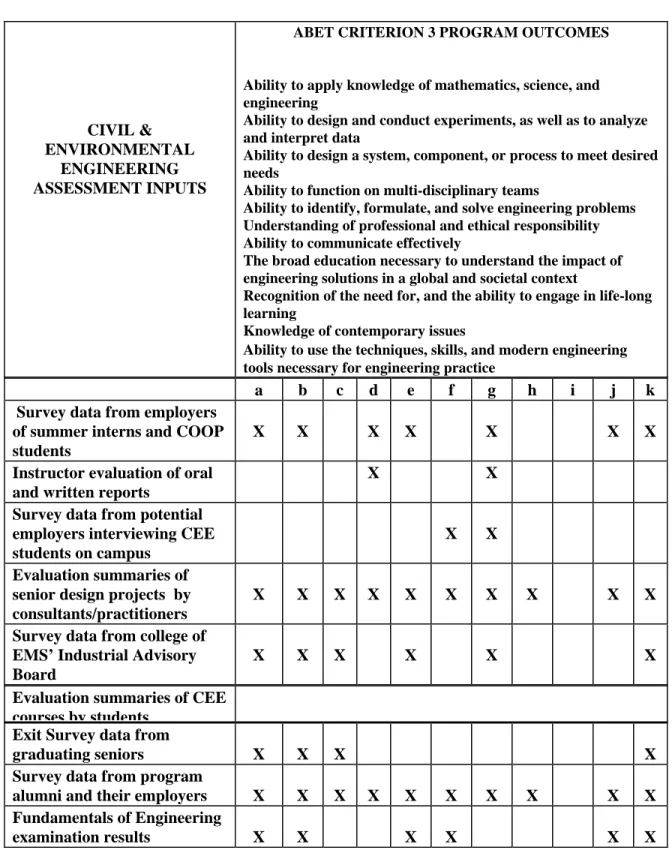
measurement tools and ABET Program Outcomes are shown in Table 3.6
Table 3.4 Assessment Measurement Tools
Survey data from employers of summer interns and COOP students Instructor evaluation of oral and written reports
Survey data from potential employers interviewing CEE students on campus Evaluation summaries of senior design projects by consultants/practitioners Program reviews by EMS’ Industrial Advisory Board
Evaluation summaries of CEE courses by students Exit Survey data from graduating seniors
Survey data from program alumni and their employers I. Fundamentals of Engineering examination results
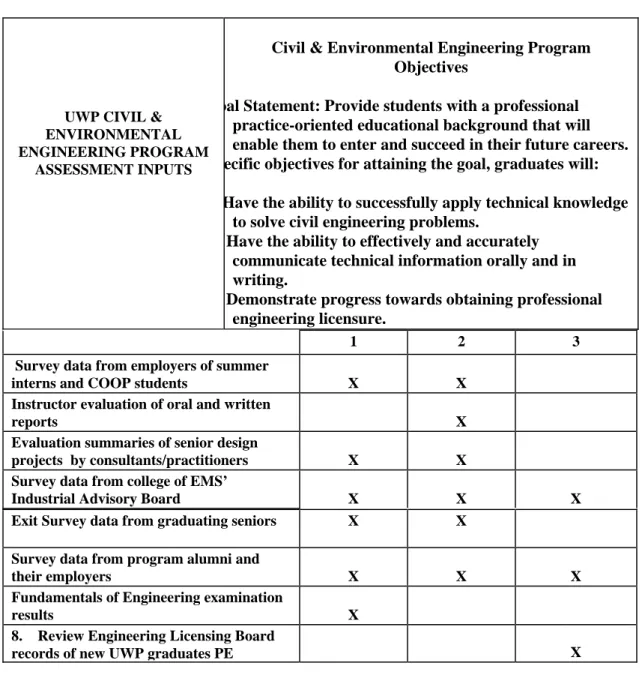
Table 3.5 Relationship of Civil Engineering Program Objectives to Assessment Measurement Tools
UWP CIVIL & ENVIRONMENTAL ENGINEERING PROGRAM
ASSESSMENT INPUTS
Civil & Environmental Engineering Program Objectives
oal Statement: Provide students with a professional practice-oriented educational background that will enable them to enter and succeed in their future careers. ecific objectives for attaining the goal, graduates will: Have the ability to successfully apply technical knowledge
to solve civil engineering problems.
Have the ability to effectively and accurately communicate technical information orally and in writing.
Demonstrate progress towards obtaining professional engineering licensure.
1 2 3
Survey data from employers of summer nterns and COOP students
i X X
Instructor evaluation of oral and written eports
r X
Evaluation summaries of senior design rojects by consultants/practitioners
p X X
Survey data from college of EMS’ ndustrial Advisory Board
I X X X
Exit Survey data from graduating seniors X X
Survey data from program alumni and heir employers
t X X X
Fundamentals of Engineering examination esults
r X
8. Review Engineering Licensing Board
registration
Table 3.6 CEE Assessment Measurement Tools and their relationship to ABET Program Outcomes CIVIL & ENVIRONMENTAL ENGINEERING ASSESSMENT INPUTS
ABET CRITERION 3 PROGRAM OUTCOMES
Ability to apply knowledge of mathematics, science, and engineering
Ability to design and conduct experiments, as well as to analyze and interpret data
Ability to design a system, component, or process to meet desired needs
Ability to function on multi-disciplinary teams
Ability to identify, formulate, and solve engineering problems Understanding of professional and ethical responsibility Ability to communicate effectively
The broad education necessary to understand the impact of engineering solutions in a global and societal context
Recognition of the need for, and the ability to engage in life-long learning
Knowledge of contemporary issues
Ability to use the techniques, skills, and modern engineering ools ne essar for ngin ering pract e
t c y e e ic
a b c d e f g h i j k
Survey data from employers of summer interns and COOP
tudents s
X X X X X X X
Instructor evaluation of oral nd written reports
a
X X
Survey data from potential employers interviewing CEE
tudents on campus s
X X
Evaluation summaries of senior design projects by
onsultants/practitioners c
X X X X X X X X X X
Survey data from college of EMS’ Industrial Advisory
oard B
X X X X X X
Evaluation summaries of CEE courses by students
Exit Survey data from raduating seniors
g X X X X
Survey data from program lumni and their employers
a X X X X X X X X X X
Fundamentals of Engineering
Implementation of Assessment Process
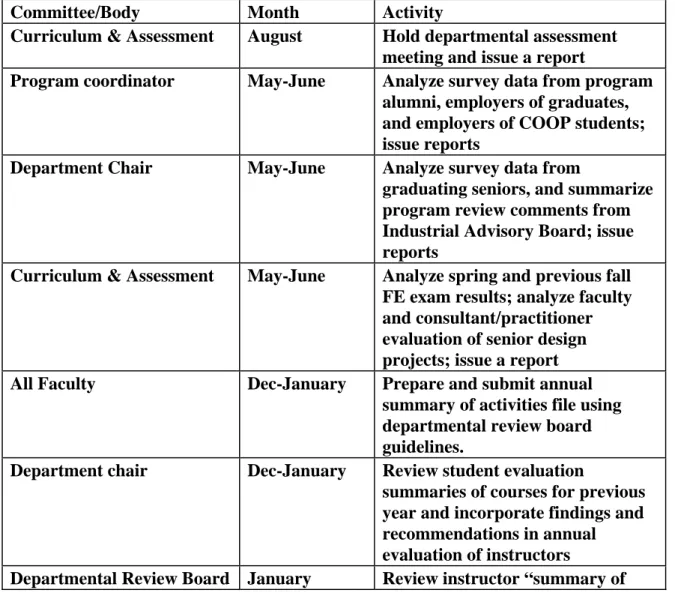
The CEE department began implementing its assessment process in the 1998-99 academic year. Departmental committee assignments leading to the implementation of the process are shown in Table 3.7. Much of the assessment information is reviewed by the
departmental committees identified in Table 3.7 and reported to the curriculum & assessment committee, which oversees departmental assessment efforts. The assessment plan is set up in such a way that if curriculum/course changes are required there will be enough time for the university’s Academic Planning Council (APC) and curriculum committee to act on them each year.
In the month of August just prior to the beginning of an academic year, there is a
departmental meeting where the curriculum & assessment committee leads a discussion of all assessment results of the previous year. This meeting is expected to enlighten faculty members about decisions affecting specific courses, curriculum and/or advising.
Table 3.7 Departmental Committee Assignments for Assessment Process Implementation
Committee/Body Month Activity
Curriculum & Assessment August Hold departmental assessment eeting and issue a report m
Program coordinator May-June Analyze survey data from program alumni, employers of graduates, and employers of COOP students;
ssue reports i
Department Chair May-June Analyze survey data from
graduating seniors, and summarize program review comments from Industrial Advisory Board; issue
eports r
Curriculum & Assessment May-June Analyze spring and previous fall FE exam results; analyze faculty and consultant/practitioner evaluation of senior design
rojects; issue a report p
All Faculty Dec-January Prepare and submit annual summary of activities file using departmental review board
uidelines. g
Department chair Dec-January Review student evaluation
summaries of courses for previous year and incorporate findings and recommendations in annual evaluation of instructors
activities” file and issue reports Laboratory January Identify needs, vendor information,
and submit budget A. The policy for the use of COOP student evaluations is outlined below.
Each agency/firm employing CEE Coop students shall complete an “employer assessment of academic preparation” survey form for all CEE Coop employees at the end of their tenure. All 12 survey categories defined on the survey form shall be evaluated by the CEE program coordinator. For any given category, the combined proportion of respondents indicating “below average” and “very poor” shall not exceed 10%. An investigation shall be warranted and considerations for improvement and implementation plans shall be made if this critical value is exceeded.
C. The policy for the use of potential employer survey results is as follows:
All potential employers interviewing CEE graduates on campus shall complete an evaluation survey for every interviewee without identifying the interviewee. All 12 survey categories defined on the survey form shall be evaluated. For any given category, the combined
proportion of respondents indicating “below average” and “very poor” shall not exceed 10%. An investigation shall be warranted and considerations for improvement and implementation plans shall be made if this critical value is exceeded.
D. The policy outlined by the curriculum & assessment committee for use of client evaluation of senior design projects is as follows:
All clients of senior design projects shall complete an evaluation survey for each project they participate in. The committee shall evaluate all 12 survey categories defined on the survey form. For any given category, the combined proportion of respondents indicating “below average” and “very poor” shall not exceed 10%. An investigation shall be warranted and considerations for possible improvements and implementation plans shall be made if this critical value is exceeded.
E. It is the departmental policy to implement IAB recommendations that improve the quality of the Civil & Environmental Engineering programs.
F. The policy outlined by the CEE curriculum and assessment committee for using student evaluation results is as follows:
Each instructor shall in his/her annual “summary of activities” report to the departmental review board (DRB), document the main student concerns (if any) in every course taught by the instructor in the previous year. Instructor shall specify where appropriate, the specific CEE program objectives or ABET program outcomes relating to the concerns expressed by students. The instructor shall provide a description of how these concerns will be addressed as well as the implementation date. If some concerns were addressed previously, instructor shall document the outcome.
G. The policy outlined by the curriculum & assessment committee for use of the senior exit survey for assessment purposes is as follows:
For any given category on the survey, the average rating assigned by respondents should be at least 3.0 (indicating a rating of very good ). An investigation shall be warranted and consideration for improvement and implementation plans shall be made if this critical rating value is not attained.
The corrective action taken will depend on which criteria is rated low. The corrective action could be curriculum changes, addition of material to class(es), change of course content, or other action appropriate to the issue.
H. The curriculum & assessment committee has developed the following policy for the use of alumni and employer surveys to assess CEE program objectives and ABET educational outcomes:
For any given survey-statement, the combined percentage of respondents indicating “disagree” and “strongly disagree” shall not exceed 10%. An investigation shall be warranted and appropriate changes (course content or other curriculum changes) shall be made in the area of concern if the 10% performance adequacy limit is
exceeded.
I. The policy established by the CEE curriculum and assessment committee for the use of the FE results is as follows:
The curriculum committee will assess performance in all FE subject areas covered in the morning and afternoon sessions of the FE exam. For each subject area the average percent of questions correctly answered by UWP CEE students shall exceed the national average, but the committee shall consider an adequate performance to be no less than 90% of the national average. An investigation is warranted and possible improvements shall be considered
regarding a particular subject if the 90% performance adequacy criterion is not met for two successive FE exams in the academic year.