European Cluster Observatory
Mobile services industries
Analysis of industry-specific
framework conditions relevant
for the development of
world-class clusters
The views expressed in this report, as well as the information included in it, do not necessarily reflect the
opinion or position of the European Commission and in no way commit the institution.
Extension of the European Cluster Observatory,
Promoting better policies to develop world-class clusters in Europe
Contract N° 71/PP/ENT/CIP/11/N04C031
Mobile services industries
Analysis of industry-specific framework conditions
relevant for the development of world-class clusters
Authors:
Kristina Dervojeda, Fabian Nagtegaal, Mark Lengton & Peyoush Datta, PwC Netherlands.
Contacts:
Kristina Dervojeda, PwC Netherlands, and Erica Monfardini, PwC Luxembourg.
Coordination:
Enterprise and Industry Directorate-General, Directorate D – “SMEs and
Entrepreneurship”, Unit D5 – “SMEs: Clusters & Emerging Industries”.
European Union, September 2013.
This work is part of a service contract for the
Enterprise and Industry Directorate-General
of the European Commission.
This report is financed under the Competitiveness and
Innovation Framework Programme (CIP) which aims to
Table of contents
Executive Summary 5
1. Objectives, scope and methodology 12
1.1. Rationale and objectives of the case study analysis 12
1.2. Definition and scope 13
1.2.1. Employed definition of mobile services industries 13
1.2.2. Scope of mobile services industries 14
1.3. Methodology 15
1.4. Structure of the report 18
2. Specifics of mobile services industries 19
2.1. Introduction 19
2.2. Key actors of the value chain 19
2.3. Key challenges of mobile services industries 21
2.4. Clusters in mobile services industries 22
3. Precursor stage: first interest in the emerging industry 24
3.1. Introduction 24
3.2. Existing prominent ICT industry 24
3.3. Mobile market liberalisation 26
3.4. Multi-operator market structure 28
3.5. Critical mass of consumers with demand for high end devices with wide application areas 30
3.6. Critical mass of Science and Technology Researchers 31
3.7. Investments in next generation technology and networks 33
4. Embryonic stage: entering a market environment 35
4.1. Introduction 35
4.2. Availability of seed and venture capital for mobile services companies 35 4.3. Policy measures promoting entrepreneurship in mobile services industries 37
5. Nurture stage: demonstrating sustainable business potential 39
5.1. Introduction 39
5.2. Critical mass of mobile services companies 39
5.3. Collaboration between regulators and operators 40
5.4. Policy measures supporting internationalisation in mobile services industries 42 5.5. Presence of a platform to promote service innovation in the area 44 5.6. Dedicated cluster organisation (cluster manager or similar) to coordinate the development of mobile
6. Growth stage: sustainable industrial growth 48
6.1. Introduction 48
6.2. Vertical integration of cluster actors 48
6.3. Exploitation of new distribution channels 50
6.4. Agreements on interface standards 51
6.5. Collaboration and strategic alignment between network operators and mobile device dealers 52 6.6. Collaboration between mobile service companies and mobile device manufacturers 53
7. Survey on industry specific framework conditions 55
7.1. Cross-regional comparison of general framework conditions 55
7.2. Industry specific framework conditions 57
8. Conclusions and policy recommendations 59
8.1. Mapping of identified framework conditions 59
8.2. Policy recommendations 60
Annex A: Survey questionnaire 66
Executive Summary
The current report represents a detailed case study description for the mobile services industries prepared by PwC for Enterprise and Industry Directorate General of the European Commission within the “Extension of the European Cluster Observatory: Promoting better policies to develop world-class clusters in Europe” (contract nr 71/PP/ENT/CIP/11/N04C031).
The European mobile services industries have a great potential for contributing into the goals of Europe 2020 Strategy, the EU’s growth strategy for the coming decade. Mobile services industries have a central role in enabling Europe to become a smart and sustainable economy, which implies achieving high levels of employment and productivity1. Despite the economic climate, mobile services industries continue to make a
strong socio-economic contribution to Europe. The mobile industry supported an estimated 1.7 million jobs in Europe in 2010 and mobile operators contributed approximately 174 billion EUR (1% of total EEA GDP) to GDP. Contribution to public funding amounted to approximately 65 billion EUR, plus an additional estimated 18 billion EUR as the indirect contribution from related industries2. It is therefore crucial to identify and
analyse the framework conditions that are key to the competitiveness of mobile services industries in European regions.
The objective of the case study analysis is to demonstrate which framework conditions are favourable for the emergence of mobile services industries in regions, and specifically how policy makers can influence the development of this industry. The analysis aims to maximise policy relevance and produce practical policy recommendations on how to support the development of mobile services industries in Europe.
In order to obtain a realistic picture of the framework conditions relevant for the emergence and development of mobile services industries, the notion of industry’s dynamic nature was put in the centre of the analysis. This notion implies that the role and importance of the relevant framework conditions is likely to change with every new stage of the industry’s life cycle. To be effective, supporting measures thus need to be tailored to the various stages of the life cycle. The current analysis is built along the first four stages of the industry’s life cycle, i.e. stages relevant for emerging industries: (1) Precursor, (2) Embryonic; (3) Nurture; and (4) Growth. Key data sources include extensive desk-research, online questionnaire and validation interviews with industry experts (representatives of ten European hotspots in mobile services industries).
This case study is part of a number of reports prepared in the framework of the extension of the European Cluster Observatory. Two additional case studies also present results for the creative industries and the eco industries. The methodology for the case studies is described in more detail in a separate methodology report on the identification and benchmarking of ideal framework conditions. The definitions of emerging industries are detailed in the methodology report for the classification of the most active, significant and relevant new emerging industrial sectors. Emerging industries can be defined as the establishment of an entirely new industrial value chain, or the radical reconfiguration of an existing one, driven by a disruptive idea (or convergence of ideas), leading to turning these ideas/opportunities into new products/services with higher added value. The European Cluster Excellence Scoreboard Pilot Version measures regional strength in emerging industries and presents results in the fields of creative industries, eco industries and mobile services. The methodology applied by this scoreboard is described in more detail in a separate methodology report. Furthermore, a policy roadmap prepared by the European Forum for Clusters in Emerging Industries (EFCEI) introduces recommendations for actions for new linkages to promote the development of emerging industries through clusters in Europe. All reports – together with further maps by country, industry and indicators – can be found at http://www.clusterobservatory.eu/index.html#!view=aboutobservatory;url=/about-observatory /emerging-industries/ and http://www.emergingindustries.eu/.
1 http://ec.europa.eu/europe2020/index_en.htm
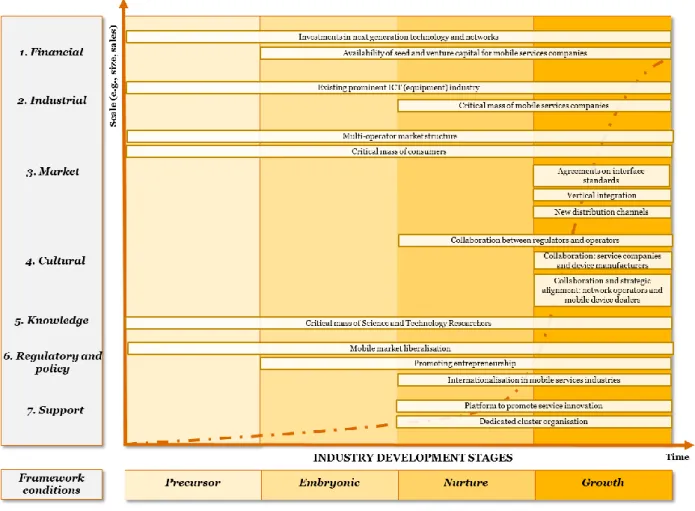
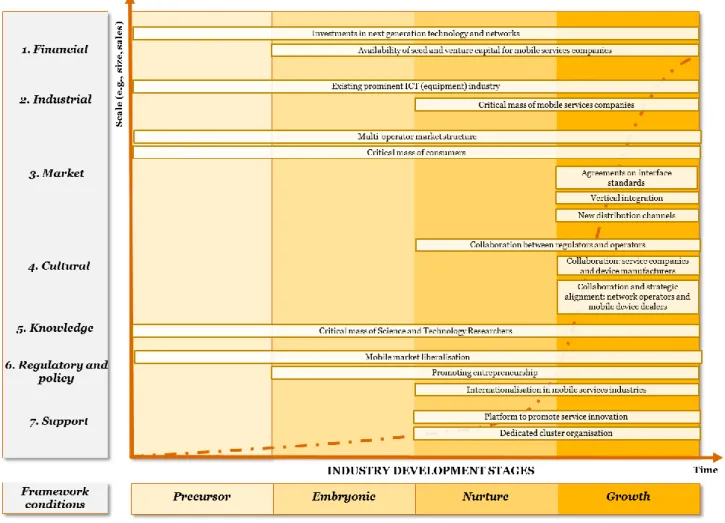
The analysis confirmed that the role and importance of the relevant framework conditions changes with new stages of the industry’s life cycle. However, all identified framework conditions prove to have a long-term impact and are relevant for more than one stage. Figure 0-1 presents the result of the mapping exercise of the analysed framework conditions for mobile services industries.
FIGURE 0-1: Mapping of identified framework conditions for mobile services industries
Key policy recommendations per industry development stage are as follows.
Policy recommendations for Precursor stage
Policy makers can stimulate the development of mobile services industries at the Precursor stage in the following ways:
1) Existing prominent ICT (equipment) industry:
a) Prominent ICT (equipment) industry is more likely to settle in a region that is more attractive to them. Policy makers can aim to increase the attractiveness of the region for this type of industry.
b) There are various ways in which policy makers can help raise the attractiveness of the region, which include stimulating and ensuring presence of skilled labour, (venture) capital, high quality educational and research institutions, and high levels of R&D investments in the region.
c) Policy makers may give (prominent) ICT companies an incentive to settle in the region by offering government funding, e.g. grants or subsidies, to new entrants.
2) Multi-operator market structure:
a) If there is no multi-operator market structure in place, policy makers need to create such a market structure. Both de-monopolisation of the market and unbundling of industries are relevant policy instruments, as well as privatisation of State Owned Enterprises (SOEs).
b) If a multi-operator market structure is already in place, policy makers need to sustain this type of market structure. By putting a regulator in place that oversees competition on the market as well as takes the desired market structure into account, a multi-operator market can be sustained. For example, a National Competition Authority may be empowered to assess mergers and acquisitions, ensuring that the local market is exposed to ample competitive pressure.
3) Critical mass of consumers with demand for high end devices with wide application areas:
a) Policy makers can stimulate the creation of a critical mass of consumers by stimulating the demand for high end mobile devices.
b) Examples of measures stimulating the demand include (pre-commercial) public procurement and making services available for high end mobile devices, such as providing citizens a mobile portal for various public services.
4) Critical mass of Science and Technology Researchers:
a) Regional stakeholders need to highlight the attractiveness of the region in order to attract highly skilled researchers. They should also create awareness for both the region as a place to live and as an innovative hotspot.
b) Policy makers should promote education and careers in the ICT and mobile services industries in the region.
c) Graduates need to be stimulated to take up research positions in the field of Science and Technology. By actively promoting and stimulating education and careers in these industries, more highly skilled human capital becomes available over time.
d) It is crucial for policy makers to understand that critical career decisions are being made already more than a decade before a student enters the workforce. Policy makers should therefore promote education and careers in high tech fields already at the pre-vocational and vocational level.
e) There is also a need to offer children early technical education programmes that broaden their choice and development opportunities. These programmes need to motivate children to want to learn more, transmit the excitement of science investigation and engineering innovation, and provide teachers with the appropriate tools to facilitate the learning process.
5) Mobile market liberalisation:
a) Policy makers should stimulate a multi-operator market structure in the region.
b) By deregulating the mobile services market, other firms can enter the market. This is specifically possible if market entry and expansion faces limited regulation, and if existing market actors face limited to no protection from the authorities.
c) In order to facilitate a multi-operator market structure, policy makers can de-monopolise existing telecommunications industries, unbundle vertically integrated actors on the markets and liberalise competitive segments.
d) An independent regulator should be introduced for making the transition from monopoly to market and to ensure a level playing field for market participants.
6) Investments in next generation technology and networks:
a) Policy makers should provide incentives to private companies to invest in next generation technologies and networks, e.g. by providing subsidies, giving out preferential loans or by guaranteeing loans. b) Policy makers should provide direct government investments, e.g. to stimulate internet penetration
Policy recommendations for Embryonic stage
Policy makers can stimulate the development of mobile services industries at the Embryonic stage by ensuring:
1) Availability of seed and venture capital for mobile services companies:
a) By providing targeted and increased support to the industry from EU Community Budget, the European Investment Fund and European Investment Bank, private investments could be triggered. b) This support from EU government bodies can take the form of providing a package of financial
instruments to cover different company sizes and structures (e.g., loans, guarantees, grants and tax incentives) aimed at increasing the attractiveness for the private sector to invest in European mobile service industry product development activities.
2) Policy measures promoting entrepreneurship in mobile services industries:
a) Policy makers should stimulate public-private partnerships focused on innovation, specifically in the field of telecommunications and mobile services. Public-private partnerships in mobile technology and mobile services are more likely to result in new solutions, characterising the emerging mobile services industries.
b) Policy makers should provide government-backed vouchers for innovation support. These vouchers can positively influence the entrepreneurial climate in a cluster.
c) Moreover, policy makers need to stimulate the creation of service innovation and promotion platforms. These platforms both stimulate service innovation and bring attention to the new mobile services industries.
d) Policy makers need to stimulate the creation of Working Groups to discuss goals, ambitions and future policy actions for the ICT and mobile services industries. Research and discussions resulting from these Working Groups can be used to formulate ambitions, policy goals and establish a roadmap for mobile service innovation.
The abovementioned policy actions are relevant also for the next two stages of industry’s development: Nurture and Growth stage.
Policy recommendations for Nurture stage
Policy makers can stimulate the development of mobile services industries at the Nurture stage by ensuring/supporting the presence of:
1) Critical mass of mobile services:
a) The key task of policy makers is to create an environment favourable for setting up and expanding businesses in the region.
b) Policy makers should therefore promote the concept of mobile services industries in the region (e.g., social marketing and advertising campaigns promoting mobile services industries, new mobile technologies and applications in the region, as well as incentivising the purchase of high end mobile devices to allow for new mobile services).
c) Policy makers also need to promote entrepreneurship in the mobile services industries;
d) Policy makers should stimulate public-private partnerships. Public-private partnerships boost innovation in the region and advances technological progress.
e) Policy makers need to simplify access to finance for mobile services companies.
f) Programmes that support SME growth (financial support; training and coaching) need to be introduced to the region.
2) Collaboration between regulators and operators:
a) Regulators must work together with operators to lower the cost of ownership of the networks, ultimately driving down the costs of mobile phones and mobile services.
b) Policy makers should actively stimulate collaboration between regulators and operators. This can for instance be facilitated by setting up joint meetings between operators and regulators to discuss current issues and new regulation.
c) Policy makers need to support platforms and associations that specifically aim to stimulate discussion between operators and regulators.
3) Policy measures supporting internationalisation in mobile services industries:
a) To stimulate internationalisation of local incumbents, regional and national policy makers can employ “National Champion”-policies. As these champions face low risk on the domestic market, they have an incentive to expand aggressively on international markets.
b) For the mobile services industries raising awareness, supporting the financial needs of internationalisation, supporting the internationalisation of services and stimulating cross-border cooperation have been of high importance. Policy makers, therefore, should pay close attention to these areas and introduce supporting policies.
c) Regional, national and EU authorities should stimulate cross-border collaboration by setting up European wide projects with a common goal. Such cross-border collaboration helps domestic firms to gain access to international markets.
4) Presence of a platform to promote service innovation in the area:
a) Policy makers should support the creation of innovation platforms that aim to accelerate service innovation in the mobile services industries. European wide innovation platforms are more likely to stimulate cross-border collaboration and knowledge transfer, which may create additional benefits. b) Policy makers are recommended to take into account that it is often advantageous to build on
successful initiatives. They should therefore stimulate linkages between newly created and existing service innovation platforms. A number of European service innovation platforms specifically in the field of mobile services are already in place (e.g. EMMA and MOBIP) and need to be taken into account.
5) Dedicated cluster organisation:
a) Regional, national and EU authorities need to offer dedicated cluster policies that typically include grants for cluster management activities and specific collaboration projects.
b) The level of bureaucracy related to application and implementation of cluster policies in the region needs to be minimised (i.e., complicated management procedures; long approval procedures for projects and excessive administrative workload need to be removed).
c) Since mobile services industry clusters represent highly complex systems with multiple stakeholders from multiple related industries involved, cluster policy measures should not be applied on a solely basis. It is rather a combination of various complementary measures that need to be applied simultaneously (e.g., education & skills, logistics & infrastructure etc.).
d) At the EU level, in close cooperation with national governments and regions, there is a need to support the efforts of cluster organisations to improve their performance and reach excellence (e.g., European Cluster Excellence Initiative and the organisation of further “train-the-trainers” activities for cluster managers).
The abovementioned policy actions are relevant also for the Growth stage.
Policy recommendations for Growth stage
Finally, besides the measures already mentioned above, policy makers can stimulate the development of mobile services industries at the Growth stage in the follow way:
1) Vertical integration of cluster actors:
a) Policy makers therefore need to carefully assess cases of vertical integration on a case-by-case basis to prevent detrimental effects on welfare and innovation, even though evidence for the harmful effects of vertical integration is suggested to be weak.
b) Policy makers should actively put the benefits of vertical integration in the growth stage up for discussion. They can set up meetings with key stakeholders in the industry and engage in public consultation with industry.
c) Policy makers may help bring industry players closer together to stimulate vertical integration, e.g. by funding collaborative projects or by stimulating active participation in mobile services clusters.
d) Policy makers from the region can engage in discussions with other regions to share their experiences with vertical integration in the domestic market. Moreover, at a European level, discussion on related aspects, such as “net-neutrality”, can raise awareness for the benefits of particular vertical integration cases.
2) Exploitation of new distribution channels:
a) Regional, national and EU authorities can raise awareness of new business opportunities, not only within the regions but also outside the regions.
b) Regulators need to ensure existence of competitive pressure on the market that is likely to spur in service innovation.
c) Policy makers should support and promote new (digital) distribution channels, e.g. by ensuring safe access for users, safe mobile payments and exerting confidence in these new distribution channels.
3) Agreements on interface standards:
a) Regional, national and EU authorities need to be aggressive in setting interface standards. European countries, compared to the U.S., have been slightly faster to set standards and aggressive time-tables for e.g. the changeover from analogue to digital broadcasting. This also led to earlier industry formation in Europe. Europe needs to continue this trend to gain a competitive advantage.
4) Collaboration and strategic alignment between network operators and mobile device dealers:
a) Policy makers should stimulate discussions between the different stakeholders groups by e.g. setting up meetings between operators and dealers.
b) Policy makers, at the regional, national and EU level, should stimulate strategic alignment by funding projects of common interest, in which the various groups of stakeholders participate.
c) Policy makers should promote an agreement on standards in which both stakeholder groups have a strategic interest. This would further stimulate a strategic alliance.
d) Policy makers need to support cluster initiatives to facilitate further discussions and collaboration between both stakeholder groups.
5) Collaboration between mobile service companies and mobile device manufacturers:
a) Policy makers should stimulate discussions between the different stakeholders groups by e.g. setting up meetings between mobile services companies and mobile device manufacturers;
b) Policy makers, at the regional, national and EU level, should stimulate strategic alignment by funding projects of common interest, in which the various groups of stakeholders participate. Projects that require both service innovation and technical innovation can lead to new mobile services, spurring growth in the mobile services industries;
c) Policy makers should promote an agreement on standards in which both stakeholder groups have a strategic interest. This would further stimulate a strategic alliance.
d) Policy makers need to support cluster initiatives to facilitate further discussions and collaboration between both stakeholder groups.
Concluding remarks
1) While favourable policy measures cannot solve all the challenges on their own, their presence can significantly accelerate the development of mobile services industry clusters.
2) There is no generic ‘silver bullet’ across all mobile services industry clusters in terms of policy measures that have to be applied. What works in one region does not necessarily have to work in another one, as
myriads of contextual factors (including historical, economic, demographic, cultural and other developments) determine the success of the applied policy measures.
3) The critical task is to ensure that policy interventions first support an effective process of identifying the action priorities and then provide the right tools to address whatever those priorities are.
4) Policy interventions supporting industry development should always be discussed with local companies, and designed in a way that captures the interest of those companies. Consequently, industry’s involvement in policy making is crucial from the very early stages, including the design stage of a policy intervention (joint objective setting), but also its monitoring and evaluation.
1.
Objectives, scope and
methodology
The current chapter summarises the objectives, scope and methodology of the case study analysis. The purpose of the chapter is to familiarise the reader with the applied approach and the rationale behind it. In the end of the chapter, we also elaborate on the structure of the current report.
1.1.
Rationale and objectives of the case study analysis
The current report represents a detailed case study description for mobile services industries prepared by PwC for Enterprise and Industry Directorate General of the European Commission within the “Extension of the European Cluster Observatory: Promoting better policies to develop world-class clusters in Europe” (contract nr 71/PP/ENT/CIP/11/N04C031).
Key objectives of the analysis
The analysis on industry specific framework conditions for the development of world-class clusters in mobile services industries implies the development of a suitable, feasible and robust methodology for the identification and analysis of these conditions that are considered to be conductive to the development of world-class clusters in emerging industries. The methodology then needs to be applied to a selection of European regions in three emerging industries: creative, mobile services and eco industries. This exercise among others is expected to lead to detailed case study descriptions demonstrating how emerging industries come to and evolve in regions, and specifically how policy makers can influence the development of these industries. The case study analysis therefore aims to maximise policy relevance and produce evidence-based policy recommendations on how to support the development of specific emerging industries in European regions.
Strategic importance of mobile services industries for Europe
The European mobile services industries have a great potential for contributing into the goals of Europe 2020 Strategy, the EU’s growth strategy for the coming decade. Mobile services industries have a central role in enabling Europe to become a smart and sustainable economy, which implies achieving high levels of employment and productivity3. This is especially true as the emerging mobile services industries integrate both
traditional ICT and telecom companies, as well as innovative service providers.
In the global landscape, the mobile services industries significantly contribute to economic growth. In China alone, the mobile industry generated 5% of the domestic GDP in 2005. The interesting fact, however, is that only a quarter of that is the direct contribution of the mobile industry; the remaining 75% came from related industries, underlining the interlinkages with other industries and the potential for growth.
For Europe, mobile services industries also play an important role. Despite the economic climate, mobile services continue to make a strong socio-economic contribution to Europe. The mobile industry supported an estimated 1.7 million jobs in Europe in 2010 and mobile operators contributed approximately 174 billion EUR (1% of total EEA GDP) to GDP. Contribution to public funding amounted to approximately 65 billion EUR, plus an additional estimated 18 billion EUR as the indirect contribution from related industries4.
A number of studies have also established a link between mobile penetration and economic growth. Mobile phones have significantly impacted society through improved communication, social inclusion, economic
3 http://ec.europa.eu/europe2020/index_en.htm
activity and productivity in sectors such as agriculture, health, education and finance. Moreover, as the underlying technology further develops, mobile services have the potential to further impact economic growth. Examples include the shift from 3G to 4G networks, which can enable broadband internet access in rural areas, and the increasing number of applications that are made possible on mobile devices, such as smartphones and tablets5.
To get a grasp of the economic impact of the mobile services industries, consider the following. Recent research has suggested that6:
for a given level of total mobile penetration, a 10% substitution from 2G to 3G penetration increased GDP per capita growth by approximately 0.15%;
a doubling of mobile data use leads to an increase in the GDP per capita growth rate of approximately 0.5%;
in case of developing markets, a 10% increase in mobile penetration increases Total Factor Productivity in the long run by approximately 4.2%.
It is therefore crucial to identify and analyse the framework conditions that are key to the competitiveness of mobile services industries in European regions.
The role of policy makers in supporting mobile services industries
Existing research suggests that policies and regulations have a tremendous influence on the development of the mobile services industries. Regulatory authorities and policy makers are suggested to have a significant large influence on the investment profile and long-term development of the mobile industry. Investment in future technologies, both from operators and regulatory stakeholders such as the European Union, are considered to be vital for future economic growth. Furthermore, it is suggested in the literature that government policy directly influences the effectiveness of ICT investment and its productivity benefits7. As the ICT industries are highly interlinked with the mobile services industries, policy makers need to
consider these as well. Therefore, adequate industrial policy initiatives for mobile services industries require a careful analysis of the relevant framework conditions and the identification of potential obstacles that have a negative influence on the industry’s competitiveness.
1.2.
Definition and scope
In this sub-section, we address the definition and scope of the mobile services industries.
1.2.1.
Employed definition of mobile services industries
Mobile services industries comprise companies whose activities enable the provision of telecommunication, information, and entertainment services, including voice, internet, SMS, text, and other data services. The mobile services industries specifically include conversation services (mobile voice and person-to-person messaging), data access services (GSM, GRPS, CDMA, EDGE, UMTS, WLAN/Wi-Fi and other methods), and content services (SMS-based, MMS-based, browser-based, downloadable applications and others)8, targeting
both consumers (messaging services, transaction-based services, news/information services, entertainment services, mobile marketing services, consumer portal offers) and corporations (messaging services, Wi-Fi
5 Deloitte, (2012). "What is the impact of mobile telephony on economic growth?", report for the GSMA. 6Ibid.
7 GSMA, A.T.Kearney & Wireless Intelligence, (2012). “European Mobile Industry Observatory 2011”, GSMA London Office. 8 Vesa, J. (2005). "Mobile services in the networked economy", IRM Press, London.
wireless access services, mobile office solutions, task-based applications, sector-based applications, corporate and professional portals).
For our understanding of the emerging mobile services industries, it is important to consider that our definition of mobile services industries encompasses two types of industries: a more traditional telecommunication industry, for which the provision of conversation and data services is its core business, and the rapidly growing mobile content industry, which enables content services. Due to the ubiquity of mobile phones, the rapid development of other connected mobile devices (tablets, e-books, etc.) and the growing mobile content, mobile services industries constitute one of the fastest growing economic sectors worldwide9.
1.2.2.
Scope of mobile services industries
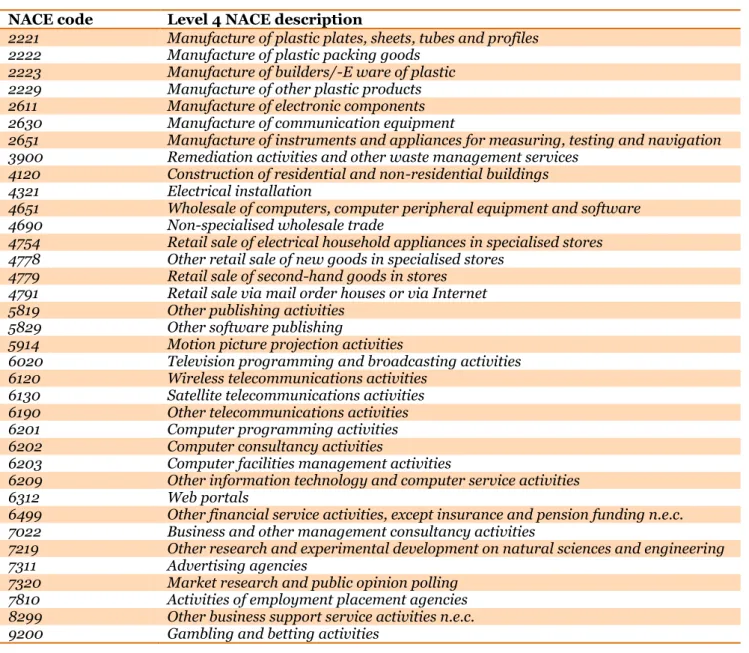
Both core and connected mobile services industries have spread over many sub-categories, of which many are related to the ICT industry. These categories are listed in Table 1-1. The connected mobile services industries are highlighted in Italic.
TABLE 1-1: Scoping of mobile services industries (based on the outputs of WP3)
NACE code Level 4 NACE description
2221 Manufacture of plastic plates, sheets, tubes and profiles
2222 Manufacture of plastic packing goods
2223 Manufacture of builders/-E ware of plastic
2229 Manufacture of other plastic products
2611 Manufacture of electronic components
2630 Manufacture of communication equipment
2651 Manufacture of instruments and appliances for measuring, testing and navigation
3900 Remediation activities and other waste management services
4120 Construction of residential and non-residential buildings
4321 Electrical installation
4651 Wholesale of computers, computer peripheral equipment and software
4690 Non-specialised wholesale trade
4754 Retail sale of electrical household appliances in specialised stores
4778 Other retail sale of new goods in specialised stores
4779 Retail sale of second-hand goods in stores
4791 Retail sale via mail order houses or via Internet
5819 Other publishing activities
5829 Other software publishing
5914 Motion picture projection activities
6020 Television programming and broadcasting activities
6120 Wireless telecommunications activities
6130 Satellite telecommunications activities
6190 Other telecommunications activities
6201 Computer programming activities
6202 Computer consultancy activities
6203 Computer facilities management activities
6209 Other information technology and computer service activities
6312 Web portals
6499 Other financial service activities, except insurance and pension funding n.e.c.
7022 Business and other management consultancy activities
7219 Other research and experimental development on natural sciences and engineering
7311 Advertising agencies
7320 Market research and public opinion polling
7810 Activities of employment placement agencies
8299 Other business support service activities n.e.c.
9200 Gambling and betting activities
9 Anthony, R., Bean, J., Coyle, J., Hayward, G. & James, K. (2011). "Sustainability Assessment of the Mobile Services
9512 Repair of communication equipment
9529 Repair of other personal and household goods
1.3.
Methodology
In the current sub-section, we highlight the key aspects of the methodology. For a detailed description of the methodology, the reader is advised to consult the Methodology Report of the analysis on industry specific framework condition for the development of world-class clusters in mobile services industries10.
Analytical framework
When studying emerging industries, their dynamic nature should not be ignored. The dynamic nature here refers to a continuous evolution of an industry and its periodical transitions from one stage to another. Therefore, in order to obtain a realistic picture of the framework conditions relevant for the emergence and development of the industries in question, the notion of their dynamic nature should be put in the centre of the analysis, since the role and importance of the relevant framework conditions is likely to change with every new stage of the industry’s life cycle. To be effective, supporting measures thus need to be tailored to the various stages of the life cycle. Furthermore, policies that aim to foster the development of clusters in emerging industries should differ from policies that aim to strengthen clusters in mature industries.
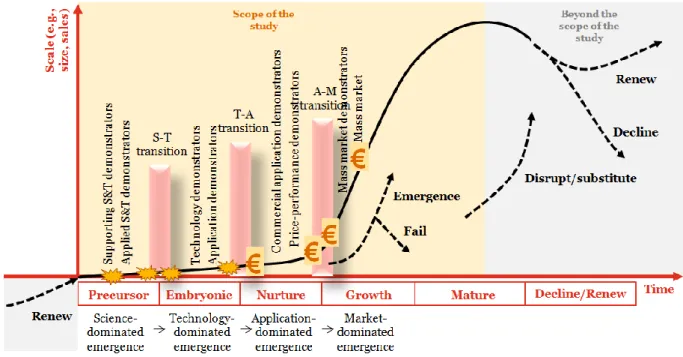
Figure 1-2 presents the employed analytical framework for characterising different stages of the development of emerging industries. The framework illustrates the growth/decline of an industry while it goes through the six main stages of its life cycle ((1) precursor, (2) embryonic; (3) nurture; (4) growth; (5) mature; and (6) decline/renewal), including three transition periods (Science -> Technology; Technology -> Application, and Application -> Market). The framework was adapted from Phaal et al. (2011) because of its comprehensive structure and high relevance to the scope of the current study. As can be seen from the Figure, sometimes an emerging industry’s first stage builds on the last stage of a mature industry.
FIGURE 1-2: Life cycle of regional industrial emergence
Source: adapted from Phaal R., O’Sullivan E., Routley M., Ford S., Probert D. (2011) A framework for mapping industrial emergence, Technological Forecasting and Social Change, Volume 78, Issue 2, February pp. 217-230
Below we elaborate on each of the stages and transition periods.
Stage 1 Precursor implies activities that support the development of a certain scientific
phenomenon, business concept and/or underpinning service/technology platform in the region, which stimulate industrial interest and investment in particular market-directed feasibility studies.
Science - Technology Transition includes activities that support the demonstration of the
feasibility of a scientific phenomenon, business concept and/or underpinning service/technology platform, helping the technology or service to be integrated into an application-oriented system.
Stage 2 Embryonic refers to activities that support the improvement of the reliability and
performance of technology and services to a point where it can be demonstrated in a market environment.
Technology – Application Transition implies activities that help to demonstrate the commercial
potential of technology and services in the region through revenue generation.
Stage 3 Nurture includes activities that help to improve the price and performance of
applications to a point where sustainable business potential can be demonstrated.
Application – Market Transition refers to activities that help to develop a market with mass
growth potential.
Stage 4 Growth implies activities that support marketing, commercial and business
development leading to sustainable industrial growth in the region.
Stage 5 Mature includes activities that help to refine established applications, production
processes and business models.
Stage 6 Renewal refers to activities that help to renew the industry through the
development/adoption of new technologies that repeat the above phases.
For the analysis, the focus has been placed on the first stages and transition periods up to the Maturity stage (Stage 5), since the study aims to analyse the framework conditions helping to foster the development of exclusively emerging industries. Once the maturity stage has been reached, the industry per definition cannot be considered ‘emerging’ anymore, and becomes a mature one, which, in turn, is beyond the scope of the current study.
Key activities
Based on extensive desk-research and in-depth interviews with experts and industry representatives, the approach implies developing a pool of relevant industry-specific framework conditions, and assigning them to specific stages and transition periods of the regional industrial emergence.
The abovementioned activities were carried out in several steps:
(1) Step 1: developing a comprehensive overview of the relevant framework conditions from available sources (desk-research): this sub-task included an in-depth analysis of information on cluster framework conditions from existing sources such as EC publications (including ECO reports), business publications, academic articles and other relevant sources. This sub-task led to an extensive list of relevant industry-specific framework conditions.
(2) Step 2: compiling and structuring framework conditions:this sub-task implied the grouping of identified framework conditions into categories based on commonality patterns among those framework conditions thereby creating a nomological net of factors. The commonality patterns here refer to specific stages and transition periods of the life cycle. Furthermore, potential causal relationships between various groups of framework conditions were extracted from the desk-research analysis.
(3) Step 3: collecting evidence from a selection of European regions: this sub-task included additional desk-research on the regions in question complemented by an online questionnaire and in-depth interview rounds with the regional representatives of the industry in question. A complete overview of the content of the online questionnaire is provided in Annex A. For each region included in the analysis, a sample of key stakeholders was drawn, with a helicopter viewon the development of the industry in the region. The helicopter view in this case means understanding the overall picture of the industry’s development in the region rather than having a one-sided perspective. The included groups of stakeholders were: (1) cluster managers; (2) policy makers (regional/national); and (3) industry associations/chamber of commerce or similar. We aimed at developing a list of 5-10 stakeholders per hotspot and then to make a shortlist with 3 key stakeholders to be involved in an in-depth analysis.
(4) Consolidating the collected evidence and developing detailed case study descriptions:
the final step implied putting all the collected evidence together into one integrated case study description, and, based on the key findings and conclusions, extracting practical policy recommendations.
Analysed framework conditions
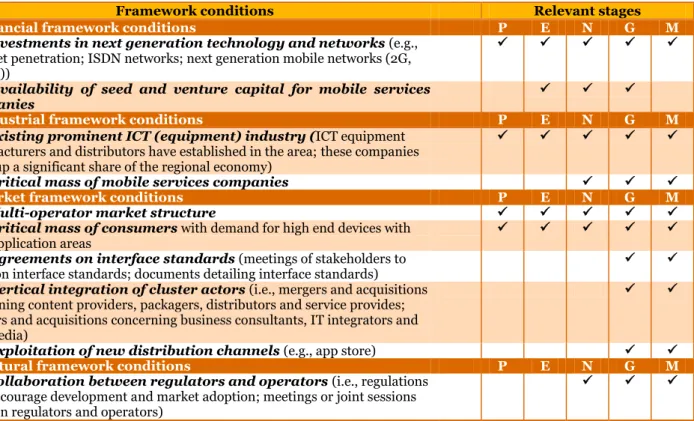
The results of the first two steps of the analysis are presented in Table 1-2.
TABLE 1-2: Consolidated overview of the identified framework conditions for mobile services industries (the acronyms in the table refer to the specific stages of the industry lifecycle: P = Precursor Stage; E = Embryonic Stage; N = Nurture Stage; G = Growth Stage; M = Maturity Stage).
Framework conditions Relevant stages
1. Financial framework conditions P E N G M
1.1. Investments in next generation technology and networks (e.g., Internet penetration; ISDN networks; next generation mobile networks (2G, 3G, 4G))
1.2. Availability of seed and venture capital for mobile services
companies
2. Industrial framework conditions P E N G M
2.1. Existing prominent ICT (equipment) industry (ICT equipment manufacturers and distributors have established in the area;these companies make up a significant share of the regional economy)
2.2. Critical mass of mobile services companies
3. Market framework conditions P E N G M
3.1. Multi-operator market structure
3.2. Critical mass of consumers with demand for high end devices with
wide application areas
3.3. Agreements on interface standards (meetings of stakeholders to
agree on interface standards; documents detailing interface standards)
3.4. Vertical integration of cluster actors (i.e., mergers and acquisitions concerning content providers, packagers, distributors and service provides; mergers and acquisitions concerning business consultants, IT integrators and new media)
3.5. Exploitation of new distribution channels (e.g., app store)
4. Cultural framework conditions P E N G M
4.1. Collaboration between regulators and operators (i.e., regulations that encourage development and market adoption; meetings or joint sessions between regulators and operators)
Framework conditions Relevant stages
4.2. Collaboration between mobile service companiesand mobile device manufacturers (stakeholder meetings or joint sessions on interoperability of devices and components)
4.3. Collaboration and strategic alignment between network operators and mobile device dealers (e.g., networks that handle assigned mobile traffic without abundant spare capacity;meetings between operators and dealers or joint sessions to increase strategic alignment)
5. Knowledge framework conditions P E N G M
5.1. Critical mass of Science and Technology Researchers
6. Regulatory and policy framework conditions P E N G M
6.1. Mobile market liberalisation (i.e., limited regulation on market entry
and expansion; limited to no protection for existing market actors)
6.2. Policy measures promoting entrepreneurship in mobile services industries
6.3. Policy measures supporting internationalisation in mobile services industries (e.g., funding creative cross-border events; industry-to-industry dialogue; scouting missions; market intelligence; collective
representation in international fairs)
7. Support framework conditions P E N G M
7.1. Presence of a platform to promote service innovation in the
area (e.g., by means of conferences and seminars on service innovation)
7.2. Dedicated cluster organisation (cluster manager or similar) to coordinate the development of mobile services industries in the region
1.4.
Structure of the report
The structure of the report is organised following the dynamic model of industry’s development in the region. Chapter 2 addresses the framework conditions relevant for the Precursor stage. Chapter 3 focuses on the framework conditions important at the Embryonic stage. Chapter 4 elaborates on the framework conditions relevant for the Nurture stage. Finally, Chapter 5 addresses the Growth stage. As shown in the Table 1-2, a framework condition is often relevant for more than one stage of industry’s development. In Chapters 3-6, we elaborate on framework conditions per stage, but to avoid repetition, if one framework condition is relevant for more than one stage, we specify it in the text where this framework condition first appears. In case there are considerable differences with other stages, we mention the same framework condition in the chapters dedicated to those other stages. In Chapter 7, we integrate the analyses of specific stages, draw the key conclusions and formulate policy recommendations. Annex A of the report contains the questions from the online questionnaire relevant for mobile services industries. Annex B provides an overview of the analysed regions and key data on mobile services industries-related clusters in those regions.
2.
Specifics of mobile services
industries
In this chapter, we elaborate on the specifics of mobile services industries, and particularly the key actors of the value chain, key challenges of the industry and the formation of clusters in mobile services industries.
2.1.
Introduction
This rise of the mobile services industry is fairly recent. It is important here to explain why the mobile services industry is categorised as an emerging industry. In the context of this study, an emerging industry refers to an industry that is most often driven by key enabling technologies, new business models such as innovative service concepts, and by societal challenges that industry must address as a matter of survival. The mobile services industry fits this description. They key enabling technological driver of the industry is the development of wireless data networks, leading to a vast array of new business models such as demonstrated by MSN Text Messaging, Spotify, data roaming payment models, WhatsApp and many more. Furthermore, increasingly more advanced smartphones allow for a whole new paradigm in digital mobile content, including the rapidly growing mobile app and mobile gaming markets.
The mobile services industry is considered to be one of the most dynamic sectors of the European economy. Partial deregulation of national telecommunication markets in the European Community (EC) and privatisation of state-owned telecommunications providers have resulted in a limited number of operators that are active in each of the European countries. National telecommunication markets are as a result characterised by intense competition between a small number of dominant firms. Moreover, additional competitive pressure is caused by governments’ decisions to auction licenses for the use of new frequency ranges, which are essential for rolling out next generation mobile networks. This trend has forced telecommunication providers to heavily invest in order to acquire these licenses. Moreover, to take advantage of the licences, high investments are needed to upgrade the network technologies. This has led to considerable debts, strongly affecting telecommunication stock performance, threatening the survival of some operators, and increasing the pressure on top management to use resources effectively11.
The mobile services industries have changed radically over the past decade. Changing consumption patterns and customer requirements, technological progress that spurred the market for smartphones, and deregulation of markets have opened up new business opportunities. Services are suggested to rapidly become obsolete in this fast-paced market, resulting in increasingly short product life cycles. Due to the increasingly global nature of the mobile industry, ideas spread more rapidly. Industry reports as a result describe a trend of swift imitation or adaptation of successful products. These factors have resulted in hypercompetitive markets, which makes having fast and efficient new service development processes an essential competitive competence for companies in the related industries. Successful companies in the current market therefore need to be highly innovative and dynamic, with a firmly competitive culture12.
2.2.
Key actors of the value chain
The mobile services industry value chain comprises a rather broad type of actors. In the literature, the mobile services industry is described to operate as a hub that delivers mobile services to consumers using both hardware and software. Considering the full value chain then, means that all actors are to be taken into account,
11 Van Riel, A. C., & Lievens, A. (2004). New service development in high tech sectors: A decision-making perspective.
International Journal of Service Industry Management, 15(1), 72-101.
from the manufacturing of mobile devices and the provision of mobile infrastructure to the delivery of mobile applications.
Figure 2-1 presents a schematic approach of the mobile services value chain. The figure shows that a set of inputs, in the form of energy and materials, are used in the production of mobile devices and transmission infrastructure. These mobile devices and infrastructure, together with mobile software, in turn provide input to the mobile services industry, which includes service and content providers. They provide the mobile services to consumers, of which the outputs include positive impacts on the economy, health, and society as well as solid waste from the used and disposed hardware devices13.
FIGURE 2-1: Value chain of the mobile services industry
Source: Sustainability Assessment of the Mobile Services Industry, by Rudi Anthony, Justin Bean, Jenn Coyle, Giles Hayward, & Kelly James, May 2011
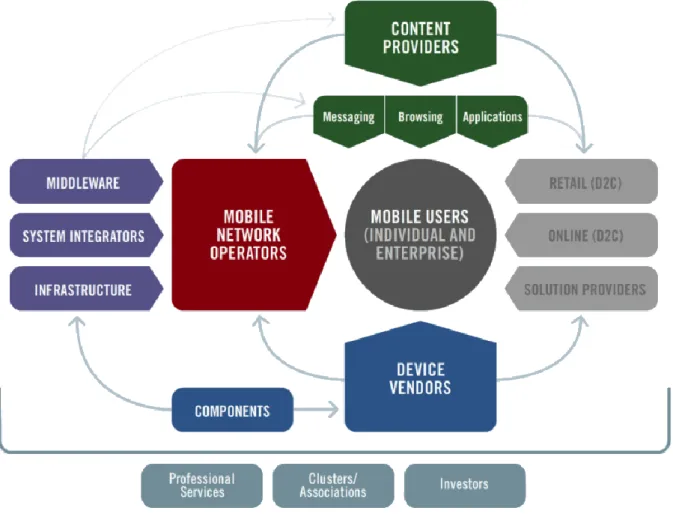
The value chain only tells part of the story, as it does not detail the type of industries and actors that play a role. It is therefore worthwhile to also consider the mobile services ecosystem. The mobile services ecosystem includes a number of key actors. Figure 2-2 summarises the ecosystem in a schematic. A number of actors can be distinguished:
Mobile network operators: these provide the mobile network solutions to mobile users and show interlinkages with device vendors and content providers.
Content providers: these actors develop mobile content, providing input to mobile network operators and retail segments, as well as develop messaging and browsing services, and mobile applications. Device vendors: they deliver handheld sets to mobile users and provide input to the mobile network
operators and retails segments.
Mobile users: the end users of mobile products, services and infrastructure.
Professional services, clusters and associations, and investors: these actors have an overall influence on the mobile services ecosystem, e.g. through facilitating investments (investors, clusters, professional services) or promoting the industry (clusters, associations).
13 Anthony, R., Bean, J., Coyle, J., Hayward, G. & James, K. (2011). “Sustainability Assessment of the Mobile Services
FIGURE 2-2: Ecosystem of the mobile services industry
Source: adapted from Mobile Experience Innovation Centre, available at http://mobilemediacanada.ca/
In addition to the ecosystem depicted above, equipment manufacturers and ICT industries play a key role in the industry by providing the necessary technology and devices for the mobile ecosystem to deliver the services on. This is partially reflected by the interlinkage between infrastructure, components and device vendors in Figure 2-2.
2.3.
Key challenges of mobile services industries
The key challenges faced by mobile services industries today include the following:
Decline in revenues from voice services14: while the success of smartphones has led to increased
data activities, it has contributed to the decline of revenues from voice services. Voice services was once one of the main channels of revenue for the entire industry, and network operators have yet to change their business models to fully adept to this.
Increasing network and infrastructure costs15: the success of smartphones has also led to an
explosion in data traffic that continues to rise. To provide adequate network infrastructure to support this trend, investments need to be made to ensure capacity. The 2012 Olympic Games in London, as
14 SAP Mobile Services, (2013). “Mobile Operator Guide 2013 - The Evolution of Mobile Services: Challenges, Strategies,
Opportunities”, Sybase, Dublin.
15 SAP Mobile Services, (2013). “Mobile Operator Guide 2013 - The Evolution of Mobile Services: Challenges, Strategies,
well as many other public events that bring about high concentrations of mobile users in the area, showed that the infrastructure available still cannot always handle the load and meet expectations for connectivity and reliability. With a large number of operators aggressively expanding their LTE networks to keep up with the market, investments are expected to be high for 2013.
A need to develop new business strategies16: aside from making large-scale investments,
operators also have to develop strategies and capabilities to compete against new rivals. The success of smartphones and availability of high speed connections has opened the door for powerful and disruptive actors to provide their innovative services. These services, such as Skype and Whatsapp, allow messaging and VoIP calls between users. The operators, however, lose revenue on voice and message services, threatening their dominant position on the market. Incumbent mobile players are reported to struggle to compete against the more agile and innovative entrants.
Cost effective provision of fast mobile services to rural areas: industry reports suggest that one of the biggest opportunities as well as on of the biggest challenges for the mobile industry is to provide fast mobile services to rural areas. More importantly, it is a challenge to do so cost effectively. Next generation network technology, i.e. LTE, has the potential to bring broadband internet services to rural areas. These networks, however, require significant investments17.
2.4.
Clusters in
mobile services industries
Clustering of mobile services industries is a complex phenomenon. To date, no comparable literature exists nor have the trends in clustering of mobile services industries been described in detail. Nevertheless, a number of trends can be observed.
The mobile industry has showcased increasingly more consolidation. This causes changes in organisational settings, rapid turnover of top management and frequent radical changes in strategic objectives, and indirectly affects decision-makers at a product level18. Consolidation can also lead to higher concentration
of actors, as a fewer number of dominant players play an important role in the (surrounding) mobile ecosystem. These dominant players in turn attract innovative startups.
The mobile clusters analysed in this report tend to be located near prominent ICT industries or clusters. The Finnish ICT cluster is a prime example for this, but also the Vienna and Attiki regions are home to respectively an ICT cluster and prominent mobile industries. The emerging mobile services industries are strongly linked to the traditional ICT and mobile industries. Moreover, the strong interlinkages between content creators, mobile device manufacturers and network operators further stimulate collaboration between these groups.
Prominent players in both the mobile and ICT industry have also started to stimulate the development of new mobile services industries. AppCampus in Finland, for example, is supported by industry giants Nokia and Microsoft and aims to create a new generation of self-sustaining mobile startups. As AppCampus is led and managed by Aalto University, these startups are likely to cluster around the existing prominent industry in the area19.
The abovementioned developments lead to the emergence and growth of clusters in mobile services industries. Clusters are generally seen as fostering technology and knowledge transfer among industry players
16 SAP Mobile Services, (2013). “Mobile Operator Guide 2013 - The Evolution of Mobile Services: Challenges, Strategies,
Opportunities”, Sybase, Dublin.
17 Cellular News, (2009). “The Big Challenge for the Mobile Industry in Emerging Markets”, retrieved from
http://www.cellular-news.com/story/36464.php
18 Van Riel, A. C., & Lievens, A. (2004). New service development in high tech sectors: A decision-making perspective.
International Journal of Service Industry Management, 15(1), 72-101.
and their suppliers and clients, thus contributing to the competitiveness of the sector. Geographically concentrated clusters may offer advantages in terms of more efficient use of resources and reduction in emissions due to reduced transportation needs. Clusters often emerge as a result of private initiatives. However, there are also various examples of clusters driven by policy initiatives or public-private partnerships20. In any
case, public policy may provide an enabling environment, which can further strengthen the cluster and the competitiveness of companies within it.
20 Public-private partnerships can have distinct structures (contracts or partnerships) and modes of operation (e.g.
“coproduction” and consensus building between public and private actors, risk-sharing arrangements, decision making, criteria used to select projects). They can add value in different ways: synergies, cost reductions, transaction costs, mobilisation of private resources etc. They need to be coordinated with other policy instruments (e.g., public R&D,
financing, creation of markets for eco-innovation). Source: OECD (2011) “Better Policies to Support Eco-innovation, OECD Studies on Environmental Innovation”, OECD Publishing, available at http://dx.doi.org/10.1787/9789264096684-en
3.
Precursor stage: first interest
in the emerging industry
In this chapter, we elaborate on the framework conditions relevant to the development of mobile services industries in the region at the Precursor stage, the first stage of the industry’s lifecycle. We first address each specific framework condition in detail and then discuss the implications for policy makers at this stage of industry’s development.
3.1.
Introduction
The Precursor stage corresponds to the activities that demonstrate the first interest of the region in a particular emerging industry. Specifically, this stage implies activities that support the initial development of a phenomenon of mobile services industries in the region, i.e., a business concept and/or underpinning service/technology platform, which stimulate industrial interest and investment in particular market-directed feasibility studies.
The following framework conditions have been identified as particularly relevant for this stage of industry’s development:
Existing prominent ICT (equipment) industry (industrial; relevant for all stages); Multi-operator market structure (market; relevant for all stages);
Critical mass of consumers with demand for high end devices with wide application areas (market; relevant for all stages);
Critical mass of Science and Technology Researchers (knowledge; relevant for all stages); Mobile market liberalisation (regulatory and policy; relevant for all stages);
Investments in next generation technology and networks (financial; relevant for all stages).
3.2.
Existing prominent ICT industry
The presence of existing prominent ICT industry can be qualified as an industrial framework condition. Essence of Framework Condition
This industrial framework condition is related to the fundamentals of the emerging mobile services industry. As discussed in Chapter 2, the mobile services industry builds on the existing telecommunications industry. More specifically, the existing telecommunications industry here comprises network operators, mobile device developers and manufacturers and equipment manufacturers. For the emergence of the mobile services industry, the existence of this traditional telecommunications industry, where network operators play a dominant role, is required.
The traditional telecommunications industry, in turn, is rooted in the ICT industry. This is because both the telecommunication devices and the operating network is highly technical. For telecommunication devices (i.e. mobile phones), chips for instance need to be developed. The semiconductors industry has traditionally played a crucial role in these developments. Moreover, the operating networks use leading-edge technology to provide increasingly higher transmission speeds, facilitate mobile internet and ensure quality of telecommunication services. The ICT industry therefore plays a crucial role in both developing and manufacturing these technologies.