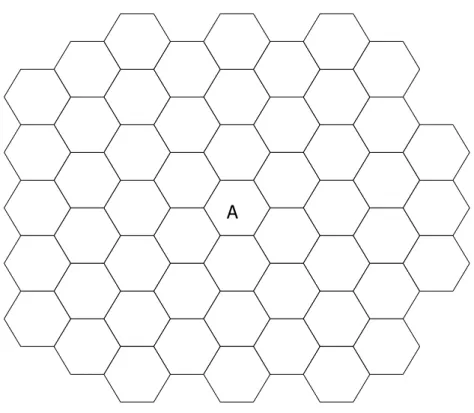
Question 1: (30 marks)
Consider a FDMA cellular system with 120 cites, a frequency reuse factor of N=12, and 900 overall two-way channels. Omni-directional antennas are used:
Figure 1 shows some of the cells.
(a) Find out the 12-cell cluster including cell A and its 11 neighboring cells, marked with B to L. (8 marks)
(b) What is the co-channel reuse ratio? (4 marks)
(c) Give the number of channels per cell, total number of channels available to the service provider, and the signal-to-interference ratio of the system. (6 marks)
(d) To expand the network, we decide to create an underlay-overlay system where the new system uses a frequency reuse factor of K=3. Give the number of channels assigned to inner and outer cells to keep a uniform traffic density over the entire coverage area. What is the total number of channels available now? (12 marks)
Figure 1: cellular system architecture
a) shown in the following figure.
b) Co-channel reuse ratio= 3N =6
c) The number of channels per cell=900/12=75
Total number of channels available to the system=75*120=9000 SIR=9N*N/6=216, 23.3dB
(d) Number of cells assigned to inner and outer cells
1 1 0
0 3 12 6
R D R D = = ×
= and D1 =3R0 so that 3 6
1 0 = R
R
and R0 =2R1
2 R K
Area= and 2 1 0
2 1 2 0 1
0 (2) and A 0.25 A
KR KR A
A = = =
If X is the number of channels, then
3 (0.25 ) 12 (0.75 ) 900X + X = and X =92.3 For the inner cells: 0.25 X = 0.25 (92.3) = 23 channels For the outer cells: 0.75 X = 0.75 (92.3) = 69 channels
Total number of channels available to the system =(23+69)*120=11040.
A A A A A A A B C D E F G H I J K L I H K J I L K
Question 2: (15 marks)
Consider a slotted aloha system with 4 users, A, B, C and D. User A uses a predefined backoff sequence (1,2,3,4) when it encounters collision, which means user A will delay 1 slot before its first retry; delay 2 slots before its second retry; delay 3 slots before its third retry; and delay 4 slots before its fourth retry. The backoff sequence of user B is (2,3,2,1). The backoff sequence of user C is (3,1,2,4). The backoff sequence of user D is (1,2,2,3). Here we use a slot as the time unit. Assume a packet is ready for transmission at user A at time 0. User B also has a packet to send at time 0. User C and user D have a packet to send at time 2 and time 3, respectively.
Complete the following timing diagram of this scenario, i.e., for each user, specify in which slot it will transmit, and whether the transmission will be successful (marked with S) or unsuccessful (marked with X).
User A
User B
User C
User D
0 1 2 3 4 5 6 7 8 9
Time slots
User A
User B
User C
User D
X
X
X
X
X
X
X
Question 3: (20 marks)
A WLAN hop accommodates 25 terminals running the same application. The
transmission rate is 1Mbps. The traffic produced by each terminal is assumed to form a Poisson process with an average arrive rate of 30 packets per second and each packet is 1000-bit long.
(a) What is the throughput of this system (in bits per second) if the terminals are using pure ALOHA protocol? (3 marks)
(b) What should the average arrive rate of each terminal be changed to, if we want to maximize the system throughput for this pure ALOHA system? Give the maximized system throughput (in bits per second). (7 marks)
(c) What is the throughput of this system (in bits per second) if the terminals use the slotted ALOHA protocol? (3 marks)
(d) What should the average arrive rate of each terminal be changed to, if we want to maximize system throughput for this slotted ALOHA system? Give the maximized system throughput (in bits per second). (7 marks)
a) Packet transmission time is T=1000/1000000=1ms, G=λ*T=25*30*1000/1000000=0.75
So S=0.75*exp(-1.5)=0.1673
Throughput=S*1000/(1000/1000000)=1.673e5 b) S’=exp(-2*G)-2G*exp(-2*G)=0 Î G=0.5 So, λ=500/25=20
S=0.1839
Throughput= S*1000/(1000/1000000)=1.839e5 c)
So, S=0.75*exp(-0.75)=0.3543 Throughput=3.543e5
d) S’= exp(-G)-G*exp(-G)=0 Î G=1 So, λ=1000/25=40
S=0.3679
Throughput=3.679e5
2G S Ge= −
G S Ge= −
Question 4: (20 marks)
A mobile terminal samples signals from four BSs as a function of time. The times and signal strengths (in dBm) from the samples are given in the table below. Assume the mobile terminal is initially attached to BS 1 (BS1). The mobile makes handoff decisions
by considering the signals from the BSs after each sampling time. For example, if just RSS is used, just after t=12.5s, the mobile terminal would be connected to BS3. On a plot,
show the handoff transitions between BSs for each of the following algorithms as a function of time. If a condition is met for more than one BS, assume the best one (strongest RSS) is selected.
a. Received signal strength (RSS) (5 marks) b. RSS + threshold of -60dBm (5 marks) c. RSS + hysteresis of 10dB (5 marks)
d. Discuss the pros and cons of the above three techniques. (5 marks) RSS from Four Base Stations
Times(s) 0 2.5 5 7.5 10 12.5 15 17.5 20
BS1 -47 -57 -56 -65 -60 -62 -60 -62 -56
BS2 -59 -56 -57 -61 -53 -56 -54 -52 -57
BS3 -70 -72 -75 -70 -58 -50 -55 -62 -75
BS4 -72 -71 -65 -59 -56 -53 -62 -63 -70
Solution:
0 2.5 5 7.5 10 12.5 15 17.5 20 (a): BS1 BS2 BS1 BS4 BS2 BS3 BS2 BS2 BS1 (a): BS1 BS1 BS1 BS4 BS4 BS4 BS2 BS2 BS2 (a): BS1 BS1 BS1 BS1 BS1 BS3 BS3 BS2 BS2
What is the duration of a bit in the normal burst of GSM? (5 marks)
If a user is allocated one time slot per frame, what is the delay between successive transmissions in successive frames? (5marks)
What is the supported data rate for this user? (5marks)
Solution:
The time needed for transmitting a timeslot in GSM is 577µs and a timeslot consists of 156.25bits. Then the time needed for transmitting a bit in GSM is 577µs/156.25 bits=3.7µs.
The delay between two successive transmissions is 8*577µs=4.615ms (5marks) 114 data bits are transmitted in a normal burst in GSM, then the data rate is 114 bits/4.615ms=24.7kb/s. // (5 marks)