International Journal of Applied Linguistics & English Literature ISSN 2200-3592 (Print), ISSN 2200-3452 (Online) Vol. 5 No. 5; September 2016
Australian International Academic Centre, Australia
A Study on English Preparatory Program EFL Learners’
Beliefs about Language Learning in Relation to
Gender, Second Foreign Language Knowledge
and Foreign Country Experience
Murat Hismanoglu (Corresponding author) Faculty of Arts and Science, Usak University, Usak, Turkey
E-mail: [email protected]
Received: 10-04-2016 Accepted: 19-06-2016 Advance Access Published: July 2016
Published: 01-09-2016 doi:10.7575/aiac.ijalel.v.5n.5p.109 URL: http://dx.doi.org/10.7575/aiac.ijalel.v.5n.5p.109
Abstract
This study aims at investigating preparatory program EFL learners’ beliefs about language learning as well as the effects of gender, second foreign language knowledge and foreign country experience on language learners’ beliefs about foreign language learning. After presenting the related literature with respect to the topic of language learners’ beliefs about foreign language learning, it continues with the methodology section that describes a quantitative research study in which 149 preparatory program EFL learners from the Foreign Languages School of a state university located in the west part of Turkey participated. The participants of the study had the same linguistic proficiencies (A1-elementary level). The paper concludes by indicating the findings of the research and also by making some recommendations for language teachers to enable teachers to design lessons that meet the needs of individual learners when teaching English as a second/foreign language (TESL/TEFL).
Keywords: beliefs, foreign language learning, preparatory program EFL learners, BALLI
1. Introduction
Over the last thirty years, researchers in the field of foreign language learning and teaching have investigated foreign language learners’ individual characteristics which can affect their success in language learning (Vibulphol, 2004). Beliefs about language learning have been one of the research focuses and attracted a number of researchers in that success relies less on materials, techniques, and linguistic analyses and more on what goes on inside learners and between the people in the classroom environment (Stevick, 1980). As Horwitz (1987) states, foreign language learners possess some presumptions about language and language learning and these beliefs have a strong impact on language learners’ behaviors in the language learning process. Therefore, students’ beliefs should be explored to enable teachers to design lessons that meet the needs and expectations of individual learners (Brown, 2009).
The term belief has been defined by many researchers. Horwitz refers to “beliefs” by utilizing the terms such as
preconceptions (1985), preconceived ideas (1987), and preconceived notions (1988). Huang (1997) states that beliefs
about language learning are “preconceptions language learners have about the task of learning the target language” (p. 29). According to Peacock (2001), beliefs are “psychologically held understandings, premises, or propositions about the world that are felt to be true” (p. 178). Kalaja and Barcelos (2003) stress that beliefs are “opinions and ideas that learners (and teachers) have about the task of learning a second/foreign language” (p.10). Horwitz (2008) emphasizes that comprehending students’ beliefs is also to be aware of their reaction in the classroom learning environment since dealing with learners’ beliefs is considering an issue that has been regarded as basic to their academic progress. Most researchers agree that language learners have different beliefs about language learning and that these language learners’ different beliefs about language learning may consciously or unconsciously affect their approaches or behaviors in language learning. For instance, if a student believes that learning a foreign language mainly consists of learning pronunciation, s/he will spend most of her/his energy on learning the segmental (e.g. vowel and consonant phonemes) and suprasegmental phonemes (e.g. stress, pitch, intonation, and juncture) of a language in formal language learning. Although positive beliefs are beneficial for language learners due to facilitating language learning process and stimulating language learners to reflect their potential power, negative beliefs are detrimental to language learners owing to hindering language learning process. To illustrate, Mantle-Bromley (1995) stressed that language learners with positive attitudes and realistic language-related beliefs are more inclined to behave in a more productive way in language learning than those with negative attitudes. However, language learners with negative attitudes and unrealistic language-related beliefs become less motivated to take part in classroom activities in the EFL classroom.
Horwitz is accepted to be the first researcher to identify language learners’ beliefs in a systematic way. In 1988, Horwitz designed a 34-item scale called Beliefs about Language Learning Inventory (Mokhtari, 2007). In the BALLI, language learners’ beliefs are assessed under five major subcategories: (1) foreign language aptitude; (2) the difficulty
of language learning; (3) the nature of language learning; (4) learning and communication strategies; and (5)
motivation and expectations (Horwitz, 1987). Since 1988, the BALLI has been widely utilized by some other
researchers (e.g. Kuntz, 1996; Oz, 2007; Fujiwara, 2012) to reveal language learners’ opinions about language learning. For instance, Oz (2007) investigated Turkish EFL learners’ (n=470) beliefs about L2 learning in secondary education and revealed that language learners’ beliefs about language learning had variability with respect to social and educational contexts, age, gender, and stages of language learning.
In the literature, there are a number of research studies that have focused on definitions of beliefs about language learning (e.g.Horwitz, 1985, 1987, 1988; Peacock, 2001; Kalaja & Barcelos, 2003), learners’ beliefs about language learning (e.g. Diab, 2006; Ariogul, Unal, Onursal, 2009; Ghobadi and Khodadady, 2011), teachers’ beliefs about language learning (e.g. Johnson, 1994; Schulz, 2001), comparison of learners’ beliefs with teachers’ beliefs (e.g. Kern, 1995; Peacock, 1999), belief change (e.g. Peacock, 2001; Basaran & Cabaroglu, 2014), the relationship between foreign language anxiety and learners’ beliefs (e.g. Hou, 2013), gender and learners’ beliefs (e.g. Siebert, 2003; Bernatt & Lloyd, 2007; Daif-Allah, 2012; Nahavandi, 2014), language proficiency and learner beliefs (e.g. Samimy & Lee, 1997; Abedini et al., 2011; Bagherzadeh, 2012), success and learners’ beliefs (e.g. Brown, 1990; Schulz, 1996; Sakui & Gaies, 1999; Dörnyei, 2005), and learners’ motivation and learners’ beliefs (e.g. Cohen and Dörnyei, 2002). However, there is a great paucity of research studies concerning the impacts of second foreign language knowledge and foreign country experience on preparatory program EFL learners’ beliefs about foreign language learning. Upon realizing this deficiency, we decided to conduct this research study to investigate preparatory program EFL learners’ beliefs about language learning in relation to gender, second foreign language knowledge and foreign country experience.
2. Methodology
2.1 Participants
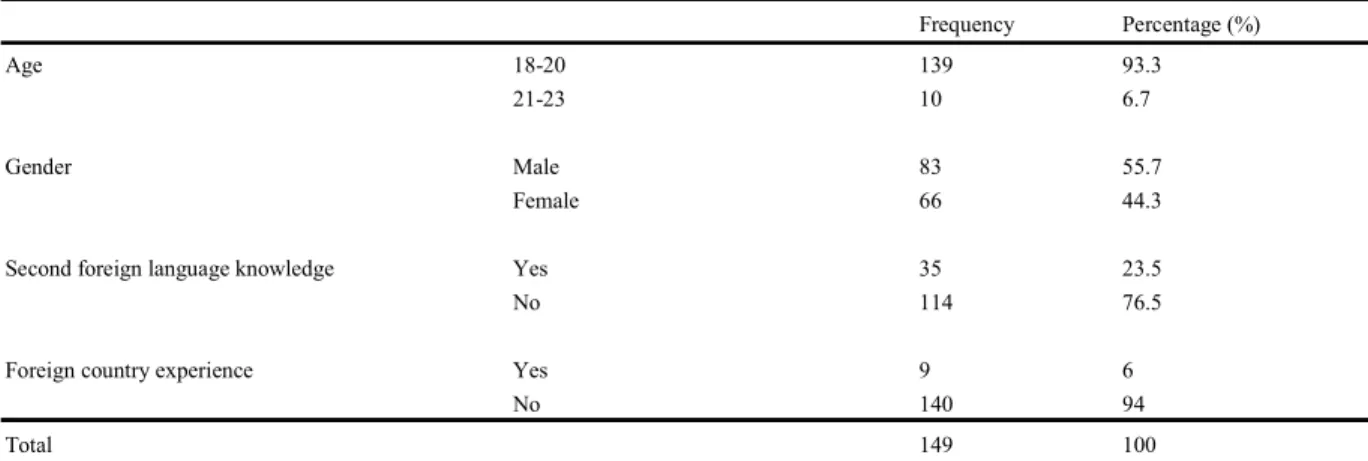
The participants in this study were 149 preparatory program EFL students from the Foreign Languages School of a state university located in the west part of Turkey. The age of students ranged from 18 to 23, with a mean of 20. Eighty-three students were male and sixty-six students were female. Table 1 presents the distribution of respondents according to age, gender, second foreign language knowledge and foreign country experience. Thirty-five students had second foreign language knowledge, whereas one hundred and fourteen students did not have second foreign language knowledge. Of these thirty-five students with second foreign language knowledge, twenty-five of them knew German as a second foreign language. Six of them knew Arabic as a second foreign language. Two of them knew Spanish as a second foreign language. One of them knew French as a second foreign language. One of them knew Russian as a second foreign language. Nine students had foreign country experience, whereas one hundred and forty students did not have foreign country experience. Of these nine students with foreign country experience, two of them visited Germany as a foreign country. Two of them visited Greece as a foreign country. One of them visited the Netherlands as a foreign country. One of them visited Hungary as a foreign country. One of them visited England as a foreign country. One of them visited Saudi Arabia as a foreign country. One of them visited Italy as a foreign country. One of them visited Switzerland as a foreign country. One of them visited Russia as a foreign country.
Table 1. Distribution of respondents according to age, gender, second foreign language knowledge and foreign country experience
Frequency Percentage (%)
Age 18-20 139 93.3
21-23 10 6.7
Gender Male 83 55.7
Female 66 44.3
Second foreign language knowledge Yes 35 23.5
No 114 76.5
Foreign country experience Yes 9 6
No 140 94
Total 149 100
2.2 Research questions
This study addresses the following research questions:
1. What are preparatory program EFL learners’ beliefs about foreign language learning?
4. Is there a significant relationship between foreign country experience and language learners’ beliefs about foreign language learning?
2.3. Instruments for data collection
The data for this study were collected through the questionnaire “Beliefs about Language Learning Inventory” (BALLI) developed by Horwitz (1987). The first part contained a series of demographic questions about students’ age, gender, second foreign language knowledge and foreign country experience. The second part contained thirty-four items based on a 5-point Likert scale (from 1=strongly disagree to 5= strongly agree) to reveal students’ beliefs with respect to foreign language aptitude, the difficulty of language learning, the nature of language learning, learning and communication strategies and motivation and expectations. To check the reliability, the instrument was analyzed through the Cronbach’s Alpha Coefficient α = 0.77, which showed a high level of reliability.
2.4 Data collection procedures
The instrument required about 10 minutes to complete and it was administered to the students in their regular English class. Prior to students’ filling out the questionnaire, they were told that their responses to the questionnaire would remain confidential. Morever, they were asked to respond to the items in the questionnaire as clearly as possible.
2.5 Data collection and analysis
Data were analyzed by using the Statistical Package for Social Sciences (SPSS. 16). The demographic variables for this study were discrete data (nominal and ordinal); therefore, descriptive statistics were utilized to run for frequencies, percentages, mean and standard deviation (Heiman, 2001; Sekaran, 2003; Beins, 2004). Parametric analysis such as independent samples t-test was administered to explore any statistically significant differences (a) between gender and language learners’ beliefs about foreign language learning, (b) between second foreign language knowledge and language learners’ beliefs about foreign language learning, (c) between foreign country experience and language learners’ beliefs about foreign language learning.
3. Results
3.1 Preparatory program EFL learners’ beliefs about foreign language learning
3.1.1 Foreign language aptitude
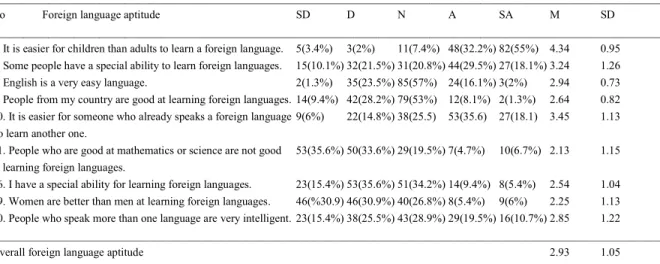
Table 2. Means, standard deviations and percentages of preparatory program EFL learners’ scores on their foreign language aptitude (n= 149)
__________________________________________________________________________________________________________
No Foreign language aptitude SD D N A SA M SD
__________________________________________________________________________________________________________
1. It is easier for children than adults to learn a foreign language. 5(3.4%) 3(2%) 11(7.4%) 48(32.2%) 82(55%) 4.34 0.95 2. Some people have a special ability to learn foreign languages. 15(10.1%) 32(21.5%) 31(20.8%) 44(29.5%) 27(18.1%) 3.24 1.26 4. English is a very easy language. 2(1.3%) 35(23.5%) 85(57%) 24(16.1%) 3(2%) 2.94 0.73 6. People from my country are good at learning foreign languages. 14(9.4%) 42(28.2%) 79(53%) 12(8.1%) 2(1.3%) 2.64 0.82 10. It is easier for someone who already speaks a foreign language 9(6%) 22(14.8%) 38(25.5) 53(35.6) 27(18.1) 3.45 1.13 to learn another one.
11. People who are good at mathematics or science are not good 53(35.6%) 50(33.6%) 29(19.5%) 7(4.7%) 10(6.7%) 2.13 1.15 at learning foreign languages.
16. I have a special ability for learning foreign languages. 23(15.4%) 53(35.6%) 51(34.2%) 14(9.4%) 8(5.4%) 2.54 1.04 19. Women are better than men at learning foreign languages. 46(%30.9) 46(30.9%) 40(26.8%) 8(5.4%) 9(6%) 2.25 1.13 30. People who speak more than one language are very intelligent. 23(15.4%) 38(25.5%) 43(28.9%) 29(19.5%) 16(10.7%) 2.85 1.22 _______________________________________________________________________________________________________________________ Overall foreign language aptitude 2.93 1.05 _______________________________________________________________________________________________________________________
Participants were asked to respond to 9 items to reveal their foreign language aptitude. The 5-point scale of responses ranged from one (strongly disagree) to five (strongly agree). Table 2 displays the results of descriptive statistics (means, standard deviations and percentages) of preparatory program EFL learners’ scores on the subscale of Foreign Language Aptitude. As seen in table 2, although preparatory program EFL learners agreed (a) that it was easier for children than adults to learn a foreign language (item 1, 48 students agreed and 82 students strongly agreed, M=4.34; SD=0.95), (b) that it was easier for someone who already speaks a foreign language to learn another one (item 10, 53 students agreed and 27 students strongly agreed, M=3.45; SD=1.13), they disagreed (a) that people who were good at mathematics or science were not good at learning foreign languages (item 11, 53 students strongly disagreed and 50 students disagreed, M=2.13; SD=1.15), (b) that they had a special ability for learning foreign languages (item 16, 23 students strongly disagreed and 53 students disagreed, M=2.54; SD=1.04) and (c) that women were better than men at learning foreign languages (item 19, 46 students strongly disagreed and 46 students disagreed, M=2.25; SD=1.13).
strongly disagreed, 35 students disagreed, 85 students were undecided), (c) people from my country being good at learning foreign languages (item 6, 14 students strongly disagreed, 42 students disagreed, 79 students were undecided), (d) people speaking more than one language being very intelligent (item 30, 23 students strongly disagreed, 38 students disagreed, 43 students were undecided). Overall, preparatory program EFL learners generally expressed negative beliefs with respect to the subcategory of foreign language aptitude by scoring lower than 4 on most of the items on the five point scale. The mean score of the foreign language aptitude subscale was 2.93, with a standard deviation of 1.05 indicating that the majority of the respondents had fair foreign language aptitude as presented in Table 2.
3.1.2. Difficulty of language learning
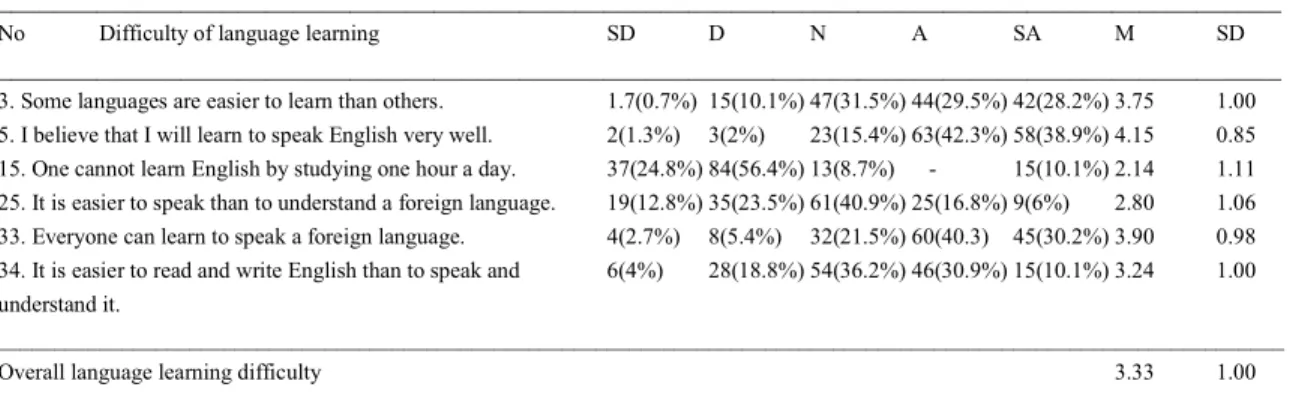
Table 3. Means, standard deviations and percentages of preparatory program EFL learners’ scores on difficulty of language learning (n= 149)
___________________________________________________________________________________________
No Difficulty of language learning SD D N A SA M SD
___________________________________________________________________________________________
3. Some languages are easier to learn than others. 1.7(0.7%) 15(10.1%) 47(31.5%) 44(29.5%) 42(28.2%) 3.75 1.00 5. I believe that I will learn to speak English very well. 2(1.3%) 3(2%) 23(15.4%) 63(42.3%) 58(38.9%) 4.15 0.85 15. One cannot learn English by studying one hour a day. 37(24.8%) 84(56.4%) 13(8.7%) - 15(10.1%) 2.14 1.11 25. It is easier to speak than to understand a foreign language. 19(12.8%) 35(23.5%) 61(40.9%) 25(16.8%) 9(6%) 2.80 1.06 33. Everyone can learn to speak a foreign language. 4(2.7%) 8(5.4%) 32(21.5%) 60(40.3) 45(30.2%) 3.90 0.98 34. It is easier to read and write English than to speak and 6(4%) 28(18.8%) 54(36.2%) 46(30.9%) 15(10.1%) 3.24 1.00 understand it.
__________________________________________________________________________________________________________________
Overall language learning difficulty 3.33 1.00
__________________________________________________________________________________________________________________
Participants were asked to respond to 7 items to reveal difficulty of language learning. Table 3 displays the results of descriptive statistics (means, standard deviations and percentages) of preparatory program EFL learners’ scores on the subscale of Difficulty of Language Learning. As seen in table 3, although preparatory program EFL learners agreed (a) that some languages were easier to learn than others (item 3, 44 students agreed and 42 students strongly agreed, M=3.75; SD=1.00), (b) that they would learn to speak English very well (item 5, 63 students agreed and 58 students strongly agreed, M=4.15; SD=0.85) and (c) that everyone could learn to speak a foreign language (item 33, 60 students agreed and 45 students strongly agreed, M=3.90; SD=0.98), they disagreed (a) that one cannot learn English by studying one hour a day. (item 15, 37 students strongly disagreed and 84 students disagreed, M=2.14; SD=1.11), (b) that it was easier to speak than to understand a foreign language (item 25, 19 students strongly disagreed and 35 students disagreed, M=2.80; SD=1.06). Lastly, preparatory program EFL learners were either undecided or they expressed their disagreement with respect to reading and writing English being easier than speaking and understanding (item 34, 6 students strongly disagreed, 28 students disagreed, 58 students were undecided, M= 3.24; SD=1.00)
Overall, preparatory program EFL learners generally indicated negative beliefs with respect to the subcategory of difficulty of language learning by scoring lower than 4 on most of the items on the five point scale. The mean score of the difficulty of language learning subscale was 3.33, with a standard deviation of 1.00 indicating that the majority of the respondents had moderate level of language learning difficulty as exhibited in Table 3.
3.1.3. Nature of language planning
Table 4. Means, standard deviations and percentages of preparatory program EFL learners’ scores on nature of language planning (n= 149)
No Nature of language planning SD D N A SA M SD
________________________________________________________________________________________________
8.It is necessary to know about English-speaking cultures 14(9.4%) 39(26.2%) 39(26.2%) 41(27.5%) 16(10.7%) 3.04 1.16 in order to speak English.
12. It is best to learn English in an English speaking country. 3(2%) 4(2.7%) 5(3.4%) 30(20.1%) 107(71.8%) 4.57 0.84 17. The most important part of learning a foreign language is 6(4%) 8(5.4%) 26(17.4%) 62(41.6%) 47(31.5%) 3.91 1.03 learning the vocabulary.
23. The most important part of learning a foreign language is 15(10.1%) 28(18.8%) 46(30.9%) 49(32.9%) 11(7.4%) 3.09 1.10 Learning the grammar.
27. Learning a foreign language is different from learning other 5(3.4%) 16(10.7%) 19(12.8%) 56 (37.6%) 53 (35.6%) 3.91 1.10 academic subjects.
28. The most important part of learning English is learning how 6(4%) 20(13.4%) 38(25.5%) 56(37.6%) 29(19.5%) 3.55 1.07 to translate from my native language.
Participants were asked to respond to 6 items to reveal nature of language planning. Table 4 displays the results of descriptive statistics (means, standard deviations and percentages) of preparatory program EFL learners’ scores on the subscale of Nature of Language Planning. As seen in table 4, although preparatory program EFL learners agreed (a) that it was best to learn English in an English speaking country. (item 12, 30 students agreed and 107 students strongly agreed, M=4.57; SD=0.84), (b) that the most important part of learning a foreign language was learning the vocabulary (item 17, 62 students agreed and 47 students strongly agreed, M=3.91; SD=1.03), (c) that learning a foreign language was different from learning other academic subjects (item 27, 56 students agreed and 53 students strongly agreed, M=3.91; SD=1.10) and (d) that the most important part of learning English was learning how to translate from their native language (item 28, 56 students agreed and 29 students strongly agreed, M=3.55; SD=1.07), they were either undecided or they expressed their disagreement with respect to (a) the necessity of knowing about English-speaking cultures in order to speak English (item 8, 14 students strongly disagreed, 39 students disagreed, 39 students were undecided) and (b) the most important part of learning a foreign language being learning the grammar (item 23, 15 students strongly disagreed, 28 students disagreed, 46 students were undecided, M=3.09; SD=1.10). As a consequence, preparatory program EFL learners generally expressed their positive beliefs with respect to the subcategory of nature of language planning by scoring nearly 4 or higher than 4 on three of the items on the five point scale. The mean score of the nature of language planning subscale was 3.68, with a standard deviation of 1.05 indicating that the majority of the respondents had high level of nature of language planning as shown in Table 4.
3.1.4 Learning and communication strategies
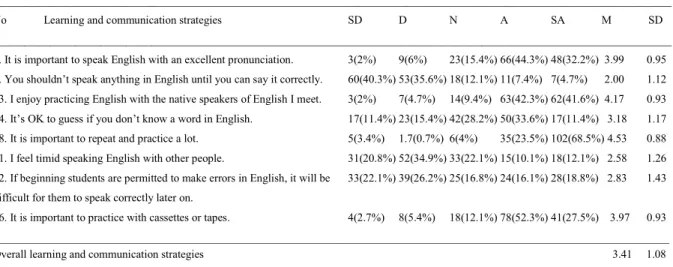
Table 5. Means, standard deviations and percentages of preparatory program EFL learners’ scores on learning and communication strategies (n= 149)
___________________________________________________________________________________________________________
No Learning and communication strategies SD D N A SA M SD
___________________________________________________________________________________________________________
7. It is important to speak English with an excellent pronunciation. 3(2%) 9(6%) 23(15.4%) 66(44.3%) 48(32.2%) 3.99 0.95 9. You shouldn’t speak anything in English until you can say it correctly. 60(40.3%) 53(35.6%) 18(12.1%) 11(7.4%) 7(4.7%) 2.00 1.12 13. I enjoy practicing English with the native speakers of English I meet. 3(2%) 7(4.7%) 14(9.4%) 63(42.3%) 62(41.6%) 4.17 0.93 14. It’s OK to guess if you don’t know a word in English. 17(11.4%) 23(15.4%) 42(28.2%) 50(33.6%) 17(11.4%) 3.18 1.17 18. It is important to repeat and practice a lot. 5(3.4%) 1.7(0.7%) 6(4%) 35(23.5%) 102(68.5%) 4.53 0.88 21. I feel timid speaking English with other people. 31(20.8%) 52(34.9%) 33(22.1%) 15(10.1%) 18(12.1%) 2.58 1.26 22. If beginning students are permitted to make errors in English, it will be 33(22.1%) 39(26.2%) 25(16.8%) 24(16.1%) 28(18.8%) 2.83 1.43 difficult for them to speak correctly later on.
26. It is important to practice with cassettes or tapes. 4(2.7%) 8(5.4%) 18(12.1%) 78(52.3%) 41(27.5%) 3.97 0.93 ________________________________________________________________________________________________________________________ Overall learning and communication strategies 3.41 1.08 ________________________________________________________________________________________________________________________
Participants were asked to respond to 8 items to unearth learning and communication strategies. Table 5 displays the results of descriptive statistics (means, standard deviations and percentages) of preparatory program EFL learners’ scores on the subscale of Learning and Communication Strategies. As seen in table 5, although preparatory program EFL learners agreed (a) that it was important to speak English with an excellent pronunciation (item 7, 66 students agreed and 48 students strongly agreed, M=3.99; SD=0.95), (b) that they enjoyed practicing English with the native speakers of English they met (item 13, 63 students agreed and 62 students strongly agreed, M=4.17; SD=0.93), (c) that it was important to repeat and practice a lot (item 18, 35 students agreed and 102 students strongly agreed, M=4.53; SD=0.88) and (d) that it was important to practice with cassettes or tapes (item 26, 78 students agreed and 41 students strongly agreed, M=3.97; SD=0.93), they disagreed that one should not speak anything in English until s/he can say it correctly (item 9, 60 students strongly disagreed and 53 students disagreed, M=2.00; SD=1.12). Additionally, the results of the questionnaire showed that preparatory program EFL learners were either undecided or they expressed their disagreement with respect to (a) guessing if not knowing a word in English (item 14, 17 students strongly disagreed, 23 students disagreed, 42 students were undecided), (b) difficulty of beginning students to speak correctly when being permitted to make errors in English (item 22, 33 students strongly disagreed, 39 students disagreed, 25 students were undecided, M=2.83; SD=1.43) and (c) feeling timid when speaking English with other people (item 21, 31 students strongly disagreed, 52 students disagreed, 33 students were undecided).
3.1.5 Motivation and expectations
Table 6. Means, standard deviations and percentages of preparatory program EFL learners’ scores on motivation and expectations (n= 149)
______________________________________________________________________________________________________________________
No Motivation and expectations SD D N A SA M SD
_______________________________________________________________________________________________________________________ 20. People in my country feel that it is important to speak English. 10(6.7%) 19(12.8%) 36(24.2%) 52(34.9%) 32(21.5%) 3.52 1.16 24. I would like to learn English so that I can get to know 2(1.3%) 6(4%) 18(12.1%) 60(40.3%) 63(42.3%) 4.18 0.89 native speakers of English better.
29. If I learn English very well, I will have better opportunities 4(2.7%) --- 2(1.3%) 13(8.7%) 130(87.2%) 4.78 0.72 for a good job.
31. I want to learn to speak English well. 4(2.7%) 1.7(0.7%) 1.7(0.7%) 10(6.7%) 133(89.3%) 4.79 0.74 32. I would like to have native-English speaking friends. 3(2%) 2(1.3%) 6(4%) 45(30.2%) 93(62.4%) 4.50 0.81 _______________________________________________________________________________________________________________________ Overall motivation and expectations 4.35 0.86
_______________________________________________________________________________________________________________________
Participants were asked to respond to 5 items to reveal motivation and expectations. Table 6 exhibits the results of descriptive statistics (means, standard deviations and percentages) of preparatory program EFL learners’ scores on the subscale of Motivation and Expectations. As seen in table 6, preparatory program EFL learners agreed (a) that people in their country felt that it was important to speak English (item 20, 52 students agreed and 32 students strongly agreed, M=3.52; SD=1.16), (b) that they would like to learn English so that they could get to know native speakers of English better (item 24, 60 students agreed and 63 students strongly agreed, M=4.18; SD=0.89), (c) that they would have better opportunities for a good job if they learned English well (item 29, 13 students agreed and 130 students strongly agreed, M=4.78; SD=0.72), (d) that they wanted to learn to speak English well (item 31, 10 students agreed and 133 students strongly agreed, M=4.79; SD=0.74) and ( e) that they would like to have native-English speaking friends (item 32, 45 students agreed, 93 students strongly agreed). Hence, it can be stated that preparatory program EFL learners generally expressed their positive beliefs with respect to the subcategory of motivation and expectations by scoring higher than 4 on most of the items on the five point scale. The mean score of the motivation and expectations subscale was 4.35, with a standard deviation of 0.86 denoting that the majority of the respondents had high level of motivation and expectations as exhibited in Table 6.
3.2 Is there a significant relationship between gender and language learners’ beliefs about foreign language learning?
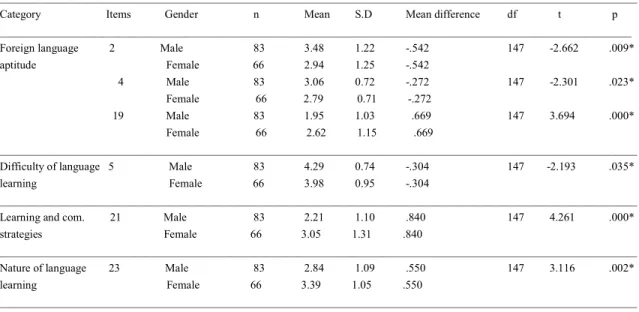
Table 7. Mean differences between males and females with respect to beliefs about foreign language learning
_________________________________________________________________________________________________________________ Category Items Gender n Mean S.D Mean difference df t p ________________________________________________________________________________________________________________ Foreign language 2 Male 83 3.48 1.22 -.542 147 -2.662 .009* aptitude Female 66 2.94 1.25 -.542
4 Male 83 3.06 0.72 -.272 147 -2.301 .023* Female 66 2.79 0.71 -.272
19 Male 83 1.95 1.03 .669 147 3.694 .000* Female 66 2.62 1.15 .669
_________________________________________________________________________________________________________________
Difficulty of language 5 Male 83 4.29 0.74 -.304 147 -2.193 .035* learning Female 66 3.98 0.95 -.304
_________________________________________________________________________________________________________________
Learning and com. 21 Male 83 2.21 1.10 .840 147 4.261 .000* strategies Female 66 3.05 1.31 .840
_________________________________________________________________________________________________________________ Nature of language 23 Male 83 2.84 1.09 .550 147 3.116 .002* learning Female 66 3.39 1.05 .550
_________________________________________________________________________________________________________________ * p< 0.05
(M=1.95, SD=1.03) and females (M=2.62, SD= 1.15); t(147)= 3.694, p < .05. This result indicated that male students disagreed more than female students that women were better than men at learning foreign languages.
Related to item 5 (difficulty of language learning), it was unearthed that there were significant differences between males (M=4.29, SD=0.74) and females (M=3.98, SD= 0.95); t(147)= -2.193, p < .05. This result indicated that male students believed more than female students that they would learn to speak English well. With respect to item 21
(learning and communication strategies), it was unearthed that there were significant differences between males
(M=2.21, SD=1.10) and females (M=3.05, SD= 1.31); t(147)= 4.261, p < .05. This result indicated that male students believed more than female students that they would learn to speak English well. Related to item 23 (nature of language
learning), it was seen that there were significant differences between males (M=2.84, SD=1.09) and females (M=3.39,
SD=1.05); t(147)= 3.116, p < .05. This result indicated that female students believed more than male students that the most important part of learning a foreign language was learning the grammar. Overall, the findings of the study unearthed that male learners held more positive beliefs about language learning than female learners as regard foreign language aptitude, difficulty of language learning, learning and communication strategies.
3.3 Is there a significant relationship between second foreign language knowledge and language learners’ beliefs about foreign language learning?
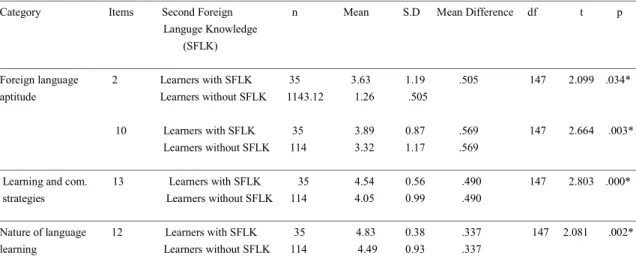
Table 8. Mean differences between second foreign language knowledge and language learners’ beliefs about foreign language learning _________________________________________________________________________________________________________________ Category Items Second Foreign n Mean S.D Mean Difference df t p Languge Knowledge
(SFLK)
_________________________________________________________________________________________________________________ Foreign language 2 Learners with SFLK 35 3.63 1.19 .505 147 2.099 .034* aptitude Learners without SFLK 114 3.12 1.26 .505
10 Learners with SFLK 35 3.89 0.87 .569 147 2.664 .003* Learners without SFLK 114 3.32 1.17 .569
_________________________________________________________________________________________________________________
Learning and com. 13 Learners with SFLK 35 4.54 0.56 .490 147 2.803 .000* strategies Learners without SFLK 114 4.05 0.99 .490
_________________________________________________________________________________________________________________ Nature of language 12 Learners with SFLK 35 4.83 0.38 .337 147 2.081 .002* learning Learners without SFLK 114 4.49 0.93 .337
_________________________________________________________________________________________________________________ * p< 0.05
To reveal whether there were significant differences between language learners with second foreign language knowledge (n=35) and those without second foreign language knowledge (n=114) in relation to their beliefs about foreign language learning, an independent samples t test was conducted to compare the means of these two groups. Based on the results of the t-test, it was unearthed that, relevant to item 2 (foreign language aptitude), there were significant differences between language learners with second foreign language knowledge (M=3.63, SD=1.19) and those without second foreign language knowledge (M=3.12, SD= 1.26); t(147)= 2.099, p < .05. That is to state that language learners with second foreign language knowledge believe some people have a special ability to learn foreign languages more than language learners not knowing a second foreign language do.
Similarly, related to item 10 (foreign language aptitude), it was found that there were significant differences between language learners with second foreign language knowledge (M=3.89, SD=0.87) and those without second foreign language knowledge (M=3.32, SD= 1.17); t(147)= 2.664, p < .05. Language learners with second foreign language knowledge found much easier for someone who already speaks a foreign language to learn another one than language learners without second foreign language knowledge did.
With respect to item 13 (learning and communication strategies), it was revealed that there were significant differences between language learners with second foreign language knowledge (M=4.54, SD=0.56) and those without second foreign language knowledge (M=4.05, SD= 0.99); t(147)= 2.803, p < .05. This outcome showed that language learners with second foreign language knowledge enjoyed practicing English with the native speakers of English they met more than language learners without second foreign language knowledge did.
3.4 Is there a significant relationship between foreign country experience and language learners’ beliefs about foreign language learning?
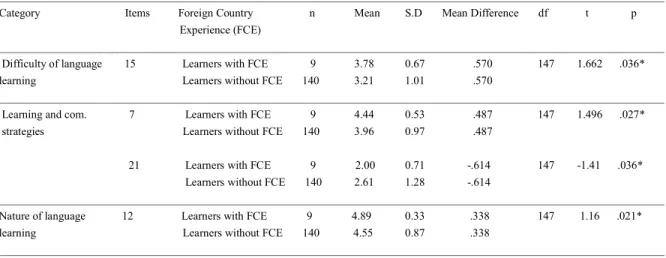
Table 9. Mean differences between language learners with foreign country experience and language learners without foreign country experience in relation to their beliefs about foreign language learning
______________________________________________________________________________________________________________________ Category Items Foreign Country n Mean S.D Mean Difference df t p Experience (FCE)
______________________________________________________________________________________________________________________ Difficulty of language 15 Learners with FCE 9 3.78 0.67 .570 147 1.662 .036* learning Learners without FCE 140 3.21 1.01 .570
______________________________________________________________________________________________________________________
Learning and com. 7 Learners with FCE 9 4.44 0.53 .487 147 1.496 .027* strategies Learners without FCE 140 3.96 0.97 .487
21 Learners with FCE 9 2.00 0.71 -.614 147 -1.41 .036* Learners without FCE 140 2.61 1.28 -.614
______________________________________________________________________________________________________________________ Nature of language 12 Learners with FCE 9 4.89 0.33 .338 147 1.16 .021* learning Learners without FCE 140 4.55 0.87 .338
______________________________________________________________________________________________________________________ * p< 0.05
To reveal whether there were significant differences between language learners with foreign country experience (n=9) and those without foreign country experience (n=140) in relation to their beliefs about foreign language learning, an independent samples t test was conducted to compare the means of these two groups. Based on the results of the t-test, it was unearthed that, relevant to item 15 (difficulty of language learning), there were significant differences between language learners with foreign country experience (M=3.78, SD=0.67) and those without foreign country experience (M=3.21, SD= 1.01); t(147)= 1.662, p < .05. This result indicates that language learners with foreign country experience believe more than language learners without foreign country experience that one cannot learn English by studying one hour a day.
Related to item 7 (learning and communication strategies), it was found that there were significant differences between language learners with foreign country experience (M=4.44, SD=0.53) and those without foreign country experience (M=3.96, SD= 0.97); t(147)= 1.496, p < .05. This result suggests that speaking English with an excellent pronunciation was more important for language learners with foreign country experience than it was for language learners without foreign country experience. Similarly, with respect to item 21 (learning and communication strategies), there were significant differences between language learners with foreign country experience (M=2.00, SD=0.71) and those without foreign country experience (M=2.61, SD= 1.28); t(147)= -1.41, p < .05. This result indicates that language learners with foreign country experience feel less timid than language learners without foreign country experience when speaking English with other people.
Relevant to item 12 (nature of language learning), it was revealed that there were significant differences between language learners with foreign country experience (M=4.89, SD=0.33) and those without foreign country experience (M=4.55, SD= 0.87); t(147)= 1.16, p < .05. This result indicated that language learners with foreign country experience believed more than language learners without foreign country experience the practicality of learning English in an English speaking country.
4. Discussion and conclusion
The present study investigated (a) preparatory program EFL learners’ beliefs about learning English as a foreign language by utilizing Horwitz’s (1987) BALLI, (b) the relationship between gender and language learners’ beliefs about foreign language learning, (c) the relationship between second foreign language knowledge and language learners’ beliefs about foreign language learning and (d) the relationship between foreign country experience and language learners’ beliefs about foreign language learning.
With respect to the relationship between gender and language learners’ beliefs about foreign language learning, the findings of the present study unearthed that male students held more positive beliefs about language learning than female students as regard foreign language aptitude, difficulty of language learning, learning and communication strategies. These results contradict with the results of Tercanlıoglu (2005) and Mesri (2012) in which there was no significant relationship between language learners’ beliefs and gender. In the literature, various research studies revealed different findings related to the relationship between gender and language learners’ beliefs about foreign language learning. For instance, the results of the study conducted by Daif-Allah (2012) indicated that there were statistically significant differences between males and females with respect to the areas of English language aptitude, learning and communication, and motivation and expectations. However, there were similar beliefs between males and females related to the difficulty and the nature of language learning. In the research study done by Bernatt & Lloyd (2007), males and females held similar beliefs with respect to foreign language aptitude, the perceived difficulty when learning a language, the nature of language learning, strategies in learning and communication, and their motivations and expectations. However, related to multilinguals’ being very intelligent, males and females had different beliefs, with more females supporting this statement. In another research study, Siebert (2003) found that females generally held stronger beliefs about language learning than males did.
Related to the relationship between second foreign language knowledge and language learners’ beliefs about foreign language learning, this study indicated that language learners with second foreign language knowledge held more positive beliefs about language learning than those without second foreign language knowledge as regards foreign language aptitude, learning and communication strategies and nature of language learning. These results contribute to the related field since previous studies did not unearth the relationship between second foreign language knowledge and language learners’ beliefs about foreign language learning.
Regarding the relationship between foreign country experience and language learners’ beliefs about foreign language learning, this study revealed that language learners with foreign country experience held more positive beliefs about language learning than those without foreign country experience with respect to difficulty of language learning, learning and communication strategies and nature of language learning. These results contribute to the related field since previous studies did not unearth the relationship between second foreign language knowledge and language learners’ beliefs about foreign language learning.
Some pedagogical implications can be drawn from the current study. First, the identification of preparatory program EFL learners’ beliefs may be very beneficial for preparatory program EFL teachers so that they can design their lessons in parallel to language learners' beliefs. Second, foreign language teachers may consider language learners' beliefs about foreign language learning when developing their teaching programs because any program taught in line with language learners’ beliefs can be motivating for learners.
References
Abedini, A., Rahimi, A., & Zare-ee, A. (2011). Relationship between Iranian EFL learners’ beliefs about language learning, their language learning strategy use and their language proficiency. Procedia Social and Behavioral Sciences, 28, 1029-1033.
Ariogul, S., Unal, D.Ç., Onursal, I. (2009). Foreign language learners’ beliefs about language learning: A study on Turkish university students. Procedia Social and Behavioral Sciences, 1(1), 1500–1506.
Bagherzadeh, H. (2012). Language learning beliefs of non-English majors: Examining the role of English language proficiency. Journal of Language Teaching and Research, 3(4), 784-792.
Basaran S & Cabaroglu, N. (2014). Language learning podcasts and learners’ belief change. The Electronic Journal for
English as a Second Language,17(4), 1-32. Retrieved from http://files.eric.ed.gov/fulltext/EJ1024978.pdf.
Beins, B. C. (2004). Research methods: A tool for life. New York: Pearson Education.
Bernat, E., & Lloyd, R. (2007). Exploring the gender effect on EFL learners’ beliefs about language learning.
Australian Journal of Educational and Developmental Psychology, 7, 79-91.
Brown (1990). Strategies for Developing Reading Skills. Retrieved from http://www.nclrc.org/essentials/reading/stratread.htm.
Brown, A. V. (2009). Students’ and teachers’ perceptions of effective foreign language teaching: A comparison of ideals. The Modern Language Journal, 93(1), 46–60.
Cohen, D., & Dörnyei, Z. (2002). Focus on the language learner: Motivation, styles, and strategies. In N. Schmitt (ed.),
An Introduction to Applied Linguistics (pp. 170–90). London: Arnold.
Daif-Allah, A.S. (2012). Beliefs about foreign language learning and their relationship to gender. English Language
Teaching, 5(10), 20-33.
Diab, R.L. (2006). University students’ beliefs about learning English and French in Lebanon. System, 34(1), 80-96. Dörnyei, Z. (2005). The psychology of the language learner: Individual differences in second language acquisition. Mahwah, NJ: Lawrence Erlbaum Associates.
Ghobadi Mohebi, S., & Khodadady, E. (2011). Investigating university students’ beliefs about language learning. RELC
Journal, 42(3), 290-304.
Heiman, G. W., (2001). Understanding research methods and statistics: An integrated introduction for psychology. Boston: Houghton Mifflin.
Horwitz, E.K. (1985). Using student beliefs about language learning and teaching in the foreign language methods class. Foreign Language Annals, 18(4), 333-340.
Horwitz, E.K. (1987). Surveying student beliefs about language learning. In A. Wenden & J. Rubin (Eds.), Learner
strategies in language learning (pp. 119- 129). London, UK: Prentice-Hall International.
Horwitz, E.K. (1988). The beliefs about language learning of beginning university foreign language students. The
Modern Language Journal, 72 (iii), 283-294.
Horwitz, E. K. (2008). Becoming a language teacher: A practical guide to second language learning and teaching (pp. 233-234). Boston, MA: Pearson, Allyn and Bacon.
Hou, Y.J. (2013). Taiwanese EFL Nursing students’ English learning beliefs and anxiety. Mediterrenean Journal of
Social Sciences, 4(11), 671-675.
Huang, S. C. (1997). Taiwanese senior high school students’ EFL learning: Focus on learning strategies and learning
beliefs. Ann Arbor, Michigan: UMI Company.
Jafari, S. M., & Shokrpour, N. (2012). The beliefs of Iranian ESP students about language learning. Journal of
Educational and Social Research, 157.
Johnson, K.E. (1994). The emerging beliefs and instructional practices of pre-service English as a second language teachers. Teaching & Teacher Education, 10(4), 439-452.
Kalaja, P. & Barcelos, A.M.F. (2003). Beliefs about SLA: New research approaches. Dordrecht: Kluwer.
Kern, R.G. (1995). Students’ and teachers’ beliefs about language learning. Foreign Language Annals, 28(1), 71-92. Kuntz, P. S. (1996). Beliefs about language learning: The Horwitz model. Retrieved from ERIC database. (ED397649) Mantle-Bromley, C. (1995). Positive attitudes and realistic beliefs: Links to proficiency. Modern Language Journal, 79(3), 372-386.
Mesri, F. (2012). The relationship between gender and Iranian EFL learners' foreign language classroom anxiety (FLCA). International Journal of Academic Research in Business and Social Sciences, 2(6), 147-156.
Mokhtari, A. (2007). Language learning strategies and beliefs about language learning: A study of university learners of Persian in the United States. Austin, Texas, USA: University of Texas, Unpublished Doctoral Dissertation.
Nahavandi, N. (2014). EFL learners’ beliefs about language learning along gender, further education in language institutes & different proficiency levels. International Journal of Applied Linguistics & English Literature, 3(1), 170-180.
Oz, H. (2007). Understanding Metacognitive Knowledge of Turkish EFL Students in Secondary Education.
Novitas-ROYAL, 1(2), 53-83.
Peacock, M. (1999). Beliefs about language learning and their relationship to proficiency. International Journal of
Applied Linguistics, 9(2), 247-265.
Peacock, M. (2001). Pre-service teachers’ beliefs about second language learning: A longitudinal study. System, 29, 177-195.
Samimy, K.K, & Lee, Y-A. (1997). Beliefs about language learning: Perspectives of first284 year Chinese learners and their instructors. Journal of the Chinese LanguageTeachers Association, 32(1), 40-60.
Sakui, K. & Gaies, S.J. (1999). Investigating Japanese learners' beliefs about language learning. System, 27, 473-492. Schulz, R. A. (1996). Focus on form in foreign language classroom: Students’ and teachers’ views on error correction and the role of grammar. Foreign Language Annals, 29(3), 343-364.
Schulz, R. A. (2001). Cultural differences in student and teacher perceptions concerning the role of grammar instruction and corrective feedback: USA-Colombia. The Modern Language Journal, 85(2), 244-258.
Sekaran, U. (2003). Research methods for business: A skill-building approach. United States of America: John Wiley & Sons, Inc.
Siebert, L. L. (2003). Student and teacher beliefs about language learning. The ORTESOL Journal, 21, 7-39.
Sioson, I, C. (2011). Language learning strategies, beliefs, and anxiety in academic speaking task. Philippine ESL
Journal, 7, 3-27.
Stevick, E.W. (1980). Teaching Languages: A Way and Ways. Rowley, Mass.: Newbury House.
Tercanlıoglu, L. (2005). Pre-service EFL teachers’ beliefs about foreign language learning and how they relate to gender. Electronic Journal of Research in Educational Psychology, 5-3(1), 145-162