Introduction
Positive feelings of self-worth (self-esteem) and supportive relationships with others (perceived social support) have each been conceptualised as resources that promote successful adaptation during late infancy and early adolescence[1]. Several studies have also assessed the effective role that these factors play in determining an improvement in emotional adjustment[2], a reduction in problematic behaviour[3], including depression, suicide and eating disorders[4], positive health practices[5] and a reduction in the use of substances[6], in particular smoking[7] . Results of these previous studies suggest that favourable self perceptions and supportive relationships could be considered as determinants for the acquisition of the tools required to positively influence an individual’s state of health[8].
In accordance with these considerations there are indications which suggest including activities in the school curriculum, which are directed towards the enhancement of both self-esteem and social competences for children during their transition into adolescence [2]. Promotion of these two types of resources is also a recommended strategy for the
design of successful programs in the public health prevention literature [9] . In a broader context, in order to attain the effect of the interventions on final health outcomes, variables such as self-esteem and perceived social support can be considered as intermediate outcomes and as necessary protective factors which can be developed at an early age[10]. According to these considerations, and with respect to the WHO recommendations, the design of health education programmes, most of which were conducted in schools, have moved from being purely informative towards a range of educational actions, based on more recent theories that explore the potential impact an intervention can have on personal characteristics, such as the level of self-esteem, or the effective management of emotions and social relationships[8, 11, 12] . The goals of these new approaches reflect two different orientations toward change. The first believes that efforts should focus on directly enhancing self-esteem, for example, by giving students affectively based exercises that encourage them to feel good about themselves.The second argues that attitudes about the self are consequences of successful achievements and thus pedagogical efforts should
Improving children’s self-esteem and perceived social related abilities:
the evaluation of a school-based program
Patrizia Lemma, Alessio Zambon, Alberto Borraccino, Giuseppe Migliaretti, Franco Cavallo
Dipartimento di Sanità Pubblica, Università di Torino.
Correspondence to: Alberto Borraccino, Dipartimento di Sanità Pubblica, Università di Torino, via Santena 5 bis, 10126 Torino, Italia.
E-mail: [email protected]
Abstract
Background and Objective: Health education programmes delivered in school settings are often design to enhance child self–esteem or various social skills in order to improve the way that they interact in every day life. Although these are becoming increasingly frequent, little is known about the real efficacy of many of the available programs that claim to be able to positively develop these psychological dimensions. This study, which takes a Public Health approach, examines the effect of a school-based educational programme, designed following the WHO recommendations, in order to favour children’s self-esteem and improve perceived socio-relational competences.
Method:To test the effectiveness of this intervention, a non randomized, controlled, prospective study was set up. All 291 eligible students, aged between 8-10 years, were enrolled. To assess self-esteem and perceived supportive relationship, a well-known and descriptive scales were utilised (MSCS, SPPC, AIR). Results:No difference was found between the experimental and control groups with respect to the children’s self-esteem and perceived socio-relational competences following the intervention, except in the quality of their relationships with their teachers, which improved in the experimental group and declined in the control group. Discussion:The educational programme used in our study did not seem to be able to enhance self-esteem in the intervention group, but the methodological instruments used to monitor the change in self-esteem domonstrated a different rate of change in the more disadvantaged sub-groups of the observed population.
be directed towards enhancing specific skills [13] . In an applied perspective, in order to both effectively increase the ability to positively contribute to broader public health concerns and to better orient the public administration’s choices for funding and selecting effective programmes, an accurate evaluation of these interventions is needed. However little is known about the real efficacy of many available programs that claim to be able to positively develop these psychological dimensions, nor is there a lack of evidence of inefficacious programs that should be avoided.
Our research is aimed at evaluating an educational intervention in its capacity to improve self-esteem and the perceived quality of supportive relationships in school children. Monitoring these variables, which are considered in prevention work as intermediate outcomes [9], also brings this research into a salutogenesisperspective as it looks at the determinants of health[14] .
Methods
Sample and Study design
The study sample consisted of all of the 15 class groups of elementary school children (3rd, 4thand 5th graders) from three villages (Villafranca Piemonte, Cavour and Campiglione Fenile) located in the same rural school district near Turin. To test the effectiveness of the intervention a non randomised, controlled, prospective study was set up. No randomization of the classes was allowed by the school; therefore it was agreed with the school administration to set up two roughly comparable groups (in quantity and quality), one represented by the classes in Villafranca and the other by the classes in Cavour and Campiglione Fenile. The assignment of classes for the intervention and for the control group was agreed upon with the school administration. The experimental group consisted of six classes located in Villafranca Piemonte (138 children).The control group was made up of the classes located in the two other neighbouring towns (153 children). Measurements were carried out in both groups during the same period of time, at the beginning and at the end of the school year. Of the 291 children initially observed, only the 279 who completed the questionnaires at the pre- and post-test sessions were included in the analyses. Exclusion factors were: absence from school at either the pre- or the post-test (2 children); having a support teacher because of severe cognitive deficits (6 children); or having missed too many questionnaire items, wherein the number of sufficient items was defined by the protocol of each test (4 children).
Educational program
The intervention was carried out during the 2000-2001 school year. The aim of our approach was to develop self-worth and social competences in children by working on their emotional development (for the theoretical framework, see Maslow[15], Rogers[16], and Putton [17]).A group of educators, experienced in working in schools throughout Piedmont, were called upon to implement the intervention that was conducted together with the students’ regular teachers. The intervention was organized over 15 meetings of 120 minutes each, during which special settings were created where children were encouraged to explore their potentialities and positive personality features. The general aim was to support the children’s self-esteem and to help them to more effectively manage their emotions and social relationships. Each meeting related to one of the five following working areas: self image, self-esteem, corporeity, active listening and final assessment. Each area had its own objectives to be fulfilled with a specific number of activities. An outline of the intervention is given in Figure 1.
Measurements
To assess the dimensions interested by the observed educational program the following psychometric tests were used:
• The MSCS (Multidimensional Self Concept Scale [18]). This estimates the child’s perception of competencies and resources in six different domains: interpersonal relations, control of the environment, emotional well-being, academic success, family life and body image. A Total Self Concept Index (TSCI), which is derived from the summation of the responses from the previous items, is also provided.
• The SPPC (Self-Perception Profile for Children [19]). In order to assess how much the child liked him/herself as a person, the General Self-Worth Scale was used (GSWS).
agreed explanation was provided. The test administration sessions (three pre and three post intervention) were organised during school time and were conducted by four educators specifically trained for the task during the same week for all of the pupils. Each student was allocated a unique identification number to ensure anonymity and to act as a matching variable for pre and post-test measurements.
Statistical Analysis
The psychometric tests allow for the quantitative evaluation of the variables related to the psychological dimensions on which the intervention was designed to act. The measures within the two groups are shown as means and standard deviations (SD); differences between pre
and post tests are shown as means along with their related 95% Confidence Intervals (95%CI).
Differences between pre- and post- test and between the control and the experimental group were tested by an ANCOVA [21] model where the difference between pre and post-test for each scale was used as the dependent variable and group assignment as the independent variable; the model was adjusted for gender, age and the baseline value of the involved scale in the pre-test. SPSS for Windows 12.0 (SPSS, Inc. 1989-2003 Chigago, IL) was used for the statistical analysis.
Based on the hypothesis that the intervention would be more effective in children who scored lower on self-esteem in the pre-test[22], a stratified analysis was performed on the two sub-groups resulting from the children scoring higher Figure 1. Intervention Scheme. Areas, objective and activities carried out. The Intervention was studied and designed for children between the age of 8 and 11 attending to elementary school.
1stArea: Self image - 2 meetings
Area objective: to raise awareness of self-directed thoughts, to increase the ability of entering in contact with others and to respect rules.
• Photo-language: choose pictures that represent something about yourself (interests, fears, memory, etc) to classmates • Patchwork: create a paper patchwork with pictures from magazines that tell something about yourself
2nd
Area: Self-esteem - 6 meetings
Area objective: to acquire a positive judgement of themselves
• Positive event: describe a positive event of the preceding two months and define the emotion you felt on that occasion • Trust:to gain trust from school-mates through role-play
• Favourite object:choose and bring a favourite object to school, explain why you chose it and why it is important to you • Favourite activities: tell classmates about a nice event that happened at school and describe the emotions you felt • Spare time: describe your spare time activities and the emotions you feel doing them
• Discovering the good in me:remember any compliments you got at school and the person(s) who gave you them • Compliments:write down and exchange a list of compliments, and share them with classmates
• If I were:choose a symbol (e.g. animal, flower, object, sentiment) that identifies you and explain why • Desire: express a deep desire and explain to the group why it was chosen
• Express yourself with colours: choose a colour that represents your emotions, explain why you chose it • Collaboration:group work in modelling clay with classmates chosen by the conductor
3rdArea: Corporeity - 3 meetings
Area objective: to express feelings nonverbally
• The body map: choose symbols that represent the body and explain the choices • Being fond of ourselves: identify and describe how you take care of your body • Expressing emotion with the body:say thanks to a classmate nonverbally • Relaxation:learn a new relaxation technique led by the conductor
• Fears and desires:freely express fear and desires about love, corporeity, sexuality
4th
Area: Active listening - 2 meetings
Area objective: to reflect on how we listen and want to be listened to
• Listening to others:try a new listening modality and retell the story
• How it feels to be listened to:describe at least two episodes when others have listened to you • Emphatics:analyse a problem with a hat given by the conductor (role play)
• Speaking:describe and communicate the emotions felt during the previous activity
5thArea: Assessment - 2 meetings
Area objective: to reflect on the work done and discuss it with parents
than the median of the pre-test for the Total Self Concept Index and of the General Self-Worth Scale and from those scoring lower.
Results
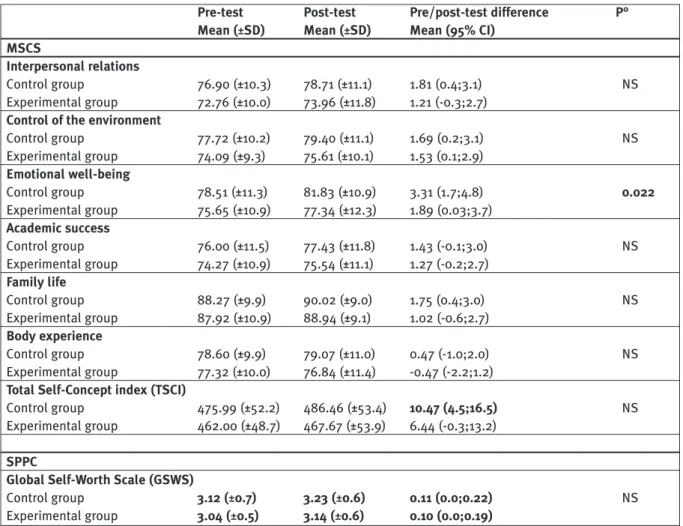
The mean score of each scale and the global scores for MSCS of the two groups at the pre- and post-test are listed in Table 1. At the beginning of the school year, the value of the Total Self Concept Index (TSCI) was slightly lower in the intervention group (462.00) than in the control group (475.99) but this difference was not statistically significant. Comparison of the sub-scales produced a similar result, with the intervention group constantly scoring lower than the control one with statistically insignificant differences. At the end of the school year there was an improvement in each of the sub-scales in both groups, except for a reduction in the body perception scale in the intervention group. In some cases these improvements are statistically significant (see Table 1): the two groups perceive an increase in both
their competence to control the environment and their emotional well-being, while only the control group perceives better interpersonal relationships and family life. Finally, we have an increment in the Total Self Concept Index in both groups, but only in the control group is this difference statistically significant. As for ANCOVA, there was only one area which produced significant results - emotional well-being, which shows a statistically significant change between the two groups (p=0.022) with a greater improvement in the control group than in the experimental one.The General Self-Worth Scale (GSWS) shows that during the school year, the increase in values in both groups, is not as statistically significant as the differences between the two groups (Table 1).
To assess the development of self-esteem in children below and above the group median, a stratified analysis was conducted (Table 2). By using TSCI, the experimental and the control groups show the same pattern during the study period (eight months): a non significant change in
Table 1. Pre- and post-intervention scores in the control and in the experimental groups at the MSCS and at the SPPC (Global Self-Worth Scale); mean scores with standard deviation (SD) are shown, along with mean differences between pre and post-test and their 95% confidence interval (95%CI).
Pre-test Post-test Pre/post-test difference P° Mean (±SD) Mean (±SD) Mean (95% CI)
MSCS
Interpersonal relations
Control group 76.90 (±10.3) 78.71 (±11.1) 1.81 (0.4;3.1) NS
Experimental group 72.76 (±10.0) 73.96 (±11.8) 1.21 (-0.3;2.7)
Control of the environment
Control group 77.72 (±10.2) 79.40 (±11.1) 1.69 (0.2;3.1) NS
Experimental group 74.09 (±9.3) 75.61 (±10.1) 1.53 (0.1;2.9)
Emotional well-being
Control group 78.51 (±11.3) 81.83 (±10.9) 3.31 (1.7;4.8) 0.022
Experimental group 75.65 (±10.9) 77.34 (±12.3) 1.89 (0.03;3.7)
Academic success
Control group 76.00 (±11.5) 77.43 (±11.8) 1.43 (-0.1;3.0) NS
Experimental group 74.27 (±10.9) 75.54 (±11.1) 1.27 (-0.2;2.7)
Family life
Control group 88.27 (±9.9) 90.02 (±9.0) 1.75 (0.4;3.0) NS
Experimental group 87.92 (±10.9) 88.94 (±9.1) 1.02 (-0.6;2.7)
Body experience
Control group 78.60 (±9.9) 79.07 (±11.0) 0.47 (-1.0;2.0) NS
Experimental group 77.32 (±10.0) 76.84 (±11.4) -0.47 (-2.2;1.2)
Total Self-Concept index (TSCI)
Control group 475.99 (±52.2) 486.46 (±53.4) 10.47 (4.5;16.5) NS
Experimental group 462.00 (±48.7) 467.67 (±53.9) 6.44 (-0.3;13.2)
SPPC
Global Self-Worth Scale (GSWS)
Control group 3.12 (±0.7) 3.23 (±0.6) 0.11 (0.0;0.22) NS
Experimental group 3.04 (±0.5) 3.14 (±0.6) 0.10 (0.0;0.19)
children with higher values and a statistically significant increase in those with lower values. On the other hand, GSWS values significantly increase in both groups of children below the median, and significantly decrease in children above the median.At the end of the eight months in school, both groups have closer mean values, but retain their relative positions. In the end, even if there are some significant changes in both groups between pre and post-test, MSCS and GSWS did not identify significant differences between the experimental and the control group.
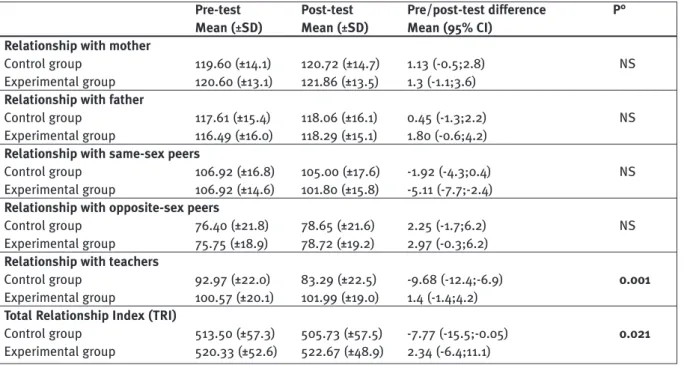
In the AIR (Table 3), the experimental group had a higher score (520.3) at the pre-test than the control group (513.5) indicating, in particular, better relationships with their teachers. At the post-test, the experimental and the control groups showed the same trend for four of the variables: relationships with the mother, father and with peers of the opposite sex improved whilst at the same time we observed a decrease in the quality of the relationships with peers of the same-sex (statistically significant in the experimental group). Looking at the global scale (TRI), we Table 2. Pre- and post-intervention scores in the control and in the experimental groups at the MSCS Total Self-Concept index (TSCI) and at the SPPC (Global Self-Worth Scale) in the two sub-groups having higher/lower values with respect to the median score at the pre-test of the whole group; mean scores with standard deviation (SD) in the two groups are shown, along with mean differences between pre and post-test and their 95% confidence interval (95%CI).
Pre-test Post-test Pre/post-test difference P° Mean (±SD) Mean (±SD) Mean (95% CI)
MSCS (TSCI) sub group below the median (<=465)
Control group 427.37 (±28.5) 446.09 (±41.5) 18.71 (9.52 ; 27.92) NS
Experimental group 427.82 (±30.6) 441.55 (±44.7) 13.74(5.03 ; 22.44)
MSCS (TSCI) sub group over the median (>465)
Control group 514.89 (±29.1) 518.75 (±37.6) 3.86 (-3.67 ; 11.40) NS
Experimental group 506.03 (±27.8) 503.08 (±44.2) -2.95 (-12.84 ; 6.94)
SPPC (GSWS) sub group below the median (<=3.17)
Control group 2.60 (±0.59) 3.02 (±0.59) 0.42 (0.25 ; 0.59) NS
Experimental group 2.71 (±0.40) 2.97 (±0.54) 0.27 (0. 15 ; 0.39)
SPPC (GSWS) sub group over the median (>3.17)
Control group 3.63 (±0.23) 3.43 (±0.51) -0.20 (-0.31 ; -0.09) NS
Experimental group 3.59 (±0.21) 3.40 (±0.46) -0.19 (-0.32 ; -0.07)
° P – significance level from the ANCOVA model
Table 3. Pre- and post-intervention scores in the control and in the experimental groups at the AIR; mean scores with standard deviation (SD) in the two groups are shown, along with mean differences between pre and post-test and their 95% confidence interval (95%CI).
Pre-test Post-test Pre/post-test difference P° Mean (±SD) Mean (±SD) Mean (95% CI)
Relationship with mother
Control group 119.60 (±14.1) 120.72 (±14.7) 1.13 (-0.5;2.8) NS
Experimental group 120.60 (±13.1) 121.86 (±13.5) 1.3 (-1.1;3.6)
Relationship with father
Control group 117.61 (±15.4) 118.06 (±16.1) 0.45 (-1.3;2.2) NS
Experimental group 116.49 (±16.0) 118.29 (±15.1) 1.80 (-0.6;4.2)
Relationship with same-sex peers
Control group 106.92 (±16.8) 105.00 (±17.6) -1.92 (-4.3;0.4) NS
Experimental group 106.92 (±14.6) 101.80 (±15.8) -5.11 (-7.7;-2.4)
Relationship with opposite-sex peers
Control group 76.40 (±21.8) 78.65 (±21.6) 2.25 (-1.7;6.2) NS
Experimental group 75.75 (±18.9) 78.72 (±19.2) 2.97 (-0.3;6.2)
Relationship with teachers
Control group 92.97 (±22.0) 83.29 (±22.5) -9.68 (-12.4;-6.9) 0.001
Experimental group 100.57 (±20.1) 101.99 (±19.0) 1.4 (-1.4;4.2)
Total Relationship Index (TRI)
Control group 513.50 (±57.3) 505.73 (±57.5) -7.77 (-15.5;-0.05) 0.021
Experimental group 520.33 (±52.6) 522.67 (±48.9) 2.34 (-6.4;11.1)
observed an improvement of 2.34 points in the intervention group vs.a decrease of 7.8 points in the control group: in particular the scores relating to the child-teacher relationships showed an increase in the experimental group and a decrease in the control group, this difference was statistically significant (p=0.001). Therefore, the positive influence of the intervention on the perceived quality of social relationships can be hypothesized only for children’s relationships with teachers.
Discussion
Concepts such as “self-esteem” and “social support” have become central since many theorists [1, 12, 23, 24] and several studies[2-7] suggest their positive influence in children’s and adolescent’s development, as they may serve as a buffer against negative outcomes[25], especially when in relation to life stress exposure[26]. As a consequence, there has been increased interest, in both school communities and at the regional level, in health education interventions aimed at the development of such dimensions. Moreover, to respond to the public health mission and bring the community towards better levels of well-being, we need to strengthen our ability to assess the effectiveness of these interventions.
The educational program evaluated in this study focused on directly enhancing self-esteem, using an affective approach, through the reduction of discrepancies between aspirations and perceived levels of adequacy and through the internalisation of positive opinions of significant others (for a summary of intervention strategy see Harter, 1999[13]).
To measure self-esteem the present study used two different, but long-employed, approaches. In the first, [18] global self-esteem is viewed as incorporating a number of more specific components in different domains, such as the self-concept of competence and perceived resources, where its value is inferred from the summation of responses to items organized in different scales. In the second, [19] the perceived global-worth is valued on a six item scale that directly inquires into what extent children are happy with the way they are, feel good about the way they act and think that they are a good person. These two approaches are derived from the hypothesis that children, aged eight and older, not only make judgements about their competence in different domains but they have also constructed a view of their general self-worth as a person[27, 28].
The results of this study show that the educational program carried out did not
significantly modify self-esteem (as measured by MSCS and GSWS) in the experimental group with respect to the control one, either in the whole group or within the sub-group that scored lower than the median at the beginning of the school year (Table 1 and 2).
It is true that the study design we were forced to use was not strictly experimental in nature, therefore confounding effects of other factors influencing the results could not be fully adjusted for.The adoption of such a design would not have allowed us in any case to understand the mechanisms of such an effect, but rather to observe a change in one group with respect to the other [29]; this effect was actually observed in the groups scoring lower than the median at the pre-test with respect to those scoring higher.
In discussing this result, some theoretical issues concerning the psychological development of self-esteem deserve consideration, as the observed sample of children allows us to confirm some of the more typical developmental changes which take place during this age span [13].
The results of this study in fact, as measured by TSCI and by GSWS, show a significant increase in self-esteem if we consider the sub-samples that scored lower than the median at the start of the school year. This result could be read just as a regression towards the mean of the two groups. But the entity of the score increase observed in the sub-sample, who scored lower on self-esteem in the pre-test, suggests a reflection of some other developmental issues.
During primary school, children become increasingly able to make realistic judgements about their competence and their aspired self [30]. So we observe an increase in the degree of congruence between the perceived self and the aspired self [31]. It is expected then, that in a period with little environmental change at school level, such as in the last years in the primary cycle with the same teachers and class-mates, the stability helps those who have a lower self-esteem to organize experiences in a meaningful way [32]. With the onset of pre-adolescence – which brings with it not only a new school structure, several different teachers, a new social hierarchy, but also a maturational change – this low stability may challenge the individual’s view of themselves, and bring about new inter-group differences.
group with lower self-esteem has, at the end of the observed eight months, a mean value closer to that of the with group with a higher value, however they retain their relative positions (Table 2). Empirical results suggest that, from early adolescence through late adolescence into young adulthood, there is a substantial ordering of consistency, which relatively becomes more and more stabled with increasing age[30, 32, 33]. So, given that adolescent self-esteem has important consequences, both for the developing individual and for society, there is a need to determine which specific strategies and techniques lead to the desired goal in late infancy when the degree of consolidation of this pattern is low. The educational program used in this study does not seem to be able to reach this result, as the observed differences seem to relate to belonging to the group scoring lower than the median at the pre-test, rather than to the effect of the educational programme.
Furthermore, affective based programs, trying to enhance the child’s self-worth directly, like the one used in this study, seem to have little impact[34] and in recent years the pendulum has shifted towards skills learning, where the intervention targets specific domains [13].
In order to assess the richness of social support, this study chose the child’s perspective in the hypothesis that the individual’s psychosocial adjustment significantly depends on his/hers perceptions [21].The AIR test measures children’s perception of the quality of their interpersonal relationships in three contexts: familiar, socially and scholarly. Even if each of these three aspects contributes to a global relationship quality, each of them has, across the period of late infancy, a specific developmental process: relationships with parents are still strong, those with the peers of the opposite sex increase in importance while those with peers of the same-sex decreases, most of all, the perceived relationships with teachers dramatically [21] worsen. This study, both in the experimental and the control group, shows this typical development, except for the change in the relationships with their teachers, which improves in the experimental group (Table 3).
As measured by AIR the intervention seems to have a significant influence only on the children’s perceived quality of the relationship with their teachers. This aspect allows us to discuss a limitation of the study design; a non randomised study, which may have influenced this result. The selection bias could be highlighted by the higher score of the experimental group on the pre-test, indicating better relationships with teachers.
However, the observed results suggest the positive effect of this intervention in making teachers able to be perceived as a resource by the student. Furthermore, it is important to remember that social support received from the school personnel is particularly important in reducing psychological distress among socio-disadvantaged adolescents [26].
Funding
The evaluation program was supported by the Piedmont Region fund for programs against drug abuse (1999).
References
1) Compas BE, Hiden BR, Gerhardt CA.Adolescent development: pathways and processes of risk and resilience.Ann Rev Psychol 1995;46:265-93.
2) Du Bois DL, Burk-Braxton C, Swenson LP, Tevendale HD, Lockerd EM, Moran BL. Getting by with a little help from self and others: self-esteem and social support as resources during early adolescence. Dev Psychol 2002;38(5):822-39.
3) Du Bois DL, Silverthorn N. Do devian peer associations mediate the contribution of self-esteem to problem behavior during early adolescence? A 2-year longitudinal study. J Clin Child Adolesc 2004;33(2):382-8.
4) Mecca AM, Smelser NJ, Vasconcellos J, eds. The social importance of self-esteem. Berkeley: University of California Press, 1989.
5) Yarcheski A, Mahon NE, Yarcheski TJ, Cannella BL. A Meta-analysis of predictors of positive health practices. J Nurs Scholarship 2004;36(2):102-8.
6) Faggiano F, Vigna-Taglianti FD, Versino E, Zambon A, Borraccino A, Lemma P. School-based prevention for illicit drugs’ use.Cochrane Database Syst Rev 2005;(2):CD003020.
7) Koval JJ,Pederson LL,Mills CA,McGrady GA,Carvajal SC.Models of the relationship of stress, depression, and other psychosocial factors to smoking behavior: a comparison of a cohort of students in grades 6 and 8. Prev Med 2000;30(6):463-77.
8) World Health Organization (WHO). Life skills education in schools. Programme on Mental Health, Division of Mental Health and Prevention of Substance Abuse, WHO, Geneva, 1997. (WHO/MNH/PSF/93.7A.Rev.2).
9) Albee GW, Gullotta TP. Primary prevention works. Thousand Oaks, CA: Sage, 1997.
10) Duncan SC, Duncan TE, Strycker LA. Risk and protective
factors influencing adolescent problem behaviour: a
multivariate latent growth curve analysis. Ann Behav Med 2000;22(2):103-9.
11) Hagquist C, Starrin B. Health education in schools: from information to empowerment models. Health Promot Int 1997;12:225-32.
12) Tones K,Tilford S. Health Education, effectiveness, efficiency and equity. 3rd ed. London, UK: Chapman & Hall, 2001. 13) Harter S. The Construction of the Self: A Developmental Perspective. New York:The Guilford Press, 1999.
14) Antonovsky A. The salutogenic model as a theory to guide health promotion. Health Promot Int 1996;11:1-18.
15) Maslow A. Motivation and Personality. New York, NY: Harper & Row Publishers Inc., 1987.
16) Rogers C. Client Centred Therapy. London, UK: Constable and Company Ltd, 1981.
17) Putton A. Empowerment e scuola. Roma: Carocci, 1999. 18) Bracken BA. Multidimensional Self Concept Scale.Austin,TX: Pro-Ed, 1992.
20) Bracken BA. Assessment of Interpersonal Relations. Austin, TX: Pro-Ed, 1993.
21) Armitage P, Berry G. Statistica Medica: Metodi statistici per la ricerca in medicina. (Medical Statistic: Statistical methods for research purposes in medicine) Milano: McGraw-Hill, 1996. 22) Pope AW, McHale SM, Craighead WE. Self-esteem enhancement with children and adolescents. New York: Pergamon Press, 1988.
23) Bandura A. Self-efficacy: Toward a unifying theory of behavioral change. Psychol Rev 1977;84:191-215.
24) Schwarzer R, Fuchs R. Self-efficacy and health behaviors. In: Conner M, Norman P editors. Predicting health behavior: Research and practice with social cognition models. Buckingham, UK: Open University Press, 1996:163-96. 25) Ruiz SY, Roosa MW, Gonzales NA. Predictors of self-esteem for Mexican American and European American Youths: A reexamination of the influence of parenting. J Fam Psychol 2002;16:70-80.
26) Geckova A,van Dijk JP,Stewart R,Groothoff JW,Post D.Influence of social support on health among gender and socio-economic groups of adolescents. Eur J Public Health 2003;13:44-50.
27) Epstein S.The self-concept revisited or a theory of a theory. Am Psychol 1973;28:405-16.
28) Rosemberg M. Conceiving the self. New York: Basic Books, 1979.
29) Pawson R. Tilley N. Realistic Evaluation. London: SAGE Publications Inc., 1997.
30) Harter S.The perceived competence scale for children. Child Dev 1982;53:87-97.
31) Block J, Robins RW.A longitudinal study of consistency and change in self-esteem from early adolescence to early adulthood. Child Dev 1993;64:909-23.
32. Alsaker FD, Olweus D. Stability of global self-evaluation in early adolescence: a cohort longitudinal study. J Res Adolescence 1992;2:123-45.