6
I
January 2018
Evaluation of COP in Refrigeration System by
using Different Refrigerants
Jeetendra Kumar Patel1, Yogesh Parkhi2, Rajesh Soni3 1
M. Tech (Thermal Engg.)2, 3 Associate Professor, Dept. of ME, SORT, Bhopal
Abstract: The refrigerant is a heat carrying medium which during their cycle (i.e. compression, condensation, expansion and evaporation) in the refrigeration system absorbs heat from a low temperature system and discards the heat so absorbed to a higher temperature system. The suitability of a refrigerant for a certain application is determined by its physical, thermodynamic, chemical properties and by various practical factors. There is no one refrigerant which can be used for all types of application i.e. there is no ideal refrigerant. If one refrigerant has certain good advantages, it will have some disadvantages also. Hence, a refrigerant is chosen which has greater advantages and less disadvantages. Properties of good refrigerants are low boiling point, high critical temperature, high latent heat of vaporization, low cost .The standard comparison of refrigerants, as used in the refrigeration industry, is based on an evaporating temperature of -15oC and a condensing temperature of +30oC. This paper deals with experimental investigation by using R600a, R-22, and R-12 refrigerant in vapour compression refrigeration system and to calculate theoretically the value of Coefficient of Performance. This Comparison has done on vapour
compressionrefrigeration system and compares COP with existing refrigerant at same load in normaltemperature and Pressure
condition.
Keywords: Refrigeration system, refrigerant, COP, R600a, R-12, R-22.
I. INTRODUCTION
Refrigeration is a process of moving heat from one location to another in controlled conditions. The work of heat transport is traditionally driven by mechanical work, but can also be driven by heat, magnetism, electricity, laser, or other means. Refrigeration has many applications, including, but not limited to: household refrigerators, industrial freezers, cryogenics, and air conditioning. Heat pumps may use the heat output of the refrigeration process, and also may be designed to be reversible, but are otherwise similar to air conditioning units.
Refrigeration has had a large impact on industry, lifestyle, agriculture and settlement patterns. The idea of preserving food dates back to at least the ancient Roman and Chinese empires. However, mechanical refrigeration technology has rapidly evolved in the last century, from ice harvesting to temperature-controlled rail cars. The introduction of refrigerated rail cars contributed to the westward expansion of the United States, allowing settlement in areas that were not on main transport channels such as rivers, harbors, or valley trails. Settlements were also developing in infertile parts of the country, filled with newly discovered natural resources. These new settlement patterns sparked the building of large cities which are able to thrive in areas that were otherwise thought to be inhospitable, such as Houston, Texas and Las Vegas, Nevada. In most developed countries, cities are heavily dependent upon refrigeration in supermarkets, in order to obtain their food for daily consumption. The increase in food sources has led to a larger concentration of agricultural sales coming from a smaller percentage of existing farms. Farms today have a much larger output per person in comparison to the late 1800s. This has resulted in new food sources available to entire populations, which has had a large impact on the nutrition of society.
The main objective of this paper is to compare the COP theoretical by using different refrigerants. And the effect of the change of refrigerant on the refrigeration system. Finally, obtain the optimum COP by using the data collected from the experiment. To be able to do this, the exact locations of the point of interest at where the data (temperature and pressure) should be collected must be identified correctly. The Present work of this report is to calculate the Coefficient of Performance by using different refrigerants R600a , R-12, R-22 in Vapor Compression Refrigeration System Testing and compare the value theoretically, with ideal COP given by Company under normal temperature and pressure.
II. LITERATURE REVIEW
amount of the charged refrigerant was about 150 g. The expansion and heat transfer components of the system were capillary tubes and plate heat exchangers, respectively. The refrigeration temperatures were set at about 4 and −10°C to simulate the situations of the cold storage and the freezing applications. Both normal and extreme conditions were investigated in this work. In the cold storage application, two capillary tubes in parallel gave better performances than a single tube. The proper sizes of the tube are between 4 and 4.5 m in length, and 0.7 mm in internal diameter in the cold storage application, while in the freezing application they are between 4.5 and 5 m in length, and 0.6 mm in internal diameter. The coefficients of performance of the system lie between 1.2 and 4.5 in the cold storage application and between 0.8 and 3.5 in the freezing application, which are comparable with those of the system with R-12 and R-22 as the refrigerant. In general, the refrigeration capacity increases with the refrigeration loads.
According to [2],the energy Performance of eco-friendly refrigerants (R600a) was investigated theoretically as alternative to R134a in refrigeration system. The results showed that the vapour Pressure and specific volume of R152a are very close to those of R134a.R152a emerged as the most energy efficient with average power per Ton of Refrigeration (PPTR) of 10.6% less than that of R134a.R152a also exhibit higher volumetric Refrigerating capacity(VRS) and coefficient of Performance (COP) than both R600a and R134a.The average COP obtained from R152a and R134a were 13.4% higher and 5.4% lower than that of R600a respectively. Generally R600a performed better than R134a in same Working Condition.R600a may be a good obtion for Vapour Compression Refrigeration System.
In [3], Power consumption is a major concern in vapor compression cycle .The objective of this research paper is to study the performance of a vapour compression refrigeration system with and without a Matrix Heat Exchanger. The concept of analytical study of vapour compression refrigeration system using matrix heat-exchanger carried out to improve the coefficient of performance of system. To improve the coefficient of performance, it is required that compressor work should decrease & refrigerating effect should increase. Most of the refrigeration system uses conventional vapour compression refrigeration (VCR) cycle which has a low Co-efficient of Performance (C.O.P), But installing a heat exchanger to the vapour compression refrigeration system (VCR) makes it more efficient.
According to [4] R134a (Hydrofluorocarbon refrigerant) is used in domestic refrigeration and other vapour compression system.R134a has zero ozone depletion potential (ODP) and excellent thermodynamic properties, but it has 1300 global warming potential (GWP) which is very high and consumes more power due to it high global warming potential. There is a need to find out the alternatives of R134a. In this study a new zeotropic mixture R407-x ((By weight ratio 88%R134a, 5%, R125, 7%R-32) is studied as a possible replacement of R134a in the vapour compression refrigeration system of water cooler. The performance analysis of new refrigerant mixture was done using property software (NIST REFPROP 6.01 SOFTWARE).It has found to improve the COP of the system 5.28 to 5.666 and may prove to be a better refrigerant for use in the water cooler.
In [5], The environmental impacts like global warming and ozone depletion has become a challenge to the refrigeration and air conditioning industry. Chloro Fluoro Carbons (CFCs) and Hydro
Flouro Carbons (HCFCs) are referred to as an Ozone Depleting Substances (ODS) because once these gases are released into the environment and reach the stratosphere, depletes the ozone layer. This research paper aims to study the performance characteristics of an R12 (CFC) vapour compression refrigeration system retrofitted with zeotrope blend of refrigerant R404a, used for cooling liquids with five different configurations of capillaries of diameters 0.033”, 0.036”, 0.044”, 0.050” and 0.30” (2 Way). The refrigerant R404a is an alternate refrigerant to CFCs and HCFCs as they are ozone friendly and have less Global Warming Potential (GWP) than R12 and R134a. The parameters employed in analysis of the performance characteristics are the Evaporator load (Qe), Coefficient of Performance (COP), Work done by the compressor (Wc) and Refrigeration Effect (RE). A detailed experimentation was carried out to compare the performance and effectiveness of the system using five different capillaries. The result obtained from the observation will help to identify the optimum diameter of capillary which could be used in the system to give the best performance.
III. OBSERVATION
advantages and less disadvantages. Properties of good refrigerants are low boiling point, high critical temperature, high latent heat of vaporization, low cost .The standard comparison of refrigerants, as used in the refrigeration industry, is based on an evaporating temperature of -15oC and a condensing temperature of +30oC.
IV. PROPOSED METHODOLOGY
[image:4.612.181.429.185.324.2]The Refrigeration test rig works on simple vapor compression refrigeration cycle and uses R600 as a refrigerant. It is environment friendly. The system is fabricated such that students can observe and study vapor compression cycle, its component principle & working. The arrangement of parts such that, all the parts are visible and working can be easily understood.
Figure 1. Test rig of vapour compression refrigeration system
Refrigeration test rig consists of a hermetically sealed compressor, air –cooled condenser, capillary and an evaporator. The evaporator cools the water in a calorimeter. A heater is provided in the calorimeter, whose output can be varied by a dimmer stat. Separate pressure gauges are provided to measure temperature at various locations (refer the Layout). Two energy meters are provided to measure energy supplied to compressor and heater. Suitable H.P.L.P. cutout, Voltmeter and ammeter are provided in the unit.
[image:4.612.178.435.424.707.2]A. Calculation of Coefficient of Performance
A Vapour compression cycle with dry saturated vapour after compression. Where four thermodynamic processes take place :
1) Compression Process. At the Compressor the work done by compressor W = h2 - h1
2) Condensation Process. The refrigerant, while passing through the condenser, gives its latent heat to the surrounding condensing mediu
3) Expansion Process. The liquid refrigerant expanded by throttling process through the expansion valve.
4) Vaporising Process. During evaporation the liquid-vapour refrigerant absorbs its latent heat of vaporization from the medium ( air, water or brine) which is to be cooled. This heat which is absorbed by the refrigerant is called refrigerating effect RE. We know that the refrigerating effect or the heat absorbed or extracted by the liquid vapour refrigerant during evaporation per kg of refrigerant is given b RE = h1 – hf3
hf3 = Sensible heat at constant temperature i.e. enthalpy of liquid refrigerant leaving the condenser.
It may be noticed from the cycle that the liquid- vapour refrigerant has extracted heat during evaporation and the work will be done by the compressor for isentropic compression of the high pressure and temperature vapour refrigerant.
Coefficient of Performance ,
Where,
h1 = enthalpy of refrigerant before compression h2 = enthalpy of refrigerant after compression h4 = enthalpy of refrigerant after condensation
V. EXPERIMENTAL & RESULT ANALYSIS
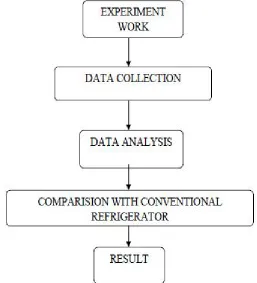
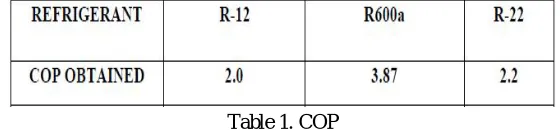
As per experimental investigation the result found that the COP and energy saving increases with increasing load and change of refrigerants. Refrigerants play very important role for achieving the maximum refrigerating effect at same compressor work. In this experiment we found that by changing the conventional refrigerant to R600a in a VCRS test rig the COP has increased to 30 percent from conventional refrigerant.
Table 1. COP
A. Performance Of R600a Refrigerant
[image:5.612.165.445.453.518.2]Theoretical Calculations were conducted on a vapour compression refrigeration test rig with refrigerant R600a, R-22,R-12 . Following results were obtained.
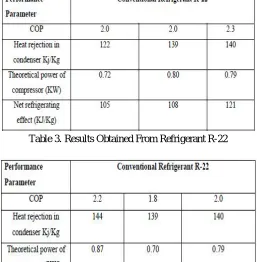
Table 3. Results Obtained From Refrigerant R-22
Table4. Results Obtained From Refrigerant R-12
By Comparing, the value of COP obtained by R600a is more than conventional refrigerant R-12 and R-22. By done this Comparing finally concluded that R600a refrigerant can also be used in Vapour compression refrigeration system with maximum Coefficient of Performance. R600a refrigerant are economically cheaper than conventional refrigerants. it is easily available in market.
This Comparison is being conducted to increase the value of COP by changing the refrigerants. The objective is to develop an efficient and economical process that can be adapted to mid-and high-power refrigerating devices, as low as 10 KWh. by using suitable refrigerant we can save 30 percent of electricity for run a compressor in VCRS. Most of the refrigerant has high heat transfer rate but due to their other disadvantage they are not used in the Vapour Compression System. Further more research are required to use different refrigerants are used in Vapour compression refrigeration system.
VI. CONCLUSION
The major advantage of using R600a refrigerant in Vapour compression refrigeration system is to achieve high Coefficient of Performance from other refrigerant at same compressor work in normal atmospheric conditions. The running of the system never require any additional efforts. Using of R600a refrigerant can save huge amount of electricity if used for industrial purpose. Also in domestic refrigerator COP obtained by using R600a refrigerant is high than traditional refrigerant. It can achieve a minimum temperature of -10oC in domestic refrigerator which is more than enough. R600a refrigerant has satisfactory thermodynamic properties.
The major application of this refrigerant is that it can use in big chiller plant. The cost of R600a refrigerant as compared to other traditional refrigerant is less. The only limitation of this refrigerant is, it highly flammable and toxic in nature. Leaking of this refrigerant can cause big environment loss.
REFERENCES
[1] https://doi.org/10.1016/S1359-4311(01)00106 5, Volume 22, Issue 5, April 2002, Pages 507–519 ELXEVIER [2] Bukola olalekan Bolaji (2009) Anal XXI,NR.1,2014 ,ISSN 1453-7397
[3] Chetan Papade , Department of Mechanical Engineering N.K.Orchid college of Engg.& Tech., Solapur, Maharashtra, India “A Review on Analysis of Vapour Compression Refrigeration System Using Matrix Heat Exchanger”
[4] Mr.Abhishek Saini* Dr. Alka Bani Agrawal * Master of Engineering in Heat Power Engineering, UIT RGPV Bhopal, M.P., (India) Professor, Mechanical Engineering Department, UIT RGPV Bhopal, M.P., (India) “Performance analysis of vapour compression refrigeration system of water cooler using an eco friendly refgrigerant” ISSN : 2277-9695 (I2OR), Publication Impact Factor: 3.785
[5] 1Lovelin Jerald, A. and 2D. SenthilKumaran, 1 Faculty of Engineering, Avinashilingam University for Women, Coimbatore, Tamilnadu, India 2Adithya Institute of Technology, Coimbatore, Tamilnadu, India. American Journal of Environmental Science 10 (1): 35- 43, 2014 ISSN: 1553-345X.
[6] S.C Arora and S.Domkundwar, a course in Refrigeration and Air Conditioning,Dhanpat Rai & sons,1996
[7] Mohanraj.M (2009), Environment friendly alternative to halogenated refrigerants A review, 2009 ,Green house gas control, 108-119
[8] Dinesh scientific (2014) , as per the manual given by the dinesh scientific the distributor of vapor compression refrigeration system from Ambala in Haryana. [9] Vicknesh.K , Department of Mechanical engineering, SRM University.” Performance test on vpour compression refrigeration system using R290 & R134a
mixture”. International Journal of Scientific and Research Publications, Volume 6, Issue 6, June 2016 470 ISSN 2250-3153
[10] G. MaruthiPrasad Yadav1 , P. RajendraPrasad2 , G.Veeresh3 1&2Associate Professor, Mechanical Engineering Dept, St Johns College of Engg& Technology, Yemmiganur- 518360, Kurnool (Dist), AP, India 3PG Student, Mechanical Engineering Dept, St Johns College of Engg& Technology, Yemmiganur-518360, Kurnool (Dist), AP, India “Experimental analysis of vapour compression refrigeration system with liquid line suction line heat exchanger by using R134A and R404A” . International Journal of Scientific Research and Management Studies (IJSRMS), ISSN: 23493771, Volume 1 Issue 12, pg: 382-395
[11] W.F Stoecker, Refrigeration & Air Conditioning . McGraw – Hill Book Company,1989.