An Experimental Study on High Performance
Concrete by Using Silica Fume and Quarry Dust
G.S.Saravanakumar1, S.Manigandan2, B.Tamilamuthan3
1, 2, 3
Assistant Professor CK College of Engineering & Tech Cuddalore, Tamil Nadu, India
Abstract: Utilization of industrial byproducts has become an attractive alternative to disposal. It may be replacing conventional materials to waste by – product has become a new trend in construction industries. Likewise, we planned to replace a portion of cement by Silica Fume (SF) and river sand by Quarry Dust (QD). Silica Fume (SF), which is byproduct of the smelting process in the silicon and ferrosilicon industry. Quarry Dust (QD), a by-product from the crushing process during quarrying activities, is one of such materials. The concrete used in this investigation was proportioned to target a mean strength of 60 MPa and designed as per ACI 211.4R-08.The water binder ratio (W/B) adopted was 0.32 and the Super Plasticizer used was ViscoCrete-10R3The investigation revealed that the partial replacement of cement by silica fume and sand by quarry dust will develop compressive strength, flexure strength and split tensile strength sufficient for construction purposes. Specimens such as cubes, beams and cylinders were cast for various mix proportions and tested at the age of 7,14and 28 days. The investigation revealed that the partial replacement of cement by silica fume will develop compressive strength, flexure strength and split tensile strength sufficient for construction purposes. The optimum dosage of silica fume found to be 7.5% (by weight), when used as partial replacement of ordinary Portland cement .Its use will lead to a reduction in cement quantity required for construction purposes and hence sustainability in the contraction industry as well as economic construction. The optimum dosage and utilization of silica fume and Quarry Dust, when used as partial replacement of ordinary Portland cement .Its use will lead to a reduction in cement & sand quantity required for construction purposes and hence sustainability in the construction industry as well as economic construction.
Keywords: Compressive strength, Flexure strength, High Performance Concrete, Silica fume, Quarry sand, Split Tensile strength, Optimum Percentage.
I. INTRODUCTION
High Performance Concrete (HPC) has been developed over the last two decades, and was primarily introduced through private sector architectural design and construction such as high rise buildings and parking garages. HPC is used for concrete mixtures, which possess high workability, high strength, and high modulus of elasticity, high density, high dimensional stability, low permeability and resistance to chemical attack. According to ACI “High Performance Concrete is defined as concrete which meets special performance and uniformity requirements that cannot always be achieved routinely by using conventional materials and normal mixing, placing and curing practices”.
The supplementary cementations materials (SCMs) such as silica fume, fly ash and ground granulated blast furnace slag are more commonly used mineral admixtures in the development of HPC mixes. They generally used to resist compressive forces and also due to its pozzolanic action the properties of High Performance Concretive, workability, durability, strength, resistance to cracks and permeability can be improved. Silica Fume is most commonly used supplementary cementitous materials used in the development of High Performance Concrete. Silica fume (SF) is a byproduct of the smelting process in the silicon and ferrosilicon industry. It is also known as micro silica, condensed silica fume, volatilized silica or silica dust. Silica fume color is either premium white or grey. Silica Fume consists of very fine vitreous particles with a surface area between 13,000 and 30,000m2/kg. Its particles are approximately 100 times smaller than the average cement particle. Because of its extreme fineness and high silica content, silica fume is a highly effective pozzolanic material. Silica fume is used in concrete to improve its properties. It has been found that silica fume improves compressive strength, bond strength, and abrasion resistance; reduces permeability; and therefore helps in protecting reinforcing steel from corrosion.[2]When Silica fume are incorporated to concrete, the silica present in these materials react with the calcium hydroxide released during the hydration of cement and forms additional calcium silicate hydrate, which improve durability and the mechanical properties of concrete.[3]
of silica fume, use of plasticizers, aggregate types and curing regimes.[4] Silica fume concrete is very susceptible to temperature variations during the hardening process. The optimum silica fume content to achieve higher strengths seems to range between 15 and 20%.[5]There are three mechanisms namely (i)Strength enhancement by pore size refinement and matrix densification, (ii) Strength enhancement by reduction in content of CH and (iii) Strength enhancement by cement paste- aggregate interfacial refinement are believed to be responsible for the strength development of concrete and mortars containing silica fume.[6]
High range water reducing admixtures (Super plasticizer) is used as a part of chemical admixtures in High Performance Concrete to produce better workability and high strengths. The brief literature on the study has been presented in following text. The influence of silica fume in replacement of cement on physical properties and resistance to sulphate attack, freezing and thawing, and alkali silica reactivity and the maximum 28 days compressive strength was obtained at 15% silica fume replacement level, at a W/C ratio of 0.35 with variable dosages of HRWRA.[7]High Performance Concrete with silica fume at a constant water binder ratio (w/b) of 0.34 and replacement percentages of 0 to 25, with varying dosages of HRWRA increases the compressive strength, the optimum percentage was obtained at 15% replacement level. Developing High Performance with a better understanding of the isolated contributions of silica fume on concrete over a wide range of w/c ratio ranging from 0.26 to 0.42 and cement replacement percentages from 0 to 30.[8] The main objective of this investigation is to minimize the usage of cement content to some proportion in the High Performance Concrete. This present work is to study various properties namely compressive strength, Split Tensile Strength and Flexure strength of M60 grade HPC mixes incorporating different percentages silica fume by weight of cement along with Sulphonated Napthalene based super plasticizer (ViscoCrete-10R3).
The Experimental program was designed to compare the mechanical properties of High Performance Concrete with M60 grade of concrete (1:1.217:2.083) with different replacement levels of ordinary Portland cement 53 grade with silica fume and river sand by Quarry dust. The ordinary Portland cement was partially replaced with silica fume by 5, 10 %, and 15% and river and was replaced with Quarry Dust by three proportions (ie 10%, 30%, 50%,).The specimens of Cube specimen of size 150 x 150 x 150 mm, Cylinder specimen of size 150 mm diameter and 300 mm height and Beam specimen of size 100 x100 x 500 mm were prepared with and without silica fume and Quarry Sand
II. MATERIALS USED
A. Cement
Ordinary Portland cement of 53 Grade was used and the specific gravity of cement was found to be 3.15.
B. Silica Fume (Grade 920 D)
[image:3.612.40.568.513.733.2]Obtained from ELKEM South Asia Pvt. Ltd. Mumbai, was named Elkem – micro silica 920 D conforming to ASTM C1240.The physical and chemical properties of cement and silica fume are given in Table.1
Table 1.Physicaland chemical Properties of cement and silica fume
Properties Physical OPC Silica fume
Specific gravity 3.15 2.2
Specific area cm2/gm 3250 1800000
Chemical
Silicon di oxide(SiO2) 20.3 89.5
Aluminium oxide(Al2O3) 6.3 1.2
Calcium Oxide(CaO) 63.6 0.2-0.8
Magnesium Oxide(MgO) 1.6 0.2-0.8
Sodium Oxide(Na2O) 0.4 0.5-1.2
Potassium Oxide(K2O) 0.51 -
Loss of Ignition 1.13 3
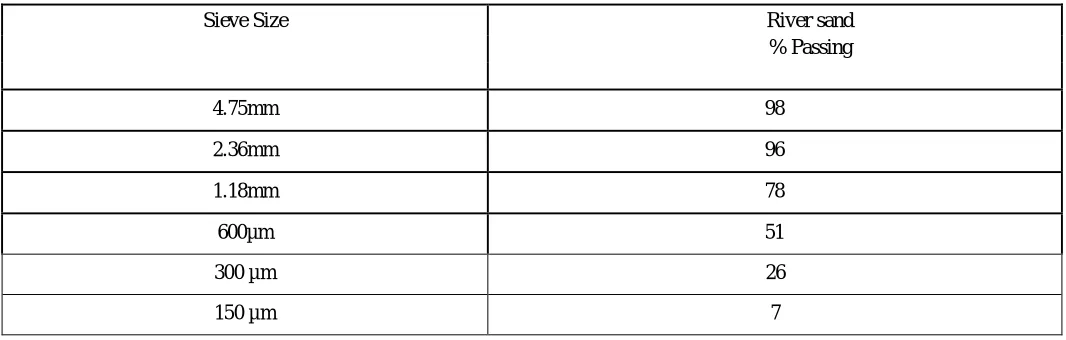
[image:4.612.40.573.261.431.2]Fine Aggregate: River sand having bulk density 1720 kg/m3was used and the specific gravity was found to be 2.56 .Sieve analysis results are shown in Table. 2
Table - 2 Sieve analysis of River sand
Sieve Size River sand
% Passing
4.75mm 98
2.36mm 96
1.18mm 78
600µm 51
300 µm 26
150 µm 7
C. Coarse aggregate
Crushed angular aggregate with maximum grain size of 12.5mm and downgraded was used and having bulk density 1691kg/m3. The specific gravity and fineness modulus was found to be 2.78 and 2.75 respectively.
D. Quarry dust (qd)
The quarry dust is the by-product which is formed in the processing of the granite stones which broken downs into the coarse aggregates of different sizes. Quarry dust has been proposed as an alternative to river sand that gives additional benefit to concrete. Quarry dust is known to increase the strength of concrete over concrete made with equal quantities of river sand, but it causes a reduction in the workability of concrete
River sand has been the most popular choice for the fine aggregate component of concrete in the past, but overuse of the material has led to environmental concerns, the depleting of securable river sand deposits and a concomitant price increase in the material. Therefore, it is desirable to obtain cheap, environmentally friendly substitutes for cement and river sand that are preferably byproducts. Fly ash (pulverized fuel ash) is used extensively as a partial replacement of cement. However, though the inclusion of fly ash in concrete gives many benefits, such inclusion causes a significant reduction in early strength due to the relatively slow hydration of fly ash. Nevertheless, fly ash causes an increase in workability of concrete
The Specific gravity depends on the nature of the rock from which it is processed and the variation is less. Shrinkage is more in when compared to that of the natural river sand. Water absorption is present so that increase the water addition to the dry mix
E. Physical Properties
Table 3 Showing the Physical properties of quarry dust and natural sand
Property Quarry Dust Natural sand Test method
Specific gravity 2.54 -2.60 2.60 IS2386(Part III)- 1963
Bulk Density (kg/m3) 1720- 1810 1460 IS2386(Part III)- 1963
Absorption (%) 1.20- 1.50 Nil IS2386(Part III)- 1963
Moisture Content (%) Nil 1.50 IS2386(Part III)- 1963
Fine particles less than
0.075 mm (%) 12-15 6 IS2386(Part III)- 1963
Sieve analysis Zone-II Zone-II IS 383- 1970
F. Chemical Properties
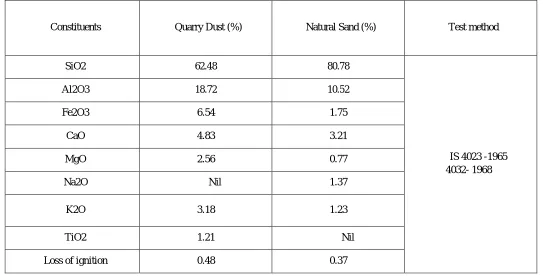
The physical of quarry dust obtained by testing the sample as per the Indian Standards are listed in the below table
Table 4 Showing the typical chemical properties of quarry dust and natural sand
Constituents Quarry Dust (%) Natural Sand (%) Test method
SiO2 62.48 80.78
IS 4023 -1965 4032- 1968
Al2O3 18.72 10.52
Fe2O3 6.54 1.75
CaO 4.83 3.21
MgO 2.56 0.77
Na2O Nil 1.37
K2O 3.18 1.23
TiO2 1.21 Nil
Loss of ignition 0.48 0.37
G. Specific Gravity
[image:5.612.35.578.411.687.2]specific gravity of the materials that we use. As the particle size is less we will use pycnometer for sand. The empty weight of the pycnometer is measured and then it is filled with sand up to a mark and the weight is measured. Then water is filled with water and the weight is measured. Then weight of the pycnometer only with water is measured and the specific gravity of the fine aggregates used is calculated.
H. Super plasticizer
1) VISCOCRETE-10R3was : used as water reducing agent to achieve the required workability. It is based on Sulphonated Naphthalene polymers complies with IS 9103:1999 and ASTM C 494 type F as a high range water reducing admixture. It is a brown liquid instantly dispensable in water.
2) Water: Fresh portable water, which is free from acid and organic substance, was used for mixing the concrete.
I. Mix Proportioning
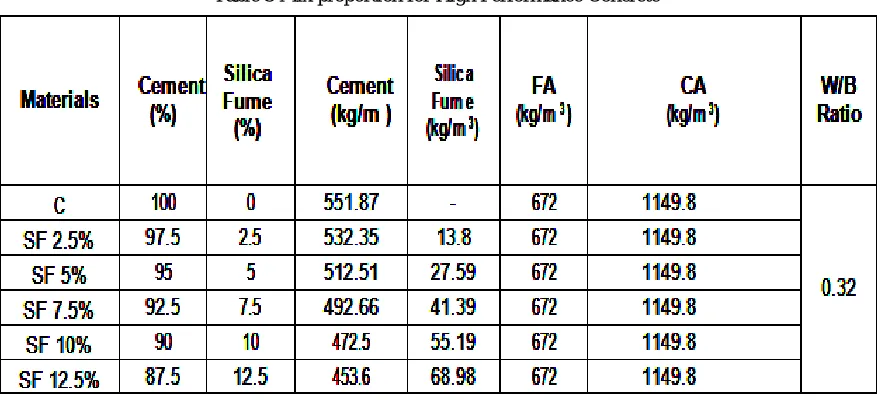
[image:6.612.88.531.309.509.2]Concrete mix design in this investigation was designed as per the guidelines specified in ACI 211.4R-08 - “Guide for selecting proportions for high strength concrete with Portland cement and other cementations materials”.[9] Six concrete mixtures with different proportions of silica fume ranging from 0% (for the control mix) to 12.5%.The mix proportions were calculated and presented in Table. 3
Table 5 Mix proportion for High Performance Concrete
J. Casting and curing of test specimens
The specimen of standard cube, Cylinder and beams were used to determine the compressive strength Split tensile and flexural strength of concrete. Three specimens were tested for 7, 14 & 28 days with each proportion of Silica fume replacement. For each measured quantities of coarse aggregate and fine aggregate was spread in a pan, the ordinary Portland cement (53 Grade) and silica fume were spread out over it, water was measured by considering the water binder ratio as 0.32 and weight of super plasticizer(ViscoCrete-10R3)was estimated as 1.2 % of weight of binder. The exact quantity of water and super plasticizer was added. The concrete was thoroughly mixed until it achieves homogeneous sand uniform consistency. The fresh concrete was cast in cube, cylinder and beam moulds, and was compacted by table vibrator. All freshly cast specimens were left in the moulds for 24 hours before being de molded. The de molded specimens were cured in water for 7, 14&28 days, were air dried and then tested for its compressive strength, Split tensile strength and flexural strength as per Indian standards.
III. RESULTS AND DISCUSSIONS
A. Compressive strength of concrete
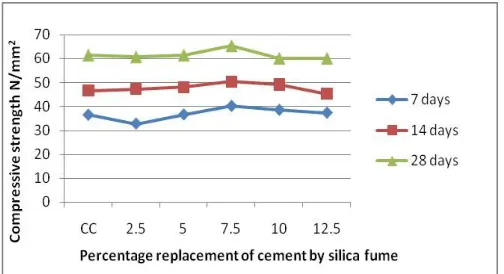
Fig. 1-Compressive Strength of High Performance Concrete With various proportions of Silica fume
Fig. 1 shows the variation of compressive strength with silica fume replacement percentage. There is a significant improvement in the compressive strength of concrete because of the high pozzolanic nature of the silica fume and void filling ability. The compressive strength with replacement of cement by silica fume was increased 0% to 7.5% and then decreased. Hence the optimum silica fume was 7.5%. The optimum silica fume replacement percentage for obtaining maximum 28-day strength of concrete ranged from 5% to 20%.[10] The maximum value of compressive strength was obtained as 65.33MPa at 7.5% replacement of silica fume.
B. Split Tensile Strength of Concrete
[image:7.612.158.385.379.486.2]The test was carried out conforming to IS 516-1959 to obtain split tensile strength of concrete at the age of 7, 14 and 28 days. The cylinders were tested using Compression Testing Machine (CTM) of capacity 2000KN. The results are presented in Figure 2.
Fig 2.Split tensile Strength of High Performance Concrete With various proportions of Silica fume
The Split tensile strength of the High Performance Concrete increases with the increase in percentage of Silica Fume. The partial replacement of 7.5% Silica fume is found to be optimum. High Performance Concrete at the age of 28 days with partial replacement of 7.5% cement by silica fume showed20%greaterSplit tensile Strength than conventional concrete respectively.
C. Flexural strength of concrete
[image:7.612.185.435.611.716.2]The test was carried out conforming to IS 516-1959 to obtain Flexural strength of concrete at the age of 7, 14 and 28 days. The beams were tested using Flexure Testing Machine (FTM) of capacity 100KN. The results are presented in Figure.3
The flexural strength at the age of 28 days of silica fume concrete continuously increased with respect of to controlled concrete and reached maximum value of 7.5% replacement level. High Performance Concrete at the age of 28 days with partial replacement of 7.5% cement by silica fume showed 23%greaterflexural Strength than conventional concrete. It can be concluded that the ultra – fine silica fume particles, which consists mainly of amorphous silica, enhance the concrete strength by both pozzolanic and physical actions.
IV. CONCLUSIONS
High performance concrete produced from cement replacement up to 7.5% silica fume leads to increase in compressive strength, split tensile and Flexure strength of concrete. Beyond 7.5 %there is a decrease in compressive strength, split tensile and Flexure strength of concrete. The compressive strength mainly depends on the percentage of silica fume because of its high pozzolanic nature to form more densely packed C-S-H gel. High Performance Concrete with silica fume can be effectively used in high rise buildings since high early strength is required, and the construction period can be reduced. The percentage of increase in the compressive strength is 15%, Split tensile strength is 20% and the flexure strength is 23% at the age of 28 days by replacing 7.5% of cement by silica fume. The optimum percentage of replacement of cement by silica fume is7.5%
REFERENCES
[1] Sensale GR., Strength development of concrete with rice husk ash, Cement and Concrete Composites,28(2), 2006, 158-160.
[2] Mohammad Iqbal Khana and Rafat Siddiqueb, Utilization of silica fume in concrete: Review of durability properties, Resources, Conservation and Recycling, 2011, 57, 30–35
[3] Igarashi S, Watanabe A and Kawamura M., Evaluation of capillary pore size characteristics in high-strength concrete at early ages. Cement and Concrete Research, 35(3), 2005, 513- 519.
[4] Bhanja,s. and Sengupta,B.(2002).”Investigations on the composite structure ofsilica fume concrete using statisticalmethods”, Cement and Concrete Research,Vol.32, pp.1391-1394.
[5] Aitcin, P.C., and Laplante, P. (1990),“Long-term compressive strength of silicafume concrete”, Journal of Materials in CivilEngineering, Vol. 2, No. 3, pp. 164-170.
[6] Feldman, R.F., Cheng-yi, H. (1985),"Properties of Portland cement silica fumepastes. II mechanical properties", Cement and Concrete Research, Vol. 15 No.6, pp.943.
[7] Yogendran V, Langan BW, Haque M and Ward MA.Silica on high strength concrete, ACI MaterialJournal, No. 2, 84(1987) 124 – 129.
[8] Bhanja S, Sengupta B. Optimum silica fume content and its mode of action on concrete, ACI MaterialsJournal, September – October 2003, pp. 407 – 712. [9] ACI Committee 211.4R.93, “Guide forSelecting properties for High StrengthConcrete with Portland Cement and Fly ash”ACI manual of concrete Practice,
2001.
[10]S.A. Khedr, M.N and Abou-Zeid, Characteristics of silica-fume concrete, J. Mater. Civ. Eng. ASCE 6 (3), 1994, 357–375.
AUTHORS BIOGRAPHY
Mr.G.S.Saravanakumar obtained PG from Anna University. His area of specialization is Structural Engineering. He has Published 5 papers in international conferences. Is a life member of various professional bodies and recipient of many awards.
Mr. S.Manigandan obtained PG from Annamalai University. His area of specialization is Structural Engineering. He has Published 3 research papers in International Journals & 2 papers in international conferences. Is a life member of various professional bodies.
Mr. B.Tamilamuthan obtained PG from Annamalai University. His area of specialization is Construction Engineering Management. He has Published 4 research papers in International Journals & 2 papers in international conferences. Is a life member of various professional bodies.