Automatic Message Sender
—
An Application For
Android
Karan Mahajan, Manish Mahajan Associate Professor
Department of IT Chandigarh Engineering College
Landran Mohali
Abstract—Android is an operating system for smart phones developed by Google Inc and the Open Handset Alliance (OHA).This era is surrounded by technology. The smart phones has so much of capabilities. This paper deals with the development of an application in smart phones which will automatically put smart phones on silent mode and automatically sends message to the person.
Keywords- Android, apk, intent, services, content provider.
1. INTRODUCTION
In the modern days, getting a new mobile phone and a new cell phone line (either prepaid or postpaid call plan) are much easier and cheaper compared to the past few years ago. It is getting more common that people are having two or more mobile phones for themselves, each of the mobile phones with an individual cell phone line or number. Android's unrestricted application market and open source have made it a popular platform for third-party applications. As of 2011, the Android Market includes more applications than the Apple App Store. There are several limitations for the various mobile operating systems like iPhone and BlackBerry OS, are designed for and can be used only in specific types of mobile devices Closed source systems such as Windows Mobile are not flexible enough for this purpose. Moreover important reason is that people want their cell phone functioning like a PC in that whatever they can access on a desktop, they should also be able to access on their cell-phones. Therefore, an operating system running on a cell phone should be similar to a common desktop operating system. In 21 Oct 2008, Google released Android, an open source software platform and operating system, which can run on every mobile device, with the hope of reaching as many mobile users as possible. Android is based on the Linux 2.6 kernel, and it
provides an Android is an operating system based on Linux with a Java programming interface. It provides tools, e.g. a compiler, debugger and a device emulator as well as its own Java Virtual machine (Dalvik Virtual Machine - DVM). Android controls access to system resources with install-time permissions. Android needs 134 permissions, categorized into three threat levels:
1. Normal permissions protect access to API calls that could annoy but not harm the user. For example, SET_WALLPAPER controls the ability to change the user's background wallpaper. 2. Dangerous permissions control access to potentially harmful API calls, like those related to spending money or gathering private information. For example, Dangerous permissions are required to send text messages or read the list of contacts.
3. Signature/System permissions regulate access to the most dangerous privileges, such as the ability to control the backup process or delete application packages. These permissions are difficult to obtain.
2. VARIOUS COMPONENTS OF ANDROID
interface of application. An application may have zero or more activities. Usually an application may have one activity and its aim is to interact with the user.
b. Intent—An Intent is basically that “GLUE” that
enables different activites from different applications to work together ensuring that tsaks can be performed as a single application.
c. Services—A services is an application in android that runs in the background without needing to interact with the user. For example, while using an application we may want to play some background music at same time, in that case the code that is playing background music need not to be interact with use.
d. Views—The user interface of the activity is build with
widgets class which inherent from
“android.view.View”.
3. ANDROID SDK AND ANDROID DEVELOPMENT
TOOLS
Android SDK includes debugger, libraries, an emulator, documentation. Sample code and tutorials. ADT plugin for Eclipse is an extension to the Eclipse IDE that supports the creation and debugging of Android application.Using ADT we will be able to do following tasks:
I. Create new Android application projects.
II. Access the tools for accessing your Android emulators and devices.
III. Compile and debug android applications. IV. Export android applications into .apk files.
V. Create digital certificates for code siging your APK.
4. DO NOT DISTURB APPLICATION FOR ANDROID
In this application, if any person is busy and he or she
wants that nobody should disturb him/her, the by
installing this application the cell phone of that person
will automatically goes to silent mode (no vibration no
ringtone) and auto message is send to caller person.
This application is useful for a person during meeting.It
the market these days. Android is used as famous
platforms for developing applications . The platform
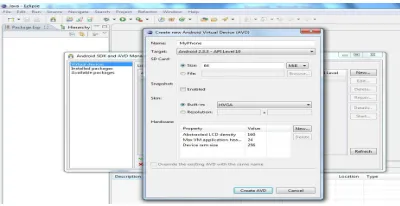
[image:3.612.345.584.127.649.2]used for developing is Ecllipse Gallileo 4.0 .
[image:3.612.354.587.176.359.2]Fig a:- Creating of AVD
Fig b:- Creating virtual device
[image:3.612.352.552.556.659.2]Fig d:- Starting virtual device
[image:4.612.41.277.306.487.2]Fig e:- Starting of Simulator
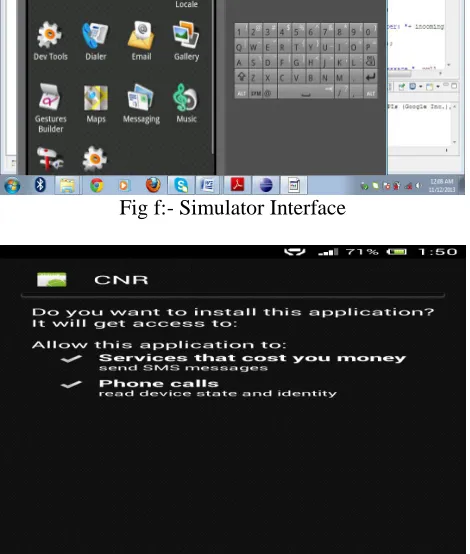
[image:4.612.338.570.526.681.2]Fig f:- Simulator Interface
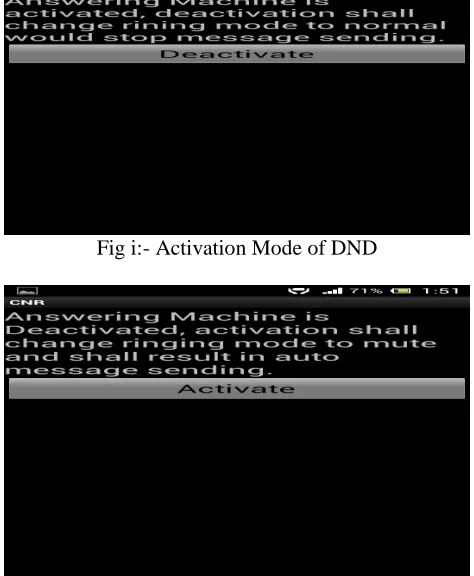
Fig i:- Activation Mode of DND
Fig j:- Deactivation Mode of DND
5. CONCLUSION & FUTURE WORK
5.1 CONCLUSION: The application is very useful for a
person during a meeting. It is one of the latest
researches in the market .The person need not to pick
the phone any say I am busy to the caller, The
application in active mode will automatically send
message to the caller and thus caller would come to
know that his call has been received .
5.2 FUTURE WORK: At present the application
sends message to a person who so ever calls. In future
numbers to which we want to send.
6. REFERENCES
1. A. Battestini, C. Del Rosso, A. Flanagan, and M. Miettinen.
Creatingnext generation applications and services for mobile
devices: Challenges and opportunities. In EEE 18th Int.
Symposium on Personal, Indoor and Mobile Radio
Communications (PIMRC), 2007, pages 1 –4, 3-7 2007.
2. A. Omicini, A. Ricci, and M. Viroli. Artifacts in the A&A
meta-model for multi-agent systems. Autonomous Agents and
Multi-Agent Systems, 17 (3), Dec. 2008.
3. Barrera, D., Kayacik, H., van Oorschot, P.,and Somayaji, A.
A methodology for empirical analysis of permission-based
security models and its application to android. In Proc. of the
ACM conference on Computer and Communications Security
(2010).
4. Bodden, E., Sewe, A., Sinschek, J., and Mezini, M. Taming
reection: Static analysis in the presence of reection and custom
class loaders. Tech. Rep. TUD-CS-2010-0066, CASED, Mar.
2010.
5. Boyapati, C., Khurshid, S., and Marinov, D. Korat:
Automated testing based on Java predicates. In Proc. of the 2002
ACM SIGSOFT International Symposium on Software Testing
and Analysis (2002).
6. Chao-Lin Chen; Kai-Ten Feng; "Hybrid Location Estimation
and Tracking System for Mobile Devices" IEEE 61st
Conference on Vehicular Technology Volume 4, 2005.
7. C. Muldoon, G. M. P. O’Hare, R. W. Collier, and M. J.
ambient applications. In Int Conference on Computational
Science (3), pages 727–734, 2006.
8. D. Desai. Malware Analysis Report:
Trojan:AndroidOS/Zitmo, Semptember 2011.
9. F. Koch, J.-J. C. Meyer, F. Dignum, and I. Rahwan.
Programming deliberative agents for mobile services:
10. Jami, I.; Ali, M.; Ormondroyd, R.F.; "Comparison of
methods of locating and tracking cellular mobiles and Their
System Applications” (Ref. No. 1999/046), IEE Colloquium on 1999
11. K. Hindriks. Modules as policy-based intentions: Modular
agent programming in GOAL. In Programming Multi-Agent
Systems, volume 5357 of LNCS, pages 156–171. Springer,
2008.
12. Luis C.M Varandas; Binod Vaidya; Joel J.P.C Rodrigues;
“mTracker: A Mobile Tracking Application for Pervasive
Environment” IEEE 24th International Conference on Advanced
Information Networking and Applications Workshops.2010.
13. M. Dastani, C. Mol, and B. Steunebrink. Modularity in
agent programming languages: An illustration in extended
2APL. In Proceedings of the 11th Pacific Rim Int. Conference
on Multi-Agent Systems (PRIMA2008), volume 5357 of LNCS,
pages 139–152. Springer, 2008.
14. N. Madden and B. Logan. Modularity and compositionality
in Jason. In Proceedings of Int. Workshop Programming
Multi-Agent Systems (ProMAS 2009). 2009.
15. Sangwoo Cho; Haekyung Jwa; Joohwan Chun; Jong Heun
Lee; Yoon Seok Jung; “Mobile position location with the constrained bootstrap filter in a cellular communication system”
Conference Record of the Thirty-Fourth Asilomar Conference