Awareness of Women Participants as an Indicator
of Implementation Structure of MNREGA
Monika
Ph.D. Research Scholar, IMSAR, M.D.U. Rohtak, Haryana (India)
Abstract: Though women employment was not the soul objectives of the scheme yet in its development goals it comes automatically. The design features of this scheme especially to attract women make this scheme gender sensitive. Although MNREGA have special provisions for women, their participation in this scheme is very low and the main reason behind this is their lack of awareness. In this paper, level of awareness of women participants about the employment scheme MNREGA is considered. The study area was confined to Gopi Gram Panchayat of Badhra Block in Bhiwani District (Haryana). Using convenient sampling method the study area was selected. For selecting the sample respondents, purposive sampling method was adopted. For this study primary data is used. Primary data is collected from 50 women respondents who have been participated in the scheme, through a structured schedule survey. Data is also collected from official record of the Panchayat Office and other documents. The researcher used statistical tools like percentage and graphical methods for analysis and interpretation. The study found that there is a huge lack of awareness among women participants about the important provisions of MNREGA or we can say that level of awareness among participant respondents is very low.
Keywords: Level of awareness, MNREGA, Provisions, Women Participants.
I. INTRODUCTION
Awareness is critical to entitlement. The MNREGA is a people-oriented and entitlement-based policy intervention. Hence, its successful implementation depends a lot on awareness among the stakeholders about its provisions and entitlements. The success story so far suggests that it has been more successful in Districts and states that have been centres for right to information campaigns and where organizations of civil society have synergized it with right to employment under the MNREGA. The Mahatma Gandhi National Rural Employment Guarantee Act, 2005 (MNREGA) was notified on September 7, 2005. MNREGA is a right based programme, unlike earlier employment schemes. MNREGA aims at enhancing livelihood security by providing at least 100 days of guaranteed wage employment in a financial year to every household whose adult members volunteer to do unskilled manual work.
A. Important Entitlements of MNREGA
1) MNREGA guarantees of 100 days of employment in a financial year to a registered household.
2) Every person working under the scheme shall be entitled to wages at the minimum wage rate fixed by the State Government. 3) Equal wages shall be paid to both men and women workers.
4) While providing employment, priority shall be given to women in such a way that at least one-third of the beneficiaries shall be women who have registered and requested for work under the scheme.
5) The job card should be issued to every registered household immediately after verification.
6) If a worker who has applied for work under MNREGS (Mahatma Gandhi National Rural Employment Guarantee Scheme) is not provided employment within 15 days from the date on which work is requested, an unemployment allowance shall be payable by the State Government at the rate prescribed in the Act.
7) It is mandatory to provide basic facilities such as safe drinking water, first-aid kits, shades for rest, period of rest and also crèche facility for children.
B. Awareness Generation: NREGA is distinctive for its unique vision to redefine avenues of providing employment opportunities to the deprived in rural India. But the possibility and efficient chances of employment largely comes with the better level of awareness as it marks the level of accessibility. The issue of awareness towards these developmental programmes has emerged as one of the major hindrances to the local community. It thus necessitates sufficient awareness amongst the intended beneficiaries regarding provisions like guaranteed days of employment, unemployment allowance, minimum wages, availability of complaint register, etc. However, the situation in this front is not very encouraging in the study area. As most of the worker respondents are illiterate and belong to the economically poor class, the extent of awareness about NREGA has emerged out to be a major concern. Awareness generation of potential and existing workers forms the most strategic aspect in the effectively implementing rural development scheme, policies and plans of the government.
II. REVIEW OF LITERATURE
A. Upask Das et al. (2012): In their research paper titled “Awareness about MNREGA: some evidence from Northern parts of West Bengal, India”, specified issues related to awareness about an ambitious welfare programme targeting the rural population of India, the MNREGA. The main objective of the survey was to get an idea of the awareness level of the villagers regarding their rights in the welfare schemes like MNREGA. Their study was based on a primary survey and found a general lack of awareness about the basic guidelines and the legal entitlements among the intended beneficiaries. They pointed out this as one of the reasons for underlying corruption and programme not being so successful in the surveyed areas as compared to some other states of India.
B. Thomas, E.M, (2010): In their research paper titled “The Relevance of NREGA in Ensuring a Corruption Less Wage Employment Programme and Women Empowerment - A Case Study”, stated that all the women workers are fully satisfied with NREGS works. The main reason for their satisfaction is that; today they are assured of 100 days of jobs. It means that no longer they have to fear the occurrence of seasonal unemployment and poverty.
C. Dattar, Chhaya (1987): In their article “Maharashtra Employment Guarantee Scheme, Mumbai: Tata Institute of Social Sciences”, stated that concentrating a large number of women in one place can increase interaction, break down social taboos, expand social awareness and instill confidence in women.
D. Dreze, J. (2007): In his paper “NREGA: Dismantling the Contractor Raj”, revealed that most of the government programmes in the past have been implemented through the agency of local contractors, who have emerged as major sources of exploitation of the rural poor, especially women. These local contractors involve themselves in fudging of “muster rolls” along with inflated employment and wage figures.
E. Menon, S.V. (2008): In his paper “Right to Information Act and NREGA: Reflections on Rajasthan”, reported substantial level of awareness about MGNREGS among the villagers in the state of Rajasthan, which is one of the Indian states where the scheme has been successfully implemented.
III. RESEARCH METHODOLOGY A. Objectives of the study
The main objective of the present study is to study the level of awareness about MNREGA among women. The present study on evaluation of the MNREGA scheme intended to assess the awareness level of the village women on the basis of their knowledge about the different provisions of MNREGA like: Daily wage rate under MNREGA; Provision of one-third participation of women; Provision of equal wages to both women and men workers; Provision of unemployment allowance; Provision of job card; and provision of worksite facilities
B. Research Design
The present study is a Case Study which is a type of Descriptive method. Case Study usually involves the detailed study of a particular case (a person or small group).
C. Universe of Study
D. Sampling Procedure
Convenient sampling method was adopted for the selection of the study area. For selecting the sample respondents, purposive sampling method was adopted.
E. Sample Size
A sample 50 women are selected from MNREGA participants. Participant women were selected to know their awareness level about the employment scheme.
F. Data Collection
Data was collected from primary sources. Schedule survey was organized with the different women participants engaged in NREGS. The data was also collected from official record of the Panchayat Office. The study considers data of the period 2010-2011 and 2012-2013. No data were available for the period of 2011-2012 because no work had done in village in this period under MNREGA.
G. Data Analysis
Percentage method, Tabular method and Graphical method are used for the analysis and interpretation of the data collected.
H. Major Findings
[image:4.612.55.553.360.524.2]Distribution of the Sample According to the Level of Awareness Regarding Some Provisions of MNREGA in the Study Area.
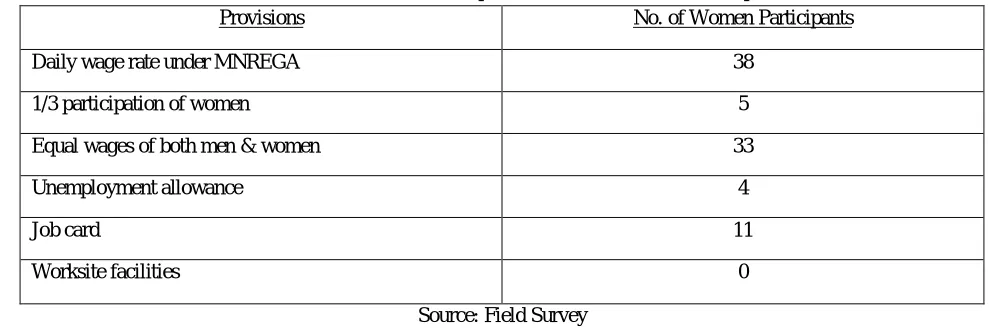
TABLE 1: Awareness level of the respondents about some MNREGA provisions
Provisions No. of Women Participants
Daily wage rate under MNREGA 38
1/3 participation of women 5
Equal wages of both men & women 33
Unemployment allowance 4
Job card 11
Worksite facilities 0
Source: Field Survey
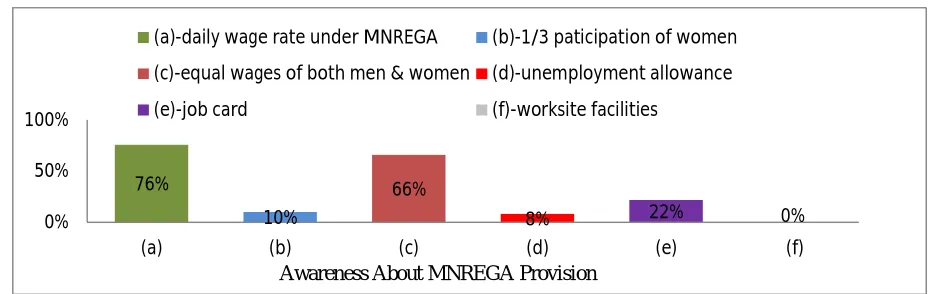
In the study area there is wide variations among female participants across the village in regard to their level of awareness regarding those provisions. It is observed that the female participants in the village are more aware of daily wage rate (about 76 percent) and of the provision of equal wage rate to both male and female, participants (about 66 percent) (Table 1.). But with regards to other provisions the level of awareness is very low. Regarding the worksite facilities the awareness level of the respondent participants is zero. It means no women know about worksite facilities. Only 8 percent women have knowledge about unemployment allowance. Regarding the provision of job card also, the awareness level of the women participants is very low (only 22%), and awareness level about the provision of minimum 1/3 participation of women is also very low which is 10% only.
On an average, the awareness level is highest about the daily wage rate and awareness level about the provision of equal wage to both men and women is also higher in comparison to the awareness level of the women participants about other provision of MNREGA. It was observed while surveying in the village that educational level of specially women is very low. Most of the women participants are illiterate or with below elementary education level. Hence, educational status especially of women would have positive impact on their level of awareness.
Figure 1: Awareness of participant respondents about MNREGA provisions
I. Daily Wage Rate Under MNREGA
1) Every person working under the scheme is entitled to wages at the rate notified by the Central Government under the Section 6(1) of the MNREGA.
2) In the study area wages were provided at the rate of current wage rate of that time in which MNREGA works were conducted. Wages were paid at the rate of Rs. 179 per day and Rs.191 Per day in 2010-11 and 2012-13 respectively.
3) Most of the participant respondents know about daily wages under the scheme. 38 women (76%) out of 50 were aware about daily wage rate (Figure 1).
J. One-Third Women Participation
1) According to the provision of MNREGA, at least one-third of the participants should be women and equal wages will be provided to both men and women.
2) Out of 50 women participants which were taken as sample for the study only, only 5 women know about the provision of 1/3 women participation. It means only 10% women (Figure 1) were aware of the provision which is very low.
3) It is observed during the survey that only educated women knows about the provision. It means lack of education is the main cause of the unawareness of the rural women.
K. Equal Wages to both Men and Women
1) Equal wages shall be paid to both men and women workers under MNREGA, and provision of Equal Remuneration Act, 1976 shall be complied with.
2) Almost participants know about the provision of equal wages to both men and women participants working under MNREGS. 33 women out of 50 were aware of the provision. The awareness level of respondents about this provision is 66% (Figure 1) which is better in comparison to other provisions.
3) The women participants who don’t know about the provision were either old or not participated in the scheme but their name registered in the muster roll.
L. Unemployment Allowance
MNREGA is a right based programme, unlike earlier employment schemes. There is a legal guarantee of 100 days of employment in a financial year to a registered household. The government is legally bound to provide employment within 15 days of the application for work by a job seeker; in case of delay or failure to provide employment to the job seeker, there is a provision of unemployment allowance.
1) It is found in the study that most of the participant women were unaware of the very important provision of MNREGA that if work is not provided within the 15 days of demanding work, the unemployment allowance would be paid to them, as per prescribed in the Act.
76%
10%
66%
8% 22% 0%
0% 50% 100%
(a) (b) (c) (d) (e) (f)
Awareness About MNREGA Provision
(a)-daily wage rate under MNREGA (b)-1/3 paticipation of women
(c)-equal wages of both men & women (d)-unemployment allowance
2) Only 4 women participants out of 50 women participants know about the provision of unemployment allowance under MNREGA (Table 1). This is very low in numbers. This shows the unawareness of the rural women about the provisions of the Act.
3) Even men participants in the scheme of MNREGA don’t know about the provision of Unemployment Allowance.
4) It is found in the survey that the participants who were aware of the provision of unemployment allowance were educated. It means illiteracy is the main hurdle in the awareness about the provisions of MNREGA.
M. Job Card
1) Job card is a key document that records workers entitlements under MNREGA. It legally empowers registered households to apply work, ensures transparency and protects workers against fraud.
2) Almost all the participant women were unaware that Job Card is necessary for participating in NREGA works. Only 11 participants out of 50 women participants were aware of the provision of Job Card. It means only 22% were aware of the provision and rest of the 78% were unaware (Figure 1).
3) Most of the participants don’t even know what job card is, they have never even heard the name of this essential document. When the job card was asked from participants, they brought the Passbook copy of their account opened under the scheme. This reflects the seriousness of lack of awareness generation programmes about MNREGA and poor implementation structure in the village.
N. Worksite Facilities
A proper working condition is primary necessity for ensuring safety and efficient condition for workers which particularly in case of women is much more important. According to MNREGA guidelines, it is mandatory to provide basic facilities such as safe water, first-aid kits, shades, period of rest and also crèche facility. But it is observed that, there is no awareness among the women regarding the worksite facilities (Table 1), which are mostly provided to attract and involve women and social audit of the activities. Some women respondents claimed that except drinking water no other facilities were arranged near worksite even in some cases drinking water was also not available. Khera and Nayak (2009) have focussed upon the importance of these facilities to attract women to participate in the employment scheme. Though, MNREGA entitles implementation of these facilities, when surveyed, none of the women respondents were aware of these mandatory guidelines.
These all are severe consequences of information gap between the villagers and the panchayat. This raises an important question, that is, whether the panchayat want the poor, innocent people to be aware of the guidelines of the programme? It is observed from the response of the respondents that there have been no efforts on the part of PRIs to make them aware of the MNREGA guidelines. It may be concluded that the PRIs take the undue advantage of the lack of awareness and illiteracy among the villagers (especially women). It is found that panchayat prefer maintaining an information gap so that they can use this gap to their advantage.
IV. RECOMMENDATIONS A. Focus on Awareness Generation
For an essentially demand-driven programme, such as MNREGA, awareness generation is perhaps the key to effective planning and implementation. Awareness will not only create conditions for articulation of demand for work as well as other entitlements, but also facilitate participatory and decentralized planning. This, in turn, will provide an opportunity to realize the developmental potential of MNREGS through appropriate selection of productive assets useful for the community. Awareness generation in the context of MNREGS was also quite essential for ensuring transparency and accountability (which the MNREGS operating framework amply provides for) as envisaged in earlier programmes of wage employment generation. Some measures recommended towards this end include the following:
1) Encourage active and regular use of media (print and electronic) for proper advertising in local areas. 2) Encourage submission of collective work applications in specifically designed forms by job seekers. 3) Open “Mobile awareness Centres” for spreading awareness among villagers.
4) Village school teachers should be given training about the MNREGA so they can help the villagers as and when needed. 5) Involve NGOs working in the vicinity for proper awareness creation.
6) Involve “Anganwadi” workers for spreading awareness.
8) 50 percent of Mates should be women. So that women participants don’t feel any hesitation in discussing their problems with Mates while working.
B. Training Arrangements
1) Trainers are required to have practical experience from the field in the subjects they are imparting training on. 2) Training should be linked to implementation experiences and the context of implementation.
3) Development of relevant course and standardise quality training material.
4) Define training course content and syllabi for different stakeholders of MNREGA.
5) Draw up national level training plan for different stages of MNREGA implementation and for different stakeholders.
6) Ensure that training requirement for MNREGA is actually being fulfilled across the country as per the standardised training plan.
7) Regulate the quality of training imparted and make specific, necessary recommendations for improvement of the same. 8) Social audit should carry out in regular interval to ensure proper implementation of the scheme.
9) There is also the important role of the Govt. in implementation of MNREGS. Thus the Government must take immediate steps to stop corruption in its implementation by which complete information about MNREGA wages reaches to the workers directly.
V. CONCLUSION
The result suggests that in the study area women are unaware or very less aware about the provisions of MNREGA except the provision of daily wage rate and provision of equal wage rate to both male and female participants. In the study area education level is very low. Most of the women participants are illiterate or with below elementary education level. This might be the main cause of unawareness among rural women. It is clear from the above discussion that women participants were not aware of their rights in the terms of MNREGA entitlements. The low level of the awareness among the women workers is the consequence of lack of awareness generation programmes in village and lack of efforts on the part of PRIs and their representatives. The success of the programme depends upon its implementation. Much of the pitfalls of MNREGA implementation can be overcome if proper processes and procedures are put in place. Thus, there should be continuous efforts towards creating adequate awareness on different provisions of MNREGA amongst the people. Creating awareness is necessary not only to motivate the people to work under the scheme but also to encourage them to participate in its planning and implementation. To make the Act more effective and make people aware, there is an urgent need to ensure citizen (especially women) participation in all stages of the implementation process. There is also the important role of the Govt. in implementation of MNREGS. Thus the Government must take immediate steps to create awareness about the scheme by which the information about MNREGA reaches to the workers properly.
REFERENCES
[1] Das, U., Singh, A., & Mahanto, N. (2012). Awareness about Mahatma Gandhi National Rural Employment Guarantee Act: Some Evidences from northern parts of West Bengal, India. Economic Bulletin, 32(1) (February), 528-537.
[2] Thomas, E.M. (2010). The Relevance of NREGA in Ensuring a Corruption less Wages Employment Programme and Women Empowerment – A Case Study. http://www.napsipag.org/pdf/EM_THOMAS.pdf
[3] Dattar, Chhaya (1987). Maharashtra Employment Guarantee Scheme, Mumbai: Tata Institute of Social Sciences. (7).
[4] Dreze, J. (2007, Nov 20). NREGA: Dismantling the Contractor Raj. The Hindu. http://www.hindu.com/2007/11/20/stories/227112056181000.htm [5] Menon, S.V. (2008). Right to information Act and NREGA: Reflections on Rajasthan. MPRA Paper number 7351
[6] Khera & Nayak (2009). Women Workers and Perceptions of NREGA. Economic political weekly.
[7] The NREGA 2005, Operational guidelines, Ministry of Rural Development, Government of India, (www.rural.nic.in).
[8] MAHATMA GANDHI NATIONAL RURAL EMPLOYMENT GUARANTEE ACT, 2005 (MNREGA), Operational Guidelines 2013, 4th Edition, Ministry of