In Bituminous Concrete Mixes Utilization of Waste
Plastic Materials
Ashutosh Pandey1, Dr. A. K. Mishra2
1
P.G. Student, Department of Cvil Engineering, MMM University of Technology, Gorakhpur, Uttar pradesh, India
2
Assistant Professor, Department of Civil Engineering, MMM University Of Technology, Gorakhpur, Uttar Pradesh, India
Abstract - The constant growth in road traffic couple with an inadequate degree of maintenance due to lack of funds has caused a continuous and accelerated deterioration of the road network. To improve this process, numerouskinds of methods are stated to be in effect, for instance, obtaining funds for maintenance, enhanced roadway design, utilization of goodquality of materials and the utilization of more effective construction techniques. Improving the quality of materials utilized in road construction had been presented to increase road service performance. Practical understanding over the last four decades have presented that the variation of the bituminous binder with polymer additives deals several benefits in bituminous concrete and has been verified in a number of countries everywhere in the World. The utilization of waste plastic materials has received a great improvement due to its plentiful supply and high resistance to insects, fungi, animals, as well as molds, mildew, rot and many chemicals. However the disposal of the waste plastic materials in huge amounts has been a problem all over the country. So this investigation was designed to examine the influence of waste plastic in the bituminous concrete properties. Waste plastic was added in grinded state as binder modifier. It was added to the blend by melting it in the bitumen used in making the bituminous concrete blend. Marshall Mix design method was utilized, first to find out the optimum bitumen binder content and then tested the modified blend properties. In total, 11 samples were prepared (6 samples were utilized to find out the optimum bitumen content and the remaining samples were utilized to study the effect of modifying the asphalt mixtures). The optimum bitumen content was 4.5%. Five proportions of waste plasticby weight of the optimum bitumen content were selected to be tested (1.0, 2.0, 3.0, 4.0 and 5%). The properties tested include bulk density, stability and flow of the concrete mix. The obtained optimum proportion of the modifier is 3%. It is found to enhance the stability, decrease the density and slightly decrease the flow of bituminous concrete sample. Conclusions from this study suggest that plastic modifier deals good engineering properties and its utilization as bitumen modifier could serve as a means of dealing the waste threat.
Keyword— Bitumen, Waste Plastic, Marshall Mix design
I. INTRODUCTION
The utilization of waste plastic materials has received a great improvement due to itsplentiful supply and high resistance to insects, fungi, animals, as well as molds, mildew, rot and many chemicals. However the dumping of the waste plastic materials in huge amounts has been a problem all over the country. These waste plastic break down in fire and form hazardous smoke, and toxic fumes or ash, typically comprising hydrogen cyanide. Burning waste plastic to recover the high energy used to create them is generally costly, so most of this waste plastic reaches the garbage dumps, decomposing very slowly. Certain reprocessing is done on them, usually creating pellets for recycle in the industry, but this is done at a much lower scale.
©IJRASET: All Rights are Reserved
519
influenced by the properties of the bituminous binder as bitumen [6]. Though, Roads formed with bitumen binders are exposed to many tough environmental conditions such as heavy traffic loading, entrance of water, chemical attack and widely changing temperatures. Normal bitumen frequently cannot provide the required resistance to these circumstances so modification of the bitumen properties becomes essential. Though, some improvements in bitumen properties have been achieved by selecting the proper starting crude to make bitumen. Unluckily, there are only a few crudes that can produce better bitumen suitable for paving applications [6, 7]. However, practical experience over the last four decades has made known that the modification of the bitumen binder with polymer additives, deals numerous benefits. These contain improved adhesion and cohesion properties, improved fatigue resistance, improved thermal stress cracking, and reduction in temperature susceptibility and reduction of rutting [8, 9, and 10]. As a result, bitumen modified with polymers is a common means of providing optimally performing pavement. This work goals to determine the influence of polythene modified bitumen on the properties of bitumen mix.
II. MATERIALSANDMETHODS
The materials used for the purpose of this research were Waste Plastic, Bitumen (VG 10), and Aggregates. Waste plastic materials were collected from the canteens of residential hostels. The collected waste plastics were sorted, de-dusted, washed when necessary and sun-dried for few days until all the samples were dry. The dried samples of the waste plastic materials were shredded into sizes between 0.6mm to 2.36mm in the shredding machine to enhance its surface area of contact with the bitumen during mixing. Normally, polymer use in bituminous concrete could be in form of aggregate or binder modifier. The modified bitumen was ready by heating bitumen with shredded plastic materials of sizes between 0.6mm to 2.36mm. Five proportion of plastic content (1.0, 2.0, 3.0, 4.0 and 5%) were considered.
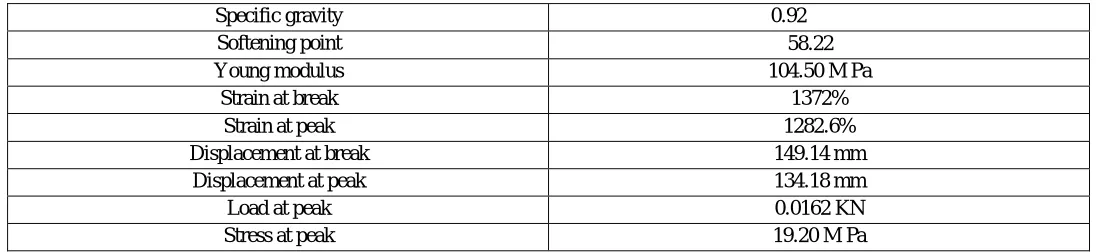
Table1. Physical Properties of Waste Plastic
Specific gravity 0.92
Softening point 58.22℃
Young modulus 104.50 M Pa
Strain at break 1372%
Strain at peak 1282.6%
Displacement at break 149.14 mm Displacement at peak 134.18 mm
Load at peak 0.0162 KN
[image:3.612.31.579.363.489.2]Stress at peak 19.20 M Pa
Table 2. Physical Properties of Bitumen Characteristics Method of Test Test Results
Specific Gravity IS1202:1978 1.09
Softening Point ( ̊C)
IS1202:1978 52
Penetration25 ̊C
(mm)
IS1202:1978 92
Table 3. Physical Properties of Aggregate Properties Unit Method of
test
Test Value
Properties of Coarse Aggregate
Bulk Specific Gravity -- IS: 2386(1) 2.68 Apparent specific gravity -- IS: 2386(1) 2.72 Impact value % IS: 2386(1) 18
Flakiness and elongation index
% IS: 2386(1) 40
Properties of fine aggregate
Bulk Specific Gravity -- IS: 2386(1) 2.68 Apparent specific gravity -- IS: 2386(1) 2.72 Angularity number -- IS: 2386(1) 49 Plasticity index -- IS: 2720 NP
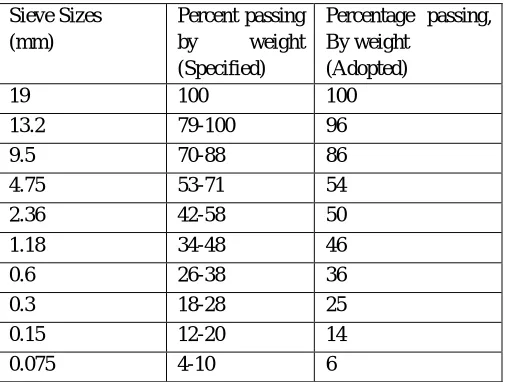
The mixture was constantly steered until a uniform mix was achieved at 265oC. The coarse and fine aggregates used were crushed granite and sand materials respectively, fly ash were used as filler materials. Sieve analysis was done using mechanical shaker. The sieve sizes range between 0.075mm to 19mm. The weight retained on each sieve was noted. Percentage passing each size was calculated.
Table4. Aggregate Grading for Bituminous Mix Sieve Sizes
(mm)
Percent passing by weight (Specified)
Percentage passing, By weight
(Adopted)
19 100 100
13.2 79-100 96
9.5 70-88 86
4.75 53-71 54 2.36 42-58 50 1.18 34-48 46
0.6 26-38 36
0.3 18-28 25
0.15 12-20 14 0.075 4-10 6
Trial mixes were made to combine the coarse and fine aggregates to find all combined grading satisfying the specification. In order to determine the effect of modified binder on the properties of bituminous concrete, it is essential to carry out mix design to find out the optimum bitumen content for the mix using unmodified bitumen as the binder. Three samples were utilized to make bitumen mixtures with one bitumen content. The average values of three samples for the Unit Weight, Bulk Specific Gravity, Marshall Stability and Flow properties for each binder content was found out. Six binder contents were considered (3.5, 4, 4.5, 5, 5.5 and 6%). All examined bitumen concrete mixes wereprepared in accordance with the standard 75-blows. Density and Bulk Specific Gravity of specimens
of compacted asphalt mixtures were find out inaccordance with AASHTO T 166.
©IJRASET: All Rights are Reserved
521
A. The following graphs were plotted1) Bulk density content vs. Bitumen content
2) Marshall Stability vs. Bitumen content.
3) Flow vs. Bitumen content.
B. Optimum bitumen content satisfying the maximum stability and bulk density, as well as therequired minimum air void was selected from the graphs.
C. The modified binders (1, 2, 3, 4 and 5%) were utilized to prepare five samples of bituminous concrete according to the mix design following the standard processes explained above. The modified binders were added at optimum bitumen content for all the specimens and the sampleswere tested for Marshall Stability, Flow and Density to detect the effect of polythene modified binder on the properties of the specimen.
III. RESULTANDDISCUSSION
A. Marshall Mix design result
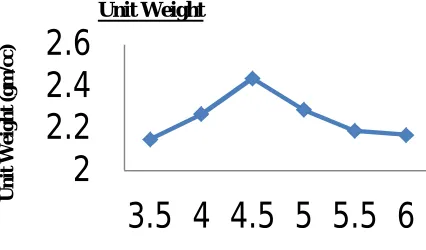
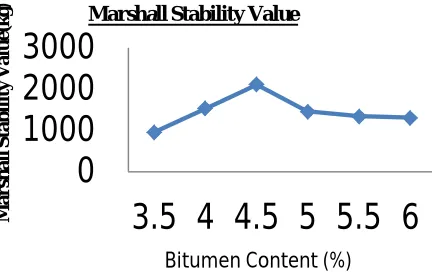
[image:5.612.193.406.353.478.2]Marshall Samples were collected by changing the binder content and then we tested for its volumetric properties. We test the sample in Marshall testing machine and find Marshall Stability Value and flow value. Optimum binder content is selected as the average binder content for maximum density, maximum stability and certain percent air voids in the total mix. We found that optimum bitumen content is 4.5%.
Figure 1. Unit Weight vs. Bitumen content
2
2.2
2.4
2.6
3.5 4 4.5 5 5.5 6
U n it We igh t (gm /c c) Unit Weight Bitumen Content(%)
0
1
2
3
4
3.5 4 4.5 5 5.5 6
Figure 2. Flow Value vs. Bitumen content
Figure 3. Marshal Stability Value vs. Bitumen content
B. Effect of plastic modified bitumen on the properties of bituminous concrete
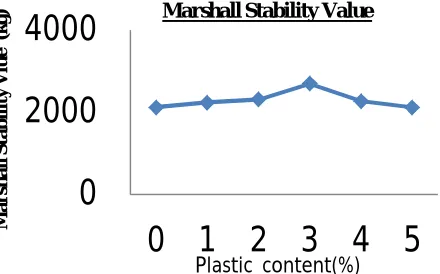
[image:6.612.206.415.373.516.2]After find the optimum bitumen content, we observe optimum plastic content at optimum bitumen content.It indicated that Marshall Stability value grows with plastic content up to 3% and after that it reduces. We note that the Marshall Flow value and unit weightfalls upon addition of plastic.
Figure 4. Unit Weight vs. Plastic content
0
1000
2000
3000
3.5 4 4.5 5 5.5 6
M ar sh al l S tab il it y V al u e( k g )
Marshall Stability Value
Bitumen Content (%)
2
2.2
2.4
2.6
0 1 2 3 4 5
U n it We igh t ( gm /c
c) Unit Weight
Plastic content(%)
0
1
2
3
0 1 2 3 4 5
F lo w V al u e ( m m ) Flow Value
[image:6.612.211.415.557.704.2]©IJRASET: All Rights are Reserved
[image:7.612.197.417.110.247.2]523
Figure 6. Marshal Stability Value vs. Plastic content
C. UNITS
1) kg represents kilogram
2) mm represents the millimeter
3) g/cc represent gram per centimeter cube
IV. CONCLUSION
The tests proceeded in two stages. Firstly, bituminous concrete mix design was completed to find out the optimum bitumen content for the blend. Secondly, modified binder prepared by mixing bitumen with waste plastic at various percentages, was utilized to make bituminous concrete specimen. The samples were tested to detect the effects of the modified binder. Testing and observation of the bituminous concrete prepared from polythene modified binder concluded that:
A. The unit weight of modified bituminous mix is lower than that of the control due to low density of the plastic.
B. The waste plastic utilized in the mix will get covered over aggregates of the mixture and increases the binding property and reduces porosity, absorption of moisture.
C. The flow value for modified bituminous concrete reduces with increasing plastic content.
D. The Marshall Stability Value is growing with a maximum increase percent of 27.27% as compared to Conventional mix when modified with 3% Plastic Waste
E. The Marshall Stability value increases with plastic content up to 3% and thereafter it decreases.
F. The optimum plastic content is 3%.
G. The improvement in stability of modified bituminous concrete is due to increase cohesion and adhesion properties of the binder will increase higher fatigue resistance, decrease thermal stress cracking, and reduce temperature susceptibility and decrease of rutting.
REFERENCES
[1] http://en.wikipedia.org
[2] González U. O. 2008. Rheological property of bitumen modified with polyethylene and polyethylene based blends.
[3] Garcia-Morales M., Partal P., Navarro F.J., Martinez- Boza F., Gallegos C., González N., González O. and Muñoz M. E. 2004. Viscous properties andmicrostructure of recycled over modified bitumen.Fuel. 83(1): 31-38.
[4] Polacco G., Stastna J., Biondi D. and Zanzotto L.2006. Relation between polymer architecture andnonlinear visco elastic behavior of modified asphalts.Current Opinion in Colloid and Interface Science. 11:230-245.
[5] Navarro F.J., M., Partal, P., Garcia-Morales M.,Martín-Alfonso M.J., Martinez-Boza F., GallegosJ.C., González N., Bordado M. and Diogo A.C. 2009.Bitumen modification with reactive and non-reactive(virgin and recycled) polymers: A comparativeanalysis. Journal of Industrial and EngineeringChemistry. 15(4): 458-464.
[6] Yuonne B. and Yajaira R. 2001. Polymer Modified Asphalt. Vision technologica. 9(1): 39-48.
[7] Garcia-Morales M., Partal P., Navarro F.J. andGallegos C. 2005. Effect of waste polymer addition onthe rheology of modified bitumen. Fuel. 85(11): 936-943.
[8] Abtahi S.M., Sheikhzadeh M. and Hejazi S.M. 2010.Fiber-reinforced asphalt-concrete - A review.Construction and Building Materials. 24(16): 871-877. [9] Gonzalez O., Munoz M. E. and Santamaria A. 2006.Bitumen/polyethylene blends: using m-LLDPE toimprove stability and viscoelastic
0
2000
4000
0 1 2 3 4 5
M ar sh al l S tab il it y V lu e ( k
g) Marshall Stability Value
properties.Rheological Act Journal. 45(5): 603-610.
[10] Pe´rez-Lepe A., Martý´nez-Boza F.J., Gallegos C.,Gonza´lez O., Mun˜o M.E. and Santamarý A. 2003.Influence of the processing conditions on therheological behavior of polymer-modified bitumen.Fuel. 82(11): 1339-1348.
[11] Sinan H., Hatice N.A. and Osman U.B. 2005. Effectsof High density polythene on the permanentdeformation of asphalt concrete. Indian Journal ofEngineering and Material Science. 12: 456-460.