5
X
October 2017
Effect of Value Added Biofertilizer Obtained From
Kota Stone Waste on Growth of Okra
(Abelmoschus Esculentus)
Swati Jain1, Ritu Mathur1 and M. P. S. Chandrawat21, 2
Deptt of Chemistry RR College, Alwar, Rajasthan
3
Eternal Universities, Sirmour, Himachal Pradesh
Abstract: India is among the largest producer of raw stone. There are various types of stones with sparkling appearance and fine finish available in different places of Rajasthan. The continuous increment in the demand of various types of stones has led to enormous increase in the business of stone sector industry. Despite this, a large amount of residues is produced in ornamental stone industry with different dimensions and particle size. Dumping of this waste causes many economical and environmental problems. This paper aims to convert Kota stone waste into value added biofertilizers and to find its effect on the growth of Okra (Abelmoschus esculentus) plant. The Kota stone waste contains macro and micro nutrients which affects the growth of plants. This study was carried out in a randomized complete block design experiment in the replicates of three. Application of stone waste as value added fertilizer in different percentages i.e. 2.5%,5% 7.5% and 10% of biofertilizers by weight of soil showed that the growth of Okra was largely enhanced in the sample containing 7.5% of biofertilizer .
Keywords: Stone, Waste, Value added biofertilizers, Okra, Growth, Pot culture technique.
I. INTRODUCTION
A remarkable growth in the consumption of stone is observed all over the world in the recent years. Various types of stones such as-Granite, Kota stone, Marble, Limestone, Slate etc. are used in construction purposes. In the building industry, Kota stone has been commonly used for various purposes like flooring, cladding, balconies, wall fixing etc., as a building material. Kota stone industry generates both solid waste and stone slurry. A solid waste results from the rejects at the mine sites or at the processing units and stone slurry is a semi liquid substance consisting of particles originating from the sawing and the polishing processes and water is used to cool and lubricate the sawing and polishing machines. During the process of cutting, the original stone waste mass is lost by 25% in the form of dust [1]. Accordingly, the amount of mining and processing waste has increased. Dumping of the waste has many negative implications on the environment. When dumped on land, it adversely affects the productivity of land due to decreased porosity, water absorption, water percolation etc [2]. Stone waste is generally a highly polluting waste due to both its highly alkaline nature and its manufacturing and processing techniques, which impose a health threat to the surroundings. Waste management to make the waste useful and to reduce its negative implications on the environment is the need of the hour. Waste can be used to produce new products so that natural resources are used more efficiently and the environment is protected from waste deposits [3]. Value addition is one of the effective techniques of waste management. The Kota stone waste contains macro and micronutrients which can be transformed into more accessible form for plants forming value added biofertilizer. Donahue et al. (1990) reported that NPK fertilizer increases soil fertility and yield of Okra. However, NPK fertilizer is very expensive and therefore increases cost of production. It is also not environmentally friendly [4]. Alternative sources of fertilizers are therefore sought to increase the yield of Okra. The potential of this biofertilizer was observed on the growth of Okra plant by pot culture technique. Results of experiments showed that value added biofertilizer from Kota stone waste and biowaste are a cheap and eco friendly source of nutrients for the growth of Okra plant.
II. MATREIALS AND METHOD
Different doses including 2.5%,5%,7.5% and 10% of biofertilizers by weight of soil added to the soil in different pots. The pots were categorized as shown in table1. The effect on biomass of okra was observed after the completion of period of growth and compared with the control having only soil without any fertilizer.
TABLE I
Number Treatment Code
1 Control C
2 2.5% Fertilizer X
3 5% Fertilizer 2X
4 7.5% Fertilizer 3X
5 10% Fertilizer 4X
III. RESULTSANDDISCUSSION
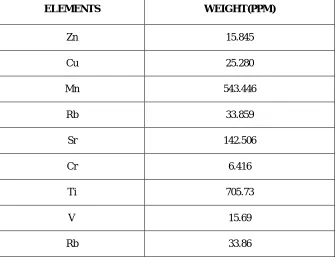
Nutrients play a vital role in the growth of the plants. Plants need different elements in different amount and show maximum growth when these nutrients are provided to them in optimal proportion. Different elements present in the Kota stone waste are shown in tables II and III.
TABLE II: MACRONUTRIENTSINKOTASTONEWASTE
TABLE III: MICRONUTRIENTSNUTRIENTSINKOTASTONEWASTE
ELEMENTS WEIGHT(PPM)
Zn 15.845
Cu 25.280
Mn 543.446
Rb 33.859
Sr 142.506
Cr 6.416
Ti 705.73
V 15.69
Rb 33.86
Presence of macro and micro nutrients in the value added biofertilizers affect the growth of Okra plant. Plants with different doses of biofertilizers showed remarkable differences in their growth as shown in fig.-1.
ELEMENTS % BY WEIGHT
Ca 23.60
K 0.677
The maximum growth was observed in the plant administered with 7.5% of biofertilizers by weight of the soil. In the plant with 10% of biofertilizer, growth was retarded as further increase in the doses of nutrients may have negative effects on the growth of the plant. Phosphorus is essential for plant growth and commonly is applied double or triple the crop removal rates[9]. Phosphorus plays important role in photosynthesis, Nitrogen fixation, crop maturation including flowering, fruiting and seed formation, root development and improving the quality of crop. Potassium exerts a balancing effect on the effects of both Nitrogen and Phosphorus .Potassium is essential for photosynthesis, for protein synthesis, for starch formation and for the translocation of sugars. Phosphorus and potassium may be present in large quantities in the soil but exert no harmful effect on the crop. Nitrogen is an integral component of many compounds, including chlorophyll and enzymes, essential for plant growth
processes[10]. It stimulates root growth and development as well as the uptake of other nutrients. Plants respond quickly to applications of nitrogen. This element encourages aboveground vegetative growth and gives a deep green color to the leaves. The optimum N for normal plant growth varies between 2% and 5% of the dry weight of the plant [11]. When too much nitrogen is applied, crop maturity is delayed and the plants are more susceptible to disease and insect pests. Ca is an essential element for plant growth and fruit development .Ca plays an important role in plant resistance to disease based on the protection of cell wall disintegrating enzyme secreted by pathogens [12]. Titanium may play a role in photosynthesis and nitrogen fixation, increases chlorophyll content and increases yield[13]. Molybdenum, copper and iron act as “electron carriers” in enzyme systems that bring about oxidation –reduction reactions in plants. Molybdenum if applied in excess may adversely affect the growth of plant. Several elements such as rubidium and strontium have been found to stimulate the growth of certain plants[14]. In 3X treatment (7.5% biofertilizers),it is thus clear that the various micro and macro nutrients(as mentioned above) are in optimum amount required for the maximum growth of the plant. Results are thus very encouraging.
IV. CONCLUSION
The conversion of kota stone waste into value added biofertilizer and its use to enhance the yield of the crop can be a very effective measure to control the degradation of the environment and to overcome the problem of disposal of waste from the Kota stone industry. It will also boost up the economy of these industries and help in fulfilling the nutritional requirement of the crop at low cost.
V. ACKNOWLEDGEMENT I am grateful to IARI, New Delhi and AIRF (JNU) for supporting in my research work.
REFERENCES
[1] .R.lakhani,R.Kumar and P.Tomar“Utilization Of Stone Waste In The Development Of Value Added Products:A State Of The Art Review”,IJISET,Vol.1,Issue
7,Sep.2014
[2] A.pappu,M.Saxena and S.R.Asolekar,“Solid waste generation in india and their recycling potential in building
materials”,Build.Environ.J.,Vol.42(6),pp.2311-2320,2007
[3] S. Kothari, “Effective Utilization Of Crusher Dust In Sustainable Concrete”, IJERA, Vol.6, pp.20-30, Feb.2016.
[4] R.Kavitha and P.Subramanian, “Bioactive Compost-A Value Added Compost with Microbial Inoculants and Organic Additives”,
84,2016
[6] P.Sudan,, “Relative Investigations on Value Added Biofertilizers from Industrial and Biowastes” Chem.thesis,University of
Rajasthan,Alwar,Rajasthan,India,2015
[7] D.S.Kumar,D.E.Tony and A.P.Kumar, “A Review On : Abelmoschus Esculentus(OKRA)”,Int.Res.J.Pharm.Appl.Sci., Vol.3(4),PP 129-132,Dec.2013
[8] A.S.Attigah,E.K.Asiedu, “ Growth And Yield Of Okra(Abelmoschus esculentus) As Affected By Organic And Inorganic Fertilizers”,ARPN
J.Agri.Bio.Sci.,Vol.8,Paper 12,Dec.2013.
[9] F.E.Khasawneh, “The Role of Phosphorus in Agriculture”, Madison ,WI:Crop Sci. Soc.Amer.,1980
[10] N.C.Brady,The Nature and Properties of Soils,10th ed.,Macmillan Publishing Co.,New York,1990
[11] C.A. Castaño, L.C.S. Morales, M.F.H. Obando,Assessment of nutritional deficiencies in growing blackberry (Rubus glaucus) under controlled conditions to
lower montane forest, Agronomy,Vol. 16 (1),pp. 75-88,2008
[12] V.T.Olivar,O.G.V.Torres and H.S.Nava, “ Role of Nitrogen and Nutrients in Crop Nutrition” J.Agric.Sci.Tech.,Vol.4,pp.29-37,Jan. 2014
[13] J.Benton Jones , Tomato Plant Culture In: The Field, Greenhouse And Home Garden CRC Press, London, New York, 2007