Study the Characteristics of MANET Routing
Protocol Using Significant Factor
Lokesh Kumar Laddhani1, Dr. Umesh Kumar Singh2
Institute of Computer Science, Vikram University, Ujjain
Abstract— Mobile wireless ad hoc networks (MANETs) have become of increasing interest in view of their promise to extend connectivity beyond traditional fixed infrastructure networks. In MANETs, the task of routing is distributed among network nodes which act as both end points and routers in a wireless multi-hop network environment. MANET routing protocols are of many type some of them are proactive, reactive and also hybrid.
Keywords— MANET, Proactive, Reactive, Hybrid, Routing Protocols
I. INTRODUCTION
How different types of mobile devices can make up MANET. Also, how MANET can be generated by the movement of these mobile devices and some challenges that are confronted in MANET are analyzed.
A. Homogenous Mobile Device Network
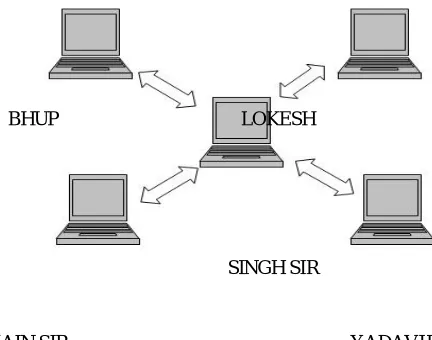
Two or more mobile devices (MD) that have networking capabilities and wireless communications are said to establish a MANET. The MD should be within their radio ranges. A destination MD that is out of radio range from the source MD, an intermediate MD that is within radio range with the destination MD can forward the packets from the source MD to the destination MD. According to [1], it is proposed an ad hoc wireless network to be self-organizing and adaptive. This suggests that, the MANET can be formed and be reformed without any system administration. The MANET can be represented in various forms, which can be standalone, mobile, or networked. An MD has the capability to detect the availability of other MD within the radio perimeter, this enable a routing handshake to be established which gives room for communication and sharing of information among the MD. The MANET does not require any fixed router or fixed radio base stations to make connection. The MANET that has two or more mobile devices that is of the same type is said to set up homogeneous mobile device network as can been seen in figure 1 below.
BHUP LOKESH
SINGH SIR
[image:2.612.187.403.450.620.2]JAIN SIR YADAVJI
Figure 1: Homogeneous Mobile Device Network of So ET
B. Mobile Devices Heterogeneity
Technology (SoET) campus where Director have Pocket PC, deputy director have laptop, faculty members haves cellular phones etc. MANET that is set up by different types of mobile devices is said to be heterogeneous mobile device network, as can be seen below in figure 2.
SKJ LAPTOP ROHIT LAPTOP
UKS IPAD
YADAVJI LAPTOP MOHIT LAPTOP
Figure 2: Heterogeneous Mobile Device Network Of SoET
C. Mobile Device Movement
When in MANET, MD are always moving. This movement can be initiated either by the source node, destination node, or the intermediate node. These MD movements allow the network to take different shape. Due to change in the Topology the movement of these MDs affects directly the routed information i.e. routing table of each MD require to update dynamically.
D. Displacement of MD in A Route
An established MANET comprises of a source node, intermediate node(s) and a destination node. The source node has downstream links which help in forwarding the routed packets from the source node to the destination node. The source node stores the downstream links from itself to the destination node. The source node used the stored downstream links to route packets to the destination node. The source node can migrate away from the MANET. Neighboring MDs of the migrated source MD should be aware of the migration in order to discard the link to the migrated source MD.This destination node, which has also an upstream links to the source node, stores these links for subsequent usage and it can also leave MANET at any time. A neighboring MD should be aware of the destination node migration so as to remove the stored link to this destination node. Also, the intermediate node(s) can still leave the network thereby creating a link failure. A new route has to be established in order to route packets from the source node to the destination node. This new route is achieved by broadcasting over the wireless medium, another intermediate node routing the packets to the destination node. This tends to consume bandwidth and increase the overall network control traffic.
E. Displacement By subnet-Bridging MD
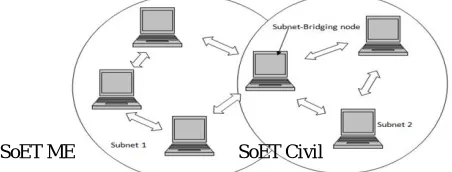
Subnet-bridging node tends to merge two or more subnets together. This merging node plays an important role when the source node and the destination node are not in the same subnet network. The subnet bridging node aids in routing packets coming from the source node to the destination node via others intermediate nodes. If this merging node decides to leave the network, the merger subnet network will be fragmented into smaller network. The two different branches of SoET below shows in Fig 3 a mobile device bridging two networks together
[image:3.612.196.422.608.694.2]SoET ME SoET Civil
II. ROUTING IN MANET
In MANET, there is always a rapid change of the topology structure due to the quick and fast mobility of the mobile devices. The rapid change of the MDs topology is possible because the MDs are small, portable and highly integrated, [1]. Distance-vector and link-state based routing protocols cannot cope effectively with the rapid dynamic change of the topology. Hence, the performance of the routing protocol leads to a poor route convergence and very low communication throughput [1]. Performance requirement for MANET routing protocols are to minimize Delay and maximize Throughput, Robustness, Scalability, Fairness, and Energy efficiency[2] .
Delay: Delay refers to the amount of time spent by a packet in the MAC layer of routing protocols before it is transmitted successfully.
Throughput: Throughput is defined as the rate at which messages are serviced by the communication system. The main objective of MANET routing protocol to is to maximize the Throughput while minimizing the message Delay.
Robustness: Robustness is a combination of reliability, availability, and dependability requirements and it reflects the degree of protocol insensitivity to errors.
Scalability: Scalability refers to the ability of the communication system to meet its performance characteristics regardless of the size of the network and the number of competing nodes.
Stability: Stability refers to the ability of communication system to handle the fluctuations of the traffic load over sustained period of time.
Fairness: Fairness is achieved if the MAC protocol can allocate the channel capacity evenly among competing nodes without reducing the network Throughput.
Energy Efficiency: Energy efficiency is the major issue in the design of MAC protocols for MANET.
III. ROUTING PROTOCOLS FOR MANET
Routing in ad hoc networks has become an interesting area of research within industrial and academic circus. Several routing protocols have been designed for multi-hop ad hoc networks. These protocols cover a wide range of design choices and approaches, from simple modifications of internet protocols, to more complex multi-level hierarchical schemes. Although the ultimate end goal of a protocol may be operation in large networks, most protocols are typically designed for moderately sized networks of 10 to 100 nodes.
Before describing the different routing approaches and example protocols, it is necessary to explain the developmental goals for an ad hoc routing protocol so that the design choices of the protocols can be better understood [6]. The design choices should be adapted in relation to the defining characteristics of ad hoc networks which comprises poor devices, limited bandwidth, high error rates, and a continually changing topology. The following are the design goals for MANET routing protocol according to [6]:
Minimal control overhead: Control messaging consumes bandwidth, processing resources, and battery power in transmitting and receiving a message. Because bandwidth is at a premium, routing protocols should not send more than the minimum number of control messages they need for operation. They should be designed in such a way that the control message threshold is relatively low. While transmitting is roughly twice as power consuming as receiving, both operations are still power consumers for the mobile devices, thus reducing control messaging also helps to conserve battery power.
Minimal processing overhead: Algorithms that are computationally complex require significant processing cycles in devices. Because the processing cycles cause the mobile device to use resources, more battery power is consumed. Protocols that are lightweight and require a minimum of processing from the mobile device reserve battery for more user-oriented tasks and extend the overall battery life time.
Multi hop routing capability: Because the wireless transmission range of mobile nodes is usually limited, source and destination nodes may typically not be within direct transmission range of each other. Hence, the routing protocol must be able to discover multi hop routes between source and destination nodes so that communication between these nodes is possible.
Dynamic topology maintenance: Once a route is established, it is likely that some link in the route will break due to node mobility. In order for a source to communicate with a destination, a viable routing path must be maintained, even while the intermediate nodes or even the source or destination nodes are mobile. More so, because link breaks in ad hoc networks are very common, link breaks must be handled quickly with a minimum of associated overhead.
either the path is fixed and the loop eliminated, or until the time to live (TTL) of the packet reaches zero. Because bandwidth is limited and packet processing and forwarding is expensive, routing loops are extremely wasteful of resources and are detrimental to the network. Even a transitory routing loop will have a negative impact on the network. Therefore, loops should be avoided at all times.
The limited resources in MANET have made optimization of efficient and reliable routing protocols a very challenging task. An intelligent routing protocol is required to efficiently use the limited resources while at the same time being adaptable to the changing network conditions such as network size, traffic density and network partitioning. In the same way, the routing protocol may need to provide different levels of Quality of Service (QoS) to different types of applications and users [6]. With the design goals described in the preceding section in mind, numerous routing protocols have been developed for ad hoc networks. There are far too many proposed routing protocols than can be discussed in this section. Therefore, this section describes the characteristics of classes of routing approaches, and subsequently describes the operations of particular routing protocols within those classes.
A. Proactive Routing Protocols
The proactive routing protocols designed for ad hoc networks are derived from the traditional distance vector and link state protocols developed for use in wire-line internet. The primary characteristic of proactive protocols is that each node in the network maintains a route to every other node in the network at all times. Route creation and maintenance are accomplished through some combination of periodic and event-triggered routing updates. Periodic updates consist of routing information exchanges between nodes at set time intervals. The updates occur at specific intervals, regardless of the mobility and traffic characteristics of the network. On the other hand, event-triggered updates are transmitted whenever some event, such as a link addition or removal, occurs. The mobility rate directly affects the frequency of event-triggered updates because link changes are more likely to occur as mobility increases.
B. Reactive Routing Protocols
Reactive routing techniques, also known as on-demand routing, take a very different approach to routing than proactive routing approaches. A large percentage of the overhead from proactive protocols stem from the need for every node to maintain a route to every other node in the network at all times. In a wired network, where connectivity patterns change relatively infrequently and resources are abundant, maintaining full connectivity graphs is a worthwhile expense. A route is readily available whenever it is needed at the expense of enormous routing overhead. In ad hoc networks, however, link connectivity can change frequently and control overhead is very costly. Because of these reasons, reactive routing protocols take a departure from traditional internet routing approaches by not continuously maintaining routes between all pairs of network nodes. Instead, routes are only discovered whenever they are actually needed. When a source node needs to send data packets to some destination, it checks its route table to determine whether it has a route. If no route exists, it performs a route discovery to find a path to the destination. Hence, route discovery, which is the flooding of the whole network with route request messages, is carried out on-demand. If two nodes never need to talk to each other, then they do not need to utilise their resources maintaining a path between each other. To reduce overhead, the search area may be reduced by a number of optimizations [6]. The merit of this approach is that control and signaling overheads are most likely to be reduced compared to proactive protocols, particularly in networks with low to moderate traffic loads. When the number of data sessions in the network becomes high, then the overhead generated by the route discoveries becomes high, and may even surpass that of the proactive routing approaches. The major disadvantage of this approach is the introduction of route acquisition latency. That is, when a route is needed by a source node, there is some finite latency while the route is being discovered. In contrast, with a proactive protocol, routes are typically available the moment they are needed, implying that there is no delay to begin the data session. The following sub-sections give a description of the major reactive routing protocols.
C. Hybrid Routing Protocols
Hybrid routing protocols are a new generation of protocols that combine the characteristics of both reactive and proactive routing protocols under different scenarios. These protocols are designed to increase scalability by allowing nodes with close proximity to work together to form some sort of a backbone in order to reduce the route discovery overheads. This novelty is mostly achieved by proactively maintaining routes to near nodes and determining routes to far away nodes using a route discovery strategy. Hybrid routing protocols are predominantly zone or cluster based. Following are Hybrid Protocols.
Comparison of Routing Protocols of MANET on the basis of there Common Characteristics
Protocol Category Metrics Route Discovery Route
Repository
Loop Free Communicati
on Overhead
Features
DSDV Proactive Shortest Path Periodic Broadcast Routing
Table
Yes High Distributed Algorithm
OLSR Proactive Shortest Path Periodic Updates Routing
Table
Not always High Probabilistic table
updates
CGSR Proactive Shortest Path Periodic Updates Routing
Table
Yes Low Cluster head is critical
node
WRP Proactive Shortest Path Periodic Updates Routing
Table
Yes Low Uses Hello message
STAR Proactive Shortest Path Periodic Updates Routing
Table
Yes Low Updates at specific events
DSR Reactive Shortest path,
Next available route
New Route, Notify source
Route Cache Yes High Completely on Demand
AODV Reactive Newest Route,
Shortest Path
Same as DSR, Local repair
Routing Table
Yes High Only Keeps track of next
hop in route
TORA Reactive Shortest path,
Next available route
Reverse Link Routing
Table
Yes High Control packets localized
to area of topology change
ABR Reactive Strongest
Associative
Local Broadcast Routing
Table
Yes Medium High delays in route
repair
SSBR Reactive Strongest
Signal
New route, Notify source
Routing Table
Yes Medium Uses a signal stability
table
ROAM Reactive Shortest Path Erase route, Start
New Search
Routing Table
Yes Medium Uses SWARM
intelligence concepts
ZRP Hybrid Shortest Path Start repair at Failure
Point
Inter zone and Intra zone Table
Yes Medium Routing range defined in
hops
FSR Hybrid Scope Range Notify source Routing
Table
Yes Low Updates are localized
LANM AR
Hybrid Shortest Path Notify Source Routing
Table
Yes Medium Using landmarks
increases scalability
RDMA R
Hybrid Shortest Path New route, Notify
source
Routing Table
Yes High Localized query flooding
SLURP Hybrid DSR for
interzone
Notify source Route Cache
at location
Yes High Eliminates global route
discovery
LAR Hybrid Power
consumed, Hop Count
Notify source Route Cache Yes Medium RERR message on link
break
DREA M
Geographic al
Hop count Routing
Table
No Low Location table at each
IV. CONCLUSION
Above table describe the routing protocols of MANET and it shows that each protocol have there own characteristics. After analysing the above table protocols have some pros and cons also there are lots of challenges to improving the performance of the MANET routing protocols.
REFERENCES
[1] C. K. Toh, “Ad Hoc Mobile Wireless Network: Protocols and Systems”, Prentice Hall, 2006. [2] T. Rappaport, “Wireless Communications”, Prentice Hall, 2006.
[3] F. Tobagi and L. Kleinrock, ,,,,Packet Switching in Radio Channels: Part II – the hidden Terminal Problem in Carrier Sense Multiple Access Modes and the Busy-Tone Solution,‟‟ in IEEE Transactions on Communications, vol.23 2007.
[4] A. Boukerche, M.Z. Ahmad, D. Turgut and B. Turgut, “A Taxonomy of Routing Protocols for Mobile Ad Hoc Networks”, In Algorithms and Protocols for Wireless and Mobile Ad Hoc Networks, A. Boukerche, Ed. New Jersey: Wiley, 2009.
[5] M. Abolhasan, T. Wysocki, and E. Dutkiewicz, A review of routing protocols for mobile ad hoc networks, Botany: Motorola Australia Research Centre, 2009.