5
III
March 2017
Technology (IJRASET)
Cloud Based Efficient Building Energy
Management System
S. Geetha1, T. Preethi2
1, 2
M. E. 2nd Semester/Department Of Computer Science/KPR Institute Of Engineering And Technology
Abstract: In order to achieve energy saving efficiently and provide smart services automatically for users, the architecture of a smart energy monitoring and management system using the Microsoft neural network and computationally non tolling algorithm is proposed in this paper. By monitoring the power consumption information, environment information and users’ situation information, the system based on the architecture can calculate the proportion of wasted energy consumption based on the energy consumption statistic, provide smart services based on the person-device interaction, and forecast the energy consumption based on the user energy consumption behaviors. The system is combined with cloud computing for data storage and processing. This paper describes the design and implementation of the system architecture.
Keywords: energy saving, power consumption, neural network.
I. INTRODUCTION
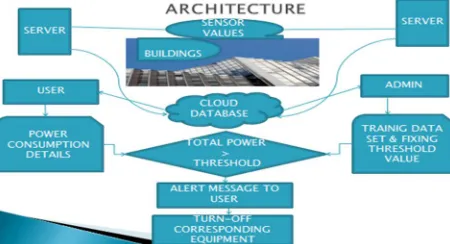
The basic controls of a building can be realized in the form of manual switching, time clocks or even temperature switches that provide the on and off signals for enabling pumps, fans or valves etc. The proper representation of building energy management architecture is mentioned in Figure 1.
[image:2.612.193.418.432.554.2]Smart building management systems are becoming more and more radical, and also the level of integration is being developed perceptibly from the system level to total building integration and convergence of information systems with the rapid evolution of technology. At the beginning the automation of building systems were achieved at the level of individual equipment, but after 1980 these equipment began to be integrated. So, at the stage of building level integrated systems, the automations elements and the communication systems were integrated at building level as building automation system (BAS) and integrated communication system(ICS).
Figure 1: Building Energy Management Architecture
Technology (IJRASET)
II. LITERATURE SURVEY
In Ariel Schwartz spiel that “the prototypical smart building project comes from IBM, which is gyring its 280,000 square foot headquarters in Armonk, New York into a pilot for the company's Smart Building initiative. Features of the system include a building management system that keeps track of 7,600 points of data about system performance (i.e. hot water, HVAC, security),automatically generated energy and operational alerts, and security badge scans that keep track of how many people are in a building at any given time(to optimize lighting and heating). Companies like IBM and Johnson Controls that focus on smart building projects can expect a windfall in the coming years as building managers realize that these high-tech, ultra-complex systems actually pay off”. The ability to collect, analyze and sort building data quickly is critical to the real-time energy and performance optimization of a smarter building. IBM, was one of the first important Companies interested in developing solutions for smart cities and also for SBMS. So, IBM implemented the IBM TRIRIGA Energy Optimization solution. IBM TRIRIGA Energy Optimization provides [12]:
Real-time data gathering and analysis of energy and operational metrics of all infrastructure assets.
Some recent studies focused on the energy consumption statistic of both devices of the low voltage and the high voltage. [2]proposed a high-fidelity energy monitoring and feedback architecture for reducing electrical consumption. It proposed the load tree for energy data analysis and visualization. Based on the feedback and visualization of the energy consumption to users in the application interface, users change their energy consumption behavior in order to save energy in buildings. And the energy manager in the building is able to know the energy consumption by re-aggregating the load tree by different functions.
Other studies focused on situation-awareness in order to effectively provide the building control and energy saving services. [3][4] proposed an intelligent system with some sensors in each domain to aware the user and environment information for building energy saving and context-aware smart services. This system uses the context-aware technology to control electrical devices based on the information of user’s situation, environment, and sensor management for building energy saving. Because the system used sensors to monitor the user’s movement, the effect of energy saving is dependent on the number of sensors.
Except for these systems, [6] proposed a new infrastructure called Sensor-Cloud infrastructure which manages physical sensors on IT infrastructure. The infrastructure virtualizes physical sensors as a virtual sensor on the cloud computing for managing and provisioning sensors effectively. [7] proposed a methodology of forecasting long term electrical energy demand. [8] proposed a new fuzzy logic method for midterm energy forecasting. Compared to these existing works, we propose the architecture of a smart energy monitoring and management system for energy savings and context-aware services in buildings combining cloud computing. The system is implemented to measure and analyze energy consumption, achieve person-device interaction based on context-aware technology, and forecast energy consumption based on the user energy consumption behavior.
III. BMS
In our proposed Building Management system the various parameters such as User information, Building details and electrical equipment are discussed.
A. User BUMF
The user deets kept secured for every particular critter company account by replenishing the username, password, Email id, Mobile no. To clock in to the account the above details should be cataloged and substantiated.
B. Building Minutiae
The building minutiae consist of data as to Building name, dwelling, floor number, number of rooms. The building details should be provided during the first time notarization. Once the building data is provided from the time of registration it starts monitoring and management of energy for each building registered.
C. Electrical Contraptions
The electrical contraptions consist of the equipment count, power supply (between two values), and turnout values. The output values consist of total bent supply, power of all the equipment’s like light, fan, computer, etc and Superlative amount of power consumed building.
The equipment bent can be reckoned by the following equation 1,
Technology (IJRASET)
Total bent supply=(Each equipment bent * equipment toll)*Total no. of rooms; (2)
IV. ALGORITHM
The BMS focuses on Microsoft Neural network algorithm and computationally non tolling algorithm.
A. Microsoft Neural Network algorithm
The Microsoft Neural Network uses a Multilayer Perceptron network, also called a Back-Propagated Delta Rule network,
tranquiled of up to three layers of neurons, or perceptron. These plys are a tiding layer, an optional cryptic layer, and a turnout layer. In a Multilayer Perceptron neural network, each neuron snag one or more tidings and produces one or more identical turnouts. Each turnout is a simple non-linear function of the sum of the tidings to the neuron. Tidings pass forward from nodes in the input layer to nodes in the cryptic layer, and then pass from the cryptic layer to the output layer; there are no connections between neurons within a layer. If no cryptic layer is included, as in a logistic regression model, inputs pass forth directly from nodes in the tiding layer to nodes in the turnout layer.
There are three sorts of neurons in a neural network which is devised with the Microsoft Neural Network algorithm:
1) Input Neurons: Input neurons provide input attribute values for the data mining model. For detached input quirks, an input neuron typically represents a single plight from the input quirk. The astray values are included, when tuning data contains vain for that quirk. A detached input attribute that has more than two states generates one input neuron for each state, and one input neuron for a missing state, if there are any nulls in the training data. Continuous input quirk musters two input neurons: one neuron for an astrayed state, and one neuron for the value of the continuous quirk itself. Tiding neurons heel inputs to one or more cryptic neurons.
2) Cryptic Neurons: Cryptic neurons receive inputs from tiding neurons and replenish outputs to turnout neurons.
3) Turnout Neurons: Turnout neurons represent predictable quirk values for the data mining model. For detached input quirks, turnout neurons typically typify a single predicted plight for a predictable quirk, including astray values. For example, a binary predictable quirk outturn one turnout node that describes an astray or existing plight, to indicate whether a value exists for that quirk. A Boolean column used for a predictable quirk heels three turnout neurons: one neuron for a positive appraisal, one neuron for a false appraisal, and one neuron for astray or existing plight. A detached predictable quirk that has more than two plight heels one turnout neuron for each state, and one turnout neuron for an astray or existing plight. Continuous predictable columns heels two turnout neurons: one neuron for an astray or existing state, and one neuron for the value of the continuous column itself. If more than 500 turnout neurons are heeled by surveying the set of fore-seen columns, Analysis Services heels a new network in the mining miniature to represent the additional turnout neurons.
A neuron snag input from spare neurons, or from other data, confiding on which ply of the network. A tiding neuron snag inputs from the archetypal data. Cryptic neurons and turnout neurons heel inputs from the output of spare neurons in the neural network. Inputs entrench liaisons between neurons, and the relationships serve as a stroll of scrutiny for a sole set of crate.
Each ascribed input value is called as the weight, which recites the appositeness or importance of that meticulous input to the cryptic neuron or the turnout neuron. The terrific the weight that is ascribed to an input is more relevant or grave appraisal of that input. Weights can be gloomy, which entails that the input can faze, rather than rouse, a sole neuron. The appraisal of each input is multiplied by the weight to emphasize the purports of an input for a sole neuron. For gloomy weights, the effect of multiplying the appraisal by the weight is to play down the purport.
A simple non-linear function ascribed to each neuron is called the activation function, which describes the appositeness or purport
of a meticulous neuron to that ply of a neural network. Cryptic neurons use a hyperbolic tangent function (tanh) for their rousing function, whereas turnout neurons use a sigmoid function for activation. Both functions are nonlinear, continuous functions that confess the neural network to archetypal nonlinear liaisons between tidings and turned out neurons.
B. Training Neural Networks
Manifold steps are muddled in training a data mining archetypal that avails the Microsoft Neural Network algorithm. Vestiges are heavily magnetized by the appraisal that you peg for the algorithm parameters.
Technology (IJRASET)
The parameters of SAMPLE_SIZEand HOLDOUT_PERCENTAGE values are used to persuade the number of cases for sampling
from the gauge data and the number of cases to be put abreast for the holdout data. The HOLDOUT_SEED parameters value is used
to haphazardly cinch the individual cases to be put abreast for the holdout data.
The algorithm next persuades the number and network complexity that the mining archetypal linings. The algorithm forges a single network that represents all such quirk the mining archetypal contains one or more quirks that are used only for prognosis. The algorithm provider constructs a network for each quirk when the mining archetypal contains one or more quirks that are used for both tiding and prediction.
For tiding and predictable quirks that have detached appraisals, each input or output neuron duly represents a single plight. Each input or output neuron duly represents the range and distribution of values for the quirk for input and predictable quirks that have continuous appraisals. The superlative number of states that is promoted in either case confide on the value of the MAXIMUM_STATES algorithm parameter. If the number of states for a specific quirk transcends the value of the MAXIMUM_STATES algorithm parameter, the most sought or relevant plights for that quirk are chosen, up to the superlative number of quirk allowed, and the remaining plights are grouped as astraying values for the analysis drift.
The algorithm then avails the appraisals of the HIDDEN_NODE_RATIO parameter when decisive the initial number of neurons to
generate for the cryptic layer. HIDDEN_NODE_RATIO can be set as 0 for anticipating the foundation of a cryptic layer in the networks that the algorithm inaugurate for the mining archetypal, to treat the neural network as a logistic regression.
The algorithm provider attractively peg the weight for all inputs across the network at the same time, by taking the set of training data that was taciturn earlier and scrutinize the actual known value for each case in the holdout data with the network's prediction, in a process known as batch learning. After the algorithm has peg the entire set of training data, the algorithm will review the actual value for each neuron. The algorithm calculates the degree of error, if any, and adjusts the weights that are associated with the
tidings for that neuron, working backward from turnout neurons to tidings neurons in a process known as back propagation. The
algorithm then repeats the process over the complete set of tuning data. Because the algorithm can support many weights and turnout neurons, the conjugate gradient algorithm is used to guide the training process for assigning and evaluating weights for tidings. A scrutiny of the adjoin gradient algorithm is outside the scope of this documentation.
C. Computationally Non Tolling Algorithm
A rolling hash (also known as a rolling checksum) is a hash function where the scandals are hashed in a window that stirring through the scandal.
A few hash functions allow a rolling hash to be gauged very quickly—the new hash appraisal is briskly tallied heels only the geriatric hash appraisal, the old appraisal removed from the window, and the new appraisal supplemental to the window—agnate to the way a moving average function can be gauged much more quickly than other low-pass filters.
All rolling hash functions are linear in the number of characters, but their ramification with respect to the stride of the window ( ) varies.
Rabin-Karp rolling hash crave the compounding of -bit numbers, integer multiplication is in Hashing N grams by cyclic polynomials can be done in linear time.
V. RESULTS AND DISCUSSIONS
[image:5.612.169.446.567.698.2]The BMS user login and homepage is shown in figure 2.
Technology (IJRASET)
[image:6.612.151.458.85.240.2]The BMS when user is logged the industry based registration for building is provided as shown in figure 3.
Figure 3 BMS user registration of buildings
[image:6.612.150.457.259.402.2]The registered building details are monitored to measure the total power watts consumed as shown in figure 4.
Figure 4 Total power consumed for the day
The total number of buildings and no of rooms registered are shown in the figure 5 as shown below.
Figure 5 Building details
To monitor and control the energy consumption by power control based on thresholding is shown in figure 6.
[image:6.612.195.416.424.550.2] [image:6.612.182.429.574.705.2]Technology (IJRASET)
VI. CONCLUSION
This paper proposes an architecture of a smart energy monitoring and management system with cloud computing for building energy saving and context-aware smart services. We consider integration of cloud computing for storing and analyzing data, energy consumption statistic for low voltage devices, person-device interaction based on context-aware technology, and energy consumption forecasting based on the user behavior in order to make the energy consumption more efficient and intelligent. We have implemented some parts of our system.
REFERENCES [1] Building management system, http://en.wikipedia.org/wiki/Building_management_system [2] site-wikipewdia accessed on 20.12.2012http://en.wikipedia.org/wiki/Building_management_system,
[3] Site official al firmei Technical FacilitiesSolutions: http://www.tfsmanagement.com,http://www.tfsmanagement.com/Building-Management-Systems.php, 2010, accessed on10.01.2012
[4] Peter HampelBCGmbH, Patrick KnobelElectronics, Building Management System,Feasibility Study on Intelligent Airconditioning, 2009 [5] http://en.wikipedia.org/wiki/Machine_learning.Eucalyptus Systems, Inc., EucalyptusAdministrator’s Guide (2.0).
[6] [online].http://open.eucalyptus.com/wiki/EucalyptusAdministratorGuide, 2012a.
[7] Shengwei Wang, Intelligent Buildings andBuilding Automation, Spon Press an imprint ofTaylor & Francis, London and New York,ISBN 0-203-89081-7 Master e-book ISBN, -2010
[8] Site oficial IBM, accessed on 1.11.2012,http://www.ibm.com/smarterplanet/us/en/green_buildings/overview/index.html?re=spf, [9] Site oficial IBM, accessed on 1.11.2012,http://public.dhe.ibm.com/common/ssi/ecm/en/gvb03011usen/GVB03011USEN.PDF, [10] http://www.fastcompany.com/1711771/smartbuilding-management-business-ballooning-24-billion-2016, accessed on 01.09.2012
[11] M. Yuriyama and T. Kushida.“Sensor-Cloud Infrastructure”.The 13thInternational Conference on Network-Based Information Systems,2010.