: identifying key component processes
Cassidy, SF
http://dx.doi.org/10.1080/03075079.2010.503269
Title Selfregulated learning in higher education : identifying key component processes
Authors Cassidy, SF
Type Article
URL This version is available at: http://usir.salford.ac.uk/14683/ Published Date 2011
USIR is a digital collection of the research output of the University of Salford. Where copyright permits, full text material held in the repository is made freely available online and can be read, downloaded and copied for noncommercial private study or research purposes. Please check the manuscript for any further copyright restrictions.
Self-regulated learning in higher education:
Identifying key component processes
SIMON CASSIDY
Directorate of Psychology, Counselling and Psychotherapy, University of Salford, Salford, UK
Abstract
The concept of self-regulated learning is becoming increasingly relevant in
the study of learning and academic achievement, especially in higher
education, where quite distinctive demands are placed on students.
Though several key theoretical perspectives have been advanced for
self-regulated learning, there is consensus regarding the central role played by
student perceptions of themselves as learners. There are two general
aims of this positional article. The first is to emphasise self-regulated
learning as a relevant and valuable concept in higher education. The
second is to promote the study of those constituent elements considered
most likely to develop our understanding beyond a mere description of
those processes thought to be involved in self-regulated learning. A case
is presented for learning style, academic control beliefs and student
self-evaluation as key constructs which contribute to an increased
understanding of student self-regulated learning and which facilitate the
application of self-regulated learning in pedagogy by enhancing its
Introduction
In their volume Self-Regulated Learning and Academic Achievement, Zimmerman and Schunk (2001) note how the fascination with
self-understanding and self-regulation has seen a recent shift in focus to learning
and academic achievement processes. They conceptualise self-regulated
learning as the way in which learners control their thoughts, feelings and
actions in order to achieve academically, and, in a climate of rapid change in
human context with a particular emphasis on technological advancement,
they consider self-regulated learning to have become an essential
requirement for individuals, particularly with regards to maintaining the
capacity for employment and lifelong learning.
Whilst there are a number or key theoretical perspectives offered for
self-regulated learning, all seem to share the common belief that ‘student
perceptions of themselves as learners and their use of various processes to
regulate their learning are critical factors in analyses of academic
achievement’ (Zimmerman, 2001, p.2). Zimmerman and Schunk (2001) go on
to describe self-regulated learning research as seeking to explain how
individuals invoke systematic and regular methods of learning to improve
performance and to explain how learners adapt to changing contexts. It is on
this basis that the current article provides an account of learning style,
academic control beliefs and student self-evaluation as pivotal constructs
underlying key component processes through which students self-regulate
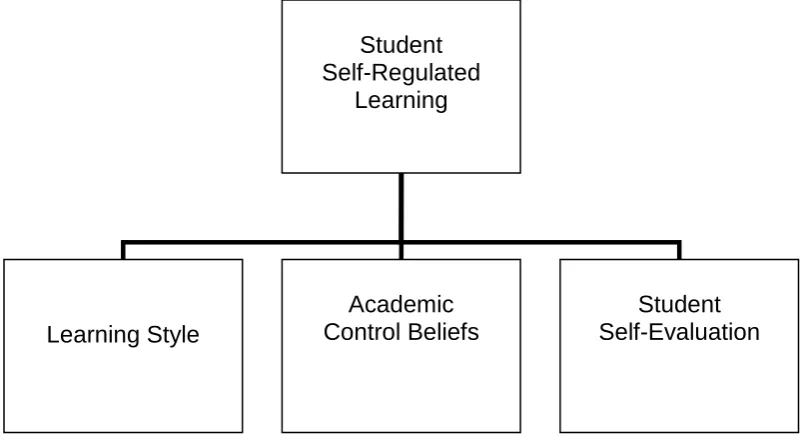
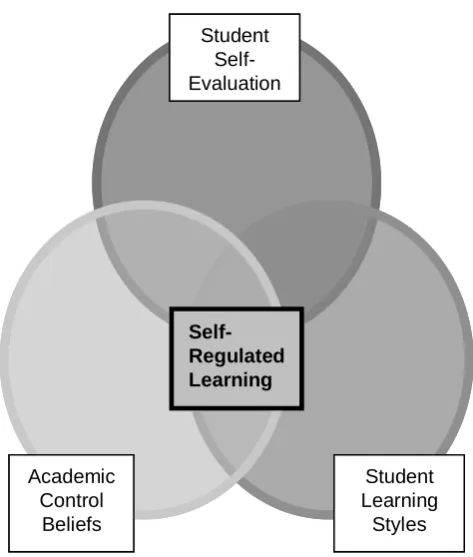
their learning (Figure 1). In this positional article it is suggested that each of
as present in the major self-regulated learning theories. These include
[image:4.595.97.499.216.439.2]motivation, self-awareness, key processes, social and environmental influences and acquisition of self-regulated learning.
Figure 1. Likely constructs underlying student self-regulated learning
The article considers the relevance of learning style, academic control beliefs
and student self-evaluation to a general model of student self-regulation
proposed by Boekaerts (1999). In doing so, pertinent issues such as Coffield
et al. (2004) and Rayner’s (2007) suggestion that the future pedagogical utility of learning styles may lie in the development of metacognitive knowledge and
awareness are addressed in the context of student self-regulated learning.
The article has two general aims. The first is to emphasise self-regulated
learning as a highly relevant and valuable concept in higher education. The
second is to promote the study of those constituent elements and processes
considered most likely to develop our understanding of self-regulated learning Student
Self-Regulated Learning
Learning Style
Academic Control Beliefs
beyond the mere description of processes thought to be involved in
self-regulated learning (see Baumert et al., 2000).
Self-regulated learning
Self-regulated learning is considered to be separate from mental ability or
academic performance skill. Instead, it refers to a self-directed process
through which learners transform mental abilities into task-related academic
skills (Zimmerman, 2001).
Woolfolk (2004) states the general influences on student self-regulated
learning as knowledge about themselves, the subject area, the task, strategies for learning and the context in which they will apply learning;
motivation to learn where students value learning not just performance, are intrinsically motivated and learning is self-determined and not controlled by or
dependent on others; and volition or will-power where students are able to protect themselves from and know how to deal with and resist distractions.
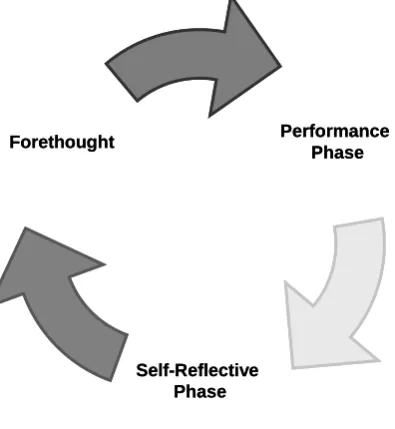
While Zimmerman (2002) suggests three phases of self-regulated learning:
Forethought, involving task analysis (goal setting, strategic planning) and self-motivation beliefs (self-efficacy, outcome expectancies, intrinsic interest/value,
learning goal orientation); Performance, involving control (imagery, self-instruction, attention focussing, task strategies) and self-observation
(self-recording, self-experimentation, self-reflection phase); and Self-reflection
involving self-judgement (self-evaluation, causal attribution) and self-reaction
(2001) three-phase cyclical model involving forethought, performance and
[image:6.595.197.395.180.395.2]self-reflection.
Figure 2. Three phases of self-regulated learning (after Zimmerman, 2002)
Performance Phase
Self-Reflective Phase
Forethought Performance
Phase
Self-Reflective Phase Forethought
In line with a social cognitive perspective (Bandura, 1986), self-regulated
learning occurs as a result of reciprocal causation between three influence
processes: personal processes such as perceptions of ability (e.g. academic self-efficacy) and self-motivation (e.g. goals); the learning environment,
including task demands and encouragement from teachers; and individual behaviour such as performance outcomes (e.g. previous marks/grades) (Singer & Bashir, 1999; Zimmerman, 1989). Zimmerman (1989) states that
‘students can be described as self-regulated to the degree that they are
metacognitively, motivationally, and behaviourally active participants in their
Key component processes inself-regulated learning
Singer and Bashir (1999) have described self-regulated learning as a meta
construct defined as ‘a set of behaviours that are used flexibly to guide,
monitor, and direct the success of one’s performance’ and ‘to manage and
direct interactions within the learning environment in order to ensure success’
(p.265). Both the theoretical and empirical literature related to self-regulated
learning (occasionally referred to as academic self-regulation) presents a number of examples which—directly or indirectly—illustrate the relevance of
learning style (i.e. preferred ways of responding to learning tasks, including
cognitive processes and behaviour, Peterson et al., 2008), perceived academic personal control (i.e. ‘beliefs about their capacity to influence and
predict daily life events’, Perry, 2003, p.3) and student peer assessment and
self-assessment (i.e. student evaluation of the academic quality of their peers’
and their own work) to self-regulated learning. It is these three constructs then
which provide the focus for this article, in which it is suggested that—certainly
according to a social cognitive perspective (Schunk, 2001)—each plays a key
role in the development and practice of student self-regulated learning.
Self-regulated learning theories also seek to explain why, despite the
apparent capacity to learn in terms of advantages in mental ability, social
economic status and quality of education, some learners fail to achieve
academically (Zimmerman, 2001). Those authors offering leading theoretical
perspectives on self-regulated learning are in agreement regarding the critical
nature of students’ self-perceptions of themselves as learners and their use of
(Zimmerman, 2001). This reflects a general consensus that students’ ability
to learn can be improved through metacognitive and motivational strategies
(Zimmerman, 2001). Zimmerman also refers to feedback, including peer
assessment and assessment, as a form of social learning relevant to
self-regulated learning.
Three common criteria are highlighted by Zimmerman which he considers to
apply across most self-regulated learning theoretical perspectives: (1)
purposive use of specific processes, strategies or responses by students to
improve their academic achievement; (2) the use of a self-orientated feedback
loop involving students monitoring the effectiveness of their learning
strategies and responding to feedback with changes in self-perceptions or
learning strategies; (3) a motivational dimension—involving self-efficacy
beliefs—which determines choice of particular self-regulatory processes,
strategies or responses.
On the basis of Zimmerman’s account of the major self-regulated learning
theories, it seems reasonable to assert that learning style, academic control
beliefs and student self-evaluation are constructs central to the advancement
of self-regulated learning research and practice. Support for such an assertion
is provided by Schunk’s (2001) social cognitive perspective on self-regulated
learning which implicates self-efficacy and outcome expectancies in the
learning; learning style in the self-awareness and key processes aspects of self-regulated learning, whereby there is self-observation and self-judgement
(i.e. metacognition) comparing existing performance with learning goals and
subsequent self-reaction effects affecting the performance phase and involving adopting learning strategies or approaches most likely to help
achieve goals; and peer assessment and self-assessment in self-awareness
[metacognition], key processes (i.e. self-observation and self-evaluation),
social and environmental influence (i.e. nature of the task, enactive mastery experience influencing self-efficacy) and acquisition (i.e. capacity to make social comparisons and ability attributions) aspects of self-regulated learning.
Boekaerts’ conceptual model of self-regulated learning
Boekaerts’ (1999) conceptual model of self-regulated learning provides a
clear illustration of the relevance of learning style, perceived academic
personal control and peer and self-assessment constructs to self-regulated
learning. Boekaerts recognises the significance of each of the constructs in
more emphatic and explicit terms, stating that our understanding of
self-regulated learning has been informed by, and shaped by, three schools of
thought: learning style research; theories of the self; and research on
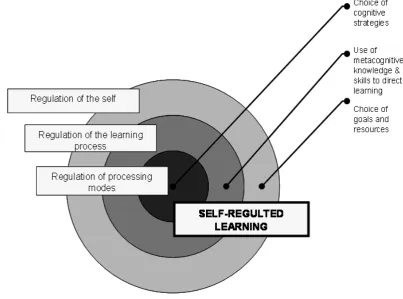
Figure 3. Three-layered conceptual model of self-regulated learning (Boekaerts, 999, p.449)
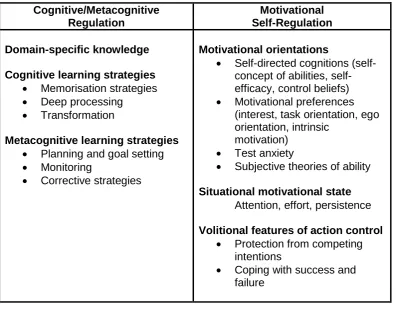
Boekaerts proposes a three-layered conceptual model of self-regulated
learning (Figure 3 & Table 1). The inner layer (i.e. learning or processing
styles) represents regulation of cognitive strategies or learning styles (i.e. the
typical way students learn) and is considered crucial for describing the quality
of students’ self-regulation process. By ‘quality’ Boekaerts is referring to the
association which some learning style theorists have drawn between certain
styles or approaches and regulation style. An example is Vermetten, Vermunt
and Lodewijks (1995) who present evidence of associations between a deep
approach to learning and a preference for opportunities for internal regulation of learning, and between a surface approach to learning and a preference for
utilisation of metacognition is presented as a regulatory process and includes
monitoring, evaluating and correcting skills (Table 1). These skills clearly reflect elements of student peer assessment and self-assessment skill and—
according to Coffield et al. (2004) and Rayner (2007)—may represent the future pedagogical utility of learning style approaches, i.e. to develop
metacognitive knowledge and awareness. The third and final layer of
Boekaerts’ model is concerned with regulation of the self and motivation (i.e. ‘motivation control system’). Information about the self-perceptions of learners is presented as an essential element for understanding self-regulation, i.e.
why students are prepared to do what they do and don’t do what they may be expected to do. Work examining academic self-efficacy and academic locus
of control is clearly situated within this motivational control system proposed by Boekaerts (1999), within which she refers to the students’ ability to
‘activate positive scenarios’ and to ‘value the task and to consider oneself
Table 1. Boekaerts’ model of self-regulated learning - adapted by Baumert et al. (2000, p.5)
Cognitive/Metacognitive Regulation
Motivational Self-Regulation
Domain-specific knowledge
Cognitive learning strategies • Memorisation strategies
• Deep processing
• Transformation
Metacognitive learning strategies • Planning and goal setting
• Monitoring
• Corrective strategies
Motivational orientations
• Self-directed cognitions (concept of abilities, self-efficacy, control beliefs)
• Motivational preferences (interest, task orientation, ego orientation, intrinsic
motivation)
• Test anxiety
• Subjective theories of ability
Situational motivational state
Attention, effort, persistence
Volitional features of action control • Protection from competing
intentions
• Coping with success and failure
Pintrich and De Groot (1990) have conducted empirical work which relates to
the motivational, cognitive and metacognitive aspects of Boekaerts’ model.
Their work focused on the three components of self-regulated learning which
conform to those proposed by Boekaerts. Namely cognitive strategies used to learn, remember and understand material, metacognitive strategies for monitoring and modifying cognition and effort management strategies and
motivation involving control beliefs and self-efficacy, intrinsic value and goals, and test anxiety. Pintrich and De Groot examined the nature of any intra and
inter component associations. Self-efficacy and intrinsic value were positively
correlated with both cognitive and metacognitve strategy use, with students
to use cognitive strategies and self-regulatory metacognitive. Self-efficacy,
intrinsic value, use of cognitive strategy and use of self-regulatory
metacognitive strategy were all positively correlated with academic
achievement. Regression analysis identified self-efficacy and self-regulatory
metacognitive strategy as significant predictors of average grade. As Pintrich
and De Groot point out, their findings provide an empirical base linking the
components of a general model of student self-regulated learning and, it is
suggested here, underline the significance of learning style, perceived
academic control and student peer assessment and self-assessment skill
[metacognitive skill] in any such model.
Self-regulated learning – pedagogical utility
Achieving a greater understanding of self-regulated learning as a rapidly
emerging concept in education remains a high priority endeavour for research
and practice-based educationalists (Baumert et al., 2000; Zimmerman & Schunk, 2001). The relevance of the constructs of learning style, perceived
academic control and student self-evaluation skill in this endeavour is
illustrated clearly and consistently in the recent relevant literature around
self-regulated learning. Chong (2007), for example, examines the role of personal
agency beliefs [including self-efficacy and self-concept] in self-regulated
learning, noting how the development of self-regulatory skill is critical,
particularly when the cognitive demands of the learning situation are
increased and effective learning is required. In a further example, Kirby and
Downs (2007) attempt to exploit student self-assessment practices to cultivate
development in foundation programme students who currently display a
surface approach and who show evidence of adopting performance rather than learning goals.
Self-regulated learning - implications for policy and practice in higher
education
Whilst work aimed at developing further our understanding of self-regulated
learning is set to continue, there are already several key messages for higher
education regarding student individual differences and self-regulated learning
which have immediate implications for institutional policy and practice.
Perhaps the most far reaching of these is the extent and range of student
individual differences existing in any given cohort and the need to
accommodate such diversity within ‘normal practice’. This renewed focus on
individual differences in learners can be explained in terms of two significant
emerging factors affecting—particularly higher—education. These are increased student diversity; and increased diversity in modes of delivery, with
a particular emphasis on information communication technologies. This is a
trend which is set to continue to increase given government initiatives to
significantly increase both the student population in higher education and
diversity within that population. Government policies relating to widening
participation in higher education and presenting a framework for the future of
higher education (Department for Business, Innovation and Skills, 2009;
Department for Education and Skills, 2003a & b), along with legislative
equality, diversity and inclusion policy governing legal rights for equal access
education in terms of both numbers and diversity. Constraints on future public
financing of higher education (Department for Business, Innovation and Skills,
2009) will also dictate changes in the manner in which courses are delivered.
Higher education as a whole is facing greatly increased student numbers as
compared with previous years (Higher Education Statistics Agency, 2010;
Universities and Colleges Admissions Services, 2010), with the student profile
in many institutions now dominated by non-traditional students (National
Centre for Education Statistics, 2000). This has created a student population
which has been described by Coomes and DeBard (2004) as one of the most
diverse ever and by Sax (2003) as the most educationally ambitious.
This emphasis on diversity, together with evidence that the level of support
provided by educational institutions in identifying and addressing diversity in
student populations is a significant factor in student adjustment and
development in higher education (Noldon & Sedlacek, 1998) underlines the
relevance of individual differences research to higher education pedagogy.
Self-regulated learning seems to offer a mechanism capable of both
representing student individual differences in learning and implementing
changes in normal practice which reflect the individual needs of students.
The relevance of self-regulation has already been recognised in other sectors
of education. Both Duckworth et al. (2009) and Meyer et al. (2008) have authored extensive government funded reports examining, and promoting,
self-regulated learning—and independent learning as a related concept—in
implementation of self-regulated learning which applies equally to higher
education. The guidance points include: not all students are equally
predisposed to self-regulate but aspects of self-regulation improve as a result
of effective teaching and learning practices; self-regulated learning requires
the development and deployment of learning strategies, positive self-efficacy
and pursuance of meaningful goals; introducing curriculum strategies which
focus on the development and enhancement of cognitive skills, metacognitive
skills and affective skills to improve regulated learning; student
self-monitoring and self-evaluation are important factors in the development of
regulated learning; regulated learning improves with practice;
self-regulated learning can be improved through guidance, modelling and effective
strategies; self-regulated learning requires an ‘enabling environment’ including
the physical setting, material resources and social interaction and positive
support from teachers and peers; there is a particular emphasis on
information communication technologies as a tool to support self-regulated
learning; self-regulated learning involves a new role for teachers which
focuses on process-orientated teaching with students actively involved in the
learning process, i.e. ‘learn how to learn’; any interventions to promote
self-regulated learning are likely to be long-term; implementation requires a
‘whole-school’ approach involving the support of both senior management and
teachers. To this list should be added an emphasis on practioner-led
initiatives which are recognised and valued by institutional management;
consensus among management and teaching staff so that there is consensus
Overall, higher education institutional policy and practice should be enabling, in that they should reflect the need for opportunities to model and practice
self-regulated learning for both students and teaching staff in order to address
misconceptions and misunderstanding, demonstrate value and allow the
development of appropriate skill sets for self-regulation.
Conclusion
It was not the intention of the article to provide an extensive explanation of or
examination of self-regulated learning theory. Rather, it was to emphasise the
development of self-regulatory learning skills in students as a priority for
higher education (Baumert et al., 2000) and to drawn attention to those psychological constructs identified as instrumental in the development of
self-regulated learning.
Noting an inevitable uncertainty surrounding what individuals will need to
know in the future, Baumert et al. (2000) suggests assuming a ‘dynamic model of continuous acquisition of new knowledge and skills’ (p.2) – with
self-regulated learning being viewed as a central element in such a model.
Self-regulated learning is thus considered a vital prerequisite of successful
acquisition of knowledge and of particular importance in sustaining lifelong
learning (Baumert, et al., 2000). In conceptualising self-regulated learning, Boekaerts (1999) proposes a layered model involving three regulatory
processes: regulation of the self (goals); regulation of the learning process
determined through the mutual dependency of the individual constituent cognitive, metacognitive and motivational components of the model. So, it is
the aggregated effect of these components which determines the efficacy of the self-regulation process, with deficiencies in any component adversely
affecting the degree to which the student self-regulates their learning. Figure 4
represents how the composite influence of learning style, academic control
beliefs and student self-evaluation on student self-regulated learning might be
conceptualised.
It is suggested then that focusing on those constituent constructs identified
within the underlying conceptual architecture of self-regulated learning will
offer a manifesto for the development of self-regulated learning skills in
students and, thus, provide a rationale for the pedagogical utility of the
self-regulated learning concept. Such an argument is stronger in the case of
those constructs where understanding is more advanced and for which valid
and reliable methods of measurement have already been developed.
Although describing self-regulated learning as a complex construct existing at
the ‘junction of many different research fields’ (Boekaerts, 1999, p.447),
Boekaerts (1997; 1999) does refer to learning style, academic personal
control and metacognitive skill development as major influences in the
development of self-regulated learning theory. The relevance of these
constructs is also noted by other authors in their accounts of self-regulated
learning (e.g. Schunk, 2001; Zimmerman & Martinez-Pons, 1990) and it would
models the influence of learning style, academic control beliefs and student
self-evaluation on self-regulated learning. This might involve exploring
learning style as a metagognitive process (Coffield et al., 2004; Rayner, 2007), examining motivational processes through academic self-efficacy
interventions (Schunk, 1989) and evaluating student peer assessment and
self-assessment as valuable forms of monitoring and corrective strategies (i.e.
[image:19.595.167.404.392.671.2]metacognitive regulation, Baumert et al., 2000; Cassidy, 2006).
Figure 4. Conceptualisation of the composite Influence of key component processes of self-regulated learning
Boekaerts (1999) goes on to describe self-regulated learning as a powerful
construct which allows the various components of successful learning to be
described. Empirical studies centred on measurable constructs such as
learning style (Entwistle & Tait, 1996), academic self-efficacy (Cassidy &
Eachus, 2002a) and student self-assessment (Cassidy, 2006), are likely to
provide a major contribution towards the advancement of self-regulated
learning research and practice. Such work would also reflect the sentiments of
Zimmerman (1990), who strongly advocates the need for the study of
component processes to contribute to a growing understanding of the distinctive features of students' self-regulated learning.
As a final point for this paper, it should not be overlooked that each of the
constructs suggested for advancing the conceptualisation and application of
self-regulated learning present their own particular thorny issues and
limitations which remain to be fully resolved. Some of the major issues include
the conceptual fragility of learning style approaches highlighted—most
notably—by Coffield et al. (2004), the precise nature and subtle conceptual distinctions within personal control beliefs described by Bandura (2006) and
how these might be captured by psychometric measures which reflect
contemporary educational contexts (Cassidy & Eachus, 2002a & b; Eachus &
Cassidy, 1997 & 2006), and an imperative for student peer assessment
self-assessment emphasized by Boud (2008) and Cassidy (2006 & 2007).
Nevertheless, these constructs remain prevalent in conceptual accounts of
self-regulated learning and are considered critical factors in our understanding
References
Bandura, A. (1986). Social foundation of though and action. A social cognitive theory. Englewood Cliffs, NJ: Prentice-Hall.
Bandura, A. (2006). Guide for constructing self-efficacy scales. In T. Urdan &
F. Pajares (Eds.). Self-Efficacy in adolescents. Greenwich, CT: Information Age Publishing.
Baumert, J., Klieme, E, Neubrand, M., Prenzel, M., Schiefele, U., Schneider,
W., Tillmann, K-J. & Weib, M. (2000). Self-Regulated Learning as a Cross-Curricular Competence. Berlin: Max-Planck Institut fur Bildungsforschung.
Boekaerts, M. (1997). Self-regulated learning: A new concept embraced by
researchers, policy makers, educators, teachers, and students. Learning and Instruction, 7(2), 161-186.
Boekaerts, M. (1999). Self-regulated learning: Where we are today.
International Journal of Education Research, 31, 445-457.
Boud, D. (2008). Rethinking assessment for learning after the course.
Proceedings of the Psychology Learning and Teaching Annual Conference, Bath, UK. Retrieved online from:
Cassidy, S. & Eachus, P. (2002a). The development of the General Academic
Self- Efficacy (GASE) Scale. British Psychological Society’s Annual Conference. Blackpool, UK.
Cassidy, S. & Eachus, P. (2002b). Development of the Computer Self-Efficacy
(CUSE) Scale: Investigating the relationship between CSE, gender and
experience with computers. Journal of Educational Computing Research, 26(2), 133-153.
Cassidy, S. (2006). Developing Employability Skills: Peer Assessment in
Higher Education. Education & Training, 48(7), pp. 508-517.
Cassidy. S. (2007). Assessing ‘inexperienced’ students’ ability to self-assess:
exploring links with learning style and academic personal control. Assessment & Evaluation in Higher Education vol. 32(3), June 2007, pp. 1-18.
Coffield, F., Moseley, D., Hall, E. & Ecclestone, K. (2004) Should we be using learning styles? What research has to say to practice. London: Learning Skills Research Centre.
Chong, Wan Har. (2007). The role of personal agency beliefs in academic
Coomes, M.D. & DeBard, R. (2004). A generational approach to
understanding students. New Directions for Student Services, 106, 5-16.
Department for Business, Innovation and Skills. (2009). Higher ambitions – the future of universities in a knowledge economy. UK, Department for Business, Innovation & Skills.
Department for Education and Skills. (2003a). The Future of Higher
Education. White Paper cm. 5735. Norwich: Department for Education and Skills.
Department for Education and Skills. (2003b). Widening Participation in Higher Education. Norwich: Department for Education and Skills.
Duckworth, K., Ackerman, R., MacGregor, A., Salter, E. & Vorhaus, J. (2009).
Self-regulated learning: a literature review. Centre for Research on the Wider Benefits of Learning. Institute of Education, University of London. Retrieved
online from: http://www.dcsf.gov.uk/research/data/uploadfiles/WBL33.pdf.
Eachus, P. & Cassidy, S. (1997). Development of the Health Student
Academic Locus of Control Scale. Perceptual and Motor Skills, 85, pp. 994.
Eachus, P. & Cassidy, S. (2006). Development of the Web User Self-Efficacy
Entwistle, N. & Tait, H.(1996). Approaches and Study Skills Inventory for Students. Centre for Research on Learning and Instruction. University of Edinburgh.
Higher Education Statistics Agency. (2010). Press release 144 – Students in
higher education 2008/9. Higher Education Statistics Agency. Retrieved
online from: www.hesa.ac.uk.
Kirby, N.F., and Downs, C.T. (2007). Self-assessment and the disadvantaged
student: potential for encouraging self-regulated learning? Assessment and Evaluation in Higher Education, 32(4), 475-494.
Meyer, B., Haywood, N., Sachdev, D. and Faraday, S. (2008). Independent learning: a literature review. Learning and Skills Network. Retrieved online from: http://www.dcsf.gov.uk/research/data/uploadfiles/DCSF-RR051.pdf.
National Centre for Education Statistics (2000). Digest of Education Statistics, 1999. National Center for Education Statistics Report 2000-031. Washington, DC: U.S. Department of Education.
Noldon, D., & Sedlacek, W. E. (1998). Gender differences in attitudes, skills,
Perry, R.P. (2003). Perceived (academic) control and causal thinking in
achievement settings. Canadian Psychology, November.
Peterson, E.R., Rayner, S., Armstrong, S.J. & Deane, K. (2008). Researchers’ Perspectives of Cognitive and Learning Styles. Technical Report 1, 1-16. Auckland: University of Auckland.
Pintrich, P.R. & De Groot, E.V. (1990). Motivational and self-regulated
learning components of classroom academic performance. Journal of Educational Psychology, 82, 33-40.
Rayner, S. (2007). A teaching elixir or best fit pedagogy? Do learning styles matter? Support for learning, 22(1), February, 24-30.
Sax, L.J. (2003). Our incoming students: what are they like? About Campus,
8(30), 15-20.
Schunk, D.H. (1989). Social cognitive theory and self-regulated learning. In
B.J. Zimmerman & D.H. Schunk (Ed). Self-regulated learning and academic achievement. Theory, research and practice. New York: Springer Verlag.
Schunk, D.H. (2001). Social Cognitive Theory and Self-Regulated Learning. In
Singer, B.D., & Bashir, A.S. (1999). What are executive functions and
self-regulation and what do they have to do with language-learning disorders?
Language, Speech, and Hearing Services in Schools, 30, 265-273.
Universities and Colleges Admissions Services. (2010). Data summary - Total UCAS applications, applicants and accepted applicants over six years.
Retrieved online form: www.ucas.ac.uk.
Vermetten, Y. J. M., Vermunt, J. D. H. M., & Lodewijks, J. G. L. C. (1995).
Changes in learning styles as a result of student oriented education. Paper
presented at the Biannual Meeting of the European Association for Research on Learning and Instruction, Nijmegen.
Woolfolk, Anita. (2004). Educational Psychology. (9th ed). Boston: Allyn and Bacon.
Zimmerman, B. J. (1989). Models of self-regulated learning and academic
achievement. In B.J. Zimmerman & D.H. Schunk (Ed). Self-regulated learning and academic achievement. Theory, research and practice. New York:
Springer-Verlag.
Zimmerman, B.J. (1990). Self-regulated learning and academic achievement:
Zimmerman, B.J. (2001) Theories of self-regulated learning and academic
achievement: An overview and analysis. In B.J. Zimmerman & D.H. Schunk
(Eds). (2001). Self-Regulated Learning and Academic Achievement: Theoretical Perspectives. Hillsdale, NJ: Lawrence Earlbaum Associates.
Zimmerman, B.J. & Schunk, D.H. (Eds). (2001). Self-Regulated Learning and Academic Achievement: Theoretical Perspectives. Hillsdale, NJ: Lawrence Earlbaum Associates.
Zimmerman, B.J. (2002). Becoming a self-regulated learner: An overview.
Theory Into Practice, 41(2), 64-71.
Zimmerman, B.J. & Martinez-Pons, M. (1990). Student differences in
self-regulated learning: Relating grade, sex, and giftedness to self-efficacy and