A Biomechanical Analysis of Variations of the Power
Clean and their Application for Athletic Development
Paul Comfort
The University of Salford
School of Health Sciences
Submitted in Partial Fulfilment of the Requirements of the Degree of
Doctor of Philosophy by Published Works
i | P a g e
TABLE OF CONTENTS
Page
List of Tables...i
Acknowledgements...iv
Terms and Abbreviations...v
1 ...
OVERVIEW AND PROGRESSION OF STUDIES ... 2
1.1 Study 1... 4
1.1.1 Summary ... 4
1.2 Study 2 & 3 ... 5
1.2.1 Summary ... 6
1.3 Study 4... 6
1.3.1 Summary ... 7
1.4 Study 5... 8
1.4.1 Summary ... 8
1.5 Study 6... 8
1.5.1 Summary ... 9
1.6 Conclusions ... 9
INTRODUCTION ... 11
2 ...
INTRODUCTION ... 12
2.1 Methods of Training used to Enhance Power Output ... 12
2.1.1 Strength Training ... 12
2.1.2 Ballistic Training... 18
2.1.3 Plyometric Training ... 20
2.1.4 Olympic Lifts ... 26
2.2 Areas for Further Research ... 31
3
...CRITICAL REVIEW OF LITERATURE ... 34
3.1 Methodological Issues with Assessment of Power ... 34
3.1.1 Kinetic methods ... 35
3.1.2 Kinematic methods ... 38
3.1.3 Comparisons of Different and Combined Methods ... 41
3.1.4 Summary ... 45
3.2 Rate of Force Development... 46
3.2.1 Force and Rate of Force Development... 46
ii | P a g e
3.2.3 Multi-Joint Assessment of Rate of Force Development ... 49
3.2.4 The Role of Rate of Force Development ... 53
3.2.5 Methodological Differences in Assessment of Rate of Force Development ... 55
3.2.6 Rate of Force Development and Impulse ... 62
3.2.7 Summary ... 64
3.3 Olympic Lifts and their Component Lifts ... 65
3.3.1 Relationships with Athletic Performance ... 65
3.3.2 Kinematic Assessment of the Olympic Lifts ... 66
3.3.3 Kinetic Assessment of the Olympic Lifts ... 68
3.3.4 Summary ... 69
3.3.5 Areas for Further Research ... 70
3.4 Optimal Loading for Peak Power Output ... 71
3.4.1 Optimal Loading during Single Joint Exercises ... 72
3.4.2 Optimal Loading during Squats ... 73
3.4.3 Optimal Loading during Squat Jumps... 76
3.4.4 Optimal Loading during the Power Clean and its Variations ... 79
3.4.4.1 Power Clean ... 81
3.4.4.2 Hang Power Clean ... 82
3.4.4.3 Mid-thigh Clean Pulls ... 84
3.4.4.4 Summary and Applications ... 85
3.4.5 Areas for Further Research ... 85
3.5 Research Hypotheses... 87
4
...Study 1 ... 88
4.1 Study 1 Commentary ... 90
5 ...
Study 2 ... 91
5.1 Study 2 Commentary ... 93
5.2 Erratum ... 93
6
...Study 3 ... 95
6.1 Study 3 Commentary ... 97
6.2 Erratum ... 97
7 ...
Study 4 ... 99
7.1 Study 4 Commentary ... 101
8
...Study 5 ... 102
8.1 Study 5 Commentary ... 104
9
...Study 6 ... 105
9.1 Study 6 Commentary ... 107
iii | P a g e
10.1 Practical Application ... 117
10.2 Ongoing Research ... 119
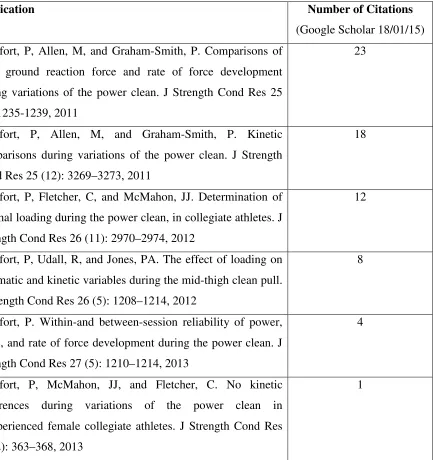
10.2.1 Citations ... 119
10.2.2 Influence in the field ... 120
10.3 Limitations ... 122
10.4 Areas of Future Research ... 126
10.5 Conclusion ... 129
iv | P a g e
LIST OF FIGURES AND TABLES
Figures 1.1 Progression of Studies...3
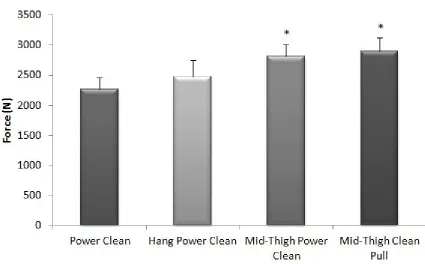
Figure 5.1: Comparison of peak force during variations of the power clean...94
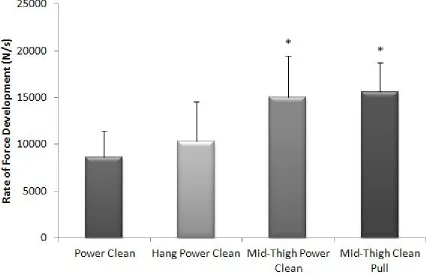
Figure 5.2: Comparison of peak RFD during variations of the power clean...95
Table 3.1 Isometric Single Joint Assessments of Rate of Force Development...56
Table 3.2 Isometric Multi-joint Assessment of Rate of Force Development...58
Table 3.3 Dynamic Multi-joint Assessment of Rate of Force Development...60
v | P a g e
ACKNOWLEDGEMENTS
I would like to thank numerous friends and colleagues for their help, guidance and continued support during the completion of this thesis for PhD by published works.
Firstly, thank you to Dr Phil Graham-Smith for providing me with the opportunity to work at the University of Salford and the early discussions and inspiration to commence this series of studies. Thank you for the continued support and advice throughout the research process. Thank you to Dr Steve Pearson for the valuable input and discussions relating to all aspects of research, related to this series of studies and a variety of additional publications, which have all helped to understand, develop and implement numerous research methodologies across a range of studies. Thank you to John McMahon and Dr Paul Jones for their assistance and input during the latter studies that make up this thesis, along with their continued input and assistance with ongoing research projects. Also, thank you to Dr Lee Herrington for his valuable feedback, insight and the odd shove in the right direction, during the writing of this thesis; I owe you one.
Dr Jason Lake and Peter Mundy, thank you for collaborating on additional research projects and publications; the discussions from which have greatly enhanced subsequent research and writing, especially regarding the methodological issues relating to the assessment of power and rate of force development. I am looking forward to continued collaborations with you both.
vi | P a g e
TERMS AND ABBREVIATIONS
Clean: Part of the Olympic lift, Clean and Jerk. The bar starts on the floor, is displaced via extension of the knees, to just above the patella and is then rapidly repositions via a double knee bend and accelerated upwards via a triple extension of the ankles, knees and hips and then caught in a full depth front squat, with a knee angle <90 degrees
CMJ: Countermovement jump; initiated with a rapid
countermovement to stimulate the stretch shorten cycle
COM: Centre of mass of an object
Forward Dynamics: Method of calculating power output based on force time data collected using a force plate
GTO Golgi tendon Organ: Sensory receptor responsible for monitoring tendon length and tension of the tendons
GRF: Ground reaction force. In this case vertical ground reaction force (vGRF) collected through the use of the force platform. Hang Power Clean: A derivative of the power clean, where the bar starts just above
the patella and is rapidly repositions via a double knee bend and accelerated upwards via a triple extension of the ankles, knees and hips and then caught in a shallow front squat position, with a knee angle >90 degrees
Inverse Dynamics: Method of calculating power output based on displacement time data, usually based on barbell velocity
IMTP: Isometric mid-thigh pull; multi-joint method of isometric assessment of lower limb kinetics
LPT: Linear Position Transducer; a device which measures displacement time data which permits calculation of velocity, usually of a barbell
Mid-Thigh Power Clean: A derivative of the power clean, where the bar starts at mid-thigh and is rapidly accelerated upwards via a triple extension of the ankles, knees and hips and then caught in a shallow front squat position, with a knee angle >90 degrees
vii | P a g e
MVIC: Maximum voluntary isometric contraction; method of isometric assessment of lower limb kinetics, usually single joint, e.g. Knee extension
PMax: Maximal Power Load; the optimal load to elicit peak power for a specific exercise
Power Clean: A derivative of the clean, where the bar starts on the floor, is displaced via extension of the knees, to just above the patella and is then rapidly repositions via a double knee bend and accelerated upwards via a triple extension of the ankles, knees and hips and then caught in a shallow front squat position, with a knee angle >90 degrees
RFD: Rate of Force Development
SJ: Squat jump; Performed from a static position with no countermovement to eliminate the stretch shorten cycle
SSC Stretch-shortening cycle; where a movement is initiated with a rapid eccentric action to stimulate the muscle spindle and store elastic energy, immediately followed by a rapid concentric action which utilises the neurological potentiation and elastic energy
System Mass: The mass of an individual and the external load applied to it, (e.g. Body mass + barbell mass)
viii | P a g e
ABSTRACT
The aim of this series of studies was to determine the effect of power clean variation (power clean (PC), hang power clean (HPC), mid-thigh power clean (MTPC) and mid-thigh clean pull (MTCP)) and load on force time characteristics, in an attempt to identify the optimal variation and load to develop specific force time characteristics.
Study 1 demonstrated that assessment of peak force, peak rate of force development (RFD) and peak power were highly reliable (ICC r≥0.968) during the PC, with smallest detectable differences of ≥8.68 N, ≥24.54 N.s, ≥68.01 W, respectively, signifying a meaningful change. Study 2 and 3 demonstrate that the MTCP and MTPC are preferential in terms of maximising acute kinetic performances when compared to the PC and HPC, as they result in the greatest peak force, peak RFD and peak power.
In contrast, study 4 showed no kinetic differences (p>0.05) across PC variations (PC, HPC, MTPC) or load (70, 70, 80% 1-RM) in inexperienced female collegiate athletes.
Study 5 revealed that peak power output during the PC was achieved at a load of 70% 1-RM, although this was not significantly (p>0.05) different when compared to the 60% and 80% 1-RM loading conditions, in inexperienced athletes, in line with previous research in well trained athletes.
ix | P a g e
1 | P a g e
2 | P a g e
1
OVERVIEW AND PROGRESSION OF STUDIES
Figure 1.1 Progression of studies
Study 1
•
Within
rate of
• Confirmed p<0.001) detectable1), and peak
Study 2
•
Comparisons of peak ground reaction force and rate of
force development during variations of the power lean
• Identified that the midsignificantly (p<0.001) greater peak force and peak RFD compared to the power clean and hang power clean
Study 3
•
Kinetic comparisons during variations of the power clean
• Confirmed findings of the previous study and identified that midpower clean and MTCP resulted in significantly (p<0.001) greater peak force and peak RFD, along with significantly (p<0.001) greater peak power compared to the power clean and hang power clean
Study 4
•
No kinetic differences during variations of the power clean
in inexperienced female collegiate athletes
• There were no significant differences (p>0.05) in peak force, peak RFD or peak power, between power clean variation (power clean, hang power clean, mid
Study 5
•
Determination of optimal load during the power clean, in
collegiate athletes
• Found 70% 1
significantly greater than the 30% (p=0.007), 40% (p=0.04) and 50% (p=0.05) 1
compared to the 60% and 80% loads.
Study 6
•
The effect of loading on kinematic and kinetic variables
during the mid
• Found peak force, peak RFD and impulse to occur between 120 1-RM power clean, whereas peak bar velocity and peak power were achieved at 40% 1
greater (p>0.05) than peak power at 60% 1
Figure 1.1 Progression of studies
Within and between session reliability of power,
force development during the power
Confirmed high reliability of each variable both ) and between (r≥0.988, p<0.001) session, detectable differences for peak force (≥8.68 N), peakpeak power (≥68.01 W).
Comparisons of peak ground reaction force and rate of
force development during variations of the power lean
Identified that the mid-thigh power clean and MTCP resulted in significantly (p<0.001) greater peak force and peak RFD compared to the power clean and hang power cleanKinetic comparisons during variations of the power clean
Confirmed findings of the previous study and identified that midpower clean and MTCP resulted in significantly (p<0.001) greater peak force and peak RFD, along with significantly (p<0.001) greater peak power compared to the power clean and hang power clean
No kinetic differences during variations of the power clean
in inexperienced female collegiate athletes
There were no significant differences (p>0.05) in peak force, peak RFD or peak power, between power clean variation (power clean, hang power clean, mid-thigh power clean), or across loads (60, 70, 80% 1
Determination of optimal load during the power clean, in
collegiate athletes
Found 70% 1-RM power clean to elicit peak power output,
significantly greater than the 30% (p=0.007), 40% (p=0.04) and 50% (p=0.05) 1-RM loads, but not significantly (p>0.05) different when compared to the 60% and 80% loads.
The effect of loading on kinematic and kinetic variables
during the mid-thigh clean pull
Found peak force, peak RFD and impulse to occur between 120 RM power clean, whereas peak bar velocity and peak power were achieved at 40% 1-RM (3712.8 ±254.4 W), although not significantly greater (p>0.05) than peak power at 60% 1-RM (3604.1
3 | P a g e
power, force and
power clean
both within (r≥0.969, session, and low smallest RFD (≥233.93 N.s
-Comparisons of peak ground reaction force and rate of
force development during variations of the power lean
thigh power clean and MTCP resulted in significantly (p<0.001) greater peak force and peak RFD compared to
Kinetic comparisons during variations of the power clean
Confirmed findings of the previous study and identified that mid-thigh power clean and MTCP resulted in significantly (p<0.001) greater peak force and peak RFD, along with significantly (p<0.001) greater peak power compared to the power clean and hang power cleanNo kinetic differences during variations of the power clean
There were no significant differences (p>0.05) in peak force, peak RFD or peak power, between power clean variation (power clean, hang power
thigh power clean), or across loads (60, 70, 80% 1-RM)
Determination of optimal load during the power clean, in
RM power clean to elicit peak power output, which was significantly greater than the 30% (p=0.007), 40% (p=0.04) and 50%
RM loads, but not significantly (p>0.05) different when
The effect of loading on kinematic and kinetic variables
Found peak force, peak RFD and impulse to occur between 120-140% RM power clean, whereas peak bar velocity and peak power were
4 | P a g e
1.1
Study 1
Numerous studies have investigated or discussed the most appropriate methods to assess power generated during lower body power exercises, concluding that force time data should be collected using a force platform and power calculated using a forward dynamics approach, based on the impulse momentum relationship (Hori et al., 2006; Cormie et al., 2007a; Cormie et al., 2007c; Cormie et al., 2007b; Hori et al., 2007; Lake et al., 2012). No studies, however, have reported the stability of such measures between testing sessions, or the smallest detectable differences, making it difficult for researchers and strength and conditioning coaches to infer meaningful changes in performance pre and post intervention, or between training or testing sessions. In addition, it was essential to establish the within and between session reliability and measurement error (Study 1) prior to undertaking any further studies.
1.1.1 Summary
5 | P a g e
1.2
Study 2 & 3
Variations of the power clean are regularly incorporated into athletes’ training regimes, with specific potential benefits hypothesised for each variation of the clean, although many of these theoretical benefits have not been substantiated by empirical evidence. The optimal loads which elicit peak power output for the power clean (Cormie et al., 2007c; Cormie et al., 2007b; Cormie et al., 2007e), hang power clean (Kawamori et al., 2005; Kilduff et al., 2007) and MTCP (Kawamori et al., 2006) have been reported between 60-80% one repetition maximum (1-RM) power clean, although these were generally not significantly different at loads ±10% of the optimal load.
6 | P a g e
generates the greatest peak power, even though these variations are regularly used by athletes in training (Study 3).
1.2.1 Summary
The results from these two studies are interesting as they imply that the MTCP and mid-thigh power clean are equally effective in generating peak power and may be more beneficial in maximising power development compared to the power clean and hang power clean. As these techniques require less technical competence and only a limited range of motion, they may be able to be performed by inexperienced athletes. Such variations of the clean may permit an enhancement in peak force, peak RFD and peak power, from the time they commence a strength and conditioning programme, without the need to acquire the skill to perform classical Olympic lifting techniques. Furthermore, when athletes’ have injuries that restrict range of motion and they cannot perform the power clean or hang power clean, the mid-thigh variations may be an excellent alternative.
1.3
Study 4
7 | P a g e
RFD and peak power, compared to the hang power clean and power clean; it was hypothesised that recreational athletes would demonstrated greater differences in kinetic variables across the variations of the power clean due to the lower level of technical competence required to perform the mid-thigh power clean, thus resulting in greater peak force, peak RFD and peak power, when compared to the power clean and hang power clean (study 4). The effect of loading was also expected to have an effect on the kinetic performance of the variations of the clean, based on the findings of previous research, where lower relative loads resulted in greater peak power due to an increased movement velocity (Kawamori et al., 2006; Cormie et al., 2007c; Cormie et al., 2007e; Hori et al., 2007). It was further hypothesised that the lowest load (60% 1-RM), during the mid-thigh power clean, would result in the greatest peak force, RFD and peak power, in line with previous research (Kawamori et al., 2006) (Study 4).
1.3.1 Summary
8 | P a g e
1.4
Study 5
As previously mentioned, the majority of previous research has been conducted using well trained team sport athletes (as with studies 1-3) or Olympic Weightlifters (Haff et al., 1997; Haff et al., 2005; Kawamori et al., 2005; Kawamori et al., 2006; Cormie et al., 2007c; Cormie et al., 2007b; Cormie et al., 2007e; Haff et al., 2008), and therefore the application of these findings to inexperienced athletes is problematic. The aim of study five, therefore, was to identify the optimal load during the power clean in relatively inexperienced collegiate athletes. It was hypothesised that 70% 1-RM would result in peak power output, in line with previous research (Cormie et al., 2007c; Cormie et al., 2007d).
1.4.1 Summary
The results of study 5 revealed, as hypothesised, that peak power output was achieved at a load of 70% 1-RM, although this was not significantly (p>0.05) different when compared to the 60% and 80% loads, which is in line with previous research in well trained athletes (Cormie et al., 2007c; Cormie et al., 2007d).
1.5
Study 6
9 | P a g e
phase of the pull to the rapid eccentric phase of the descent into the catch phase. Additionally, as the catch phase of the power clean is omitted during the MTCP, it is possible to use loads that are greater than 100% of the 1-RM power clean. The aim of study 6 therefore was to identify the effects of loading (40-140% 1-RM power clean) on kinematic and kinetic variables during the mid-thigh clean pull. Based on the force velocity relationship it was hypothesised that the lowest load (40% 1-RM) would result in the highest bar velocity and greatest peak power and that the heaviest load would result in the greatest peak force and peak RFD.
1.5.1 Summary
The findings of study 6 revealed that the heavier loads, of 120-140% 1-RM power clean, resulted in the greatest peak force, peak RFD and impulse and that the lightest load (40% 1-RM) resulted in the highest bar velocity and greatest peak power, as hypothesised. It is therefore suggested that the MTPC may be effective at developing both speed strength (40-60% 1-RM) and strength speed (120-140% 1-RM) if appropriate loading is applied. This loading should be applied in a periodized manner appropriate to the athletes’ specific goals.
1.6
Conclusions
10 | P a g e
not assessed. Moreover, as the MTCP does not include the catch phase of the power clean, it permits a load greater than 100% 1-RM power clean to be used, which at 120-140% 1-RM power clean, results in greater peak force, peak RFD and impulse, when compared to loads
≤100% 1-RM power clean (Figure 1.1). To further elucidate the possible advantages of such variations in the performance and loading of these exercises a training intervention study is recommended.
11 | P a g e
12 | P a g e
2
INTRODUCTION
Power is an essential component of sports performance, not just in short duration explosive activities (e.g. sprinting, jumping and throwing events) but also during decisive moments in team sports (e.g. acceleration, change of direction and jumping) (Gabbett et al., 2011c; Gabbett et al., 2011a; Gabbett et al., 2011b). The development of power within an athletes’ training programme is therefore essential, however, there are a variety of methods including strength training, ballistic training, plyometric training and Olympic lifts which are commonly used to increase power output (Stone, 1993; McBride et al., 2002; Hansen et al., 2003; Stone et al., 2003a; Cormie et al., 2007d; Harris et al., 2008; Cormie et al., 2010b; Cormie et al., 2010a; Cormie et al., 2011b) with no clear consensus regarding which method or mode of training is optimal. What is clear is that there are moderate to strong associations between power output and athletic performance in sports specific tasks (Cronin and Hansen, 2005; Harris et al., 2008; Harris et al., 2010b; Gabbett et al., 2011c; Lopez-Segovia et al., 2011; Marques et al., 2011; Requena et al., 2011; Cunningham et al., 2013; Sekulic et al., 2013). Moreover, power output is one of the key determinants of tackling ability in rugby league (Gabbett et al., 2011a; Gabbett et al., 2011b) and more importantly match performance in rugby league (Gabbett et al., 2011c).
2.1
Methods of Training used to Enhance Power Output
2.1.1 Strength Training
13 | P a g e
group of 2-6 repetitions, with a 3-5 minute rest between sets 2-3 days per week (Baechle et al., 2008). With differences in the optimal intensity, sets, repetitions and frequency identified for previously untrained (60% 1-RM, 4 sets, 3 days per week), recreationally trained non-athletes (80% 1-RM, 4 sets, 2 days per week), and trained non-athletes (85% 1-RM, 8 sets, 2 days per week) (Peterson et al., 2004; Peterson et al., 2005).
Possibly the most commonly performed and extensively researched exercise for the development of lower body strength is the back squat, with a number of studies finding moderate to strong associations between maximal strength (1-RM) and short sprint performance (Baker and & Nance, 1999; Wisloff et al., 2004; McBride et al., 2009; Requena et al., 2009; Requena et al., 2011; Comfort et al., 2012a; Kirkpatrick and Comfort, 2012), and three repetition maximum back squat (3-RM) and 10 and 30m sprint performance (Baker and & Nance, 1999; Brechue et al., 2010; Lockie et al., 2011; Comfort et al., 2013b; Cunningham et al., 2013).
14 | P a g e
Additional research, in soccer players, has also demonstrated improvements in sprint performance and change of direction associated with increases in squat strength (Helgerud et al., 2011; Keiner et al., 2013). Similarly, Nimphius, McGuigan and Newton (2012) also found improvements in sprint and change of direction performance along with increases in relative strength during the competitive season, in female softball players. In contrast de Villarreal (2012) found no change in sprint performance even though they observed an increase in strength and power after 7 weeks of training; however, the subjects were relatively weak to start with and therefore the increases in strength may have been predominantly neurological and therefore not transferred to sprint performance within the duration of the study.
15 | P a g e
Furthermore, Stone et al. (2003a) observed that stronger athletes (1-RM = 2.00 ± 0.24 kg/kg) generated much higher peak power during the countermovement jump (CMJ) (5079 ± 2363 W vs. 3785 ± 376 W) and SJ (5464 ± 2507 W vs. 3842 ± 443 W), when compared to weaker athletes (1-RM = 1.21 ± 0.18 kg/kg).
16 | P a g e
reported that the participants relative strength only influenced initial power production (≤200 ms) during stretch shorten cycle movements and not those performed from a static position without a prior eccentric stimulus, however, this was during the bench press.
17 | P a g e
al., 2008; McCurdy et al., 2009), which may explain the difference in the findings and the lack of differences observed between traditional plate loading and the inclusion of chain loading in most studies.
Maximising strength levels has been shown to be more beneficial than high velocity power training in athletes with relatively low strength levels (those that can squat <1.9 x body mass as barbell mass), whereas higher velocity power training in relatively strong athletes (those that can squat ≥1.9 x body mass as barbell mass) appears to be more beneficial than focussing on strength development (Cormie et al., 2010b; Cormie et al., 2010a). In contrast however, Fatouros et al., (2000) reported that weight training combined with plyometric training resulted in significantly greater improvements (p<0.05) in jump performances than weight training alone, however, the weight training had a muscular endurance focus (8-12 repetitions per set) rather than a strength focus. It is not surprising that group that performed jumping activities in their training demonstrated greater improvements in jump performances due specificity of training. There were, however, no significant differences (p>0.05) in squat or leg press strength between groups.
18 | P a g e
2.1.2 Ballistic Training
Ballistic training usually consists of more dynamic versions of strength training exercises (speed squats and deadlifts), ideally with no deceleration phase during the final stages of the concentric phase, as with squat jumps and bench throws (Newton et al., 1996; Swinton et al., 2011a; Swinton et al., 2011b; Swinton et al., 2012). During such power based training loads of 75-95% 1-RM, for 3-5 sets of 1-6 repetitions have traditionally been recommended (Baechle et al., 2008). Numerous studies, however, have identified that the optimal loads to elicit peak power output for such exercise is substantially lower (Baker, 2001; Stone et al., 2003a; Cormie et al., 2007a; Cormie et al., 2007c; Cormie et al., 2007b; Cormie et al., 2007e; Hori et al., 2007; Cormie et al., 2008; Thomasson and Comfort, 2012) than the loads traditionally recommended for such training, as these guidelines were originally based performances in on Olympic lifts (Baechle et al., 2008).
19 | P a g e
increase the load at which peak power is achieved (Cormie et al., 2007a; Cormie et al., 2007c; Hori et al., 2007; Cormie et al., 2008) (This is discussed in detail in Chapter 3.1).
20 | P a g e
presented such velocity specific adaptations of training across a spectrum of loads (Kaneko et al., 1983; Moss et al., 1997; Jones et al., 2001; McBride et al., 2002).
It would appear, therefore, that the initial focus of athletic development should be on maximising strength, while developing appropriate technique during power exercises (ballistic and Olympic style lifts) until athletes can be considered as being strong (parallel depth back squat ≥1.9 x body mass) (Cormie et al., 2010b; Cormie et al., 2010a; Cormie et al., 2011b; Cormie et al., 2011a). Low load ballistic exercises such as squat jumps are likely to be most beneficial in developing speed-strength and power, where as higher load ballistic exercises, such as speed deadlifts, with 20-40% load from chains, are likely to develop strength-speed, once athletes have developed a base level of strength (Swinton et al., 2011b). It is important, however, that strength is maintained if such an approach is adopted, as any decline in force production would result in a decrease in power generating capacity (Cormie et al., 2011b; Haff and Nimphius, 2012).
2.1.3 Plyometric Training
21 | P a g e
athletic performance (Bosco and Komi, 1979; Bosco et al., 1981; Bosco et al., 1982a; Bosco et al., 1982b; Komi, 2000).
Elastic energy is generated via the lengthening of the associated tendons (series elastic component (SEC)) and the muscle fascia (parallel elastic component (PEC)), during the eccentric phase of the activity and returned during the concentric phase (Asmussen and Bonde-Petersen, 1974a; Asmussen and Bonde-Petersen, 1974b; Komi, 2000; Wilson and Flanagan, 2008). Simultaneously, during the eccentric phase, both the change in length and the rate of change in length is detected by the muscle spindles, which result in increased potentiation of the agonist muscles and therefore increased force production, during the concentric phase, referred to as the contractile element (Cavagna et al., 1968; Bosco and Komi, 1979; Bosco et al., 1981; Bosco et al., 1982a; Bosco et al., 1982b; Bobbert et al., 1996). The relative contribution of the elastic element and the contractile element have been shown to be determined by the lengths of both components, with a longer tendon resulting in a larger contribution from the elastic component and longer muscle fascicles, resulting in a greater contribution from the contractile element (Arakawa et al., 2010). It is therefore not surprising that medial and lateral gastrocnemius fascicle length, pennation angle and Achilles tendon length have been shown to be related to jump performance (Earp et al., 2010; Earp et al., 2011; Comfort et al., 2014b).
22 | P a g e
stimulation of the GTO. Part of the adaptive response to strength training is a reduction in the sensitivity of the GTO (Gabriel et al., 2006; Folland and Williams, 2007) , therefore requiring a higher force prior to stimulation of the GTO and the resultant inhibition of the antagonist muscle. It is possible that this apparent reduced sensitivity of the GTO is due to the increase in tendon stiffness associated with training (Narici et al., 1996; Kubo et al., 2006; Burgess et al., 2007; Kubo et al., 2007), which in turn results in a greater force required to elicit the same magnitude of stretch to the tendon.
General recommendations for plyometric training suggest that they should be performed 2-4 x week, on non-consecutive days, with 5-10 s rest between repetitions, 2-3 mins rest between sets, for 80-100 repetitions for beginners, 100-120 repetitions at intermediate level and 120-140 repetitions for advanced level athletes (Potach and Chu, 2008). Although, if the intensity of the exercise is increased; for example progressing from a countermovement jump to a depth jump, the total volume (number of repetitions) should be reduced to accommodate the increased demands of the tasks (Potach and Chu, 2008).
23 | P a g e
1982b; Bobbert et al., 1996). It is important to note that increasing drop height, during depth jumps, results in an increase in loading (force on ground contact) but that this also increases ground contact time.
Lower body plyometrics are commonly divided into long contact times (>250 ms), whereby large angular displacement of the ankles, knees and hips occur, and short contact times (≤250 ms) with reduced angular displacement of the associated joints (Schmidtbleicher, 1992; Wilson and Flanagan, 2008). These different categories of plyometrics are usually selected in an attempt to meet the demands of different sporting tasks, for example the longer ground contact times during the initial acceleration phase of a sprint and the low ground contact times during maximal velocity sprinting (Brughelli et al., 2011; Cross et al., 2014).
24 | P a g e
Numerous studies have identified that plyometric training enhances performance in athletic tasks (Adams et al., 1992; Lyttle et al., 1996; Fatouros et al., 2000; Tricoli et al., 2005; Arabatzi et al., 2010; Lloyd et al., 2012) albeit generally in low load tasks such a vertical jump performance (Adams et al., 1992; Wilson et al., 1993; Tricoli et al., 2005). Adams et al. (1992) investigated the effect of 6 weeks of plyometric training, strength training (squats) and combined plyometric and strength training, on jump performance, in 48 recreationally trained college students. Results demonstrated that each group improved their vertical jump performance (3.30 cm, 3.81 cm, 10.76 cm respectively), although the combined training was more effective, demonstrating a significantly (p<0.001) greater increase in jump performance compared to the other groups. More recently, Fatouros et al. (2000) found similar results after a 12 week training programme, with each intervention resulting in an increase in jump performance (plyometric training, 6.0 cm; strength training, 5.4 cm; combined training, 9.6 cm) with a significantly (p<0.05) greater increase in jump performance in the combined training group. The greater increase in the combined training group is likely a result of the greater increase in maximal strength, as identified by 1-RM back squat performance in the combined group (plyometric, 6.4 kg; strength, 28.9 kg; combined, 36.1 kg), combined with the specificity of the movement patterns from the plyometric training.
25 | P a g e
been shown to misrepresent the true power applied to the system centre of mass and therefore results in an increase in the load which elicits the greatest peak and mean power (Cormie et al., 2007a; Cormie et al., 2007c; Cormie et al., 2007b; Cormie et al., 2007d; Cormie et al., 2007e; Cormie et al., 2008; McBride et al., 2011; Lake et al., 2012) (See Chapter 3.1 for a detailed discussion of methods of assessing power). In addition, the strength training was sub-optimal, using loads which permitted 6-10 repetitions, rather than the usual high loads (85-95% of one repetition maximum (1-RM)), for 2-6 repetitions (Baechle et al., 2008), which may have reduced the resultant adaptive responses.
26 | P a g e
While plyometric training and combined plyometric and strength training has been shown to enhance performance (Adams et al., 1992; Fatouros et al., 2000; Harris et al., 2008), it is important to note that the greatest benefits appear to be related to increased force production (Cormie et al., 2010b; Cormie et al., 2010a; Cormie et al., 2010c; Cormie et al., 2011b). Strength has been shown to be more trainable than velocity (Cronin et al., 2002; Cormie et al., 2010a; Cormie et al., 2010c; Barr and Nolte, 2014) until athletes are strong (Squat ≥1.9 x body mass), at which time a greater emphasis should be placed on the development of velocity and power, while maintaining strength (Cormie et al., 2010b; Cormie et al., 2010a; Cormie et al., 2010c; Haff and Nimphius, 2012), in a periodised manner.
2.1.4 Olympic Lifts
Olympic lifts consist of the snatch and the clean and jerk, with Strength and Conditioning Coaches incorporating numerous variations of these exercises into their athletes’ training programmes. Variations of the Olympic lifts are usually performed with the intent to move as rapidly as possible for 4-8 sets of 1-6 repetitions at loads of 75-90% 1-RM (Baechle et al., 2008).
27 | P a g e
the point of a Romanian deadlift, with the shoulders in front of the bar), or from mid-thigh (bar resting mid-mid-thigh while the athlete is in a semi-squatting position, with the shoulders directly above the bar). Similar start positions can be used for the snatch and power snatch, albeit with the bar slightly higher during the hang position (the bar starts at approximately mid-thigh) and the snatch from the hip (this replaces the mid-thigh position, although the participant is still in a semi-squatting position with the shoulders directly above the bar) due to the wider grip width.
Variations of these Olympic lifts are commonly used to enhance power development during sports-specific movements (rapid extension of ankles, knees and hips) (Stone, 1993; Stone et al., 2003a; Stone et al., 2003b; Stone et al., 2007) with performance in such lifts positively associated with performance in athletic tasks, including sprint, jump and agility performances (Stone et al., 2003b; Hori et al., 2008; McGuigan and Winchester, 2008; McGuigan et al., 2010). The positive associations between such performances are unsurprising as Canavan et al. (1996) previously reported similar kinetics between Olympic style lifts (hang snatch) and squat jump performances, similar to the previous observations between the second pull phase of the snatch and jump performances by Garhammer and Gregor (1992).
28 | P a g e
Lacrosse players has been shown to substantially improve technique in the power clean (Winchester et al., 2005), highlighting the importance of appropriate coaching of these complex activities.
29 | P a g e
Technical models for the ‘ideal’ performance in Olympic lifts has been determined by observation of elite lifters (Hakkinen et al., 1984; Gourgoulis et al., 2000; Gourgoulis et al., 2002; Chiu et al., 2010; Hadi et al., 2012; Harbili, 2012) and then applied as technical models (Pierce, 1999; Hedrick, 2004) for derivatives of these exercises for non-weightlifters (Graham, 2002; Duba et al., 2009). Such approaches, however, have been criticised as they assume that success is closely related to technique and general ignore other athletic characteristics (Lees, 2002). It is unreasonable to expect athletes from other sports to have the technique and athletic ability to perform the Olympic lifts with similar technique as Olympic weightlifters who specialise solely in these disciplines, unless they have been subject to an effective and progressive long term athlete development programme from a developmental age (Lloyd et al., 2013). In addition, athletes other than Olympic weightlifters tend to perform the power clean, power snatch and their derivatives rather than the full lifts, with technical models commonly provided to guide strength and conditioning coaches (Graham, 2002; Blackwood, 2004; Duba et al., 2009). It is important to note that the concentric phase of the power clean and clean should demonstrate the same kinematics and kinetics, with only the depth of the catch position being different between the two variations.
30 | P a g e
Pennington et al., 2010; Hadi et al., 2012; Harbili, 2012), where power was assessed using the same methods as Garhammer (1980, 1985, 1993).
Only four studies have previously reported kinetic variables during the different phases of the power clean, finding that the greatest peak force occurred during the second pull, compared to the first pull and transition phases (Enoka, 1979; Hakkinen et al., 1984; Garhammer and Gregor, 1992; Souza et al., 2002). No research however, has compared the kinetics of the different variations (mid-thigh clean pull, mid-thigh power clean, hang power clean, power clean) of the power clean to determine if the second pull phase results in the greatest peak force, peak RFD or peak power output, or if this is a product of the bar already gaining momentum during the first pull and transition phase of the power clean. No research, however, has compared the peak force or peak RFD, during the power clean, hang power clean (bar held, in the start position, just above the patella) the mid-thigh power clean and the mid-thigh clean pull (this is the concentric phase of the mid-thigh power clean without the catch phase). Furthermore, no studies have compared peak power during the power clean, hang power clean and mid-thigh power clean to establish which generates the greatest power.
31 | P a g e
2.2
Areas for Further Research
As the second pull phase of the Olympic lifts has been observed to result in the greatest force (Enoka, 1979; Hakkinen et al., 1984; Garhammer and Gregor, 1992; Souza et al., 2002), bar velocity and power (Garhammer, 1979; Garhammer, 1980; Garhammer, 1982; Garhammer, 1985) and the fact that strength and conditioning coaches regularly use various derivatives of the clean (e.g. power clean, hang power clean, mid-thigh power clean and mid-thigh clean pull) it would be useful to identify differences in force time characteristics between each of these variations. The results of such findings would permit strength and conditioning coaches to make more informed decisions regarding exercise selection.
32 | P a g e
33 | P a g e
34 | P a g e
3
CRITICAL REVIEW OF LITERATURE
3.1
Methodological Issues with Assessment of Power
35 | P a g e
Numerous researchers have investigated the different methods available for assessing power output during dynamic multi-joint exercises including the squat jump and power clean (Cormie et al., 2007a; Cormie et al., 2007c; Cormie et al., 2007b; Hori et al., 2007; Li et al., 2008; McBride et al., 2011; Lake et al., 2012). Three categories of methods are available to determine power during the power clean: kinetic methods, kinematic methods, and combined kinetic and kinematic methods, although a variety of combinations of these methods have been employed within the literature (Dugan et al., 2004; Cormie et al., 2007a; Cormie et al., 2007c; Cormie et al., 2007b; Hori et al., 2007; Li et al., 2008; McBride et al., 2011; Lake et al., 2012). Power estimation methods belonging to each category, including both the choice of instrument(s) and subsequent calculations, have been previously described within the literature (Cormie et al., 2007a; Cormie et al., 2007c; Cormie et al., 2007b; Hori et al., 2007; Li et al., 2008; Hansen et al., 2011; McBride et al., 2011; Lake et al., 2012). Despite several attempts, however, no standardized method for determining the power has been accepted (Dugan et al., 2004; Cormie et al., 2007a; Cormie et al., 2007c; Cormie et al., 2007b; Hori et al., 2007; Li et al., 2008; Hansen et al., 2011; McBride et al., 2011; Lake et al., 2012). Although, Lake et al. (2012) suggest that inverse dynamics based on barbell velocity should be avoided during lower body exercises. In general, the different methods either result in calculation of the power applied to the object (usually the barbell), COM or system COM, but result in differing power values and intensities which elicit peak power.
3.1.1 Kinetic methods
36 | P a g e
either a forward dynamics approach (Cormie et al., 2007a; Cormie et al., 2007c; Cormie et al., 2007b; Hori et al., 2007) or an impulse-momentum approach (Dugan et al., 2004). Within the numerical integration method, force applied to the system (body + external load) COM (F) is directly collected; therefore it is important that the full system mass is applied to the force platform prior to the onset of movement (Hori et al., 2007; McBride et al., 2011). System COM velocity (v) is obtained by time (t) integration (most commonly by applying the Simpson or trapezoidal rule (Street et al., 2001) of system COM acceleration (a); that is, F minus system weight (W) divided by system mass (m) (Cavagna, 1975; Driss et al., 2001):
= dt = F − Wm dt
(1) For each time point (i), power (P) is calculated as the product of F and v:
P = F∗
(2) Peak power output is identified as the greatest power output at any given time point during the concentric phase of the activity, with mean power output defined as the average of the power outputs at each individual time point during the concentric phase (based on sampling frequency) divided by the number of time points within the movement duration.
37 | P a g e
al., 2011; Lake et al., 2012), while the effect of horizontal motion of the barbell on the system COM remains unclear. It is worth acknowledging, that in Olympic weightlifters bar displacement and velocity may be important than the system COM, whereas for athletes performing such lifts to enhance lower body power output the motion of the bar is less important, with maximising power applied to the system COM the primary focus, in line with previous recommendations by McBride et al. (2011) and Lake et al. (2012).
The accuracy of the numerical integration method is limited only by the precision of the measured forces and the precision of the initial velocity integration constant (Cavagna, 1975; Maus et al., 2011). A correctly mounted and calibrated force platform (Lees and Lake, 2008) sampling at a sufficient frequency (1000 Hz recommend, although ≥200 Hz has been shown to be sufficient (Vanrenterghem et al., 2001; Hori et al., 2009)) is considered the gold standard of force measurement during ground based tasks. Errors related to the precision of the measured forces, such as instrumental instability and background noise, appear to be minimal. The precision of the initial velocity integration constant and the determination of system mass are therefore the primary threats to the integrity of the numerical integration method (Cavagna, 1975; Vanrenterghem et al., 2001; Maus et al., 2011). To ensure precision and accuracy of these measures it is imperative that subjects remain stationary for a short period (~0.5 s), with the system mass applied to the force platform, prior to the commencement of any movement, the integration constant of initial velocity is a known zero upon the start of integration at the initiation of movement (Cavagna, 1975; Vanrenterghem et al., 2001; Hori et al., 2007; Hori et al., 2009; Maus et al., 2011).
38 | P a g e
calculation of power applied to the COM during lower body exercises (Cormie et al., 2007a; Cormie et al., 2007c; Cormie et al., 2007b; Li et al., 2008; Lake et al., 2012). It should be acknowledged, however, that power may be underestimated as the COM moves independently of the bar which may result in underestimation of velocity and therefore power, calculating power of system COM avoids this (Haff et al., 1997; Cormie et al., 2007c; Lake et al., 2012).
3.1.2 Kinematic methods
Motion analysis using video or linear position transducers (LPT) can be utilized to obtain the velocity of the barbell from displacement time data. During the Olympic lifts it is essential to note that this does not represent the velocity of the COM or system COM as they move independently of each other (Garhammer, 1993; Cormie et al., 2007c; McBride et al., 2011; Lake et al., 2012). Using this approach (inverse dynamics), barbell velocity (v) and acceleration (a) are obtained at each time point (i) by differentiation (most commonly finite difference technique) of the barbell displacement (x) time (t) data (Cormie et al., 2007c; Winter, 2009):
=
(3)
=
39 | P a g e
The force applied to the system COM (F) is obtained as the product of system mass (m) and the summation of system COM acceleration (based on acceleration of the barbell) and acceleration due to gravity (g) (Newton’s second Law):
= ∗
(5)
Power is then calculated through equation 2.
This method, often referred to as the inverse dynamics method (Cormie et al., 2007a; Cormie et al., 2007b; Hori et al., 2007), has been applied to data obtained from video (Garhammer, 1980; Garhammer, 1982; Garhammer, 1991; Lake et al., 2010), motion analysis systems (Gourgoulis et al., 2000; Gourgoulis et al., 2002; Chiu et al., 2010; Chiu, 2010a) and linear position transducers (Cormie et al., 2007a; Cormie et al., 2007c; Cormie et al., 2007b; Hori et al., 2007; Hansen et al., 2011) during lower body power exercises.
40 | P a g e
accelerated during such triple extension movements. To allow vertical only displacement to be accurately measured, horizontal motion may be corrected for using basic trigonometry with the application of two triangulated LPT (Cormie et al., 2007a; Cormie et al., 2007c). Moreover, only horizontal motion of the barbell has been considered, while asymmetrical movement of the bar and deformation of the barbell itself may influence the resultant power values (Chiu et al., 2008; Chiu, 2010a; Chiu, 2010b), with Lake et al. (2010) demonstrating a 4-6% difference in peak power from assessing bar velocity at either end of the bar across a range of loads.
41 | P a g e
3.1.3 Comparisons of Different and Combined Methods
Hori et al. (2007) compared four different methods of assessing power during the hang power clean and squat jump in trained males: one LPT plus barbell mass, one LPT plus system mass, FP only and FP plus LPT. Results demonstrated that the LPT plus barbell mass significantly (p<0.05) underestimate force, due to the exclusion of body mass, and therefore power (1644 ± 295 W) (>40% lower than inverse dynamics approach) compared to each of the other methods (FP = 3079 ± 638 W; LPT plus system mass = 3821 ± 917 W; FP plus LPT = 4017 ± 833 W). The authors also concluded that calculating power using the FP and inverse dynamics was the most reliable method for both the hang power clean (ICC r = 0.90) and squat jump (ICC r = 0.97). The assumption that the change in bar velocity (acceleration) represents the change in velocity (acceleration) of the centre of mass (COM) needs to be treated with caution, as there were significant differences (p<0.05) in barbell velocity and velocity of COM calculated from the LPT (2.16 ± 0.25 m.s-1) and FP (1.48 ± 0.20 m.s-1), respectively, demonstrating that inverse dynamics is likely to overestimate the force applied to the system. Similar findings for velocity and the therefore power applied the barbell, COM and system COM have been reported by McBride et al. (2011) and Lake et al. (2012).
42 | P a g e
the peak power outputs calculated via the different methods are illustrated by the optimal load for power output occurring at different loads across methods. During the power clean, the kinematic only data (1 LPT and 2 LPT), which excluded body mass, under-valued force resulting in identification of an optimal load for peak power at 30% 1-RM, whereas the methods using kinetic data (FP, FP plus 1 LPT and FP plus 2 LPT) identified optimal load as 80% 1-RM, although peak power values differed across all methods. The combined methods, using both FP and LPT data resulted in greater power outputs, compared to the FP only method, due to the greater velocity associated with the barbell, compared to the velocity of the system COM (McBride et al., 2011; Lake et al., 2012).The authors caution that calculating velocity from force time data tends to undervalue bar velocity and therefore result in lower power outputs (Cormie et al., 2007c), however, this is power applied to the barbell and not power applied to the system COM. In contrast, Lake et al. (2012) caution the use of barbell velocity when calculating power as it was shown to be >18% higher than velocity of system COM, which results in greater acceleration values required to approximate force. For most athletes power applied to the system is more important than power applied to the bar, however, for Olympic lifters barbell displacement, velocity and power is highly important.
43 | P a g e
More recently, McBride et al. (2011) compared the effects of calculating power from velocity of the bar, body COM or system COM, across a range of loads for the squat, squat jump (0-90% 1-RM) and power clean (30-(0-90% 1-RM) at 10% increments. Results revealed that the load that elicits peak power varies during the squat when calculated from velocity of the bar (90% 1-RM), body (10% 1-RM) or system (50% 1-RM), with a similarly diverse range of loads for the squat jump (80%, 0%, 0% 1-RM respectively). Interestingly, the authors found minimal difference in the load that elicits peak power during the clean, when calculated from velocity of the bar (90% 1-RM), body (90% 1-RM) or system (80% 1-RM), although there were dramatic differences in velocities and peak power outputs across methods bar (1.78 ± 0.12 m.s-1; 2145 ± 407 W) body (0.81 ± 0.18 m.s-1; 1125 ± 528 W) system (0.73 ± 0.15 m.s-1; 1611 ± 505 W). These results reinforce the fact that the change in bar velocity does not represents the change in velocity of the centre of mass (COM) as previously noted by Hori et al. (2007). It is worth noting that the low peak power values reported by McBride et al. (2011) are as a result of the fact that system mass was not used in the calculation of force, which has previously been reported to result in an underestimation of force and therefore power (Cormie et al., 2007c; Hori et al., 2007).
44 | P a g e
athletes, whereas assessment of power applied to the system COM may be more meaningful in jumpers and sprinters. Therefore, if monitoring changes in lower body power output, or the making kinetic comparisons of exercises or variations in loading, a forward dynamics approach should be used when assessing power. In contrast, if assessing changes in technique or performance in weightlifters, bar displacement and velocity, with the calculation of power output using inverse dynamics may be more valid and informative to the coach and athlete.
Due to the variations and limitations in each of the aforementioned kinetic, kinematic and combined methods of assessing power, during lower body exercises it has been suggested that the methods should be standardised to ensure that they are comparable (Cormie et al., 2007c; Hori et al., 2007; McBride et al., 2011; Lake et al., 2012). The concern with methodologies that use barbell displacement time data (LPT or video) is the necessity for extensive data manipulation. An inverse dynamics approach is required to determine force from displacement data and although these calculations are based on sound mathematical principles, the methodologies are restricted through the collection of kinematic data, including the calculation of force based on the acceleration of the barbell rather than the system COM. The amplification of noise and the associated possibility of compromising the integrity of the derived data set are inherent in such manipulations (Wood, 1982). These methodologies rely on double differentiation procedures involving different filtering and smoothing operations, which increase the potential for error, and therefore affects the validity of the derived power values (Dugan et al., 2004; Cormie et al., 2007c).
45 | P a g e
systems track only barbell displacement, resulting in calculation of velocity and acceleration of the barbell, which is greater than that of the system COM (Cormie et al., 2007c; Hori et al., 2007). As a consequence, the force–time curve during the power clean is determined independent of the action of the body that is producing the force acting on the barbell. Thus the resulting force and power calculations are representative of the barbell and not the entire system; this contributes to the elevated power values observed in the power clean (Cormie et al., 2007c; Hori et al., 2007). These factors may explain the overestimation of power output with kinematic methods, although, in terms of success in weightlifting, power applied to the bar may be the most important and valid method of assessment.
3.1.4 Summary
46 | P a g e
3.2
Rate of Force Development
3.2.1 Force and Rate of Force Development
As the term suggests, RFD refers to the amount of force generated in a given time period, usually identified as maximum or peak RFD during a task, or muscle action, or the mean RFD achieved in a specified time-epoch. Rate of force development can be calculated as the slope of the force time curve (∆force/∆time), although numerous variations in methods have been used; for example peak RFD calculated as the maximal tangential slope between two adjacent data points during an activity, or mean RFD as the slope of the force time curve over a specific time epoch, 0-50 or 0-250 ms (Discussed in detail in section 3.2.5).
47 | P a g e
3.2.2 Factors Affecting Rate of Force Development
Physiological factors affecting RFD include cross sectional area (CSA) of the muscle (Hakkinen et al., 1985; Narici et al., 1996; Aagaard et al., 2002; Suetta et al., 2004; Folland and Williams, 2007), maximal strength (maximal force production) (Hakkinen et al., 1985; Schmidtbleicher, 1992; Narici et al., 1996; Andersen and Aagaard, 2006; Holtermann et al., 2007; Cormie et al., 2010b; Cormie et al., 2011b), muscle fibre type and composition (Harridge et al., 1996), along with neural drive (Grimby et al., 1981; Aagaard et al., 2002; Gruber and Gollhofer, 2004; Folland and Williams, 2007; Holtermann et al., 2007; Tillin et al., 2012) and visco-elastic properties of the musculo-tendinous complex (Narici et al., 1996; Bojsen-Moller et al., 2005; Burgess et al., 2007; Tillin et al., 2012).
48 | P a g e
Training studies, over 8-24 weeks, have reported that increases in mean RFD over 150-250 ms mirror increases in maximal muscle force production (Hakkinen and Komi, 1983; Hakkinen et al., 1985; Narici et al., 1996; Aagaard et al., 2002; Andersen and Aagaard, 2006). Hakkinen and Komi (1983) investigated the changes in mechanical characteristics after 16 weeks of high intensity (80-120% MVIC) concentric and eccentric knee extension training, in 14 trained men. Results demonstrated significant (p<0.05) increases in force and RFD, during jump performances along with increases in isometric force production. The authors speculated that no changes occurred in the elastic properties of tendons or fascia as there was no alteration in eccentric utilisation ratio, although no assessment of tendon properties was performed. After a further 8 weeks of detraining there was a significant (p<0.001) decrease in peak force, but only a non-significant (p>0.05) decrease in RFD. Similarly, a later study by Hakkinen et al. (1985) studied the effects of 24 weeks of high intensity (70-120% MVIC; concentric and eccentric) training of the knee extensors, on force, RFD and cross sectional area (CSA), in 11 strength trained males. An increase in isometric force, RFD and CSA, occurred during the first 12 weeks, with no further changes during the final 12 weeks of training. During an additional 12 weeks of detraining, force and cross sectional area decreased, as would be expected once the training stimulus has been removed.
49 | P a g e
Aagaard (2006) investigated the influence of maximal muscle strength on contractile properties and mean RFD in 25 sedentary males. The results demonstrated strong correlations (r=0.89, p<0.001) between MVC and mean RFD (200 ms), with similar relationships for mean RFD >90 ms, with MVC accounting for 52-81% of mean RFD between 90-250 ms.
The generalisation of the findings of the aforementioned studies is limited in an athletic setting, due to the training status of the subjects, their use of isometric, single joint assessment of force and RFD, which does not represent the dynamic and multi-joint nature of athletic performances. Additionally, many of the interventions use single joint exercises, with loads that are not comparable to those generally recommended for strength and power development in athletic populations (Stone et al., 2007; Baechle et al., 2008; Cormie et al., 2011b; Cormie et al., 2011a; Haff and Nimphius, 2012). Multi-joint isometric assessments, such as the isometric mid-thigh (IMTP) pull, however, may be more appropriate and have been shown to be reliable (Comfort et al., 2014a) and relate to performance in tasks such as vertical jumping (Kawamori et al., 2006; Nuzzo et al., 2008; McGuigan et al., 2010; Khamoui et al., 2011; West et al., 2011), maximal squatting (McGuigan and Winchester, 2008; McGuigan et al., 2010) and performance in the Olympic lifts (Haff et al., 2005).
3.2.3 Multi-Joint Assessment of Rate of Force Development
50 | P a g e
determine the relationships with dynamic athletic tasks. Haff et al. (2005) demonstrated strong correlations between peak force and isometric peak RFD (as measured during the IMTP) and clean and jerk (r = 0.69; r = 0.69) and snatch (r = 0.93; r = 0.79) performance in competitive female weightlifters. Kawamori et al. (2006) found peak force during IMTP to be correlated with jump height in both the countermovement jump (CMJ) (r = 0.82) and squat jump (SJ) (r = 0.87), however, peak RFD was not associated with performances in the SJ and CMJ, in Olympic weightlifters.
51 | P a g e
In a study using well trained cyclists, Stone et al. (2004) reported that peak force and peak RFD, during the IMTP, were more closely associated with peak power output, during a modified Wingate test (r=0.74-0.90, p<0.05), compared to power output during jumping tasks. In addition they also observed that the faster cyclists generated significantly (p<0.05) greater peak force (4164 ± 803 N) compared to the slower cyclists (2795 ± 528 N) and greater peak RFD (13250 ± 5318 N.s-1 vs.10326 ± 2209 N.s-1; p>0.05), although this was not statistically significant.
McGuigan et al. (2008) reported strong correlations (r = 0.61-72, p<0.05) between peak force during the IMTP and 1-RM back squat and power clean performances, in well trained collegiate football players. In contrast peak RFD was not associated with performance with 1-RM or jump performances. More recently, McGuigan et al. (2010) found similar relationships between performance in the IMTP and dynamic performances, in recreationally trained men, with an almost perfect correlation (r=0.97, p<0.05) between peak force during the IMTP and 1-RM back squat performance. The authors also observed good associations between peak force, during the IMTP, and vertical jump height (r=0.72, p<0.05) and a slightly weaker association between maximal back squat performance and vertical jump height (r=0.69, p<0.05). In contrast, peak RFD did not relate well to other performance measures.
52 | P a g e
mean RFD at 50 and 100 ms was also moderately associated with peak velocity (r=0.56, p<0.05) and acceleration of the barbell (r=0.52, p<0.05; r=0.49, p<0.05, respectively) during the high pull; although mean RFD was not associated with any of the jump or high pull data. The authors suggest that mean RFD during the initial 50-100 ms may be a better predictor of dynamic performances, and more important to develop in athletes compared to mean RFD across longer epochs. Similarly, West et al. (2011) also reported significant inverse correlations between force at 100 ms (r = -0.68) and 10 m sprint performance, but also between peak RFD (r = -0.66) and 10m sprint performance, in rugby league athletes.
In contrast, peak RFD during isometric squats, performed on a Smith machine were not associated with short sprint performance, whereas peak RFD and force at 30 ms, during a squat jump, were related (r-0.445; r-0.616) to 30 m sprint performance (Wilson et al., 1995). However, the participants in this study appeared to take approximately 1.5 s to achieve peak force, which is likely to have substantially reduced the peak RFD, as data from our laboratory demonstrates, that peak RFD during IMTP is achieved in <0.5 s. It is likely that dynamic assessment of RFD may be a better predictor of performance in athletic tasks, due to their dynamic nature, however, dynamic tasks require higher skill levels and are not as easy to standardise as isometric assessments.
53 | P a g e
method (discussed in more detail later in this chapter, section 3.2.5). In addition, RFD during the initial 50-100 ms may be more important than peak RFD in determining performance in athletic tasks (Khamoui et al., 2011; West et al., 2011). It is possible that monitoring RFD during dynamic tasks, such as the hang power clean, or during loaded jumping tasks, may be more closely associated with performance in athletic tasks, due to the dynamic nature of the activities.
3.2.4 The Role of Rate of Force Development
54 | P a g e
higher during the CMJ. It is important to note, however, that RFD alone may be limited when relating this kinetic variable to performance, as an individual can produce a low force, but if produced quickly this leads to a high RFD which is unlikely to transfer to a ‘good’ athletic performance (Bellumori et al., 2011; Haff and Nimphius, 2012).
55 | P a g e
Further research should identify if either multi-joint isometric (e.g. IMTP) or dynamic assessment (mid-thigh pull) of peak RFD is preferential for identification of neuromuscular fatigue.
3.2.5 Methodological Differences in Assessment of Rate of Force Development
Rate of force development is calculated as the slope of the force time curve (∆force/∆time), although numerous variations in methods have been used; for example calculating RFD as the steepest slope between two adjacent force samples (peak RFD), or the slope of the force time curve over a specific time epoch (mean RFD). This variation in methodologies can lead to difficulties when comparing RFD values between studies.