International Journal of Emerging Technology and Advanced Engineering
Website: www.ijetae.com (ISSN 2250-2459, ISO 9001:2008 Certified Journal, Volume 7, Issue 2, February 2017)
39
CFD Simulation for Methane Optimization in Fixed Dome
Shaped Digester at Diffetent Slurry Temperature, with Baffle
Plates and Without Baffle Plates
Pradnya More
1, Dr J. P. Shete
2, Sushilkumar M. Jogdankar
31M.Tech Thesis Student, VIT, Pune, Maharashtra state, India
2Professor Mechanical, VIT, Pune, Maharashtra state, India
3
Strategic Account CFD, Project Leader, Onward Technologies Ltd, Pune, Maharashtra state, India
Abstract--This Paper is numerical study of methane optimization in fixed dome shaped digester. The parameters of study are slurry temperature, diameter of the digester and number of baffle plates. Simulated results are validated with the available data provided by the Urja Biotech System Pvt. Ltd.. Results are generated in the form of variation in methane gas generation. Fluent 6.2.16, a finite volume flow solver is used for solving the set of governing equations for the present geometry, in order to compute % of methane collection at the gas outlet of digester and to visualize the velocity contours in the digester Large enough cell count and domain size is used to obtain numerical results. Appropriate boundary conditions are imposed under natural mode. Fluid flow characteristics are presented in the form of velocity vectors and velocity contours .Anaerobic processes are used to treat the cow dung for the production of biogas. This paper developed a three-dimensional CFD model to predict the effects of geometry and operating conditions on methane output in fixed dome shaped digester. The work was carried out by changing the slurry temperature for with and without baffle plates. The model is based on the principles of conservation of mass, conservation of energy, and species transport with volumetric reaction approach. Here only one chemical reaction is considered out of the 21 different chemical reactions which are used in biogas generation process. k-€ model is used to predict the forward reaction rate in the digestion process. The inclusion of baffles in the digester with diameter 15 m increased the methane output for constant slurry temperature. Validation is done with the experimental results provided by Urja Biotech System Pvt. Ltd, Pune. Results are obtained in the form of methane production in the digester.
Keywords-- Biogas Digester, Species Transport, Fixed Dome Digester, CFD.
I. INTRODUCTION
Biogas is an important renewable energy source for rural areas in India. It is produced by anaerobic digestion of biological wastes. It is an environment friendly, clean, cheap and versatile fuel. Biogas generally comprise of 55-65 % methane, 35-45 % carbon dioxide, 0.5-1.0 % hydrogen sulfide and traces of water vapor. Average calorific value of biogas is 20 MJ/m3. The use of biogas systems can increase agricultural productivity.
All the agricultural residue, and dung generated are available for anaerobic digestion, whereas previously, a portion would be combusted daily for fuel. Therefore more is returned to the land in the form of fertilizer.
A change in feed to the digester can cause various problems in anaerobic digestion, particularly with mixing. A lot of research has been carried out on the anaerobic digestion, and good process monitoring can help, control, optimize and evaluate the biogas process very well. In particular, a new challenge is to optimize the mixing systems in biogas digesters to increase the biogas production rate.
II. LITERATURE REVIEW
International Journal of Emerging Technology and Advanced Engineering
Website: www.ijetae.com (ISSN 2250-2459, ISO 9001:2008 Certified Journal, Volume 7, Issue 2, February 2017)
The properties of both water and liquid manure were used in the simulations and compared. Terashima et al. (2009) developed a 3D model of a mechanically agitated digester with a centrally-located internal draft tube; the rheological properties of digested sludge were incorporated through empirically-determined power law parameters. Meroney and Colorado (2009) simulated four large, circular anaerobic digester tanks with single and multiple draft tube mixers. Ford et al. (2006) used CFD to model the dynamic response of agitated pulp stock chests to a pseudo-random binary input. The pulp was modeled as a non-Newtonian Bingham Plastic. They found that the reactor designs studied were far from ideal due to a high degree of channeling in the system. Ford et al. (2007) continued this work by studying the effect of impeller speed on degree of channeling. Anaerobic digestion was affected by many factors, especially impacted by temperature, biogas yield was increased when temperature increasing, but the energy consumption was also greatly enhanced to hold temperature. Therefore, a swine manure related research was carried out to inquire into the optimum digesting temperature during anaerobic digestion of cow dung excrement, providing a scientific guidance to methane fermentation in breeding industry. Figure shows the reaction mechanism of xylose in supercritical water within a temperature interval of 450 and 650 °C proposed by Goodwin and Rorrer.
Fig:1 Reaction mechanism of xylose
[image:2.595.333.529.133.292.2]III. CFDANALYSIS
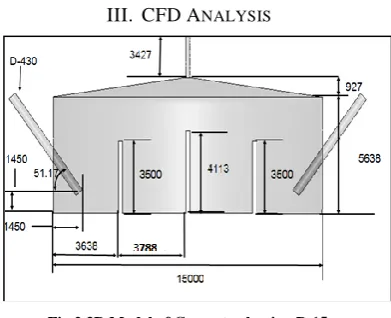
Fig.2 3D Model of Geometry having D 15m.
The study contributes a three-dimensional steady-state computational fluid dynamics (CFD) simulation has been performed for a particular anaerobic digester, in order to visualize the flow patterns and also the amount of methane mass fraction at the outlet of digester. Flow and velocities profiles have been represented inside the digester to identify possible dead zones or stratifications. This paper developed a CFD model to simulate the hydrodynamic characteristics of single phase flow in biogas digester. This work carried out by changing the two different digester diameters for with and without baffles. Species Transport model with volumetric reaction approach was applied to describe the flow of the phases with chemical reaction, using Ansys Fluent. Following objective were defined to simulate, geometry of a real digester which installed by Urja Bio System Pvt. ltd in order to consider the proposed methodology. 1. To Study the effect of slurry temperature on methane
generation in fixed dome type digester.
2. To Study the effect of baffle plates on methane generation in fixed dome type digester.
Configuration
[image:2.595.60.270.464.596.2]International Journal of Emerging Technology and Advanced Engineering
Website: www.ijetae.com (ISSN 2250-2459, ISO 9001:2008 Certified Journal, Volume 7, Issue 2, February 2017)
41 The tank’s internal volume is about 450 m3. The inlet pipe diameter is 0.43 m inclined with 51 deg. In this study, the pump located in the front of the digester to feed the biomass is not modelled, its pressure effect is included while simulation, also acted as a pusher to push the sludge inside the digester. Due to limitations of time constrained, actual chemical properties of volumetric reactions getting in digester, there is need to consider some assumptions, which is listed as below
Assumptions
1. 3-D, steady state with Heat flow and species transport through the digester.
2. Adiabatic conditions for the digester cover, walls, and floor.
3. Liquid manure is considered to be Newtonian. 4. pH range is between 6.5 and 7.5
5. Species reaction takes place only in one step, i.e., reactants are directly converted into final product without intermediate products.
6. The model is single phase, in which phase-interaction is negligible, and thus, rise of biogas to the surface has no effect on manure transport.
Governing Equations
The model is based on the principles of conservation of mass, conservation of energy, and species transport with volumetric reaction approach, equation to get the desired results
These equations are described below Mass conservation equation
The conservation of mass or continuity equation used is expressed as:
=0
………(1)Momentum Equation
v vv p g Ft
) .(
. ……….(2)
Here,
is stress tensor and given asEnergy Equation
The energy equation used is of the form (Patankar 1980):
( E) + ( (E + p)) =
-∑ + u j( )eff ) + Sh … (3)
Where, the first three terms on the right-hand side of the equal sign represent energy transfer due to conduction, species diffusion, and viscous dissipation, respectively. Sh includes heat of chemical reaction and any other volumetric heat sources.
Species transport equations
The species transport equations for liquid manure can be written in a general form as (Patankar 1980):
( Yj) + ( ui Yi) + + Ri
………(4)
For mass diffusion in laminar flow, the diffusion flux, Ji, is computed as
Ji=ρ ………. (5)
Chemical reaction equations
The initial conversion of raw waste to soluble organics can be expressed as (Chang 2004)
Modeling reaction rate
The reaction rate can be computed using the Arrhenius expression as
Ri= Mw,j ∑ ……….(6)
Where, Ri,r is molar rate of creation or destruction of species i in reaction r, which is calculated as:
̂ = ∏ ]Ƞ,r)
………. (7)
Information for k f, r is not available in the literature. In this study, k f,r is calculated by using first-order BOD removal rate in an ideal plug-flow reactor (Metcalf and Eddy 2003) as:
= exp(-kf,r.τ) ……….. (8)
Where, C/Co is percentage remaining of (CO2).
Grid Generation
The modeling of this problem is done by using Ansys workbench while meshing by Ansys ICEM software. The tetra meshing type is created by using Ansys ICEM software. Set the nomenclature as per requirement. The Global mesh size given around max element of 60 with 0.4 scale factor, and tri mesh type is selected for shell surface mesh. Tetra mesh type with robust octree method is selected for volume mesh. Part mesh setup is used to set individual meshing parameters for each part. Volume mesh is computed by using tetra type of meshing, using automated algorithm used in Ansys ICEM software. Once created meshing, the mesh is checked by using parameters like skewness, angle, orthogonal quality, negative volume. Angle should be less than 15, orthogonal quality is valid if get till 0.1, while the domain should free from negative volume.
After initializing the conditions, for each case, computation time required is around 20 Hrs. to get the desired accuracy. The accuracy of 10-4 was considered for getting solution convergence. After getting convergence the results are described below.
2. 3 T
v v vI
International Journal of Emerging Technology and Advanced Engineering
Website: www.ijetae.com (ISSN 2250-2459, ISO 9001:2008 Certified Journal, Volume 7, Issue 2, February 2017)
Fig.4.Meshing for Geometry having diameter 15 m
[image:4.595.69.259.376.584.2]Fig.5.Contours of Mass fraction of CH4 (with baffles)
Fig.6 Contours of Velocity Magnitude (m/s)
Fig.7 Contours of Vector Velocity
IV. EXPERIMENTAL VERIFICATION
Table 1.
Experimental values from Urja Biotech System, Pune.
Sr N
o
Parameters
Experimental Values from Urja Biotech
system
Numerical Values
1 Pressure at
gas outlet 102.796 kPa
101.325 kPa
2
Mass flow rate of Biogas
0.00487 kg/sec 0.00367 kg/sec
3
Inlet temperature
of slurry
20 0C– 27 0C 300C
4
Temperature Inside the
digester
38 0C – 40 0C 39.850C
In the experiment the information about the above parameters are given by the Urja Biotech system, pvt .ltd., Pune. The model is single phase, in which phase-interaction is negligible, and thus, rise of biogas to the surface has no effect on manure transport. Discretized 3D model is simulated by using Ansys Fluent 16.0 software. Computations are performed by varying slurry temperatures ranging from 200C,300C and 400C All simulations used a generalized coordinate, finite volume code (Ansys Fluent 16) with Simple pressure velocity coupling with first order upwind for momentum, kinetic energy and dissipation rate is used.
International Journal of Emerging Technology and Advanced Engineering
Website: www.ijetae.com (ISSN 2250-2459, ISO 9001:2008 Certified Journal, Volume 7, Issue 2, February 2017)
43 Eddy dissipation rate type is used for volumetric reaction, as the flow inside the digester has turbulence effect when reaction takes place. In eddy dissipation rate type, mixing rate for reactant and product is 4 and 0.2 respectively, as per fluent help manual. Adiabatic conditions are considered for the digester cover, walls, and floor. Simulation consist only one reaction due to time consumption for analyzing the digester.
Reaction : CO + 3H2 → CH4 + H2O
[image:5.595.326.531.149.302.2]V. EXPERIMENTAL RESULT
Table II.
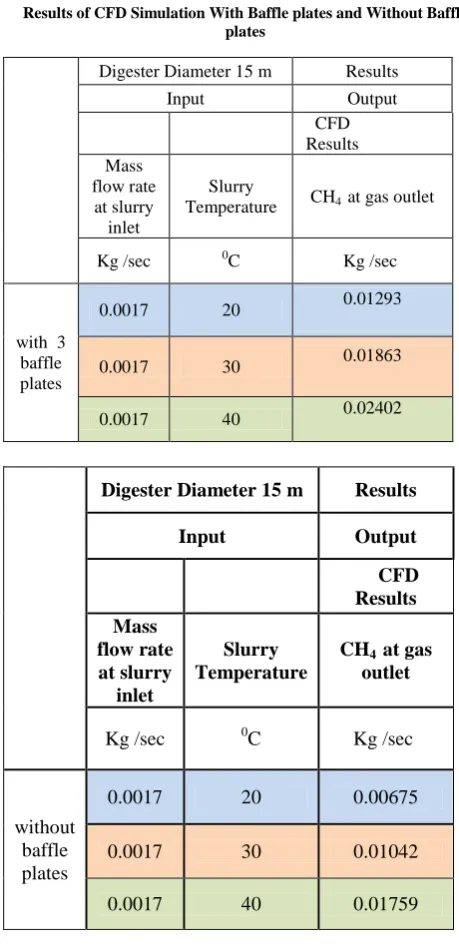
Results of CFD Simulation With Baffle plates and Without Baffle plates
[image:5.595.41.271.279.753.2]VI. RESULTS AND DISCUSSIONS
Fig.8 Comparison between with baffles and without baffles for Change in methane production vs slurry temperature
From the above graph, .Baffles create disturbances to flow which helps in anaerobic digestion and effect on the methane production rate. because of the baffles it creates disturbance to the flow so it takes some time to flow forward and anaerobic digestion but after increasing baffles up to certain limit it creates some problem of improper mixing and that is why methane production get reduced .
Fig.9 Comparison plot between experimental and actual values of change in methane production rate vs Temperature.
From the graph, temperature impacted the digestion time during the anaerobic fermentation, the high the temperature, the faster consumption of material and the shorter digestion time, but the anaerobic microorganisms made more gaseous impurities product in the high-temperature metabolism, which inhibited microbial growth and influenced the production of biogas and methane yield in a certain extent, and fermentation under the higher temperature consumed more energy and less energy benefit.
Results carried out are manipulated and compared with, Digester installed by Urja Bio System Pvt. Ltd., Pune, on client site locations.
0% 10% 20% 30% 40% 50% 60% 70%
0 20 40 60
m
e
thane
pr
oduct
ion
rat
e
Temperature ( 0C ) Comparison plot
with three baffles
without baffles
54% 56% 58% 60% 62% 64% 66%
0 20 40 60
M
et
h
an
e
P
ro
d
u
ct
io
n
r
at
e
Temperature ( 0C )
Experimental value
Actual
Digester Diameter 15 m Results
Input Output
CFD
Results Mass
flow rate at slurry
inlet
Slurry
Temperature CH4 at gas outlet
Kg /sec 0C Kg /sec
with 3 baffle plates
0.0017 20 0.01293
0.0017 30 0.01863
0.0017 40 0.02402
Digester Diameter 15 m Results
Input Output
CFD
Results Mass
flow rate at slurry
inlet
Slurry Temperature
CH4 at gas outlet
Kg /sec 0C Kg /sec
without baffle plates
0.0017 20 0.00675
0.0017 30 0.01042
[image:5.595.322.545.437.583.2]International Journal of Emerging Technology and Advanced Engineering
Website: www.ijetae.com (ISSN 2250-2459, ISO 9001:2008 Certified Journal, Volume 7, Issue 2, February 2017)
The result variation with respect to CFD simulation and results carried out at client site location by Urja Bio System Pvt. Ltd., Pune, is around 10 – 15 % variation in methane output production..
Table III.
Comparison of analysis result and experimental result.
Digester Diameter 15 m
Input Output
Vol.Flo w Rate
Ambient Temperatur
e
CH4 at
Gas outlet
m3
/day 0
C Numerica l Value
Experimenta l Value
% Erro r
Withou t baffle
Case
-1 449.1 20 27.78% 30% 7.4 Case
-2 449.1 30 29.29% 32% 8.4 Case
-3 449.1 40 32.89% 35% 6.02
with 3 baffles
Case
-1 449.1 20 48.26% 50% 3.4 Case
-2 449.1 30 54.68% 55% 0.5 Case
-3 449.1 40 62.52% 63% 0.7
In the above table III the simulation results are compared with experimental given by the Urja Biotech System, Pune.
VII.CONCLUSION
1. The methane production increases as the temperature increases.
2. Temperature impacted the digestion time during the anaerobic fermentation, the high the temperature, the faster consumption of material and the shorter digestion time so it helps for the better fermentation which results
3. Baffle plates also effect on the methane production rate. By adding the baffle plates methane production rate increases because of the baffle plates it creates disturbance to the flow so it takes some time to flow forward and anorbic digestion it increases hydraulic retention time (HRT).
REFERENCES
[1] Bachmann A, Beard V L and McCarty P L; (1985); Performance characteristics of the anaerobic baffled reactor; Wat. Sci. & Tech; 19 (1); 99 - 106.
[2] Vesvikar and al-Dahhan ; (2005) The use of the anaerobic baffled reactor (ABR) for wastewater treatment: A review; Wat. Research; 33 (7); 1559 - 1578.
[3] Latha .S, Borman. D, and Sleigh .P.A; (2009); CFD Multiphase modelling for evaluation of gas mixing in an anaerobic digester ; University of Leeds, UK.
[4] Elena MANEA, Dan ROBESCU ;(2012);“ Simulation of mechanical mixing in anaerobic digester”; U.P.B. Sci. Bull., Series D, Vol.74, Iss. 2, 2012 ; ISSN 1454-2358.
[5] Ahmad Indra Siswantara1, Asyari Daryus, Steven Darmawan1, Gun Gun R. Gunadi, Rovida Camalia1;(2016); CFD analysis of slurry flow in an anaerobic digester ; International Journal of Technology (2016) 2: 197-203 ISSN 2086-9614 © IJTech 2016 [6] Alexandra Martínez Mendoza1, Tatiana Montoya Martínez,
Vicente Fajardo Montañana, P. Amparo Lopez Jiménez ; (2011) ; Modeling flow inside an anaerobic digester by CFD techniques ; INTERNATIONAL JOURNAL OF ENERGY AND ENVIRONMENT; Volume 2, Issue 6, 2011 pp.963-974 [7] Robert N. Meroney, Robert E. Sheker ;(2014); CFD Simulation of
Vertical Linear Motion Mixing in Anaerobic Digester Tanks ; Civil and Environmental Engineering Department, Colorado State University, Fort Collins, CO 80523; surface mail: 6218 Eagle Ridge Court, Fort Collins, CO 80525;
[8] P. Amparo Lopez-Jimenez, Juan Escudero-Gonzalez, Tatiana Montoya Martinez, Vicente Fajardo Monta˜nana, Carlo Gualtieri ; (2015); Application of CFD methods to an anaerobic digester: The case of Ontinyent WWTP, Valencia, Spain; Journal of Water Process Engineering 7 (2015) 131–140.
[9] Dugba et al. “Simulated two-stage digestion using two anaerobic sequential batch reactors “(ASBR). (1999)
[10] Axapoulos et al. “Investigated the heat transfer and biogas production of a solarheated plug flow anaerobic digester in Greece”, (2001).
[11] Zupancic and Ros “ Compared the heat requirements and biogas production of mesophilic and thermophilic complete mix anaerobic digesters for waste water treatment”.(2003)