DEVELOPMENT OF A FRAMEWORK FOR PARTNERING
THROUGH ALIGNING ORGANIZATIONAL CULTURES IN
THE MALAYSIAN CONSTRUCTION INDUSTRY
Faizatul Akmar ABDUL NIFA
ii
DEVELOPMENT OF A FRAMEWORK FOR PARTNERING
THROUGH ALIGNING ORGANIZATIONAL CULTURES IN
THE MALAYSIAN CONSTRUCTION INDUSTRY
Faizatul Akmar ABDUL NIFA
College of Science and Technology
School of the Built Environment
The University of Salford
Salford, UK
Submitted in Partial Fulfilment of the Requirements of the Degree of
Doctor of Philosophy
i
LIST OF CONTENTS
LIST OF CONTENTS………...i
LIST OF FIGURES…...viii
LIST OF TABLES...x
LIST OF ABBREVIATIONS..…...xiii
ACKNOWLEDGEMENT...xv
DECLARATION... xvi
ABSTRACT... xvii
CHAPTER 1: INTRODUCTION TO THE RESEARCH ... 1
1.1 BACKGROUND ... 1
1.2 PROBLEM STATEMENTS / RESEARCH GAP ... 3
1.3 RESEARCH AIM AND OBJECTIVES ... 4
1.4 RATIONALE/RESEARCH QUESTIONS ... 5
1.5 RESEARCH PROCESS ... 5
1.6 OUTCOMES OF THIS RESEARCH …... 9
1.7 SCOPE OF RESEARCH ... 10
1.8 STRUCTURE OF THESIS ... 10
1.9 SUMMARY...12
CHAPTER 2: PARTNERING IN THE CONSTRUCTION INDUSTRY ...13
2.1 INTRODUCTION ………..……… 13
2.2 THE CONSTRUCTION INDUSTRY ……….….. 14
2.3 KEY PLAYERS OF THE CONSTRUCTION INDUSTRY ………. 15
2.4 CURRENT CHALLENGES IN THE CONSTRUCTION INDUSTRY …………... 17
2.5 PARTNERING IN THE CONSTRUCTION INDUSTRY …...……… 19
2.5.1 DEFINITION OF PARTNERING ………. 21
ii
2.7 IMPLEMENTATION METHODS OF PARTNERING ………... 26
2.7.1 PUBLIC-PRIVATE PARTNERSHIP (PPP) ………. 27
2.8 ENABLING FACTORS FOR PARTNERING ………. 30
a. COLLABORATION AND COOPERATION ……….30
b. COMMITMENT ……….. 31
c. COMMUNICATION ………...33
d. CULTURE ………...……… 34
e. TRUST ………...……….. 36
f. TOOLS ………. 37
g. POLICIES ………..……….………. 38
h. PROCUREMENT ……… 39
2.9 OUTCOMES OF SUCCESSFUL PARTNERING ……… 42
2.10 BARRIERS TO PARTNERING ……… 43
a. LACK OF TRUST ………... 43
b. LACK OF COMMON GOALS ………...… 44
c. UNDERBIDDING OF CONTRACTS …………...………. 44
d. PERSONNEL ISSUES ……… 44
2.11 STRATEGIC APPROACHES FOR PARTNERING ………....… 45
2.12 GAPS IN PARTNERING KNOWLEDGE ……… 52
2.13 SUMMARY ………..………. 53
CHAPTER 3: THE MALAYSIAN CONSTRUCTION INDUSTRY AND THE IMPORTANCE OF ORGANIZATIONAL CULTURE IN PARTNERING….……… 55
3.1 INTRODUCTION ……….……. 55
3.2 THE MALAYSIAN CONSTRUCTION INDUSTRY ... 56
3.3 PROJECT PROCUREMENT METHODS IN MALAYSIA ………... 57
3.3.1 TRADITIONAL PROJECT PROCUREMENT ……… 57
3.3.2 DESIGN AND BUILD PROCUREMENT METHOD ………...…….. 59
3.3.3 THE IMPLEMENTATION OF PARTNERING IN MALAYSIA ………… 60
iii
3.5 CURRENT CHALLENGES IN MALAYSIAN CONSTRUCTION INDUSTRY.... 65
3.6 THE MALAYSIAN CULTURE ... 68
3.7 ORGANIZATIONAL CULTURE ACROSS DIFFERENT INDUSTRIES IN MALAYSIA.………...……….. 69
3.8 THE CONCEPT OF ORGANIZATIONAL CULTURE... 70
3.9 ASSESMENT OF ORGANIZATIONAL CULTURE... 73
3.9.1 HOFSTEDE FRAMEWORK OF ORGANIZATIONAL CULTURE (HOFSTEDE ET AL, 1990) ………...… 74
3.9.2 SCHEIN’S MODEL (SCHEIN, 1989) ………...………….. 75
3.9.3 DEAL AND KENNEDY’S MODEL OF ORGANIZATIONAL CULTURE (1982) ………...77
3.9.4 HANDY’S MODEL OF ORGANIZATIONAL CULTURE (1985) ………..……….78
3.9.5 TROMPENAARS & HAMPDEN-TURNER’S FRAMEWORK (1997) ……….………..80
3.9.6 ORGANIZATIONAL CULTURE PROFILE (O’REILLY, CHATMAN & CALDWELL, 1991) ...82
3.9.7 THE COMPETING VALUES FRAMEWORK (CAMERON & QUINN, 1999) ………..83
3.10 COMPARISON OF ORGANIZATIONAL CULTURE ASSESSMENT METHODS ………...………..….. 85
3.11 ORGANIZATIONAL CULTURE DIMENSIONS IN THE CONSTRUCTION INDUSTRY ………...……… 87
3.12 CONCEPTUAL MAPPING FOR THIS RESEARCH ………….……… 88
3.13 SUMMARY ……….………. 93
CHAPTER 4: RESEARCH DESIGN AND METHODOLOGY ………...……... 95
4.1 INTRODUCTION ……….. 95
4.2 THE RESEARCH PROCESS MODEL ... 96
4.3 RESEARCH PHILOSOPHIES ……….………. 97
4.3.1 ONTOLOGICAL ASSUMPTIONS ………..… 99
4.3.2 EPISTEMOLOGICAL ASSUMPTIONS...……….…………. 100
iv
4.4 RESEARCH APPROACH ………..…. 103
4.5 RESEARCH STRATEGY ………...… 105
4.5.1 MIXED METHODS DESIGN …………... 109
4.6 RESEARCH TECHNIQUES ………... 111
4.6.1 LITERATURE REVIEW ………. 111
4.6.2 SEMI-STRUCTURED INTERVIEWS ………... 112
4.6.3 QUESTIONNAIRE SURVEYS ……….113
4.7 OBJECTIVES OF THIS RESEARCH AND THE CORRESPONDING METHODS OF INVESTIGATION ………... 114
4.8 RELIABILITY AND VALIDITY ISSUES ………. 115
4.9 SUMMARY…...120
CHAPTER 5: QUALITATIVE DATA ANALYSIS ... 122
5.1 INTRODUCTION ... 122
5.2 QUALITATIVE DATA COLLECTION – INTERVIEW ... 122
5.2.1 AIM OF THE INTERVIEW ...122
5.2.2 DESIGN OF THE INTERVIEW PROCESS...123
a. Section I – Profile of participants ...123
b. Section II – Understanding of the partnering concept (Theme 1)……...124
c. Section III – Awareness of partnering practices (Theme 2)...124
d. Section IV – Organizational culture and structure in Malaysian construction industry (Theme 3) ...125
e. Section V – Role of organizational culture in partnering (Theme 4)...125
5.2.3 SURVEYED SAMPLE ...126
5.2.4 CONTENT ANALYSIS ………...128
5.2.5 APPLICATION OF NVIVO 10 IN DATA ANALYSIS... 129
5.3 FINDINGS ...130
5.3.1 UNDERSTANDING OF THE PARTNERING CONCEPT... 131
5.3.2 AWARENESS OF PARTNERING PRACTICES (THEME 2) ...135
5.3.3 ORGANIZATIONAL CULTURE AND ORGANIZATIONAL STRUCTURE IN DESIGN FIRMS (THEME 3)... 141
v
5.3.5 EMERGENT THEMES ...149
a. Communication Issues ...150
b. Human Factor …...150
c. Industry Norms………...151
5.4 SUMMARY………...154
CHAPTER 6: QUANTITATIVE DATA ANALYSIS ... 156
6.1 INTRODUCTION ... 156
6.2 QUANTITATIVE DATA COLLECTION – QUESTIONNAIRE... 156
6.2.1 QUESTIONNAIRE DESIGN ...157
a. Section I – Respondent profile...157
b. Section II – Understanding of the partnering concept (Theme 1)...157
c. Section III – Awareness of partnering practices (Theme 2)... 158
d. Section IV – Organizational culture and structure in Malaysian construction firm (Theme 3) ………...158
e. Section V – Role of organizational culture in partnering (Theme 4)... 158
6.2.2 SAMPLING PROCEDURES ………...159
6.3 FINDINGS FROM QUESTIONNAIRE ... 160
6.3.1 RESPONDENT PROFILE... 160
a. Job title...160
b. Level of qualification ...161
c. Country where qualification gained ………...162
d. Age category ...163
e. Number of years in current organisation ...164
f. Number of years in industry...165
g. Size of organisation...166
h. Nature of business …...167
6.4 PARTNERING IN MALAYSIAN CONSTRUCTION INDUSTRY ... 168
6.4.1 UNDERSTANDING OF THE PARTNERING CONCEPT (THEME 1) ...168
a. FREQUENCY DISTRIBUTION OF RESPONSES ... 169
i.Collaboration and cooperation (Items 10 – 11) ... 170
ii.Trust (Items 12 – 14) ... 171
vi
iv.Communication (Items 18 – 19)... 173
v.Tools ... 174
vi.Commitment (Items 22 and 26) ... 175
vii.Policies (Items 23 – 24) ...176
viii.Culture (Items 25, 27 and 28) ... 177
b. CHI-SQUARE ANALYSIS …...179
c. KRUSKAL-WALLIS ANALYSIS...180
d. CROSS-TABULATION OF RESULTS...182
e. PEARSON’S CORRELATION COEFFICIENT, r...189
i.Policy vs. Trust... 190
ii.Tools vs. Policy... 190
iii.Culture vs. Commitment... 191
iv.Procurement vs. Policy...192
v.Communication vs. Trust...193
vi.Culture vs. Tools ...193
6.4.2 AWARENESS OF PARTNERING PRACTICES (THEME 2) ……….……….. 195
a. FREQUENCY DISTRIBUTION OF RESPONSES ... 195
b. CHI-SQUARE ANALYSIS ... 196
c. KRUSKAL-WALLIS ANALYSIS ... 197
d. PEARSON’S CORRELATION COEFFICIENT, r ... 198
6.5 ORGANIZATIONAL CULTURE IN MALAYSIAN CONSTRUCTION INDUSTRY ... 199
6.5.1 ORGANIZATIONAL CULTURE AND STRUCTURE IN MALAYSIAN CONSTRUCTION FIRMS (THEME 3) ... 199
a. FREQUENCY DISTRIBUTION OF RESPONSES ... 200
i.Client orientation ... 202
ii.Workforce orientation ... 202
iii.Leadership/management ...203
iv.Outcome / Performance orientation ... 203
v.Reward orientation ... 204
vi.Innovation orientation ... 205
vii.Teamwork orientation ...205
b. CHI-SQUARE ANALYSIS ... 206
c. KRUSKAL-WALLIS ANALYSIS ... 207
d. PEARSON’S CORRELATION COEFFICIENT, r ... 209
6.5.2 ROLE OF ORGANIZATIONAL CULTURE IN PARTNERING (THEME 4) ………... 210
vii
CHAPTER 7: CONCLUSIONS, DISCUSSION & RECOMMENDATIONS... 214
7.1 INTRODUCTION ...214
7.2 DISCUSSIONS OF FINDINGS... 214
7.2.1 EXISTING PRACTICES OF PARTNERING, ITS OVERALL CONCEPTS AND EXISTING FRAMEWORKS IN THE CONSTRUCTION INDUSTRY ………...215
7.2.2 THE CONCEPT OF ORGANIZATIONAL CULTURE AND ITS RELATIONSHIP WITH PARTNERING IN THE CONSTRUCTION INDUSTRY……... 219
7.2.3 PRIVATE SME CONSULTANT FIRMS: INVOLVEMENT IN PARTNERING, PARTNERING BARRIERS AND ENABLERS EXPERIENCED ... 221
7.2.4 THE MALAYSIAN CULTURAL BARRIERS AND TYPE OF ORGANIZATIONAL CULTURE FOR FIRMS IN THE MALAYSIAN CONSTRUCTION INDUSTRY………... 226
7.3 PROPOSED FRAMEWORK FOR PARTNERING IN MALAYSIAN CONSTRUCTION INDUSTRY ... 230
7.4 LIMITATIONS OF THIS STUDY... 232
7.5 CONTRIBUTIONS TO THE BODY OF KNOWLEDGE... 234
7.6 RECOMMENDATIONS... 236
7.7 CONCLUSIONS ... 237
REFERENCES ………..... 239
APPENDICES………..263
APPENDIX 1 : SEMI-STRUCTURED INTERVIEW SCHEDULE ………..263
APPENDIX 2: QUESTIONNAIRE ………. 268
viii
LIST OF FIGURES
Figure 1.1 Research methodological framework ... 7
Figure 2.1 The actors of the construction industry (Gann and Salter, 2000) ... 17
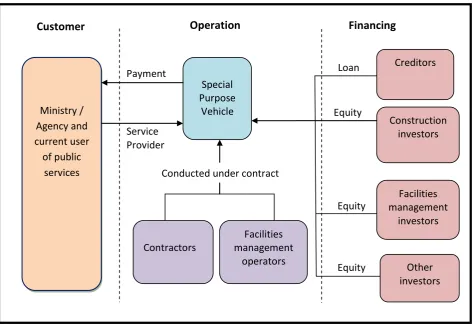
Figure 3.1 The Malaysian PPP Model as shown in 3PU guideline for PPP (Source: PPP Guideline, 2009)...64
Figure 3.2 Cultural Web (Johnson, 1988)... 72
Figure 3.3 Levels of culture and their interaction (Schein, 1989)... 76
Figure 3.4 Model of Organizational Culture (Deal & Kennedy, 1982) ... 77
Figure 3.5 Organizational culture profile (OCP) dimensions by O’Reilly, Chatman and Caldwell (1991) ... 82
Figure 3.6 Organizational culture typology (Cameron and Quinn, 1999) ... 84
Figure 3.7 Conceptual mapping for this research ... 89
Figure 3.8 Soft System Methodology (Checkland, 1981) ... 91
Figure 3.9 The conceptual framework for this research ... 92
Figure 4.1 Nested methodology research model (Kagioglou et al, 2000) ... 96
Figure 4.2 Philosophical orientations in research (Sexton, 2003) ... 102
Figure 4.3 Inductive theory generation process... 104
Figure 4.4 Screen shot of reliability test from SPSS 17 ... 118
Figure 4.5 Research process model (adapted from Kagioglou et al, 2000) ... 120
Figure 5.1 Screen shot for content analysis in Nvivo10 ... 129
Figure 5.2 Screen shot of Nvivo 10 showing the nodes on understanding of partnering concept ... 131
Figure 5.3 Screen shot of Nvivo 10 showing the nodes on awareness of partnering practices ... 136
Figure 5.4 Screen shot of Nvivo 10 showing the nodes on organizational culture and structure in design firms ... 142
Figure 5.5 Screen shot of Nvivo 9 showing the nodes on the role of organizational culture in partnering ... 146
Figure 5.6 Screen shot of Nvivo 10 showing the nodes on emergent themes ... 149
Figure 6.1 Job title distribution of research sample ... 161
Figure 6.2 Distribution for respondents’ highest level of qualification ... 162
Figure 6.3 Distribution for countries where respondents gained their ... 163
Figure 6.4 Respondents age distribution ... 164
Figure 6.5 Respondents distribution – Number of years working in current organization ... 165
Figure 6.6 Experience of respondents in construction industry ... 166
Figure 6.7 Size of organisations included in the sample... 167
Figure 6.8 Nature of business for organisations included in the sample... 167
Figure 6.9 Frequency distribution of responses for questions in Section II of the questionnaire ... 191
Figure 6.10 Frequency percentage for responses to Items Q33 - Q39 in section IV of the questionnaire... 201
ix Figure 7.2 Outcomes from successful partnering as found in previous literatures... 217 Figure 7.3 Partnering: The Malaysian Construction Industry experience ... 225 Figure 7.4 The position of 7 organizational culture dimensions for
Malaysian construction firms ... 229 Figure 7.5 Framework for effective partnering through aligning organizational
x
LIST OF TABLES
Table 2.1 The construction team according to Murdoch and Hughes (2007) ... 16
Table 2.2 Definitions of construction partnering in existing literatures ... 23
Table 2.3 Summary of PPP case studies ... 28
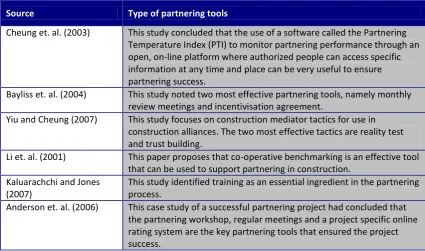
Table 2.4 List of effective partnering tools from various partnering literatures ... 38
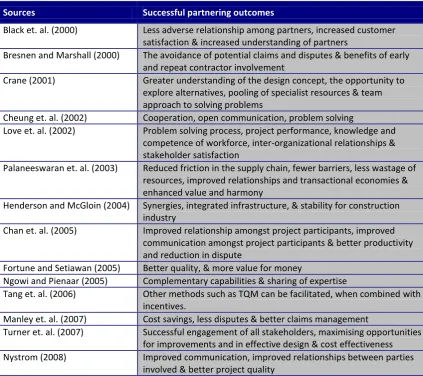
Table 2.5 Outcomes of successful partnering from various partnering literatures ... 42
Table 2.6 Strategic approaches for partnering in construction ... 46
Table 3.1 Weaknesses and specific problems in the application of partnering (Sulaiman, 2011) ... 61
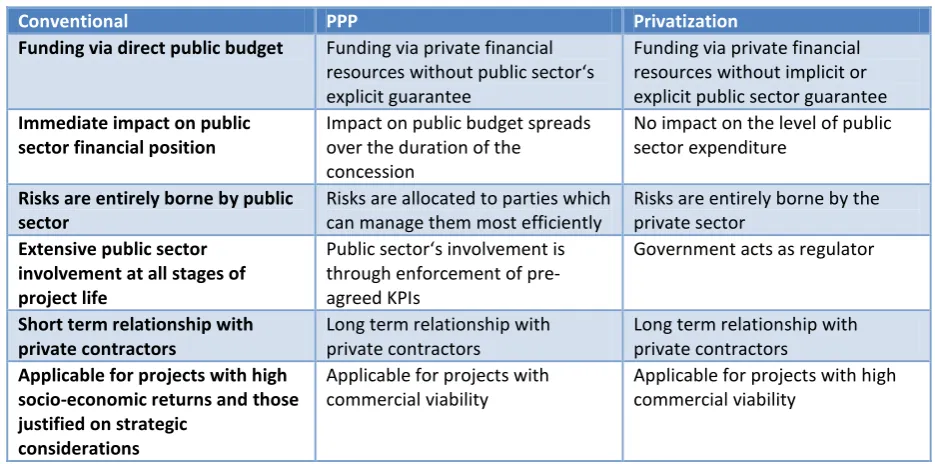
Table 3.2 Differences between conventional, PPP and privatization methods of procurement (Source: PPP Guideline, 2009.)…. ... 63
Table 3.3 Framework of Cultural Differences (Hofstede, 2010) ... 74
Table 3.4 Framework for organizational culture (Hofstede et al, 1990) ... 75
Table 3.5 Charles Handy Model of Organizational Culture ... 79
Table 3.6 Trompenaars& Hampden-Turner Framework of Cultural Dimensions ... 81
Table 3.7 Frameworks and Models for Organizational Culture Typologies ... 86
Table 3.8 Past research findings on organizational culture dimension ... 88
Table 4.1 The differences between Positivism and Interpretivism (Easterby-Smith et al, 2002) ... 98
Table 4.2 Fundamental differences between quantitative and qualitative methods (Bryman and Bell, 2007) ... 105
Table 4.3 Comparison of various research strategies (Nawi, 2012) ... 107
Table 4.4 Research objectives in relation to methods of investigation ... 114
Table 4.5 Reliability statistics results from SPSS 17 ... 117
Table 5.1 Detail of sample for interview ... 127
Table 5.2 Summary of Theme 1 parent nodes ... 132
Table 5.3 Summary of previous involvement in partnering node (1st parent node – Theme 1) ... 132
Table 5.4 Summary of description of partnering process node (2nd parent node – Theme 1)………... 133
Table 5.5 Summary of personal understanding of partnering node (3rd parent node – Theme 1)………...……… 133
Table 5.6 Summary of lessons and problems in partnering node (4th parent node – Theme 1)... 135
Table 5.7 Summary of Theme 2 parent nodes ...136
Table 5.8 Summary of awareness of UK partnering nodes (1st parent node – Theme 2)... 137
Table 5.9 Summary of feelings and perceptions towards partnering nodes (2nd parent node – Theme 2)... 138
Table 5.10 Summary of feelings and perceptions towards partnering nodes (3rd parent node – Theme 2) ... 139
xi Table 5.12 Summary of requirement for partnering success nodes
(5th parent node – Theme 2) ...140
Table 5.13 Summary of Theme 3 parent nodes ...142
Table 5.14 Summary of current organizational culture nodes (1st parent node – Theme 3) ...143
Table 5.15 Summary for type of organizational culture nodes (2nd parent node – Theme 3) ... 143
Table 5.16 Summary for understanding of culture in organization (3rd parent node – Theme 3) ... 144
Table 5.17 Summary of current organizational structure nodes (4th parent node – Theme 3) ... 145
Table 5.18 Summary for influence of current structure nodes (5th parent node – Theme 3) ... 145
Table 5.19 Summary of Theme 4 parent nodes... 146
Table 5.20 Summary for similarity of culture helps partnering node (1st node – Theme 4) ... 147
Table 5.21 Summary of improvements to current culture node (2nd parent node – Theme 4) ... 148
Table 5.22 Summary of Theme 5 emergent nodes ... 149
Table 6.1 Job titles of respondents in the research sample ... 161
Table 6.2 Detail for the objective of questionnaire items and corresponding factors ... 169
Table 6.3 Frequency distribution of responses for questions in Section II of the Questionnaire... 170
Table 6.4 Detailed results for items corresponding to Collaboration and Cooperation factor ... 171
Table 6.5 Detailed result for items corresponding to Trust factor ... 172
Table 6.6 Detailed result for items corresponding to Procurement factor ... 172
Table 6.7 Detailed result for items corresponding to Communication factor... 174
Table 6.8 Detailed result for items corresponding to Tools factor... 175
Table 6.9 Detailed result for items corresponding to Commitment factor... 176
Table 6.10 Detailed result for items corresponding to Policies factor ... 177
Table 6.11 Detailed result for items corresponding to Culture factor ... 178
Table 6.12 Significance level (p) of responses to Items 10 – 28 in the questionnaire ... 180
Table 6.13 Kruskal-Wallis ANOVA analysis for Section II ... 181
Table 6.14 Cross-tabulation of enabling factors and respondents’ age category... 183
Table 6.15 Cross-tabulation of enabling factors & respondents’ management levels.... 185
Table 6.16 Cross-tabulation of enabling factors & respondents’ industrial experience.. 186
Table 6.17 Cross-tabulation of enabling factors and respondents’ years in current Organization... 187
Table 6.18 Cross-tabulation of enabling factors and respondents’ type of firm... 188
Table 6.19 Correlations between policy and trust factor ... 190
xii
Table 6.21 Correlations between culture and commitment factor... 191
Table 6.22 Correlations between procurement and policy factor ... 192
Table 6.23 Correlations between communication and trust factor ... 193
Table 6.24 Correlations between culture and tools factor ... 194
Table 6.25 Detail for the objective of questionnaire items and the questions in Section III ... 195
Table 6.26 Detailed result for items in Section III ... 196
Table 6.27 Significance level (p) of responses to Items 29-30 in Section III of the questionnaire ... 197
Table 6.28 Kruskal-Wallis ANOVA analysis for Section III ... 197
Table 6.29 Correlations between item Q29 and Q30 from Section III ... 198
Table 6.30 Detail for the objective of questionnaire items and corresponding dimensions tested ... 198
Table 6.31 Detailed result for item Q32, general type of organizational culture in Section IV... 200
Table 6.32 Detailed result for item Q40 – Type of organizational structure...206
Table 6.33 Significance level (p) of responses to Items 33 - 39 in the questionnaire ... 207
Table 6.34 Kruskal-Wallis ANOVA analysis for Section IV ... 208
Table 6.35 Correlations between items Q33-Q39 against respondent profile ... 209
Table 6.36 Detail for the objective of questionnaire items and the questions in Section V ... 210
Table 7.1 Description of enabling factors for partnering ... 216
xiii
LIST OF ABBREVIATIONS
3PU Public-Private Partnerships Unit 9MP Ninth Malaysia Plan
ANP Analytical Network Process
CIDB Construction Industry Development Board CIMP Construction Industry Master Plan
COBAP Co-operative Benchmarking Approach to Partnering COLA Cross Organization Learning Approach
CVF Competing Values Framework D&B Design & Build
EOT Extension of Time GDP Gross Domestic Products HEI Higher educational institute IBS Industrialised Building Systems IT Information technology
LNG Liquid Natural Gas MY Malaysia
OCP Organizational Culture Profile PFI Private Finance Initiative PPP Private Public Partnerships PSI Private Sector Involvement PWD Public Works Department RM Ringgit Malaysia
SME Small and Medium Enterprises SPV Special Purpose Vehicle SSM Soft systems methodology UK United Kingdom
USA United States of America
xiv
To my heart and soul,
xv
ACKNOWLEDGEMENTS
Praise be to Allah the Almighty God of the Universe from whom I came and belong, for leading me to this path of self-discovery and humbling experience.
I would like to express my heartfelt gratitude and appreciation to my supervisor, Prof Vian Ahmed for her utmost patience, for her warmth and kindness, endless motivation and support throughout my entire PhD journey. Her invaluable insights, critical comments and exceptional guidance have brought out the researcher in me which I have never known to exist. Thank you Prof Vian, May Allah bless you always.
I am also eternally grateful to my sponsors who have funded this PhD research; The Ministry of Higher Education and Universiti Utara Malaysia, without which this PhD dream would not be a reality. I wish to also thank all of my colleagues within SoBE who have given me invaluable assistance and support, as well as the ever-helpful research administration staff Moira Mort, Rachel Lilley, Cheryl Batley, Catriona Barkley and Carol Gordon for their unrelenting support and kindness during my time at Salford. From the bottom of my heart, I thank you all.
I would also like to express my utmost gratitude to my family;
To my beloved parents Abah and Mama; who have been my twin pillar of strengths throughout my entire life and have taught me courage, faith, love and perseverance in life. Thank you for always believing in me.
To my dear siblings Abang, Teh and Aisyah; I thank you dearly for your never-ending support, understanding and love even when I am thousands of miles away.
To my precious children Afwan and Auni; for being the stars that always shine in my darkest of nights, for the laughters and giggles that warm my heart in the coldest of days, Mummy is eternally grateful.
xvi
DECLARATION
This thesis is presented as an original contribution based on Doctorate of Philosophy research at the University of Salford, Salford, United Kingdom and has not been previously submitted to meet requirements for an award at any higher education institution under my name or that of any other individuals. To the best of my knowledge and belief, the thesis contains no previously published or written by another person except where due reference is made.
……… (Signed)
xvii
ABSTRACT
In line with the main awareness of partnering in solving the many issues within the global construction industry, the Malaysian government has call upon the local industry to embrace and adapt partnering practices in their project delivery. Although culture has been noted as one of the main enabler for partnering, there is lack of research in highlighting the role of culture in partnering and virtually no evidence of a partnering framework established for a multi-ethnic and racial workforce in a developing country such as Malaysia. This research aims to develop a framework for partnering that aligns organizational culture in the Malaysian construction industry. This exploratory research studies the basic concept of partnering and the influence of culture to partnering success. This research seeks to identify which partnering enablers are readily available in the Malaysian construction industry at present. Apart from that, this research also explores the current organizational culture which affects the level of engagement in partnering among private SME consultant firms in particular and the industry in general. The private SME consultant firms are highlighted in this research due to the evidence that indicates the critical role of the consultants in driving the innovations in the industry, which is also cited as one of the outputs from successful partnering.
This research leans towards interpretivist epistemological standpoint with an inductive approach and employs a convergent parallel mixed methods survey design in order to answer the research questions. In this research, 14 semi-structured interviews were conducted with top and middle managers in 4 private SME consultant firms and 69 questionnaires were completed by practitioners from various segments of the Malaysian construction industry. As the design suggests, findings from a critical literature review, semi-structured interviews and questionnaires are merged to form a foundation for the development of framework in this research.
| 1
CHAPTER 1
INTRODUCTION TO THE RESEARCH
1.1 BACKGROUND
The construction industry is commonly cited as a multifaceted industry, of many adversarial relationships due to different parties collaborating in temporary organizations working together towards completing a project (Bresnen and Marshall, 2000; Wood et. al., 2002; Sorrell, 2001; Meng et al, 2011). The industry is also widely cited as being the least susceptible to innovation, as compared to manufacturing and other service industries (Slaughter, 1993; Dulaimi et. al., 2002; Blayse and Manley, 2004). The nature of the construction industry is an industry whose firms come together as temporary organizations to deliver the construction projects (or products); delivering its product to its client base by way of a stream of generally single and unique projects. These projects typically draw together a significant number of diverse small and large construction firms with varying collaborations (Sexton and Barret, 2003). The success of these construction projects often relies heavily on smooth coordination among the member firms in temporary organizations. The projects are also subject to dispute and misunderstanding risks among member firms, which in turn could cause potentially beneficial relationships turning into relationships that are more adversarial in nature.
| 2 contributed by the robust expansion in civil engineering and residential subsector (MoF, 2012). The expansion in the civil engineering subsector relates to the acceleration of works in large-scale infrastructure projects, namely the Sungai Buloh-Kajang Line MY Rapid Transit, LNG Regasification Terminal in Melaka and Manjung Coal-Fire Plant in Perak. The current increase in the number of infrastructure projects and the government’s intention to implement mega project as private finance initiatives (PFI) (Koh, 2006) has reflected the Malaysian government’s efforts to implement partnering in construction projects, seeing that PFI is a subset of PPP as understood in Malaysia (Rusmani, 2010). Realizing these issues, the Malaysian Construction Industry Development Board (henceforth CIDB) has proposed the 10-year Malaysian Construction Industry Master Plan (2006-2015) which identified and recommended partnering as a method to overcome the inherent problems within the construction industry. Partnering is believed to be a viable approach to integrate the construction industry supply chain, improve the client-customer relationship, enhance levels of productivity and quality of construction project implementation (Egan, 1998; Garnett et al, 1998; CIDB, 2009).
The partnering strategy in the construction industry made its debut in the 1990s following the release of the Latham Report (1994) which was later complemented with the publication of Egan Report (1998). Naoum (2003) states that this strategy has then been implemented successfully in the UK, USA, Australia and Japan and since then has been made the main point of reference due to their success in establishing suitable procedures for the selection of subcontractors in public sector contracts. The adoption of partnering into the construction industry in these countries can be attributed to the fact that the relationships in these industries were commonly lacking trust, respect and honesty between clients, main contractors and subcontractors (Humphreys et. al, 2003).
| 3 robust dispute resolution system (Naoum, 2003) which sets it apart from the conventional method. In line with the implementation of partnering, the Malaysian government has established a Public Private Partnership Unit (3PU) of which its main role is to oversee and support the implementation of PPP methods within the country. Along with the aim of implementing partnering practices, it is important that all partnering factors are present to ensure its success. These factors include collaboration and cooperation, tools, policies, procurement, communication, trust and culture (Nifa and Ahmed, 2010).
1.2 PROBLEM STATEMENTS / RESEARCH GAP
It should also be taken into consideration that generally the problem faced by the Malaysian construction industry mentioned above could be attributed to the nature of the construction industry, which is a multifaceted industry comprised of several firms in ‘temporary organizations’ coming together bound by contract to implement the project (Nifa and Ahmed, 2009). These different firms each bring a type of organizational culture and work ethics and failure to align these cultures in a construction project may contribute to differing objectives and understanding in implementing the project. Additionally, this will cause friction among the construction team and may result in more adverse relationships and lack of trust. This issue is crucial to deal with as the Malaysian construction industry is becoming even more saturated each year with 66,210 construction firms registered with CIDB up to March 2012, compared to 63,977 in 2008 (CIDB, 2012); and is mostly comprised of SMEs (Kamal and Flanagan, 2012) which may possess different organizational cultures and work ethics.
| 4 organizational culture which serves as a deterrent to partnering; apart from identifying partnering enabling factors that are already present within the industry. By understanding the type of organizational culture that benefits partnering in Malaysia, the risks that accompany the implementation of partnering can be minimized. This research develops a framework, which adopted, will enhance the chances of success for partnering implementation in the Malaysian construction industry. The learning process and knowledge sharing between partners is greatly assisted when trust is present, and because of this fact, culture is also important in improving the industry’s innovativeness (Ivory, 2005). Taking into consideration the role of private SME consultant firms in having a pivotal role to increase the industry’s innovativeness (Ling, 2003; Panuwatwanich et al, 2008), this research seeks their specific insights on how partnering could be enabled more effectively in Malaysia. In order to reach a robust understanding of the situation, a mixed methods survey research design is employed. The methodology will be discussed in detail in following chapters of this thesis.
1.3 RESEARCH AIM AND OBJECTIVES
The aim of this research is to propose a framework for partnering that meets the needs of different organizational cultures within the Malaysian construction industry.
This aim will be achieved via the following objectives;
To develop an understanding of partnering in general; its overall concept and existing frameworks in the construction industry.
To investigate the concept of organizational culture and its relationship with partnering in the construction industry.
To determine the level of engagement in partnering practices among private SME consultant firms in Malaysian construction industry.
To identify the enablers or barriers of partnering as perceived by the private SME consultant firms.
| 5
To develop a framework for effective partnering through aligning different organizational cultures in Malaysian construction industry.
1.4 RATIONALE/RESEARCH QUESTIONS
One of the main components for partnering is the construction practitioners, who are the active players in the industry. The practitioners are human factors which daily interactions are influenced by their organizational cultures be it consciously or not. As the construction industry is made of firms from various specialities, different types of organizational culture exist and will affect the interaction of these firms within a construction project. Is there a way to align all of these different organizational cultures in a partnering relationship to ensure successful partnering implementation? Culture is also an integral variable in relationship creation and network formation, and this will impact the success of the partnering venture between these firms. From this standpoint, this research will bring light to current partnering situation in Malaysian construction industry through answering these research questions;
1. What are the enabling partnering factors already present in Malaysia, and how many have yet to be developed?
2. What types of organizational culture exists in Malaysian construction firms? 3. How can organizational culture assist the success of partnering to benefit the
Malaysian construction industry?
These questions will be explored in details in chapters 2, 3, 5 and 6 of this thesis. In order to achieve validity of the results, multiple data sources analysis will be adopted in this research
1.4 RESEARCH PROCESS
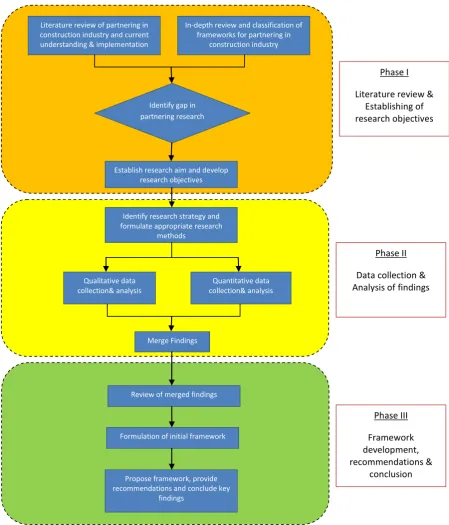
| 6 The first phase commencing this research is the literature review phase. The first part of phase is conducted to develop a comprehensive understanding of partnering practices in the construction industry, identifying its key enabling factors, benefits and barriers, classifying partnering frameworks in current literatures, reviewing current guidelines on partnering made available by the authorities in Malaysia and exploring current dissemination of knowledge for partnering in Malaysia.
| 7 The second phase of this research focuses on developing a sound methodology to achieve the aim and objectives of this research, as well as answering the research questions posed. Through justifications of research design and methodologies selected, both qualitative and quantitative data collection will be conducted at this phase.The data collection revolves around 4 themes in this research namely;
Review of merged findings
Phase I
Literature review & Establishing of research objectives
Phase II
Data collection & Analysis of findings
Phase III
Framework development, recommendations &
[image:26.595.107.557.58.584.2]conclusion
Figure 1.1: Research methodological framework
Formulation of initial framework
Propose framework, provide recommendations and conclude key
findings Literature review of partnering in
construction industry and current understanding & implementation
In-depth review and classification of frameworks for partnering in
construction industry
Establish research aim and develop research objectives
Identify research strategy and formulate appropriate research
methods Identify gap in partnering research
Qualitative data collection& analysis
Quantitative data collection& analysis
| 8
Understanding of partnering concept
Awareness of partnering in other countries
Types of organizational culture and structure in construction firms
Role of organizational culture in partnering
| 9 The final phase of this research is the framework development, recommendation and reporting stage. The findings from both qualitative and quantitative analyses are then tabulated according to the themes in answering the research questions. As this research is founded upon the inductive process of theory building, findings from this research will be taken on board and incorporated into the development of a framework for effective partnering through aligning different organizational cultures in Malaysian construction industry. Recommendations will be made based on the findings of this research and conclusions from this research will be included in the thesis.
The research process is discussed more extensively in the following Chapter 4.
1.5 OUTCOMES OF THIS RESEARCH
This research will seek to explore the issues pertaining to the implementation of partnering in Malaysian construction industry, and how these issues can be assisted with aligning organizational cultures among parties involved in the partnering ventures. The main outcomes of this research are summarized as below:
Recognizing the actual level of engagement in partnering among construction practitioners in Malaysia.
Identifying the types of organizational culture in Malaysian construction industry.
Exploring the current partnering implementation issues in Malaysia through mixed methodology.
Identifying and classifying partnering key enablers and frameworks in current literatures.
Identifying the policies pertaining to implementation of partnering in Malaysia.
| 10
1.6 SCOPE OF RESEARCH
As previously mentioned in section 1.5, the data collection stage was conducted over the span of 6 months between October 2010 to March 2011, in which both qualitative and quantitative data were collected concurrently. Methods of data collection employed in this research are semi-structured interviews and questionnaire survey. The unit of analysis chosen in this research are engineering consultant (designer) firms. This is mainly due to the Construction Industry Master Plan (CIMP) (CIDB, 2006) which has identified partnering as one of the remedies to improve the innovativeness of Malaysian construction industry. Engineering consultant (designer) firms were chosen as the main sample in this research due to their capable position in introducing innovation in the construction industry, consistent with the findings from Ling (2003); which highlight the role of designer and consultants in innovation. This made the views of consultants in engineering design firms critical in understanding the issues pertaining to the implementation of partnering. Through understanding the issues faced by this particular segment, the findings can assist partnering efforts to be implemented with success and improve the innovativeness of the industry.
1.7 STRUCTURE OF THESIS
The thesis is divided into seven chapters. A brief breakdown of the chapters and what the researcher seeks to address in each chapters are as follows:
Chapter 1 Introduction
This chapter provides the background of the research, the research problems, aim and objectives as well as the relevant research questionswhich will be the foundation for all discussions in the following chapters. Accordingly, the achievements of this research are also briefly mentioned besides the scope of this research. Finally the structure of the thesis is presented at the end of the chapter.
Chapter 2 Partnering in the Construction Industry
| 11 pertaining to construction partnering are included in this chapter. The stages, benefits and barriers are explored extensively in this chapter. This chapter proceeds with the identification and classification of key factors for partnering, which the progresses to the categorization of partnering frameworks as found in current literatures. The categorization helps in visualizing the gap in the knowledge with regards to partnering. This chapter ends with a summary of key findings, which direct the decisions for the coming stages in this research.
Chapter 3 The Malaysian Construction Industry and the Importance of
Organizational Culture in Partnering
This chapter discusses in detail the background of the Malaysian construction industry, the methods of project delivery applied in Malaysia and the problems faced by the industry are explored, which could be resolved with the aid of partnering. The current state of partnering implementation in Malaysia, and related issues such as regulations in place and authorities responsible for promoting partnering are discussed in this chapter. Apart from that, this chapter also highlights the importance of culture as an enabling factor for partnering, and how organizational culture plays a critical role in improving partnering success. The cultural antecedents of Malaysia are also discussed, progressing to the organizational culture across different industries in Malaysia. Methods for assessing organizational culture are also evaluated in this part of the chapter, which later will informs the selection of the best method for assessing organizational culture among firms in the Malaysian construction industry. The model selected will be incorporated in the following data collection and data analysis stages in this research.
Chapter 4 Research Design and Methodology
| 12
Chapter 5 Qualitative Data Analysis
This chapter concentrates on the qualitative data analysis; specifically the participants in interview sessions and the rationale of sampling, the management of qualitative data, the coding process, methods chosen and the steps in analysing the qualitative data. The findings from qualitative data analysis are discussed in detail in this chapter.
Chapter 6 Quantitative Data Analysis
This chapter includes the discussion of findings from quantitative data analysis. It will also include discussion on the sample included in the questionnaire survey, tests conducted in the analysis and the findings from each section of the questionnaire.
Chapter 7 Conclusions, Discussion, and Recommendations
This chapter will revisit the findings in accordance with the objectives first set out at the initial stage of this research. It outlines the proposed framework for partnering in Malaysian construction industry, which takes organizational culture into consideration for success of partnering. The reflection of the researcher on the applicability of the framework and the research process is also included. The final section of this chapter includes the limitations for this research, recommendations and suggestion for future research. The chapter ends with conclusions for this research.
1.8 SUMMARY
| 13
CHAPTER 2
PARTNERING IN THE CONSTRUCTION INDUSTRY
2.1 INTRODUCTION
The first chapter of this thesis has set the scene for partnering as the potential solution in curing the construction industry’s many problems. Accordingly, it is important to achieve a thorough understanding of the overall concept of partnering and its current practices in the construction industry as it will inform other decisions in progressing with the research. Therefore, the main purpose of this chapter is to provide a review of partnering based on an extensive search of existing literature published in the academic and trade world.
| 14
2.2 THE CONSTRUCTION INDUSTRY
The construction industry is a significant contributor to the world economy. The products of this industry provide the necessary public infrastructures and private physical structures for many daily activities such as services, commerce, utilities and other industries. The industry is not only important for its finished product, but it also employs a large number of people (directly and indirectly) hence the effect on the economy of a country during the actual construction process (Wibowo, 2009). Similarly, Dlamini (2012) has also noted the strong relationship between the construction industry and economic growth, specifically in terms of the provision of capital infrastructure. The importance of the construction industry and its many significant contributions are also noted by many studies (Xiou, 2002 ; UKCG, 2009; Khan, 2008; and Dlamini, 2012) specifically in terms of impacts on Gross Domestic Products (GDP), economic activities, government revenues, benefit of investment and nation-wide employments.
At present the global construction industry is recovering from the recent economic downturn from 2007 to 2009, and countries are taking measures to ensure the continued prosperity of their construction sector. According to Baldauf-Cunnington and Hubbard (2011), constrained lending and fiscal measures to address budget deficits in mature markets such as the UK will have a major impact in determining the future of the construction industry. Contrastingly, in fast growing emerging markets, such as Asia and Latin America as well as the frontier markets in the Middle East, population pressures will drive demand for investment in the built environment and fiscal space will allow governments to pursue these plans. Furthermore, in developing nations such as Malaysia, Indonesia and Vietnam, the construction industry is simply too important to be allowed to stagnate or even further decline. Wirahadikusumah and Pribadi (2011) emphasized that the additional pressure from trade liberalization in the construction industry will soon initiate the radical improvement in the process of construction.
| 15 major industry players are easily exposed to conflicts and numerous issues. This could be due to the misunderstanding of roles and improper risk management within the industry. Therefore, considering the significance of the construction industry, it is highly important to identify the key players of the construction industry, who are the generators of activity and income within the industry. The next section will explore the classification of the construction team of the construction industry, and the roles of these key players within the industry.
2.3 KEY PLAYERS OF THE CONSTRUCTION INDUSTRY
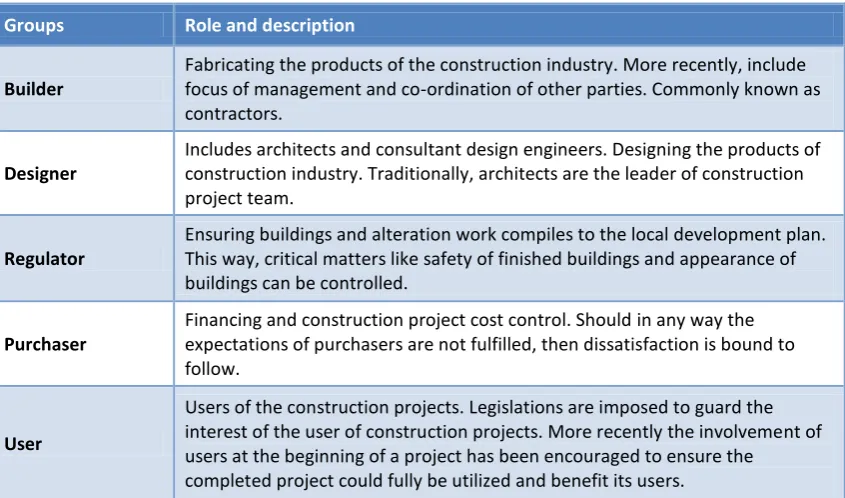
The construction industry is comprised of various parties with distinctive expertise coming together to deliver a construction project. It is essential to identify these key players in order to understand the relationships between them. Many attempts have tried to define the construction team. For the purpose of this research, two classifications of construction team will be discussed to highlight the similarities in the general understanding in regards to the composition of key players within the construction industry.
| 16
Table 2.1: The construction team according to Murdoch and Hughes (2007)
Groups Role and description
Builder
Fabricating the products of the construction industry. More recently, include focus of management and co-ordination of other parties. Commonly known as contractors.
Designer
Includes architects and consultant design engineers. Designing the products of construction industry. Traditionally, architects are the leader of construction project team.
Regulator
Ensuring buildings and alteration work compiles to the local development plan. This way, critical matters like safety of finished buildings and appearance of buildings can be controlled.
Purchaser
Financing and construction project cost control. Should in any way the expectations of purchasers are not fulfilled, then dissatisfaction is bound to follow.
User
Users of the construction projects. Legislations are imposed to guard the interest of the user of construction projects. More recently the involvement of users at the beginning of a project has been encouraged to ensure the
completed project could fully be utilized and benefit its users.
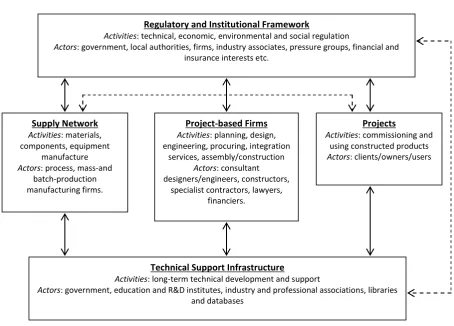
Although the classification made by Murdoch and Hughes (2007) has clearly defined the different groups and roles of practitioners involved in the construction industry, the classification made by Gann and Salter (2000) have established that these different groups of practitioners are interconnected in a network which the construction industry is built upon. Based on the construction industry’s participants and project-based processes, the authors have defined five dominant groups in the construction industry namely the regulatory and institutional framework; supply network; project based firms; projects; and technical support infrastructure.
| 17
Figure 2.1 The actors of the construction industry (Gann and Salter, 2000)
The segmented nature of the construction industry is the result of firms having various specialities working together towards the completion of construction projects in distinct separate stages, as cultured by the traditional procurement system (Nawi, 2012). Apart from their specialities these firms may also have different perceptions of priorities which lead to friction, misunderstanding and issues within the construction industry. The current challenges faced by the construction industry at present will be discussed in the following section.
2.4 CURRENT CHALLENGES IN THE CONSTRUCTION INDUSTRY
As the global construction industry recovers from the turbulence of world economic downturn, it is imperative that the challenges being faced by the key players of the industry are identified so that actions can be taken to improve the state of the construction industry. A review of current literature has brought to light some of the current challenges within the industry; trends of sustainability in construction as well
Regulatory and Institutional Framework
Activities: technical, economic, environmental and social regulation
Actors: government, local authorities, firms, industry associates, pressure groups, financial and insurance interests etc.
Project-based Firms
Activities: planning, design, engineering, procuring, integration
services, assembly/construction
Actors: consultant designers/engineers, constructors,
specialist contractors, lawyers, financiers.
Supply Network
Activities: materials, components, equipment
manufacture
Actors: process, mass-and batch-production manufacturing firms.
Projects
Activities: commissioning and using constructed products
Actors: clients/owners/users
Technical Support Infrastructure
Activities: long-term technical development and support
| 18 as problems in human resources and construction labour market which further show the need for partnering in the construction industry.
Pressures from the business world and global economic situation have led the construction industry to embrace sustainable efforts in its processes and output. Pitt et al (2008) highlighted the three key areas involved within sustainability in construction namely; environmental responsibility, social awareness and economic profitability. Sustainability development strives for meeting the needs of the present without compromising the ability of the future generations to meet their needs (WCED,1987). In defining the way forward for sustainability in construction, Pitt et al (2008) asserted that achieving sustainable construction requires bridging the gap with client demands and awareness in environmental considerations with what is being offered as sustainable process and products in the construction industry.
In parallel to the industry’s effort towards sustainability, several studies (Yunus and Yang, 2012; Nawi et al, 2011; Jaillon and Poon, 2008) have examined the application of prefabrication construction or Industrialised Building Systems (IBS) as a catalyst for increased sustainability in building structures. There are however some hesitation to the adoption of these methods in the construction industry (Yunus and Yang, 2012). The hesitation of adapting these methods can be caused by the lack of understanding from the client, which could be resolved by the early collaboration and involvement of the designers, builders and user/client from the project inception stage through partnering relationships.
| 19 overlapping and redundancy, as well as wastage of limited resources in its implementation process.
At the heart of these issues, a prominent challenge actually lies with implementing collaborative working as it has the potential to improve current conditions of the industry and overcome the aforementioned challenges. While the existence of a competent workforce does increase the performance for construction industry, collaborative working is paving the way for more coordinated and flexible method of project delivery. Accordingly, Akintoye and Main (2007) note the latest development in project delivery methods that emphasizes collaborative working such as partnering, joint venture, public-private partnerships and strategic alliances; which stems from the need for coordination and flexibility especially in projects with high complexities and uncertainties within the construction industry (Anvuur and Kumaraswamy, 2007). Rahman et al (2012) highlighted the importance of identifying the readiness for collaborative working prior to engaging the collaborative project delivery method, so that the mutual objectives of collaborative working within all parties involved can be achieved.
Considering partnering is one of the current methods for project delivery, it is therefore important to fully understand the concept of partnering as it is implemented in the construction industry, which is the focus of this chapter. The following sections will highlight the concept of partnering in the construction industry.
2.5 PARTNERING IN THE CONSTRUCTION INDUSTRY
| 20 forced to compensate on quality and time in order to achieve profit to survive. According to Cushman et al (2001), claims and disputes were difficult to resolve, as all parties involved were very protective of their interests.
Project management were then introduced in the attempt to resolve the numerous difficulties and disputes, by creating another entity that manages the projects while the designers, builders, surveyors and specialist contractors concentrate on doing what they know best according to their expertise (Forcada Matheu, 2005). The project management entity also has the interests of the clients in mind, and provided the clients who are unfamiliar with the projects with necessary information. Although project management has resolved some of the issues in the construction industry, the problems associated with competitive bidding and dispute resolutions still remain.
The Latham report of Rethinking Construction has urged the stakeholders and industry players to react proactively in avoiding the negative effect which result from competitive bidding and dispute resolutions. According to Peace (2008), construction partnering was formally recognized in the UK in 1994 following the Latham report. Partnering requires the parties involved to work together in an open and trusting relationship based on mutual objectives, an agreed decision making process and an active search for continuous measurable improvements. Parties opting to implement partnering would have the construction contracts drawn up, with deliverables and measures clearly stated. Oyegoke et al (2009) further state that in some cases, the use of partnering is incorporated in the contract document, while in most cases the tools of partnering is being implemented informally, along with the standard construction contract.
| 21 effectiveness of each other’s business. Therefore, it can be concluded that partnering can be seen as positive change to improve the industry in terms of project delivery method.
2.5.1 DEFINITION OF PARTNERING
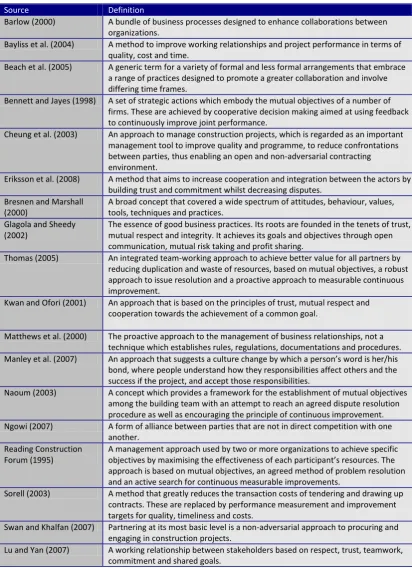
In the recent years, there has been an increasing amount of literature discussing partnering in the context of construction industry. In the UK, the partnering strategy had started to be implemented more widely since the recommendations in the Latham Report in 1994 and the Rethinking Construction report in 1998 (Kumaraswamy and Matthews, 2000; Cox and Ireland, 2002; Mason, 2007; and Jones and Kaluarachchi, 2008). In the US, Australia and Japan, the partnering strategy made its debut in the 90s and have then been made the point of references due to their success in establishing suitable procedures for the selection of subcontractors in public sector contracts (Naoum, 2003). According to Humphreys et al (2003), the adoption of partnering into the construction industry in these countries can be attributed to the fact that the relationships in these industries were commonly lacking trust, respect and honesty between clients, main contractors and subcontractors.
| 22 (2003) perfectly fits into the second category. Naoum (2003) defines partnering as a concept which provides a framework for the establishment of mutual objectives among the building team with an attempt to reach an agreed dispute resolution procedure as well as encouraging the principle of continuous improvement.
A key definition of partnering, which is commonly cited by numerous partnering literature is provided by the Reading Construction Forum (1995) where partnering is defined as a management approach used by two or more organisations to achieve specific business objectives by maximising the effectiveness of each participant’s resources. The approach is based on mutual objectives, an agreed method of problem resolution, and an active search for continuous measurable improvements.
| 23
Table 2.2: Definitions of construction partnering in existing literatures.
Source Definition
Barlow (2000) A bundle of business processes designed to enhance collaborations between organizations.
Bayliss et al. (2004) A method to improve working relationships and project performance in terms of quality, cost and time.
Beach et al. (2005) A generic term for a variety of formal and less formal arrangements that embrace a range of practices designed to promote a greater collaboration and involve differing time frames.
Bennett and Jayes (1998) A set of strategic actions which embody the mutual objectives of a number of firms. These are achieved by cooperative decision making aimed at using feedback to continuously improve joint performance.
Cheung et al. (2003) An approach to manage construction projects, which is regarded as an important management tool to improve quality and programme, to reduce confrontations between parties, thus enabling an open and non-adversarial contracting environment.
Eriksson et al. (2008) A method that aims to increase cooperation and integration between the actors by building trust and commitment whilst decreasing disputes.
Bresnen and Marshall (2000)
A broad concept that covered a wide spectrum of attitudes, behaviour, values, tools, techniques and practices.
Glagola and Sheedy (2002)
The essence of good business practices. Its roots are founded in the tenets of trust, mutual respect and integrity. It achieves its goals and objectives through open communication, mutual risk taking and profit sharing.
Thomas (2005) An integrated team-working approach to achieve better value for all partners by reducing duplication and waste of resources, based on mutual objectives, a robust approach to issue resolution and a proactive approach to measurable continuous improvement.
Kwan and Ofori (2001) An approach that is based on the principles of trust, mutual respect and cooperation towards the achievement of a common goal.
Matthews et al. (2000) The proactive approach to the management of business relationships, not a technique which establishes rules, regulations, documentations and procedures. Manley et al. (2007) An approach that suggests a culture change by which a person’s word is her/his
bond, where people understand how they responsibilities affect others and the success if the project, and accept those responsibilities.
Naoum (2003) A concept which provides a framework for the establishment of mutual objectives among the building team with an attempt to reach an agreed dispute resolution procedure as well as encouraging the principle of continuous improvement. Ngowi (2007) A form of alliance between parties that are not in direct competition with one
another. Reading Construction
Forum (1995)
A management approach used by two or more organizations to achieve specific objectives by maximising the effectiveness of each participant’s resources. The approach is based on mutual objectives, an agreed method of problem resolution and an active search for continuous measurable improvements.
Sorell (2003) A method that greatly reduces the transaction costs of tendering and drawing up contracts. These are replaced by performance measurement and improvement targets for quality, timeliness and costs.
Swan and Khalfan (2007) Partnering at its most basic level is a non-adversarial approach to procuring and engaging in construction projects.
Lu and Yan (2007) A working relationship between stakeholders based on respect, trust, teamwork, commitment and shared goals.
Another definition, much simpler yet concise and is widely adopted by construction partnering literature is by Bennett and Jayes (1998) who defined partnering as a set of strategic actions which embody the mutual objectives of a number of firms. These
| 24 continuously improve joint performance. This definition by Bennett and Jayes (1998) has become the main starting point of this research, which aims to explore the best strategic approach for partnering through aligning different organizational cultures among various firms in the construction industry. Although this definition is published more than a decade ago when partnering was introduced in the United Kingdom, this definition is still relevant to the current situation in Malaysia which construction industry is just beginning to embrace partnering practices. This definition also inspires the aim of this research not only because it describes the necessity of planned and scheduled actions that has specific purpose in synergizing the resources and collaboration of each parties involved in the partnering team; but also it highlights the importance of feedback in increasing the effectiveness of the partnering team to improve collective performance.
In order to fully realize the many benefits of partnering as the definition implies, it is only logical that the partnering approach must be perfected over a period of time and need to be developed in stages. The following section will describe the stages of partnering identified by current literatures.
2.6 DEVELOPMENTAL STAGES OF PARTNERING
| 25 relationship within the supply chain to produce specific products designed for specific customers. These specific products provide a steady stream of work for the construction firm. There is a clear difference between stages, and how partnering evolves in these stages can easily be related to actual partnering practice.
Cheng and Li (2001) propose a different set of stages for partnering in the construction industry. They had incorporated several concepts from change management literature and identified the three stages of partnering. The three stages are partnering formation, partnering application and finally partnering completion and reactivation. Each stage is an independent sub-process and forms the basis of the following stage. The first stage, partnering formation, basically refers to a formal or informal agreement between all parties involved to establish an informal relationship aimed to accomplish a set of mutually agreed goals and objectives. This set of mutually agreed goals and objectives will then be translated into activities during the construction project where all partners will in one way or another provides their inputs or expertise to carry out specific tasks to benefit the partnering relationship as a whole. Consequently in the second stage, partnering application, the partners involved need to learn and experience new ideas and methods which are brought upon by their counterparts. The final stage, partnering completion and reactivation is where the partners have the intention to collaborate in an informal relationship again with the same group of companies in another construction project.
| 26 sustainability of businesses within the industry. However it is also important to identify how the partnering is implemented in the construction industry as a project delivery method. The next section describes how partnering stems from the need of the government sector in funding the continuous development of infrastructures and identify the common manner in which partnering is implemented.
2.7 IMPLEMENTATION METHODS OF PARTNERING
In developing a country, the government is responsible for taking measures to ensure the continuity of development regardless of the economic state of its nation. In the past the government is seen as the sole entity to finance and initiate development projects, however it is not uncommon for the government to entrust the position of financing and initiating the development to the private sector in the recent times. Initially the measures taken to relieve the government of project financing burdens, have then evolved into a quest of efficiencies and value for money. According to Kumaraswamy et al (2007), these efficiencies are expected to result in superior performance levels in creating and managing, and not merely maintaining assets and properties.
The transition from public to market-oriented sponsorship has encouraged the emergence of other forms of procurement in order to add value and efficiency to public sector activities. Partnering is implemented through a number of methods most commonly known as; public-private partnerships (PPP), private finance initiatives (PFI) and private sector involvement (PSI) (Oyegoke et al, 2009). In PPP, the government assumes the primary responsibilities and functions from public to private sector. The PFI method sees the government moving away from its traditional role (finance, ownership, operation) by purchasing of services from the private sector. The PSI is a strategy for improving public services by involving the private sector in selected roles and responsibilities otherwise performed by the government.
| 27 Rusmani (2010). The following section will discuss in detail the concept and definition of PPP, as well as the lessons learned from previous case studies in PPP.
2.7.1 PUBLIC-PRIVATE PARTNERSHIP (PPP)
Akintoye et. al. (2003) define Public-Private Partnership (PPP) as a cooperative venture between the public and private sectors for the delivery of a public service through appropriate allocation of resources, risks and rewards. It can simply be seen as means of public sector procurement using private sector finance and best practice (Jefferies, 2006). PPP can involve design, construction, financing, operation and maintenance of the infrastructure and facilities, or the operation of services to meet public needs.
A comprehensive definition of PPP is given by Alfen et. al. (2009) when discussing PPP in infrastructure development. The term PPP refers to a long-term, contractually regulated cooperation between the public and private sector for the efficient fulfilment of public tasks in combining the necessary resources (e.g. know-how, operational funds, capital and personnel) of the partners and distributing existing project risks appropriately according to the risk management competence of the project partners.
Under a PPP scheme, a facility is designed and constructed by the private sector. The private party then will be responsible for managing and maintaining the facility and have control of the facility for a certain period of time as stated in the contract. Within this period, the private party reserves the right to earn income from the operation of the facility. At the expiry of the contracting period, the facility will be handed over to the public sector.