http://dx.doi.org/10.4236/opj.2013.35A001 Published Online September 2013 (http://www.scirp.org/journal/opj)
Quantification of Solid Residues by Raman Spectroscopy
Esau Araiza-Reyna1, Roberto Sato-Berrú2, América Vázquez-Olmos2
1Facultad de Ciencias, Universidad Autónoma de San Luis Potosí,
Av. Salvador Nava Martínez s/n, Zona Universitaria, San Luis Potosí, México
2Centro de Ciencias Aplicadas y Desarrollo Tecnológico, Universidad Nacional Autónoma de México,
Circuito Exterior s/n, Ciudad Universitaria, Delegación Coyoacán, México D.F., México Email: [email protected]
Received May 17, 2013; revised June 22, 2013; accepted July 19, 2013
Copyright © 2013 Esau Araiza-Reyna et al. This is an open access article distributed under the Creative Commons Attribution Li- cense, which permits unrestricted use, distribution, and reproduction in any medium, provided the original work is properly cited.
ABSTRACT
We suggest a mathematical route which has the capability to obtain quantitative information of solid residues on a sub- strate of aluminum, in which the evaporation of the deposited micro-drops has the form of coffee rings. In this job, the glycine aminoacid was used as probe molecule. We suppose that the number of moles present on the study sample is proportional to the Raman signal and to the experimental parameters of the used Raman system. Then, the mass and the number of molecules can be determined with these data. We showed that the mathematical expression is simple and ele- gant for its implementation. On the other hand, we have applied and demonstrated that the technique of principal com- ponent analysis (PCA) can be used to obtain quantitative information of the sample. Our results show quantitative analysis of glycine residues between 10−11 to 10−15 g.
Keywords: Quantitative Raman; Aminoacids; Glycine; Solid residues; Drop Coating Deposition Raman; Principal Component Analysis
1. Introduction
Glycine is the smallest molecule between the aminoacids; it has the simplest chemical structure (NH2CH2COOH)
and it is part of various proteins in living of things [1-3]. Its function inside the organism is as inhibiting neuro- transmitter in the central nervous system that acts as door of chlorine channel [4]. Because of the clinical signifi- cance of the proteins and aminoacids in the body, it is important to develop new and better techniques for your detection and quantification. Raman and infrared spec- troscopy offers potentially powerful and noninvasive technique for analysis of biomolecules [5-7].
Raman spectroscopy has made great progress and partly because of its versatility of analysis. For example, the samples require no preparation in comparison with other techniques. However, there is a lack of information of this technique in the quantitative analysis, especially in the quantification of solid residues. Raman spectros- copy (macroRaman) is a technique that requires rela- tively large quantities of samples which has a detection limit of the order of concentrations greater than 10−3 M.
Raman microscopy (microRaman) can detect small quantities of sample but still a high concentration (10−5
M) is necessary. This technique uses a combination of
Raman technique and a conventional optical microscope to allow a micrometric characterization of the material [6,7]. The Drop Coating Deposition Raman (DCDR) method, based in the aliquots deposition on hydrophobic substrates, allows obtaining solid residues in the form of coffee rings. This technique has a detection limit about of 10−6 M [8-10]. For the detection of substances diluted to
more low concentrations, methods such as the SERS (Surface Enhanced Raman Scattering) have been devel- oped [11,12], which involve complex metallic substrates or synthesis of colloidal suspensions [13,14]. The SERS phenomenon is the enhancement of Raman signal from molecules in the presence of metallic nanostructures which has a detection limit around of 10−10 M [15,16].
we have introduced and demonstrated that technique of principal component analysis can be used to obtain quan- titative information and discrimination of data in form simultaneous.
2. Materials and Methods
2.1. Raman SpectroscopyWe recorded Raman spectra with an Almega XR disper- sive Raman spectrometer. An Olympus microscope (50X and 0.85 NA: numerical aperture) was used both for fo- cusing the laser on solid samples (residues) and for col- lecting the scattered light in a 180-degree backscattering configuration. In addition, Raman spectra were accumu- lated over 25 s with a resolution of ~4 cm−1, the excita-
tion source was 532 nm radiation from a Nd:YVO4 laser
(frequency-doubled) and the laser power on the sample was 10 mW.
On aluminum substrates, aliquots of 1 µL were depos- ited and dried at 40˚C. These drops produced residues with form of coffee rings. Eight spectra were measured around of each ring. In first approximation, we have con- sidered a homogeneous area
AH of 7.8 × 10⁻⁷ m2 andthe laser spot area
as of 5.2 × 10⁻¹³ m2. We have
found the geometric ratio A
a As H
that was of 6.6× 10⁻⁷.
We seek to test the feasibility of implementing the mi- croRaman technique for quantitative analysis using con- ventional substrates such as glass; silicon and aluminum foil [17]. The glycine aminoacid (99%)was purchased of Fluka and prepared in different concentrations from 0.133 M (10000 ppm) to 1.33 × 10⁻⁵ M (1 ppm) in
tri-distilled water (QuimiNet, Mexico). All samples used in this work were used as received.
2.2. Theoretical Analysis
We have studied the following relationship:
i i H s, where we considered that i and i
are the volume and the concentration initial (sample of reference);
C V A a V C
H
A is the area in a homogeneous configura- tion and as is the area of the laser spot used in the Ra-
man experiment. For an objective (microRaman con- figuration), we have used the following relation:
1.22
d NA as the diameter of a circle. Where is the wavelength of laser and is the numerical aperture of the objective, see Figure 1. Whereas a Gaussian beams, we determined the area of the laser spot [18].
NA
However, we have noted that the number of moles “n” does not remain constant ( initial Homogeneous spot), this changes as the volume of study decreases. Based on these considerations, a mathematical expression can be obtained for number of moles that exist within the laser spot (area or volume):
[image:2.595.309.538.84.137.2]n n n
Figure 1. Gaussian profile of laser beam. “d” is the beam waist.
s
n A C V (1) where A G G s H is the ratio between the geometry of
the laser spot and the homogeneous geometry considered in the experiment, Gs can represent the volume or the
area of the laser spot, and GH can represent the volume
or the residual area in a homogeneous distribution of the study sample. C is the concentration of the sample in Molarity and V is the volume of study in liters. If the number of moles in a system is known, the sample mass and the number of molecules can be determined with the following relations:
s
gn W (2)
molecules s Avog
N n N (3) where, W is the molecular weight of the study sample and Av is the Avogadro’s number (6.022 × 10²³
mol−1). N og
On the other hand, theoretically, it is known that the Raman intensity is mainly proportional to the intensity of the excitation source and to the number of moleculesin the sample volume being probed with the Raman instru- ment [19,20]. Experimentally, it is known that the inten- sity of a Raman spectrum is directly proportional to the concentration. In this paper, considering the previous premises, we will propose and define that the Raman signal is proportional to the number of molecules by us- ing the following simple relationship:
R
I M i (4) where M represents the number of elementary entities and i represents the intrinsic Raman emission, which is individual and representative of the material of study under the experimental conditions. If we assume that
s
Mn , where ns represents the number of moles pre-
sent within the laser spot (area). Using Expression (1), the unitary intensity can be expressed as i I n R s .
Similarly, it can be assumed that it also satisfies the rela- tion Ir n i, where Ir represents an arbitrary Raman
signal. Therefore, the number of moles “n” can be deter- mined in an arbitrary Raman signal with the following relation:
s
n I n (5)
3
matical general approach proposed in this paper.
For solid residues, we must consider the following ex- pression:
n I A C V (6)
where A a A S H,C C V V i, nL orVμL ; where S
and
a H
A are the laser spot and the homogeneous distri- bution areas, respectively, of the study sample; is the initial (reference) concentration; and nL μL is
the aliquot in nanoliters or microliters deposited on the substrate.
i V
C
or
V
However, it is observed that solid residues acquire ha- bitually a heterogeneous distribution. Therefore, the n
(experimental) value and the expected value
ns canbe related by
heterogeneous s
n n h n (7)
where h ≥ 1 and it is a scaling factor on a more real measure of the studied sample. This represents the dif- ferent distributions of the sample when this evaporates on the analysis substrate. For example: h = 1, the distri- bution is 100% coincidental with the homogeneous dis- tribution; h = 2, the distribution is 50% coincidental; h = 5, the distribution is 20% coincidental, and so on. We implemented all these expressions in an excel worksheet.
3. Results and Discussion
[image:3.595.312.530.544.705.2]We have used the Equations (1)-(3) for analysis of gly- cine residues and have obtained the expected values in a micro-Raman experiment as the moles number, the mass amount and the molecules number present in the laser spot, see Table 1. Here, we have considered that the volume of 1 L produced homogeneous residual areas (c.a. 1 mm) which obviously, they are larger than the area of laser spot. However, we have observed that the residue acquired a heterogeneous distribution which im- plies a lesser probability or certainty of that the residue or sample in study is found within the laser spot. There- fore, we note that in the microRaman configuration, the detection limit by glycine was found in a concentration of 10−5 M. However, we have found 10−16 g or 106 mole-
Table 1. Expected values in the homogeneous case (using the Equations (1)-(3)): initial concentration (molaridad); number of moles; mass amount and number of molecules.
Molarity Moles Grams Molecules
1.3 × 10⁻¹ 1.08 × 10⁻¹³ 8.13 × 10⁻¹² 6.50 × 10¹⁰
1.3 × 10⁻² 1.08 × 10⁻¹⁴ 8.13 × 10⁻¹³ 6.50 × 10⁹
1.3 × 10⁻³ 1.08 × 10⁻¹⁵ 8.13 × 10⁻¹⁴ 6.50 × 10⁸
1.3 × 10⁻⁴ 1.08 × 10⁻¹⁶ 8.13 × 10⁻¹⁵ 6.50 × 10⁷
1.3 × 10⁻⁵ 1.08 × 10⁻¹⁷ 8.13 × 10⁻¹⁶ 6.50 × 10⁶
cules into the laser spot. Finally, these equations us pre- dicts that in 10−12 M, we should be detecting a single
molecule. This range of concentration can be observed in work different, especially on SERS and SMD (Single Molecular Detection) jobs [21,22].
Due to heterogeneity in the drying of the sample, we have observed light variations in the intensity of Raman signal in several areas of the same solid residue. The most common solution to this problem is to use a stan- dard sample, wherein a homogeneous distribution and that the concentration of the sample is assumed to be proportional to the ratio of the sample peak height to the standard peak height. The instrumental variation affect the signal measured from the standard sample in the same way as the problem sample signal, this method can achieve excellent quantitative results as will be seen in this work.
For this analysis, we have obtained eight Raman spec- tra from different areas of the residue and at the different concentrations. We have chosen the peak at 1328 cm−1
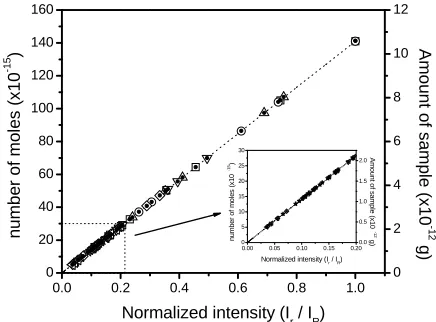
for the analysis that is a typical vibration of glycine ami- noacid. Figure 2 shows the number of moles (geometric figures) and mass amount (black points) which they can be obtained in a microRaman experiment. For this exer- cise, we must know the reference Raman intensity
IRand the intensity of the problem sample
Ir , then wehave used the Equation (6) for determine the number of moles. The concentration 10−1 M is a good point of ref-
erence for this range of concentrations.
Figure 3 shows the deviation values,
experiment expected expected 100
D , between
the expected and experimental data. Because of experi- mental complexity, we have observed that a homogene- ous distribution is not adequate. Therefore, we have had that considerer a heterogeneous distribution by the analysis of solid residues. The Expression (7) is imple- mented and used when the value of “h” exceeds a value
0.0 0.2 0.4 0.6 0.8 1.0 0
20 40 60 80 100 120 140 160
0.00 0.05 0.10 0.15 0.20
0 5 10 15 20 25 30
Normalized intensity (Ir / IR)
nu
m
ber
of
m
ol
es
(
x
10
-1
5)
0.0 0.5 1.0 1.5 2.0Am
o
unt
o
f s
am
p
le
(x
10
-12
g)
Normalized intensity (Ir / IR)
nu
mb
er o
f
m
ol
es
(x
1
0
-1
5 )
0 2 4 6 8 10 12
Am
ou
nt o
f sa
mp
le (
x10
-1
2
g)
[image:3.595.56.287.627.734.2]0.00 0.02 0.04 0.06 0.08 0.10 0.12 0.14 -100
-80 -60 -40 -20 0 20 40 60 80 100
Heterogeneous
Deviat
ion values
(%
)
Concentration (M) F=50
F=20
F=10
F=6 F=4 F=2
Experiment > Expected
F=1
Experiment < Expected
B
0.00 0.02 0.04 0.06 0.08 0.10 0.12 0.14
-100 -80 -60 -40 -20 0 20 40 60 80 100
A
Homogeneous
Experiment > Expected
D
e
viation value
s
(%
)
Concentration (M) Experiment < Expected
(a)
[image:4.595.73.276.80.405.2](b)
Figure 3. Deviation values of data, (a) homogeneous distri- bution and (b) heterogeneous distribution.
of 10. The deviation rises above of 100% and in this case, we must take a new reference. The results are shown in
Figures 3(a) and (b).
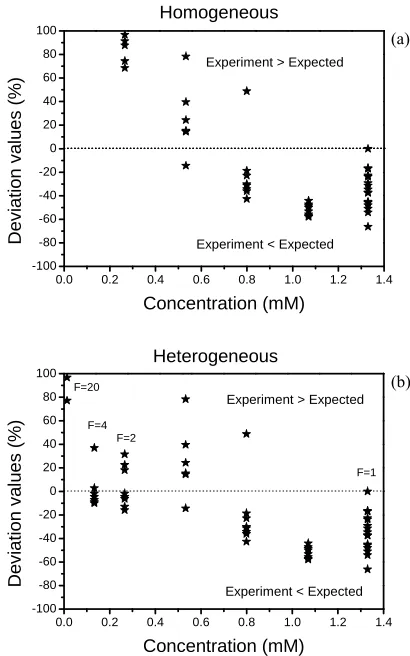
The quantitative analysis of solid residues on sub- strates is not easy task. Here, we show that it is feasible obtain quantitative information changing the initial con- centration (reference) to another point and detect other concentration using solid residues as 10−3 M. Figure 4
shows the number of moles that they can be obtained in a microRaman experiment. For this exercise, we must know the reference Raman intensity
IR and the in- tensity of the problem sample
Ir , then we use the equation 6 for determine the number of moles. The con- centration 10−3 M is a good point of reference for this [image:4.595.311.531.89.246.2]new range of concentrations. These results give us a first approximation the quantitative development of values in more reliable.
Figure 5 shows the deviation values between the ex- pected and experimental data. Equally, because of ex- perimental complexity, we have observed that a homo- geneous distribution is not adequate in this experiment. Therefore; we have had that considerer a heterogeneous distribution by the analysis of solid residues. Again, the Expression (7) is used when the value of “h” exceeds a
0.0 0.2 0.4 0.6 0.8 1.0 0.0
0.5 1.0 1.5 2.0 2.5 3.0
Normalized intensity (Ir / IR)
nu
mber of
mol
e
s
(x
10
-15
)
noise
0.00 0.05 0.10 0.15 0.20 A
m
oun
t of
s
a
mp
le
(x
1
0
-1
2
[image:4.595.320.525.290.618.2]g)
Figure 4. Expected (line) and experimental (geometric fig- ures) data for glycine sample.
0.0 0.2 0.4 0.6 0.8 1.0 1.2 1.4
-100 -80 -60 -40 -20 0 20 40 60 80 100
B
F=4 F=2
De
viation va
lu
es (%
)
Concentration (mM) Heterogeneous
Experiment > Expected
Experiment < Expected F=1 F=20
0.0 0.2 0.4 0.6 0.8 1.0 1.2 1.4
-100 -80 -60 -40 -20 0 20 40 60 80 100
A
Deviation va
lu
es (%
)
Concentration (mM) Homogeneous
Experiment > Expected
Experiment < Expected
(a)
(b)
Figure 5. Deviation values of data, (a) homogeneous distri- bution and (b) heterogeneous distribution.
value of 10. The deviation rises above 100% and in this case, we must take a new reference. The results are shown in Figures 5(a) and (b).
5
0.0 0.1 0.2 0.3 0.4 0.5 0.6 0.7 0.8 0.9 1.0 1.1
-0.4 -0.2 0.0 0.2 0.4 0.6 0.8
ppm 10,000 5,000 2,500 1000 500 250 100 100
PCA2 (2.9
6%)
PCA1 (91.27%)
10-13 10-14
A)
(a)
0.0 0.1 0.2 0.3 0.4 0.5 0.6 0.7 0.8 0.9 1.0 1.1 -0.2
-0.1 0.0 0.1 0.2
B)
n o i s e
ppm 100 80 60 40 20 10 1
PCA
2
(9.9
1%)
PCA1 (60.47%)
10-15 10-16
[image:5.595.62.285.84.422.2](b)
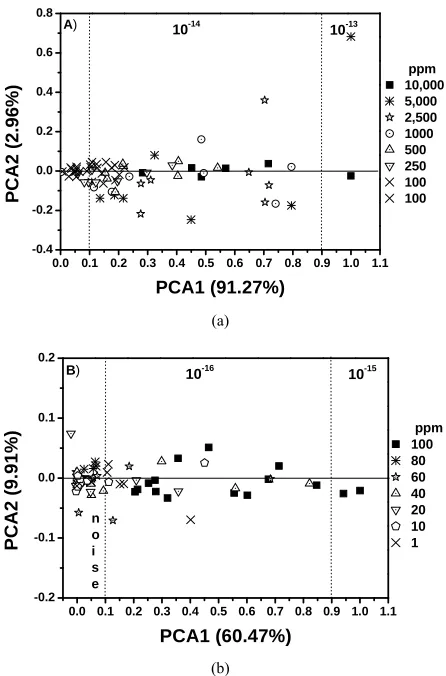
Figure 6. Scores of (a) PCA1 (91.27%) vs PCA2 (2.96%) between 10−13 and 10−14 moles. (b) PCA1 (60.47%) vs PCA2
(9.91%) between 10−15 and 10−16 moles.
represents a Raman spectrum and also, the initial con- centration is indicated. Each drop generated a residual distribution heterogeneous, and therefore, different in- tensities of the Raman signals were obtained. Our pro- posal is that each Raman signal is proportional to the mass amount of the sample in study. In addition, we have modified the x axis (PCA 1) so that it matches the ratio of intensities. With this technique we can determine ranges of measurable values and discern spectral differ- ences from the measurements. We could identify interac- tions between the sample and substrate; we could discern between Raman and SERS spectrum in the same mole- cule and we could determine the orientation of the mi- crocrystal formed. The PCA is an excellent tool to dif- ferentiate molecules in a mixture.
The experimental data show that our quantification proposal is viable and very easy to implement. Under our experimental conditions, we can assign the amount of sample that could be obtained in a homogeneous distri- bution and the studied analyte concentration could be obtained through the Raman signal with enough preci- sion. With respect to the problem of heterogeneity of
some experimental arrangements, we observed that they can be minimized with the acquisition of a good point of reference or adequate initial concentration. The purpose of considering a tunable initial concentration is based on the idea that it is not right to measure objects with the same tool when they have large differences in size. Nev- ertheless, the development of standard samples was a problem in this work; therefore, we are working on it. We are aware that there is appropriate technology to de- velop sampling standards that will help us in the devel- opment of more reliable quantitative measures through the Raman technique since this technique is used in a wide variety of applications, and also because it presents various benefits.
This is the first work that presents a math relationship that relates directly the Raman signal to the amount of studied sample. Also, we think that it could be used to obtain quantitative information in the SERS technique.
4. Conclusion
In this work, we have demonstrated and applied a simple mathematical route for obtaining quantitative information from Raman signals. This approach, along with the PCA technique, helped us to assign quantitative values to the Raman intensity. We showed that it is feasible to con- sider a homogeneous distribution for quantitative analy- sis. However, we have observed that we can also obtain quantitative information in a heterogeneous distribution. The aluminum substrate, for the solid residue analysis, has showed be a promising tool, as well as in the study of aminoacids. The samples deposited on the aluminum substrate have generated residues of coffee rings. In summary, we showed a general equation that could help us to quantify any type of specimen using the Raman technique.
5. Acknowledgements
The authors acknowledge the PAPIIT IA100813 (UNAM) project. The ICyTDF and Cofor for their support, but special acknowledge from E. A. Araiza-Reyna at CONACYT by their support with registration number 168944.
REFERENCES
[1] H. Betz and B. Laube, “Glycine Receptors: Recent In- sights into Their Structural Organization and Functional Diversity,” Journal of Neurochemistry, Vol. 97, No. 6, 2006, pp. 1600-1610.
doi:10.1111/j.1471-4159.2006.03908.x
[3] J. Loertscher and V. Minderhout, “Foundations of Bio- chemistry,” Pacific Crest, Plainfield, 2011.
[4] S. Yamashina, K. Ikejima, I. Rusyn and N. Sato, “Glycine as a Potent Anti-Angiogenic Nutrient for Tumor Grow- th,” Journal of Gastroenterology and Hepatology, Vol. 22, No. S1, 2007, pp. S62-S64.
[5] D. A. Skoog, F. J. Holler and S. R. Crouch, “Principios de Análisis Instrumental,” Cengage Learning Editores, Me- xico City, 2008.
[6] J. J. Laserna, “Modern Techniques in Raman Spectros- copy,” John Wiley and Sons Ltd., Chichester, 1996. [7] Y. Shi and L. Wang, “Collective Vibrational Spectra of α-
and γ-Glycine Studied by Terahertz and Raman Spec- troscopy,” Journal of Physics D: Applied Physics, Vol. 38, No. 19, 2005, pp. 3741-3745.
doi:10.1088/0022-3727/38/19/024
[8] D. Zhang, Y. Xie, M. F. Mrozek, C. Ortiz, V. J. Davisson and D. Ben-Amotz, “Raman Detection of Proteomic Analytes,” Analytical Chemistry, Vol. 75, No. 21, 2003, pp. 5703-5709. doi:10.1021/ac0345087
[9] Y. Xie, Y. Jiang and D. Ben-Amotz, “Detection of Amino Acid and Peptide Phosphate Protonation Using Raman Spectroscopy,” Analytical Biochemistry, Vol. 343, No. 2, 2005, pp. 223-230. doi:10.1016/j.ab.2005.05.038
[10] C. Ortiz, D. Zhang, Y. Xie, A. E. Ribbe and D. Ben- Amotz, “Validation of the Drop Coating Deposition Ra- man Method for Protein Analysis,” Analytical Bio- chemistry, Vol. 353, No. 2, 2006, pp. 157-166.
doi:10.1016/j.ab.2006.03.025
[11] F. J. Garcia-Vidal and J. B. Pendry, “Collective Theory for Surface Enhanced Raman Scattering,” Physycal Revies Letters, Vol. 77, No. 6, 1996, pp. 1163-1166. doi:10.1103/PhysRevLett.77.1163
[12] J. S. Suh and M. Moskovits, “Surface-Enhanced Raman Spectroscopy of Amino Acids and Nucleotide Bases Adsorbed on Silver,” Journal of the American Chemical Society, Vol. 108, No. 16, 1986, pp. 4711-4718.
doi:10.1021/ja00276a005
[13] R. Sato-Berrú, R. Redón, A. Vázquez-Olmos and J. M. Saniger, “Silver Nanoparticles Synthesized by direct Photoreduction of Metal Salts. Application in Surface- Enhanced Raman Spectroscopy,” Journal of Raman Spectroscopy, Vol. 40, No. 4, 2009, pp. 376-380.
doi:10.1002/jrs.2135
[14] J. M. Zhang and D. Y. Shen, “A Novel Substrate Used for Simultaneous SERS and RAIR,” Chinese Chemical Let- ters, Vol. 13, No. 6, 2002, pp. 563-566.
[15] J. B. Jackson and N. J. Halas, “Surface-Enhanced Raman Scattering on Tunable Plasmonic Nanoparticles Sub- strates,” Proceedings of the National Academy of Sci- ences of the United States of America, Vol. 101, No. 52, 2004, pp. 17930-17935. doi:10.1073/pnas.0408319102 [16] E. Horváth, Gy. Kátay, E. Tyihák, J. Kristóf and A.
Rédey, “Critical Evaluation of Experimental Conditions Influencing the Surface-Enhanced Raman Spectroscopic (SERS) Detection of Substances Separated by Layer Liq- uid Chromatographic Techniques,” Chromatographia, Vol. 51, No. 1, 2000, pp. S297-S301.
doi:10.1007/BF02492821
[17] R. Y. Sato-Berrú, J. Medina-Valtierra, C. Medina-Gut- ierrez and C. Fraustro-Reyes, “Quantitative NIR-Raman Analysis of Methyl-Parathion Pesticide Microdroplets on Aluminum Substrates,” Spectrochimica Acta Part A, Vol. 60, No. 10, 2004, pp. 2231-2234.
doi:10.1016/j.saa.2003.11.021
[18] A. E. Siegman, “Lasers,” University Science Books, Sau- salito, 1986.
[19] G. Placzek, “Rayleigh-Streuung und Raman- Effekt in Handbuch der Radiologie,” In: E. Marx, Ed., Translation: The Rayleigh and Raman Scattering (University of Cali- fornia Radiation Laboratory (UCRL), Trans 526(L), 1962), Acadeische-Verlag, Leipzig, 1934, p. 205.
[20] D. A. Long, “Raman Spectroscopy” McGraw-Hill, New York, 1977.
[21] A. G. Ryder, G. M. O’Connor and T. J. Glynn, “Quantita- tive Analysis of Cocaine in Solid Mixtures Using Raman Spectroscopy and Chemometric Methods,” Journal of Raman Spectroscopy, Vol. 31, No. 3, 2000, pp. 221-227. doi:10.1002/(SICI)1097-4555(200003)31:3<221::AID-JR S518>3.0.CO;2-5