http://www.scirp.org/journal/health ISSN Online: 1949-5005
ISSN Print: 1949-4998
Mental Functioning of Workers with Cancer
Diagnosis by Brazilian Version of the Work Role
Functioning Questionnaire—
WRFQ-Br
Cristiane Helena Gallasch
1, Neusa Maria Costa Alexandre
2, Sergio Carlos Barros Esteves
3,
Eugenio Fuentes Pérez Júnior
1, Magda Guimarães de Araujo Faria
1, Elias Barbosa de Oliveira
4,
Priscila Cristina da Silva Thiengo
1, Patricia Campos Pavan Baptista
51Faculty of Nursing, Rio de Janeiro State University, Rio de Janeiro, Brazil
2Post Graduation Programs Professor, Group of Studies and Researches in Occupational Health and Ergonomics Leader, Faculty of
Nursing, State University of Campinas, Campinas, Brazil
3CAISM Hospital da Mulher Dr. José Aristodemo Pinotti, State University of Campinas, Campinas, Brazil
4Post Graduation and Under Graduation Programs Professor, Mental Health and Work, Study Group Leader (GESMT), Faculty of
Nursing, Rio de Janeiro State University, Rio de Janeiro, Brazil
5Post Graduation and Under graduation Programs Professor, Leader of the Group of Studies on the Health of Nursing Worker (GESTE),
School of Nursing, University of São Paulo, São Paulo, Brazil
Abstract
Aim: To evaluate data related to mental work functioning of workers with cancer diagnosis in radiotherapy in a private service in the city of Campinas, State of São Paulo, Brazil. Method: It consists in a cross-sectional, observational and analytical study with comparison between cancer patients and healthy people, using the Brazil-ian version of the Work Role Functioning Questionnaire (WRFQ-Br). Descriptive and statistical analysis is performed by the Mann-Whitney test. Results: There was a significant difference between the groups in the evaluation of mental demand; how-ever, the population diagnosed with malignant neoplasm submitted to radiotherapy had unexpected higher scores, reflecting lower mental exigency. Conclusions: The observed context may occur due to extensive support of family, government and in-terdisciplinary team of health care for individuals diagnosed with cancer. This data provide support for new research studies related to the importance of the work to promote mental health, considering aspects related to social interaction and produc-tivity as the support system members. The importance of disseminating these results and limitation is based in the necessity of investments to improve research and ac-tions to promote the permanence and early return to work for cancer survivors in Brazil and Latin America.
How to cite this paper: Gallasch, C.H., Alexandre, N.M.C., Esteves, S.C.B., Júnior, E.F.P., de Araujo Faria, M.G., de Oliveira, E.B., da Silva Thiengo, P.C. and Baptista, P.C.P. (2016) Mental Functioning of Work-ers with Cancer Diagnosis by Brazilian Ver-sion of the Work Role Functioning Ques-tionnaire—WRFQ-Br. Health, 8, 1495-1505.
http://dx.doi.org/10.4236/health.2016.814148
Received: October 14, 2016 Accepted: November 13, 2016 Published: November 16, 2016
Copyright © 2016 by authors and Scientific Research Publishing Inc. This work is licensed under the Creative Commons Attribution International License (CC BY 4.0).
Keywords
Neoplasms, Mental Health, Social Support, Occupational Health Nursing
1. Introduction
Cancer and other chronic diseases represent severe public health problem. They cause physical, psychological and social impairments, as well as absenteeism, labor market exit, and a reduced quality of life [1][2][3][4].According to the World Health Organ-ization, about 27 million new cases of cancer could happen until 2030, with 17 million deaths and 75 million survivors, due to the increase of life expectancy and risk factors exposure. Approximately 50% of cases occur in developing countries, such as Brazil, where 576,000 notifications of new cases of cancer were expected per year in 2014 and 2015 [5]. Newer Brazilian data are not available until this moment.
After clinical therapeutic cycles, cancer survivors should move forward with their lives, and to address aspects of work in survivorship is relevant in the rehabilitation process, during and post-treatment to prevent challenges related to “live with cancer diagnosis” [6]. In several countries, including Brazil, many cancer patients remain at work during treatment or return to work soon afterward, since the work provides in-comes, such as health insurance, as well as it is a way to maintain social relation-ships, self-identity and self-esteem. Attention to limitations relative to work demands is warranted in all fields of health, particularly in those who desire or need to work [7].
North American and European studies show work limitations related to cancer sur-vivorship since 2000’s. Cancer survivors may present work limitations in up to 11 years after diagnosis and starting treatment [8]. Previous studies using the Work Limitations Questionnaire (WLQ) related fatigue depression, anxiety and cognitive loss in patients after cancer therapies [9][10]. It is noteworthy that patients may present residual symp-toms after chemo- and radiotherapy, causing a direct and negative impact in return to work [7][11].
For a long time, psychological symptoms of cancer patients were neglected. However, it has recently received increased research attention, recognizing its impact on patients’ quality of life [12][13]. To date, there is still a gap of publications related to the evalua-tion of psychological/mental disorders in general workers with cancer diagnosis, as well as the impact of these conditions in return to work.
In the present study, we use the mental subscale of the Brazilian version of the Work Role Functioning Questionnaire (WRFQ-Br), by measuring cognitive demands, in-cluding attention and concentration. The WRFQ-Br has shown good reliability and va-lidity in populations with musculoskeletal symptoms and among workers with cancer diagnosis in radiotherapy, i.e., it is an appropriate instrument to measure the mental functioning of workers with chronic health conditions [14][15][16].
this study is to investigate mental functioning in workers with cancer diagnoses when in radiotherapy. It is expected to find lower mental functioning scores for patients when compared to healthy workers.
2. Methods
2.1. Ethical Considerations
The full research protocol and the informed consent were approved by the Faculty of Medical Sciences, State University of Campinas’ Ethics Committee, being identified by CAAE 4840.0.000.146-09 and report number 1104/2009, following the Helsinki Decla-ration and all Ethics Brazilian regulation law.
2.2. Study Design
The present study concerns a cross-sectional, observational study, testing the hypothe-sis that workers with cancer diagnohypothe-sis in radiotherapy have significantly different scores for mental work functioning demand than healthy workers.
2.3. Subjects and Setting
The study included cancer patients receiving radiotherapy in a private health service in the state of São Paulo, where people with any age and miscellaneous social, economic and educational level can be attended, through private health insurance or paid service. Fifty-one patients who received radio-oncology assistance between 2011 and 2012 and 105 individuals with no complaints were selected to participate.
Inclusion criteria: Symptomatic individuals included in this study comprised literate patients aged 18 - 65 years, with cancer diagnosis confirmed by laboratorial tests, and receiving radiotherapy in a private radiotherapy center, with minimum exposure doses of 2000 cGy or that had radiotherapy recently (for a maximum of 24 months). Workers who maintained formal or informal employment during treatment were included [15], being this the main reason to interview only 51 subjects. In clinical practice, we ob-served that, even patients don’t present complaints; health professionals usually suggest the full removal from work activities during cancer therapies.
Exclusion criteria: Illiterate patients or those with some degree of difficulty in read-ing and understandread-ing, and/or those who refused to participate, as if those who weren’t working during radiotherapy protocol were excluded of this study.
Workers who did not report any health complaints or difficulties at work, who parti-cipated of a previous study [14][15][16], with similar social, economic and educational were selected among employees at a technological development center in the state of São Paulo, and defined as “Healthy Workers”. This inclusion was approved by the eth-ical committee.
2.4. Instruments and Data Collection
occupa-tion, job hours per week, period of work and complaints about health was performed to define population socio, demographic and clinical data characteristics [14]. Thereafter, occupations were classified as job types according to Hébert’s classification [17], fol-lowing the same methods as previous studies.
The Brazilian version of the WRFQ (WRFQ-Br) was used to examine mental work functioning demand, considering the importance of to evaluate this population feature, as explained above. The WRFQ-br examines the percentage of time that workers have dif-ficulties in accomplishing the work demands due to health problems [18][19][20]. This health measurement tool was translated and had its psychometric properties evaluated for whole instrument ad for each subscale to Brazilian workers in previous studies [14] [16].
Patient’s data were collected in the radiotherapy center, for those who were still in treatment. For those who had finished treatment, data were collected in home visits, or by sending a postal questionnaire. In a phone call prior to data collection, patients were asked to choose how they would like to complete the questionnaire. Healthy workers answered the questionnaire at the workplace, after having received information about the study objectives.
2.5. Statistical Analyses
Initially, a descriptive analysis was carried out to characterize the participants. Data collected were entered into data bank (Microsoft Office Excel 2007, SAS version 9.2 - Cary, NC, USA: SAS Institute Inc., 2008 and R-project 2.15.0) and submitted to statis-tical analysis with the collaboration of the University’s Statistics Department.
To compare patients with healthy population, as results did not demonstrate a nor-mal distribution, and only two variables were obtained, the Mann-Whitney test was used to perform data evaluation.
3. Results
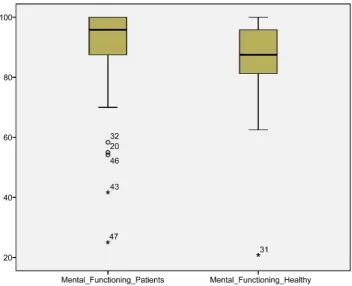
Socio-demographic characteristics of all subjects are described in Table 1. Occupations were classified as job types according to Hébert’s classification [17]. The mean score for mental functioning evaluated using the WRFQ-Br is shown in Table 2 and in Figure 1.
Difference about age between groups was observed as expected, with older people between patients. Both presented majority of workers in mixed activities of work, with no statistical difference about weekly work hours.
Majority of cancer diagnosis were breast cancer (45.1%) and prostate cancer (23.5%). Other cancer diagnosis concerned non-Hodgkin’s Lymphoma (5.9%), rectum, uterus, parotid, stomach, pharynx, skin, bones and bladder cancer.
Table 1. Socio-demographic, clinical and laboral characteristics. Campinas, São Paulo, Brazil, 2013.
Workers in radiotherapy
(n = 51) Workers with no health complains (n = 105) p-value* Gender n (%)
Male 23 (45.1) 46 (43.8)
Female 28 (54.9) 59 (56.2)
Mean age (years (±SD)) 53.4 (10.1) 34.8 (11.8) <0.0001
Cancer Diagnoses
Breast 23 (45.10)
Prostate 12 (23.53)
Head and Neck 4 (7.85)
Non Hodgkin Limphoma 3 (5.88)
Rectum 2 (3.92)
Uterus 2 (3.92)
Stomach 2 (3.92)
Others 3 (5.88)
Educational Level n (%)
Elementary 9 (17.6) 3 (2.9)
High school 6 (11.8) 35 (33.3)
Undergraduation 28 (54.9) 44 (41.9)
Post-graduation 8 (15.7) 23 (21.9)
Mean weekly work hours (±SD) 41.5 (10.0) 40.6 (2.5) 0.0663
Mean Period of job (years (±SD)) 20.3 (11.9) 9.9 (10.0) <0.0001
Job Type n (%)
Manual 13 (25.5) 14 (13.3)
Mixed 21 (41.2) 65 (61.9)
Non-Manual 17 (33.3) 26 (24.8)
*Mann-Whitney test.
Table 2. Mean score for mental work functioning. Campinas, São Paulo, Brazil, 2013.
Workers in radiotherapy
(n = 51) Workers with no health complains (n = 105) p-value*
μ (±SD) Median μ (±SD) Median
Mental Work Functioning 89.05 (16,57) 95.83 86.07 (13,72) 87.50 0.0189
[image:5.595.193.555.630.694.2]Figure 1. Mean score for mental work functioning compared by box plot. Campinas, São Paulo, Brazil, 2013.
4. Discussion
In this study, we found mental work functioning between the observed groups. Unex-pectedly, cancer patients presented higher mental work functioning than healthy pa-tients. It may be associated with the patient’s function in the family, at work, hence into society [21]. The systematic involvement of health professionals in psychosocial sup-port to the work of cancer patients and the integration among physicians involved in the treatment and occupational characteristics may facilitate the return to work activi-ties [22].
The possible explication is that worker diagnosed with cancer receives largest health multidisciplinary support to return to work, in addition to better understanding and protection from all stakeholders. It is wondered if part of this population may not differ from the general population in some aspects of health evaluation. It is relevant to recol-lect that all patients kept their work activities, which may represent better clinical con-ditions in the moment of the study.
Work has been understood as part of the world experienced by the subject, his/her body and his social relations, representing a way of enjoyment or pain, resulting in dif-ferent expressions of productivity and creativity [23]. Through the work human can find his/her place in the community [21]. In a perspective of labor as a source of plea-sure, it is necessary to consider the centrality of work in the human life, contributing to the identity formation, influencing self-perception about the world and subjective building of desires and life projects. So, as explained since 1990’s by the one of the most important authors who study psychodynamic, work may act positively on worker men-tal health strengthening psychic reserves when configured as a source of pleasure and satisfaction [24].
Due to high physical and mental requirement in work, there is a great amount of removal from job activities between patients with cancer diagnosis. In Brazil, there is a gap of information about removal, but it is know that in the year of this study, more than 130,000 financial social benefits were given to workers during cancer treatment [25]. In this study, it was observed 13.4% of patients were out of work, even after the end of treatment. There are no clear data about how to assess ability/disability of these individuals or attempts of work environment adaptation, reducing output/schedule demands or journey, as ways of avoiding total removal of labor activities.
The increased survival rate after cancer treatment for individuals in economically ac-tive age expands the chances of staying or returning to work activities. This rate of re-turn to work varies according to the characteristics of the support of each country, in-cluding health systems, rehabilitation and social systems [26].
This context is one of the reflections of this study. Considering social role of work and all support systems and stakeholders procedures related to it, with direct influence on psychosocial aspects of health, how the maintenance work activities could do a posi-tive role in the management of stress and coping of that patients? Authors know, be-cause of their clinical practice, that may times it is not possible for patients to maintain full-time work activities due to the necessity to attend to health services appointments, and because of clinical symptoms related to the treatment protocols.
However, would all individuals need the full removal in Brazilian context? Would be benefits in partial stay on the work environment? Partial removal is a reality in some European countries. In addition, there is the reality of care that many patients with self-employment (autonomous), who keep the work activities, as the only form of sub-sistence.
Scientific literature describing benefits of working to promote mental health are un-common, with a predominance of paper about psychosocial damage caused by work activities and few reflections on the positive aspects related to family and social circles involved and their relationship with clinical. Contributions of Dejours’ studies high-light to impact of labor on mental life, reinforcing the centrality of work in under-standing not only the disease but also health and pleasure [27].
exer-cise freedom and creativity in the labor process, experiencing the tasks as a means of mental relaxation. The work can be a balancing form, to provide pleasure during the execution, contributing to the worker feel better than even before to have them started [28]. In this context, the work is able to minimize negative thoughts and anxious crises, strengthening social support through the emotional ties links with his peers in the work relationship.
It is important to remember that worker with cancer diagnosis and receiving radio-therapy lives with a high negative charge resulting from disease prognosis and lifestyle changes imposed by the treatment, being subject to the imbalance of his/her mental health. Self-image, identity, wishes and life perspectives are directly affected. Thereby, it is necessary to reflect on the impact of sick leave in the fear of worthlessness, lack of recognition and maintenance of its survival on their subjectivity [29].
In Brazilian context, occupational health, psychology, psychiatry and oncology pro-fessionals need to talk with compensation systems and other stakeholders and to access more information to develop interdisciplinary skills that allow promoting changes in the workplace and the improvement of actions to promote permanence and early re-turn to work [6].
Authors understand that the small sample size is a limitation of this study, however, since it was intended to approach individuals who kept their work activities even dur-ing radiotherapy, this scene reflects the behavior of Brazilian public and private health systems, with a predominant behavior of removing individuals diagnosed with cancer from work activities. The importance of disseminate these results and limitation is based in the necessity of investments to improve research and actions to promote the permanence and early return to work for cancer survivors in Brazil and Latin America.
5. Conclusions
The study has shown that there are significant differences between patients with cancer diagnosis in radiotherapy and healthy population. Results refuted the hypothesis that the lower mental functioning scores would be found in patients when compared to healthy workers.
Authors propose that it may happen due to extensive support of family, government, interdisciplinary team of health care and others stakeholders for individuals diagnosed with cancer provided by a better comprehension of the disease, which is observed dur-ing clinical practice in oncology.
The study was conducted to deal with the challenge of expanding discussions about cancer survivors in Brazil. It is necessary to find strategies to identify work functioning and to promote work changes and to reorganize the work process for this population, considering the new reality of survivorship after cancer treatment.
Furthermore, it is necessary to enhance the role of transdisciplinary effort to assist worker return to work, according to his/her individual clinical conditions and the type of activity that will be developed in the workplace.
ex-periences, can be a cause of suffering, and the return to the old function is not the bet-ter choice.
It is hoped that the data can provide support for new research studies related to the importance of the work to promote mental health, considering aspects related to social interaction and productivity as the support system members
Acknowledgements
Authors thank to Coordination for the Improvement of Higher Education Personnel (CAPES) for supporting this study.
References
[1] Feuerstein, M. (2005) Introduction: The World Challenge of Work Disability. Journal of Occupational Rehabilitation, 15, 451-452. http://dx.doi.org/10.1007/s10926-005-8026-z
[2] Steiner, J.F., Nowels, C.T. and Main, D.S. (2010) Returning to Work after Cancer: Quantit-ative Studies and Prototypical NarrQuantit-atives. Psychooncology, 19, 115-124.
http://dx.doi.org/10.1002/pon.1591
[3] DiBonaventura, M.C., Gupta, S., McDonald, M., et al. (2012) Impact of Self-Rated Os-teoarthritis Severity in an Employed Population: Cross-Sectional Analysis of Data from the National Health and Wellness Survey. Health and Quality of Life Outcomes, 10, 30.
http://dx.doi.org/10.1186/1477-7525-10-30
[4] Dall, T.M., Gallo, P., Koenig, L., et al. (2013) Modeling the Indirect Economic Implications of Musculoskeletal Disorders and Treatment. Cost Effectiveness Resource Allocation, 11, 5.
http://dx.doi.org/10.1186/1478-7547-11-5
[5] Brasil (2007) Ministério da Saúde. Secretaria de Atenção à Saúde. Instituto Nacional de Câncer. Coordenação de Prevenção e Vigilância de Câncer. Estimativas 2008: Incidência de Câncer no Brasil. INC, Rio de Janeiro.
[6] Feuerstein, M. (2007) Defining Cancer Survivorship. Journal of Cancer Survivorship, 1, 5-7.
http://dx.doi.org/10.1007/978-0-387-34562-8
[7] Moskowitz, M.C., Todd, B.L., Chen, R., et al. (2014) Function and Friction at Work: A Multidimensional Analysis of Work Outcomes in Cancer Survivors. Journal of Cancer Sur-vivorship, 8, 173-182. http://dx.doi.org/10.1007/s11764-013-0340-4
[8] Yabroff, R., Lawrence, W.F., Clauser, S., et al. (2004) Burden of Illness in Cancer Survivors: Findings from a Population-Based National Sample. JournalofNationalCancerInstitute, 96, 1322-1330. http://dx.doi.org/10.1093/jnci/djh255
[9] Feuerstein, M., Hansen, J.A., Calvio, L.C., et al. (2007) Work Productivity in Brain Tumor Survivors. Journal of Occupational and Environmental Medicine, 49, 803-811.
http://dx.doi.org/10.1097/JOM.0b013e318095a458
[10] Hansen, J.A., Feuerstein, M., Calvio, L.C., et al. (2008) Breast Cancer Survivors at Work.
Journal of Occupational and Environmental Medicine, 50, 777-784.
http://dx.doi.org/10.1097/JOM.0b013e318165159e
[11] Tevaarwerk, A.J., Lee, J.W., Sesto, M.E., et al. (2013) Employment Outcomes among Survi-vors of Common Cancers: The Symptom Outcomes and Practice Patterns (SOAPP) Study.
Journal of Cancer Survivorship, 7, 191-202. http://dx.doi.org/10.1007/s11764-012-0258-2
http://dx.doi.org/10.1002/1099-1611(200101/02)10:1<19::AID-PON501>3.0.CO;2-6
[13] Artherholt, S.B. and Fann, J.R. (2012) Psychosocial Care in Cancer. Current Psychiatry Re-ports, 14, 23-29. http://dx.doi.org/10.1007/s11920-011-0246-7
[14] Gallasch, C.H., Alexandre, N.M.C. and Amick, B.C. (2007) Cross-Cultural Adaptation, Re-liability and Validity of the Work Role Functioning Questionnaire to Brazilian Portuguese.
Journal of Occupational Rehabilitation, 17, 701-711.
http://dx.doi.org/10.1007/s10926-007-9103-2
[15] Abma, F.I., Van der Klink, J.J. and Bültmann, U. (2013) The Work Role Functioning Ques-tionnaire 2.0 (Dutch Version): Examination of Its Reliability, Validity and Responsiveness in the General Working Population. Journal of Occupational Rehabilitation, 23,135-147.
http://dx.doi.org/10.1007/s10926-012-9379-8
[16] Gallasch, C.H., Alexandre, N.M.C. and Esteves, S.C.B. (2015) Psychometric Properties of the Brazilian Version of the Work Role Functioning Questionnaire Evaluating Workers in Radiotherapy. UERJ Nursing Journal, 23, 817-824.
http://dx.doi.org/10.12957/reuerj.2015.15791
[17] Hébert, F. (1996) Les indicateurs de lésions em santé et sécurité au travaiul: analyses par secteur d’activitééconomique em 1991. Institut de recherche Robert-Sauvé em santé et sécurité au travail, Montreaul.
[18] Lerner, D., Amick, B.C., Lee, J.C., et al. (2003) Relationship of Employee-Reported Work Limitations to Work Productivity. Medical Care, 41, 649-659.
http://dx.doi.org/10.1097/01.MLR.0000062551.76504.A9
[19] Amick, B.C., Habeck, R.V., Ossmann, J., et al. (2004) Predictors of Successful Work Role Functioning Alter Carpal Tunnel Release Surgery. Journal of Occupational and Environ-mental Medicine, 46, 490-500.
http://dx.doi.org/10.1097/01.jom.0000126029.07223.a0
[20] Durand, M.J., Vachon, B., Hong, Q.N., et al. (2004) The Cross-Cultural Adaptation of the Work Role Functioning Questionnaire in Canadian French. International Journal of Reha-bilitation Research, 27, 261-268. http://dx.doi.org/10.1097/00004356-200412000-00002
[21] Inada, J.F. (2011) Happiness and Discontents in the Civilization. Revista Digital Adverbum, 6, 74-88.
http://www.psicanaliseefilosofia.com.br/adverbum/vol6_1/06_01_06felicidademalestarcivili
z.pdf
[22] Tamminga, S.J., de Boer, A.G., Bos, M.M., et al. (2012) A Hospital-Based Work Support Intervention to Enhance the Return to Work of Cancer Patients: A Process Evaluation.
Journal of Occupational Rehabilitation, 22, 565-578.
http://dx.doi.org/10.1007/s10926-012-9372-2
[23] Mendes, A.M.B. (1995) Aspectos psicodinâmicos da relação homem-trabalho: as contribuições de C. Dejours. Psicologia: Ciência e Profissão, 15, 34-38.
http://www.scielo.br/scielo.php?script=sci_arttext&pid=S1414-98931995000100009
http://dx.doi.org/10.1590/s1414-98931995000100009
[24] Dejours, C. (1992) Loucura do trabalho. Oboré, São Paulo.
[25] Brasil (2015) Ministério da Previdência Social. Instituto Nacional do Seguro Social. Empresa de tecnologia e informações da Previdência Social. Anuário Estatístico da Previdência Social 2013, Brasília, Brazil.
http://www.mtps.gov.br/dados-abertos/dados-da-previdencia/previdencia-social-e-inss/anu
ario-estatistico-da-previdencia-social-aeps
Workplace. Deutsches Ärzteblatt International, 109, 102-108.
[27] Bouyer, G.C. (2010) Contribution of Psychodinamics of Work to the Debate “The Con-temporary World of Work and Worker’s Mental Health”. Revista Brasileira de Saúde Ocupacional, 35, 249-259. http://www.scielo.br/pdf/rbso/v35n122/a07v35n122.pdf [28] Dejours, C., Abdoucheli, E. and Jayet, C. (2010) Psicodinâmica do Trabalho Contribuições
da Escola Dejouriana à análise da relação prazer, sofrimento e trabalho. Atlas, São Paulo. [29] Dejours, C. (2011) A banalização da injustiça social. Editora da FGV, Rio de Janeiro.
Submit or recommend next manuscript to SCIRP and we will provide best service for you:
Accepting pre-submission inquiries through Email, Facebook, LinkedIn, Twitter, etc. A wide selection of journals (inclusive of 9 subjects, more than 200 journals)
Providing 24-hour high-quality service User-friendly online submission system Fair and swift peer-review system
Efficient typesetting and proofreading procedure
Display of the result of downloads and visits, as well as the number of cited articles Maximum dissemination of your research work