Reduction of PAPR using Modified PTS Technique
Improvement: Simulation and Hardware Implementation
Kalyani G. Fule
PG Student: Dr. DYPSOE Lohgaon, Pune, India
B K. Shiragapur
Asst. Professor, Dr .DYPSOE Lohgaon, Pune, India
ABSTRACT
In this paper, the design and implementation of OFDM system along with Multi-Point Square Mapping combined with PTS (M-PTS) technique has received much attention in reducing the high peak to average power ratio (PAPR) of Orthogonal Frequency Division Multiplexing signals (OFDM). As compared to C-PTS technique, the proposed M-PTS technique needs not to submit side information but keeping almost the same performance of PAPR reduction as the C-PTS technique. A detailed Simulation of OFDM system is conducted and implemented using FPGA to validate the results.
Keywords
(MSM) Multi-point Square Mapping, (OFDM) Orthogonal Frequency Division Multiplexing, (M-PTS) Modified -PTS, (PTS) Partial Transmit Sequence, (C-PTS) Conventional PTS, (PAPR) Peak to average power ratio, (FPGA) Field Programmable Gate Array.
1.
INTRODUCTION
Orthogonal frequency division multiplexing is being used for data transmission in a number of wireless communication systems, which includes digital audio broadcasting (DAB) and digital video broadcasting (DVB) SYSTEMS. OFDM is a multicarrier system, with various advantages over single carrier systems, such as ISI mitigation, robustness to multipath fading by the use of cyclic prefix, high bandwidth efficiency and low implementation complexity [1]. As a result, OFDM is a good choice for high data rate broadband communication.
However, one of the major drawbacks in the design of practical OFDM is high peak to average power ratio (PAPR), especially when the total number of subcarriers is large and all the subcarriers with same initial phase are added. In an OFDM transmitter, power amplification is performed by power amplifier (PA). If the OFDM signal has high fluctuations then PA should have very large linear range of operation and also leads to high complexity of analog to digital conversion, which makes it very expensive. A large PAPR introduces both in band distortion and out band distortion [2] which is undesirable.
Many schemes have been proposed in the literature [3]-[16] to reduce the PAPR of the OFDM signal. Among all schemes which are used to reduce PAPR, PTS and SLM techniques are very attractive due to their good PAPR reduction without the restriction of the number of subcarriers. In C-PTS technique, if the number of sub-blocks or the number of phase factors in the phase set increases then it not only increases the computational complexity for selecting the optimum set of phase sequence but also increases the amount of SI to be conveyed to the receiver. The SI results in data rate loss in OFDM system.
In this paper, detailed study of a Multi-point square mapping method combined with C-PTS, which is named as M-PTS, to avoid transmitting side information (SI) but giving the almost same results of reduction of PAPR as that of C-PTS. The paper is organized into 5 sections, in section 2 problems related to PAPR and C-PTS technique are discussed , whereas section 3 gives study of M-PTS scheme and in Section 4 Simulations results and Hardware results, Section 5 conclusion are discussed in detail.
2.
C-PTS IN OFDM SYSTEM TO
REDUCE PAPR
2.1 PAPR in OFDM System
Presence of large number of independently modulated sub – carriers in an OFDM system the peak value of the system can be very high as compared to the average of the whole system. This ratio is termed as peak to average power ratio (PAPR). The major disadvantages of a high PAPR are – increased complexity in the analog to digital / digital to analog converter and reduction in efficiency of amplifiers.
Let the data blocks of length N be represented by a vector X=[𝑋0, 𝑋1, … … … . , 𝑋𝑁−1]. Duration of any symbol 𝑋𝑘 in the set X is T and represents one of the sub-carriers {𝑓𝑛, 𝑛 =
0,1, … … , 𝑁 − 1} set. As the N sub –carriers chosen to
transmit the signal are orthogonal to each other, so we can have 𝑓𝑛= nΔf , where nΔf = 𝑁𝑇1 and NT is the duration of the
OFDM data block X. the complex data block for the OFDM signal to be transmitted is given by
x(t)= 𝑁1 𝑁−1𝑁=0𝑋𝑛. 𝑒𝑗2𝜋𝑛𝛥𝑓𝑡, 0 ≤ 𝑡 ≤ 𝑁𝑇, (1)
The PAPR of the transmitted signal is defined as
PAPR=max |x t |1 20≤𝑡<𝑁𝑇
𝑁𝑇 |𝑥
𝑁𝑇 0 (𝑡)|2𝑑𝑡
(2)
Reducing the max |x(t)| is the principle goal of PAPR reduction techniques. Since, discrete –time signals are deal with in most systems, many PAPR techniques are implemented to deal with amplitudes of various samples of x(t). Due to symbol spaced output in the first equation we find some of peaks missing which can be compensated by oversampling the equation by some factor to give the true PAPR value.
2.2
C-PTS Scheme
X= 𝑀𝑙=1𝑋𝑙 (3)
Here, it is assumed that the clusters 𝑋𝑙 consist of a set of
sub-blocks and are of equal size. Then, a weighted sum combination of the M sub-blocks which are written as
𝑋′= 𝑏
𝑙𝑋𝑙, 𝑀
𝑙=1 𝑏𝑙=𝑒𝑗 𝜙1 (4)
Where 𝑏𝑙 , l = 1,2,……….,M is the weighting factor with
phase factor 𝜙𝑙 = 0 or π commonly.
After transforming to the time domain, the time domain vector becomes
𝑥 = IFFT { 𝑀𝑙=1𝑏𝑙. 𝑋𝑙} = 𝑀𝑙=1𝑏𝑙.IFFT {𝑥𝑙} (5)
The PAPR can be minimized by exhaustive search for appropriate combination of each block and its corresponding phase factors. With the optimized weighing factor 𝑏 𝑙, the
optimized transmitted bit vector 𝑋 can be generated as
𝑋= 𝑀𝑙=1𝑏 𝑙 𝑋𝑙 (6)
Fig 1 Block diagram of C-PTS technique
3.
PROPOSED M-PTS FOR PAPR
REDUCTION
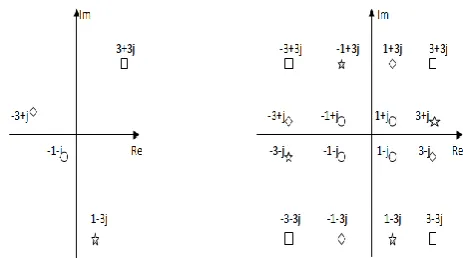
In this section, a multi-point square mapping based PTS technique has been reviewed to reduce PAPR. In this method, receiver does not require any SI to retrieve the original OFDM signal. In this scheme, the bit stream is first converted into quaternary data points (0, 1, 2 and 3) which are lying in four different quadrants and then obtained quaternary data points are initially mapped to four different points of 16-QAM constellation as per Table 1. As seen from Fig 2(a) the initially mapped constellation points lie in four different quadrants and cover all 16 points of 16-QAM constellation after multiplication with 4 phase factors (1,j,-1,-j). In Fig 2(b) the constellation points generated from (3+3j, -3+j, -1-j, 1-3j) after multiplication with phase factors (1,j,-1,-j) , are denoted by the same style of marker. All data points of 16-QAM constellation are divided into four different groups. Each of these groups has four constellation points lying in four different quadrants. Each of these groups corresponds to one quaternary data point. The complete mapping scheme used in M-PTS is given in Table 1. After performing quaternary to 16-QAM mapping, conventional PTS scheme is used to reduce the PAPR of the OFDM signal.
[image:2.595.320.552.71.200.2]Fig 2 (a) Quaternary data (b) Mapping of quaternary data to 16-QAM constellation using 4 phase factors in M-PTS
[image:2.595.57.293.260.445.2]Table 1 Mapping of Quaternary data points to 16-QAM Constellation
Table 2 De-mapping of 16-QAM Constellation Symbols to quaternary Data Points
A de-mapping scheme shown in Table 2 is used to recover the quaternary data points. According to Table 2, if any of the data points is decoded as {3+3j, -3+3j, -3-3j, 3-3j} , {-3+j, -1-3j, 3-j, 1+3j}, {-1-j, 1-j, 1+j, -1+j} or {1--1-3j, 3+j, -1+-1-3j, -3-j}, then is de-mapped to quaternary data 0,1,2 or 3 respectively. Decoding does not require any information about the phase factors thus the major constraints of PTS technique; means the need of SI is completely eliminated.
4.
RESULT AND DISCUSSIONS
4.1
Matlab Simulation
[image:2.595.317.552.428.548.2]Fig 3 CCDF curve for original OFDM, C-PTS and M-PTS
Fig 3 depicts the performance of the PAPR reduction of M-PTS and C-M-PTS techniques are compared with OFDM system. When QAM is employed and N=128 . As shown in Fig 3, PAPR = 7.5dB for C-PTS technique, and PAPR= 7dB for the proposed M-PTS technique, whereas PAPR=8.5dB for Original OFDM. The PAPR reduction of 1dB for C-PTS as compared to Original OFDM and 1.5dB in case of M-PTS which is a most significant part for the reduction of PAPR.
4.2
Hardware implementation
FPGA Implementation for PAPR reduction have implemented on a Virtex5 (XC5VLX110T) family FPGA using the Xilinx 13.4 ISE design tool suite and displayed results on chipscope-pro.
After modelsim simulation, Hardware implementation has been done using chip scope, and for same input. During the compilation and synthesis process, the ISE tool chain generates a report showing device utilization. Once the system
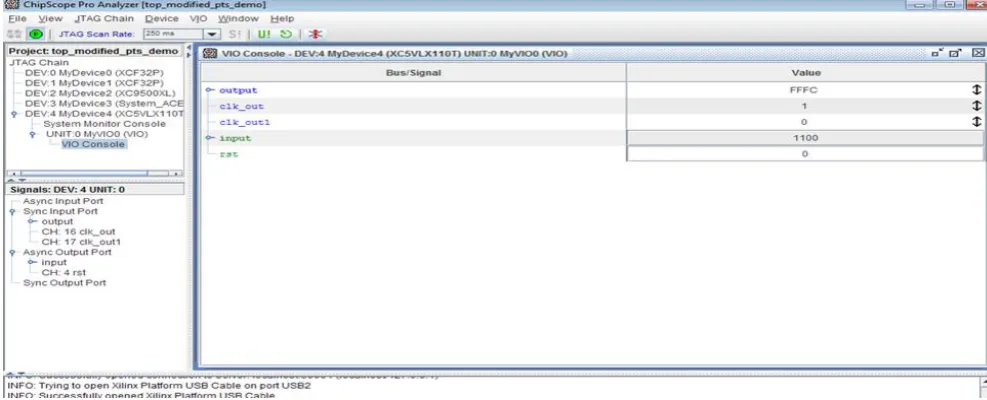
was implemented in Verilog HDL this report was used to determine the overall size and structure of the FPGA device required to implement this technique. The behavioural test of this M-PTS transmitter has been tested as mentioned earlier using the ISE tool chain as shown in Figure 5. This behavioral test has been done using Modelsim simulator, in this modelsim input is din (1100) and output is as shown in fig.5 and dout=fffc in hex the output of the chip scope is as shown in fig 4.
In the same way as shown in fig 4 and fig 5 the results of Basic OFDM and C-PTS is obtained. Compare the Basic OFDM, C-PTS and M-PTS results.
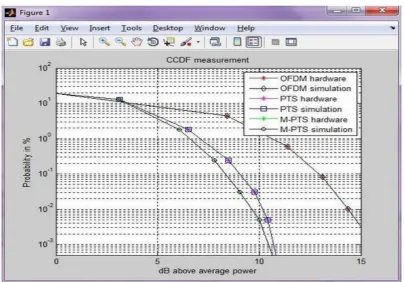
Fig 6 depicts the performance of the PAPR reduction of M-PTS and C-M-PTS techniques are compared with OFDM system, When QAM is employed. As shown in Fig 6, PAPR = 11.2dB for C-PTS technique, and PAPR= 11dB for the proposed M-PTS technique, whereas PAPR=15dB for Original OFDM. The PAPR reduction of 3.8dB for C-PTS as compared to Original OFDM and 4dB in case of M-PTS which is a most significant part for the reduction of PAPR.
From fig 6 it shows that the proposed scheme is practically implemented. It is feasible and cost effective in real time application.
5.
CONCLUSION
[image:3.595.65.559.485.685.2]In this paper, we first reviewed a technique, called as Multi-Point Square Mapping. Then, we describe how to combine Multi-Point Square Mapping and the C-PTS, named as M- PTS, to reduce the PAPR in OFDM systems. The M-PTS scheme could offer good PAPR reduction, which is almost the same as that of C-PTS technique. However, the proposed M-PTS technique needs not to submit side information (SI). Therefore, the proposed M-PTS technique has better bandwidth efficiency compared with the C-PTS technique. Hardware implementation shows that proposed scheme is feasible practical and real time. Above the table body
Fig 5. Simulation result of M-PTS using modelsim
Fig 6 CCDF plots of the hardware implementation of the proposed PAPR reduction technique (for QAM modulation process)
6.
ACKNOWLEDGMENTS
Our thanks to the experts who have contributed towards development of the “PAPR Reduction using PTS techniques”.
7.
REFERENCES
[1] Y .Wu and W.Y. Zou, “Orthogonal frequency division multiplexing: A multi carrier modulation scheme,” IEEE Transc. Consumer Electronics, vol. 41, no.3, pp. 392-399, Aug. 1995.
[3] J. Armstrong , Peak –to –average power reduction for OFDM by repeated clipping and frequency domain filtering , Electronics Letters, 38 (Feb.) (2002) 246-247.
[4] M. Ferdosizadeh Naeiny, F. Marvasti , “ Iterative clipping recovery in spatially multiplexed OFDM system” , Scientia Iranica, D(2012) 19 (3), 739-744.
[image:4.595.96.501.287.569.2]companding to reduce the PAPR of OFDM systems, Int. J.Electron.Commun.(AEU¨ ) 64(2010) 844–857.
[7] T. Jiang, Y. Yang , Y. Song, Exponential companding transform for PAPR reduction in OFDM systems, IEEE Transaction on Broadcasting , 51 (June ) (2005) 244-248.
[8] R. W. Bauml, R. F. H. Fischer, J. B. Huber, Reducing the peak –to average power ratio of multicarrier modulation by selective mapping , Electronics Letters, 32(Oct.) (1996) 2056-2057.
[9] S. H. Muller, J. B. Huber, OFDM with reduced peak-to-average power ratio by optimum combination of partial transmit sequences, Electronics Letters, 33 (Feb.) (1997) 36-69.
[10]Leonard J. Cimini, Jr., and Nelson R. Sollenberger, Peak-to-average Power Ratio Reduction of an OFDM Signal using Partial Transmit Sequences with embedded sode information, in : Proc of IEEE GlobeComm’00, Nov. 2000, pp 740-750.
[11] A. D. S. Jayalath and C. Tellambura, SLM and PTS peak-power reduction of OFDM signals without side information, IEEE Transactions on Wireless Communications, 4(5) (Sept.) (2005) 2006–2013.
[12]H. Ochiai, A novel trellis-shaping design with both peak and average power reduction for OFDM systems, IEEE Transactions on Communications, 52 (Nov) 2004 1916– 1926.
[13]T. T. Nguyen, L. Lampe, On partial transmit sequences for PAR reduction in OFDM systems, IEEE Transactions on Wireless Communications, 2 (Feb.) (2008) 746 – 755
[14]Ashish Goel, Prerna Gupta, Monika Agrawal, SER analysis of PTS based techniques for PAPR reduction in OFDM systems, Digital Signal Processing,
[15]Y. Zhou, T. Jiang, A Novel Multi-Point Square Mapping Combined with PTS to Reduce PAPR of OFDM Signals without Side Information, IEEE Transactions on Broadcasting, 55( Dec.) (2009) 831–835.
[16]A. Goel, P. Gupta, M. Agrawal, Concentric Circle Mapping Based PTS for PAPR Reduction in OFDM without Side Information, in: proceeding of 6 th IEEE Conference on Wireless Communication and Sensor Networks, Allahabad, India, Dec. 2010, 201-204.
[17]L. Yang, K. K. Soo, S.Q. Li, Y.M. Siu, PAPR Reduction Using Low Complexity PTS to Construct of OFDM Signals Without Side Information, IEEE Transactions on Broadcasting, 57(June) (2011) 284-290.
[18]Yeo E., Nikolic B., and Anantharam V., “Architectures and Implementation of Low-Density Parity- Check Decoding algorithms,” in 45th IEEE Midwest Symposium on Circuits and Systems, pp. 437– 440, August 2002.
[19]Tarokh V. and Jafarkhani H., “On the Computation and Reduction of the Peak-to- Average Power Ratio in Multicarrier Communications,” IEEE Transactio Communications, vol. 48, no.1, pp.37–44, 2000.
[20]O. Daoud , O. Alani , “PAPR Reduction by Linear Coding Techniques for MIMO-OFDM Systems Performance Improvement: Simulation and Hardware Implementation,” EuroJournals Publishing, Vol.36 No.3, pp 376-393 (2009).
[21] Chen Y. and Hocevar D., “An FPGA and ASIC Implementation of Rate 1/2 8088-b Irregular Low Density Parity Check Decoder", Global Telecommunications Conference, vol. 1, pp. 113-117, 2003.
[22] Seog Gcun Kang, Jeong Goo Kim and Eon Kyeong Joo, “A Novel Subblock Partition Scheme for Partial Transmit Sequence OFDM” , IEEE transactions on broadcasting, VOI.. 4s. NO. 3. September I999.
[23] Seung Hee Han and Jae Hong Lee, “PAPR Reduction of OFDM Signals Using a Reduced Complexity PTS Technique” , IEEE signal processing Letters, VOL. 11, NO. 11, November 2004
[24]Lingyin Wang and Ju Liu, “PAPR Reduction of OFDM Signals by PTS With Grouping and Recursive Phase Weighting Methods”, IEEE transactions on broadcasting, vol. 57, no. 2, june 2011.
[25]L. Yang, K. K. Soo, S. Q. Li, and Y. M. Siu, “PAPR Reduction Using Low Complexity PTS to Construct of OFDM Signals Without Side Information” , IEEE transactions on broadcasting, vol. 57, no. 2, june 2011
[26]E. Al-Dalakta, A. Al-Dweik, A. Hazmi, C. Tsimenidis, and B. Sharif, Senior , “Efficient BER Reduction Technique for Nonlinear OFDMTransmission Using Distortion Prediction”, IEEE transactions on vehicular technology, vol. 61, no. 5, june 2012
[27] J.Kim and Y.Shin, “An effective clipping companding scheme for PAPR Reduction of OFDM Signal”, IEEE International Conference on Communications, Beijing 2008.PP 668-672.