Development of JPEG2000 with Gamma Code based on
Discrete Wavelet Transform for Still Image Compression
Standard
P.Sumitra,
Ph.D Assistant ProfessorDept of C.Sc,
Vivekanandha College of Arts and Sciences for Women Elayampalayam – 637205, Tiruchengode, Tamil Nadu,
India
ABSTRACT
For many contemporary applications, such as distributed multimedia systems, rapid transmission of images is necessary. Cost of transmission and storage tends to be directly proportional to the volume of data. Therefore, application of digital image compression techniques becomes necessary to minimize the cost. A number of digital image compression algorithms have been developed and standardized. The method proposed by Joint Photographic Experts Group (JPEG) is a lossy compression technique. An improved version of JPEG is JPEG2000, which is currently the most popular compressor. The paper deals with a new compressing non-negative integer method JPEG2000 with Gamma code compressors by modifying the JPEG2000 architecture. In the proposed methods, the entropy coder is replaced by new coders. Simulated experiments using the methods show that proposed methods gives better image quality when compared to the JPEG2000 at any given bit rate.
Keywords
JPEG2000, Discrete Wavelet Transform, Scalar Quantisation, Gamma code
1.
INTRODUCTION
A variable-length code represents a positive integer „v‟ used by a variable number of bits [1]. An example of a variable-length code is the unary code, which represents „v‟ using „v-1‟ zeroes followed by a one. Another is the binary code, which represents „v‟ using the bit binary representation of „v‟. While using variable-length codes for compression, it is useful to concatenate large number of codes together for storage. The gamma code is a variable-length prefix code that represents a positive integer „v „with [log v] zeroes, followed by the bit binary representation of „v‟, with a
total of 2 bits.
Given a string „s‟ containing a gamma code for an integer „d‟ followed possibly by other information, it is possible to decode the gamma code in constant time. To encode negative (or zeros) as well as positive integers a sign bit can be stored with the gamma code. Gamma codes are only one of the several variable-length codes which use O(log n) bits to represent a positive integer „n‟ . Gamma code is efficient for small integers [2], [3]. Daniel and Belloch[4] demonstrated a simple blocking technique that produces an ordered set structure supporting the same operations in the same time
bounds. In their work they used the gamma code. They compared the implementation with blocking and without blocking. Daniel and Blelloch [1] devised a method based on gamma code. Gamma code is only one of the several variable length codes which use O(log n) bits to represent a positive integer „n‟. They described data structures for maintaining a dynamic dictionary, a compact array structure that supports variable-bit-length strings and several data structures for various applications that made use of the variable-bit-length dictionary(VLD).
Rest of the paper is organized as follows: Section 2 deals with detailed description of discrete wavelet transform. Section 3 deals with JPEG2000 architecture and Section 4 deals with proposed method of JPEG2000 with Gamma code. Section 5 gives the experimental results and discussion. Finally Section 6 gives the conclusion.
2.
DISCRETE WAVELET TRANSFORM
Wavelet Transform is a signal analysis method [5] of the time scale and has a advantage of higher compression ratios and avoids blocking artifacts. It allows good localization both in spatial and frequency domain. The discrete wavelet transform is a linear transformation that operates on a data vector whose length is an integer power of two, transforming it into a numerically different vector of the same length.
2.1 One Dimensional Discrete Wavelet
Transform (1-D DWT)
The DWT transforms a discrete time signal to a discrete wavelet representation[6]. The first step is to discretize the wavelet parameters, which reduces the continuous basis set of wavelets to a discrete and orthogonal set of basis wavelets.
such that (1) The 1-D DWT is the inner product of the signal x(t) being transformed with each of the discrete basis function.
(2) The 1-D inverse DWT is given as:
(3) The generic form of 1-D DWT is depicted in Fig.1. A
filters H and G, which in most instances are the filters H and G reversed.
f
Decomposition Synthesis
Bank Bank
Fig.1 Reconstruction filter bank for 1-D DWT
2.2 Two Dimensional Discrete Wavelet
Transform (2-D DWT)
The 1-D DWT can be extended to 2-D transform using separable wavelet filter[7]. With separable filters, applying a 1-D transform to all the rows of the input and then repeating it for 2-D DWT applied on an image all columns will yield the 2-D transform. When one-level 2-D DWT is applied to an image, four transform coefficient sets LL, HL, LH and HH are created. LL corresponds to application of either a low pass or high pass filter to the rows and HL refers to the filter applied to the columns. The 2-D DWT applied on an image is depicted in Fig 2.
Barbara Image
On rows
On Columns
Fig. 2 2-D DWT applied on an image
The 2-D DWT converts images from spatial domain to frequency domain. At each level of the wavelet decomposition, each column of an image is first transformed using a 1D vertical analysis filter-bank. The same filter-bank is applied horizontally to each row of the filtered and subsampled data. One-level of wavelet decomposition produces four filtered and subsampled images referred as subbands. We can use multiple levels of wavelet transforms to concentrate data energy in the lowest sampled bands. The LL subband can then be transformed to LL2, HL2, HL2 and HH2 subbands, producing a two-level wavelet transform.
3.
JPEG2000 ARCHITECTURE
JPEG2000 [8][9] has recently been proposed to meet the demand for efficient, ROI (Region of Interest) coding, quality versus resolution, flexible and scalability essential in today‟s still image compression standards. The key algorithms involved, Discrete wavelet transform, quantization and entropy coding[10][11]. The block diagram of the JPEG2000 encoder and decoder is shown in Fig 3.
DWT is applied to each tile, all image tiles are DC level shifted by subtracting the same quantity, such as the component depth, from each sample[12]. DC level shifting involves moving the image tile to a desired bit plane, and it is also used for region of interest coding. Each tile component is then decomposed using the DWT into a series of decomposition levels which contain a number of subbands. These subbands contain coefficients that describe the horizontal and vertical characteristics of the original tile component. All the wavelet transforms employing the JPEG 2000 compression method are fundamentally one-dimensional in nature[13].
Applying one-dimensional transforms in the horizontal and vertical directions forms two-dimensional transforms. This results in four smaller image blocks; one with low resolution(LL),one with high vertical resolution(HL) and low horizontal resolution(LH), one with low vertical resolution and high horizontal resolution and one with all high resolution. This process of applying the one-dimensional filters in both directions is then repeated a number of times on the low-resolution image block. This procedure is called as dyadic decomposition. A different quantizer is employed for the coefficients of each subband and each quantizer has only one parameter, its step size. Mathematically, the quantization process is defined as:
(4) Where, Δ is the quantizer step size, U(x, y) is the input
subband signal and V(x, y) denotes the output quantizer indices for the subband. The two modes of operation are
integer mode and real mode. In integer mode, the integer-to-integer transforms are used. Lossy coding is
achieved by discarding bit-planes. In real mode, real-to-real transforms are used. Quantization steps are in conjunction with rate control. In this mode, lossy compression is achieved by discarding bit-planes or changing the size of the quantization step or both.
Each sub-band is divided into rectangular blocks called precincts. Three spatially consistent rectangles comprise a packet. Each precinct is further divided into non-overlapping rectangles called code-blocks. Each code-block forms the input to the entropy encoder and is encoded independently. Within a packet, code-blocks are visited in raster order. The coefficients in a code block are separated into bit-planes. The individual bit-planes are coded in 1 to 3 coding passes. Each of these coding passes collects contextual information about the bit-plane data. The contextual information along with the bit-planes are used by the entropy encoder to generate the compressed bit-stream. The inverse process is vice versa.
2
2
2
2
„‟ „‟ ' H
DiscreteWavelet Transform ScalarQuantisation
Barbara Tile
Image Original Image (a) Subband
Compressed bit streams
(b)
Reconstructed Image Fig. 3 Block Diagram of JPEG2000 Architecture (a) Encoder (b) Decoder
4.
PROPOSED JPEG2000 METHOD
WITH GAMMA CODE
A method that is within a factor of optimal is encoding. codes implement variable-length encoding by splitting the representation of a gap G into a pair of length and offset. We propose a new JPEG2000 with Gamma code to compress losslessly the scalar quantized, discrete wavelet transform coefficients. The compression engine of JPEG2000 with Gamma code (JPG2KGAC) is shown in Fig. 4.
The source image is decomposed into components. The image components are decomposed into rectangular tiles. The tile-component is the basic unit of a discrete wavelet transform. The tile is decomposed into different resolution levels. The decomposition levels are made up of subbands of coefficients to describe the frequency characteristics of local areas of the tile components. The sub-bands of co-efficients are quantized and collected into rectangular arrays of code
blocks. The bit planes of the co-efficients in a code block is gamma encoded. The decoder basically performs the reverse of the encoder. The code-stream is received by the decoder. The co-efficients in the packets are then decoded and dequantized and the inverse discrete wavelet transform is performed.
(a)
(b)
Fig. 4 Compression engine of JPEG2000 with Gamma code (a) encoder (b) decoder
Encoding Algorithm for JPEG2000 with Gamma code [14]
tile
tile
tile
tile
subband
subband subband
subband Entropy
Encoding
Code block
Code block
Code block Code block
011011000001……
Entropy Decoding Inverse Discrete Wavelet
Transform
Inverse Scalar Quantisation
Discrete Wavelet Transform
Scalar
Quantisation Gamma Encoding
Original Image (512 x 512)
Compressed image
Inverse scalar Quantisation Inverse Discrete
Wavelet Transform Reconstructed Image
(512 x 512)
The following steps are used to encode the value „n‟. To get GAC
Step 1: Input the value N.
Step 2: Convert the given number N into Binary value. Step 3: Eliminate the Most Significant Bit (MSB). Step 4: Take the remaining bit as offset.
Step 5: Find the length of the offset value. Step 6: Find the Unary code(length(offset)). Step 7:Gamma code = Unary code | offset value . Example
Step 1: n = 10.
Step 2: Binary value of 10 is 1010 Step 3: MSB = 1
Step 4: Offset = 010
Step 5: Length[offset] = 3bits
Step 6: Unary code(3) = 110 [ Refer: Reference[15] ] Step 7: GAC = 110010
Decoding Algorithm for JPEG2000 with Gamma code To get the original n from Gamma Code (GAC) the following steps are used.
Step 1: Read the bit stream.
Step 2: Read the unary code until „0‟ is encountered. Step 3:Take the remaining bit as offset value. Step 4: Prefix 1 to offset value.
Step 5: Find decimal equivalent of binary as n. Example
Step 1: GAC = 110010
Step 2: Read until 0 is encountered 110 Step 3: Offset value =010
Step 4: Prefix 1 to offset value = 1010 Step 5: n = 10
The GAC for the first 10 natural numbers are given in Table 1 Table 1. GAC for the first 10 natural numbers
n Gamma code
1 0
2 0|0
3 0|1
4 10|00
5 10|01
6 10|10
7 10|11
8 110|000
9 110|001
10 110|010
5.
EXPERIMENTAL RESULTS AND
DISCUSSION
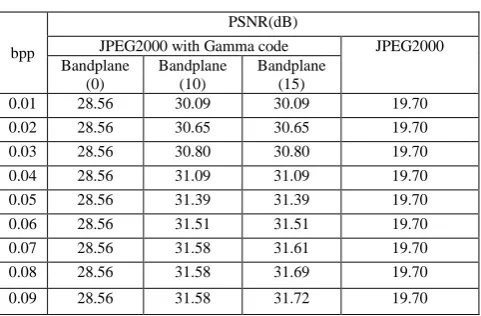
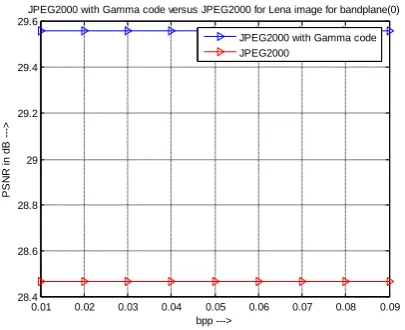
We carried out experiments by applying the proposed compressor JPEG2000 with Gamma code on standard images of size 512 x 512 pixels, “Lena” and “Barbara” and computed PSNR values. The bit rates varied from 0.01 to 0.09 bpp for different band planes 0, 10 and 15. The results obtained for Lena image are given in Table 2 and for Barbara image in Table 3. We also plotted the bpp versus PSNR for bandplanes 0 which are given in Fig.5-Fig.6 for the images Lena and Barbara respectively. The reconstructed images for the bandplane 0, 10, 15 are shown in Fig. 7 (a)-(c) for Lena image.
Table 2. PSNR values for JPEG2000 with Gamma code (Proposed method) for different bpp and bandplanes
[image:4.595.307.548.322.480.2]0, 10 and 15 for lena image
Table 3. PSNR values for JPEG2000 with Gamma code (Proposed method) for different bpp and bandplanes
0, 10, and 15 for Barbara image
From Table. 2 for Lena image, it is noted that the PSNR values of the reconstructed images have the following relationship: bit plane 0 < bit plane 15 < bit plane 30. For bit plane 0, the PSNR values remain constant at 29.56 for all bit rates. The PSNR values for bit plane 15 increases with increases in bpp and reaches a saturation value of 34.31at bpp = 0.07. Similar behavior is found for bit plane 30.
From Table. 3 for Barbara image, the PSNR values for bit plane 0 remains constant at 28.56 for all bit rates. The use of bandplane 0 for compression gives higher PSNR values than that of JPEG2000 method upto a critical bit rate of bppc = 0.09, and for bpp > bppc, JPEG2000 method gives
higher PSNR values. The results indicate that the use of different bandplanes for compression gives different image quality.
bpp
PSNR (dB)
JPEG2000 with Gamma code JPEG2000
Bandplane (0)
Bandplane (10)
Bandplane (15)
0.01 29.56 31.68 31.68 28.47
0.02 29.56 32.50 32.50 28.47
0.03 29.56 32.72 32.72 28.47
0.04 29.56 33.37 33.37 28.47
0.05 29.56 33.87 33.87 28.47
0.06 29.56 34.23 34.23 28.47
0.07 29.56 34.31 34.31 28.47
0.08 29.56 34.31 34.39 28.47
0.09 29.56 34.31 34.52 28.47
bpp
PSNR(dB)
JPEG2000 with Gamma code JPEG2000
Bandplane (0)
Bandplane (10)
Bandplane (15)
0.01 28.56 30.09 30.09 19.70
0.02 28.56 30.65 30.65 19.70
0.03 28.56 30.80 30.80 19.70
0.04 28.56 31.09 31.09 19.70
0.05 28.56 31.39 31.39 19.70
0.06 28.56 31.51 31.51 19.70
0.07 28.56 31.58 31.61 19.70
0.08 28.56 31.58 31.69 19.70
0.01 0.02 0.03 0.04 0.05 0.06 0.07 0.08 0.09 28.4
28.6 28.8 29 29.2 29.4 29.6
bpp --->
P
S
N
R
i
n
d
B
-
-->
JPEG2000 with Gamma code versus JPEG2000 for Lena image for bandplane(0)
[image:5.595.67.366.69.714.2]JPEG2000 with Gamma code JPEG2000
Fig. 5 PSNR values of JPEG2000 with Gamma code versus JPEG2000 with different bpp and for Lena image for
bandplane = 0
0.01 0.02 0.03 0.04 0.05 0.06 0.07 0.08 0.09 19
20 21 22 23 24 25 26 27 28 29
bpp --->
P
S
N
R
i
n
d
B
-
-->
JPEG2000 with Gamma code versus JPEG2000 for Barbara image for bandplane (0)
JPEG2000 with Gamma code JPEG2000
Fig. 6 PSNR values of JPEG2000 with Gamma code versus JPEG2000 with different bpp and for Barbara image for
bandplane = 0
(a) (b) PSNR = 29.56, PSNR= 33.87, bpp = 0.01, bandplane = 0 bpp = 0.05, bandplane=10
(c)
PSNR = 34.39, bpp = 0.08 , bandplane = 15 Fig. 7 (a) – (c) Reconstructed image of Lena for JPEG2000
with Gamma code
6.
CONCLUSIONS
A new modified JPEG2000 method for image data compression have been developed by replacing entropy coder by Gamma code. Experimental results by applying the proposed method on standard gray scale images are given. The performance of the proposed method is evaluated by computing the bit rate (bpp), bandplane and quality of the reconstructed image in terms of PSNR and compared with the results of JPEG2000. JPEG2000 with Gamma code performs much better at low bit rate ≤ 0.09, when compared to that of JPEG2000.
7.
REFERENCES
[1] Daniel K. Blandford and Guy E. Blelloch,” Compact Dictionaries for Variable-Length Keys and Data, with Applications”, Journal ACM Transactions on Algorithms (TALG), Vol.4, pp. 17-42, 2008.
[2] Hugh E. Williams and Justin Zobel, “Compressing Integers for Fast File Access”, Computer Journal, Vol. 42, pp.193-201, 1999.
[3] Andrew Trotman, “Compressing Inverted Files”, Information Retrieval, Vol. 6, pp. 5-19, 2005.
[4] Daniel K. Blandford and Guy E. Blelloch,” Compact Representations of Ordered Sets”, Proceedings of the Fifteenth Annual ACM-SIAM Symposium on Discrete Algorithms, Vol.114, 2004.
[5] Tinku Acharya and Chaitali Chakrabarti, “A Survey on Lifting-base Discrete Wavelet Transform Architectures “, Journal of VLSI Signal Processing, Vol. 42, pp. 321-339, 2006.
[6] Adeel Abbas and Trac D. Jran,”Rational Coefficient Dual-Tree Complex Wavelet Transform:Design and Implementation”,IEEE Transactions on Signal Processing, Vol. 56, pp.3523-3531,2008.
[7] Tinku Acharya and Chaitali Chakrabarti,”A Survey on Lifting-base Discrete Wavelet Transform Architectures”, Journal of VLSI Signal Processing, Vol.42,pp.321-339,2006.
[8] "JPEG2000 part I final draft international standard," ISO/IEC JTC1/SC29/WG1 N1890, (2000).
[9] D. S. Taubman and M. W. Marcellin, JPEG2000: image compression fundamentals, standards and practice, MA: Kluwer, Norwell, (2002).
[10] M. D. Adams, H. Man, F. Kossentini, and T. Ebrahimi, “JPEG 2000:The next generation still image compression standard,” Doc. ISO/IEC JTC1/SC29/WG1 N1734. [11] Skodras, C. Christopoulos, and T. Ebrahimi, “The JPEG
2000 still image compression standard,” IEEE Signal Processing Magazine,(2001).
[12] M. J. Gormish, D. Lee, M. W. Marcellin, “JPEG 2000: overview,architecture, and applications,” in Proc. IEEE Int. Conf. Image Processing, 2, (2000).
[13] M. W. Marcellin, M. J. Gormish, A. Bilgin, and M. P. Boliek, “An overview of JPEG-2000,” in Proc. IEEE Data Compression Conf.(DCC2000), (2000).
[14] K. Somasundaram and P.Sumitra,”Compress Integer with Fibonacci Code and Gamma Code Using Variable-Length code in JPEG2000”, International Journal of Computer Science and Information Technology (IJCSIT) Vol.2, pp.754-757, March 2011.
[image:5.595.63.266.74.239.2] [image:5.595.59.275.74.447.2]AUTHORS PROFILE