Feature Selection for Sentiment Analysis by using SVM
Rohini S. Rahate
PG-Student PICT, Pune-411043Maharashtra, India
Emmanuel M
Pune-411043, Maharashtra, IndiaABSTRACT
Sentiment analysis depends on feature selection methods to approaches that use general statistical measures where features are selected on empirical evidence. Empirical evidence (research) is a way of gaining knowledge by means of direct and indirect observation or experience. there are new features selection schemes that use a content and syntax model that is used to automatically learn a set of features in a review document and removing the entities that are being reviewed from the subjective expression that describe those entities in terms of polarities.
General Terms
Sentiment analysis is the branch of natural language processing and information extraction. The main aim of sentiment analysis is obtain author’s feelings expressed in form of positive and negative comments, and by analyzing a large number of documents.
Keywords
Sentiment analysis, feature selection, syntax model, sentiment levels, movie domain
1.
INTRODUCTION
In recent years, there is fast growth in text analysis. Rather than just the subjects, Textual contents can be categorized as attitude express in text, feelings, opinion. Sentiment analysis or opinion mining is the application of NLP, text analytics to find out and extract subjective information in review document, blogs or any source materials. And polarity of the sentence can be positive or negative. A basic task in sentiment analysis is classifying the polarity of a given text data at the document, sentence, word or feature/aspect level whether the expressed opinion is positive, negative, or neutral. The sentiment analysis or opinion mining is useful for finding out author’s attitude. There are basically two types of sentiments facts and opinion. Facts are called as objective expression about events. Opinion is usually called as subjective expression. Opinion mining is a sub branch of data mining and computational linguistics is the computational techniques for extracting, classifying, understanding, and assessing the opinions expressed in various online news sources, social media comments, and other user-generated content. Sentiment analysis is often used to identify sentiment, affect, subjectivity, and other emotional states in online text. People express their sentiment, attitudes on social media including discussion forums, tweets, blogs etc. Sentiment based text classification is different from topical text classification so it involves perception based on expressed opinion on a topic. Sentiment analysis concerns about extracting and finding out opinion or sentiment from online text. Feature selection is significant for sentiment analysis as the opinionated text may have high dimensions, which can badly affect the performance of sentiment analysis classifier. There are three level of sentiment analysis. Word level, Sentence level and Document level, Sentence-level polarity is classify as positive and negative sentiments for each sentence,
Document-level polarity is classify as positive and negative sentiments for news articles, movie reviews or Web forum postings. Phrase level categorization is done in order to capture several sentiments that may be present within a single sentence.
There are three types by which sentiment analysis domain is distinguished like or, news article, web discourse, and reviews. Reviews are of three types product review, movie review and music review. Here in this paper is concentrating on Movie review domain. Sentiment analysis weblog data was always useful for predicting the movie success. There are many ways on internet that provide reviews about movie domain and product. The review that collected from Amazon because of large domain it covers and it offers large number of choice for customers. There are Amazon’s web services API. Using these API reviews is obtained whereby system gets an XML response, then after that XML file is parsed to obtain the review.
The movie domain is experimentally convenient because here is large no of online collection. Again it uses more expressive words, and extractable rating indicators, such as a number of stars, no of actors this domain is most difficult domain of several domain. [4].
Just like the product domain, in movie domain also there are various reviews sites giving critics views about the performance of actors and actress, movie story, and very important aspect that is public recognition of the movie. For automation, sentiment analysis plays very important role. It is useful for automatically find out the opinion of movie reviewer by analyzing the different reviews which are available on various sites. And it generates rating on given scale. In movie review domain, where the user rating is expressed either with some numerical value. And Ratings can be automatically collected and converted into three categories positive, negative or neutral.
Binary classification task of labeling an opinionated document as expressing either an overall positive or an overall negative opinion is called sentiment polarity classification. Sentiment polarity classification is conducted in the context of reviews for movie reviews e.g. “Thumbs up” or “Thumbs down”. There are many indicators like “like” “dislike” from that positive and negative opinion are taken[5].When it need to decide whether a given document contains subjective information or not and identify which portion of document are subjective. The problem of differentiating subjective versus objective instance has often proved to be more difficult than subsequent polarity classification, promise to positively impact sentiment classification [5]. It is not hard to imagine that opinion words and phrases are the dominating indicators for sentiment classification. Thus, using unsupervised learning based on such words and phrases would be quite natural [4].
2.
PROBLEM DEFINITION
only considered. It does not take into account images, audio, video etc. residing in the web page. For Reviews, only English language is considered.
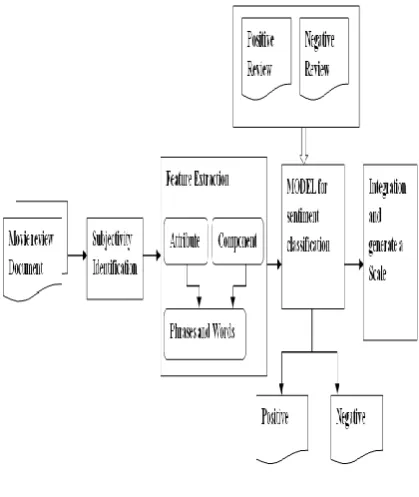
[image:2.595.56.280.166.204.2]Typical Feature Selection Sentiment Analysis Model: The Model takes a collection of review s as a input and processes them using three steps
Fig 1: Typical Feature Selection of Sentiment Analysis Model
Data Preparation: The data preparation steps perform necessary data preprocessing and cleaning on dataset for subsequent analysis. Some commonly used preprocessing steps include removing non-textual contents and markup tag (for HTML Pages) and removing information about the reviews that are not required for Sentiment Analysis, such as review dates and reviewer’s names.
Review Analysis: The review analysis step analyzes the features of reviews so that interesting information, including opinion and/ or Movie features, can be identified.
Step1: Extracts opinion and movie features from the process reviews.
Step II: Reviews analysis is done using POS Tagging. Pos tagging helps to identifying interesting words that have particular Pos tag or pattern for reviews.
Step III: Make use of Corpus Statistics or Wordnet to decide the terms that may appear in reviews.
Step IV: Identify frequent and infrequent features and specify the Weight for each word in Wordnet.
Sentiment Classification: For classification approach is used for classifying reviews, by using machine learning approach.
For example, the sentence ‘this is superb’ has a higher sentiment score than the less positive sentence ‘this is good’. Sentiment scores are used to classify the sentiment polarity (i.e. positive, negative or neutral) of clauses or sentences.
3.
LITERATURE SURVEY
Much research exists on sentiment analysis of user opinion data, which mainly judges the polarities of user reviews. In these studies, sentiment analysis is often conducted at one of the three levels: the document level, sentence level, or attribute level. In relation to sentiment analysis, the literature survey done indicates two types of techniques including machine learning and semantic orientation. In addition to that, the nature language processing techniques (NLP) is used in this area, especially in the document sentiment detection. Current-day sentiment detection is thus a discipline at the crossroads of NLP and Information retrieval, and as such it shares a number of characteristics with other tasks such as information extraction, text-mining, computational linguistics, psychology and predicative analysis.
3.1
Sentiment Classification
The machine learning approach applicable to sentiment analysis mostly belongs to supervised classification in general and text classification techniques in particular. Thus, it is called “supervised learning”. In a machine learning based classification, two sets of documents are required: training
and a test set. A training set is used by an automatic classifier to learn the differentiating characteristics of documents, and a test set is used to validate the performance of the automatic classifier. A number of machine learning techniques have been adopted to classify the reviews. Machine learning techniques like Naive Bayes (NB), maximum entropy (ME), and support vector machines (SVM) have achieved great success in text categorization. Sentiment classification is sub-branch of topical-base categorization.
3.2
Feature Selection
There are four feature categories.3.2.1
Syntactic Feature.
3.2.2
Semantic Feature.
3.2.3
Link-base Feature.
3.2.4
Stylistic Feature.
There are four feature categories that have been used in previous sentiment analysis studies. These include syntactic, semantic, link-based, and stylistic features. Along with semantic features, syntactic attributes are the most commonly used set of features for sentiment analysis.
3.2.1. Syntactic feature
Syntactic features uses word/POS tag, N-grams, phrase patterns or punctuation, one among all. The cited authors noted that phrase patterns such as “n+aj” (noun followed by positive adjective) typically represent positive sentiment orientation, while “n+dj” (noun followed by negative adjective) often express negative sentiment [7].
3.2.2. Semantic feature
Semantic is the study of meaning. It focuses on the relation between signifiers such as words, phrases, signs and symbols. Linguistic semantics is the used to understand human expression through language. Score-base method is typically used in conjunction with semantic feature these technique generally classify message sentiment based on the title sum of comprised positive and negative semantic feature.
3.2.3. Link base feature
Link base samples are classified using the relations and link that are present among them. Link-based features use link/citation analysis to determine sentiments for Web artifacts and documents.In opinion Web pages heavily linking to each other often share similar sentiments. They exacts opposite for USENET newsgroups discussing issues such as abortion and gun control. They noticed that forum replies tended to be Antagonistic. Due to the limited usage of link-based features, it is unclear how effective they may be for sentiment classification [3].
3.2.4. Stylistic feature
Stylistic features that artist’s use in trying to pass a message to us. Use of symbolism: This is where the writer/artist uses a symbol to describe, represent or characterize aperson, thing
3.3
Comparative Study
Along with semantic features, syntactic attributes are the most commonly Used set of features for sentiment analysis. Below are the comparison for the same
Characteristics of feature selection
As for selecting the features from reviews there are some important aspect
1. The features are more expressive then it is very useful in the classification process.
2. The features are domain dependent then it is more useful. 3. Feature should be occurred rarely.
4. Features are select on document frequency then good accuracy it gives.
[image:3.595.321.531.127.252.2]In order to build a sentiment analyzer, first need to equip ourselves with the right tools and methods. Machine learning is one such tool where people have developed various methods to classify. Classifiers may or may not need training data. In particular, deal with the following machine learning classifiers, namely, Naive Bayes Classifier, Maximum Entropy Classifier and Support Vector Machines. All of these
Table 1. Comparison of Semantic and Syntactic Features
Under the category of supervised classification.
3.4 Classification Technique
3.4.1 Classification Based on Supervised learning.
Naive Bayes assumes that all features in the feature vector are independent, and applies Bayes’ rule on the sentence. Naive Bayes calculates the prior probability frequency for each label in the training set. Each label is given a likelihood estimate from the contributions of all features, and the sentence is assigned the label with highest likelihood estimate. Maximum Entropy classifiers compute parameters that maximize the likelihood of the training corpus. They represent the generalization of Naive Bayes classifiers. The classifier applies iterative optimizations, which find local maximum. The start state is initialized randomly. They are run multiple times during the training to find the best set of parameters. Decision trees create a flowchart based classifier. At each level it utilizes decision stumps, simple classifiers that check for the presence of a single feature. The label is assigned to the sentence at the leaf nodes of the tree. Supervised learning techniques divide the data corpus into two groups – training set and test set. The training of the classifier is done on the [image:3.595.48.269.315.538.2]sentences from the training set. The quality of the training is later evaluated on the sentences from the test set. In order to decrease the bias of particular choice of training and test data, common practice is to perform the cross-validation.
Fig. 2: Supervised learning techniques divide the data corpus training set and test set [7].
3.4.2 Classification Based on unsupervised
learning.
Since sentiment words are often the dominating factor for sentiment classification, it is not hard to imagine that sentiment words and phrases may be used for sentiment classification in an unsupervised manner. The method in [10] is such a technique. It performs classification based on some fixed syntactic patterns that are likely to be used to express opinions. The syntactic patterns are composed based on part-of-speech (POS) tags. The algorithm given in [7]consists of three steps.
Step 1. Two consecutive words are extracted if their POS tags conform to any of the patterns in Table 3.2. For example, pattern 2 means that two consecutive words are extracted if the first word is an adverb, the second word is an adjective, and the third word (not extracted) is not a noun. As an example, in the sentence “This piano produces beautiful sounds”, “beautiful sounds” is extracted as it satisfies the first pattern. The reason these patterns are used is that JJ, RB, RBR, and RBS words often express opinions. The nouns or verbs act as the contexts because in different contexts a JJ, RB, RBR and RBS word may express different sentiments. For example, the adjective (JJ) “unpredictable” may have a negative sentiment in a car review as in “unpredictable steering,” but it could have a positive sentiment in a movie review as in “unpredictable plot.”
It performs classification based on some fixed syntactic phrases that are likely to be used to express opinions [4]. There are basic three steps:
Step 1: find out the phrases in the input that contain adjectives or adverbs. Words like adjectives and adverbs are important because it is most expressive words.
Step 2: Opinion orientation of each extracted phrase.
Step 3: After the sentiment classification, document is integrated.
3.4
Objective of the present Work
The main objective of this paper is to determine the attitude ofan Author or speaker or a writer with some Review or the overall polarity of a document. The attitude may be user’s judgment or evaluation, affective state (that is, the emotional
State of the author when writing) this requires to represent textual information in terms of mathematical object and to
Syntactic Feature Semantic feature
Syntactic constrains results in relatively short-range dependencies.
Semantic constraints results in long-term dependencies.
Syntactic constraints spanning several words but not going beyond the limits of sentence.
Semantic technology have different sentences within a document are likely to have similar content, and use similar words.
The functional words are divided into syntactic classes. The syntactic categories include preposition, pronouns, past-tense
differentiate between semantic features and syntactic features. So an effective approach to represent textual information in terms of mathematical object and method to find out what are the semantic features and syntactic features.
Sentiment analysis is a task of identifying whether the opinion expressed in a text source is positive or negative
Table 2. Patterns of POS tags for extracting two-word phrases [4]
about a given topic, and can classify it further more to other nine identified human sentiments like laughter, love, compassion, valor, anger, disgust, fear, wonder and peace. Sentiment analysis in context of movie reviews involves automatically classifying whether authors have expressed positive or negative opinions regarding a movie. However, it is usually early-on about Movie cycle that a director wants to quickly assess popular sentiment towards a movie. Under such situations, the only option available is to manually label a large number of movie reviews to generate training data; a costly endeavor. This work have explored some solutions to this problem. In particular analysis extent the classification models trained on one set of movie can be used for analysis of reviews of a different movie. In particular this work explore appropriate strategies for classification models trained on different movie. So to answer the problem of predicting the sentiment polarity of a new sentiment in form of a movie review using training data available for a different set of movie, This work is focusing on a statistical machine learning technique of SVM classifiers. This approach of Support Vector Machine classifiers join up with vocabulary inter-sectional heuristic will help build a outperforming SVM based sentiment analysis tool.
Definition of movie sentiment analysis: Given a significant number of labeled reviews for movie M1 to Mn This work want to learn a classification model for a new movie Mn+1 for which only a small number of labeled reviews are provided. Let Di represent a set of labeled movie reviews for movie i. Then each element of Di is a two tuple (rij, lij), where rj is the jth review for movie Pi and lj is its sentiment label (either positive:1 or negative:0). Goal is to use the available data in sets D1…Dn to achieve a high prediction accuracy on the test set of reviews Dn+1 for movie Mn+1.Support vector machines have been widely successful for various text classification tasks in past therefore start with SVM as baseline model. SVM approach is based on the following intuition. Given two different Movie domains, one could obtain an estimate of their similarity by looking at how well the feature vectors of their reviews, or in this case the vocabulary of their reviews, overlaps. While predicting the sentiment polarity of a review for a novel product, it would often prefer to use the classifiers that were trained on other similar movie, than those trained on very different ones. Thus once domain similarity is calculated, one could assign different movie classifiers weights
proportional to their similarity scores. Mathematically, it formalize this idea as follows: Given a set of labeled movie specific reviews D1 through Dn, it train n SVM classifiers C1 through Cn, one per movie. Let the prediction score of classifier Ci on some review r for the target movie Pn+1 (r ∈ Dn+1) be given by Ci(r) where:
C (r) > 0 i : If review sentiment is positive.
C (r) < 0 i : If review sentiment is negative.
Overall the ensemble SVM classifier combines the predictions of all n SVM classifiers and weighs them based on their domain’s similarity with the target product. If the resulting prediction score is greater than 0, it classify the review as positive otherwise it classify as negative. In the subsequent section it describe the dataset used and present output results. For evaluation criteria it uses classification accuracy. It is the percentage of total reviews in test set whose sentiment polarity was correctly predicted by the classifier. Mathematically, accuracy is the ratio of the sum of the true positives and the true negatives to the total number reviews taken in the test set i.e. the sum of total positives and total negatives in the test set.
Accuracy = ((True Positives +True Negatives)*100) /Total Test Reviews
4.
SYSTEM ARCHITECTURE
Movie Review describing the main features of the plot (or summary of the story in the film) general comments and opinions on the acting, the music, the photography, special effects ( e.g. sci‐fi movies).A Facts and background information concerning the film, such as the title, the name of the artists or actors and actresses, the name of the director, the type of movie, the place where the story in the film happen. The movie reviews are normally found in newspapers, magazines or as part of a letter. The style used depends on the intended readers. Therefore, it can be semi‐formal or formal. Present tensesare normally used. A variety of adjectivesare used to make the review more interesting to readers. Formal film reviews should see a frequent use of passive voice. In a formal review, there should be no short forms of words.
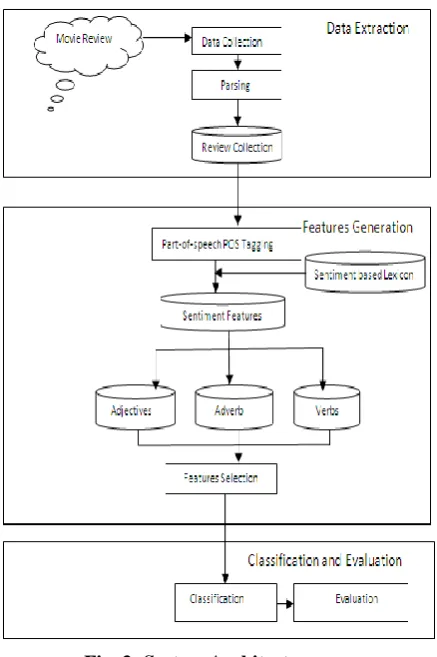
Fig 4.1 diagram shows the overall system architecture. It is start with Data extraction. Crawler is used to develop` to collect the textual data from online sources as HTML pages.
4.1 ARCHITECTURE STUDY
4.1.1 Data collection:
Data collection takes place early on in an improvement paper, and is often formalized through a data collection plan which often contains the following activity. Pre collection activity agree on goals, target data, definitions, methods Collection data collections Present Findings usually involves some form of sorting analysis and/or presentation. As it is for movie base paper the data is collected from Bollywood Hungama website.
First word Second word Third word (Not Extracted)
JJ NN or NNS Anything
RB, RBR, or RBS
JJ not NN nor NNS
JJ JJ not NN nor NNS
NN or NNS JJ not NN nor NNS
RB, RBR, or RBS
VB, VBD, VBN, or VBG
Anything
RB, RBR, or RBS
[image:4.595.49.265.178.298.2]Fig. 3: System Architecture
4.1.2 Data parsing:
Parsing programs are developed to parse out the information
from the raw HTML pages and store it into a database.
4.1.3 Feature generation:
Content-free features (i.e., lexical features, syntactic features, and structural features) and content-specific features (e.g., word n-grams) are extracted from the textual data Collection. To extract sentiment features, first need to conduct Part-of-Speech (POS) tagging on the data collection. Once it gets the POS tag for each word, and can calculate the sentiment score of the word by looking up a sentiment-based lexicon.
Lexical feature: Lexical features are character-, or word-based statistical measures of lexical variation. Examples of character-based lexical features are total number of characters, characters per sentence, characters per word, and the usage frequency of individual letters. Examples of word-based lexical features are total number of words, words per sentence, word length distribution.
Syntactic feature: Syntactic features indicate the patterns used to form sentences. Syntactic features are important because they can indicate people’s different habits of organizing sentences. Function words and punctuation are often used as syntactic features.
Structural feature: Structural features show the text organization and layout. They are especially useful for online text. In total, it uses 5 structured features: Total number of sentences in a review, Total number of paragraphs in a review, Number of sentences per paragraph in a review, Number of characters per paragraph in a review, and Number of words per paragraph in a review. In this, it does not use a big number of structural features.
4.1.5 Extracting adjectives, adverbs and verbs:
In order to extract the sentiment features, first conduct Part-of-Speech (POS) tagging on the whole data collection. Paper use Stanford POS tagger to do the tagging. Then it selects all the adjectives, adverbs, and verbs as the sentiment features. Adjectives are most widely used to denote semantic orientations; adverbs, verbs, and nouns have also been used to express sentiments In this study, it chooses to use adjectives, adverbs, and verbs as the sentiment features. here nouns are not included since they are more contexts dependent. Obtaining the prior-polarity sentiment scores of adjectives, adverbs and verbs: To determine the sentiment scores of the extracted adjectives, adverbs and nouns, it uses a sentiment-based lexicon use WordNet as lexicon. WordNet is a lexical resource for sentiment analysis. It assigns to each synset of WordNet three sentiment scores: positivity, negativity, and objectivity. It has been used as the lexicon in sentiment classification studies. WordNet is determining the polarities of adjectives which then lead to the document polarities for multilingual sentiment analysis. Since each word in WordNet has multiple senses, then calculate the average polarity scores (i.e., positive, negative, and objective scores) for its adjective, adverb, and verb senses separately.4.2 SYSTEM DATA FLOW
In Today’s movie world it is very important for individual how to decide the selection criteria to watch any movie. In Internet world have different web-site where people used to provide their review, opinion for the movie and based on that review people took the decision. In recent years, it became witnesses of a large number of websites that enable users to contribute, modify, and grade the content. Users have an opportunity to express their personal opinion about specific topics. The examples of such web sites include blogs, forums, movie review sites, and social networks. Opinion can be expressed in different forms. One example may be web sites for reviewing movie review sites such as Hangama.com which enable rating of movie, usually on some fixed scale as well as leaving personal reviews.
Sentiment analysis aims to uncover the attitude of the people on a movie review from the written text. Other terms used to denote this research area include “opinion mining” and “subjectivity detection”. It uses Service vector machine (SVM) techniques to find the movie review polarity in terms of positive and negative. It will gain popularity in recent years due to its immediate analysis capability from different web-sites.
movie showcases the true comprehension of determination ultimate creation of opm.this is what he known for Bhaag Milkha BHaag ... Awesome Movie .. Must Watch .. 5/5 Star .. Just like ChakdeIndia
Fig. 4 : System Data Flow Example of Negative file that is the input for SVM. this is a very long movie. not worth to watch it. very slow movie, timepass hai not worth to see in family. can't bare for three hours farhan akhatar done over acting.
Text File is generated that is input for SVM
5.
EXPERIMENTAL WORK
5.1EXPERIMENTAL SETUP
System configuration used as, relational databases MySQL 5.6, Intel core i3 processor with 3.1 GHz, 4GB of RAM and 500 GB of hard disk. For the development of user interface and programming logic, I have used Net Beans 6.8, JDK 1.6 through mysql-jdbc-driver connected to MySQL 5.6.
5.2 EXPERIMENTS
This section presents experimental analysis on Move review available in MYSQL sever5.6.
5.2.1 Experiment 1:
[image:6.595.313.558.382.592.2]In this experiment 20 movie review are consider for same movie. For 5 reviews the polarity is 3 and 2 respectively. As compare negative and positive polarity it shows that 20 reviews are toward the positive polarity so movie is Excellent. For the first experiment this work have considered total five movie reviews. In the result part done by SVM it have received the total 3 positive and 2 negative review.
Table 3. 20 Movie reviews Movie Class
Review
Positive Negative
5 3 2
10 7 3
15 10 5
20 15 5
In terms of percentile
Test 1 movie got 75% positive reviews and 25% as negative reviews.
Test 2 movie got 70% positive reviews and 30% as negative reviews.
Test 3 movie got 66.667% positive reviews and 33.333% as negative reviews.
Test 4 movie got 75% positive reviews and 25% as negative reviews.
Fig. 5: Plot of 20 Movie reviews
5.2.3 Experiment 2:
In this experiment 20 movie review are consider for same movie. For 5 reviews the polarity is 3 and 2 respectively. As compare negative and positive polarity it shows that 20 reviews are toward the positive polarity so movie is Excellent.
In terms of percentile
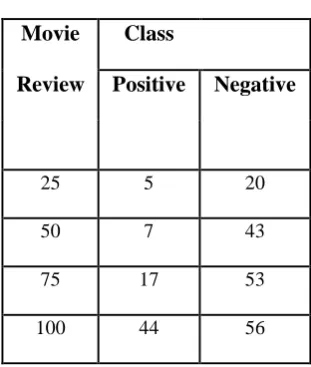
Test 1 movie got 20% positive reviews and 80% as negative reviews.
Test 2 movie got 14% positive reviews and 86% as negative reviews
0 5 10 15 20
1 2 3 4 5
Chart Title
Movie Review
Class Possitive
Table 4. 100 Movie reviews
Test 3 movie got 22.667% positive reviews and 70.667% as negative reviews.
[image:7.595.315.550.85.455.2]Test 4 movie got 44% positive reviews and 56% as negative reviews
.
Fig. 6: Plot of 100 Movie reviews
5.2.4 Experiment 3:
In this experiment 20 movie review are consider for same movie. For 5 reviews the polarity is 3 and 2 respectively. As Compare negative and positive polarity it shows that 20 reviews are toward the positive polarity so movie is Excellent. In terms of percentile
Test 1 movie got 56% positive reviews and 44% as negative reviews.
Test 2 movie got 75% positive reviews and 25% as negative reviews.
Test 3 movie got 85.33% positive reviews and 14.6% as negative reviews.
Test 4 movie got 94.5% positive reviews and 5.5% as negative reviews
.
Table 5. 400 Movie reviews
Fig. 7: Plot of 400 Movie reviews for same movie
The method of sentiment analysis is based upon SVM tool. Here is Explanation of what sources of data used, how to selected features, and how to performed classification In Social networking web site which enables its users to submit links and recommend the content from other web sites. Ten relatively popular web sites are considered for movie review. They are about movie reviews of recent blockbuster movies.
In order to perform SVM, it is necessary to extract positive or negative clues from the sentence that may lead to correct classification. The value of the word may be a binary value, indicating the presence or absence of the feature, an integer or decimal value, which may further express the intensity of the feature in the original text. The selection of features strongly influences the subsequent learning. The goal of selecting Good features is to capture the desired properties of the original text in the numerical Form. Ideally, it should select the properties of the original text that are relevant for the Sentiment analysis task. The possible candidates for good features that is applicable to sentiment analysis. For feature selection all the positive and negative polarity words having weight have collected and given the value to each words for example Barfi is very awesome movie, from this sentence it has given the high value for the word awesome i.e. 5 which indicate positive polarity for that sentence similarly for negative words. And maintain all such words in database to know the polarity of each word.
0 20 40 60 80 100 120
1 2 3 4 5
Chart Title
Movie Review
Class Possitive
Class Negative
0 50 100 150 200 250 300 350 400 450
1 2 3 4 5
Movie Review
Class Possitive
Class Negative
Movie
Class
Review
Positive
Negative
25 5 20
50 7 43
75 17 53
100 44 56
Movie Class
Review Positive Negative
100 56 44
200 150 50
300 256 44
[image:7.595.54.291.326.516.2]Classification algorithm predicts the label for a given input sentence. For classification purpose all the movie review data is extract from web-site as text file which in turn extract all the positive and negative words and create two different files POS and NEG file. These two files are input to SVM tool. The SVM algorithm rectifies all the positive and negative words polarity, and creates the input file for SVM tool. This input file will have start position of word and polarity value. SVM tool use this file as input and create the MODEL file which actually recognize by SVM tool. After that as per the SVM algorithm logic it checks individual sentence and checks term frequency (occurrence) for that word and create the OUTPUT file. This file will actually show how many users or critics show their review about the movie.
In order to extract the sentiment features first conduct Part-of-Speech (POS) tagging on the whole data collection. Paper use Stanford POS tagger to do the tagging. Then Paper selects all the adjectives, adverbs, and verbs as the sentiment features. Adjectives are most widely used to denote semantic orientations; adverbs, verbs, and nouns have also been used to express sentiments in this study, this work chooses to use adjectives, adverbs, and verbs as the sentiment features. Nouns are not included since they are more contexts dependent. To determine the sentiment scores of the extracted adjectives, adverbs and nouns, it uses a sentiment-based lexicon. It uses WordNet as lexicon. WordNet is a lexical resource for sentiment analysis. It assigns to each synset of WordNet three sentiment scores: positivity, negativity, and objectivity. It has been used as the lexicon in sentiment classification studies. WordNet is determining the polarities of adjectives which then lead to the document polarities for multilingual sentiment analysis. Since each word in WordNet has multiple senses, then calculate the average polarity scores (i.e., positive, negative, and objective scores) for its adjective, adverb, and verb senses separately.
Sample movie Review
Positive Movie Review for Bhaag Milkha Bhaag
RESPECT ... Unbelievable... Engaging... Inspiring.. Enthralling... Farhan Akhtar- Outstanding... Four out of Five Seen Paid Preview the hall was full packed at cinemax infinity andheri , movie duration is to long 2:40 min approx . audience enjoy all Must watch... awsuuummmm movie and fabulous acting done by Farhan Akhtar Awesome movie. Om Prakash Mehra has recreated the magic of Rang De Basanti once again. A movie which cherishes the life and achievement I would say one of d best biopics made in recent times nice movie nice homework done good cinematography screenplay art direction overall a complete package value for ur money and time such The movie showcases the true comprehension of determination ultimate creation of opm. This is what he known for Bhaag Milkha BHaag ... Awesome Movie .. Must Watch .. 5/5 Star .. Just like ChakdeIndia this is very big Movie. Not
Worth to watch it .very slow movie, timepass hai not worth to see in family.can't bare for three hours farhan akhatar done over acting.
Fig.8: Sentiment analysis output result
6.
CONCLUSIONS AND SCOPE FOR
FUTURE WORK
Finally, it can extend the framework to classify review documents based on a scale. Thus far this work has focused on the binary classification task. A review document can be either ‘positive’ or ‘negative’. Many applications needed detail such as ‘how positive’ and ‘how negative’. So it has implemented this by using machine learning approach. This Work covers various tasks, techniques, domains, types of features of sentiment analysis. This work focus is on types of features and comparison and pros and cons of the same and feature selection characteristics. Sentiment Analysis is still a difficult and Complex problem in computer Science. Sentiments are express by Humans in Different Ways. The attitude may be user’s judgment or evaluation, affective state (that is, the emotional state of the author when writing) this requires representing text document in terms of Sentiments. Sentiment analysis aims to uncover the attitude of the people on a movie review from the written text. Other terms used to denote this research area include “opinion mining” and “subjectivity detection”. It uses Service vector machine techniques to find the movie review polarity in terms of positive and negative. It will gain popularity in recent years due to its immediate analysis capability from different web-sites. The focus of this work paper is the analysis of the sentiments in the short web site comments. The short comment is use to express briefly and directly user and critic’s opinion on certain movies. Paper focus on below important property of movie text: Polarity – whether the user or critics expresses positive or negative opinion. For output graphical methods is used to capture the sentence polarity. Graphical analysis is done on word level. SVM technique is use to classify the polarity of the sentence.
readers. Therefore, it can be semi‐formal or formal. Present tensesare normally used. A variety of adjectivesare used to make the review more interesting to readers. Formal film reviews should see a frequent use of passive voice. In a formal review, there should be no short forms of words.
To facilitate future work, a discussion of Classification Based on unsupervised learning is also provided. Performing larger scale experiments using SVM techniques; it could benefit from having larger data set. Using WordNet path similarity for obtaining numerical features of how close the sentence is to the selected features; Movie reviews that are consider for English Language so it further implemented for other Language.
7.
REFERENCES
[1] Adnan Duric and Fei Song “Feature Selection for Sentiment Analysis Based on Content and Syntax Models,” Proceedings of the 2nd Workshop on Computational Approaches to Subjectivity and Sentiment Analysis, ACL-HLT 2011.
[2] Ahmed Abbasi,Hsinchun Chen, and Arab Salem “Sentiment Analysis in Multiple Languages: Feature Selection for Opinion Classification in Web Forums,” ACM Transactions on Information Systems, Vol. 26, No. 3, Article 12, Publication date: June 2008.
[3] An Introduction to SA.
[4] Jun Karamon, Yutaka Matsuo, Hikaru Yamamoto, Mitsuru Ishizuka “Generating Social Network Features for Link-based Classification,” IEEE Trans. Knowledge and Data Eng., vol. 17, no. 6, pp. 796-807, June 2005.
[5] Thomas L, Griffiths, Mark Steyvers, David M. Blei, Joshua B. Tenenbaum “Integrating Topics and Syntax,” in Advances in Neural Information Processing Systems, 17.
[6] John Rothfels ,Julie Tibshirani “Unsupervised sentiment classification of English movie reviews using automatic selection of positive and negative sentiment items,” June 2, 2010
[7] B. Pang and L. Lee. A sentimental education: “Sentiment analysis using subjectivity summarization based on minimum cuts,” In Proceedings of the ACL, volume 2004, 2004.
[8] B. Pang and L. Lee. “Opinion mining and sentiment analysis. Foundations and Trends in Information Retrieval,” 2(1-2):1{135, 2008.
[9] B. Pang, L. Lee, and S. Vaithyanathan. “Thumbs up?: sentiment classification using machine learning techniques.” In Proceedings of the ACL-02 conference on Empirical methods in natural language processing-Volume 10, pages 79{86. As association for Computational Linguistics, 2002.
[10] P.D. Turney et al. “Thumbs up or thumbs down?Semantic orientation applied to unsupervised classification of reviews.” In Proceedings of the 40th annual meeting of the Association for Computational Linguistics, pages 417{424, 2002.
[11] Bo Pang, Lillian Lee, “A sentimental education: Sentiment analysis using subjectivity summarization based on minimum cuts,” Proceedings of the Association for Computational Linguistics (ACL), 2004, pp. 271– 278.
[12] Bo Pang, Lillian Lee, “Opinion mining and sentiment analysis, Foundations and trends in Information Retrieval,” 2 (January 2008) 1–135.
[13] ]Amazon online retailer web site. http://www.amazon.com.
[14] Digg social networking site. http://www.digg.com.
[15] Natural language toolkit. http://www.nltk.org.
[16] Rottentomatoes movie review site. http://www.rottentomatoes.com.

![Fig. 2: Supervised learning techniques divide the data corpus training set and test set [7]](https://thumb-us.123doks.com/thumbv2/123dok_us/8058079.775675/3.595.48.269.315.538/fig-supervised-learning-techniques-divide-data-corpus-training.webp)
![Table 2. Patterns of POS tags for extracting two-word phrases [4]](https://thumb-us.123doks.com/thumbv2/123dok_us/8058079.775675/4.595.49.265.178.298/table-patterns-pos-tags-extracting-word-phrases.webp)