38
New Approach for Graph Algorithms on GPU using
CUDA
1
Gunjan Singla,
2Amrita Tiwari,
3Dhirendra Pratap Singh
Department of Computer Science and EngineeringMaulana Azad National Institute of Technology Bhopal, Madhya Pradesh
ABSTRACT
Large Graph algorithms like Breadth-First Search (BFS), Depth-First Search(DFS), shortest path algorithms etc. used frequently in various engineering and real world applications that demand execution of these algorithms in large graphs having millions of edges and sequential implementation of these algorithms takes large amount of time. Today’s Graphics Processing Units (GPUs) provide a platform to implement such applications with high computation power and massively multithreaded architecture at low price. In this paper, we present parallel implementations of two basic graph algorithms breadth-first search and Dijkstra’s single source shortest path algorithm by using a new approach called edge based kernel execution on GPU. The performance analysis of parallel implementation over the serial execution gives a good speed-up.
Keywords
SSSP (Single Source Shortest Path) problem, Dijkstra’s algorithm, BFS (Breadth -First Search), CUDA (Compute Unified Device Architecture) model, GPU(Graphic Processing Unit).
1.
INTRODUCTION
Graphs are the commonly used data structures that describe a set of objects as nodes and the connections between them as edges. A large number of graph operations are present, such as minimum spanning tree, breadth-first search, shortest path etc., having applications in different problem domains like VLSI chip layout [1], phylogeny reconstruction [2] , data mining, and network analysis[3].
With the development of computer and information technology, researches on graph algorithms get wide attention. In particular, the Single Source Shortest Path (SSSP) problem is a major problem in graph theory which computes the weight of the shortest path from a source vertex to all other vertices in a weighted directed graph. The most well-known algorithm for solving this problem was given by Dijkstra in 1959 [4] with non-negative edge weights and further, more work is done considering it as base algorithm. So far, many different variants of Dijkstra’s algorithm have implemented sequentially as well as in parallel manner. In all parallel implementations, a thread corresponds to a node in graph database but in our implementation, a thread corresponds to edges and as number of edges is greater than number of nodes, comparatively more degree of parallelism is achieved.
We have also given parallel implementation of BFS [5] [6] on the basis of edges as it is one of the basic paradigm for the
design of efficient graph algorithm and hence, requires high degree of parallelism. Given a graph G= (V, E) with m edges, n vertices and a source vertex s, BFS traverses the edges of G to discover every vertex that is reachable from s.
At present, the serial graph algorithms have reached the time limitation as they used to take a large amount of time. Therefore, the parallel computation is an efficient way to improve the performance by applying some constraints on the data and taking the advantage of the hardware available currently.
Different implementations of parallel algorithms for the SSSP problem are reviewed in [7]. Bader et al. [8], [9] use CRAY supercomputer to perform BFS and single pair shortest path on very large graphs. A. Crauser et al. [10] have given a PRAM implementation of Dijkstra’s algorithm while such methods are fast, hardware used in them is very expensive. N. Jasika et al. [11] presented a parallel dijkstra’s algorithm using OpenMP (Open Multi-Processing) and OpenCL (Open Computing Language) which gives good results over serial algorithm. Pedro J. Martín et al. [12] have given an efficient parallel dijkstra’s algorithm on GPU using CUDA. L. Luo et al. [13] have given a GPU implementation of BFS which gives around 10X speed-up over the algorithm given by P. Harish et al. [14].
In this paper, we present new edge based parallel implementations of Dijkstra’s algorithm and breadth first search (BFS) on GPU using CUDA handling large graphs up to 2 million edges. We show the results for the speed-up obtained by our parallel algorithm over its serial execution. The rest of the paper is organized as follows: CUDA basics along with GPU architecture is discussed in Section 2. Graph representation used by our implementation is discussed in Section 3. Section 4 presents edge based parallel Dijkstra’s algorithm with a subsequent edge based parallel BFS implementation in section 5. Performance analysis of our implementation on various types of graphs is done in section 6 and finally concluded in section 7.
2.
CUDA MODEL ON GPU
co-39 processor that is used only for the computational task and
[image:2.595.58.271.212.339.2]cannot initiate the task without CPU. Each multiprocessor has a number of cores which execute in Single Instruction Multiple Data (SIMD) manner. In this model, execution is done on threads, a set of threads form a block and a group of blocks that executes same instruction set constitutes one grid. Each thread and block is given its own unique ID by which they are referred, named as threadID and blockID. Each thread executes a single instruction set called the kernel which is a part of code which defines the task and is executed on each thread by using threadID. The use of shared memory in this model improves performance of computation [15], [16].
Figure 1: CUDA hardware interface [15]
3.
GRAPH REPRESENTATION
In this paper, we have represented graph in the form of adjacency list as it takes less space as compared to adjacency matrix representation. We have stored the adjacency lists of all the nodes into a single large array. The data representation consists of node array Va and edge array Ea, where each element in the Va points to the starting index from Ea array of each edge and the array Ea stores the destination nodes of each edge. One extra element is needed in node array to indicate outdegree of last node as shown in Fig 1. Moreover, three arrays: edge start node array Sa stores the start node of each edge, edge end node array Ea stores the end node of each edge, edge weight array Wa stores the weight of each edge, are also required for parallel implementation such that each thread can run on edges rather than on nodes as in previous implementations.
Figure 2: Graph representation
4.
EDGE BASED PARALLEL
DIJKSTRA’S ALGORITHM
4.1
Dijkstra’s algorithm overview
Dijkstra’s algorithm is inherently sequential and solves SSSP problem in time. In Dijkstra’s algorithm, nodes are divided into two categories: settled and unsettled, settled nodes are those nodes having minimum node weight and whose outgoing edges are relaxed while unsettled nodes may be unreachable nodes i.e. Node weight = ∞ or nodes not having minimum node weight. Initially s is settled and its outgoing edges (s, u) are relaxed. In next iteration, node u having minimum node weight is settled and its outgoing edges (u, w) are relaxed. This procedure is repeated until all the nodes come to settled state.
4.2
Parallel Dijkstra’s algorithm
In parallel implementation, number of threads is equal to number of edges in the graph. For each unsettled node, its outgoing edges are relaxed in parallel in order to reduce computation time. Initially, cost i.e. node weight of all the vertices is initialised to ‘∞’ and mask is set to ‘0’, except for the start node whose cost is initialised to ‘0’ and mask value is set to ‘1’. Each time, from a settled node, we relax all unsettled nodes outgoing from settled node i.e. minimum cost is set for each unsettled node and then, threshold value ‘minimum’ is updated with minimum cost among all unsettled nodes. Edge based parallel Dijkstra’s algorithm is given in Figure 3.
Figure 3: Edge based parallel Dijkstra’s algorithm
In kernel RELAX as shown in Figure 4, if a node is unsettled and its node weight is minimum, then its outgoing edges should be relaxed and node weight of adjacent nodes should be updated.
EDGE_DIJ (Graph G (V, E, W), Source Vertex S)
Create start node array Sa, end node array Ea, weight array Wa, node weight array Na from G (V, E, W);
Create outdegree array Da, Mask array Ma and minimum variable;
Initialise Ma[v] to 0 and Na[v] to ∞ for every v V
Set Na[S] to 0, Ma[S] to 1 and minimum to 0;
for each vertex v Sa[i] for edge index i if Ma[v] not equals to 1 do in parallel
set minimum equal to minimum node weight;
end for
for each vertex u Sa[i] for edge index i having Na[u] equal to minimum and Ma[u] not equal to 1 do in parallel
Invoke RELAX(Ma, Na, Ea, Wa, Da) kernel;
end for
RELAX (Ma, Na, Ea, Wa, Da)
Set Ma[u] equal to 1;
While Da[u] is greater than 0 do
for each vertex v Ea[i] for edge index i
if Na[v] is greater than Na[u] + Wa[i] then Na[v] equal to Na[u] + Wa[i];
[image:2.595.63.272.562.649.2]40
Figure 4: Kernal Relax
5.
EDGE BASED PARALLEL BFS
IMPLEMENTATION
5.1 BFS overview
BFS is a graph traversal technique to discover every node that is reachable from starting node level by level and uses queue for traversing all the nodes of the graph G. In this, first we take any node s as a starting node, then, we take all the nodes adjacent to s. Similar approach we take for all other adjacent nodes, which are adjacent to s and so on. We maintain the status of visited node in one array so that no node can be traversed again. At the end, it produces a breadth first tree rooted with s containing all the vertices reachable from s. It works in the way such that all vertices at level k are first visited, before traversing any vertices at level k+1.
5.2 Parallel BFS algorithm
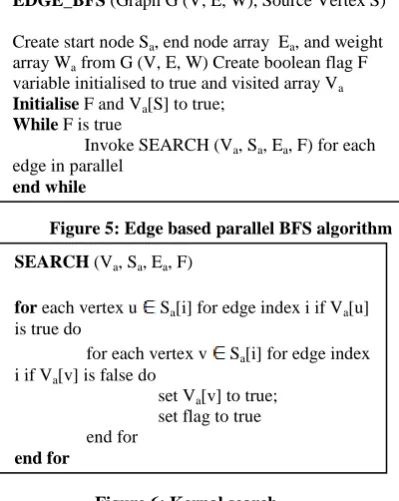
In edge based parallel BFS implementation using CUDA, number of threads is equal to the number of edges in the graph. We have created a flag variable to denote whether an updation in visited array occurred or not and if yes, flag is set to true. First, source node s is marked as visited node then its adjacent nodes are marked during graph traversal level by level. Whenever there is no updation, program exits, hence making the program efficient. Edge based parallel BFS is shown in Figure 5.
Figure 5: Edge based parallel BFS algorithm
Figure 6: Kernal search
In kernel SEARCH (Va, Sa, Ea, F) as shown in Figure 6, if status of start node of an edge is visited then we are setting status of its all end node to visited in parallel. At each update, flag value is set to true so that the algorithm continues and if there is no change in flag value then algorithm exits. Three factors which make it better than sequential BFS are: first,
nodes at a particular level traverse next level node in parallel manner, second, early exit of program rather than looping for every node, third, threads run corresponding to edges achieving high degree of parallelism
.
6.
PERFORMANCE ANALYSIS
We have evaluated the performance of edge based parallel Dijkstra’s algorithm and edge based parallel BFS algorithm on a large range of graph statistical data such as sparse, general, almost complete directed graphs of 6 thousands to 0.2 million vertices having up to 2 million edges. We will compare the execution times of these algorithms over their respective serial algorithms.
6.1
Experimental Setup
We have used two Desktop PCs to evaluate the results of edge based parallel Dijkstra’s algorithm and edge based parallel BFS algorithm with their respective sequential versions.
Experimental Setup 1:
CUDA 4.1
NVIDIA GeForce GTS 450 GPU
Compute Capability 2.1
192 Cores and 4 Multiprocessors
1 GB Dedicated GPU Memory
Intel Core i5 CPU @ 3.20 Ghz
2 GB RAM
Windows 7 Professional x86
Visual Studio Professional 2008
Experimental Setup 2:
CUDA 5.0
NVIDIA Tesla C2075 GPU
Compute Capability 2.0
448 Cores and 14 Multiprocessors
4 GB Dedicated GPU Memory
Intel Xeon CPU @
24 GB RAM
Windows 7 Professional 64-bit OS
Visual Studio Professional 2010
The results for edge based Dijkstra’s algorithm are summarized in Figure 7 for NVIDIA GeForce Graphic card. Experimental results show that GPU implementation achieves a significant speed-up of up to 5 times over serial implementation. For a graph of 30K vertices and 90K edges, it computes SSSP in about 7 milliseconds.
EDGE_BFS (Graph G (V, E, W), Source Vertex S) Create start node Sa, end node array Ea, and weight array Wa from G (V, E, W) Create boolean flag F variable initialised to true and visited array Va
Initialise F and Va[S] to true;
While F is true
Invoke SEARCH (Va, Sa, Ea, F) for each edge in parallel
end while
SEARCH (Va, Sa, Ea, F)
for each vertex u Sa[i] for edge index i if Va[u] is true do
foreach vertex v Sa[i] for edge index i if Va[v] is false do
set Va[v] to true; set flag to true end for
[image:3.595.315.535.600.747.2]Figure 7: Comparison of parallel Edge based Dijkstra’s algorithm with serial Dijkstra’s algorithm on the basis of edges on Setup 1.Here, edge_Dij_GPU refers to parallel edge based implementation of Dijkstra’s algorithm and Dij_CPU refers to serial Dijkstra’s algorithm.
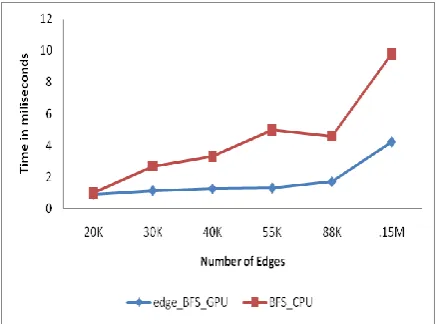
Figure 8 summarizes comparison of parallel edge based implementation of Breadth First Search with serial BFS on NVIDIA GeForce GTS Graphic card. As can be seen from figure that implementation of BFS over GPU reduces considerable amount of execution time over CPU. For 1,50,000 edges, it takes just 9 seconds.
For larger graphs, it can show better speed-up but due to the restriction of memory on the CUDA device and host CPU, graphs above 2 million vertices cannot be handled using current GPUs.
Figure 8: Comparison of parallel Edge based BFS with serial BFS algorithm on varying number of edges on Setup 1. Here, edge_BFS_GPU refers to parallel implementation of BFS and BFS_CPU refers to serial implementation.
Figure 9 shows comparison of parallel edge based Dijkstra’s algorithm with corresponding sequential implementation on NVIDIA Tesla Graphic Card as depicted in Experimental Setup 2. As can be seen from Figure 9, with the increase of number of edges in the graph, speed-up also increases. Initially, the gap between two curves, depicting parallel and sequential implementations respectively, is less, but with the increase of graph size, gap widens. For a graph having 23,12,777 edges, parallel implementation is taking just 0.5 seconds while, sequential implementation is taking approximately 2 seconds.
Figure 9: Comparison of parallel edge based Dijkstra’s algorithm with serial Dijkstra’s algorithm based on edges on Setup 2. Here, edge_Dij_GPU refers to edge based parallel implemenation of Dijkstra’s algorithm and Dij_CPU refers to sequential implementation.
In Figure 10, comparison of edge based parallel implementation of Breadth First Search with sequential Breadth First Search is represented. For a graph having 20,000 edges, parallel implementation is showing a speed-up of just 1.5 times, but for a graph having 23,12,777 edges, it is showing a speed-up of up to 11 times. So, for larger graphs, It can show more speed-up.
[image:4.595.314.537.70.225.2] [image:4.595.54.275.258.420.2] [image:4.595.313.543.387.555.2]42
7.
CONCLUSION
In this paper, we presented a new method to perform graph operations such that shortest path computation by Dijkstra’s algorithm and graph traversal by BFS,using edges. As number of edges is greater than number of nodes and threads are mapped to edges rather than nodes, greater degree of parallelism can be achieved. Achieved results show a considerable speed-up over corresponding serial implementation for various graph instances having varying degrees.
8.
REFERENCES
[1] Ashok Jagannathan. Applications of Shortest Path Algorithms to VLSI Chip Layout Problems. Thesis Report. University of Illinois. Chicago. 2000.
[2] Karla Vittori, Alexandre C.B. Delbem and Sérgio L. Pereira. Ant-Based Phylogenetic Reconstruction (ABPR): A new distance algorithm for phylogenetic estimation based on ant colony optimization. Genetics and Molecular Biolog., 31(4), 2008.
[3] Jiyi Zhang, Wen Luo, Linwang Yuan, Weichang Mei. Shortest path algorithm in GIS network analysis based on Clifford algebra. Transactions of the IRE Professional Group. 18(11, 12).
[4] Dijkstra E.W. 1959. A note on two problems in connexion with graphs. Num. Math. 1, pp. 269–271 [5] Quinn M.J. and Deo N. 1984. Parallel graph algorithms.
ACM Comput. Surv., 16(3), pp. 319-348.
[6] Reghbati A.E. and Corneil D.G. 1978. Parallel computations in graph theory. SIAM Journal of Computing, 2(2): pp. 230-237.
[7] Meyer U., Sanders P. 2003. Δ -stepping: a parallelizable shortest path algorithm. J. of Algorithms 49, pp. 114– 152.
[8] Bader D.A., Madduri K. 2006. Designing multithreaded algorithms for breadth-first search and st-connectivity on the Cray MTA-2. ICPP, pp. 523–530.
[9] Bader D.A., Madduri K. 2006. Parallel algorithms for evaluating centrality indices in real-world networks. ICPP 2006. Proceedings of the 2006 International Conference on Parallel Processing, IEEE Computer Society Press, Los Alamitos , pp. 539–550
[10]Crauser A., Mehlhorn K., Meyer U., and Sanders P. 1998. A Parallelization of Dijkstra's Shortest Path Algorithm. MFCS'98- LNCS 1450, Lubos Prim et al. (Eds.), Springer-Verlag Berlin Heidelberg, pp. 722-731. [11]Jasika N., Alispahic N., Elma A., Ilvana K., Elma L. and
Nosovic N. 2012. Dijkstra's shortest path algorithm serial and parallel execution performance analysis. MIPRO, pp. 1811-1815.
[12]Martín P. J., Torres R., and Gavilanes A. 2009. CUDA Solutions for the SSSP Problem. ICCS 2009, Part I, LNCS 5544, G. Allen et al. (Eds.), Springer-Verlag Berlin Heidelberg , pp. 904-913.
[13]Luo L. And Wong M., Hwu W. 2010An Effective GPU Implementation of Breadth-First Search, DAC'10, ACM, pp. 52-55.
[14] Harish P. and Narayanan P. J. 2007. Accelerating large graph algorithms on the GPU using CUDA, IEEE High Performance Computing, pp. 197-208.
[15]Nvidia, CUDA programming guide version 3, at developer.download.nvidia.com/compute/cuda/1_1/NVI DIA_CUDA_Programming_Guide.pdf (2010). [16]Nvidia CUDA: http://www.nvidia.com/cuda/.
![Figure 1: CUDA hardware interface [15]](https://thumb-us.123doks.com/thumbv2/123dok_us/8072620.780033/2.595.63.272.562.649/figure-cuda-hardware-interface.webp)