1
A comparison of performance of Islamic and conventional banks
2004 to 2009
Jill Johnes1, Marwan Izzeldin and Vasileios Pappas2
November 2012 Revised May 2013 Department of Economics
Lancaster University Management School Lancaster University LA1 4YX
United Kingdom
Abstract
We compare, using data envelopment analysis (DEA) and meta-frontier analysis (MFA), the performance of Islamic and conventional banks during the period 2004-2009. The use of non-parametric MFA is new to the Islamic banking context. Our DEA finds no significant difference in mean efficiency between conventional and Islamic banks when efficiency is measured relative to a common frontier. The MFA however, reveals some fundamental differences between the two bank types. In particular, the modus operandi in Islamic banking appears to be less efficient on average than the conventional one. Managers of Islamic banks, however, make up for this as mean efficiency in Islamic banks is higher than in conventional banks when efficiency is measured relative to their own bank type frontier. A second-stage analysis shows that differences between the two banking systems remain even after banking environment and bank-level characteristics have been taken into account. These findings are relevant to both policy-makers and regulators. In particular, Islamic banks should explore the benefits of moving to a more standardized system of banking, while the underperformance of conventional bank managers could be examined in the context of the on-going remuneration culture.
Keywords: Banking sector; Islamic banking; Efficiency; Data Envelopment Analysis; Meta-frontier analysis
JEL Classification: C14; G21
1Corresponding author: email: [email protected]
2 Acknowledgement: The authors are grateful to the Gulf One Lancaster Centre for Economic Research
(GOLCER) for support; to the discussant and participants at the JEBO Islamic Finance Conference 29th
2
1.
IntroductionThe recent financial crisis led to difficulties in many conventional3 banks across the globe. Islamic banks, in contrast, were largely insulated from the crisis (Willison 2009; Yılmaz 2009). It appeared that their highly regulated operational environment guided by Shariah principles prohibited investment in the type of financial products which adversely affected conventional banks and which prompted the crisis (Hasan and Dridi 2010).
The success of Islamic banks relative to conventional banks in the macroeconomic environment is in contrast to expectations of their performance (by which we mean technical efficiency) in a microeconomic context. Islamic banks might be expected to have lower technical efficiency than conventional banks for a number of reasons. First, the strict application of Shariah rules means that many of the Islamic banking products are unstandardised thereby increasing operational costs. Second, Islamic banks are typically small compared to conventional banks, and there is evidence that technical efficiency increases with size in the banking industry (see, for example, Miller and Noulas 1996; Abdul-Majid et al. 2005a; Chen et al. 2005; Drake et al. 2006). Third, Islamic banks are typically domestically owned and there is evidence to support the contention that foreign-owned banks are more technically efficient than their domestically-owned counterparts (see, for example, Sturm and Williams 2004; Matthews and Ismail 2006).
Studies specifically focusing on the performance of Islamic banks relative to conventional banks, however, are inconclusive in their findings. We therefore aim to fill a gap in the literature by investigating two questions to which previous studies have failed to provide adequate answers. First, which types of banks (Islamic or conventional) are more technically efficient? Second, what are the underlying reasons for any differences in efficiency between Islamic and conventional banks?
The traditional values of Islamic finance have increasing appeal to Western investors who are disillusioned with the banking practices of conventional banks in the wake of the global financial crisis (Arthur D Little Report 2009). As a consequence, Islamic banks are no longer limited to traditional Muslim regions: there are more than 300 Islamic financial institutions spread across 70
3
countries. Indeed, there are now 5 Islamic banks in the UK, and 19 Islamic financial institutions in the USA. Thus a study comparing the performance of Islamic and conventional banking is of widespread interest.
We focus our empirical study on countries with a substantial (at least 60%) Muslim population and where there are both Islamic and conventional banks in operation. Our analysis comes in two stages. In a first stage, we assume a degree of competition between Islamic and conventional banking sectors4 and compute and directly compare the efficiency of 45 Islamic banks with 207 conventional banks across 18 countries over the period 2004 to 2009. As part of this first stage, we adopt a meta-frontier approach which decomposes efficiency into two components: one due to the modus operandi and one due to managerial competence at converting inputs into outputs. In a
second stage we investigate the determinants of the two components of efficiency (rather than just the overall efficiency) and are thereby able to uncover and discuss more effective ways in which managers and policy-makers can improve efficiency.
The paper is in six sections of which this is the first. Section 2 discusses the methodological approaches to efficiency measurement while a brief literature review is presented in section 3. Section 4 describes the sample data and the empirical model, and results are presented and interpreted in section 5. Conclusions and policy implications are discussed in section 6.
2.
MethodologyStudying banking efficiency can be done in two possible ways: either by use of traditional financial ratio analysis (FRA); or by the distance function approach which leads to frontier estimation methods such as data envelopment analysis (DEA) and stochastic frontier analysis (SFA). The pros and cons of FRA as a method of efficiency measurement are well known (Ho and Zhu 2004; Hasan 2005). In the context of Islamic banking, the most severe drawback is the assumption underlying financial ratios of cost minimisation or profit maximisation; these are unlikely to be the most pressing objectives in the context of Islamic banking (Abdul-Majid et al. 2010). The distance function
4 This is not an unreasonable assumption given the growing appeal of Islamic financial products, and given that
4
approach, whereby a firm’s observed production point is compared to a production frontier which denotes best practice, does not assume any specific optimizing objective on the part of the firms, and is therefore our preferred method of approach.
It is worth reflecting at this point upon our intention to compare directly the efficiency of Islamic and conventional banks5. Critics might argue that the objectives of the two banking systems differ so much that such a comparison is invalid: for example, conventional banks can be seen to be motivated only by profit, while Islamic banks may have both profit and ethical goals. We believe that this criticism can be rejected using one or other of two possible arguments:
a) We question the extent to which Islamic and conventional banks differ: a recent paper concludes that Islamic banking and finance ‘... simply replaces conventional banking terminology with terms from Classical Arabic and offers near-identical services to its clients but at a higher cost.’ (Khan 2010, p818). If this is truly the case then directly comparing Islamic and conventional banks is clearly legitimate.
b) We allow for the eventuality that the objectives of the two types of banks are indeed different. We believe that it is still possible to make a direct comparison so long as the estimation method appropriately allows for differences between (and within) the banking systems. We have a choice of estimation methods, namely the parametric stochastic frontier analysis (SFA) or the non-parametric data envelopment analysis (DEA) (Majumdar 1995; Coelli et al. 2005) both of which make the assumption that production units are comparable. While the general advantages and disadvantages of each of these are well-known one aspect must be emphasized. DEA, by estimating a frontier which envelops the observed production points with piecewise linear segments, allows each bank to have its own objectives as it will only be compared with banks of similar input and output mix. For example, a small Islamic bank, financing its loans using a balanced mix of equity and deposits, would not in DEA be compared with a large conventional bank with a different input-output mix financing its loans predominantly using deposits. Similarly, an Islamic bank mainly involved in sale and mark-up transactions will not be compared with one
5 This is not an entirely original approach and there are examples in previous literature (see section 3 for
5
which undertakes joint venture finance as they will have different mixes of outputs. SFA, on the other hand, applies the same parameters6 to all observations in the sample. By choosing DEA rather than SFA as our estimation method in the first stage, we therefore overcome any criticism of pooling banks with different objectives as DEA only compares like with like.
The effectiveness of policies to improve bank efficiency depends on the source of inefficiency, for example, whether it is managerial incompetence or whether it is the banking system in which the bank operates. We adopt a meta-frontier methodology (similar to one introduced by Charnes et al. 1981) for decomposing the efficiency of banks into two components: one which is due to the modus operandi i.e. the context in (or rules under) which the bank operates (namely conventional or
Islamic); and one which is due to managerial competence at converting inputs into outputs within the context in which the bank operates. Whilst relatively new to the Islamic banking literature, this type of method has been applied in banking more generally (Bos and Schmiedel 2003) as well as in other contexts including education, sport and the water industry (De Witte and Marques 2009; Tiedemann et al. 2011; Wongchai et al. 2012).
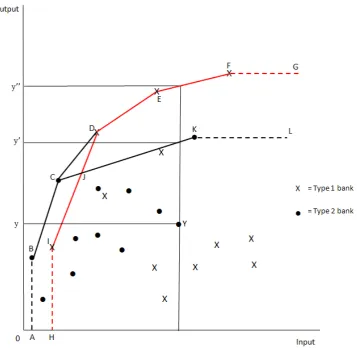
The first stage decomposition can be illustrated by means of a simple example whereby we assume that each bank produces one output (for example loans) from one input (for example deposits). The hypothetical production points for a number of banks are plotted in figure 1. The boundary ABCDEFG envelops all banks in the sample, and banks lying on the frontier are efficient relative to others. Bank Y lies inside the frontier and has an efficiency score of 0y/0y′′.
[Figure 1 here]
In order to assess the sources of inefficiency of bank Y, we need to consider each bank’s efficiency relative only to the banks of the same bank type. Let us assume that banks in the sample can be categorised into two types: type 1 (represented by crosses) and type 2 (represented by dots). The original boundary ABCDEFG is the gross efficiency boundary. HIDEFG is the boundary for type 1 banks, and ABCKL is the boundary for type 2 banks. We call these the net efficiency boundaries. Bank Y, a type 2 bank, has a net efficiency score of 0y/0y′ which represents the proportion of output
6 A random parameter variant of SFA would also allow firms to differ in their objectives. But this method
6
obtained by bank Y relative to the best possible output achievable by type 2 banks only and given bank Y’s input level. The distance between the net and gross boundaries measures the impact on output of bank type. The type efficiency score of bank Y is therefore 0y′/0y′′ and indicates the impact on bank Y of operating under a type 2 system.
There are some potential problems with this approach but we have taken steps to minimize the effect of these. First of all, it should be clear from the previous exposition that the estimation of gross and net efficiencies is based on different samples of banks. Efficiencies calculated using DEA, which is a non-parametric method, are affected by sample size (Zhang and Bartels 1998), and hence the results of the meta-frontier approach can be biased when DEA is used to perform the calculations and comparisons (De Witte and Marques 2009). In order to guard against this problem, we resort to bootstrapping methods to deliver bias-corrected efficiency scores which correct for sampling variability 7.
Second, the approach requires an assumption regarding concavity of the meta-frontier. A concave meta-frontier implies that points on the line segments of the gross efficiency frontier are feasible for both types of observations. In figure 1, for example, this means that since point C is obtainable by type 2 banks and point D is obtainable by type 1 banks, then points on the line joining C and D are attainable by both types of banks, but are currently not being observed because of some constraint or limitation of one or other of the two banking systems (not because of managerial inefficiency). A non-concave meta-frontier (Tiedemann et al. 2011) implies that the meta-frontier comprises entirely of line segments which are on either of the net efficiency frontiers. In figure 1, for example, line segment CD would not be part of the non-concave meta-frontier, but would be replaced by CJD. The effect of choice of concavity assumption on results is likely to be smaller the larger the sample size. Both concave and non-concave meta-frontiers have been applied in the literature. For ease of estimation we assume a concave meta-frontier, as in Charnes et al. (1981).
Differences between Islamic and conventional banks in gross, net and type efficiency (respectively) might be a consequence of some other underlying characteristic(s) of each group of
7 Bias-corrected efficiencies are calculated using the homogeneous bootstrapping algorithm of Simar and
7
banks and not purely operation within the given system. Thus we intend to perform a second stage analysis which will ascertain the determinants of each efficiency component and which will include as one of the explanatory variables an indicator of bank type.
We use a (bank) random effects estimation approach with heteroscedasticity-corrected standard errors in our second stage analysis8 as recommended in recent work which compares various second stage approaches (Hoff 2007; McDonald 2009). This contrasts with previous studies which have adopted a Tobit regression approach (examples in the banking context include: Jackson and Fethi 2000; Casu and Molyneux 2003; Drake et al. 2006; Ariff and Can 2008; Sufian 2009). The choice of a Tobit model, however, is based on the premise that the dependent variable comprising DEA efficiency scores is a censored variable, whereas efficiency scores are not censored but are fractional data (McDonald 2009), thus making Tobit analysis inappropriate.
3.
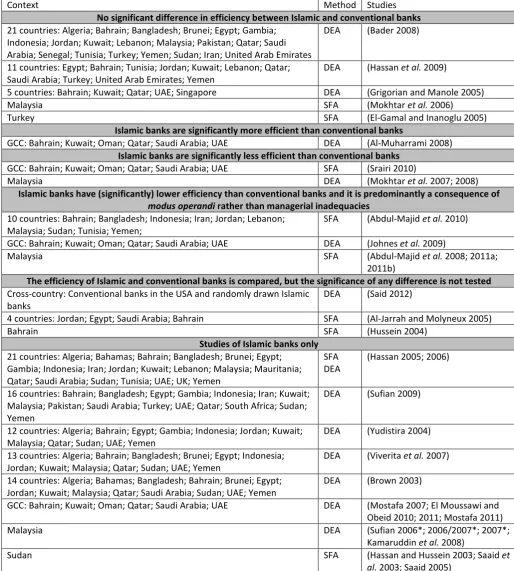
Literature reviewThere is an abundant literature on the efficiency of banking institutions: detailed (albeit somewhat outdated) reviews can be found elsewhere (Berger and Humphrey 1997; Berger and Mester 1997; Brown and Skully 2002). A small subset of this literature focuses on Islamic banking either in isolation or in comparison to conventional banking (see table 1 for details of studies which use frontier estimation methods to derive measures of efficiency). The remainder of this section will focus predominantly on the comparative literature.
[Table 1 here]
We have previously hypothesized that Islamic banks will typically have lower efficiency than conventional banks. The evidence from previous empirical studies of Islamic and conventional banking is mixed: some find no significant difference in efficiency between the two types of banking (Abdul-Majid et al. 2005b; El-Gamal and Inanoglu 2005; Mokhtar et al. 2006; Bader 2008; Hassan et al. 2009; Shahid et al. 2010); some studies do not test whether observed differences in efficiency are
significant and this is mainly due to small sample size (Hussein 2004; Al-Jarrah and Molyneux 2005; Said 2012). One study (Al-Muharrami 2008) claims that Islamic banks are significantly more efficient
8
than conventional banks, but results of significance tests are not shown, and the result is based on a sample which only contains 7 Islamic banks. Only a small number of studies find, as expected a priori, that Islamic banks are significantly less efficient than conventional banks, but the possible
reasons for the difference are not explored further (Mokhtar et al. 2007; 2008; Srairi 2010).
One group of studies deserves particular mention because they make a distinction between ‘gross’ and ‘net’ efficiency (Abdul-Majid et al. 2008; Johnes et al. 2009; Abdul-Majid et al. 2010; 2011a; 2011b). Gross efficiency incorporates both managerial competence and efficiency arising from modus operandi; net efficiency isolates the managerial component and therefore provides a measure of managerial efficiency. In one study based on banks in Malaysia, gross efficiency scores are derived from a SFA estimation of a cost function which makes no allowance for various characteristics of each bank (including whether or not it is Islamic), while net efficiency scores are estimated by taking into account the operating characteristics of banks in the SFA cost function (Abdul-Majid et al. 2008; 2011a; 2011b). Gross efficiency is found to be highest for conventional banks and lowest for Islamic banks, and the significance of the Islamic dummy in the cost equation including the environmental variables suggests that this difference is significant. There are, however, only slight differences in net efficiency between the different types of banks. The findings from this study are questionable for two reasons. First they are derived from an estimated cost function for a sample of Islamic and conventional banks, and this implicitly assumes an objective of cost minimization on the part of all the banks in the data set. Second, the estimation technique (SFA) applies the same parameter to all observations and hence does not allow for differences in objectives between banks in the sample.
9
Johnes et al (2009) take a different approach by examining gross and net efficiency using an output distance function estimated using DEA. They find (like Abdul-Majid et al. 2008; 2011a; 2011b) that the lower performance of Islamic banks in the Gulf Cooperation Council (GCC) region is due to modus operandi rather than managerial incompetence.
These studies are interesting and offer a way forward in terms of isolating the underlying causes of the differing performance of Islamic and conventional banks. There is a need, however, for a comparison of efficiency between conventional and Islamic banks based on a large sample of banks using an approach which makes no underlying assumptions regarding the banks’ objectives, and which allows for inter-bank differences in outlook. It is also necessary to investigate the factors underlying the gross and net efficiency scores. Thus, it is not enough to know whether it is modus operandi or managerial inadequacies which underpin a bank’s performance; bank managers need to
know how and to what extent their behaviour can affect their efficiency. A detailed second stage analysis of both gross and net efficiency scores will provide this information.
4.
Sample data and modelsThe empirical analysis presented in this study focuses on countries where at least 60% of the population is Muslim and where both bank types coexist. We include in the sample banks for which a complete set of data for the DEA model can be compiled using the data source Bankscope, for the period 2004 to 20099. This is an interesting time period over which to undertake this study as it also allows us to gain insights into the effects of macroeconomic turmoil and instability on the efficiency of the banking sector (two studies examine Islamic and conventional banks over the same period: Rokhim and Rokhim 2011; Beck et al. 2013).
Banks are designated Islamic or conventional on the basis of the Bankscope definition10, and conventional banks which operate Islamic windows are not included in our sample. Data for 252
9 Note that Bankscope moved to International Financial Reporting Standards (IFRS) from 2004 onwards, and so data should be comparable over time.
10We cross-check the banks listed as ‘Islamic’ in Bankscope with other databases of Islamic banks including the
10
banks (207 conventional and 45 Islamic) across 18 countries11 are extracted from the consolidated data in US dollars (USD) having been converted from own currencies by end of accounting year exchange rates. In addition, all variables are deflated to 2005 prices using appropriate deflators12. Both banking sectors (conventional and Islamic) in the sample countries are required to follow national and international regulatory requirements under the supervision of the banking authorities of their host country, and both bank types adhere to the same accounting standards (Alexakis and Tsikouras 2009). Thus data should be consistent across the two bank types, but any discrepancy in practice (for example, Islamic banks must also conform to the requirements of the Shariah supervisory board) is allowed for in the first stage by the use of DEA.
4.1 First stage analysis: estimation of efficiencies
The choice of variables qualifying for the DEA model is guided by previous literature and data availability. We assume that banks perform an intermediary role between borrowers and depositors (Pasiouras 2008) and that they use i) deposits and short term funding, ii) fixed assets, iii) general and administration expenses and iv) equity as inputs to produce i) total loans and ii) other earning assets.
Islamic banks do not offer loans in the same way as conventional banks, and so the term ‘total loans’ is a generic term used to encompass the equity financing products they use. Conventional banks earn money from the spread between lending interest and borrowing interest rates. Islamic banks have a similar spread which is defined in terms of profit share ratios between the entrepreneurs (borrowers) and the depositors (lenders).
Fixed assets are included to represent capital input, while general and administration expenses are used as a proxy for labour input. While it may not be a perfect reflection of labour input, it is more easily available than better measures (e.g. employee numbers or expenditure on wages) and has been used in previous studies (e.g. Drake and Hall 2003) where it is argued that personnel expenses make up a large proportion of general and administration expenses.
11 The countries are: Bahrain; Bangladesh; Brunei; Egypt; Indonesia; Jordan; Kuwait; Malaysia; Mauritania;
Pakistan; Palestine; Qatar; Saudi Arabia; Sudan; Tunisia; Turkey; United Arab Emirates; Yemen. Details of the number and type of banks included in the sample and population can be found here: http://www.lancs.ac.uk/people/ecajj/1islamicbanking2013.htm.
12These were calculated using data from World Development Indicators (WDI) and Global Development
11
It has been suggested that an indicator of risk-taking should explicitly be incorporated into any model of banking efficiency (Charnes et al. 1990), and this aspect is likely to be particularly important in a context which compares Islamic and conventional banks where one would expect a difference in taking behaviour (Sufian 2006). There are several suggestions of measures of risk-taking activity. Some studies use off-balance sheet items (Pasiouras 2008; Lozano-Vivas and Pasiouras 2010) but this variable has the disadvantage that data are not widely available and the sample is consequently severely reduced by its inclusion. Other studies use equity which is more widely available; moreover bank attitudes to holding equity have responded quickly to changes in the financial climate, and this makes it particularly attractive in a study which encompasses a period of financial crisis. Indeed, equity has been used to reflect risk in previous studies which have covered times of financial crisis: the East Asian crisis (Abdul-Majid et al. 2008), and the savings and loans crisis in the USA (Alam 2001). We therefore feel that the variable equity captures the general attitudes towards risk (enforced or preferred) of the two types of banks over the period, and use it to reflect risk in our own study.
Descriptive statistics of the DEA variables are presented in table 2. Over the whole period of study, the typical conventional bank has just over US $6000 million in total loans and US $2500 million in other earning assets. These are 1.5 and 3 times the values for Islamic banks (respectively). There has been growth in these output variables in both banking sectors over the period but this has slowed down (understandably given the world economic climate) towards the end of the period13. Input variables are typically up to twice as big in the conventional compared to the Islamic banking sector.
[Table 2 here] 4.2 Second stage analysis: determinants of efficiency
In a second stage, an investigation of the possible determinants of the different types of efficiency scores (gross, net and type) of the banks is undertaken. We consider two broad categories: the characteristics of the individual banks, and the banking context, over which
12
managers have no control, and which is particularly relevant in cross-country studies (Dietsch and Lozano-Vivas 2000; Lozano-Vivas et al. 2002). The proposed explanatory variables and their potential impact are discussed below. The effects of these variables have not all been explored in an Islamic banking context and so we draw on the conventional banking literature for inspiration in choosing variables. We consider eight variables to reflect bank-level characteristics.
• A binary variable to reflect whether or not the bank is classified by Bankscope as fully-fledged
Islamic (ISLAMIC). This variable is included in the second stage to assess whether any differences
in efficiency between the two types of banks remain after the economic environment and the bank’s own characteristics have been taken into account.
• A dummy variable to reflect whether the bank is listed on the stock market (LIST) and an
interaction term between ISLAMIC and LIST (ISLIST). Listing on the stock market has been found
to have a positive effect on efficiency in the context of conventional banks in Europe (Casu and Molyneux 2003) but a negative effect in the context of Islamic banks (Yudistira 2004) – hence the inclusion of both the listing dummy and interaction term.
• The value of a bank’s total assets (ASSETS). Value of total assets14 is included to reflect bank size. Islamic banks are typically smaller than conventional banks and so it might be size which causes any observed differences in efficiency. Indeed, cost efficiency appears to be negatively related to size in the context of Islamic banks (Beck et al. 2013). We check for a non-linear relationship between efficiency and size by also including the square of ASSETS (ASSETSSQ).
• The ratio of loan loss reserves to loans (LOANLOSS/LOANS). This variable acts as a proxy for
credit risk (the higher the loan loss reserves ratio the lower the credit risk). In managing increasing credit risk, banks may incur additional expenses to monitor their loans (Barajas et al. 1999) which might lead to lower efficiency; on the other hand, a lower ratio has been associated with increased profit margins (Miller and Noulas 1997) and this may lead in turn to higher efficiency. Islamic and conventional banks may well manage credit risk differently, and this variable is included to capture any potential effect of that possibility. Previous evidence, derived
14 Note that this variable (total assets) is distinctive from the variable fixed assets included in the first stage
13
from an analysis of conventional banks, finds no significant relationship between the ratio of loan loss reserves to loans and efficiency (Staikouras et al. 2008).
• The ratio of total loans to total assets (LOANS/ASSETS) and the ratio of net loans to total assets
(NETLOANS/ASSETS). Total loans is the sum of reserves for impaired loans (relative to non-performing loans) and net loans. By including both variables we obtain the effect on efficiency of the components of total loans. Thus the sum of the coefficients on these two variables will reflect the effect on efficiency of net loans (relative to total assets), and the coefficient on LOANS/ASSETS will indicate the effect on efficiency of the value of reserves for impaired loans (relative to non-performing loans): the greater are these reserves, the higher is the bank’s liquidity and hence the lower its exposure to defaults; on the other hand, the lower are the reserves, the higher are potential returns. Thus the potential overall effects of NETLOANS/ASSETS and LOANS/ASSETS on efficiency are unclear, a priori, although previous research has suggested a positive relationship between liquidity and efficiency in both Islamic and European banks (Hasan and Dridi 2010).
We consider five variables – sourced from World Development Indicators (WDI) and Global Development Finance (GDF) databases – to reflect the overall banking environment.
• The normalised Herfindahl index (HHI). This variable reflects the competitive environment of each country’s banking sector. The index is calculated using all the banks (contained in Bankscope15) for a given country and hence assumes that Islamic and conventional banks compete against each other16. The ‘quiet life’ theory suggests that increased industry concentration is related to lower technical efficiency as there is little incentive to be efficient when competition is low (Berger and Mester 1997). The ‘efficiency hypothesis’, on the other
15The normalized Herfindahl index is
𝐻𝐼∗=𝐻𝐼−1/𝑁
1−1/𝑁 where HI is the Herfindahl index, calculated using market
shares (based on total assets) at year end, and N is the number of firms (Bikker and Haaf 2002; Čihák and Hesse 2010). The normalised Herfindahl index ranges from 0 to 1 and gives lower rankings than the original Herfindahl index for industries with small number of firms (Busse et al. 2007). It is therefore more appropriate in the present context. Bankscope is not entirely comprehensive in its coverage, but omitted banks are likely to be small and hence the HHI calculated on this basis should adequately reflect the competitive environment. 16 This is justified on the grounds that Islamic banking products increasingly appeal to non-Muslim customers;
14
hand, argues that concentration and efficiency are positively related. There is evidence from previous studies in the context of conventional banks to support both the ‘quiet life’ theory (Yudistira 2004; Staikouras et al. 2008) and the ‘efficiency hypothesis’ (Dietsch and Lozano-Vivas 2000; Koutsomanoli-Filippaki et al. 2009).
• The degree of market capitalization i.e. the percentage valuation of listed firms across all sectors
relative to the country’s GDP (MCAP). This is included to reflect the level of stock market activity in the economy, and its possible effect on bank efficiency is unknown a priori.
• Growth in real GDP (GDPGR) and Inflation (INF). These variables are included to capture the
buoyancy of the economy in which the bank is located. While their precise effects are unknown a priori, previous evidence, derived from studies of conventional banks, has shown a positive
relationship between GDP growth and banking efficiency (Staikouras et al. 2008; Awdeh and El Moussawi 2009).
• Per capita GDP (GDPPC). This variable reflects the level of institutional development and the
supply and demand conditions in the market in which the bank is located. While previous evidence based on conventional banks has shown a positive relationship between per capita income and costs (Dietsch and Lozano-Vivas 2000), the precise effect of this variable on efficiency is ambiguous a priori.
We include additional variables to reflect the time and regional dimensions of the data.
• Year dummies are included to allow for changes in banking efficiency over time; these are used
15
• Region dummies are included to allow for differences in efficiency between three broad
regions17.
We estimate, using random effects, with heteroscedasticity-corrected standard errors, the following equation:
𝑦𝑛,𝑡=𝛼+𝛽′𝑿𝑛,𝑡+𝛾′𝒁𝑐,𝑡+𝛿′ʹʹ𝑫𝑟+𝜑′𝑭𝑡+𝜇𝑛+𝜀𝑛,𝑡
where: 𝑛= 1, … ,𝑁, represents banks; 𝑡= 1, … ,𝑇 represents time; 𝑐= 1, … ,𝐶 represents country; 𝑟= 1, … ,𝑅 represents region; and 𝑟 ⊆ 𝑐 ⊆ 𝑛. The dependent variable 𝑦 denotes efficiency and separate equations are estimated for gross, net and type efficiency respectively; 𝛼 is the intercept term and denotes the mean of the unobserved heterogeneity; 𝜇𝑛~𝐼𝐼𝐷�0,𝜎𝜇2� is the random heterogeneity specific to the nth bank and is constant over time; 𝜀𝑛,𝑡~𝐼𝐼𝐷(0,𝜎𝜀2) and is uncorrelated over time; 𝑿𝑛,𝑡 is an Nx8 matrix of bank-level explanatory variables (see section 4.2); 𝒁𝑐,𝑡 is an Nx5 matrix of country-level explanatory variables (see section 4.2); 𝑫𝑟 is an Nx2 matrix of regional-level dummies (see footnote 10); 𝑭𝑡 is an Nx10 matrix of year dummies, and year and Islamic interaction dummy variables.
Descriptive statistics of the variables included in the second stage analysis are presented in table 3. There are clear differences between Islamic and conventional banks in terms of these variables. Most notably Islamic banks are much smaller (less than half the size) and, through their country location, they face a much higher (nearly double) per capita GDP than their conventional counterparts.
[Table 3 here] 5. Results
5.1 First stage results
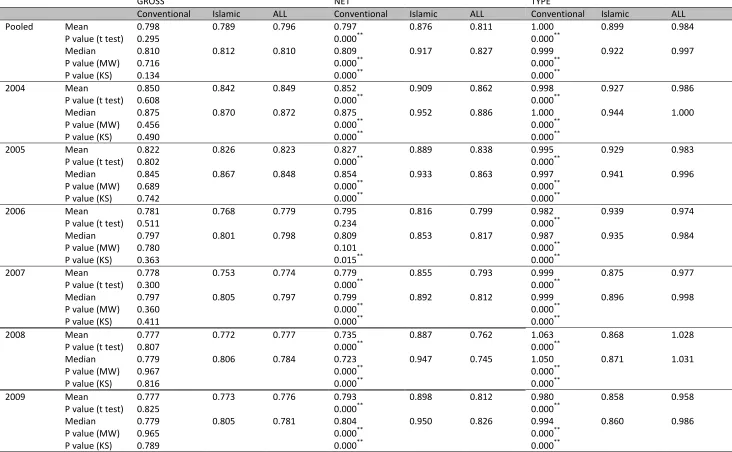
Bias-corrected18 DEA efficiencies, calculated using an output-oriented constant returns to scale (CRS) approach, on the assumption that production conditions vary over time19, are reported in
17 The regions are: Middle East and North Africa (MENA) = Egypt, Jordan, Mauritania, Palestine, Sudan, Tunisia,
16
table 4 and displayed in figure 2. We discuss the findings in the context of, respectively, gross efficiency, type efficiency and net efficiency as defined in section 2.
[Table 4 here] [Figure 2 here]
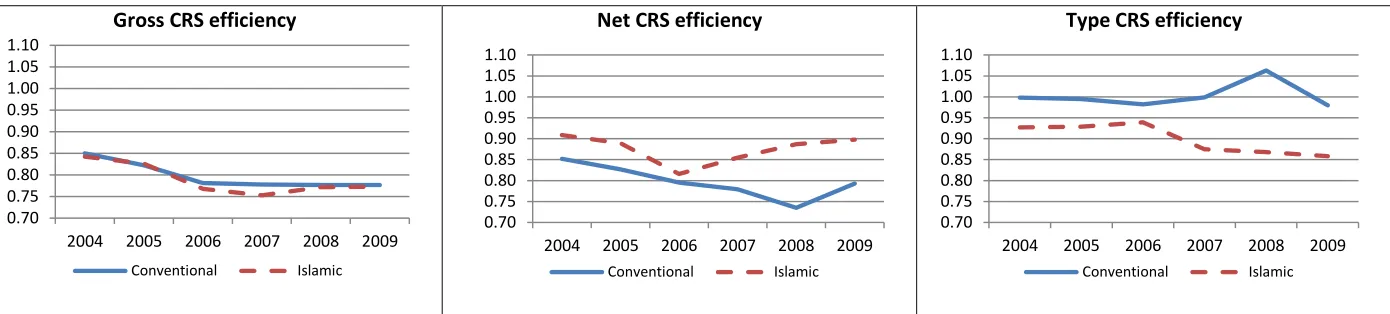
In terms of gross efficiency there is no evidence to suggest significant differences in mean efficiency levels between conventional and Islamic banks. Thus, when measured against a common frontier, each type of bank typically has the same level of efficiency.
In the context of type efficiency, we see that conventional banks have higher efficiency, on average, than the Islamic banks, and this difference is significant in all years of the study. These results provide clear evidence that the Islamic banking system is less efficient than the conventional one. This is in line with earlier conclusions derived using SFA and DEA (Abdul-Majid et al. 2008; Johnes et al. 2009; Abdul-Majid et al. 2011a). The fact that the Islamic banking modus operandi is less efficient than its conventional counterpart comes as no surprise for a number of reasons. First, an Islamic bank operates mainly with customised contracts which are either equity-type (profit and loss sharing) or services-type (leasing agreements, mark-up pricing sale). These contracts are tailor-made as many of the relevant parameters (such as maturity, repayments and collateral) are client-specific. The bank, as the financer, needs to conduct a feasibility and profitability analysis for equity-type contracts; this is costly and time-consuming, depending on nature and size of project. Second, an Islamic bank needs to seek approval for its financial products from the Shariah board of the bank. This is done for every Islamic bond issue (sukuk) and also for the majority of equity-based contract; exceptions are fee-based contracts which tend to be more standardised and hence rarely require the approval of the Shariah board. Thus Islamic banks incur greater administration costs and higher operational risk than conventional banks.
18 Results calculated without bootstrapping can be found here http://papers.ssrn.com/sol3/papers.cfm?abstract_id=2071615.
19 This means that the DEA is performed for each year separately. Given the expanding populations and
17
Turning now to net efficiency, Islamic banks consistently have higher average levels of efficiency than conventional banks and the differences are largely significant over time. Thus, when banks are measured against their own frontier, Islamic banks are more efficient, on average, than conventional banks. The implication of this finding is that managers of Islamic banks appear to make up for the inefficiencies arising from modus operandi (evident from the type efficiency results) by being more efficient than their counterparts in conventional banks. We return to this in the following section.
We can see how these results might be represented in a simple banking model by referring back to figure 1. The conventional banks are most closely represented by the crosses in figure 1. The gross efficiency frontier is mainly (but not exclusively) determined by crosses – i.e. conventional banks. But a large number of conventional banks are highly inefficient and lie at some distance from the gross (and net) efficiency frontiers. In contrast, relatively few Islamic banks determine the gross efficiency frontier, but many of them lie close to the gross (and net) efficiency frontiers with only a few being highly inefficient. The average gross efficiency score is therefore similar for the two types of banks, but the net efficiency score is much higher, on average, amongst Islamic banks compared to conventional banks.
The composition of banks forming the gross efficiency frontier (dominated by conventional banks) combined with the location of the different types of inefficient banks is such that the peer groups of both Islamic and conventional banks are likely to be dominated by conventional banks. An examination of the peers from the DEA generally confirms this finding. There is a subtle difference between the two groups however: for the study period as a whole, the composition of the peer group of a typical inefficient Islamic bank is 38% Islamic banks, and 62% conventional banks; for a typical inefficient conventional bank the percentages are 32% and 68% respectively.
5.2 Second stage results
18
Islamic banks is significantly higher (by 0.08) than in conventional banks, while type efficiency is lower (by 0.07) for Islamic banks than conventional banks. The Islamic method of banking results in lower efficiency than conventional banking (as indicated by type efficiency), but the managers of the Islamic banks make up for this disadvantage (as indicated by net efficiency), and this is the case even after taking into account other contextual and bank-level characteristics. The efforts of the
managers of Islamic banks in terms of recouping efficiency lost due to modus operandi is an interesting finding and is in contrast to reports from the late 1990s which suggested that managers of Islamic banks were lacking in training (Iqbal et al. 1998). It seems therefore that the expansion of demand in Islamic financial products has coincided with an improvement in managerial efficiency. This might have occurred for a number of reasons. Clearly operating with tailor-made financial products (as in Islamic banks) requires considerable human input, and so Islamic banks have spent more on human resources than conventional banks in order to emphasise reputation, trust and interpersonal relationships (Pellegrina 2008). In addition, Islamic finance has become better understood in recent years (and specifically over the period of the study) as a consequence of, for example, marketing campaigns20.
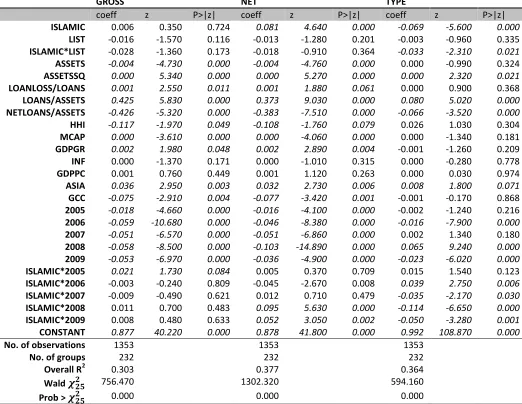
[Table 5 here]
Some other results in table 5 are worthy of further discussion. A number of variables are significant in explaining gross and net but not type efficiency. Increasing size initially decreases gross and net efficiency but beyond an asset value of around $40 billion gross and net efficiency tend to increase with size. Given that mean size is around $7 billion, many banks (and nearly all Islamic banks) experience the negative relationship between gross and net efficiency and size.
The ratio of total loans to total assets and the ratio of net loans to total assets are the two remaining bank-level variables which significantly affect gross and net efficiency, the former positively and the latter negatively. These results need to be considered together since total loans are the sum of net loans and reserves for impaired loans (relative to non-performing loans). Thus the coefficient on the ratio of total loans to total assets reflects the effect of holding reserves for
20 To this end, Bank Syariah Mandiri in Indonesia sponsors documentaries on Islamic finance while Emirates
19
impaired loans on efficiency: in this case the higher the reserves (and hence the higher the protection for the bank from bad loans) the higher are gross and net efficiency. This suggests that banks which behave prudently in terms of insuring against bad loans reap rewards in terms of higher gross and net efficiency. The sum of the two coefficients suggests that the size of net loans (relative total assets)has little effect on gross and net efficiency.
Three macroeconomic (country-level) variables are significant in the net and gross efficiency equations at the 10% significance level. First, the significantly negative coefficient on HHI provides support for the ‘quiet life’ hypothesis. Second, a higher level of market capitalization (and hence stock market activity) leads to lower gross and net efficiency. Third, increasing GDP growth is associated with higher efficiency (gross and net) as expected.
The two dummy variables to reflect geographical region are also significant with banks in the Asian region having higher gross and net efficiency (than banks in MENA) by 0.04, and banks in the GCC having lower efficiency (than banks in MENA) by around 0.08. We speculate that the size of population may be responsible for these differences between regions: Asia has the largest population, followed by the MENA region, and then by the GCC. It is possible that higher demand for banking products in the highly populated region leads to greater standardization of products, and the possibility of reaping economies of scale. The opposite may be the case for the smallest region. Further research is necessary to confirm these conjectures.
20
2004. Managers of Islamic banks seem therefore to have coped with the recent financial crisis better than managers of conventional banks (as signalled by the net efficiency results). However, the crisis seems to have had a more adverse effect on type efficiency in Islamic than conventional banks: thus the efficiency disadvantage of operating under Islamic rules appears to have become greater over the period of crisis..
6.
ConclusionOur purpose in this paper has been to compare efficiency, using DEA, amongst a sample of Islamic and conventional banks located in 18 countries over the period 2004 to 2009. The DEA results provide evidence that there are no significant differences in gross efficiency (on average) between conventional and Islamic banks. This result is in line with a number of previous studies (El-Gamal and Inanoglu 2005; Mokhtar et al. 2006; Bader 2008; Hassan et al. 2009).
By using a non-parametric meta-frontier analysis we have been able to decompose gross efficiency into two components: net efficiency provides a measure of managerial competence, while type efficiency indicates the effect on efficiency of modus operandi, and by doing this we have discovered that the result of no significant difference in gross efficiency between banking types conceals some important distinctions. First, the type efficiency results provide strong evidence that Islamic banking is less efficient, on average, than conventional banking. Second, net efficiency is significantly higher, on average, in Islamic compared to conventional banks suggesting that the managers of Islamic banks are particularly efficient given the rules by which they are constrained. The apparent inefficiency of the Islamic banking system is counterbalanced by the efficiency of the managers of Islamic banks.
21
Each type of banking could therefore learn from the other. Islamic banks need to look at the conventional banking system for ideas on how to make their own system more efficient. An obvious possibility would be to standardize their portfolio of products as in conventional and the larger Islamic banks.
Conventional banks need to examine the managerial side of Islamic banking for ideas on how to improve the efficiency of their own managers. If there is little difference in the inherent ability or the training of managers in each type of bank, then other aspects, such as the remuneration systems and project viability might hold the key. Remuneration of managers in conventional banks comprises a fixed element (salary) and variable components (shares, bonuses and other benefits). Most recently, bonuses have been criticized for being attached to short-term goals. It is to be expected that managers focus upon goals to which bonuses are attached, and these are usually quantity-oriented (i.e. the number of loans) rather than quality-quantity-oriented (i.e. viability of the project). Here, the long investment horizon of conventional financial products, which can be up to 20 or 30 years, could be an impediment to the manager’s focus and judgment of the pecuniary worth. Bonuses are not part of the Islamic banking culture21. It is also plausible that the shorter horizon of financial projects in Islamic banks alongside the personalized services (i.e. custom-based contracts) force managers to perform more efficiently, although we have no evidence to support this contention. There is clearly scope for further research into why the managers of Islamic banks appear to perform more efficiently than those of conventional banks.
Other ways in which banks might improve their performance include increasing the size of banks. The second stage analysis finds that the relationship between efficiency and bank size is quadratic, and most banks in the sample are operating on the downward sloping part of the function. Managers should also take note of the beneficial effects on efficiency of prudent behaviour in terms of holding reserves relative to non-performing loans.
21 For example, the Gulf Finance House in Bahrain does not give any form of performance related bonuses
22
23
24 Figure 2: DEA efficiencies for the sample banks – mean values 2004 to 2009
Gross CRS efficiency Net CRS efficiency Type CRS efficiency
0.70 0.75 0.80 0.85 0.90 0.95 1.00 1.05 1.10
2004 2005 2006 2007 2008 2009
Conventional Islamic
0.70 0.75 0.80 0.85 0.90 0.95 1.00 1.05 1.10
2004 2005 2006 2007 2008 2009
Conventional Islamic
0.70 0.75 0.80 0.85 0.90 0.95 1.00 1.05 1.10
2004 2005 2006 2007 2008 2009
25
Table 1: Islamic banking efficiency studies (frontier estimation approach)
Context Method Studies
No significant difference in efficiency between Islamic and conventional banks
21 countries: Algeria; Bahrain; Bangladesh; Brunei; Egypt; Gambia; Indonesia; Jordan; Kuwait; Lebanon; Malaysia; Pakistan; Qatar; Saudi Arabia; Senegal; Tunisia; Turkey; Yemen; Sudan; Iran; United Arab Emirates
DEA (Bader 2008)
11 countries: Egypt; Bahrain; Tunisia; Jordan; Kuwait; Lebanon; Qatar;
Saudi Arabia; Turkey; United Arab Emirates; Yemen DEA (Hassan et al. 2009)
5 countries: Bahrain; Kuwait; Qatar; UAE; Singapore DEA (Grigorian and Manole 2005)
Malaysia SFA (Mokhtar et al. 2006)
Turkey SFA (El-Gamal and Inanoglu 2005)
Islamic banks are significantly more efficient than conventional banks
GCC: Bahrain; Kuwait; Oman; Qatar; Saudi Arabia; UAE DEA (Al-Muharrami 2008)
Islamic banks are significantly less efficient than conventional banks
GCC: Bahrain; Kuwait; Oman; Qatar; Saudi Arabia; UAE SFA (Srairi 2010)
Malaysia DEA (Mokhtar et al. 2007; 2008)
Islamic banks have (significantly) lower efficiency than conventional banks and it is predominantly a consequence of
modus operandi rather than managerial inadequacies
10 countries: Bahrain; Bangladesh; Indonesia; Iran; Jordan; Lebanon;
Malaysia; Sudan; Tunisia; Yemen; SFA (Abdul-Majid et al. 2010)
GCC: Bahrain; Kuwait; Oman; Qatar; Saudi Arabia; UAE DEA (Johnes et al. 2009)
Malaysia SFA (Abdul-Majid et al. 2008; 2011a;
2011b)
The efficiency of Islamic and conventional banks is compared, but the significance of any difference is not tested
Cross-country: Conventional banks in the USA and randomly drawn Islamic
banks DEA (Said 2012)
4 countries: Jordan; Egypt; Saudi Arabia; Bahrain SFA (Al-Jarrah and Molyneux 2005)
Bahrain SFA (Hussein 2004)
Studies of Islamic banks only
21 countries: Algeria; Bahamas; Bahrain; Bangladesh; Brunei; Egypt; Gambia; Indonesia; Iran; Jordan; Kuwait; Lebanon; Malaysia; Mauritania; Qatar; Saudi Arabia; Sudan; Tunisia; UAE; UK; Yemen
SFA
DEA (Hassan 2005; 2006)
16 countries: Bahrain; Bangladesh; Egypt; Gambia; Indonesia; Iran; Kuwait; Malaysia; Pakistan; Saudi Arabia; Turkey; UAE; Qatar; South Africa; Sudan; Yemen
DEA (Sufian 2009)
12 countries: Algeria; Bahrain; Egypt; Gambia; Indonesia; Jordan; Kuwait;
Malaysia; Qatar; Sudan; UAE; Yemen DEA (Yudistira 2004)
13 countries: Algeria; Bahrain; Bangladesh; Brunei; Egypt; Indonesia;
Jordan; Kuwait; Malaysia; Qatar; Sudan; UAE; Yemen DEA (Viverita et al. 2007) 14 countries: Algeria; Bahamas; Bangladesh; Bahrain; Brunei; Egypt;
Jordan; Kuwait; Malaysia; Qatar; Saudi Arabia; Sudan; UAE; Yemen DEA (Brown 2003)
GCC: Bahrain; Kuwait; Oman; Qatar; Saudi Arabia; UAE DEA (Mostafa 2007; El Moussawi and Obeid 2010; 2011; Mostafa 2011)
Malaysia DEA (Sufian 2006*; 2006/2007*; 2007*;
Kamaruddin et al. 2008)
Sudan SFA (Hassan and Hussein 2003; Saaid et
al. 2003; Saaid 2005)
26 Table 2: Descriptive statistics for the DEA input and output variables
Conventional Islamic All
All Years Mean Median SD Mean Median SD Mean Median SD
Deposits and short-term funding 5638 1551 9113 2370 799 4584 5061 1362 8581
Fixed assets 95 28 291 66 15 186 90 25 276
General and administrative expenses 156 42 426 68 29 113 141 38 391
Equity 1163 615 1312 880 561 925 1113 601 1257
Total loans 6120 3453 5835 4306 2954 3850 5799 3338 5579
Other earning assets 2587 584 5012 875 313 1556 2285 518 4641
Note: All variables are reported in US $ millions at 2005 prices. The number of observations in each year is 45 Islamic banks and 210 conventional banks.
Table 3: Descriptive statistics for the second stage explanatory variables
Conventional Islamic All
All Years Mean Median SD n Mean Median SD n Mean Median SD n
ASSETS 8.090 2.245 13.435 1260 3.619 1.275 7.004 270 7.301 1.941 12.656 1530
LOANLOSS/LOANS 6.126 3.510 7.067 1234 5.248 3.542 6.908 221 5.993 3.530 7.048 1455
LOANS/ASSETS 0.533 0.560 0.173 1260 0.473 0.510 0.223 269 0.522 0.550 0.184 1529
NETLOANS/ASSETS 0.536 0.559 0.162 1260 0.472 0.504 0.222 269 0.525 0.552 0.175 1529
HHI 0.136 0.101 0.080 1260 0.181 0.155 0.103 270 0.144 0.104 0.086 1530
MCAP 113.235 89.950 105.870 1194 91.416 69.815 93.375 216 109.893 89.950 104.319 1410
GDPGR 5.701 5.850 3.393 1260 6.381 6.180 4.051 270 5.821 5.930 3.526 1530
INF 8.874 8.550 6.712 1260 9.832 10.390 7.711 270 9.043 8.790 6.906 1530
GDPPC 7.815 1.543 12.496 1256 15.023 6.929 15.928 266 9.075 2.625 13.436 1522
[image:26.842.33.725.243.379.2]27 Table 4: First stage DEA results by year for all countries – mean and median values
GROSS NET TYPE
Conventional Islamic ALL Conventional Islamic ALL Conventional Islamic ALL
Pooled Mean 0.798 0.789 0.796 0.797 0.876 0.811 1.000 0.899 0.984
P value (t test) 0.295 0.000** 0.000**
Median 0.810 0.812 0.810 0.809 0.917 0.827 0.999 0.922 0.997
P value (MW) 0.716 0.000** 0.000**
P value (KS) 0.134 0.000** 0.000**
2004 Mean 0.850 0.842 0.849 0.852 0.909 0.862 0.998 0.927 0.986
P value (t test) 0.608 0.000** 0.000**
Median 0.875 0.870 0.872 0.875 0.952 0.886 1.000 0.944 1.000
P value (MW) 0.456 0.000** 0.000**
P value (KS) 0.490 0.000** 0.000**
2005 Mean 0.822 0.826 0.823 0.827 0.889 0.838 0.995 0.929 0.983
P value (t test) 0.802 0.000** 0.000**
Median 0.845 0.867 0.848 0.854 0.933 0.863 0.997 0.941 0.996
P value (MW) 0.689 0.000** 0.000**
P value (KS) 0.742 0.000** 0.000**
2006 Mean 0.781 0.768 0.779 0.795 0.816 0.799 0.982 0.939 0.974
P value (t test) 0.511 0.234 0.000**
Median 0.797 0.801 0.798 0.809 0.853 0.817 0.987 0.935 0.984
P value (MW) 0.780 0.101 0.000**
P value (KS) 0.363 0.015** 0.000**
2007 Mean 0.778 0.753 0.774 0.779 0.855 0.793 0.999 0.875 0.977
P value (t test) 0.300 0.000** 0.000**
Median 0.797 0.805 0.797 0.799 0.892 0.812 0.999 0.896 0.998
P value (MW) 0.360 0.000** 0.000**
P value (KS) 0.411 0.000** 0.000**
2008 Mean 0.777 0.772 0.777 0.735 0.887 0.762 1.063 0.868 1.028
P value (t test) 0.807 0.000** 0.000**
Median 0.779 0.806 0.784 0.723 0.947 0.745 1.050 0.871 1.031
P value (MW) 0.967 0.000** 0.000**
P value (KS) 0.816 0.000** 0.000**
2009 Mean 0.777 0.773 0.776 0.793 0.898 0.812 0.980 0.858 0.958
P value (t test) 0.825 0.000** 0.000**
Median 0.779 0.805 0.781 0.804 0.950 0.826 0.994 0.860 0.986
P value (MW) 0.965 0.000** 0.000**
P value (KS) 0.789 0.000** 0.000**
28 Table 5: Second stage results
GROSS NET TYPE
coeff z P>|z| coeff z P>|z| coeff z P>|z|
ISLAMIC 0.006 0.350 0.724 0.081 4.640 0.000 -0.069 -5.600 0.000
LIST -0.016 -1.570 0.116 -0.013 -1.280 0.201 -0.003 -0.960 0.335
ISLAMIC*LIST -0.028 -1.360 0.173 -0.018 -0.910 0.364 -0.033 -2.310 0.021
ASSETS -0.004 -4.730 0.000 -0.004 -4.760 0.000 0.000 -0.990 0.324
ASSETSSQ 0.000 5.340 0.000 0.000 5.270 0.000 0.000 2.320 0.021
LOANLOSS/LOANS 0.001 2.550 0.011 0.001 1.880 0.061 0.000 0.900 0.368
LOANS/ASSETS 0.425 5.830 0.000 0.373 9.030 0.000 0.080 5.020 0.000
NETLOANS/ASSETS -0.426 -5.320 0.000 -0.383 -7.510 0.000 -0.066 -3.520 0.000
HHI -0.117 -1.970 0.049 -0.108 -1.760 0.079 0.026 1.030 0.304
MCAP 0.000 -3.610 0.000 0.000 -4.060 0.000 0.000 -1.340 0.181
GDPGR 0.002 1.980 0.048 0.002 2.890 0.004 -0.001 -1.260 0.209
INF 0.000 -1.370 0.171 0.000 -1.010 0.315 0.000 -0.280 0.778
GDPPC 0.001 0.760 0.449 0.001 1.120 0.263 0.000 0.030 0.974
ASIA 0.036 2.950 0.003 0.032 2.730 0.006 0.008 1.800 0.071
GCC -0.075 -2.910 0.004 -0.077 -3.420 0.001 -0.001 -0.170 0.868
2005 -0.018 -4.660 0.000 -0.016 -4.100 0.000 -0.002 -1.240 0.216
2006 -0.059 -10.680 0.000 -0.046 -8.380 0.000 -0.016 -7.900 0.000
2007 -0.051 -6.570 0.000 -0.051 -6.860 0.000 0.002 1.340 0.180
2008 -0.058 -8.500 0.000 -0.103 -14.890 0.000 0.065 9.240 0.000
2009 -0.053 -6.970 0.000 -0.036 -4.900 0.000 -0.023 -6.020 0.000
ISLAMIC*2005 0.021 1.730 0.084 0.005 0.370 0.709 0.015 1.540 0.123
ISLAMIC*2006 -0.003 -0.240 0.809 -0.045 -2.670 0.008 0.039 2.750 0.006
ISLAMIC*2007 -0.009 -0.490 0.621 0.012 0.710 0.479 -0.035 -2.170 0.030
ISLAMIC*2008 0.011 0.700 0.483 0.095 5.630 0.000 -0.114 -6.650 0.000
ISLAMIC*2009 0.008 0.480 0.633 0.052 3.050 0.002 -0.050 -3.280 0.001
CONSTANT 0.877 40.220 0.000 0.878 41.800 0.000 0.992 108.870 0.000
No. of observations 1353 1353 1353
No. of groups 232 232 232
Overall R2 0.303 0.377 0.364
Wald 𝝌𝟐𝟓𝟐 756.470 1302.320 594.160
Prob > 𝝌𝟐𝟓𝟐 0.000 0.000 0.000
29 REFERENCES
Abdul-Majid, M., N. G. Mohammed Nor and F. F. Said (2005a). Efficiencies of Islamic banks in Malaysia. International Conference on Islamic Banking and Finance, Bahrain,2005. Abdul-Majid, M., N. G. Mohammed Nor and F. F. Said (2005b). 'Efficiency of Islamic banks in
Malaysia'. Islamic Finance and Economic Development. M. Iqbal and A. Ahmad (ed). New York, Palgrave Macmillan.
Abdul-Majid, M., D. S. Saal and G. Battisti (2008). 'The efficiency and productivity of Malaysian banks: an output distance function approach.' Aston Business School Research Paper RP 0815.
Abdul-Majid, M., D. S. Saal and G. Battisti (2010). 'Efficiency in Islamic and conventional banking: an international comparison.' Journal of Productivity Analysis 34(1): 25-43.
Abdul-Majid, M., D. S. Saal and G. Battisti (2011a). 'Efficiency and total factor productivity change of Malaysian commercial banks.' The Service Industries Journal 31(13): 2117-2143.
Abdul-Majid, M., D. S. Saal and G. Battisti (2011b). 'The impact of Islamic banking on the cost efficiency and productivity change of Malaysian commercial banks.' Applied Economics 43(16): 2033-3054.
Al-Jarrah, I. and P. Molyneux (2005). 'Efficiency in Arabian banking'. Islamic Perspectives on Wealth Creation. M. Iqbal and R. Wilson (ed). Edinburgh, Edinburgh University Press: pp97-117. Al-Muharrami, S. (2008). 'An examination of technical, pure technical and scale efficiencies in GCC
banking.' American Journal of Finance and Accounting 1(2): 152-166.
Alam, I. M. S. (2001). 'A nonparametric approach for assessing productivity dynamics of large US banks.' Journal of Money, Credit, and Banking 33(1): 121-139.
Alexakis, C. and A. Tsikouras (2009). 'Islamic finance: Regulatory framework challenges lying ahead.' International Journal of Islamic and Middle Eastern Finance and Management 2(2): 90-104. Ariff, M. and L. Can (2008). 'Cost and profit efficiency of Chinese banks: a non-parametric analysis.'
China Economic Review 19(2): 260-273.
Arthur D Little Report (2009). 'Islamic finance comes of age; joint opportunities for Western and Arabic financial institutions.' Financial Services Viewpoint April.
Awdeh, A. and C. El Moussawi (2009). 'Bank efficiency and foreign ownership in the Lebanese banking sector.' Review of Middle East Economics and Finance 5(2): 1-22.
Bader, M. K. I. (2008). 'Cost, revenue, and profit efficiency of Islamic versus conventional banks: international evidence using data envelopment analysis.' Islamic Economic Studies 15(2): 23-76.
Barajas, A., R. Steiner and N. Salazar (1999). 'Interest spreads in banking in Colombia, 1974–96.' IMF Staff Papers 46: 196-.
Beck, T., A. Demirgüç-Kunt and O. Merrouche (2013). 'Islamic vs. conventional banking: Business model, efficiency and stability.' Journal of Banking and Finance 37(2): 433-447.
Berger, A. N. and D. B. Humphrey (1997). 'Efficiency of financial institutions: international survey and directions for future research.' European Journal of Operational Research 98(2): 175-212. Berger, A. N. and L. J. Mester (1997). 'Inside the black box: What explains differences in the
efficiencies of financial institutions.' Journal of Banking and Finance 21(7): 895-947. Bikker, J. A. and K. Haaf (2002). 'Competition, concentration and their relationship: An empirical
analysis of the banking industry.' Journal of Banking and Finance 26(11): 2191-2214. Bos, J. W. B. and H. Schmiedel (2003). 'Comparing efficiency in European banking: A metafrontier
approach.' Research Series Supervision 57 Netherlands Central Bank, The Netherlands. Brown, K. (2003). 'Islamic banking comparative analysis.' The Arab Bank Review 5(2): 43-50.
Brown, K. and M. T. Skully (2002). 'International Studies in Comparative Banking: A Survey of Recent Developments.' SSRN eLibrary.
Busse, J. A., T. C. Green and K. Baks (2007). 'Fund Managers Who Take Big Bets: Skilled or Overconfident.' SSRN eLibrary. http://ssrn.com/paper=891727.
30
Charnes, A., W. W. Cooper and E. Rhodes (1981). 'Evaluating program and managerial efficiency: an application of data envelopment analysis to program follow through.' Management Science 27(6): 668-697.
Charnes, A., Z. M. Huang and D. B. Sun (1990). 'Polyhedral cone-ratio DEA models with an illustrative application to larger commercial banks.' Journal of Econometrics 46(1-2): 73-91.
Chen, X., M. Skully and K. Brown (2005). 'Banking efficiency in China: application of DEA to pre- and post-deregulation eras: 1993-2000.' China Economic Review 16(3): 229-245.
Čihák, M. and H. Hesse (2010). 'Islamic banks and financial stability: An empirical analysis.' Journal of Financial Services Research 38: 95-113.
Coelli, T. J., D. S. P. Rao, C. J. O'Donnell and G. E. Battese (2005). An Introduction to Efficiency and Productivity Analysis. New York, Springer.
De Witte, K. and R. C. Marques (2009). 'Capturing the environment, a metafrontier approach to the drinking water sector.' International Transactions in Operational Research 16(2): 257-271. Dietsch, M. and A. Lozano-Vivas (2000). 'How the environment determines banking efficiency: A
comparison between French and Spanish industries.' Journal of Banking and Finance 24(6): 985-1004.
Drake, L. and M. J. B. Hall (2003). 'Efficiency in Japanese banking: an empirical analysis.' Journal of Banking and Finance 27(5): 891-917.
Drake, L., M. J. B. Hall and R. Simper (2006). 'The impact of macroeconomic and regulatory factors on bank efficiency: a non-parametric analysis of Hong Kong's banking system.' Journal of
Banking and Finance 30: 1443-1466.
El-Gamal, M. A. and H. Inanoglu (2005). 'Inefficiency and heterogeneity in Turkish banking: 1990-2000.' Journal of Applied Econometrics 20: 641-664.
El Moussawi, C. and H. Obeid (2010). 'Evaluating the productive efficiency of Islamic banking in GCC: A non parametric approach.' International Research Journal of Finance and Economics 53: 178-190.
El Moussawi, C. and H. Obeid (2011). 'Evaluating the productive efficiency of Islamic banking in GCC: A non-parametric approach.' International Management Review 7(1): 10-.
Emrouznejad, A. and A. L. Anouze (2009). 'A note on the modelling the efficiency of top Arab banks.' Expert Systems with Applications 36(3 part i): 5741-5744.
Emrouznejad, A. and A. L. Anouze (2010). 'Data envelopment analysis with classification and regression tree - a case of banking efficiency.' Expert Systems 27(4): 231-246.
Grigorian, D. A. and V. Manole (2005). 'A Cross-Country Nonparametric Analysis of Bahrain’s Banking System.' IMF Working Paper WP/05/117 International Monetary Fund, Washington DC. Hasan, M. and J. Dridi (2010). 'The effects of the global crisis on Islamic and conventional banks: A
comparative study.' IMF Working Paper WP/10/201 Interntional Monetary Fund, Washington DC.
Hasan, Z. (2005). 'Evaluation of Islamic banking performance: on the current use of econometrics models.' Munich Personal RePEc Archive 7272.
Hassan, M. K. (2005). 'The cost, profit and X-efficiency of Islamic banks.' Paper presented at 12th ERF Annual Conference. www.erf.org.eg/CMS/getFile.php?id=469.
Hassan, M. K. (2006). 'The x-efficiency in Islamic banks.' Islamic Economic Studies 12(2): 49-78. Hassan, M. K. and K. A. Hussein (2003). 'Static and dynamic efficiency in the Sudanese banking
system.' Review of Islamic Economics 14: 5-48.
Hassan, T., S. Mohamad and M. K. I. Bader (2009). 'Efficiency of conventional versus Islamic banks: evidence from the Middle East.' International Journal of Islamic and Middle Eastern Finance and Management 2(1): 46-65.
Ho, C.-T. and D.-S. Zhu (2004). 'Performance measurement of Taiwan's commercial banks.' International Journal of Productivity and Performance Management 53(5/6): 425-434. Hussein, K. A. (2004). 'Banking efficiency in Bahrain: Islamic versus conventional banks.' Islamic
31
Iqbal, M., A. Ahmad and T. Khan (1998). 'Challenges facing Islamic banking.' Islamic Research and Training Institute, Islamic Development Bank, Occasional Paper No. 1 Islamic Research and Training Institute, Islamic Development Bank.
Jackson, P. M. and M. D. Fethi (2000). 'Evaluating the technical efficiency of Turkish commercial banks: an application of DEA and Tobit analysis.' Efficiency and Productivity Research Unit. https://lra.le.ac.uk/bitstream/2381/369/1/dpno5.pdf University of Leicester.
Johnes, J., M. Izzeldin and V. Pappas (2009). 'The efficiency of Islamic and conventional banks in the Gulf Cooperation Council (GCC) countries: An analysis using financial ratios and data envelopment analysis.' LUMS Working Papers Series 2009/023 Lancaster University Management School.
Kamaruddin, B. H., M. S. Safa and R. Mohd (2008). 'Assessing the production efficiency of Islamic banks and conventional bank Islamic windows in Malaysia.' International Journal of Business and Management Research 1(1): 31-48.
Khan, F. (2010). 'How 'Islamic' is Islamic banking.' Journal of Economic Behavior and Organization 76: 805-820.
Koutsomanoli-Filippaki, A., D. Margaritis and C. Staikouras (2009). 'Efficiency and productivity growth in the banking industry of Central and Eastern Europe.' Journal of Banking and Finance 33(3): 557-567.
Lozano-Vivas, A. and F. Pasiouras (2010). 'The impact of non-traditional activities on the estimation of bank efficiency: International evidence.' Journal of Banking and Finance 34(7): 1436-1449. Lozano-Vivas, A., J. T. Pastor and J. M. Pastor (2002). 'An efficiency comparison of European banking
systems operating under different environmental conditions.' Journal of Productivity Analysis 18: 59-77.
Majumdar, S. K. (1995). 'X-efficiency in emerging competitive markets: The case of US telecommunications.' Journal of Economic Behavior and Organization 26: 129-144. Matthews, K. and M. Ismail (2006). 'Efficiency and productivity growth of domestic and foreign
commercial banks in Malaysia.' Cardiff Economics Working Papers E2006/2: 23pp. http://www.cf.ac.uk/carbs/econ/workingpapers/papers/E2006_2.pdf Cardiff University, Cardiff.
Miller, S. M. and A. G. Noulas (1996). 'The technical efficiency of large bank production.' Journal of Banking and Finance 20(3): 495-509.
Miller, S. M. and A. G. Noulas (1997). 'Portfolio mix and large-bank probability in the USA.' Applied Economics 29(4): 505-512.
Mokhtar, H. S. A., N. Abdullah and S. M. Al-Habshi (2006). 'Efficiency of Islamic banking in Malaysia: A stochastic frontier approach.' Journal of Economics Cooperation 27(2): 37-70.
Mokhtar, H. S. A., N. Abdullah and S. M. Alhabshi (2007). 'Technical and cost efficiency of Islamic banking in Malaysia.' Review of Islamic Economics 11(1): 5-40.
Mokhtar, H. S. A., N. Abdullah and S. M. Alhabshi (2008). 'Efficiency and competition of Islamic banking in Malaysia.' Humanomics 24(1): 28-48.
Mostafa, M. (2007). 'Modeling the efficiency of GCC banks: a data envelopment analysis approach.' International Journal of Productivity and Performance Management 56(7): 623-643. Mostafa, M. (2011). 'Modeling Islamic banks' efficiency: A non-parametric frontier approach.'
International Journal of Islamic and Middle Eastern Finance and Management 4(1): 7-29. Pasiouras, F. (2008). 'Estimating the technical and scale efficiency of Greek commercial banks: the
impact of credit risk, off-balance sheet activites, and international operations.' Research in International Business and Finance 22(3): 301-318.
Pellegrina, L. D. (2008). 'Capital adequacy ratios, efficiency and governance: a comparison between Islamic and Western banks.' Working Paper Centro Paolo Baffi, Bocconi University, Milan. Rokhim, G. and R. Rokhim (2011). 'The stability comparison between Islamic banks and conventional