& Political Science
Dynamic Group Decision Making
Jan Z´apal
A thesis submitted to the Department of Economics of the London School of Economics & Political Science for the degree of Doctor of
Herman Melville, Moby Dick
There are too many people to thank. First and foremost, I would like to
thank Ronny Razin for his advice, encouragement and all the time and attention he has devoted over the years as my supervisor. His help has been
invaluable. My gratitude extends to many others at LSE: Gilat Levy, Balazs Szentes, all the members of the theory group and fellow PhD students.
During my Caltech visit, I have greatly benefited from interaction with
Leeat Yariv, Jean-Laurent Rosenthal and Salvatore Nunnari.
On a more personal level, this thesis would have never seen the light of
day without the continuous support of my family, friends, Katka ˇSp´anikov´a, M´ıˇsa Krˇc´ılkov´a and a nudge to do a ‘decent PhD’ from Ondˇrej Schneider.
Chapter specific acknowledgements follow. All the remaining errors are my
own.
Chapter 1: For inspiring discussions I would like to thank Marina Agra-nov, Rabah Amir, Martin Gregor, Gene M. Grossman, Rafael Hortala-Vallve, Roman Horvath, Gilat Levy, Francesco Nava, Salvatore Nunnari,
Gerard Padro i Miquel, Thomas R. Palfrey, Torsten Persson, Jean-Laurent
Rosenthal, Balazs Szentes, Leeat Yariv, and seminar participants at Caltech, LSE, IES FSV UK and the XXI SIEP conference in Pavia, Italy. As this
chapter is based on my job market paper, everyone I have talked to about
the paper during the process deserves credit.
Chapter 2: I would like to thank David Baron, John Duggan and Antoine Loeper for discussions about the research presented in this chapter.
Chapter 3: I would like to thank Roman Horv´ath for his invitation to participate on the project that eventually led to this chapter. With
my co-authors, we thank Marianna Blix-Grimaldi, Jakob de Haan, Michael Ehrmann, Petra Gerlach-Kristen, Etienne Farvaque, Jan Fil´aˇcek, Tom´aˇs
Holub, Jarek Hurn´ık, Jakub Matˇej˚u, Marek Rozkrut, Marek Rusn´ak,
An-drey Sirchenko and seminar participants at the CESifo conference on central bank communication, the European Public Choice Society annual
confer-ence, the Czech Economic Society biennial conferconfer-ence, the Czech National
Bank and the Eurasia Business and Economics Society conference for help-ful discussions. We are gratehelp-ful to Andrey Sirchenko for sharing with us the
data on the voting record in Poland. This research was supported by Czech National Bank Research Project A3/09. We appreciate the support from
I certify that the thesis I have presented for examination for the MPhil/PhD degree of the London School of Economics & Political Science is solely my
own work other than where I have clearly indicated that it is the work of
others (in which case the extent of any work carried out jointly by me and any other person is clearly identified in it).
The copyright of this thesis rests with the author. Quotation from it is
permitted, provided that full acknowledgement is made. This thesis may not be reproduced without my prior written consent.
I warrant that this authorization does not, to the best of my belief,
infringe the rights of any third party.
I declare that my thesis consists of 33,940 words.
Statement of conjoint work
I confirm that Chapter 3 was jointly co-authored with Kateˇrina ˇSm´ıdkov´a and Roman Horv´ath and I contributed 33.3% of this work.
A common theme running throughout the three chapters of this thesis is
dynamic recurring group decision making. The first chapter sets up a model with endogenous status-quo (dynamic bargaining model) in which decision
makers are uncertain about their own future preferences. The main focus of the chapter is on how different bargaining protocols influence equilibrium
decisions. The two protocols considered are i)implicit status-quobargaining protocol in which present period policy serves as the status-quo for the next period and ii) explicit status-quo bargaining protocol in which the current decision involves both current policy and a possibly different status-quo
for the future. The main observation of the chapter is that the former bargaining protocol leads to decisions diverging from the preferences of the
actors involved even in the periods in which their preferences coincide, this
divergence being driven by the concerns to maintain a bargaining position for the future. The latter bargaining protocol, on the other hand, delivers
decisions fully reflecting preferences of the actors involved in the periods
when these coincide, but may lead to decisions reflecting only the proposer’s preferences.
The second chapter shows how to construct equilibria in a class of
dy-namic bargaining models in which players have fixed preferences over all the dimensions of a policy space. The construction applies both to
one-dimensional and multi-one-dimensional policy spaces and delivers equilibria with
simple and intuitive structure. The chapter works out several examples to show i) the multiplicity of equilibria and ii) the non-monotonicity of the
existence of the simple equilibria in the underlying model parameters.
The third paper is a collaborative work with Roman Horv´ath and Kateˇrina ˇ
Sm´ıdkov´a from the Czech National Bank (currently published as a CNB
working paper). The chapter analyses decision making in monetary policy committees, the decision making bodies of central banks. On the empirical
side, the chapter shows that voting records of monetary policy committees are informative about their own future decisions. On the theoretical side,
the chapter shows that the voting records’ predictive power can be generated
Introduction 14
1 Explicit and implicit status-quo determination in dynamic
bargaining: Theory and application to FOMC directive 19
1.1 Introduction. . . 20
1.2 Model . . . 27
1.3 Two period model . . . 29
1.4 Infinite horizon model . . . 32
1.5 Re-interpretation of asymmetric FOMC directive . . . 51
1.A1 Proofs . . . 61
1.A2 Static mechanism implementation. . . 108
1.A3 Numerical simulation of equilibrium under explicit status-quo bargaining . . . 109
2 Simple equilibria in dynamic bargaining games over policies115 2.1 Introduction. . . 116
2.2 Literature survey . . . 117
2.3 Model . . . 120
2.4 Equilibria withX ∈R . . . 121
2.5 Equilibria withX ∈Rn . . . 129
2.6 Discussion . . . 134
2.7 Conclusion . . . 136
2.A1 Proofs . . . 137
3 Central Banks’ Voting Records and Future Policy (joint work with Roman Horv´ath and Kateˇrina ˇSm´ıdkov´a)146 3.1 Introduction. . . 147
3.2 Related Literature . . . 149
3.3 A Model of Central Bank Board Decision-Making . . . 152
3.4 Institutional Background. . . 171
3.5 Empirical Methodology . . . 175
3.6 Empirical Results . . . 179
3.7 Concluding Remarks . . . 189
3.A1 Derivation of Central Bank Board Decision-Making Model and Simulation Robustness Checks . . . 190
3.A2 Data . . . 208
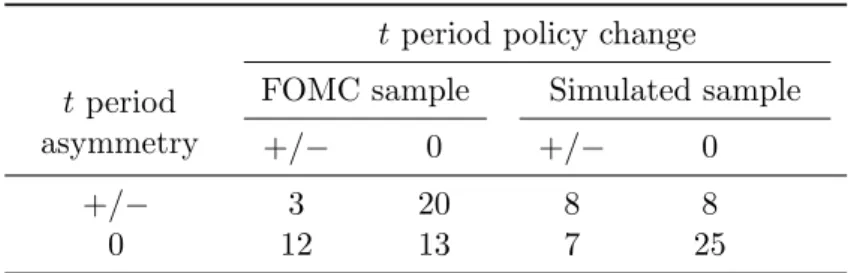
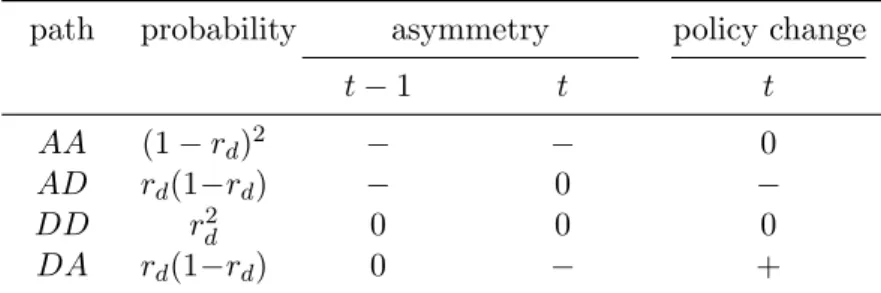
1.1 Predicting future policy changes hypothesis
t+ 1 period policy change and tperiod asymmetry . . . 56
1.2 Consensus building hypothesis
tperiod policy change andt period asymmetry . . . 57
1.3 Authoritarian regime
predicting future policy/consensus building hypothesis . . . . 58
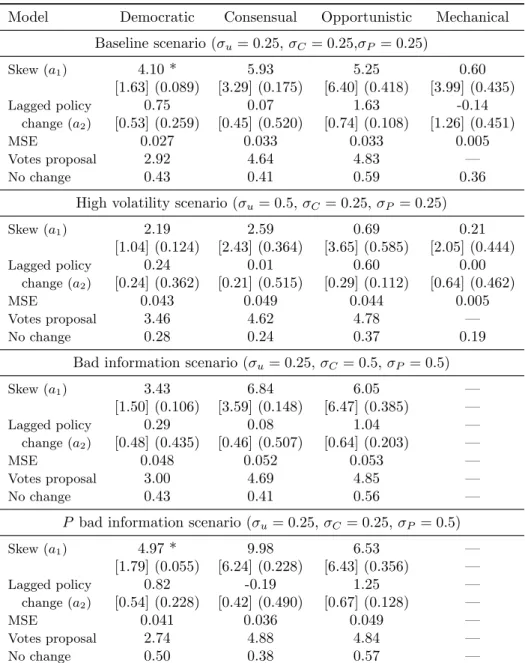
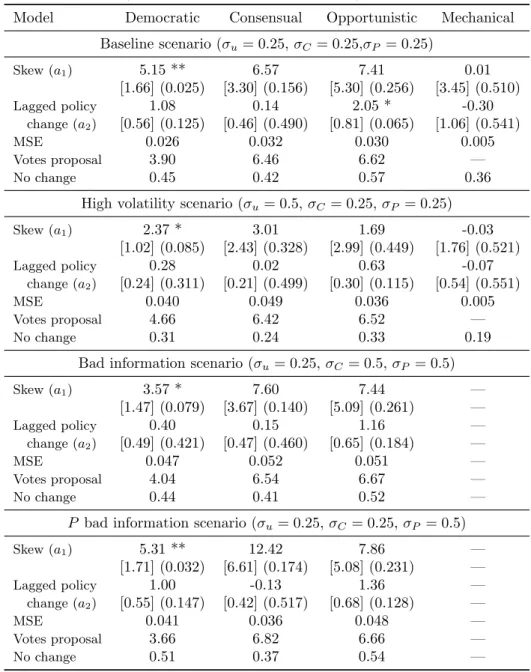
3.1 Does the Voting Record Predict Policy Rate Changes?
Estimates Using Simulated Data with N = 4 and ρ= 0.95
∆pt+1 =a0+a1skewt+a2∆pt+ut+1 . . . 166
3.2 Does the Voting Record Predict Policy Rate Changes?
Estimates Using Simulated Data with N = 6 and ρ= 0.95
∆pt+1 =a0+a1skewt+a2∆pt+ut+1 . . . 167
3.3 Does the Voting Record Predict Policy Rate Changes?
Estimates Using Simulated Data
∆pt+1 =a0+a1skewt+a2∆pt+ut+1 . . . 170
3.4 Does the Voting Record Predict Repo Rate Changes?
Baseline Estimates
∆it+1=b0+b1skewτ(t)+b2∆it+b3(iχ(t),L−iχ(t),S) +ut+1 . 180
3.5 Does the Voting Record Predict Repo Rate Changes?
Alternative Specifications - Different Maturities in Term Struc-ture and Uncertainty
∆it+1=b0+b1skewτ(t)+b2∆it+b3(iχ(t),L−iχ(t),S)+b4dispersiont+ ut+1 . . . 183
3.6 Does the Voting Record Predict Repo Rate Changes?
Alternative Specifications - Data until Financial Crisis Only ∆it+1=b0+b1skewτ(t)+b2∆it+b3(iχ(t),L−iχ(t),S) +ut+1 . 185
3.7 Does the Voting Record Predict Repo Rate Changes in the USA?
Chappell, McGregor, and Vermilyea (2005) Data for Burns and Greenspan Era
∆it+1=b0+b1skewτ(t)+b2∆it+b3dispersiont+b4committee biast+ ut+1 . . . 187
3.8 Does the Voting Record Predict Repo Rate Changes in the
USA?
Chappell et al. (2005) Data for Burns and Greenspan Era Skew for Alternate Members Added
∆it+1=b0+b1skewτ(t)+b2∆it+b3dispersiont+b4committee biast+ b5skew alternatest+ut+1 . . . 188
3.9 Does the Voting Record Predict Policy Rate Changes?
Estimates Using Simulated Data with N = 4 and ρ= 0.90
∆pt+1 =a0+a1skewt+a2∆pt+ut+1 . . . 200
3.10 Does the Voting Record Predict Policy Rate Changes?
Estimates Using Simulated Data with N = 6 and ρ= 0.90
∆pt+1 =a0+a1skewt+a2∆pt+ut+1 . . . 201
3.11 Does the Voting Record Predict Policy Rate Changes?
Estimates Using Simulated Data with N = 4 and ρ= 0.99
∆pt+1 =a0+a1skewt+a2∆pt+ut+1 . . . 202
3.12 Does the Voting Record Predict Policy Rate Changes?
Estimates Using Simulated Data with N = 6 and ρ= 0.99
∆pt+1 =a0+a1skewt+a2∆pt+ut+1 . . . 203
3.13 Does the Voting Record Predict Policy Rate Changes?
Estimates Using Simulated Data with N = 4 and ρ1 = 1.95,
ρ2 =−0.98
∆pt+1 =a0+a1skewt+a2∆pt+ut+1 . . . 204
3.14 Does the Voting Record Predict Policy Rate Changes?
Estimates Using Simulated Data with N = 6 and ρ1 = 1.95,
ρ2 =−0.98
∆pt+1 =a0+a1skewt+a2∆pt+ut+1 . . . 205
3.15 Does the Voting Record Predict Policy Rate Changes? Opportunistic Model with Simple Majority, Estimates Using
Simulated Data with N = 4
3.16 Does the Voting Record Predict Policy Rate Changes? Opportunistic Model with Simple Majority, Estimates Using
Simulated Data with N = 6
1.1 Equilibrium policy with implicit status-quo
π∗= 2, φ= 1, δ = 0.5, rd= 0.5 . . . 37
1.2 Equilibrium policy with explicit status-quo
π∗= 2, φ= 1, δ = 0.5, rd= 0.5 . . . 43
1.3 Equilibrium status-quo with explicit status-quo
π∗= 2, φ= 1, δ = 0.5, rd= 0.5 . . . 44
1.4 Long-run status-quo with explicit status-quo
average over 10.000 random 100 period long paths
π∗= 2, φ= 1, δ = 0.5, rd= 0.5 . . . 46
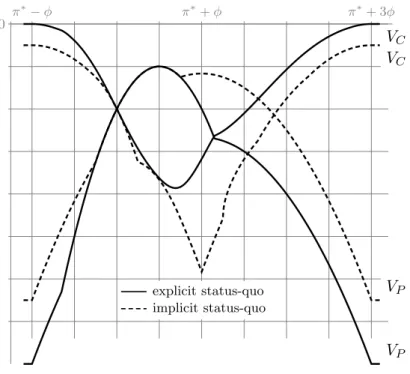
1.5 Equilibrium value functions
π∗= 2, φ= 1, δ = 0.5, rd= 0.5 . . . 48
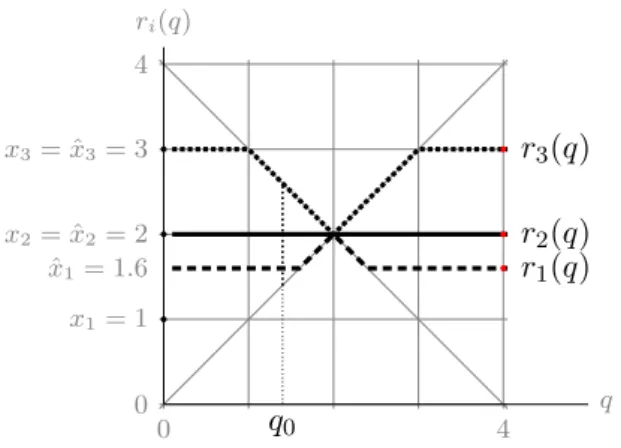
2.1 Conjectured equilibrium in Example 2.1 . . . 123
3.1 Simulated Policy Paths . . . 168
3.2 Actual Voting Record Skew and Future Policy Rate Change . 174
The common denominator of my thesis is recurrent group decision making.
A group of decision makers is repeatedly making the same type of decision. Once a decision is made in a given bargaining round it determines the
status-quo for the subsequent round. The resulting endogeneity of the status-quo makes the situation one of dynamic bargaining. The rationale for the
explicit modelling of such situations comes from an attempt to understand
the determination of policies that need to be continuously specified over time, such as central bank interest rates, tax rates or regulatory limits.
The dynamic bargaining literature, to which this thesis contributes, grew
from the original bargaining model of Rubinstein (1982) and its political economy application by Baron and Ferejohn (1989). Where the dynamic bargaining literature diverges from these papers is in assuming that reaching
a decision does not end the bargaining process, proceeding into a next period of typically infinite horizon interaction instead. What makes the interaction
dynamic, as opposed to repeated, is the endogeneity of status-quo. A current
decision is made against the status-quo determined by previous decisions and will in turn determine the status-quo in the future. Baron (1996) is among the first to analyse a model with these features.1
In this context, the first chapter focuses on the role of the bargaining protocol in the dynamic bargaining model with uncertainty regarding future
preferences of the actors involved. The chapter compares two bargaining
protocols: i) the implicit status-quo protocol under which present period policy serves as the status-quo for the next period and ii) theexplicit status-quo protocol under which the decision in the current period involves both current policy and a (possibly different) status-quo for the ensuing period. While the former bargaining protocol is standard in the dynamic bargaining
1
See chapter2for survey of the dynamic bargaining literature.
literature, the latter one and their comparison is the key novel feature. The chapter shows that the two bargaining protocols lead to notably
different policy outcomes, with the difference most marked in the periods
of common interest. These are still characterized by disagreement under implicit status-quo bargaining, while under explicit status-quo bargaining
lead to the policy decisions that fully reflect the congruent preferences of
the committee members. This result arises due to the dual role of policy under the implicit status-quo protocol. Policy serves not only as policy
but also determines the future status-quo and hence the bargaining position of committee members. The disagreement then arises even in periods of
common interest due to the possibility of future conflict. The explicit
status-quo protocol retains only the former role of policy with the policy decisions fully reflecting the common interests, when these arise.
A second difference arising from the two bargaining protocols is in the
evolution of bargaining power as captured by the status-quo. The explicit status-quo protocol allows the proposer, by giving her more flexibility in
crafting her proposals, to gain and retain the dominant position in the
com-mittee. Relative to implicit status-quo bargaining, this results in the policy outcomes that reflect, to a larger extent, the proposer’s preferences, policy
outcomes that are too extreme from the point of view of the committee as
a whole.
The differences in the policy outcomes also determine the answer to
a question on which of the two bargaining protocols would be chosen by a
committee of decision makers who know it would be used in their subsequent interaction, or by a utilitarian central planner. The chapter shows that the
explicit status-quo protocol is superior only if the initial status-quo gives
little bargaining power to the proposer, such that the benefits of the common interests being reflected in the decisions outweigh the costs of the proposer’s
dominance.
The second chapter shows how to construct equilibria in the dynamic bargaining model, with fixed preferences of the players involved and, in the
terminology of the previous chapter, with implicit status-quo bargaining protocol. For a similar model of bargaining over the share of a fixed-size
budget, this has been done byKalandrakis(2004), but for a model based on
Baron (1996) where the bargaining proceeds over a one-dimensional space
in the dynamic bargaining literature.
The bargaining proceeds over a space of policies with each player having
quadratic preferences defined around a bliss point, where the policy space
can be either one-dimensional as inBaron (1996) or multi-dimensional. In the absence of dynamic considerations the player recognized to be a
pro-poser would propose her bliss point and, given sufficiently adverse
status-quo, would have it approved by at least a minimum winning coalition of the remaining committee members. The chapter shows that in the same
situation, the player recognized to be a proposer proposes herstrategic bliss point, a policy between her and the median player’s original bliss points.
The exact position of the strategic bliss point for a given player depends
on the model parameters, such as the discount factor and the probability of being recognized as a proposer, but is shown to be the result of two
opposing forces. One force pushes the player into proposing policies close
to her original bliss point. The second and strategic force pushes the player in the opposite median player’s direction, in an attempt to propose policies
that constrain the future proposals of all the remaining players.
The chapter constructs an algorithm that calculates the strategic bliss points for a given model parametrization and shows how to use these to build
conjectured equilibrium strategies. It further derives two conditions, one
suf-ficient and one necessary, that the conjectured strategies need to satisfy in order to constitute an equilibrium. Both of these conditions are easy to check
as they consider only a finite set of points in otherwise continuous policy
space. Finally, the chapter works out several examples showing a number of interesting features that equilibria in the model may exhibit. These include
a subset of players behaving in a way indistinguishable from the behaviour
of the median player despite having different preferences, asymmetric equi-librium behaviour in otherwise symmetric environments and multiplicity
of equilibria possibly complicating their computational approximation that
typically relies on the uniqueness of the equilibrium being approximated. The third chapter is an application of the dynamic bargaining framework
to central bank decision making. In most modern central banks decisions to change or retain a given interest rate level is done by a group of decision
makers, the monetary policy committee. The committee meets in a recurring
status-quo for the next one.
The chapter builds on the observation made by Gerlach-Kristen (2004) for the Bank of England that a voting pattern from a given monetary
pol-icy committee meeting is informative regarding interest rate changes in the subsequent meetings. The chapter finds similar result in voting and
deci-sion making data from several other central banks and, from the theoretical
perspective, asks if it is possible to generate predictive power of the voting pattern in a formal group decision making model.
The model used posits a committee of decision makers making recurring decisions about policy, trying to match an unobserved time-varying optimal
policy that follows AR(1) process. Non-unanimous voting arises from the
committee members having private signals about the optimal policy and hence voting either for the status-quo or for the policy proposed by the
committee chairman. The alternative attracting (super-)majority of votes
then becomes status-quo for the subsequent committee meeting.
The chapter investigates three variants of the model that differ in the
degree of informational influence among the committee members. In the
democraticversion the influence is limited with committee members extract-ing no information from the chairman’s proposal and the chairman havextract-ing
no information regarding signals of the remaining committee members. In
the consensual version it is the chairman who has the informational influ-ence, with the other committee members extracting information from her
proposal, while in theopportunisticversion the influence works in the oppo-site direction, with the chairman having information about private signals of the other committee members.
Using computer simulations, the chapter generates decision making and
voting data from the three model versions and uses these in an econometric estimation akin to the one used with the real world data. The results suggest
that in order to generate predictive power of the voting pattern for the future
policy changes large degree of informational independence is needed, as in the democratic version of the model. The chapter further investigates the
effect of the noise in private signals, of the variability in the optimal policy and of the size of the committee, showing that the size can be used as a
substitute for quality of information in generating predictive power of the
Baron, D. P. (1996). A dynamic theory of collective goods programs. Amer-ican Political Science Review 90(2), 316–330.
Baron, D. P. and J. A. Ferejohn (1989). Bargaining in legislatures.American Political Science Review 83(4), 1181–1206.
Gerlach-Kristen, P. (2004). Is the MPC’s voting record informative about
future UK monetary policy? Scandinavian Journal of Economics 106(2), 299–313.
Kalandrakis, A. (2004). A three-player dynamic majoritarian bargaining game. Journal of Economic Theory 116(2), 294–322.
Rubinstein, A. (1982). Perfect equilibrium in a bargaining model. Econo-metrica 50(1), 97–109.
Explicit and implicit status-quo
de-termination in dynamic bargaining:
Theory and application to FOMC
directive
Several other members indicated that they would have preferred to tighten at that meeting. . . . The asymmetric directive, which held prospect of near-term tightening, once again allowed FOMC to reach a consensus.
Meyer(2004), page 83
And we know from firsthand accounts that Greenspan was holding back an FOMC that was eager to raise rates.
Blinder and Reis(2005), page 58
1.1
Introduction
We study recurring group decision making problems with the preferences
of the actors involved varying over time. As a leading example, consider periodic meetings of a monetary policy committee. In every period, the
preferences of each committee member will be affected by host of factors,
such as the state of the economy, his view of future economic development, his opinion about the strength of monetary policy transmission channels,
or judgment about the suitable inflation monetary policy should aim for.
Inevitably, most of those factors will change stochastically over time, opening the possibility for renegotiation of decisions reached at an earlier stage. Of
course, there are many other examples of recurring decision making with
varying preference, both in the economic and the political spheres.
With changing preferences of the involved parties, bargaining over a
decision at any given point in time will proceed under varying degrees of
disagreement. In the monetary policy committee case, ambiguity of infor-mation the committee holds can provoke disagreement over the most
appro-priate policy in some periods, but can lead to agreement in other periods
when the information becomes more definite. Uncertainty over the future then implies uncertainty about the extent of future disagreement as well.
Recurring decisions naturally create dynamic linkages that need to be
considered. First, strategic linkages arise due to the repeated nature of the interaction. The current action of any given decision maker will take into
account its possible impact on the future behaviour of the remaining
unattainable in static settings. This is analysed in the folk theorems liter-ature in general and in the political arena context in particular by Dixit,
Grossman, and Gul(2000) andMaggi and Morelli(2006). We abstract away
from these strategic linkages in recurring decisions by focusing on Stationary Markov Perfect equilibria.
Instead, we concentrate on the second type of linkages, procedural ones.
These involve the role past decisions play during the determination of sub-sequent ones. These linkages stem from the need to ensure continuity in
policy making. Protocols in place ensure that some policy is chosen even in the case of a decision not being reached.
The simplest of such protocols is the one under which a policy, once
established, becomes the status-quo for the ensuing round of bargaining. Inaction, no change in a given policy or contract, leaves the previous decision
in place. For example, in most countries personal income tax rates apply
until changed. Labour unions negotiate agreements with firms regarding wage and employment levels which are effective until renegotiated. In effect,
current policyimplicitly determines status-quo.
However, there are several prominent examples of decision processes that enlarge the space of current decisions to include provisions for the future.
These yield not only current policy but also explicitly determine a (poten-tially different) status-quo for the next round of negotiations. Legislative
sunset provisionsspecify a time horizon for the statute or regulation in ques-tion, after which it automatically terminates. These are often found in tax
laws or in laws impinging civil liberties, most prominently in the US Eco-nomic Growth and Tax Relief Reconciliation Act of 2001 and US Patriot
Act of 2001. Regulatory escape clauses are another example of the present policy and the status-quo being distinct.1
In this paper, we investigate decisions reached in recurring negotiations
with stochastically changing preferences of the actors involved. The
status-1
quo for a given round of bargaining is determined endogenously during the previous negotiations. We call the distinction between the new status-quo
being implicitly or explicitly decided uponbargaining protocol and ask how the bargaining protocol influences decisions reached.
We are motivated by normative, positive and theoretical questions. On
the normative side we analyse how the different bargaining protocols
influ-ence the ability of the committee to respond to the changing preferinflu-ences of the involved parties. The procedural linkages mentioned above imply that
the behaviour of each decision maker will reflect both current and future incentives. This might imply that even in ‘agreement’ periods,
character-ized by similar current preferences of the decision makers, their behaviour
might be driven by efforts to affect future decisions. We will show below that enlarging the space of current decisions to include provisions for the
future via the explicit status-quo bargaining protocol delivers policies
bet-ter tailored to changing circumstances. A potential downside of allowing for such provisions comes from the resulting increase in proposal power.
Con-sequently, from the utilitarian perspective none of the bargaining protocols
clearly dominates the other and we lay out conditions under which one or the other of them should be endorsed.
Our positive motivation builds on one of our motivating examples,
mon-etary policy committees. Monmon-etary policy in most central banks is decided upon by a committee composed of several members convening with regular
frequency. The policy usually consists of the bank’s operating target, its
interest rate. In most central banks the interest rate decided in a given committee meeting serves also as a status-quo for the next meeting.
Inac-tion leads to no change in monetary policy stance, hence the status-quo is
implicitly determined by a given decision.
In contrast, the Federal Open Market Committee (FOMC), the decision
body of the US Federal Reserve System, issues at the close of each meeting
operating instructions for the Federal Reserve Bank of New York known as the domestic policy directive. The directive contains not only the decision about current policy but also a statement concerning the FOMC’s expecta-tion of future policy stance. Viewing the ‘asymmetry’, ‘bias’ or ‘tilt’ in the
policy directive as explicitly specifying a status-quo policy possibly different
decision making process.2 Our model then suggests a novel rationale for the existence of the asymmetry.
The theoretical motivation is to advance growing dynamic bargaining
literature. While acknowledging endogeneity of the status-quo in recurring decision making situations, this literature has invariably assumed that the
status-quo is equal to the policy decision of the previous bargaining round.
While this is a natural assumption in many environments, some environ-ments might be more appropriately modelled as having an explicit
status-quo bargaining protocol. Our analysis of explicit status-status-quo bargaining is not only, to our knowledge, novel in the literature, but also highlights
differ-ences the two bargaining protocols bring by analysing them in an otherwise
identical model setup.
In the model, a committee composed of two members, one of whom
possesses fixed proposal power, takes repeated decisions on a policy from
a one-dimensional policy space over which each of the committee members has single peaked preferences represented by a bliss point. Every period is
randomly selected to be either an agreement or disagreement one, with only
the present period type being common knowledge. In agreement periods, the two members share a common bliss point whereas in the disagreement
periods the bliss points of the two members differ. While certainly a crude
simplification of the continuum on which conflict of preferences can take place, the agreement/disagreement dichotomy allows us to clearly illustrate
the effect of the bargaining protocol on policy outcomes.
Besides the period type, every committee meeting is characterized by a one-dimensional status-quo. Under the implicit status-quo bargaining
pro-tocol, the status-quo is pitched against a proposed policy with the
win-ning alternative being both the current policy outcome and the next period quo. Under the explicit quo bargaining protocol, the
status-quo is pitched against a joint proposal for a policy and a new status-status-quo. If
the committee selects the proposed pair, this proposal determines the cur-rent policy outcome and a possibly diffecur-rent future status-quo, otherwise,
the status-quo becomes both the policy implemented today and the future status-quo.
We first show existence and uniqueness in a certain well defined sense
2
of Stationary Markov Perfect equilibrium (S-MPE) under both bargaining protocols (propositions1.1 and 1.4). The lack of general S-MPE existence results and typically ill behaved induced preferences over the ‘state’
vari-able in dynamic bargaining models (Baron,1996;Baron and Herron,2003;
Kalandrakis, 2004; Duggan and Kalandrakis, 2012) make this a nontrivial
exercise and we are forced to work with induced preferences that typically
lack monotonicity, concavity and continuity. Adding further stochastic el-ements would allow us to use existing results on existence of S-MPE in
dynamic bargaining context.3 We refrain from doing so, limiting general-ity of our results to cases of sufficiently but not excessively strong conflict
between the two players. On the other hand, this allows us to characterize
equilibria of the model to a greater extent.
For the implicit status-quo bargaining protocol, we show that in
equilib-rium negotiations display inefficiency in agreement periods; the committee
members are unable to agree on a policy corresponding to their common bliss point (proposition 1.2). The intuition for this result is the dual role of policy under the implicit status-quo bargaining protocol. Policy serves
not only as policy but also determines the future status-quo. Moreover, we show that bargaining quickly reaches a point of gridlock, with the
pol-icy outcomes unresponsive to changing preferences (proposition 1.2). Once in gridlock, the two players have antithetic preference over policy even in agreement periods, as it determines the future status-quo and affects their
future bargaining positions. Explicit status-quo bargaining reverses both of
these results. In equilibrium, it leads to the policy outcomes corresponding to the common committee members’ bliss point in the agreement periods
(proposition 1.3) and does not lead to the gridlock as the policy outcomes remain responsive to the changing preferences of the committee members (proposition1.5).
One possible side effect of explicit status-quo bargaining comes from
the increase of proposal power relative to implicit status-quo bargaining. Allowing for proposals with different policy and status-quo creates room
for the proposer to push through policies fully reflecting her preferences. Those are too extreme for the rest of the committee and the committee as a
3
whole might prefer different bargaining protocols in different environments (proposition1.6).
Finally, we show that these results carry over to a committee composed
of an odd number of members with preferences similar to those in the bench-mark model (proposition1.7). This allows us to shift attention to the FOMC decision making process and examine the role of the asymmetry in its
direc-tive. We focus mainly on its role as a predictor of future policy changes and as an instrument to achieve more consensual FOMC decisions. Our model
delivers these two predictions and also suggests a novel explanation for the existence of the asymmetry as a tool which allows the FOMC chairman to
maintain his dominant position in the committee.
The model we build belongs to the dynamic bargaining literature that assumes that the status-quo during a given round of bargaining is
endoge-nously determined during previous bargaining rounds. Differently from most
of the existing literature (Baron,1996;Baron and Herron,2003;Kalandrakis,
2004;Bernheim, Rangel, and Rayo,2006;Battaglini and Coate,2007;Baron,
Diermeier, and Fong,2012;Battaglini and Palfrey,2012) we focus on an
en-vironment with stochastic preferences and abstract from distributional issues analysed in many of the mentioned papers.
Despite its obvious appeal, the dynamic bargaining literature with
time-varying preferences is rather scarce. Battaglini and Coate (2008) build a dynamic model of legislative bargaining with general and targeted public
spending. In their model, the status-quo is fixed but the intertemporal link
is created by accumulated public debt while the time-varying preferences stem from a stochastic value of general public spending. Diermeier and Fong(2009) build a similar model. Riboni and Ruge-Murcia(2008) analyse a model similar to ours with the implicit status-quo bargaining protocol. They analytically solve the two period version of their model and resort
to numerical simulation of the infinite period version. Dziuda and Loeper (2010) also analyse a model closely related to ours with the implicit status-quo bargaining protocol. In their model, a two member committee takes
repeated decisions over a binary agenda with the preference parameter of each of the committee members being a continuous random variable
dis-tributed on the real line. In our model, it is the preference parameter that
current decisions to include provisions for the future changes policy out-comes and ability of the committee members to renegotiate in the changing
environment, something our explicit status-quo bargaining protocol does. It
is the comparison between the two bargaining protocols or institutions we are interested in.
Another strand of literature related to this paper is the literature
in-vestigating the effect of linking decisions. In Jackson and Sonnenschein (2007) agents are constrained to represent their preferences across decision problems such that the representation corresponds to the underlying distri-bution of their preferences. The main result of their paper is that linking
large numbers of decisions leads to approximate ex ante Pareto efficiency. In
Casella(2005) agents can store their votes and use them in future meetings
when their preferences are more intense. This typically leads to ex ante
welfare improvement over non-storable votes. Hortala-Vallve (2010) proves similar result in a setting where agents can distribute a given number of votes freely across a predetermined number of issues. The first mentioned
paper improves efficiency by putting constraints on the misrepresentation
of preferences allowed for, while the two latter papers improve efficiency by relaxing the one-person-one-vote constraint. In the context of this
lit-erature, our explicit status-quo bargaining protocol, by relaxing the ‘policy
equal to status-quo’ constraint, can be viewed as relaxing constraint on the committee decision making but also as removing constraint on the proposal
power.
We proceed as follows. The next section lays out the theoretical model. Section 1.3 solves for the equilibrium in a two period version. It is meant to build intuition for the infinite horizon version and to show that the key
results are not sensitive to changes in the foresight horizon. Section 1.4 contains all the theoretical results. These describe equilibria for both of the
bargaining protocols, discuss conditions under which one of them should be
1.2
Model
We analyse the effect of bargaining protocol on dynamic policy making in
a simple model. Policies in the model are set by a committee composed of two members. The first member is the chairman, who has policy proposal
power and whom we denote byC (she). The second committee member is denoted byP (he) and has policy approval power. The voting rule used by
the committee is simple majority with ties decided againstC’s proposal so
that in order forC’s proposal to pass, consent of both committee members is required.4
The committee sets policyptin each periodtof an infinite horizon. The
utility playeri∈ {C, P}receives from the path of policiesp={p0, p1, p2, . . .}
is given by
Ui(p) = ∞ X
t=0
δtui,t(pt)
whereδ ∈[0,1) is common discount factor. Instantaneous utility ui,t(pt) of
each player is
ui,t(pt) =−(pt−π∗−εi,t)2
where π∗ is a common component in the committee members’ preferences and εi,t is a stochastic time-varyingi−specific preference shock.
The timing of actions in periodt is as follows. First, nature determines
εi,t according to the process specified below and the committee convenes
withxt being the default option. Both εi,t and xt are common knowledge.
Second, the chairmanC proposes a pair γt={pt, qt}against default option
¯
γt ={xt, xt}. Third, voting takes place between γt and ¯γt. If P prefers γt
it is implemented (C always votes for her proposal), players receive their
payoffs from the offered policy pt and the offered status-quo qt becomes
default option for the next period, i.e. xt+1 = qt. If P prefers ¯γt, players
receive their payoffs from the default policy xt and the default status-quo
xt becomes default option for the next period, i.e. xt+1 = xt. Finally, the
committee adjourns and the game moves into periodt+ 1.
In the text we refer to the pair γt = {pt, qt} C proposes as to (C’s) proposal or offer, call its first element pt proposed (offered) policy and its
4 An alternative assumption that would not change any of the results isC making a
second element qt proposed (offered) status-quo. The pair ¯γt = {xt, xt}
is then default option or simply default and we abuse notation slightly in calling xt by the same term.
Without loss of generality we assume that C whose utility maximizing offerγtcoincides with the default option ¯γtproposes ¯γtinstead of proposing
a policy she knows would be rejected. It is also easy to see that in any
equilibrium of the game it has to be the case that ifP is indifferent between default ¯γt and C’s proposal γt he votes for γt. As a result C’s offer γt is
always accepted and we do not need to distinguish between proposed and accepted policies.
Up to this point the model generates dynamic policy making in that
the proposed (and hence accepted) status-quo qt from period t becomes
the default option xt+1 for the t+ 1 period. To study how this feature
interacts with the bargaining protocol used by the committee, we contrast
two versions of the model. The first model version and bargaining protocol is with implicit status-quo. Under this bargaining protocol C’s proposals are constrained to those that satisfypt=qtso that the tperiod status-quo
qt, and hencet+ 1 period default optionxt+1, is implicitly defined by thet
period policypt. The second model version and bargaining protocol is with explicit status-quo. Under this bargaining protocol t period status-quo qt,
and hence t+ 1 period default optionxt+1, is explicitly determined during
the committee bargaining.
To close the model we need to specify the distribution of the preference
shocksεi,t. We assume those are generated according to
εi,t= (
−φfori=C and φfori=P with probability rd
0 for i∈ {C, P} with probability 1−rd
whereφ >0 andrd∈[0,1]. In words, there are two types of periods. With
probability rd bliss points in the instantaneous utility functions of C and
P are π∗−φ and π∗+φ respectively. We call those disagreement periods orD periods for short. The second type of period occurs with probability
1−rd and are called agreement periods or A periods for short. In these,
bliss points in the instantaneous utility functions of both players areπ∗. Several comments regarding our modelling choices are in order. First,
the proposal power to C is motivated by our interest in the trade-off the explicit status-quo bargaining protocol creates. On the one hand, it should
lead to more efficient policy outcomes, but it also opens the door to an abuse
of proposal power. We want to see the full effect on both sides and thus opt for arguably strong assumptions.
Second, having A and D periods in the model reflects our belief that
in recurrent decision making this is a natural assumption. We could have chosen either purely ideological or purely common preferences, which our
model indeed includes as special cases with rd = 1 or rd = 0. However, it
is easy to show that under both specifications the bargaining protocol plays
no role. It is the interaction with the time varying preferences that creates
an interesting problem to study.
1.3
Two period model
To build intuition for the results below, we first solve a two period version of the model. All the results are easily derived using backward induction
and we state them without formal proofs.
Lemma 1.1 (Last period). For the last period default option x1 and both bargaining protocols, equilibrium policy proposals pA,1(x1) and pD,1(x1), in
A and D periods respectively, satisfy
pA,1(x1) =π∗
pD,1(x1) =f(x1, φ)
where f(x, φ) = max{min{2(π∗+φ)−x, x}, π∗−φ}.
In the last period there is no procedural link with the future via the status-quo and hence the bargaining protocol plays no role. It is thus easy
to see why the two policy makers decide on π∗ inA periods as it is a bliss
point in their common utility function.
D period policy then reflects conflict in the committee. P’s acceptance
set consists of a symmetric interval around his bliss point π∗+φwith one
boundary given by default optionx1, [2(π∗+φ)−x1, x1]. C maximizes her
utility with bliss point at π∗−φ by proposing minimum of P’s acceptance
(the min term) but only if she cannot propose her bliss point (the max
[π∗−φ, π∗+φ], there is no other policy except forx1 the two policy makers
are willing to agree on. P would reject any policy belowx1 andC does not
want to offer any policy abovex1 and thus f(x1, φ) =x1.5
C’s and P’s expected utilities before nature determines the type of last period, as a function of x1 (and hence as a function of the first period
status-quo),
E[UC,0(x1)] =−rd(pD,1(x1)−π∗+φ)2+ (1−rd)·0
E[UP,0(x1)] =−rd(pD,1(x1)−π∗−φ)2+ (1−rd)·0,
reflect intertemporal preferences of the two policy makers and are
inter-esting for several reasons. First, both are non-concave and non-monotone.
E[UC,0(x1)] and E[UP,0(x1)] are non-increasing and non-decreasing
respec-tively for x1 ≤ π∗ +φ and vice-versa for x1 ≥ π∗ +φ. This is the reason
why we cannot work with equilibria associated with well-behaved (concave, monotone) value functions as in, for example, Battaglini and Coate (2007, 2008), as the ill-behaved intertemporal preferences are an inherent feature of the model.
Second, potential future conflict spills over to the current period through
the conflict in the intertemporal preferences. P prefers default optionx1 as
close to π∗+φ as possible while C prefers it as far away from π∗+φ as
possible. Thus the committee members have an incentive to manipulatex1
in the first period as it determines their bargaining positions. Under implicit status-quo bargaining this is done via the enacted policy and under explicit
status-quo bargaining this is done via the enacted status-quo.
Third,E[UC,0(x1)] andE[UP,0(x1)] are constant forx1 ∈/(π∗−φ, π∗+3φ).
For the first period under explicit status-quo bargaining this means that
whenever z /∈ (π∗−φ, π∗+ 3φ) is an equilibrium status-quo proposal for
some default option, so is z0 ∈/ (π∗−φ, π∗+ 3φ). However, this multiplicity has no effect on the last period policy. No matter whether z or z0 is
pro-posed, last periodP’s acceptance set includes, on a policy dimension unique,
unconstrained maximizer of C’s overall utility.
5Notice also that the interval wheref(·,·) is not constant, the interval of default options
Lemma 1.2(First period,D). For the first period default optionx0, implicit status-quo protocol policy proposal pID,0(x0) and explicit status-quo protocol policy and status-quo proposalspED,0(x0) and qD,E0(x0) in D periods satisfy
pID,0(x0) =pED,0(x0) =qED,0(x0) =f(x0, φ).
For the implicit status-quo protocol this reflects conflict in terms of
both current and intertemporal preferences. The same holds for the ex-plicit status-quo, but C can, in principle, offer a policy different from the
status-quo. To see the nature of her trade-off, C can either concede on the
policy dimension in order to gain a better bargaining position on the status-quo dimension, or vice versa. The strength of those two forces, to satisfy
instantaneous or intertemporal utility, then determines her equilibrium
pro-posal. As we will see below, the two forces exactly cancelling each other, which leads to pED,0(x0) = qD,E0(x0), is a result specific to the two period
model.
Lemma 1.3 (First period, A). For the first period default optionx0, equi-librium policy proposal under the implicit and explicit status-quo protocol,
pIA,0(x0) and pEA,0(x0) respectively, in A periods satisfy
pIA,0(x0) =f(x0, φκ0)
pEA,0(x0) =π∗
where κ0 = δrd
1+δrd ≤
1 2.
First A periods reveal the key difference between the two bargaining
protocols. Under the implicit status-quo bargaining, policy serves two roles.
It is a policy in the standard sense but also determines future bargaining positions. Agreeing on π∗ in A period would entail, at least for one of the
players, giving up bargaining position relative to x0. Combining current
preferences favouring π∗ and intertemporal preferences favouring π∗ −φ
(π∗+φ) for C (P) makes A periods ‘lesser disagreement’ periods with the
degree of conflict given byφκ0. The more probable the true D periods are
and the more players care about future, the more of the conflict spills over toAperiods.
Explicit status-quo bargaining on the other hand implies π∗ is
policy dimension and, crucially, with the policy and status-quo possibly different, C does not compromise her bargaining position by proposing π∗
policy. To the contrary, this allowsC to propose status-quo that improves
her bargaining position. She has a room to do so since proposingπ∗ on the policy dimension has madeP better off compared to the default option x0.
A key advantage of the two period model just discussed is that it delivers
key predictions about the difference in policy outcomes under the two bar-gaining protocols in a relatively simple framework. On the other hand, with
a fixed time horizon we are unable to discuss the evolution of policies in the long-run, and the fixed horizon also raises concerns about robustness of the
results presented. For this reason we turn to the infinite horizon version of
the model next.
1.4
Infinite horizon model
This section solves the infinite horizon dynamic bargaining model for the two
bargaining protocols. For technical reasons we restrict the proposal space along any dimension to lie in a convex compact subset X of R. Hence for
bothC’s proposals and default options, we haveγt,¯γt∈X2 ⊆R2. However,
it will become apparent from the model equilibria below that withX taken to be ‘sufficiently large’, this assumption is without loss of generality.
We focus on Stationary Markov Perfect Equilibria (S-MPE) where strate-gies in a given period depend only on the type of that period and on the
default option for that period, i.e. only on payoff relevant variables.
Focus-ing on the S-MPE we can drop all time subscripts. We denote byx∈X the default option for a given period with the understanding that it is composed
of a default policy status-quo pair ¯γ(x) ={x, x} ∈X2. Any policy is always denoted by (appropriately subscripted)p∈X and any status-quo is always denoted byq ∈X.
For this model, S-MPE will be a combination of several components. For
C, we are looking for four functions, two of them mapping the space of de-fault optionsXinto proposed policies for each type of period,pD(x), pA(x) :
X2→X, and the remaining two mappingX into the proposed status-quo,
qD(x), qA(x) : X2 → X. Formally, ρC = {pD(x), pA(x), qD(x), qA(x)} :
i ∈ {A, D} and default option x maps the combination of ¯γ(x) and γi(x)
into his vote, hence it is a mapping ρP :X8 → {yes,no}2.
It has to be acknowledged that our definition ofρC andρP does not allow
for mixed strategies. ForP this is driven by the already mentioned fact that in any equilibrium P’s voting strategy has to be to vote for C’s proposal
γi(x) whenever indifferent betweenγi(x) and ¯γ(x) fori∈ {A, D}. ForCthe
reason behind focusing on pure strategies is twofold. First, we have assumed above thatC whose utility maximizing proposal coincides with the default
option ¯γ(x) indeed proposes ¯γ(x) instead of coming up with a proposal she knows would be rejected. Second, below we focus on a certain class of
equilibria (see definition 1.3) for which it will be true that C’s indifference among K proposals{γi1(x), . . . , γiK(x)} for some default option x ∈X and
i ∈ {A, D} will imply indifference by P among the same proposals. As a
result, in case ofC’s indifference between two or more proposals we can pick
oneγki(x) out of{γi1(x), . . . , γiK(x)} without changing the equilibrium (via changing the equilibrium value functions defined below) and hence we can
think ofρC as a function instead of thinking of ρC as a distribution onX4.
With this qualification in mind, our definition of S-MPE is as follows.
Definition 1.1(Stationary Markov Perfect Equilibrium). A pair of strate-giesρ∗ ={ρ∗C, ρ∗P} constitutes S-MPE if it constitutes subgame perfect equi-librium.
Notice that any given pair of strategies ρ = {ρC, ρP} for given x and
given path of A and D periods generates a unique path of implemented
policies {p0, p1, . . .}. Taking expectations over all possible paths gives a
continuation value function for each policy maker who knows x but does
not know whether the next period will be anA orDone,
VCρ(x) =E
"∞ X
t=0
−δt(pt−π∗+φID(t))2 #
VPρ(x) =E
"∞ X
t=0
−δt(pt−π∗−φID(t))2 #
where ID(t) is D-period indicator function and the superscript ρ captures
these can be equivalently derived as
VCρ(x) =rd
−(pD(x)−π∗+φ)2+δVCρ(qD(x))
+ (1−rd)
−(pA(x)−π∗)2+δVCρ(qA(x))
VPρ(x) =rd
−(pD(x)−π∗−φ)2+δVPρ(qD(x))
+ (1−rd)
−(pA(x)−π∗)2+δVPρ(qA(x))
.
Finally, we denote by Aρi(x) P’s acceptance set in period i ∈ {A, D} given default optionx and strategies ρ. The acceptance sets are given by
AρD(x) ={{p, q} ∈X2| −(p−π∗−φ)2+δVPρ(q)≥ −(x−π∗−φ)2+δVPρ(x)}
AρA(x) ={{p, q} ∈X2| −(p−π∗)2+δVPρ(q)≥ −(x−π∗)2+δVPρ(x)}
and both are nonempty as ¯γ(x)∈Ai(x) for i∈ {A, D}.
With this notation, C’s problem can be restated in terms of a pair of
the usual Bellman functional equations
UDρ(x) = max
{p,q}∈AρD(x)
{−(p−π∗+φ)2+δrdUDρ(q) +δ(1−rd)UAρ(q)}
UAρ(x) = max
{p,q}∈AρA(x)
{−(p−π∗)2+δrdUDρ(q) +δ(1−rd)UAρ(q)}
(1.1)
where C’s continuation value function VCρ will be the probability-weighted sum of the value functions of the two optimization problems, i.e. VCρ =
rdUDρ + (1−rd)UAρ. An alternative definition of S-MPE that exploits the
recursive structure of the model and that we use is the following.
Definition 1.2(Stationary Markov Perfect Equilibrium). A pair of strate-gies ρ∗ = {ρ∗C, ρ∗P} constitutes a S-MPE if for all x ∈ X and any period
i∈ {A, D}
1. C’s proposal strategy ρ∗C solves (1.1)
2. P votes for C’s proposal γi(x) if and only if γi(x)∈Aρ
∗
i (x).
An equivalent way to express the requirement of the S-MPE is to say we
are looking for ρ giving rise to VCρ and VPρ such that when C and P max-imize their utility in the current period, their optimal behaviour is indeed
expressed as ρ. If we can find such a ρ then by the one deviation principle
we have an equilibrium.
Below, when we discuss S-MPE for the two bargaining protocols, it will
become apparent that many of them satisfy an additional restriction in P
C’s offer, provided C’s proposal differs from the unconstrained maximizer of her overall utility. Another way to view this is that as long as the default
option x providesP with any real bargaining power,C’s proposal will
pro-vide him with the minimum utility sufficient for her proposal to pass. We call S-MPE satisfying this feature Conflict S-MPE (CS-MPE). Denoting by
γCDρ and γCAρ solutions to the two optimization problems in (1.1) when the restrictions on {p, q} to lie in P’s acceptance sets are removed, CS-MPE is defined as follows.
Definition 1.3 (Conflict Stationary Markov Perfect Equilibrium). A pair of strategies ρ∗ ={ρ∗C, ρ∗P} constitutes a CS-MPE if for all x∈X and any periodi∈ {A, D}
1. ρ∗ constitute a S-MPE
2. P is indifferent between γi(x) and γ¯(x) provided γCi∈/ Aρi(x).
Our focus on CS-MPE has another rationale as it can be viewed as a
fo-cus on equilibria with the minimum winning coalition property. Whenever
C is constrained by the other committee member her proposal will make
P indifferent between accepting and rejecting. Assuming P is a median member of some larger committee with C’s proposal accepted if and only
ifP accepts, something we show in the context of larger committee in the
proposition1.7below, CS-MPE will imply C establishes minimum winning coalitions supporting her proposals. This is reminiscent of the result by
Dug-gan and Kalandrakis (2012) (see part 4 of their theorem 1) who show that
minimum winning proposals are a natural feature of equilibria in dynamic bargaining models.6
From here on we focus on the equilibrium strategies and we drop the
superscript ρ whenever the chance of confusion is minimal. Finally, for the bargaining protocol with implicit status-quo all results of this section
additionally require any policy status-quo pair to have both of its elements
equal.
6 Formally the game just described can be viewed as a mapping from a pair of value
Equilibrium with implicit status-quo
In this section we prove equilibrium existence and uniqueness result for the
bargaining protocol with implicit status-quo. We then discuss predictions of the equilibrium about the evolution of policies under implicit status-quo
bargaining.
Proposition 1.1(S-MPE with implicit status-quo). Assumeδ2rd(3−2rd)≤
1−δ(1−rd). Then there exists unique CS-MPE. Equilibrium proposals sat-isfy
pD(x) =qD(x) =max{min{z∈X|z∈AD(x)}, γCD}
pA(x) =qA(x) =max{min{z∈X|z∈AA(x)}, γCA}
for ∀x∈X, where γCD =π∗−φ andγCA =π∗−φδrd. Proof. See appendix1.A1.
In words, for a given type of period i ∈ {A, D} and default option x,
C proposes the lowest policy out of P’s acceptance setAi(x), provided the
policy that is an unconstrained maximizer of her overall utility would be rejected, that is providedγCi ∈/Ai(x).
The strategy of the proof follows. Existence follows by construction. We
conjecture that the construction will give us a CS-MPE which allows us to deriveP’s continuation value functionVP and hence his acceptance setsAA
andAD. Given the acceptance sets we conjecture thatC’s proposal strategy
will be the one given in the proposition allowing us to derive her continuation value functionVC. Having the proposal strategy we note it indeed generates
VP and we confirm strategies generated byVP and VC satisfy definition 1.3
showing that the construction is CS-MPE.
To prove uniqueness of the CS-MPE, we note that it has to generate a
uniqueVP. What we then need to show is uniqueness of the solution toC’s
dynamic optimization program (1.1) given acceptance sets generated byVP.
We show this using an extended version, which we prove, of the theorem
guaranteeing existence and uniqueness of solutions to Bellman functional
equations from Stokey and Lucas(1989).
The assumption on {δ, rd} in proposition 1.1 ensures existence of the
CS-MPE equilibrium. The assumption can be alternatively expressed as
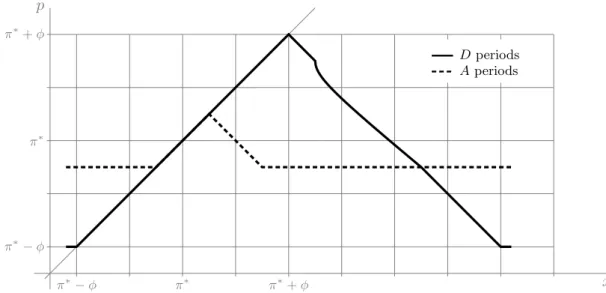
Figure 1.1: Equilibrium policy with implicit status-quo
π∗ = 2, φ= 1, δ= 0.5, rd= 0.5
x p
π∗+φ
π∗+φ π∗
π∗ π∗−φ
π∗−φ
Aperiods
D periods
effect we are ruling out cases where the ‘future looms large’ asδ approaches
unity. When this happens the requirement onC’s proposals under CS-MPE,
to bring P to indifference between accepting and rejecting when unable to propose the unconstrained maximum of her overall utility, might fail in D
periods. Intuitively, with δ large C focuses primarily on her bargaining
position captured by the VC function when determining which policy to
propose. With the VC function non-monotone, C might propose a policy
strictly inside AD, in effect disregarding her instantaneous utility. When
this happen the equilibria become cumbersome to characterize due to non-continuity of VP so that we rule those cases out by assumption.
To see how the equilibrium from proposition1.1looks in graphical form, figure1.1shows a particular parametrization forπ∗= 2, φ= 1, δ= 0.5, rd=
0.5. While proving proposition 1.1we show that depending on the values of
δ and rd, the equilibrium falls into one of four (mutually exclusive) cases.
For all four of those cases the A period proposed policypA(x) has exactly
the same shape as the one given in the figure, with the constant part given
byγCA evaluated at particular values of{δ, rd}.
However, there are case dependent differences regarding the shape of the
constant and then linear increasing part for low values of x. Nevertheless, the default option x for which pD(x) reaches a maximum in general differs
depending on the values ofδ andrdand the ‘right’ part ofpD(x) (decreasing
part in figure 1.1) is not necessarily monotone or even continuous. One common feature is that it eventually decreases to γCD where it becomes a
constant function again.
Figure1.1(and proposition1.1) shows that the equilibrium shares several features with the equilibrium in the two period version of the model. It is a
CS-MPE,P is indifferent between accepting and rejecting unlessCproposes the unconstrained maximizer of her utility. Furthermore, A periods are in
effect lesser disagreement periods with degree of conflict captured by φδrd
and the committee members are failing to agree onπ∗, common bliss point in their instantaneous utility functions. Basic intuition for this result is again
the dual role of policy under the implicit status-quo bargaining, it enters
policy makers’ instantaneous utility while at the same time determining their bargaining position. On the other hand it is the Aperiods during which C
forgoes her bargaining position. By proposing pA(x) closer to π∗ relative
to the default option x, she compromises her intertemporal preferences in exchange for the current ones. Dperiods are then truly disagreement periods
and C is fully using her proposal power to steer policy towards her most
preferred one.
In order to discuss the long-term policy outcomes generated in
equilib-rium, we find it helpful to define a set of default options x which, when
reached, implies a constant path of default options irrespective of the type of period. Constant default options then imply policies alternating between
two (not necessarily) different values, one forAperiods and the other forD
periods. We call such a set a set ofstable default options and define it along with two notions of efficiency in the following definition.
Definition 1.4 (Stable default options and efficiency). Set S ⊆X defined by
S ={x∈X|qA(x) =qD(x) =x}
is called set of stable default options (stable set). We say bargaining displays A-efficiency whenever
We say bargaining displays D-efficiency if
pD(x) =p∗
for some p∗ ∈[π∗−φ, π∗+φ] acrossD periods.
The rationale behind the definition of stable set is that once the
bar-gaining reaches x ∈ S, resulting status-quo outcomes are constant forever for any path ofAandDperiods. If additionally we have pA(x) =pD(x) for
all x∈S we can say that the bargaining outcomes are unresponsive to the changing preferences of the committee members.
Our notion of efficiency then comes from a static Pareto efficient
mech-anism implementing an infinite sequence of policies in the current environ-ment. As we show in appendix1.A2, such a mechanism implementsπ∗ inA
periods andp∗∈[π∗−φ, π∗+φ] in Dperiods. The notion ofA-inefficiency
whenever pA(x) 6= π∗ comes from the fact that the policy makers fail to
agree on their current-period most preferred policyπ∗ due to their concerns
about their bargaining position in the future. GivenAperiod and defaultx
such that pA(x)6=π∗, if they could sign a binding contract specifying that
the next period default option will bexirrespective of today’s policy (which
they would set to π∗), both of them would be made better off. The notion
ofD-inefficiency on the other hand stresses the fact that both policy makers have a preference for policy smoothing. Finally, note that our notion of
A-efficiency looks at eachAperiod individually whileD-efficiency compares
policy decisions reached in different Dperiods.
Discussing equilibrium policy outcomes is further complicated by the fact
that those will in general depend on the default x with which bargaining
starts and on the path ofAandDperiods which is stochastic. Nevertheless, denoting byxt(x)∈X the default option aftertperiods of equilibrium play starting with default option x and some path of A and D periods, the
following proposition captures the key features.
Proposition 1.2 (Policy outcomes with implicit status-quo). CS-MPE from proposition1.1generates policy and status-quo decisions satisfying fol-lowing.
2. If x∈S thenpA(x) =pD(x)∈[π∗−φδrd, π∗+φδrd]
For initial default option x0 being continuous random variable with pdf
f(x0) defined onX, for anyt= 1,2, . . .
3. Rx
0∈XP(x
t(x
0)∈/S)f(x0)dx0 ≤rtd
4. Rx
0∈XP(pA(x
t(x
0)) =π∗)f(x0)dx0= 0 unless rd= 0. Proof. See appendix1.A1.
Recalling the equilibrium in figure 1.1the intuition behind the result is straightforward. For any default option x ∈ S we have policies constant not only in Dperiods (part one) but also in A periods (part two). For the
third part, for any default optionxinAperiod, policy and hence status-quo
reachesS immediately and can stay out ofS only for the path ofDperiods with the probability oftconsecutiveDperiods beingrtd. The last part then comes from the fact that the set of default options in X that can bring π∗
as a policy outcome in the future for some combination ofAand Dperiods has zero measure.
What proposition 1.2 says is that in CS-MPE from proposition1.1 un-der the bargaining protocol with implicit status-quo, bargaining outcomes eventually become stable for any distribution of initial default option (part
three). When this happens the policy outcomes display D-efficiency (part
one) on the one hand but become unresponsive to the changing preferences of the two policy makers on the other (part two) with the policy constant
henceforth. At the same time, unlessrd= 0 for any distribution of initial
de-fault option the chance that the bargaining satisfiesA-efficiency is zero both
on the path toS and once it is reached (part four). In other words, in the
CS-MPE under the implicit status-quo bargaining there is no equilibrium force that would bring the bargaining outcome eventually toA-efficiency.
Equilibrium with explicit status-quo
We now show how policy outcomes change when C’s proposals are not
re-stricted to those with policy and status-quo equal. The first result we prove is that policy in A periods is equal toπ∗ for any default option. The logic
behind the result is that since in the A periods the preferences of the two
they should not be able to reach an agreement onπ∗, as doing so needs not compromise their bargaining position embodied in status-quo. The intuition
is confirmed by the proposition.
Proposition 1.3 (pA(x) with explicit status-quo). In any S-MPE for any default option x∈X
pA(x) =π∗.
Proof. See appendix1.A1.
A key strength of proposition 1.3is that it applies to any S-MPE under the explicit status-quo bargaining protocol and shows that this bargaining
protocol allows the committee members to reach consensus in A periods.
What the proposition does not ensure is existence of such S-MPE, which is what the next proposition does.
Proposition 1.4 (S-MPE with explicit status-quo). Assume δ ≥ 1 5rd, δ ≥ 1−rd2 and δ≤1−(1−rd)2
2 . Then there exists a unique CS-MPE in terms of associated value functions VC andVP. Equilibrium proposals satisfy
1. pA(x) =π∗ for ∀x∈X
2. VC(x)≤VC(qA(x))for ∀x∈X
3. VC(qD(x))≤VC(qD(x0))for x, x0 ∈X satisfying AD(x)⊆AD(x0) 4. C proposes γCD (γCA) for ∀x ∈ X such that γCD ∈ AD(x) (γCA ∈
AA(x))
where γCD = {π∗ −φ, z} and γCA = {π∗, z0} for some z, z0 ∈ X\(π∗ −
φ, π∗+ 3φ).
Proof. See appendix1.A1.
In words, equilibrium under explicit status-quo bargaining involves
pol-icy equal to π∗ in A periods (part one) withC using A periods to improve her bargaining position (part two). BecauseC can improve her bargaining
position inA periods, she is willing to surrender more of it in D periods in
whichP has more bargaining power (part three). Finally,C’s unconstrained proposals areγCA and γCD inA and D periods respectively, implementing
C’s instantaneous utility bliss point and status-quo that maintains her
The idea of the proof is similar to the proof of proposition 1.1. For the existence part we partially characterize the equilibrium, conjecturing
first that we are characterizing CS-MPE. This gives us theVP function and
associated acceptance sets AA and AD. We prove these are well behaved,
which allows us to prove existence of C’s continuation value function VC
as a solution toC’s dynamic optimization program (1.1). We then confirm that the proposal strategies generated by VC indeed satisfy definition 1.3
of CS-MPE. Uniqueness in terms of associated value functions then follows
from the uniqueness ofVP in any CS-MPE and resulting uniqueness of VC.
The key difficulty in the proof of proposition 1.4 and the source of the assumptions on{δ, rd}is confirming that proposal strategies associated with
VC indeed satisfy the definition of CS-MPE. What we need to ensure is that
intertemporal incentives are strong enough (first two conditions) so that C
is willing to use the status-quo dimension of her proposal space inAperiods
to bring P to indifference between accepting and rejecting as the definition of CS-MPE demands. On the other hand we need to make sure that the
intertemporal incentives are not too strong (third condition). When this
happens, inD periods P is willing to accept a wide range of policies when offered an even slightly more favourable status-quo compared to the default
option. One of those policies isC’sD period most preferred policyπ∗−φ.
With proposals involving π∗ −φ policy possibly violating requirements of CS-MPE, we need to make sure thatC foregoes only little of her bargaining
position exactly for those values of {δ, rd}, somewhat paradoxically, when
the bargaining position is most valuable.
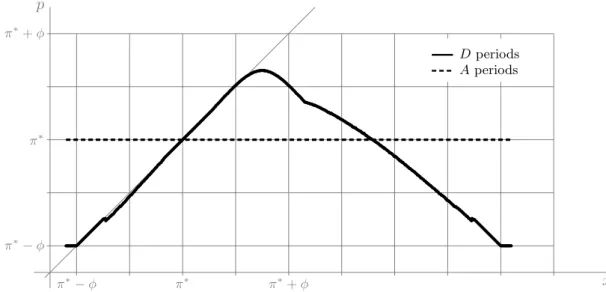
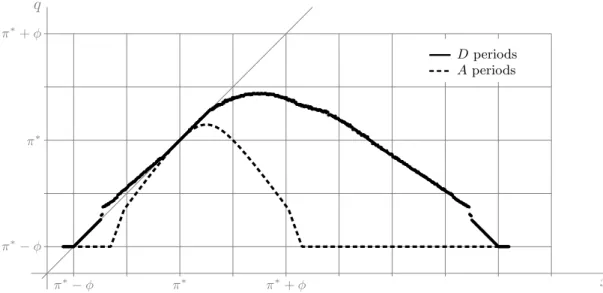
Figures 1.2 and 1.3 show equilibrium proposals from proposition 1.4 on the policy and status-quo dimension respectively for the same values
of parameters used in figure 1.1. Even though we do not have an explicit expression forVC we use computer simulation to estimateVC and associated
equilibrium proposal policies (see appendix1.A3for details of the numerical simulation). From proposition 1.4 we know that proposals on the status-quo dimension need not be unique and involve z, z