1
I
MPROVING CONSTRUCTION MANAGEMENT PRACTICE IN
S
AUDI
A
RABIA WITH THE
L
AST
P
LANNER
S
YSTEM
:
A CASE
STUDY
Abdullah O. AlSehaimi
Administration of Projects and Engineering Affairs, Ministry of Health, Saudi Arabia, and
Patricia Tzortzopoulos Fazenda and Lauri Koskela University of Salford, UK
ABSTRACT
Construction management suffers from many problems which need to be solved or better understood. The research described in this paper evaluates the effectiveness of implementing the Last Planner System (LPS) to improve construction planning practice and enhance site management in the Saudi construction industry. To do so, LPS was implemented in two large state-owned construction projects through an action research process. The data collection methods employed included interviews, observations and a survey questionnaire. The findings identify major benefits covering many aspects of project management, including improved construction planning, enhanced site management and better communication and coordination between the parties involved. The fact that the structural work in one of the projects studied was completed two weeks ahead of schedule provides evidence of improvement of the specific site construction planning practices. The paper also describes barriers to the realisation the full potential of LPS, including the involvement of many subcontractors and people’s commitment and attitude to time.
KEY WORDS: Construction planning, Last Planner System implementation, action research
1. INTRODUCTION
2
between the parties involved, delay in materials delivery and late procurement of materials. In order to improve performance, this research paper argues that the impact of such controllable causes of delay needs to be minimised.
One of the most important initiatives in the field of management and one which has created a direct impact has been the introduction and adoption of lean thinking. Since the early 1990s, its application to construction (lean construction) has been practised as a way to manage construction more efficiently and effectively. Among its main goals are improving planning efficiency and reliability, decreasing waste and improving productivity (Ballard et al., 2002). Diverse lean techniques have been implemented by many construction firms around the world, aiming to enhance their project management practice by eliminating waste, improving productivity and maximising value. The best known lean construction technique is the Last Planner System (LPS), which has been demonstrated during the last decade to be a very useful tool for the management of the construction process and the continuous monitoring of planning efficiency (Christoffersen et al. 2001; Ballard and Howell, 2003). LPS has been implemented in various projects in different environments around the world (Fiallo and Revelo, 2002; Thomassen et al., 2003; Lim et al., 2006; Alarcon et al., 2008; Formoso and Moura, 2009). This study has chosen LPS as the main tool for improvement in lean construction because it has been tested in the field and refined over the last decade with achievement of great benefits (Junior et al., 1998; Fiallo and Revelo, 2002; Koskenvesa and Koskela, 2005; Thomassen et al., 2003; Kim and Yang, 2005). This technique promises to make project programmes more predictable by making assignments ready, by supporting short-term planning and by minimising waste and non-value-adding work. In addition, it enables the collaborative management of the entire network of relationships and communications needed to guarantee effective programme co-ordination, production planning and project delivery (Ballard, 2000; Koskela and Ballard, 2006; Mossman, 2009).
The literature on lean construction and LPS shows no evidence of its practical application within the construction industry in Saudi Arabia. Therefore, to the best of the authors’ knowledge, the research reported here is the first application of lean construction in Saudi Arabia. It aims to improve management practice by solving practical problems and create new knowledge. That is to say, this study is concerned with the application of existing principles (LPS) to a new context and different working environment where commitment and attitude to time make it likely to operate differently. As this study was undertaken to improve the quality of work in practice, to solve practical problems and to contribute to knowledge, an action research approach was employed to facilitate this improvement. Further justification for choosing the action research approach is given in section 4 on research methods.
3
understood, then practical action to minimise its causes is proposed, by improving the practice of construction management. That is to say, the main aim of this paper is to contribute to the improvement of performance by making practical endeavours to reduce delays. This contribution is made by identifying the causes of delay that have controllable effects and the extent to which these effects can be minimised in the Saudi construction industry. The proposed solution, LPS implementation, has been tested practically with the aim of examining the utility of the technique in improving planning practice, thus overcoming or minimising causes of delay.
The paper is organised as follows. First, the problem addressed (delay factors related to poor project management) is explained in detail. Next, there is a brief review of literature on construction project management, lean construction and LPS, followed by a presentation of the primary results of implementing LPS in two large state-owned construction projects with the aim of determining its ability to improve construction planning practice and thus to overcome or minimise delay. There is an account of the action research strategy which was adopted and the data collection methods employed, including interviews, observation and a survey questionnaire. There is then a presentation of the benefits achieved in terms of improving construction management practice, a discussion of the critical success factors for implementing LPS and an examination of potential barriers to implementation. Finally, the contribution of this study to both practice and knowledge is examined and a general conclusion is offered.
2. PROBLEM ADDRESSED
A number of studies have examined delay in the Saudi construction industry (Assaf et al., 1995; Al-Khalil and Al-Ghafly, 1999; Assaf et al., 2002; Bubshait and Al-Juwairah, 2002; Falqi, 2004; Assaf and Al-Hejji, 2006; Al-Kharashi and Skitmore, 2009). Factors related to poor project management are seen to be common to most of these studies, although they vary in their importance from one study to another. The most common controllable factors identified are ineffective planning and control, poor site management, material procurement problems, low labour productivity and weak communication and coordination.
4
3. LITERATURE REVIEW
3.1CONSTRUCTION PROJECT MANAGEMENT
It has been argued that production management in construction is based on deficient theory, which leads to added costs and the reduction of overall performance (Koskela, 1992; Ballard and Howell, 1998; Ballard, 2000; Koskela, 2000; Koskela and Howell, 2002). Koskela and Howell (2002) contend that current construction project delivery practices fail to provide a solid basis for improvement and are inadequate when projects are complex, uncertain and quick. They cite the simplicity and insufficiency of two underlying theories, ‘management as planning’ and the ‘thermostat model’ of control, whose shortcomings are summarised under three headings: 1) the unrealistic role of planning and poor short-term planning; 2) unsystematic management of execution and 3) a narrow view of control as measuring and taking corrective action, rather than as a process of learning. The same authors criticise the traditional construction planning and control system, as described in the PMBOK guide (2004), for the insufficiency of its underlying theories and the ineffectiveness of its techniques (Koskela and Howell, 2002; Howell and Koskela, 2004).
These claims are in agreement with Laufer and Tucker (1987), who pointed out more than two decades ago that the primary internal motivation for planning is often control, rather than execution. Thus, the significance of control is somehow corrupted by the separation of execution from planning, and in practice planning becomes a way of explaining what has happened and trying to find a way to recover it. In this paper, it is argued that addressing these shortcomings of project management provides a possible starting point for improvement in practice. A reasonable approach to tackle the aforementioned shortcomings could be the applicability of tools to help in improving planning and control. Such tools should facilitate short-term planning and allow managers to ensure the availability of all task prerequisites before the start, investigate reasons for failure and act on them (Howell and Koskela, 2001; Koskela and Howell, 2002). This argument is supported by several scholars (Koskela, 1992; Morris et al., 2000; Maylor, 2001; Morris, 2004), who identify the need to introduce alternative theoretical approaches to the study of projects. Koskela (2000) suggests that project management theory could be based on three points of view: transformation (realising value-adding activities efficiently), flow (reducing the share of non-value-adding activities) and value (improving customer value).
3.2LEAN CONSTRUCTION
5
Lean construction, much like current practice, has the goal of better meeting customer needs while using fewer resources. Furthermore, it is based on production management principles, the ‘physics’ of construction. The result is a new project delivery system that can be applied to any kind of construction but is particularly suited to complex, uncertain and quick projects (Howell, 1999). This system advocates identifying the root causes of waste, removing those causes by means of related tools and techniques, and encouraging the prevention of loss rather than reactively attempting to overcome the negative effects of loss (Womack and Jones, 1996; Lapinski et al., 2006).
Three features distinguish lean construction from conventional construction management practice (Ballard and Howell, 1994; Howell, 1999). First, it focuses on reducing waste that may exist in any form in the construction process, such as inspection, transportation, waiting and unnecessary motion. Second, it aims to reduce variability and irregularity so that materials and information can flow without interruption. Third, construction material is expected to be on site only when it is needed. Howell (1999) contends that lean construction supplements traditional construction management approaches in two ways: first with two critical and necessary dimensions for successful capital project delivery, by requiring the deliberate consideration of material and information flow and value generation in a production system; and secondly, with different project and production management (planning-execution-control) paradigms.
Lean construction considers planning and control to be complementary and dynamic processes maintained during the course of the project. Planning defines the criteria and creates the strategies required by the project objectives. At the same time, control makes sure that each event will occur in the planned sequence. Replanning must be done when the previously established sequences are no longer applicable or convenient, while feedback facilitates learning when events do not occur as planned (Howell, 1999; Ballard, 2000). Howell (1999) argues that control should be redefined from ‘monitoring results’ to ‘making things happen’. Planning system performance is measured and improved to assure reliable workflow and predictable project outcomes.
3.3LAST PLANNER SYSTEM™
6
ready by ensuring that materials, information and equipment are available; by filtering planned activities through the weekly work planning procedure to ensure that the preceding activities have been completed; and by seeking conscious and reliable commitment of labour resources by the leaders of the work teams involved. According to Ballard and Howell (1994), LPS focuses on quality characteristics of weekly work plans by selecting the right work sequence and the right amount of work and by ensuring that the selected work can be done.
LPS has five main integrated elements (Ballard, 1997; Ballard, 2000; Ballard and Howell, 2003; Mossman, 2009): master planning, phase planning, lookahead planning, weekly work planning, percent plan complete (PPC) and analysis of reasons for incomplete assignments.
• The master plan serves to obtain the collaborative creation of, and agreement to, the production sequence. The aim is to bring all the major actors together early in the process, so that critical interdependencies can be discussed, assumptions tested and best practice agreed on. The purpose of the master plan is to develop and display execution strategies, demonstrate the feasibility of completing the work within the available time and identify milestones important to clients or stakeholders.
• Phase planning is about dividing the master plan into various phases, aiming to develop more detailed work plans and provide the project team with goals that can be considered targets. Since a construction project moves through various phases, phase planning aims to provide certain goals for each phase and then work backwards to achieve them. Its purposes are to develop a plan for completing work within a phase of the master plan, to produce the best possible plan by involving representatives of all organisations working on that phase and to develop detailed works plan for each of the parties (contractors, subs, clients, consultants, suppliers etc) involved in the phase.
• Lookahead planning means making tasks ready so that they can be done when the right time comes. This can be achieved by means of a medium-term lookahead plan. Lookahead planning helps to focus management’s attention on what is supposed to happen at some time in the future, and to encourage actions in the present that will produce the desired outcome. According to Henrich and Koskela (2005), the objectives of lookahead are to reduce uncertainty, to identify and eliminate constraints and to achieve the project objectives in the lookahead period, which typically varies from 4 to 8 weeks. Making ready (Ballard, 1997) ensures that tasks are ready for production when required, thereby reducing waste of time, materials and equipment.
7
occur in the field. It promotes two-way communication and team planning to share information on the project efficiently and accurately.
• Percent plan completed and analysis of reasons for non-completed tasks are intended to improve project planning by continual assessment and learning from failure. PPC is a measure of the proportion of promises made that are delivered on time. It can be calculated as the number of activities that are completed as planned divided by the total number of planned activities, presented as a percentage. According to Ballard and Howell (2001), the starting point for improvement in planning is measuring PPC, identifying reasons for non-completion and tracing these back to root causes that can be eliminated to prevent repetition (Ballard, 2000). Additionally, over time, PPC statistics show where attention should be paid to yield better results. This in turn can assist in improving the learning process over the project period and in the longer term.
The aforementioned integrated components of LPS, when systematically implemented, offer major benefits to construction management practice in general and planning practice in particular. Outcomes of LPS implementation in a large number of projects across several countries since 1992 (Ballard and Howell, 2003) provide evidence of these benefits. Many reports and research papers have confirmed that the technique has achieved remarkable improvements, including better planning and control, improved work flow reliability, promotion of team building, improved communication and collaboration, increased productivity and improved work quality, thereby reducing the duration and cost of projects (Ballard et al., 1996; Junior et al., 1998; Ballard, 1999; Fiallo and Revelo, 2002; Koskenvesa and Koskela, 2005; Thomassen et al., 2003; Kim and Yang, 2005; Court et al., 2009). When compared with the critical path method, LPS produces far superior project results (Ballard and Howell, 2003).
4. RESEARCH METHODS
Two action research studies were conducted in Saudi Arabia to examine the impact of LPS on improving construction planning practice in government facilities. The chosen contractors were selected mainly because of their good reputation, extended history in the business and recognised success in different kinds of construction. According to the Saudi contractors’ classification, the firms were classified in the top rank of the organisations that typically bid for government projects and contracts in Saudi Arabia. The two construction organisations were mostly active in building projects. However, they also worked on other types of construction including roads, water and drainage networks. Two ongoing projects were selected for the motivation of their staff concerning this research, the firm commitment of executive management and the cooperation of clients in providing access to research-related data.
8
Justifying the adoption of action research in this study, the reflection and data collection process should focus on aspects that cannot easily be captured by other approaches (Eden and Huxham, 1996). Action research was chosen in order to respond to the practical concerns of people and to provide solutions to existing practical problems (Järvinen, 2007). What differentiates it from traditional research approaches is that the researcher plays an active role in the case under study, working collaboratively with other participants (Naoum, 2001; Herr and Anderson, 2005). The researcher may have some knowledge, but his or her role is essentially that of a facilitator (Stringer, 1999). The present authors believe that organisations should benefit from advances in knowledge, rather than just being subjects of research. To make academic research relevant, researchers should try out their theories with practitioners in real situations and real organisations (Avison et al, 1999). Action research also allows the parties involved to review the existing process (problem domain), identify the problem, introduce changes to improve the situation, evaluate their effects and reflect on the process and the outcome, to generate new knowledge (Hult and Lennung, 1980; Baskerville, 1999; Naoum, 2001).
In the action research reported here, data were collected by a number of methods (triangulation) to examine LPS implementation. The following methods of data collection were employed: (a) Semi-structured interviews lasting 2-3 hours were conducted with two project managers, two
site managers and one planning engineer working on the projects under study, in order to evaluate their current planning practices before LPS implementation. Diverse questions were asked regarding the techniques being used, the involvement of other parties in the planning process, frequent meetings during the construction process to review and update the plan, the facilitation of lookahead planning and means of communication between the parties. It was revealed that the construction stage normally commenced with a pre-construction or construction coordination conference, i.e. a meeting of the principal parties involved in the planning and execution of the project, whose prime purposes were to establish acceptable ground rules and to ensure that contractors understood all the job requirements and that the work was coordinated to produce a satisfactory outcome.
(b) The first author, acting as facilitator of LPS implementation, attended weekly meetings over a period of eighteen weeks with the project teams in the presence of representatives of all parties involved (client, consultant and subcontractors’ managers). In these meetings, PPC figures were recorded and reasons for incomplete assignments were tracked and analysed. (c) The first author engaged in participant and non-participant observation. In the latter case,
over a period of two weeks he observed managerial practice in general and planning practice in particular. He also undertook participant observations by direct involvement as facilitator throughout the LPS implementation period.
9
potential solutions could be examined during the weekly meetings, which also covered issues such as managing resistance to change by encouragement and offering financial rewards to the most productive parties.
(e) Finally, a survey questionnaire was used to assess stakeholders’ perceptions of LPS implementation, with the following specific aims:
• to evaluate the process of implementing LPS in the projects under study and to examine the extent to which this tool had improved planning practice. Two questions were asked, concerning the advantages of LPS over the traditional planning method and its effectiveness in improving project management practice.
• to report the benefits achieved from implementing LPS;
• to identify barriers to the effective implementation of LPS as a planning and management technique; and
• to discover the main critical success factors (CSFs) for the implementation of LPS. In the first project, 32 questionnaires were distributed among the parties and 26 responses received. In the second, 40 questionnaires were distributed and 32 responses received. The questionnaire contained ten items, but only those questions relating to benefits achieved, CSFs and barriers to LPS implementation are covered in this paper. Section 6.4 below presents participants’ responses to statements concerning the attributes of LPS, which were given on a five-point Likert scale from “strongly agree” to “strongly disagree”. The attributes were selected for inclusion from reports of previous LPS studies, from the literature on lean construction and LPS and from observation and notes taken during the researcher’s involvement in its implementation.
4.1 THE COMPANIES AND THE PROJECTS STUDIED
10
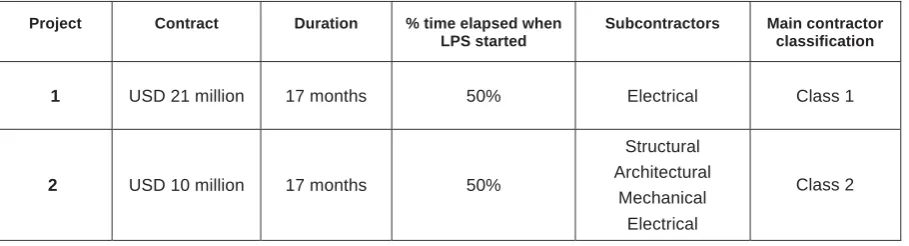
Table 1: Description of the projects studied
Project Contract Duration % time elapsed when
LPS started
Subcontractors Main contractor
classification
1 USD 21 million 17 months 50% Electrical Class 1
2 USD 10 million 17 months 50%
Structural Architectural
Mechanical Electrical
Class 2
5. LPS IMPLEMENTATION
5.1 CURRENT PLANNING PRACTICE
Interviews concerning the current planning practice before implementing LPS revealed that most planning was based on a master plan presented on bar chart issued at the beginning of the construction phase. A systematic review of project planning (and project review in general) was found to be rare or non-existent. The researcher enquired about overall project evaluation, since it is necessary to establish the reasons for shortcomings in project execution. Most informants said that they did not tend to refer to past job records, as these were either non-existent or inadequate. The interviews also revealed an absence of detailed short-term planning and improvement meetings to discuss project progress. As for planning techniques, most of the interviewees stated that their firms used the critical path method. The software packages most commonly employed were MS Project and Primavera.
Investigation into current practice established an overview of the status of the planning process followed by the two organisations and suggested a direction for improvement. Following the interviews, the application of LPS and its implementation strategy were discussed in detail and examples from previous studies were considered. As part of these discussions, the weaknesses of the current planning practices were observed and thought was given to how LPS could enhance practice and support existing efforts.
5.2 LPS IMPLEMENTATION STRATEGY
11
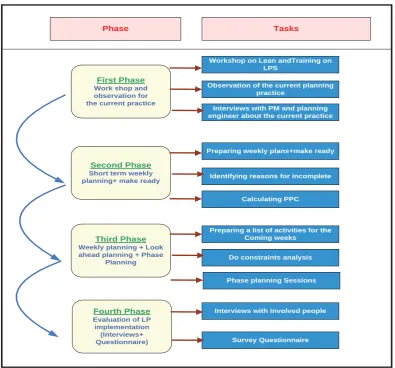
next one. Figure 1 shows the LPS implementation strategy adopted in both cases, followed by explanations of the phases and the tasks carried out during each one.
Phase Tasks
First Phase Work shop and observation for the current practice
Workshop on Lean andTraining on LPS
Observation of the current planning practice
Interviews with PM and planning engineer about the current practice
Second Phase Short term weekly planning+ make ready
Preparing weekly plans+make ready
Identifying reasons for incomplete
Third Phase Weekly planning + Look ahead planning + Phase
Planning
Preparing a list of activities for the Coming weeks
Do constraints analysis
Fourth Phase Evaluation of LP
implementation (Interviews+ Questionnaire)
Interviews with involved people
Survey Questionnaire Calculating PPC
[image:11.595.107.503.155.523.2]Phase planning Sessions
Figure 1: LPS implementation strategy in the studied projects
FIRST PHASE
12
SECOND PHASE
It was agreed that PPC and reasons for incomplete assignments would be traced and recorded weekly for five weeks, in an attempt to help the team in driving improvement and to see how LPS would improve planning practice. In this phase, the focus was on short-term planning and make-ready, while little attention was directed to lookahead planning. Two weekly meetings were held with the involvement of all project parties (contractor’s team, client representatives, consultant engineers). Data (PPC and reasons for incomplete assignments) were collected during the summer, which is a very hot season in Saudi Arabia; in the year of the study, the temperature reached 52 °C. Furthermore, data collection coincided with the month of Ramadan, when Muslims fast during daylight hours. Taken together, these factors significantly affected labour productivity and hence assignment completion.
THIRD PHASE
The third phase was the longest, lasting for eleven weeks in each project, during which, in addition to weekly planning and make-ready, two main components of LPS were introduced: lookahead planning and phase planning. Phase planning allowed activities to be pulled through by reverse team planning and for resources to be optimised in the long term. In the first project, there were two lookahead windows, one covering four weeks and the other six weeks, whereas in the second case, only the four-week lookahead window was feasible. A possible explanation is that the involvement of many subcontractors made it difficult to produce six-week lookahead plans. Lookahead planning was extracted from the master plan zone by zone, then coordinated in the Last Planner sheets. Phase planning sessions were held throughout the project phases (structural, finishing and mechanical). All planning levels were linked, since lookahead plans were connected to the phase plans, which were connected to the master plan. Practically, during the all-day phase planning sessions, sticky notes were used to show the names, durations, prerequisites and locations of individual tasks on the project map. Each session was dedicated to a certain type of activity, aiming to provide certain goals in each phase and then work backwards from the target completion date to achieve the proposed milestones. In practice, phase planning allowed better visualisation of the flow of work, assisting all parties to negotiate deadlines for the planned work.
FOURTH PHASE
13
6. OUTCOMES AND FINDINGS
6.1 WEEKLY PERCENT PLANNED COMPLETED
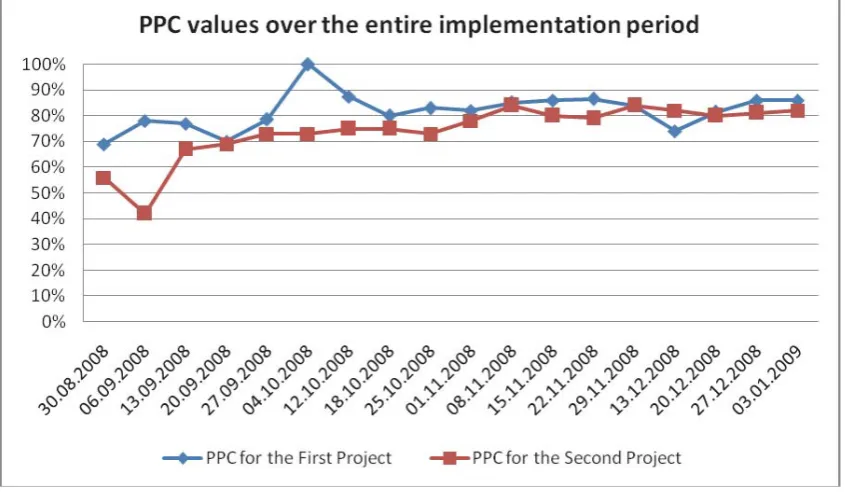
[image:13.595.88.511.300.548.2]Generally, there was a gradual increase in weekly PPC over the implementation period, as shown in Figure 2. This indicates improvement in the planning practice and management process (Koskela and Ballard, 2006). In the first project, PPC increased from 69% in the first week to 86% in the last week, peaking at 100% in the first week after the introduction of lookahead planning and then stabilising at 86% for the last two weeks of the project. In the second project and over the same period, PPC rose from 56% in the first week to 82% in the last week, reaching a peak of 84% in the middle of the period and stabilising above 80% for the last five weeks. Figure 2 facilitates the comparison of results for the two projects, showing that for most of the time, PPC was slightly higher for the first than for the second.
Figure 2: Weekly PPC values over the entire implementation period for both projects
6.2 REASONS FOR INCOMPLETE ASSIGNMENTS
14
[image:14.595.71.530.197.447.2]workforce was insufficient to meet needs. Most of the subcontractors appear to have exceeded their capabilities in their commitment to supply labour. The underlying cause was believed to be the persistently high demand for skilled labour at a time when the country was passing through an unprecedented construction boom: multi-billion dollar projects were under way in both the public and private sectors, with many more in the planning stage.
Figure 3: Reasons for incomplete assignments over the whole period in the two projects
The second main reason for non-completion encountered by the two projects was the restricted availability of materials, which occurred because of several factors. Firstly, the approval procedure required by the client was time-consuming and caused delays. Secondly, suppliers did not always deliver the materials on time. Sometimes the wrong materials might be delivered, mostly because the supplier was confused by the use of different block types and sizes. In other instances (specifically during the last phase, in relation to some of the mechanical materials) key deliveries were not made as scheduled.
15
private ones, since the approval of materials and decision making needs to go through a certain process between consultant and client.
The fourth most common reason for incomplete assignments in the first project was a change of priorities, which mostly affected architectural activities, as they were not always sequence dependent. However, in some cases there was a need to change priority because of factors including the redistribution of labour between zones, confusion in sharing resources and the availability of professionals such as builders and carpenters. In the second project, the fourth reason for non-completion was prerequisite work, which again applied mostly to structural and architectural activities.
The fifth reason for incomplete assignments for the first project was labour, while for the second project it was late or incomplete information. The sixth factor in the first project was equipment problems, which occurred with the same frequency in the second project.
6.3DISCUSSION
The results show a broad similarity between the two projects in the identity of the factors causing assignments to be incomplete, but with differences in terms of their importance. There was a tendency for PPC to increase gradually over the period of LPS implementation in the two cases. Many advantages were gained by calculating PPC, analysing the reasons for incomplete assignments and conducting a constraints analysis, while the preparation of lookahead plans, continuous assessment and learning from failures and mistakes all helped to improve performance. Additionally, the action research process, involving collaboration between the researcher and the organisations being studied, produced improvements in quality of work practice, enhanced managerial practice and helped to expand knowledge and learning. The researcher also observed the benefits of LPS implementation throughout his period of participation in the projects. Frequent site visits were made and discussions held with the people involved to assess their perceptions of LPS implementation, leading to the observation that many benefits had been gained.
16
6.4INVESTIGATING THE VIEWS OF THE PARTIES INVOLVED
6.4.1 Participants’ views of the effectiveness of LPS implementation
A questionnaire survey was distributed to participants at the final stage of the researcher’s involvement in the implementation process, aiming to evaluate their perceived experience of LPS in their projects. In both cases, after the experience of eighteen weeks’ involvement in LPS implementation, most respondents agreed that it was effective in improving management practice. A strong majority (about 90%) of the 26 respondents in the first project either strongly agreed or agreed that LPS was effective. In the second project, most of the 32 participants (about 86%) agreed that it was effective in improving planning practice and enhancing site management. Very encouragingly, the entire sample agreed that it was effective in improving planning and control. In respect of site management, a large majority agreed that LPS was effective, while most agreed that it was useful in minimising waste.
6.4.2 Perceived benefits, critical success factors and barriers
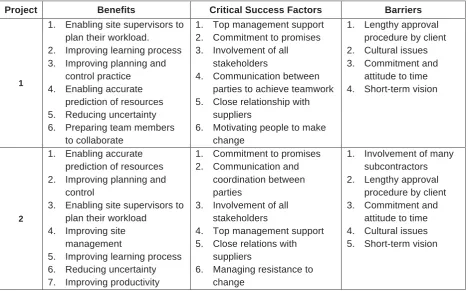
In terms of the benefits gained, one of the major conclusions that can be drawn from the questionnaire findings is that the process of implementing LPS was very successful. It had a positive impact on performance, as reflected by the outcome of the implementation process. The most important benefits, the key CSFs and the main barriers revealed by interviews and questionnaires are summarised in Table 2. There are strong similarities between the two cases as to the benefits and CSFs, with slight differences only in the degree of agreement between respondents. LPS was found to have significantly enhanced cooperation and collaboration between the project teams and created an organised work environment.
17
Table 2: Benefits, CSFs and barriers to implementation of Last Planner System
Project Benefits Critical Success Factors Barriers
1
1. Enabling site supervisors to plan their workload.
2. Improving learning process 3. Improving planning and
control practice 4. Enabling accurate
prediction of resources 5. Reducing uncertainty 6. Preparing team members
to collaborate
1. Top management support 2. Commitment to promises 3. Involvement of all
stakeholders
4. Communication between parties to achieve teamwork 5. Close relationship with
suppliers
6. Motivating people to make change
1. Lengthy approval procedure by client 2. Cultural issues 3. Commitment and
attitude to time 4. Short-term vision
2
1. Enabling accurate prediction of resources 2. Improving planning and
control
3. Enabling site supervisors to plan their workload
4. Improving site management
5. Improving learning process 6. Reducing uncertainty 7. Improving productivity
1. Commitment to promises 2. Communication and
coordination between parties
3. Involvement of all stakeholders
4. Top management support 5. Close relations with
suppliers
6. Managing resistance to change
1. Involvement of many subcontractors 2. Lengthy approval
procedure by client 3. Commitment and
attitude to time 4. Cultural issues 5. Short-term vision
7.
CONTRIBUTIONS TO PRACTICE AND KNOWLEDGEContributions to the problem addressed: This study contributes to existing construction research in the form of action research and its integrative implementation, which partially overcame some of the delay problems in construction projects. Through collaboration between the researcher and the organisations studied, improvements were achieved in quality of work practice, enhancement of managerial practice, knowledge expansion and learning. An important result that indicates the success of LPS implementation is the fact that the structural work finished two weeks ahead of schedule in one of the projects. The other most valuable contribution of this study is that implementing LPS via action research allowed the underlying reasons for delays to be identified and dealt with, thus preventing their reoccurrence. This could not have been achieved by earlier explanatory delay studies, whereas action research participants can gain a better understanding of problems and their potential solutions.
18
contributed to improving management practice and developed a basis for the development of research in the area of lean construction. It may help construction organisations to establish new strategies and policies to improve their managerial practice. Additionally, this initiative has made a valuable contribution to achieving one of the major objectives of the Saudi government’s development plans in the field of construction: to strengthen the industry by making it more organised, effective and productive, whilst emphasising time, cost and quality. The results can also be used as a reference for organisations which seek to improve their managerial practice. To further validate the research results, a presentation was made to professionals from a number of construction organisations and government departments, focusing on the strategy and key findings from the implementation of LPS in the projects studied. In order to generalise the findings, data were shared and participants were asked to comment on the applicability of lean construction principles and techniques in their organisations and on the potential for implementation. Their feedback was used to develop a strategy for future initiatives in LPS implementation and the best ways to introduce such techniques into practice.
Contributions to Last Planner literature: This research has helped to fill a gap in the literature regarding the adoption of LPS in an environment different from those of the countries where it has usually been implemented, taking into account all the influencing factors. It has made a contribution by demonstrating a practical way of applying LPS to Saudi construction projects and by identifying many of the related benefits, CSFs and potential barriers. Commitment and attitude to time had a negative influence on the implementation process. However, the overall results indicate that LPS is an effective management tool that is applicable to different contexts. When taken together, this adds to existing evidence of the applicability and value of LPS in improving management practice.
Contribution to construction management literature in general: The study has contributed by introducing a practical technique for approaching internal causes of delay and overcoming or minimising these problems via action research. It has also shown that implementing an effective technique based on a new theory can help to pinpoint those causes of delay which are external to the project.
8. CONCLUSION
19
project participants, assisting in collaborative planning and providing forward information for control. LPS enabled site teams to be more organised, effective and productive, which resulted in significant improvement to overall project management practice. Moreover, the learning process improved by means of continuous assessment and evaluation.
Besides its contribution to improving project management practice in the companies being studied, this study has made a valuable contribution to construction management practice in Saudi Arabia and added to the theory of lean construction and LPS. The outcomes of the case studies can be generalised to the extent that each of the construction organisations involved had a good quality record and a good reputation nationally. The first was classified among the top six construction contractors and ranked 80th among Saudi firms, while the second was well known and very active in construction work, particularly in the western region of the country. Given these attributes, the research findings can safely be generalised beyond the chosen sample and used as a reference for organisations seeking to improve their managerial practice, while the benefits of the study can be extended from Saudi Arabia to other countries in the region. The outcomes will be translated into Arabic and published in local journals and construction magazines.
9.
REFERENCES
Abdul-Rahman H.; Berawi M.; Berawi A.; Mohamed O.; Othman M. and Yahya I., (2006) Delay mitigation in the Malysian construction industry, Journal of Construction Engineering and Management, 132(2):125-133.
Alarcón, L., Diethelm, S., Rojo, O. and Calderón, R. (2008) Assessing the impacts of implementing Lean Construction, Revista Ingeniería de Construcción 23(1), available at www.ing.puc.cl/ric.
Al-Khalil, M. and Al-Ghafly, M. (1999) Important causes of delay in public utility projects in Saudi Arabia, Construction Management and Economics 17(5): 647-655.
Al-Kharashi, A. and Skitmore, M. (2009) Causes of delays in Saudi Arabian public sector construction projects, Construction Management and Economics 27(1):3-23.
Al-Momani, A. (2000) Construction Delay: A Quantitative Analysis, International Journal of Project Management, 18(1):51-59.
Alsehaimi, A. and Koskela, L. (2008) Critical evaluation of previous delay studies in construction, Proceedings of the 8th International Postgraduate Conference in the Built Environment, June 2008, Prague
Assaf, A., Al-Hammad A., Jannadi A. and Abu Saad S. (2002) Problems of application of life cycle costing in construction projects, Cost Engineering 44(2):17-22.
20
Assaf, S., Al-Khalil M. and Al Hazmi M. (1995) Causes of delay in large building construction projects, Journal of Management in Engineering 11(2): 45-50.
Avison, D., Lau, F., Myers, M. and Nielsen, P. (1999) Action research, Communications of the ACM 42(1): 94-97.
Ballard, G. (1994) The Last Planner, Spring Conference of the Northern California Construction Institute, Monterey, CA, April 22-24.
Ballard, G. (1997) Lookahead Planning, the missing link to production control, Proceedings 5th IGLC Conference, Griffith University, Gold Coast, Australia.
Ballard, G. (2000) The Last Planner System of production control, PhD thesis, School of Civil Engineering, University of Birmingham.
Ballard, G. and Howell, G. (1994) Implementing Lean Construction: Stabilizing the work flow, Proceedings of the 2nd IGLC Conference, Santiago, Chile.
Ballard, G. and Howell, G. (1998) Shielding production: Essential step in production control, Journal of Construction Engineering and Management 124(1):11–17.
Ballard, G. and Howell, G. (2003) An update to Last Planner, Proceedings of the 11th IGLC Conference, Virginia, USA.
Ballard, G., Howell, G. and Casten, M. (1996) PARC: A case study, Proceedings of the 4th IGLC Conference, Birmingham, England, reprinted in Alarcon (1997).
Ballard, G., Tommelein, I., Koskela, L. and Howell, G (2002) ‘Lean Construction Tools and Techniques’, in Best and De Valence (Eds), Design and Construction: Building in Value, pp.227-255, Butterworth-Heinemann, Oxford.
Baskerville, R. (1997) Distinguishing action research from participative case studies, Journal of Systems and Information Technology 1(1):25-45.
Baskerville, R. (1999) Investigating information systems with action research, Communications of the Association of Information Systems 2(19):7-17.
Bubshait, A. and Al-Juwairah, A. (2002) Factors contributing to construction costs in Saudi Arabia, Cost Engineering 44(5):30-34.
Christoffersen, A., Sander, D. and Bojsen J. (2001) Application of lean methods in the Danish construction industry: Getting it started, keeping it going, Proceedings of the 3rd Annual Lean Construction Congress, Berkeley.
Court, P., Pasquire, C. and Gibb, A. (2009) A lean and agile construction system as a set of countermeasures to improve health, safety and productivity in mechanical and electrical construction, Lean Construction Journal, pp 61-76.
Dick, B. (2002) Action research: Action and research, available at http://www.scu.edu.au/schools/gcm/ar/arp/aandr.html, accessed on 27.02.2009.
Eden, C. and Huxham, C. (1996). Action research for management research, British Journal of Management, 7(1):75-86.
21
Fiallo, C. and Revelo, V. (2002) Applying LPS to a construction project: A case study in Quito, Ecuador, Proceedings of the 10th IGLC Conference, Gramado, Brazil.
Formoso, C. and Moura, C. (2009) Evaluation of the impact of the Last Planner System on the performance of construction projects, Proceedings of the 17th Annual Conference of the International Group for Lean Construction, Taipai, Taiwan, 15-17th July, pp.153-164.
Gummesson, E. (2000) Qualitative Methods in Management Research, 2nd edition. Thousand Oaks, CA: Sage.
Henrich, G., Tilley, P. and Koskela, L. (2005) Context of production control in construction, Proceedings of 13th IGLC Conference, Sydney, Australia.
Herr, K. and Anderson, G. (2005) The Action Research Dissertation, Thousand Oaks: Sage. Howell, G. (1999) What is lean construction 1999? Proceedings of 6th IGLC Conference,
California, Berkeley.
Howell, G. and Koskela, L. (2001) Reforming project management: The role of planning, execution and controlling, 9th IGLC Conference, Singapore.
Hult, M. and Lennung, S. (1980) Towards a definition of action research: A note and bibliography, Journal of Management Studies 5(2):241-250.
Järvinen, P. (2007) Action research is similar to design science, Quality and Quantity 41(1):37-54.
Junior, A., Scola, A. and Conte, A. (1998) Last Planner as a site operations tool, Proceedings of the 6th IGLC Conference, Guaruja, Sao Paulo, Brazil.
Kim Y. and Jang, J. (2005) Case study: Application of Last Planner to heavy civil construction in Korea, Proceedings of the 13th IGLC conference, Sydney, Australia.
Koskela, L. and Howell, G. (2002) The underlying theory of project management is obsolete, Proceedings of Project Management Institute Research Conference.
Koskela, L. (2000) An Exploration into a Production Theory and its Application to Construction. Doctoral Thesis, Espoo: VTT.
Koskela, L. (2008) Which kind of science is construction management? Proceedings of the 16th IGLC Conference, July 2008, Manchester, UK.
Koskela, L. and Ballard G. (2006) What is lean construction 2006? CIB Conference, Rome, Italy.
Koskenvesa, A. and Koskela, L. (2003) Introducing Last Planner: Finnish experiences, CIB Conference, Finland, Helsinki
Lapinski, A., Horman, M. and Riley, D. (2006) Lean processes for sustainable project delivery, Journal of Construction Engineering and Management 132(10):1083-1091.
Laufer, A. and Tucker, R. (1987) Is construction project planning really doing its job? A critical examination of focus, role and process. Construction Management and Economics 5(3): 243-266.
22
Mansfield, N., Ugwu, O. and Doran, T. (1994) Causes of delay and cost overruns in Nigerian construction projects. International Journal of Project Management, 12(4):254-260.
Maylor, H. (2001) Beyond the Gantt chart: Project management moving on, European Management Journal, 29(1):92-100.
McKernan, J. (1991) Curriculum Action Research, A Handbook of Methods and Resources for the Reflective Practitioner, London: Kogan Page.
MEED (2007) Saudi Arabia’s six top construction, available at http://www.meed.com/construction/people/2007/12/saudi_arabia_construction.html.
Mezher, T., and Tawil, W. (1998) Causes of delays in the construction industry in Lebanon, Journal of Engineering, Construction and Architectural Management, 5(2):252-260.
Ministry of Public Works (2006) Contractors’ Classification, Ministry of Planning, Saudi Arabia. Morris, P. (2004) ‘Current trends in project and programme management’. In Association for
Project Management Yearbook. High Wycombe: Association for Project Management. Morris, P., Patel, M. and Weame, S. (2000) Research into revising the APM project management
body of knowledge, International Journal of Project Management 18(3):155-164.
Mossman, A. (2009) Last Planner System, collaborative conversations for reliable design and
construction delivery, available at www.thechangebusiness.co.uk/.../collaborative.../LastPlanner2009-05-21.pdf, accessed on
04.05.2010
Naoum, S. (2001) Dissertation Research and Writing for Construction Students, Butterworth Heinemann.
Näslund, D. (1999) Bridging the Gap between Strategy and Operations: a Process based Framework, Lund University, Lund.
Odeh, A., and Battaineh, H. (2002) Causes of Construction Delay: Traditional Contracts, International Journal of Project Management, 20(1):67-73.
Ogunlana, S., and Promkuntong K. (1996) "Construction delays in a fast-growing economy: comparing Thailand with other economies" International Journal of Project Management, 14(1):37-45.
PMBOK (2004) A Guide to the Project Management Body of Knowledge, 3rd edition. USA: PMI.
Reason, P. and Rowan, J. (Eds.) (1981) Human Enquiry: A Sourcebook in New Paradigm Research. Chichester: Wiley.
Stringer, E. (1999) Action Research, 2nd Edition, Thousand Oaks: Sage.
Sweis, G., Sweis R., Abu Hammad, A., and Shboul A. (2008) Delays in construction projects, the case of Jordan, International Journal of Project Management, 26(6): 665-674.
23
Van Aken, J. (2005) Management research as a design science: Articulating the research products of Mode 2 knowledge production in management, British Journal of Management 16(1):19-36.
Voordijk H. (2009) Construction management and economics: the epistemology of a multidisciplinary design science, Construction Management and Economics 27(8):713–720. Whyte, W.F. (ed) (1991) Participatory Action Research. Newbury Park: Sage.