0095-1137/11/$12.00 doi:10.1128/JCM.01259-11
Copyright © 2011, American Society for Microbiology. All Rights Reserved.
Development of a Multiplex PCR Assay Targeting O-Antigen
Modification Genes for Molecular Serotyping of
Shigella flexneri
䌤
Qiangzheng Sun,
1† Ruiting Lan,
2† Yiting Wang,
1† Ailan Zhao,
1† Shaomin Zhang,
1† Jianping Wang,
1Yan Wang,
1Shengli Xia,
3Dong Jin,
1Zhigang Cui,
1Hongqing Zhao,
1Zhenjun Li,
1Changyun Ye,
1Shuxia Zhang,
1Huaiqi Jing,
1and Jianguo Xu
1*
State Key Laboratory for Infectious Disease Prevention and Control, National Institute for Communicable Disease Control and Prevention, China CDC, P.O. Box 5, Changping, Beijing, China1; School of Biotechnology and Biomolecular Sciences,
University of New South Wales, Sydney, New South Wales 2052, Australia2; and Branch for Enteric Disease Control and Prevention, Institute for Infectious Disease Control and
Prevention, Henan Center for Disease Control and Prevention, Zhengzhou, China3
Received 25 June 2011/Returned for modification 8 August 2011/Accepted 18 August 2011
Shigella flexneri is the major Shigellaspecies that causes diarrheal disease in developing countries. It is further subdivided into 15 serotypes based on O-antigen structure. Serotyping ofS. flexneriis important for epidemiological purposes. In this study, we developed a multiplex PCR assay targeting the O-antigen synthesis gene wzx and the O-antigen modification genes gtrI, gtrIC, gtrII, oac, gtrIV, gtrV, and gtrX for molecular serotyping ofS. flexneri.The multiplex PCR assay contained eight sets of specific PCRs in a single tube and can identify 14 of the 15 serotypes (the exception being serotype Xv) ofS. flexnerirecognized thus far. A nearly perfect concordance (97.8%) between multiplex PCR assay and slide agglutination was observed when 358S. flexneristrains of various serotypes were analyzed, except that 8 strains were carrying additional cryptic and/or defective serotype-specific genes. The multiplex PCR assay provides a rapid and specific method for the serotype identification ofS. flexneri.
Shigellais the major pathogen causing bacterial dysentery in developing countries. There are about 164.7 million cases of shigellosis annually worldwide, resulting in 1,100,000 deaths, most of which are children under 5 years of age (10). Of the four species ofShigella, S. flexneriis the predominant species affecting economically poor populations.
S. flexneriis further divided into different serotypes based on the structure of the O antigen. At least 15 serotypes have been recognized: 1a, 1b, 1c, 2a, 2b, 3a, 3b, 4a, 4b, 5a, 5b, X, Xv, Y, and F6 (15, 17, 21). Serological analysis ofS. flexnerihas long been used to characterize isolates for epidemiological and bac-teriological purposes.
A slide agglutination method using rabbit antiserum raised against specific type and group factors has been the only means to routinely identify the serotypes ofS. flexneri. Commercially available diagnostic antisera have been used in microbiology laboratories worldwide. However, there exist some deficiencies in this scheme. First, it is time-consuming since up to 10 sep-arate agglutination tests using antisera for type antigens I, II, III, IV, V, and VI and for group antigens 3;4, 7;8, and 6 and the monoclonal antibody MASF1c for 1c are required to serotype an isolate (16, 18, 21). Second, an incorrect reading can occur as a result of visual assessment of the agglutination reactions.
Finally, expensive antiserum kits limit its application in the laboratories of developing countries.
All serotypes except serotype 6 ofS. flexneri share a poly-saccharide backbone comprising repeating units of a tetrasac-charide in the polysactetrasac-charide (15). The basic O antigen is referred to as serotype Y, and the addition of glucosyl and/or
O-acetyl residues to the tetrasaccharide unit results in serolog-ical type (i.e., I, II, III, IV, and V)-, group (i.e., 3;4, 7;8, and 6)-, and 1c-specific antigenic determinants (17).
Three genes—gtrA,gtrB, andgtr(type)—are responsible for the glucosylation ofS. flexneri. The first two genes are highly homologous and interchangeable, whereas the third gene,gtr
(type), is unique and encodes the serotype-specific glucosyl-transferase (3, 17). The serotype-specificgtrgenes for types I, II, IV, and V, group 7;8, and 1c aregtrI,gtrII,gtrIV,gtrV,gtrX, and gtrIC, respectively (1, 2, 8, 9, 12, 17). The gtrgenes are encoded by different prophage genomes within the host chro-mosome. O-acetylation, which results in group 6 and/or type III O-antigen modification in serotype 1b, 3a, 3b, and 4b strains, is mediated by theoacgene, which is also carried by prophage (6, 19). Strains of different serotypes characteristi-cally carry one or more of the appropriate prophage genomes encoding specific O-antigen modification genes (Fig. 1).
In the present study, we developed a multiplex PCR assay targeting O-antigen modification genes to serotypeS. flexneri. Except for the serotype X variant (Xv), which cannot be dif-ferentiated from serotype X, all other serotypes recognized up to now can be successfully serotyped using this approach. This multiplex PCR assay provides a rapid and specific method for molecular serotyping ofS. flexneri.
* Corresponding author. Mailing address: State Key Laboratory for Infectious Disease Prevention and Control, National Institute for Communicable Disease Control and Prevention, China CDC, P.O. Box 5, Changping, Beijing, China. Phone: 860 10589 00749. Fax: 860 10589 00748. E-mail: [email protected].
† Q.S., R.L., Y.W., A.Z., and S.Z. contributed equally to this study.
䌤Published ahead of print on 31 August 2011.
3766
on May 16, 2020 by guest
http://jcm.asm.org/
MATERIALS AND METHODS
Bacterial strains.A total of 14S. flexneristrains (Table 1) representing 14 serotypes recognized (except for serotype 5b, of which we have no strains in our collection) are used to set up the conditions for a multiplex PCR using eight primer pairs (see below). A total of 358S. flexneristrains (Table 2) were analyzed to evaluate the validation of the multiplex PCR assay. To test the cross-reaction of primers used in the present study, 50 strains of other species were tested (the number of strains of each species is given in parentheses):S. sonnei(n⫽2),S. dysenteriae(n⫽12, including all 12 serotypes),S. boydii(n⫽18, including all 18 serotypes), enteroaggregativeEscherichia coli(n⫽2), enterohemorrhagicE. coli O157:H7 (n⫽3), enteroinvasiveE. coli(n⫽1), enteropathogenicE. coli(n⫽ 1), enterotoxigenicE. coli(n⫽1), uropathogenicE. coli(n⫽1),E. coliK-12 (n⫽2),Listeria monocytogenes(n⫽1),Vibrio cholerae(n⫽1),Salmonella entericaserovar Paratyphi A (n⫽1),S. entericaserovar Paratyphi B (n⫽2), Yersinia enterocolitica(n⫽1), andSalmonella entericaserovar Choleraesuis (n⫽
1). The serotypes ofS. flexneristrains were identified usingShigellamonovalent antisera (Denka Seiken, Japan) and monoclonal antibody (Reagensia AB, Swe-den). The ChineseS. flexneristrains used here were isolated from diarrheal patients in China and preserved in our laboratory. Other strains were obtained from the National Collection of Type Cultures (NCTC), United Kingdom.
Preparation of DNA templates.DNA templates were prepared directly from bacterial colonies by the boiling method. Briefly, a single colony from an over-night culture at 37°C on LB agar was suspended in 30l of distilled water and boiled at 100°C for 10 min. The sample was immediately cooled on ice for 5 min and centrifuged at 13,000⫻gat 4°C for 10 min. The supernatant, containing DNA, was used as the template for PCR amplification.
PCR primers.Primers used in the present study are listed in Table 3. Primers used for the amplification of the O-antigen flippase genewzxwere from Li et al. (11). The other primers were designed for our study based on the sequences of theS. flexneriserotype-specific genesgtrI,gtrIC,gtrII,oac,gtrIV,gtrV, andgtrX. The primers were synthesized by Sangon Biotech (Shanghai) and dissolved in TE buffer (10 mM Tris-Cl, 1 mM EDTA [pH 8.0]) to obtain a 50M stock solution. PCR amplification and detection.Multiplex PCR were performed using Qia-gen multiplex PCR kit (QiaQia-gen). The reaction mixture for each PCR consisted of 1⫻PCR Master Mix (containing HotStarTaqDNA polymerase, multiplex PCR buffer, and deoxynucleoside triphosphate mix), 0.2M concentrations of each primer, and 3l of template DNA in a final reaction volume of 50l. PCR amplification was performed using a standard multiplex PCR cycling protocol according to the instruction for the kit: 95°C for 15 min, followed by 30 cycles of 94°C for 30 s, 55°C for 90 s, and 72°C for 60 s, with a final extension of 72°C for 10 min in a thermocycler (Senso, Germany). A portion (5l) of the reaction mixture was mixed with loading buffer, subjected to electrophoresis in 1.5% agarose gel, and visualized by ethidium bromide staining. If necessary, PCR products were either sequenced directly or cloned into the pMD20-T TA cloning vector (TaKaRa, Japan) for sequencing.
RESULTS AND DISCUSSION
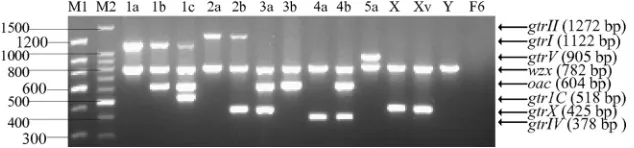
First, we performed singleplex PCR using template DNA extracted from reference strains. Each pair of primers obtained the predicted amplification product, which were 782 bp (wzx1-5),
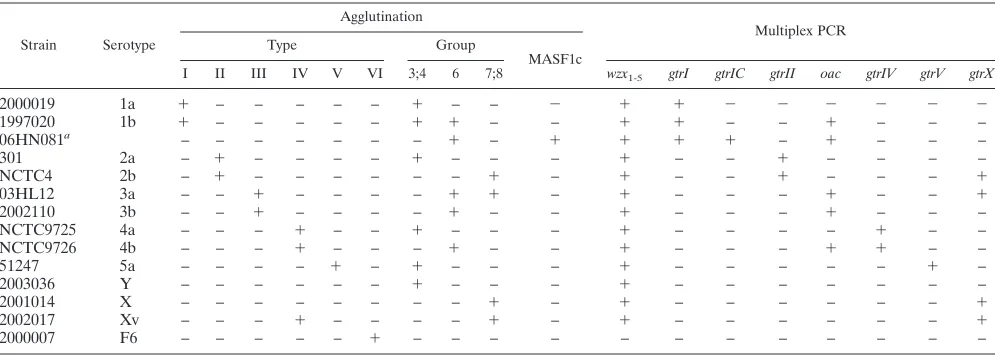
1,122 bp (gtrI), 518 bp (gtrIC), 1,272 bp (gtrII), 604 bp (oac), 378 bp (gtrIV), 905 bp (gtrV), and 425 bp (gtrX). The identity of each product was further confirmed by DNA sequencing. We then performed multiplex PCR according to the protocols de-scribed in Materials and Methods. We tested annealing tem-peratures from 54 to 63°C, and the highest yield was obtained at 55°C (data not shown). Different serotypes show specific amplification patterns, as shown in Fig. 2 and Table 1. Each
[image:2.585.43.541.531.709.2]FIG. 1. Chemical composition and specific O-antigen modification genes of different serotypes ofS. flexneri. The basic O antigen consists of repeating units of tetrasaccharide. Serotypes differ by the addition of either glucosyl or O-acetyl groups to different sugars within the tetrasaccharide repeat unit via the linkages indicated. Specific O-anti-gen modification O-anti-genes for different serotypes are indicated in paren-theses.
TABLE 1. Serotype characteristics ofS. flexnerireference strains by agglutination and multiplex PCR
Strain Serotype
Agglutination
Multiplex PCR
Type Group
MASF1c
I II III IV V VI 3;4 6 7;8 wzx1-5 gtrI gtrIC gtrII oac gtrIV gtrV gtrX
2000019 1a ⫹ – – – – – ⫹ – – ⫺ ⫹ ⫹ ⫺ ⫺ ⫺ ⫺ ⫺ ⫺
1997020 1b ⫹ – – – – – ⫹ ⫹ – – ⫹ ⫹ – – ⫹ – – –
06HN081a – – – – – – – ⫹ – ⫹ ⫹ ⫹ ⫹ – ⫹ – – –
301 2a – ⫹ – – – – ⫹ – – – ⫹ – – ⫹ – – – –
NCTC4 2b – ⫹ – – – – – – ⫹ – ⫹ – – ⫹ – – – ⫹
03HL12 3a – – ⫹ – – – – ⫹ ⫹ – ⫹ – – – ⫹ – – ⫹
2002110 3b – – ⫹ – – – – ⫹ – – ⫹ – – – ⫹ – – –
NCTC9725 4a – – – ⫹ – – ⫹ – – – ⫹ – – – – ⫹ – –
NCTC9726 4b – – – ⫹ – – – ⫹ – – ⫹ – – – ⫹ ⫹ – –
51247 5a – – – – ⫹ – ⫹ – – – ⫹ – – – – – ⫹ –
2003036 Y – – – – – – ⫹ – – – ⫹ – – – – – – –
2001014 X – – – – – – – – ⫹ – ⫹ – – – – – – ⫹
2002017 Xv – – – ⫹ – – – – ⫹ – ⫹ – – – – – – ⫹
2000007 F6 – – – – – ⫹ – – – – – – – – – – – –
a
06HN081 is an untypeable F1 strain that was positive both for MASF1c and group 6 antisera. Based on this serological reaction pattern, the strain belongs to the newly defined serotype 7b (see the text for details).
on May 16, 2020 by guest
http://jcm.asm.org/
serotype gave the expected specific PCR products. The ampli-con sizes showed good separation on 1.5% agarose gels and when two different molecular markers were used, and each PCR product could be unambiguously identified by size. The expected products for reference strains were as follows: 1a (wzx1-5andgtrI), 1b (wzx1-5,gtrI, andoac), 1c (wzx1-5,gtrI, and
gtrIC), 2a (wzx1-5 and gtrII), 2b (wzx1-5, gtrII, and gtrX), 3a (wzx1-5, oac, and gtrX), 3b (wzx1-5 and oac), 4a (wzx1-5 and
gtrIV), 4b (wzx1-5,gtrIV, andoac), 5a (wzx1-5andgtrV), X, Xv (wzx1-5 and gtrX), and Y (wzx1-5). wzx1-5 can also act as a control for PCR since it is expected to be positive for allS. flexneriserotypes except for serotype F6. There was no ampli-fication for serotype F6, as expected, because the O-antigen synthesis genes of F6 are different from those of other S. flexneriserotypes and there are no modification genes (4, 15). We attempted adding a pair of primers specific for serotype F6 to the reaction. However, since the reaction already con-tained eight primer pairs, adding an additional pair of primers
significantly increases the difficulty of optimizing the multiplex PCR. After testing three pairs of primers based on the F6-specific O-antigenwzx6 gene sequence, we failed to optimize the multiplex PCR. Without a positive means for the identifi-cation of F6 in the multiplex PCR, caution should be exercised in the interpretation of negative PCR results as the F6 sero-type. We strongly recommend confirmation of F6 serotype using singleplex PCR with the F6-specific primer pair listed in Table 3, which amplifies a 739-bp product. Since isolates would have been identified asS. flexneriusingShigellaand subgroup B polyvalent sera prior to carrying out the multiplex PCR assay, the likelihood of an F6 false positive (multiplex PCR negative) is expected to be low. Serotype F6 prevalence was 6% on average, ranging from 0% (China) to 15% (Pakistan) in Asian countries in a study by von Seidlein et al. (20). Simulta-neous singleplex F6 specific PCR may be conducted in coun-tries where the prevalence of F6 is high.
[image:3.585.44.540.81.237.2]Note that the primers used to amplify oacwere designed
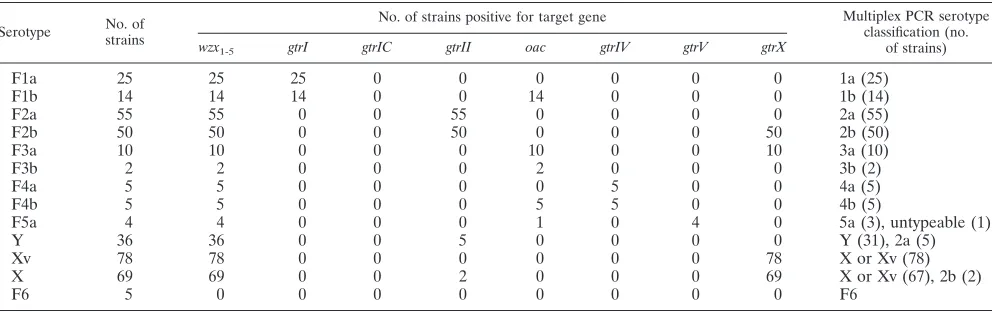
TABLE 2. Correlation of multiplex PCR and conventional serotyping for 358S. flexneristrains tested
Serotype No. of
strains
No. of strains positive for target gene Multiplex PCR serotype
classification (no. of strains) wzx1-5 gtrI gtrIC gtrII oac gtrIV gtrV gtrX
F1a 25 25 25 0 0 0 0 0 0 1a (25)
F1b 14 14 14 0 0 14 0 0 0 1b (14)
F2a 55 55 0 0 55 0 0 0 0 2a (55)
F2b 50 50 0 0 50 0 0 0 50 2b (50)
F3a 10 10 0 0 0 10 0 0 10 3a (10)
F3b 2 2 0 0 0 2 0 0 0 3b (2)
F4a 5 5 0 0 0 0 5 0 0 4a (5)
F4b 5 5 0 0 0 5 5 0 0 4b (5)
F5a 4 4 0 0 0 1 0 4 0 5a (3), untypeable (1)
Y 36 36 0 0 5 0 0 0 0 Y (31), 2a (5)
Xv 78 78 0 0 0 0 0 0 78 X or Xv (78)
X 69 69 0 0 2 0 0 0 69 X or Xv (67), 2b (2)
[image:3.585.50.539.494.692.2]F6 5 0 0 0 0 0 0 0 0 F6
TABLE 3. Primers used in this studya
Target gene
Primer Amplicon
size (bp)
Serotype
specificity Accession no.
Orientationb
Sequence (5⬘⫺3⬘)
gtrI F CTGTTAGGTGATGATGGCTTAG 1,122 1a, 1b, 1c AF139596
R ATTGAACGCCTCCTTGCTATGC
gtrII F ATTTATTGTTATTGGGGGTGGTTG 1,272 2a, 2b AF021347
R ATTTGTTCTTTATTTGCTGGTT
oac F CTGTTCGGCTTTGAAAGTGCTG 604 1b, 3a, 3b, 4b AF547987
R CGTAGGCGTACATAGCAAGCAAAGA
gtrIV F ATGTTCCTCCTTCTTCCTTT 378 4a, 4b AF288197
R TCCTGATGCTACCTTATCCA
gtrV F AATACGATTCTCCTGGTGCTAAAC 905 5a, 5b U82619
R TAGGGCATTGCTTGTATCTTTCAT
gtrX F AATGCTGGATGGGATAATCACCTT 425 2b, 3a, 5b, X, Xv L05001
R GAGACGGCTTCTCCATGTTTTGCT
wzx1-5
d F CACTTGTTGGGTATGCTGG 782 1-5, X, Xv, Y AE005674
R CCGGCAAACAGATTAGAAA
gtrIC F AGGGAATGGCATTAGGGATCGG 518 1c FJ905303
R GCTGCAAGTGGTTTTTGTTGGA
wzx6
c F TTAAGAGCGATCATTTC 739 F6 EU294165
R CCATCCAAGCGGACATT
a
Data in the last three columns apply to both orientations of each primer.
b
F, forward; R, reverse.
c
The primer pair forwzx6was used to confirm the F6 serotype. d
The primer pair forwzx1-5was used to amplify thewzxgene of all serotypes except for F6.
on May 16, 2020 by guest
http://jcm.asm.org/
based on the conserved region ofoacandoac1b, which share only 88% identity (unpublished data). Note also that a refer-ence strain for 5b was not available for testing; we expect amplification patterns of 905 bp (gtrV) and 425 bp (gtrX) for serotype 5b, based on the known O-antigen modification of 5b. Due to the unavailability of a typical serotype 1c strain, we used an F1 (untypeable) strain, 06HN081, which reacted with 1c-specific monoclonal antibody MASF1c, as a control for de-tecting the serotype 1c-specific modification gene gtrIC. In contrast to typical 1c strains, which reacted with MASF1c only, the F1 (untypeable) strain was positive both for MASF1c and for group 6 antisera. Correspondingly, thegtrICandoacgenes responsible for MASF1c and group 6 antigen were identified from the F1 (untypeable) strain by multiplex PCR and con-firmed by sequencing. These results suggest that the O-antigen of the F1 (untypeable) strain was a modification of 1b by GtrIC and is a new serotype (Table 1). This new serotype has the same serological reaction pattern as the newly proposed sero-type 7b by Forster et al. (7), suggesting that the serosero-type of 06HN081 is 7b. It should be noted that Forster et al. redefined 1c as 7a since both 7a and 7b share a positive reaction with MASF1c (7). Thus, our multiplex PCR can identify these two newly defined serotypes.
Strains of serotype Xv and serotype X presented the same amplification pattern (wzx1-5 and gtrX) by multiplex PCR. Therefore, they are classified into the same serotype Xv or X. Serotype Xv has been one of the most predominant serotypes in China since 2002 (21). It was initially named asS. flexneri
serotype 4c due to reaction with both monovalent anti-type IV serum and anti-group 7;8 serum (13). However, factors respon-sible for type IV antigenic determinant (v factor) had not been identified (21), and it is not yet feasible to develop a PCR method for typing Xv. An additional slide agglutination method using monovalent anti-type IV serum is necessary to differentiate serotype Xv from serotype X (21).
In order to evaluate the specificity of the primers used here, a multiplex PCR assay was also performed against 50 strains of otherShigellaspecies and bacterial pathogens commonly pres-ent in stool samples. No amplification was detected from any of these strains. Thus, the specificity of our multiplex PCR is 100%.
To determine whether this multiplex PCR assay was gener-ally applicable to allS. flexneristrains and to evaluate its va-lidity, 358S. flexneristrains of various serotypes were analyzed by this method (Table 2). All except eight isolates determined by multiplex PCR were the same as that determined by slide agglutination, with a concordance rate of 97.8%. For the eight exceptions, five, one, and two isolates were serotypes Y, 5a,
and X, respectively (Table 2). A multiplex PCR showed that the serotype Y and X isolates were originally 2a and 2b, re-spectively, while the serotype 5a strain (NCTC8523) was orig-inally a novel F5 serotype. Sequencing revealed that for the five Y isolates, four were due to frameshift mutations ingtrIIwith one having a four-base deletion (bases 1197 to 1282) and three having a single base deletion (base 1031). One has an intact
gtrII, but the defect may lie in elsewhere. For the two serotype X strains, both had a single base deletion (base 1024) ingtrII. The anomalous serotype 5a isolate possesses unexpectedly an
oac gene. DNA sequencing found that there is a two-base deletion (bases 345 to 346) in theoacgene, rendering it de-fective in this isolate. Serotype Y strains carrying a dede-fective
gtrII gene have been reported previously. One case was an insertion sequence disruption of gtrII, while another was a single amino acid residual change leading to an inactive GtrII (5, 14). The higher number ofgtrIImutations found in serotype 2a and 2bS. flexneristrains may be due to a higher proportion of these serotypes in nature.
This study developed a multiplex PCR method for molecular serotyping ofS. flexneri. With a single reaction, most serotypes (14 of 15) recognized up to now can be easily and specifically identified. In contrast to the conventional slide agglutination method, which needs up to 10 separate reactions to identify the serotype of an isolate, the multiple PCR assay saves time and does not require expensive antisera, especially for high-throughput serotype identification. PCR results can be ob-tained in less than 3.5 h, and isolates in batches of 96 (depend-ing on the capacity of the thermocycler) can be processed simultaneously. The cost of PCR typing is only 25% of the cost of agglutination based serotyping in our experience, providing a substantial saving. The disadvantage of molecular serotyping is the presence of cryptic/defective O-antigen modification genes that can give rise to discordant results with serology-based typing. However, the proportion of such strains is small. On the other hand, this variation offers further differentiation than conven-tional agglutination-based serotyping. This method is available for high-throughput detection in any laboratories equipped with PCR facilities.
ACKNOWLEDGMENTS
This study was supported by grants 2011CB504901, 2008ZX10004-008, 2008ZX10004-009, 2009ZX10004-203, 2011SKLID203, 2008SKLID106, and YB20098450101 from the Ministry of Science and Technology and the State Key Laboratory for Infectious Disease Prevention and Control, People’s Republic of China.
[image:4.585.134.451.70.144.2]We thank Naresh Verma for providing thegtrICsequence. FIG. 2. Multiplex PCR products ofS. flexnerireference strains representing all 15 serotypes. PCR products were electrophoresed on a 1.5% (wt/vol) agarose gel, stained with ethidium bromide, and photographed under UV light. Serotypes are indicated above the lanes. M1 and M2, 150-and 100-bp DNA ladder markers (TaKaRa, Japan).
on May 16, 2020 by guest
http://jcm.asm.org/
REFERENCES
1.Adams, M. M., G. E. Allison, and N. K. Verma.2001. Type IV O antigen modification genes in the genome ofShigella flexneriNCTC 8296. Microbi-ology147:851–860.
2.Adhikari, P., G. Allison, B. Whittle, and N. K. Verma.1999. Serotype 1a O-antigen modification: molecular characterization of the genes involved and their novel organization in theShigella flexnerichromosome. J. Bacteriol. 181:4711–4718.
3.Allison, G. E., and N. K. Verma.2000. Serotype-converting bacteriophages and O-antigen modification inShigella flexneri. Trends Microbiol.8:17–23. 4.Cheah, K. C., D. W. Beger, and P. A. Manning.1991. Molecular cloning and
genetic analysis of therfbregion fromShigella flexneritype 6 inEscherichia coliK-12. FEMS Microbiol. Lett.67:213–218.
5.Chen, J. H., W. B. Hsu, C. S. Chiou, and C. M. Chen.2003. Conversion of Shigella flexneriserotype 2a to serotype Y in a shigellosis patient due to a single amino acid substitution in the protein product of the bacterial gluco-syltransferasegtrIIgene. FEMS Microbiol. Lett.224:277–283.
6.Clark, C. A., J. Beltrame, and P. A. Manning.1991. Theoacgene encoding a lipopolysaccharide O-antigen acetylase maps adjacent to the integrase-encoding gene on the genome ofShigella flexneribacteriophage Sf6. Gene 107:43–52.
7.Forster, R. A., et al.Structural elucidation of the O-antigen of theShigella flexneriprovisional serotype 88-893: structural and serological similarities withS. flexneriprovisional serotype Y394 (1c). Carbohydr. Res.346:872–876. 8.Guan, S., D. A. Bastin, and N. K. Verma.1999. Functional analysis of the O antigen glucosylation gene cluster ofShigella flexneribacteriophage SfX. Microbiology145:1263–1273.
9.Huan, P. T., D. A. Bastin, B. L. Whittle, A. A. Lindberg, and N. K. Verma. 1997. Molecular characterization of the genes involved in O-antigen modi-fication, attachment, integration and excision inShigella flexneri bacterio-phage SfV. Gene195:217–227.
10.Kotloff, K. L., et al.1999. Global burden ofShigellainfections: implications
for vaccine development and implementation of control strategies. Bull. World Health Organ.77:651–666.
11.Li, Y., et al.2009. Molecular detection of all 34 distinct O-antigen forms of Shigella. J. Med. Microbiol.58:69–81.
12.Mavris, M., P. A. Manning, and R. Morona.1997. Mechanism of bacterio-phage SfII-mediated serotype conversion inShigella flexneri. Mol. Microbiol. 26:939–950.
13.Pryamukhina, N. S., and N. A. Khomenko.1988. Suggestion to supplement Shigella flexnericlassification scheme with the subserovarShigella flexneri4c: phenotypic characteristics of strains. J. Clin. Microbiol.26:1147–1149. 14.Roberts, F., A. V. Jennison, and N. K. Verma.2005. TheShigella flexneri
serotype Y vaccine candidate SFL124 originated from a serotype 2a back-ground. FEMS Immunol. Med. Microbiol.45:285–289.
15.Simmons, D. A., and E. Romanowska.1987. Structure and biology ofShigella flexneriO antigens. J. Med. Microbiol.23:289–302.
16.Stagg, R. M., P. D. Cam, and N. K. Verma.2008. Identification of newly recognized serotype 1c as the most prevalentShigella flexneriserotype in northern rural Vietnam. Epidemiol. Infect.136:1134–1140.
17.Stagg, R. M., et al.2009. A novel glucosyltransferase involved in O-antigen modification ofShigella flexneriserotype 1c. J. Bacteriol.191:6612–6617. 18.Talukder, K. A., et al.2003. Phenotypic and genotypic characterization of
provisional serotypeShigella flexneri1c and clonal relationships with 1a and 1b strains isolated in Bangladesh. J. Clin. Microbiol.41:110–117. 19.Verma, N. K., J. M. Brandt, D. J. Verma, and A. A. Lindberg.1991.
Molec-ular characterization of theO-acetyl transferase gene of converting bacte-riophage SF6 that adds group antigen 6 toShigella flexneri. Mol. Microbiol. 5:71–75.
20.von Seidlein, L., et al.2006. A multicentre study ofShigelladiarrhoea in six Asian countries: disease burden, clinical manifestations, and microbiology. PLoS Med.3:e353.
21.Ye, C., et al.2010. Emergence of a new multidrug-resistant serotype X variant in an epidemic clone ofShigella flexneri. J. Clin. Microbiol.48:419– 426.