www.impactjournals.com/oncotarget/ Oncotarget, 2016, Vol. 7, (No. 52), pp: 87284-87300
Identification of aberrantly expressed glycans in gastric cancer
by integrated lectin microarray and mass spectrometric analyses
Xiang Li1,2, Feng Guan2,3, Dongliang Li3,4, Zengqi Tan3, Ganglong Yang3, Yanli Wu3, Zhaohui Huang11Wuxi Oncology Institute, Affiliated Hospital of Jiangnan University, Wuxi, Jiangsu, China 2College of Life Science, Northwest University, Xi’an, Shannxi, China
3The Key Laboratory of Carbohydrate Chemistry & Biotechnology, Ministry of Education, School of Biotechnology, Jiangnan
University, Wuxi, China
4Bioimaging Core, Faculty of Health Sciences, University of Macau, Taipa, Macau SAR, China Correspondence to: Zhaohui Huang, email: [email protected]
Keywords: gastric cancer, lectin microarray, lectin histochemistry, mass spectrometry, N-glycan Received: May 12, 2016 Accepted: November 01, 2016 Published: November 24, 2016
ABSTRACT
Cancer progression is usually associated with alterations of glycan expression patterns. Little is known regarding global glycomics in gastric cancer, the most common type of epithelial cancer. We integrated lectin microarray and mass spectrometry (MS) methods to profile glycan expression in three gastric cancer cell lines (SGC-7901, HGC-27, and MGC-803) and one normal gastric epithelial cell line (GES-1). Significantly altered glycans were confirmed by lectin staining and MALDI-TOF/TOF-MS. The three cancer cell lines showed increased levels of core-fucosylated N-glycans, GalNAcα-Ser/Thr (Tn antigen), and Sia2-6Galβ1-4GlcNAc N-glycans, but reduced levels of biantennary N-glycans, Galβ1-3GalNAcα-Ser/Thr (T antigen), and (GlcNAc)n N-glycans. Lectin histochemistry was used to validate aberrant expression of four representative glycans (core-fucosylation, Sia2-6Galβ1-4GlcNAc, biantennary N-glycans, T antigen, recognized respectively by lectins LCA, SNA, PHA-E+L, and ACA) in clinical gastric cancer samples. Lower binding capacity for ACA was correlated with significantly poorer patient prognosis. Our findings indicate for the first time that glycans recognized by LCA, ACA, and PHA-E+L are aberrantly expressed in gastric cancer, and suggest that ACA is a potential prognostic factor for gastric cancer.
INTRODUCTION
Gastric cancer is a common epithelial cancer and the second leading cause of cancer death worldwide [1, 2]. In China, ~400,000 new cases of gastric cancer and ~300,000 deaths from the disease were reported during 2005-2010, making it the second most common type of cancer [3, 4]. New prognostic biomarkers are needed to facilitate early diagnosis of cancer, improve treatment outcome, and prolong patient survival. Early detection of gastric cancer typically relies on endoscopic examination, and diagnostic accuracy depends on the skill of the endoscopist [5]. More reliable tissue or serum biomarkers for early diagnosis of gastric cancer are highly desirable.
Glycosylation is a common post-translational
modification estimated to occur in >70% of human proteins
[6]. It plays crucial roles in molecular recognition, cell-cell
adhesion, molecular trafficking, receptor activation, signal transduction, and endocytosis [7]. Aberrant protein
glycosylation often occurs during malignant transformation,
leads to formation of specific tumor-associated glycans,
and is associated with tumor invasiveness, metastasis, and overall poor prognosis [8, 9].
Several studies have suggested aberrant expression of glycans in gastric cancer cells. Serum levels of sialyl Lewisx, sialyl Lewisa, and sialyl-Tn antigens were elevated in gastric cancer patients [10]. Ishizuka et al found that complex type N-glycans were accumulated in gastric
cancer cell lines MKN7 and MKN45 [11]. Huang et al [12] proposed that two lectins (VVA and MPL) are potential
biomarkers for distinguishing gastric cancer from gastric
ulcer. However, to date glycans have not been extensively applied as clinical tumor biomarkers because of (i) technical difficulties in glycan purification and analysis,
www.impactjournals.com/oncotarget
and (ii) variations in accuracy depending on the analytical method and type of equipment [13]. An integrated strategy is needed for identification of aberrantly expressed glycans
in gastric cancer.
In the present study, we used an approach integrating
lectin microarray and mass spectrometry (MS) to
quantitatively analyze glycan expression in gastric cancer
cells and normal gastric epithelial cells, and confirmed
our results in clinical gastric cancer tissues and their
adjacent noncancerous tissues. Our findings indicate that (i) core-fucosylation, biantennary N-glycans, and Galβ1-3GalNAcα-Ser/Thr (T antigen), recognized respectively by the lectins LCA, PHA-E+L, and ACA, are aberrantly expressed in gastric cancer, and (ii) ACA is a potential
prognostic tool for gastric cancer.
RESULTS
Glycopattern analysis of normal gastric and gastric cancer cell lines
Patterns of glycoproteins reflect the expression,
function, and metabolism of oligosaccharides in cells.
We used lectin microarrays containing 37 lectins
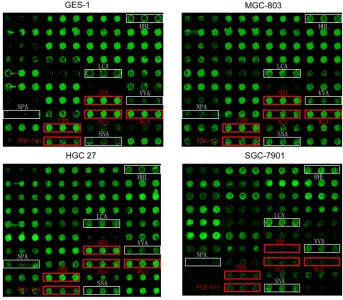
(Supplementary Table S2), two negative controls (BSA), and one positive control (Cy3-BSA) (Supplementary Figure S1) to analyze fine glycan structures of glycoproteins in GES-1, SGC-7901, HGC-27, and MGC-803 cells. Significant differences (fold change >1.5 observed in at least two gastric cancer cell lines)
[image:2.612.134.477.371.671.2]of glycans recognized by 10 different lectins were observed for cancer cells in comparison with normal cells
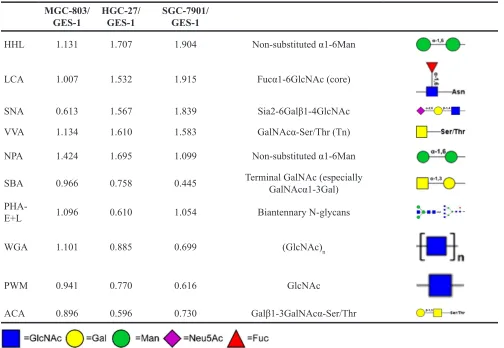
(Figure 1). Gastric cancer cells had higher expression of five glycan structures recognized by lectins HHL, LCA, NPA, VVA, and SNA, and lower expression of five glycan structures recognized by SBA, PWM, ACA, WGA, and PHA-E+L (Table 1).
Increased staining by SNA (recognizing Sia2-6Galβ1-4GlcNAc), LCA (recognizing Fucα1-6GlcNAc), VVA (recognizing GalNAcα-Ser/Thr (Tn antigen)) indicated elevated levels of α2-6 sialylation, core-fucosylation, and Tn antigen in MGC-803, HGC-27, and SGC-7901 cells, respectively. Fluorescence intensity of HHL and NPA (recognizing non-substituted α1-3 and α1-6Man) was also higher in these gastric cancer cell
lines, suggesting increased expression of
high-mannose-type N-glycans. Reduced fluorescence intensity of PHA-E+L and ACA indicated down-regulation of tri-and tetra-antennary structures tri-and
Galβ1-3GalNAcα-Figure 1: Glycan profiles of gastric cancer and normal gastric cell lines obtained by lectin microarray analysis. Differentially expressed glycans in three gastric cancer cell lines (SGC-7901, HGC-27, and MGC-803) and one normal gastric epithelial cell line (GES-1). White boxes: fluorescence intensities of lectins higher in gastric cancer cells. Red boxes: fluorescence intensities of
Ser/Thr structure, and reduced SBA, WGA, and PWM fluorescence intensity indicated lower expression of terminal GalNAc and GlcNAc, in gastric cancer cells (Figure 1B; Table 1).
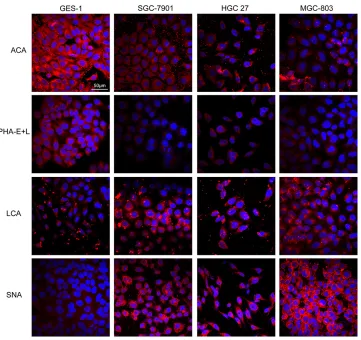
Because the glycans recognized by ACA, PHA-E+L, LCA, and SNA are known to be aberrantly expressed
in several types of cancer, we selected these four lectins for the validation of differentially expressed glycans in our experimental cell lines. The three gastric cancer cell
lines showed higher fluorescence signal intensities of LCA and SNA but lower intensities of PHA-E+L and ACA,
consistent with the results of lectin microarray analysis
(Figure 2).
N-Glycan profiles obtained by matrix-assisted laser desorption/ ionization time-of-flight mass
spectrometry (MALDI-TOF/TOF-MS)
N-Glycans are involved in cell-cell and cell-matrix
interactions, receptor-mediated functions, and specific protein functions [14, 15]. Aberrant N-glycosylation
patterns have been observed in many types of tumors, suggesting the potential use of cancer-associated N-glycans
as tumor biomarkers [16–18]. We used MALDI-TOF/
TOF-MS to profile total N-glycans in GES-1, SGC-7901, HGC-27, and MGC-803 cells and observed abnormal
N-glycosylation of gastric cancer.
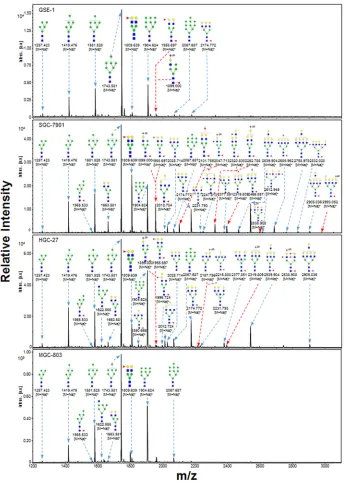
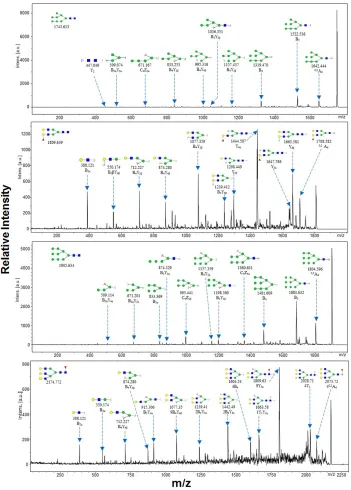
Representative MALDI-TOF/TOF-MS spectra of N-glycans with signal-to-noise ratios >3 from total
glycoproteins were annotated using the GlycoWorkbench
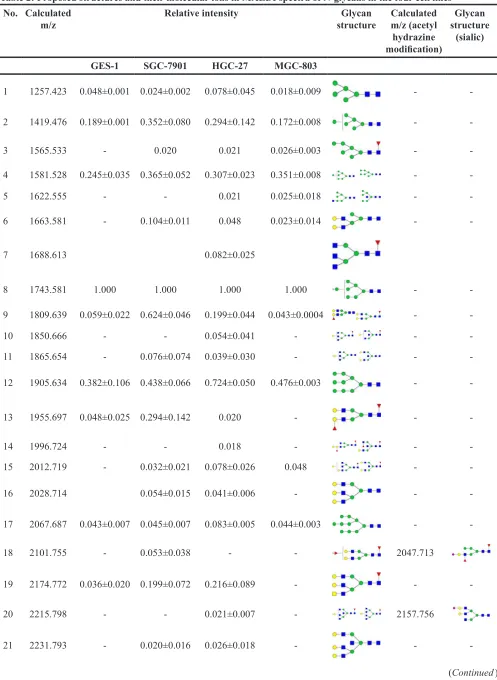
software program (Figure 3). GES-1, SGC-7901, HGC-27, and MGC-803 cells showed 9, 22, 18, and 10 distinct m/z N-glycans in both two independent experiments,
respectively. Nine N-glycan structures were present in
all four cell lines. SGC-7901 and HGC-27 cells had
ten and four unique N-glycan structures, respectively
(Table 2). MALDI-TOF/TOF-MS analysis per se is
not sufficient to yield detailed glycan composition. Therefore, MALDI-TOF/TOF-MS was further performed
to obtain detailed information regarding substitutions and branching patterns of monosaccharide constituents.
Tandem MS spectra of precursor ions with m/z 1743.613, 1809.639, 1905.634, and 2174.772 are shown in Figure
4. Structures of mannose branches were revealed by
fragment ions B4Y3β (833.253) and B4Y5β (1157.437) in
[image:3.612.57.561.73.421.2]m/z 1743.613. The presence of fucose was indicated by B4Y6β (1239.41) in m/z 1809.639 and by Y1 (2028.714) in m/z 2174.772.
Table 1: Differential glycopatterns of four cell lines (three gastric cancer and one normal gastric epithelia), determined by lectin microarray analysis
MGC-803/
GES-1 HGC-27/ GES-1 SGC-7901/GES-1
HHL 1.131 1.707 1.904 Non-substituted α1-6Man
LCA 1.007 1.532 1.915 Fucα1-6GlcNAc (core)
SNA 0.613 1.567 1.839 Sia2-6Galβ1-4GlcNAc VVA 1.134 1.610 1.583 GalNAcα-Ser/Thr (Tn)
NPA 1.424 1.695 1.099 Non-substituted α1-6Man
SBA 0.966 0.758 0.445 Terminal GalNAc (especially GalNAcα1-3Gal)
PHA-E+L 1.096 0.610 1.054 Biantennary N-glycans
WGA 1.101 0.885 0.699 (GlcNAc)n
PWM 0.941 0.770 0.616 GlcNAc
www.impactjournals.com/oncotarget
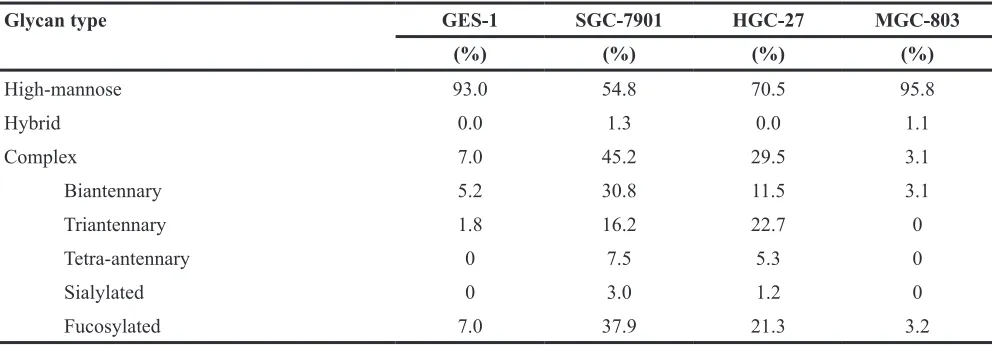
Relative variation of major types of N-glycans in the four cell lines is summarized in Table 3. The percentage of high-mannose-type N-glycan structures
was greater (93.0%) in GES-1 than in SGC-7901 (54.8%) or HGC-27 (70.5%). In contrast, complex-type N-glycan structures had a lower percentage in GES-1 (7.0%) than in SGC-7901 (45.2%) or HGC-27 (29.5%). Bi-, tri-, tetra-,
and penta-antennary N-glycan structures (particularly
triantennary) were suppressed in GES-1. Percentages of
fucosylated complex-type N-glycan structures were higher
in SGC-7901 (37.9%) and HGC-27 (21.3%) than in GES-1 (7.0%). The role of sialylated N-glycans in gastric cancer was investigated using acetohydrazide, which modifies both α2-3-linked and α2-6-linked sialic acids. Sialylated
N-glycans were then annotated using the GlycoWorkbench
program (Figure 3; sialic acid residues labeled as “Ah”).
O-Glycan profiles obtained by MALDI-TOF-MS
Representative MALDI-TOF-MS spectra of O-glycans with signal-to-noise ratios >4 from total
glycoproteins were also annotated using GlycoWorkbench
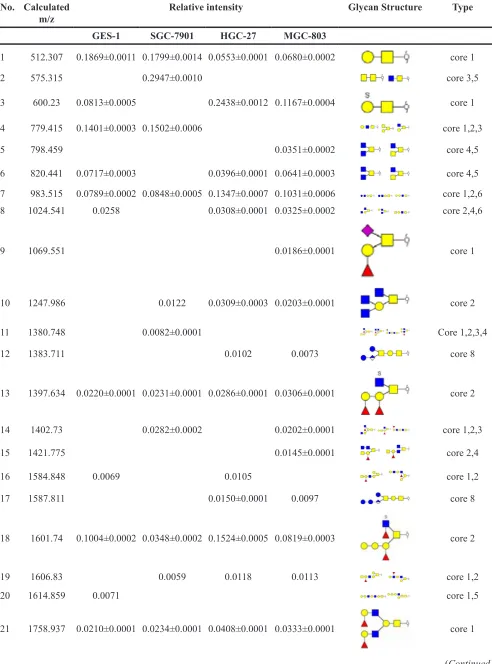
software program. A total of 36 O-glycan structures were
identified in the four cell lines, 22 in GES-1, 21 in SGC-7901, 25 in HGC-27, and 29 in MGC-803 (Figure 5 and Table 4). A total of 12 O-glycans were presented in all the four cells. Two O-glycans with m/z 1247.986 ((Glc NAc)3(Gal)1(GalNAc)1) and 1606.830 ((Fuc)1(GlcNAc)2 (Gal)3(GalNAc)1) were specifically identified in SGC-7901, HGC-27, and MGC-803. One O-glycans with m/z 1614.859 ((GlcNAc)1(Gal)4(GalNAc)2) was specifically identified in GES-1. Interestingly, the relative intensity of Thomsen-Friedenreich antigen (TF antigen or T antigen) with m/z 512.307 (Gal(β1-3)GalNAc) was greater (18.69%) in GES-1 than in HGC-27 (5.53%) or MGC-803 (6.80%), and slightly higher in GES-1 than SGC-7901 (17.99%) (Table 4).
Validation of differential glycopatterns in clinical
gastric cancer tissues by lectin histochemistry
Expression levels of LCA, SNA, ACA, and PHA-E+L in gastric cancer cells were significantly different from those
[image:4.612.129.490.342.682.2]in normal gastric epithelial cells. We examined the expression of the glycans recognized by these four lectins in clinical gastric cancer tissues and adjacent non-cancerous tissues
(Figure 6A). Aberrant expression of the glycans recognized by LCA, PHA-E+L, and ACA was consistent with findings for gastric cancer cell lines (Figure 6B). In contrast, binding of SNA to clinical gastric cancer tissues vs. adjacent non-cancerous tissues was not significantly different (Figure 6B).
To further evaluate the potential clinical value of these glycan structures in gastric cancer prognosis,
patients were classified into “relatively high” and “relatively low” groups using the median level of each
lectin in tumor tissues as a cutoff value. Notably, reduced
ACA binding in gastric cancer was significantly correlated
with higher TNM stage (r= -0.204, P= 0.026) and poorer
prognosis (P= 0.008) (Figure 7). After adjusting for age,
gender, T stage, N stage, TNM stage and tumor grade,
Cox multivariate analyses showed that ACA expression
is an independent prognostic factor for gastric cancer
[image:5.612.136.480.187.669.2](HR=0.355; 95% CI= 0.198-0.636, P= 0.001). No significant associations were observed between binding capacities of the other three lectins (LCA, SNA, PHA-E+L) and clinicopathologic features of gastric cancer.
Figure 3: MALDI-TOF/TOF-MS spectra of total N-glycans in the four cell lines. N-glycans were characterized in the four
www.impactjournals.com/oncotarget
Table 2: Proposed structures and their molecular ions in MALDI spectra of N-glycans in the four cell lines No. Calculated
m/z Relative intensity structureGlycan Calculated m/z (acetyl
hydrazine modification)
Glycan structure
(sialic)
GES-1 SGC-7901 HGC-27 MGC-803
1 1257.423 0.048±0.001 0.024±0.002 0.078±0.045 0.018±0.009 -
-2 1419.476 0.189±0.001 0.352±0.080 0.294±0.142 0.172±0.008 -
-3 1565.533 - 0.020 0.021 0.026±0.003 -
-4 1581.528 0.245±0.035 0.365±0.052 0.307±0.023 0.351±0.008 -
-5 1622.555 - - 0.021 0.025±0.018 -
-6 1663.581 - 0.104±0.011 0.048 0.023±0.014 -
-7 1688.613 0.082±0.025
8 1743.581 1.000 1.000 1.000 1.000 -
-9 1809.639 0.059±0.022 0.624±0.046 0.199±0.044 0.043±0.0004 -
-10 1850.666 - - 0.054±0.041 - -
-11 1865.654 - 0.076±0.074 0.039±0.030 - -
-12 1905.634 0.382±0.106 0.438±0.066 0.724±0.050 0.476±0.003 -
-13 1955.697 0.048±0.025 0.294±0.142 0.020 - -
-14 1996.724 - - 0.018 - -
-15 2012.719 - 0.032±0.021 0.078±0.026 0.048 -
-16 2028.714 0.054±0.015 0.041±0.006 - -
-17 2067.687 0.043±0.007 0.045±0.007 0.083±0.005 0.044±0.003 -
-18 2101.755 - 0.053±0.038 - - 2047.713
19 2174.772 0.036±0.020 0.199±0.072 0.216±0.089 - -
-20 2215.798 - - 0.021±0.007 - 2157.756
21 2231.793 - 0.020±0.016 0.026±0.018 - -
No. Calculated
m/z Relative intensity structureGlycan Calculated m/z (acetyl
hydrazine modification)
Glycan structure
(sialic)
GES-1 SGC-7901 HGC-27 MGC-803
22 2247.813 - 0.015 - - -
-23 2320.829 - 0.051±0.038 - - 2262.788
24 2377.851 - 0.010±0.001 0.038±0.003 - -
-25 - - 0.069 0.020 - 2319.809
26 2393.846 0.036±0.0002
27 2466.887 - 0.028 - - -
-28 2539.904 - 0.214±0.077 0.147±0.048 - -
-29 - - 0.017±0.014 0.015±0.012 - 2538.908
30 2612.945 - 0.009 - - -
-31 2685.962 - 0.036±0.027 - - -
-32 2758.978 - 0.006±0.001 - - -
-33 2832.02 - 0.013 - - -
-34 2905.036 - 0.011±0.003 0.020±0.006 - -
-35 - - 0.006 - - 2993.052
N-glycans with SD were identified in two independent experiments, and N-glycans without SD were identified in only one
www.impactjournals.com/oncotarget
DISCUSSION
Altered (aberrant) expression of N-glycans,
O-glycans, and other glycoconjugates is often associated with tumor development and progression [19–21]. Gastric cancer is the most common type of epithelial cancer
worldwide; however, the functional roles of glycosylation in gastric cancer remain mostly unclear. Better understanding
of these functional roles requires more sophisticated and
comprehensive analytical techniques. In this study, we
integrated By integrating lectin microarray analysis with mass spectrometry, we were able to globally profile glycan
expression in gastric cancer cells, and validate aberrant glycan expression in clinical gastric cancer tissues using
specific lectins.
[image:8.612.132.483.181.671.2]Lectin-based methodology is capable of revealing glycan structures of all glycoconjugates, i.e., glycoproteins, glycolipids, and glycosaminoglycans [22]. There are
three effective lectin-based methods: (i) Simultaneous
quantitative analysis of N-glycans and O-glycans using lectin microarrays with intact biological structures, following minimal sample preparation without release
or derivatization of glycans [23, 24]. (ii) Lectin staining for identification and localization of glycoproteins and
glycolipids in cells and tissues, and detection of subtle
alterations in cellular glycosylation [25]. (iii) Lectin
histochemistry, which is easily performed in a variety of
cells, frozen or cryostat sections, and formalin-fixed or paraffin-embedded surgical specimens [26]. Combined application of these three methods ensures identification
of correct glycosylation status in gastric cells or clinical
samples. Using lectin microarray analysis, Huang et al. showed that VVA and MPL can be used as biomarkers to
distinguish gastric cancer from gastric ulcer[12].
MS is a rapid and sensitive technique to detect
glycan components and glycome profile of a biological sample [27]. The integrated strategy used in the present
study and validation in both cell lines and clinical samples,
led to several important findings. Gastric cancer cells
showed clearly increased expression of core-fucosylated
N-glycans, GalNAcα-Ser/Thr (Tn antigen), and Sia2-6Galβ1-4GlcNAc N-glycans, but decreased expression of biantennary N-glycans, Galβ1-3GalNAcα-Ser/Thr (T antigen), and (GlcNAc)n N-glycans (Table 1).
Lectin microarray, lectin staining, and lectin histochemical analyses of gastric cancer cells and clinical samples revealed differential expression of core-fucosylation, biantennary N-glycans, and T antigen
(recognized by LCA, PHA-E+L, and ACA, respectively),
suggesting that these glycans are involved in development and progression of gastric cancer. There is increasing evidence for a role of core-fucose residue in a variety of physiological and pathological processes. Levels of
core-fucosylated N-glycans (recognized by LCA) in certain
serum proteins are undetectable in normal cells, but are higher in cancer cells [28–30]. On the other hand, Chen et al. observed lower total abundance of core-fucosylated
residues in sera of gastric cancer patients [31]. In the present study, levels of core-fucosylated N-glycans were
significantly higher in gastric cancer cells than in normal
epithelial cells. Core-fucosylation, which is catalyzed
by α1,6-fucosyltransferase (Fut8) in mammalian tissues,
plays multiple roles in cancer. Increased core-fucosylation has been reported in prostate, ovarian, pancreatic, and
non-small cell lung cancers [32]. High levels of
core-fucose were also observed during the process of epithelial-mesenchymal transition [32]. Depletion of core-fucose in human IgG1 enhances antibody-dependent cell-mediated cytotoxicity during cancer therapy [33]. Disruption of the Fut8 gene in mice resulted in growth retardation, death during postnatal development, and lung emphysema [34].
In a study by Shimada et al., cancer patients and normal subjects showed similar levels of total free
sialic acids [35]. However, levels of most sialylated oligosaccharides, and of α2-3 (but not α2-6) sialic acid
that binds to lactose, were higher in advanced cancer patients than in normal subjects [35, 36]. In the present
study, α2-6 sialic acid (recognized by SNA) was higher in gastric cancer cells than in normal cells, but no significant
difference was observed between clinical gastric cancer samples and corresponding normal tissues. Larger sample sizes of gastric cancer at various stages will be required to clarify this point.
A high concentration of Tn antigen on the surface of
cancer cells is often associated with aggressive or highly malignant properties. T antigen is formed by addition of
one Gal residue to GalNAc to yield Gal(β1-3)GalNAc. We observed lower levels of T antigen (recognized by ACA)
in gastric cancer cells correspondence the results from
lectin array and O-glycan/N-glycan analysis, in contrast
to previous reports of high T antigen levels in sera of
gastric cancer patients [37]. A possible explanation of
high Tn antigen level but low T antigen level in gastric
cancer cells is the decreased enzymatic activity of
[image:9.612.59.561.62.235.2]β1,3-galactosyltransferase, which adds Gal to Tn substrate to form T antigen. Our survival analysis and multivariate Table 3: Relative variation of major types of N-glycans in the four cell lines
Glycan type GES-1 SGC-7901 HGC-27 MGC-803
(%) (%) (%) (%)
High-mannose 93.0 54.8 70.5 95.8
Hybrid 0.0 1.3 0.0 1.1
Complex 7.0 45.2 29.5 3.1
Biantennary 5.2 30.8 11.5 3.1
Triantennary 1.8 16.2 22.7 0
Tetra-antennary 0 7.5 5.3 0
Sialylated 0 3.0 1.2 0
www.impactjournals.com/oncotarget
Figure 5: MALDI-TOF/TOF-MS spectra of total O-glycans in the four cell lines. O-glycans were characterized in the four
Table 4: Proposed structures and their molecular ions in MALDI spectra of O-linked glycans in the four cell lines No. Calculated
m/z Relative intensity Glycan Structure Type
GES-1 SGC-7901 HGC-27 MGC-803
1 512.307 0.1869±0.0011 0.1799±0.0014 0.0553±0.0001 0.0680±0.0002 core 1
2 575.315 0.2947±0.0010 core 3,5
3 600.23 0.0813±0.0005 0.2438±0.0012 0.1167±0.0004 core 1
4 779.415 0.1401±0.0003 0.1502±0.0006 core 1,2,3
5 798.459 0.0351±0.0002 core 4,5
6 820.441 0.0717±0.0003 0.0396±0.0001 0.0641±0.0003 core 4,5
7 983.515 0.0789±0.0002 0.0848±0.0005 0.1347±0.0007 0.1031±0.0006 core 1,2,6 8 1024.541 0.0258 0.0308±0.0001 0.0325±0.0002 core 2,4,6
9 1069.551 0.0186±0.0001 core 1
10 1247.986 0.0122 0.0309±0.0003 0.0203±0.0001 core 2
11 1380.748 0.0082±0.0001 Core 1,2,3,4
12 1383.711 0.0102 0.0073 core 8
13 1397.634 0.0220±0.0001 0.0231±0.0001 0.0286±0.0001 0.0306±0.0001 core 2
14 1402.73 0.0282±0.0002 0.0202±0.0001 core 1,2,3
15 1421.775 0.0145±0.0001 core 2,4
16 1584.848 0.0069 0.0105 core 1,2
17 1587.811 0.0150±0.0001 0.0097 core 8
18 1601.74 0.1004±0.0002 0.0348±0.0002 0.1524±0.0005 0.0819±0.0003 core 2
19 1606.83 0.0059 0.0118 0.0113 core 1,2
20 1614.859 0.0071 core 1,5
21 1758.937 0.0210±0.0001 0.0234±0.0001 0.0408±0.0001 0.0333±0.0001 core 1
www.impactjournals.com/oncotarget
analyses showed that prognosis was significantly worse for patients with low (vs. high) ACA binding capacity, suggesting that glycans recognized by ACA are potential
prognostic factors for gastric cancer.
PHA-E+L includes PHA-E and PHA-L, which recognize bisecting GlcNAc and biantennary N-glycans, respectively. Overexpression of bisecting GlcNAc
inhibited tumor progression in mice, perhaps through an effect on growth factor signaling [38]. Our lectin
microarray analysis revealed no significant changes in bisecting GlcNAc, and reduced expression of biantennary
N-glycans was observed in gastric cancer cells and clinical
cancer tissue samples. We consider biantennary N-glycan
as the novel identified N-glycan in this study.
Taken together, our findings from lectin microarray
analysis, MS, and histochemical staining demonstrate increased expression of Tn antigen, N-glycan structures, and core-fucosylated N-glycans, and reduced expression of T antigen and biantennary N-glycans in gastric cancer cells and clinical samples. Our follow-up studies, in progress, are focused on alterations of these glycans and their related genes at the molecular level, the glycoproteins to which the altered glycans bind, and the roles of these glycans in functional modulation of the glycoproteins in gastric cancer. No. Calculated
m/z Relative intensity Glycan Structure Type
GES-1 SGC-7901 HGC-27 MGC-803
22 1777.932 0.0061 core 2
23 1788.948 0.0106 0.0108±0.0001 0.0209±0.0001 0.0099 core 1
24 1791.911 0.0213±0.0001 0.0161±0.0001 0.0144±0.0001 core 8
25 1834.941 0.0296±0.0001 0.0136±0.0001 0.0370±0.0001 0.0275±0.0001 core 2,3
26 1857.969 0.0132 core 1,2
27 1963.037 0.0077 0.0127 0.0155 core 1
28 1996.035 0.0137±0.0001 0.0122±0.0001 0.0105 0.0143 core 2,4
29 2009.03 0.1310±0.0006 0.1006±0.000 0.0752±0.0003 0.1404±0.0004 core 2
30 2039.041 0.0177±0.0001 0.0103 0.0140 core 2
31 2167.137 0.0259±0.0002 0.0215±0.0001 0.0187±0.0001 0.0291±0.0001 core 1,2
32 2199.047 0.0279±0.0001 0.0.45±0.0001 0.0208±0.0001 core 2
33 2243.14 0.0421±0.000 0.0177±0.0001 0.0233±0.0001 0.0298±0.0001 core 1
34 2370.204 0.0082 0.0076 core 3
35 2417.23 0.0841±0.0007 0.0434±0.0001 0.0648±0.0003 0.0764±0.0002 core 2
Figure 7: Kaplan-Meier overall survival curves for gastric cancer patients classified according to relative expression levels of four lectins. Patients were classified into “relatively high” and “relatively low” groups using the median expression level of ACA A., LCA B., PHA-E+L C., or SNA D. in gastric cancer tissues as respective cutoff value.
Figure 6: Differential glycopatterns in gastric cancer and normal gastric epithelial tissues evaluated by lectin histochemistry. Four lectins (ACA, LCA, PHA-E+L, SNA) were used. Lectin histochemistry was performed in duplicate, and
[image:13.612.167.449.438.681.2]www.impactjournals.com/oncotarget
MATERIALS AND METHODS
Cell lines and clinical samples
Gastric cancer cell lines SGC-7901 (metastatic stomach adenocarcinoma derived cell), HGC-27 (undifferentiated stomach adenocarcinoma cell), and
MGC-803 (poorly differentiated stomach mucinous
adenocarcinoma cell), and immortalized normal gastric
epithelial cell line GES-1, were obtained from the Cell
Bank of the Chinese Academy of Sciences (Shanghai). All cells were cultured in RPMI 1640 (HyClone; Logan, UT, USA) containing 10% fetal bovine serum (Gibco; Carlsbad, CA, USA) and 1× penicillin/ streptomycin (Gibco) at 37 °C in 5% CO2 atmosphere.
Tissue microarrays including 120 pairs of gastric tissues and adjacent normal tissues (Supplementary Table
S1) were supplied by the Affiliated Hospital of Jiangnan University. All patient materials were obtained with
written informed consent from all subjects. This study and all the experimental protocols were approved by the
Clinical Research Ethics Committee of Affiliated Hospital of Jiangnan University. All the study methods were
consistent with the guidelines approved by the Committee.
Total protein extraction
Cells (at 80-90% confluence) were lysed with Tissue Protein Extraction Reagent (T-PER) (Thermo Scientific; San Jose, CA, USA) according to the manufacturer’s instructions. Protein content was determined by BCA assay (Beyotime; Shanghai).
Lectin microarray analysis
Lectin microarray analysis was performed as described
previously [39–41]. In brief, 37 commercial lectins from Vector Laboratories (Burlingame, CA, USA), Sigma-Aldrich (St Louis, MO, USA), and Calbiochem Merck (Darmstadt, Germany) were immobilized on a solid support at high spatial density. Glycoprotein samples labeled with fluorescent dye Cy3 (GE Healthcare; Buckinghamshire, UK) were applied and scanned with a GenePix 4000B confocal scanner (Axon Instruments; Union City, CA, USA). Raw values less than
the mean background value were omitted from analysis. The median for each lectin was globally normalized to the sum
of medians of all valid data for the 37 lectins. Each sample
was repeated tested in three lectin microarrays and the mean value of each lectin from 3 repeated arrays and its SD were calculated.
Lectin staining
Cells were cultured in 24-well plates with sterilized
glycergel (DakoCytomation; Carpinteria, CA, USA) to 60-70% confluence, and stained with Cy3-labeled lectins (ACA, PHA-E+L, LCA, SNA) as described previously14.
Separation of N-glycans, and amidation of
sialylated N-glycans
Proteins (2 mg) from each cell line were
concentrated and desalted using a size-exclusion
spin ultrafiltration unit (Amicon Ultra-0.5 10 KD, Millipore; Billerica, MA, USA) as described previously
[39, 42, 43]. In brief, proteins were denatured with 8 M
urea, 10 mM DTT, and 20 mM IAM (Sigma-Aldrich),
and centrifuged. Samples were washed with 50 mM
NH4HCO3, and desalted by washing with deionized water.
The desalted proteins were redissolved with 100 μL of 1M acetohydrazide (Sigma-Aldrich), 20 μL of 1 M HCl, and 20 μL of 2 M EDC (1-ethyl-3-(3-dimethyllaminopropyl) carbodiimide hydrochloride) (Sigma-Aldrich). The
mixture was incubated at room temperature for 4 h to amidate sialylated N-glycans. The sample was further
digested with PNGase F (New England BioLabs; Ipswich, MA, USA) (1:1000) overnight at 37 °C. Released
amidated N-glycans were collected and lyophilized.
Desalting of N-glycans
Desalting was performed using Sepharose 4B (Sigma-Aldrich) as described previously [44]. Sepharose 4B in a microtube was washed with methanol/ H2O (1:1 v/v) (MW) and 1-butanol/ methanol/ H2O (5:1:1 v/v/v) (BMW) under centrifugation. Glycans were dissolved in 500 μL BMW and added to the microtube. The mixture
was gently shaken for 45 min and washed three times
with BMW. N-glycans were eluted with MW, collected,
and lyophilized.
Separation and permethylated derivatization of O-linked glycans
Glycoproteins were subjected to modify
β-elimination protocol. The proteins were denatured and desalted using a size-exclusion spin ultrafiltration
unit. 300 µL ammonia- borane complex, prepared in
28% ammonium hydroxide were added to samples and incubated for 24 h at 37 °C and subsequently cool to room temperature prior to the addition of sufficient 1 M HCl
to neutralize any residual ammonia - borane complex and ammonium hydroxide. This step was conducted in an ice bath. The samples were lyophilized, methanol-washed, and then dried three times to remove residual borate [45]. The glycans were cleaned-up using carbon
SPE column (Grace Davison Discovery Sciences, USA)
and then lyophilized. The resulting reduced glycans were subsequently subjected to permethylated derivatization.
Four NaOH pellets (approximately 500 mg) were crushed in 10 mL anhydrous DMSO; 200 μL of this slurry and 50μL CH3I were then added to the dried glycans and the mixture was shaken vigorously for 20-30 mins. The
mixture was extracted five times sequentially with a
combined chloroform phases were dried under nitrogen.
The permethylated O-glycans were further purified through carbon SPE column [46].
Mass spectrometry
N-glycans were characterized by MALDI-TOF/ TOF-MS (UltrafleXtreme, Bruker Daltonics; Bremen, Germany). Lyophilized N-glycans were resuspended in 5 μL MW, and 1 μL of the mixture was spotted onto an MTP AnchorChip sample target and air-dried. One μL of 20 mg/mL 2,5-dihydroxybenzoic acid (DHB) in MW
was spotted to recrystallize the glycans. Mass calibration was performed using peptide calibration standards (250
calibration points; Bruker). Measurements were taken in
positive-ion mode and the intense ions from MS spectra
were subsequently selected and subjected to MS/MS.
Representative MS spectra of N-glycans with
signal-to-noise ratios >3 were chose and annotated using the GlycoWorkbench program with the accuracy < 1.0 (http:// code.google.com/p/glycoworkbench/). Relative intensities were analyzed and generated using the FlexAnalysis software program (Bruker Daltonics). Relative variation
was calculated by dividing the relative intensity of a particular type of N-glycan by the sum of N-glycan
relative intensity in one scan, as described previously [47].
Lectin histochemistry
Lectin histochemistry staining was performed on
4-mm sections of paraffin-embedded tissue samples
for detection of lectin expression levels, as described previously14. Representative area and fluorescence intensity of tissue dots were measured using the Image-Pro Plus 6.0 software program (Media Cybernetics; Carlsbad, CA, USA) [48, 49].
Statistical analyses
The quantitative or qualitative data was subjected
to the Mann–Whitney U test or χ2 test, respectively. Spearman correlation analysis was performed to evaluate potential relationship between different variables. The survival curves were plotted according to the Kaplan–
Meier method and verified by the log-rank test. Cox
proportional hazards regression analysis was used to
estimate the HRs and the 95% confidence intervals (CI). A value of P < 0.05 was considered to be statistically
significant.
ACKNOWLEDGMENTS
This study was supported in part by grants from the National Natural Science Foundation of China
(81470294, 31400691, 81272299, and 81672328), Natural Science Foundation of Jiangsu Province (BK20140169, BK20150004, and BK20151108), the
Fundamental Research Funds for the Central Universities
(NOJUSRP51619B), Medical Key Professionals Program of Jiangsu Province (RC2011031), “333” Talents Project of Jiangsu Province, and a Program from Hospital Management Center of Wuxi (YGZXM1401). The authors are grateful to Dr. S. Anderson for English editing of the
manuscript.
CONFLICTS OF INTEREST
The authors declare no conflicts of interest.
Author contributions
X.L. and Z.H.H. designed the study and wrote the manuscript. X.L., D.L.L., and Z.Q.T. performed
the experiments. F.G., Y.L.W., and G.L.Y. performed the statistical analyses and critiqued the manuscript.
Z.H.H. collected all tumor specimens and clinical pathological data. All authors read and approved the final manuscript.
REFERENCES
1. Cunningham D, Jost LM, Purkalne G, Oliveira J and Force
EGT. ESMO Minimum Clinical Recommendations for
diagnosis, treatment and follow-up of gastric cancer. Ann Oncol. 2005; 16:i22-23.
2. Jemal A, Bray F, Center MM, Ferlay J, Ward E and Forman D. Global cancer statistics. CA Cancer J Clin. 2011; 61:69-90.
3. Jing JJ, Liu HY, Hao JK, Wang LN, Wang YP, Sun LH
and Yuan Y. Gastric cancer incidence and mortality in
Zhuanghe, China, between 2005 and 2010. World J Gastroenterol. 2012; 18:1262-1269.
4. Yang L. Incidence and mortality of gastric cancer in China.
World J Gastroenterol. 2006; 12:17-20.
5. Ono H. Early gastric cancer: diagnosis, pathology, treatment techniques and treatment outcomes. Eur J Gastroenterol Hepatol. 2006; 18:863-866.
6. Apweiler R, Hermjakob H and Sharon N. On the frequency
of protein glycosylation, as deduced from analysis of the
SWISS-PROT database. Biochim Biophys Acta. 1999; 1473:4-8.
7. Li M, Song L and Qin X. Glycan changes: cancer metastasis and anti-cancer vaccines. J Biosci. 2010; 35:665-673.
8. David L, Nesland JM, Clausen H, Carneiro F and
Sobrinho-Simoes M. Simple mucin-type carbohydrate antigens (Tn,
sialosyl-Tn and T) in gastric mucosa, carcinomas and metastases. APMIS Suppl. 1992; 27:162-172.
9. Nakasaki H, Mitomi T, Noto T, Ogoshi K, Hanaue H, Tanaka Y, Makuuchi H, Clausen H and Hakomori
S. Mosaicism in the expression of tumor-associated carbohydrate antigens in human colonic and gastric cancers.
www.impactjournals.com/oncotarget
10. Nakagoe T, Sawai T, Tsuji T, Jibiki MA, Nanashima A, Yamaguchi H, Yasutake T, Ayabe H, Arisawa K and Ishikawa H. Predictive factors for preoperative serum levels of sialy Lewis(x), sialyl Lewis(a) and sialyl Tn antigens in gastric cancer patients. Anticancer Res. 2002; 22:451-458.
11. Ishizuka A, Hashimto Y, Naka R, Kinoshita M, Kakehi K, Seino J, Funakoshi Y, Suzuki T, Kameyama A and Narimatsu H. Accumulation of free complex-type N-glycans in MKN7 and MKN45 stomach cancer cells. Biochemical J. 2008; 413:227-237.
12. Huang WL, Li YG, Lv YC, Guan XH, Ji HF and Chi BR.
Use of lectin microarray to differentiate gastric cancer from
gastric ulcer. World J Gastroenterol. 2014; 20:5474-5482.
13. Zhang X, Wang Y, Qian Y, Wu X, Zhang Z, Liu X, Zhao R, Zhou L, Ruan Y, Xu J, Liu H, Ren S, Xu C and Gu J. Discovery of specific metastasis-related N-glycan
alterations in epithelial ovarian cancer based on quantitative
glycomics. PloS one. 2014; 9:e87978.
14. Kannicht C, Lucka L, Nuck R, Reutter W and Gohlke M. N-glycosylation of the carcinoembryonic antigen related
cell adhesion molecule, C-CAM, from rat liver: detection of
oversialylated bi- and triantennary structures. Glycobiology.
1999; 9:897-906.
15. Gu J, Isaji T, Xu Q, Kariya Y, Gu W, Fukuda T and Du Y. Potential roles of N-glycosylation in cell adhesion. Glycoconjugate J. 2012; 29:599-607.
16. Meany DL and Chan DW. Aberrant glycosylation associated with enzymes as cancer biomarkers. Clin Proteomics. 2011; 8:10.1186.
17. Adamczyk B, Tharmalingam T and Rudd PM. Glycans as cancer biomarkers. Biochim Biophys Acta. 2012; 1820:1347-1353.
18. Balog CI, Stavenhagen K, Fung WL, Koeleman CA, McDonnell LA, Verhoeven A, Mesker WE, Tollenaar RA, Deelder AM and Wuhrer M. N-glycosylation of colorectal cancer tissues: a liquid
chromatography and mass spectrometry-based investigation.
Mol Cell Proteomics. 2012; 11:571-585.
19. Saldova R, Royle L, Radcliffe CM, Hamid UMA, Evans R, Arnold JN, Banks RE, Hutson R, Harvey DJ and Antrobus R. Ovarian cancer is associated with changes
in glycosylation in both acute-phase proteins and IgG.
Glycobiology. 2007; 17:1344-1356.
20. de Leoz ML, Young LJ, An HJ, Kronewitter SR, Kim J, Miyamoto S, Borowsky AD, Chew HK and Lebrilla CB. High-mannose glycans are elevated during breast cancer progression. Mol Cell Proteomics. 2011; 10:M110 002717.
21. Campbell BJ, Yu LG and Rhodes JM. Altered glycosylation in inflammatory bowel disease: a possible role in cancer development. Glycoconjugate J. 2001; 18:851-858.
22. Goodarzi MT and Turner GA. A lectin method for
investigating the glycosylation of nanogram amounts of
purified glycoprotein. Glycoconjugate J. 1997; 14:493-496.
23. Kuno A, Uchiyama N, Koseki-Kuno S, Ebe Y, Takashima S, Yamada M and Hirabayashi J. Evanescent-field
fluorescence-assisted lectin microarray: a new strategy for glycan profiling. Nat Methods. 2005; 2:851-856.
24. Tateno H, Uchiyama N, Kuno A, Togayachi A, Sato T, Narimatsu H and Hirabayashi J. A novel strategy for mammalian cell surface glycome profiling using lectin microarray. Glycobiology. 2007; 17:1138-1146.
25. Qin Y, Zhong Y, Dang L, Zhu M, Yu H, Chen W, Cui J, Bian H and Li Z. Alteration of protein glycosylation in human
hepatic stellate cells activated with transforming growth
factor-beta1. J Proteomics. 2012; 75:4114-4123.
26. Meyer W, Godynicki S and Tsukise A. Lectin histochemistry
of the endothelium of blood vessels in the mammalian integument, with remarks on the endothelial glycocalyx
and blood vessel system nomenclature. Ann Anat. 2008; 190:264-276.
27. An HJ, Kronewitter SR, de Leoz ML and Lebrilla CB. Glycomics and disease markers. Curr Opin Chem Biol. 2009; 13:601-607.
28. Yamashita K, Liang CJ, Funakoshi S and Kobata A.
Structural studies of asparagine-linked sugar chains of human ceruloplasmin. Structural characteristics of the triantennary complex type sugar chains of human plasma
glycoproteins. J Biol Chem. 1981; 256:1283-1289.
29. Yamashita K, Ideo H, Ohkura T, Fukushima K, Yuasa I,
Ohno K and Takeshita K. Sugar chains of serum transferrin
from patients with carbohydrate deficient glycoprotein
syndrome. Evidence of asparagine-N-linked oligosaccharide
transfer deficiency. J Biol Chem. 1993; 268:5783-5789.
30. Miyoshi E, Noda K, Yamaguchi Y, Inoue S, Ikeda Y, Wang
W, Ko JH, Uozumi N, Li W and Taniguchi N. The alpha1-6-fucosyltransferase gene and its biological significance. Biochim Biophys Acta. 1999; 1473:9-20.
31. Chen J, Fang M, Zhao YP, Yi CH, Ji J, Cheng C, Wang MM, Gu X, Sun QS, Chen XL and Gao CF. Serum N-Glycans: A New Diagnostic Biomarker for Light Chain Multiple Myeloma. PloS one. 2015; 10:e0127022.
32. Miura Y, Hashii N, Tsumoto H, Takakura D, Ohta Y, Abe Y, Arai Y, Kawasaki N, Hirose N, Endo T and Sonic. Change in N-Glycosylation of Plasma Proteins in Japanese Semisupercentenarians. PloS one. 2015; 10:e0142645.
33. Shinkawa T, Nakamura K, Yamane N, Shoji-Hosaka E, Kanda Y, Sakurada M, Uchida K, Anazawa H, Satoh M, Yamasaki M, Hanai N and Shitara K. The absence of fucose but not
the presence of galactose or bisecting N-acetylglucosamine of human IgG1 complex-type oligosaccharides shows the critical role of enhancing antibody-dependent cellular
cytotoxicity. J Biol Chem. 2003; 278:3466-3473.
34. Wang X, Inoue S, Gu J, Miyoshi E, Noda K, Li W, Mizuno-Horikawa Y, Nakano M, Asahi M, Takahashi M, Uozumi N, Ihara S, Lee SH, Ikeda Y, Yamaguchi Y, Aze
Y, et al. Dysregulation of TGF-beta1 receptor activation leads to abnormal lung development and emphysema-like
35. Shimada I, Shoji M, Futatsuya R, Katoh T, Kominato Y, Sakamoto T and Fujikura T. Elevation of ratio of urinary N-acetylneuraminlactose to free sialic acid in
some advanced cancer patients. J Gastroenterol. 1995; 30:21-27.
36. Jun L, Yuanshu W, Yanying X, Zhongfa X, Jian Y, Fengling W, Xianjun Q, Kokudo N, Wei T, Weixia Z and Shuxiang C. Altered mRNA expressions of sialyltransferases in human gastric cancer tissues. Med Oncol. 2012; 29:84-90. 37. Kodar K, Izotova J, Klaamas K, Sergeyev B, Jarvekulg
L and Kurtenkov O. Aberrant glycosylation of the
anti-Thomsen-Friedenreich glycotope immunoglobulin G
in gastric cancer patients. World J gastroenterol. 2013; 19:3573-3582.
38. Song Y, Aglipay JA, Bernstein JD, Goswami S and Stanley P. The bisecting GlcNAc on N-glycans inhibits growth
factor signaling and retards mammary tumor progression.
Cancer Res. 2010; 70:3361-3371.
39. Tan ZQ, Lu W, Li X, Yang GL, Guo J, Yu HJ, Li Z and Guan F. Altered N-Glycan Expression Profile in
Epithelial-to-Mesenchymal Transition of NMuMG Cells Revealed by an Integrated Strategy Using Mass Spectrometry and
Glycogene and Lectin Microarray Analysis. J Proteome Res. 2014; 13:2783-2795.
40. Yu H, Zhu M, Qin Y, Zhong Y, Yan H, Wang Q, Bian H and Li Z. Analysis of glycan-related genes expression and glycan profiles in mice with liver fibrosis. J Proteome Res. 2012; 11:5277-5285.
41. Yang G, Tan Z, Lu W, Guo J, Yu H, Yu J, Sun C, Qi X, Li Z and Guan F. Quantitative glycome analysis of N-glycan
patterns in bladder cancer vs normal bladder cells using an
integrated strategy. J Proteome Res. 2015; 14:639-653.
42. Gil GC, Iliff B, Cerny R, Velander WH and Van Cott KE. High throughput quantification of N-glycans using one-pot sialic acid modification and matrix assisted laser desorption ionization time-of-flight mass spectrometry. Anal Chem. 2010; 82:6613-6620.
43. YANG G-L, MA T-R and LI Z. Enrichment and
Characterization of Total N-linked Glycans From
Glycoproteins by Ultrafiltration Units and Mass Spectrometry. Prog Biochem Biophys. 2014; 41:403-408.
44. Yang G, Cui T, Wang Y, Sun S, Ma T, Wang T, Chen Q and Li Z. Selective isolation and analysis of glycoprotein
fractions and their glycomes from hepatocellular carcinoma
sera. Proteomics. 2013; 13:1481-1498.
45. Goetz JA, Novotny MV, Mechref Y. Enzymatic/chemical
release of O-glycans allowing MS analysis at high
sensitivity. Anal Chem. 2009; 81: 9546–9552.
46. Wang C, Fan W, Zhang P, Wang Z, Huang L. One-pot
nonreductive O-glycan release and labeling with 1-phenyl-3-methyl-5-pyrazolone followed by ESI-MS analysis.
Proteomics. 2011; 11: 4229–4242.
47. Ceroni A, Maass K, Geyer H, Geyer R, Dell A and Haslam SM. GlycoWorkbench: a tool for the computer-assisted annotation of mass spectra of glycans. J Proteome Res. 2008; 7:1650-1659.
48. Hayek A, Beattie GM, Lopez AD and Chen P. The use of
digital image processing to quantitate angiogenesis induced
by basic fibroblast growth factor and transplanted pancreatic islets. Microvasc Res. 1991; 41:203-209.