Development and Evaluation of a Fluorogenic 5
⬘
Nuclease
Assay To Detect and Differentiate between
Ebola Virus Subtypes Zaire and Sudan
TAMMY R. GIBB,* DAVID A. NORWOOD, JR., NEAL WOOLLEN,
ANDERIK A. HENCHAL
Diagnostic Systems Division, United States Army Medical Research Institute of Infectious Diseases,
Fort Detrick, Maryland 21702-5011
Received 3 April 2001/Returned for modification 12 May 2001/Accepted 19 August 2001
The ability to rapidly recognize Ebola virus infections is critical to quickly limit further spread of the disease.
A rapid, sensitive, and specific laboratory diagnostic test is needed to confirm outbreaks of Ebola virus
infection and to distinguish it from other diseases that can cause similar clinical symptoms. A one-tube reverse
transcription-PCR assay for the identification of Ebola virus subtype Zaire (Ebola Zaire) and Ebola virus
subtype Sudan (Ebola Sudan) was developed and evaluated by using the ABI PRISM 7700 sequence detection
system. This assay uses one common primer set and two differentially labeled fluorescent probes to
simulta-neously detect and differentiate these two subtypes of Ebola virus. The sensitivity of the primer set was
comparable to that of previously designed primer sets, as determined by limit-of-detection experiments. This
assay is unique in its ability to simultaneously detect and differentiate Ebola Zaire and Ebola Sudan. In
addition, this assay is compatible with emerging rapid nucleic acid analysis platforms and therefore may prove
to be a very useful diagnostic tool for the control and management of future outbreaks.
Ebola virus is a single-stranded, nonsegmented,
negative-sense RNA virus that belongs to the family
Filoviridae
. It is one
of two members (Ebola virus and Marburg virus) that are
responsible for sporadic epidemics of hemorrhagic fever in
human and nonhuman primates.
Infection with Ebola virus results in rapid disease
progres-sion and high mortality rates. The main route of transmisprogres-sion
of filoviruses is contact with contaminated bodily fluids, such as
through improper needle hygiene, direct contact with infected
tissue or fluid samples, or close contact with infected patients,
which are the primary routes of transmission (1, 2, 5).
Conse-quently, those at greatest risk for contracting the disease are
health care providers and families, who, in rural African
com-munities, may be the primary care providers for sick patients.
Because of the mode of transmission, high fatality rates, and
the need to institute proper barrier nursing precautions and
public health measures during outbreaks, it is essential to
es-tablish a diagnosis early in the course of the disease. In regions
of Africa where numerous diseases can cause similar clinical
syndromes (Lassa fever,
Shigella
dysentery, and malaria), the
diagnosis of filoviral infections can present a challenge. During
an Ebola virus outbreak, the ability to establish a rapid
diag-nosis may help save the lives of patients presenting with
treat-able diseases such as
Shigella
dysentery and malaria. In these
instances, proper triage of patients depends heavily on a rapid
and accurate diagnosis.
Assays currently available for the diagnosis of Ebola virus
infections include virus culture, transmission electron
micros-copy (TEM), immunohistochemistry, antigen detection
en-zyme-linked immunosorbent assays (ELISAs), antibody
detec-tion ELISAs, and a convendetec-tional reverse transcripdetec-tion-PCR
(RT-PCR) (8, 13, 14, 18, 20). Each method has both
advan-tages and disadvanadvan-tages; however, few assays that can be used
in the field and that are capable of providing a sensitive,
spe-cific, and rapid diagnosis are available. Virus culture is
sensi-tive but must be performed in a biological safety level 4
labo-ratory. TEM is a rapid technique (⬍3 h), but it is usually
available only in well-equipped research facilities (8). Both
virus culture and TEM are routinely performed by reference
laboratories. Antibody detection ELISAs are often unreliable
because patients with symptomatic Ebola virus infections often
fail to mount a detectable humoral response prior to death (3,
15). Antigen detection ELISAs are adequate for the detection
of Ebola virus infections during the acute stages of infection;
however, special precautions must be taken when handling
infectious samples. Alternatively, samples can be inactivated
with
-propiolactone. To date, the most rapid and potentially
deployable assay that also has good clinical sensitivity is based
on conventional RT-PCR.
Conventional RT-PCR is a more sensitive method than
an-tigen detection ELISAs and has the advantage of rendering
samples noninfectious before use. However, current RT-PCR
assays are not capable of detecting all known subtypes of Ebola
virus, and they are not compatible with emerging rapid nucleic
acid analysis systems (20). Several rapid nucleic acid analysis
systems use a fluorogenic probe-based assay to monitor the
accumulation of PCR product in real time. With these assays,
it is possible to detect a positive sample in 1 h or less.
Fluoro-genic probes are not incorporated into the design of
conven-tional RT-PCR assays; therefore, these assays are not capable
of being monitored on real-time nucleic acid analysis systems.
Instead, following RT-PCR, which is routinely performed as
two separate steps (an RT step and a PCR step), samples must
be analyzed by gel electrophoresis. The total assay time for
* Corresponding author. Present address: SBCCOM, building
#3150, Edgewood Area, Aberdeen Proving Ground, MD 21010.
Phone: (410) 436-7831. Fax: (410) 436-2081. E-mail: Tammy.Gibb
@SBCCOM.APGEA.ARMY.MIL.
4125
on May 15, 2020 by guest
http://jcm.asm.org/
conventional RT-PCR, including data analysis by gel
electro-phoresis, can be 3 to 4 h.
The purpose of the present study was to demonstrate a
highly sensitive, specific, and rapid assay that would be
com-patible with emerging rapid nucleic acid analysis platforms.
MATERIALS AND METHODS
Viral growth, purification, and titers.Ebola, Marburg, and Lassa virus strains were propagated in Vero E6 cells. Crimean-Congo hemorrhagic fever and mea-sles (Edmonston strain) viruses were propagated in Vero cells. Vesicular stoma-titis virus was propagated in BHK cells. Upon visualization of 60 to 70% cyto-pathic effects, the supernatant was harvested and clarified by centrifugation. For Ebola, Marburg, and measles virus purification, the supernatant was clarified by centrifugation at 1,500⫻gfor 15 min in a Sorvall centrifuge. Polyethylene glycol (PEG; average molecular weight [MW], 8,000) and NaCl were added to the supernatant to final concentrations of 7.5% (wt/vol) and 0.5 M, respectively. Virus was allowed to precipitate for 4 h at 4°C. Precipitated virus was pelleted by centrifugation at 10,000⫻gfor 30 min and suspended in 5 ml of TNE (10 mM Tris-HCl [pH 8.0], 100 mM NaCl, 1 mM EDTA [pH 8.0]). Suspended virus was then concentrated by ultracentrifugation at 27,000 rpm in a SW28 rotor through a 20 to 60% (wt/wt) sucrose gradient in TNE (10). For Crimean-Congo hemor-rhagic fever virus, the supernatant material was precipitated with 8% (wt/vol) PEG containing 2.3% (wt/vol) NaCl for 3 h at 4°C. The precipitate was pelleted, suspended in TNE, and overlaid onto a 15 to 65% (wt/wt) sucrose gradient in TNE. The gradients were centrifuged at 40,000 rpm in a SW41 rotor for 1.5 h at 4°C. Fractions (1 ml) of the gradient were analyzed directly by sodium dodecyl sulfate-polyacrylamide gel electrophoresis as described previously (11). For Lassa virus purification, the supernatant was clarified in a Sorvall centrifuge at 8,000 rpm in a GSA rotor. Seven percent (wt/vol) PEG (average MW, 6,000) and 2.3% (wt/vol) NaCl were added to the supernatant. The virus was then allowed to precipitate for 3 h at 4°C. The precipitate was then purified through a dis-continuous 10 to 40% Renografin gradient in an SW41 rotor at 37,000 rpm for 75 min. The visible virus band was harvested, diluted in 3 ml of TNE, and purified through a continuous 10 to 50% Renografin gradient in an SW41 rotor at 30,000 rpm overnight. The virus was harvested, pelleted by centrifugation in an SW41 rotor at 38,000 rpm for 45 min, and suspended in 2 ml of TNE (P. B. Jahrling, unpublished protocol). For vesicular stomatitis virus purification, cell culture supernatants were clarified by centrifugation at 10,000⫻gfor 30 min. PEG (average MW, 8,000) and NaCl were added to the clarified supernatant to final concentrations of 7 and 2.3%, respectively. Virus was precipitated overnight at 4°C. The precipitated virus was then pelleted by centrifugation at 10,000⫻gfor 30 min, resuspended in Dulbecco’s phosphate-buffered saline (PBS) and then purified by centrifugation through a 20 to 60% (wt/wt) sucrose density gradient for 3.5 h at 100,000⫻g. Sucrose solutions were prepared in Hank’s balanced salt solution without NaHCO3containing 0.02 MN-2-hydroxyethylpiperazine-N⬘
-2-ethanesulfonic acid buffer (pH 7.2) (16).
The titers of the filoviruses were determined by performing plaque assays on Vero E6 cells as described previously (17). Briefly, viral stock was serially diluted in Eagle’s minimum essential medium (EMEM) with nonessential amino acids (NEAA), adsorbed onto confluent Vero E6 cells in 12-well dishes, incubated for 1 h at 37°C, and covered with an agarose overlay. A 1:5,000 dilution of neutral red in buffered saline solution was added 7 days later, and plaques were counted the next day.
Primer and probe design.The characteristics of selected primer and probe sets are listed in Table 1. The sequences of the Zaire and Sudan subtypes of Ebola virus (Ebola Zaire and Ebola Sudan, respectively) were aligned by using the DNA Star MegAlign software. After careful study of the aligned sequences, an 111-bp region of the glycoprotein (GP) was targeted for primer and probe development. In order to achieve efficient amplification of the Ebola Zaire and Ebola Sudan templates, degenerate primers were designed. The EBOGP-1D primer and double-probe set (Table 1) was designed by evaluating the Ebola virus GP gene (GenBank Accession numbers U77384 [Ebola virus subtype Ga-bon-94], U31033 [Ebola Zaire], U28134 [Ebola Sudan, Boniface strain], U23069 [Ebola Sudan, Maleo strain], U23417 [Ebola virus subtype Reston, Siena strain]) with Primer Express Software (Applied Biosystems, Foster City, Calif.). The primer and double-probe set was designed to meet the guidelines recommended by Applied Biosystems. In brief, the primers were designed with melting tem-peratures (Tms) between 58 and 60°C. Probes were designed to have aTmat least
7 to 10°C higher than theTms of the primers. The presence of a guanine at the
5⬘ends of the probes was avoided, and the amplicons were designed to be less than 200 bp in length. Primer and probe dimers, hairpins, stem-loops, and false priming sites were avoided.
Two differentially labeled fluorogenic probes that would hybridize to the template between the EBOGP-1D PCR primers were designed. An Ebola Zaire-specific probe which has a covalently linked fluorescent reporter dye, 6-carboxy-fluorescein (FAM), attached to the 5⬘end and a quencher dye, 6-carboxytetra-methylrhodamine (TAMRA), covalently attached to its 3⬘end was designed to recognize the Ebola Zaire template. An Ebola Sudan-specific probe which has a covalently linked fluorescent reporter dye, VIC, attached to the 5⬘end and a quencher dye, TAMRA, covalently attached to its 3⬘end was designed to rec-ognize the Ebola Sudan template. Depending on the template present in the sample, either the FAM-labeled Ebola Zaire-specific probe or the VIC-labeled Ebola Sudan-specific probe would generate a fluorescent signal. These signals could be distinguished from one another on the basis of their emission spectra. The sequences of the primers and probes are as follows: 5⬘-TGGGCTGAAA AYTGCTACAATC-3⬘for the EBOGP-1D forward primer and 5⬘-CTTTGTG MACATASCGGCAC-3⬘ for the EBOGP-1D reverse primer. The probe se-quences are 5⬘-CTACCAGCAGCGCCAGACGG-3⬘for EBOGP-1DZPrb and 5⬘-TTACCCCCACCGCCGGATG-3⬘for EBOGP-1DSPrb.
Fluorogenic 5ⴕnuclease assays.The RT-PCR assays were performed on an ABI PRISM 7700 sequence detection system with an Applied Biosystems Taq-Man EZ RT-PCR kit in accordance with the manufacturer’s instructions. Ther-mocycling conditions for the EBOGP-1D primer and double-probe set were as follows: 55°C for 45 min and 94°C for 1 min followed by 40 cycles at 94°C for 15 s and 60°C for 30 s. The final concentrations used in the 50-l reaction mixture were as follows: 0.5M each primer, 0.2M each probe, 5 U of rTthenzyme, 300M deoxynucleotide triphosphates, 1⫻Applied Biosystems TaqMan RT-PCR buffer containing the passive reference dye ROX, and 2.5 mM manganese acetate. The total assay time on the ABI PRISM 7700 sequence detection system was approximately 2 h.
[image:2.587.42.542.86.165.2]Conventional RT-PCR assays.Previously published primer sets (Table 1) were tested by using the Applied Biosystems EZ rTthRNA PCR kit in accordance with the manufacturer’s instructions. Thermocycling conditions for each set were published previously (20). The final concentrations used in the 50-l reaction mixture were as follows: 0.5M each primer, 5 U of rTthenzyme, 300M deoxynucleotide triphosphates, 1⫻Applied Biosystems EZ buffer, and 2.5 mM manganese acetate. All assays were performed on a PTC 100 thermocycler (MJ Research, Waltham, Mass.).
TABLE 1. Sensitivity of Ebola virus primer-probe sets
Primer set Target genea Assayb Amplicon length (bp)
LOD for Ebola
Zairec LOD for EbolaSudan
Reference or source
PFU Mass PFU Mass
ZAI-NP1/NP2
NP
⫺
268
8
10 fg
ND
dND
20
FILOA/FILOB
L
⫺
419
8
10 fg
74
1 pg
20
EBO-GP1/2
GP
⫺
580
680
100 pg
770
100 pg
20
EBOGP1D-DblPrb
GP
⫹
111
8
10 fg
3
100 fg
Newly designed assay
aNP, Ebola virus nucleoprotein; L, Ebola virus polymerase; GP, Ebola virus glycoprotein. b⫹, TaqMan assay;⫺, conventional RT-PCR.
cPFU LODs are based on a known number of PFU from which viral RNA was extracted. Mass LODs are based on known amounts of purified viral RNA. dND, not detected.
on May 15, 2020 by guest
http://jcm.asm.org/
Direct analysis and detection of RT-PCR-amplified products on agarose gels. Ten-microliter aliquots of the RT-PCR products were electrophoresed on 4% agarose gels (NuSieve; FMC BioProducts, Rockland, Maine) in Tris-borate-EDTA buffer (TBE) containing 1g of ethidium bromide per ml. The DNA bands were visualized with an imaging system (Alpha Inotech Corporation, San Leandro, Calif.).
Sequencing of RT-PCR products.To confirm the identities of the PCR prod-ucts, amplicons from RT-PCR were sequenced with dye-labeled terminators and by cycle sequencing (Taq Prism kit; Applied Biosystems, Foster City, Calif.). The products from the sequencing reactions were analyzed on an Applied Biosystems 377 sequencer. The sequences were then identified with the National Center for Biotechnology Information’s Basic Local Alignment Search Tool (BLAST; http://www.ncbi.nlm.nih.gov/BLAST/).
LOD assays.To determine the limits of detection (LODs) of the numbers of PFU, serial 10-fold dilutions of sucrose-purified Ebola virus seeds (Zaire and Sudan subtypes) were prepared in 1 ml of EMEM with NEAA. Control samples lacking template were prepared with virus-free EMEM with NEAA. One hun-dred microliters of each dilution was placed in Trizol LS (Gibco BRL, Gaith-ersburg, Md.), and RNA was isolated in accordance with the manufacturer’s instructions. Briefly, chloroform was added to the virus-Trizol LS mixture, the mixture was centrifuged, and the aqueous phase containing the RNA was har-vested. The RNA was then precipitated with isopropanol, washed with 75% ethanol, and resuspended in 100l of RNase-free water. One microliter of each RNA preparation was used in subsequent TaqMan assays. To determine the number of PFU per dilution, serial 10-fold dilutions were assayed on Vero E6 cells as described above. The LOD was defined as the last dilution in the fluorogenic 5⬘nuclease assays in which the threshold cycle (CTvalue) was less
than 40.
To determine LODs by mass, sucrose-purified virus was placed in Trizol LS (Gibco BRL) and the RNA was isolated as described above. The RNA was quantitated by spectrophotometry, and serial 10-fold dilutions containing from 1 ng to 10 fg were prepared. One microliter of each dilution was used in subse-quent TaqMan and conventional RT-PCR assays. All assays were performed in triplicate. The LODs of the newly designed Taqman assay were compared to the LODs of previously designed Ebola primers (Table 1).
Spiked clinical samples.Whole blood, plasma, and serum were collected from nonhuman primates. One hundred microliters each of blood, plasma, serum, and PBS was spiked with known amounts (ranging from 78, 125 to 25 PFU) of sucrose-purified Ebola Zaire. One hundred microliters of EMEM with NEAA was added to each spiked sample, and each sample was placed in the appropriate volume of Trizol LS (Gibco BRL). The RNA was isolated as described above and was resuspended in a volume of 20l. Five microliters of each RNA preparation was used in subsequent TaqMan assays.
Cross-reactivity panel. To evaluate for potential cross-reactivity of the EBOGP-1D primer-probe set, RNA was isolated from genetically related viruses (vesicular stomatitis virus, measles virus, and Marburg virus strains Musoke, Ravn, and Ci67) and other hemorrhagic fever viruses (Lassa virus and Crimean-Congo hemorrhagic fever virus). RNAs were extracted from purified seeds of these viruses with Trizol LS, as described above. One nanogram of each viral template was used for cross-reactivity testing. The cross-reactivity panel was blinded by an independent investigator who assigned random numbers to each sample.
RESULTS
TaqMan primer-probe design.
Two hundred sets of primers
and probes specific for a highly conserved region of the Ebola
Zaire and Ebola Sudan GP gene were generated by using
Primer Express software. The EBOGP-1D primer and
double-probe set was chosen on the basis of guidelines recommended
by Applied Biosystems, outlined above. The primer and
dou-ble-probe set chosen, EBOGP-1D, was designed to amplify a
111-bp region of the GP gene. The EBOGP-1D primers are
degenerate primers designed to amplify both Ebola Zaire and
Ebola Sudan. Because of sequence variability, degenerate
primers were required to achieve efficient amplification of both
templates. The probes specific for each virus (Ebola Zaire or
Ebola Sudan) were designed so that there was 100% homology
with the appropriate template. The probes were designed for
the same sequence of the Ebola virus GP gene; however, the
strains differed by seven nucleotides in this region.
Specificity of a double-probe assay for Ebola Zaire and
Ebola Sudan templates.
The sequence variability between the
two subtypes of Ebola virus (⬎40%) necessitated the design of
a degenerate primer set to efficiently amplify both targets (18,
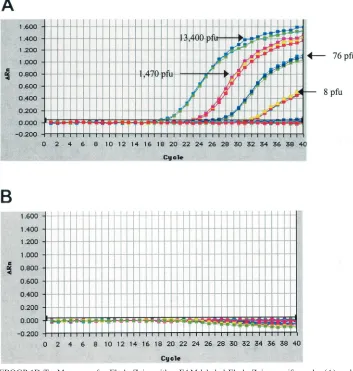
19). The FAM-labeled Ebola Zaire probe was specific for
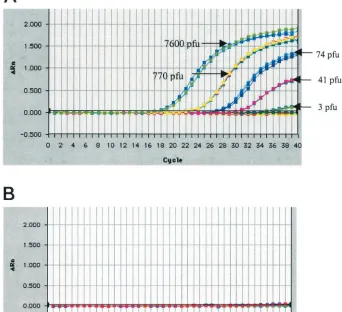
Ebola Zaire (Fig. 1). Likewise, the VIC-labeled Ebola Sudan
probe was specific for Ebola Sudan (Fig. 2). If we observed a
C
Tvalue less than 40 with the FAM-labeled probe, we
posi-tively identified the template as Ebola Zaire. Likewise, if we
observed a
C
Tvalue less than 40 with the VIC-labeled probe,
we positively identified the template as Ebola Sudan (Fig. 1
and 2).
LOD experiments: assay sensitivity.
The EBOGP-1D
primer and double-probe set was as sensitive or more sensitive
than previously designed primer sets intended for use in
con-ventional RT-PCR assays (Table 1). The EBOGP-1D
primer-probe set was able to detect 10 fg and 8 PFU of purified Ebola
Zaire RNA and infectious virus, respectively (Table 1 and Fig.
1A), and 100 fg and 3 PFU of purified Ebola Sudan RNA and
infectious virus, respectively (Table 1 and Fig. 2A). Previously
designed primer sets (Table 1) for use in conventional
RT-PCR assays were able to detect 10 fg and 8 PFU (ZAI-NP1/NP2
and FILOA/FILOB) or 100 pg and 680 PFU (EBOGP1/2) of
purified Ebola Zaire RNA and infectious virus, respectively.
These same primer sets detected 1 pg and 74 PFU (FILOA/
FILOB) or 100 pg and 770 PFU (EBOGP1/2) of Ebola Sudan
RNA or infectious virus, respectively. ZAI-NP1/NP2 was not
able to detect Ebola Sudan (Table 1). All control samples
lacking template were negative.
Assay specificity.
Several genetically related viruses and
other hemorrhagic fever viruses were used to determine the
cross-reactivity of the EBOGP-1D primer and double-probe
set. By using TaqMan chemistry, the EBOGP-1D primer and
double-probe set detected Ebola Zaire and Ebola Sudan
RNAs; however, it did not detect any of the genetically related
or other hemorrhagic fever viruses (Table 2). When examined
by gel electrophoresis, the EBOGP-1D primer set also
ampli-fied Ebola virus subtype Reston RNA. The amplification
effi-ciency of Ebola virus subtype Reston was not as great as that
for Ebola Zaire or Ebola Sudan. EBOGP-1D was able to
detect only 1 ng of subtype Reston RNA. Ebola virus subtype
Reston was not detected by fluorescence during TaqMan
as-says. The FILOA/FILOB primer set was able to detect Ebola
Zaire, Ebola Sudan, and Ebola virus subtype Ivory Coast (a
very weak amplicon was observed with 1 ng of Ebola virus
subtype Ivory Coast RNA); however, it also amplified Marburg
virus strains Musoke and Ci67. ZAI-NP1/NP2 detected only
Ebola Zaire. Therefore, the FILOA/FILOB primer set was not
specific for Ebola Zaire or Ebola Sudan and the ZAI-NP1/NP2
primer set was capable of detecting only Ebola Zaire (Table 2).
The previously designed EBO-GP1/2 primer set amplified
Ebola virus subtypes Zaire, Sudan, and Reston. The
amplifi-cation efficiency of the EBOGP1/2 primer set was weak with
the Ebola virus subtype Reston and Ebola virus subtype Ivory
Coast templates. The LOD for EBOGP1/2 with the subtype
Reston and Ivory Coast templates was 1 ng (data not shown).
Assay performance in clinical matrices.
The performance of
the EBOGP-1D TaqMan assay in clinical matrices was tested
on May 15, 2020 by guest
http://jcm.asm.org/
by spiking whole blood, serum, and plasma from non-human
primates with known amounts of Ebola Zaire (ranging from
78,125 to 25 PFU). PBS was spiked with virus as a control. The
sensitivity of the assay in clinical matrices was similar to that
observed in PBS, with 5 PFU being the LOD (Table 3).
DISCUSSION
Here we have reported on the development and
evalua-tion of a fluorogenic double-probe-based, one-step RT-PCR
assay on the ABI PRISM 7700 sequence detection system
for the identification of Ebola Zaire and Ebola Sudan
in-fections. This assay is based on the 5⬘
nuclease assay, which
exploits the 5⬘
nuclease activity of r
Tth
polymerase to cleave
a nonextendable, dual-labeled fluorogenic probe that is
an-nealed to the target sequence during amplification (4, 7, 12).
We chose the GP gene of Ebola virus as an assay target for
several reasons. First, the GP protein of Ebola virus is
required for entry into cells. Second, the membrane-bound
GP of Ebola virus is reported to play a central role in the
virus-mediated cytotoxicity of endothelial cells and
there-fore appears to be an important virulence factor of Ebola
virus (21). Finally, sequence analysis of the GP genes of
Ebola Zaire and Ebola Sudan revealed that regions within
this gene would permit the design of a primer-probe set on
the basis of the guidelines set forth by Applied Biosystems.
This assay has several advantages over the conventional
RT-PCR assays used to detect Ebola virus. First, the use of
a fluorogenic probe results in an increased level of
spe-cificity compared to that of conventional RT-PCR. The
EBOGP-1D primer and double-probe set was specific for
Ebola Zaire and Ebola Sudan when it was tested in a
blinded cross-reactivity panel (Table 2). In contrast, a
pre-viously designed primer-probe set (FILOA/FILOB)
ampli-fied two of three Marburg virus strains tested and therefore
lacked the specificity of the EBOGP-1D primer and
double-probe set (Table 2). ZAI-NP1/NP2 was capable of
identify-ing only Ebola Zaire. Second, this assay provides the
capa-bility of simultaneously detecting and differentiating two of
the three subtypes of Ebola virus that are pathogenic for
humans. This unique feature will provide public health
of-FIG. 1. LOD of EBOGP-1D TaqMan assay for Ebola Zaire with a FAM-labeled Ebola Zaire-specific probe (A) and a VIC-labeled Ebola
Sudan-specific probe (B). Total RNA isolated from serial dilutions of sucrose-purified virus was used as the template. Each assay was performed
in triplicate. The graphs depict amplification plots for the Ebola Zaire template obtained with both probes. Amplification plots show that the
VIC-labeled Ebola Sudan-specific probe does not cross-react with the Ebola Zaire template.
⌬
Rn, change in fluorescence.
on May 15, 2020 by guest
http://jcm.asm.org/
[image:4.587.114.467.77.448.2]ficials with an assay that can not only identify an Ebola virus
outbreak but also give them the information they need to
predict probable mortality rates and the severities of
epi-demics. Ebola Zaire infections traditionally result in higher
fatality rates during an outbreak compared to the fatality
rates that result from Ebola Sudan infections. Third, the
one-tube fluorogenic RT-PCR assay is compatible with
emerging rapid nucleic acid analysis platforms (6). These
new platforms are capable of performing both
thermocy-cling and fluorescence detection in real time. Sources of
these instruments include Applied Biosystems, Roche
Diag-nostics (Indianapolis, Ind.), Idaho Technologies (Salt Lake
City, Utah), Cepheid (Sunnyvale, Calif.), and Bio-Rad
(Her-cules, Calif.). With the more rapid thermocycling
[image:5.587.122.464.85.397.2]instru-FIG. 2. LOD of EBOGP-1D TaqMan Assay for Ebola Sudan with a VIC-labeled Sudan specific probe (A) and a FAM-labeled Ebola
Zaire-specific probe (B). Total RNA isolated from serial dilutions of sucrose-purified virus was used as the template. Each assay was performed
in triplicate. The graphs depict amplification plots for the Ebola Sudan template obtained with both probes. Amplification plots show that the
FAM-labeled Ebola Zaire-specific probe does not cross-react with the Ebola Sudan template.
⌬
Rn, change in fluorescence.
TABLE 2. Cross-reactivity panel with Ebola virus primer sets
Primer set Detection of the following
a:
Lassa Measles VSV CCHF Ebo-Z Ebo-S Ebo-IC Ebo-R MBG-RAVN MBG-MSK MBG-Ci67
EBOGP-1D
⫺
⫺
⫺
⫺
⫹
⫹
⫺
⫹
⫺
⫺
⫺
ZAI-NP1/NP2
bND
ND
ND
ND
⫹
⫺
⫺
⫺
⫺
⫺
⫺
FILOA/FILOB
bND
ND
ND
ND
⫹
⫹
⫹
⫺
⫺
⫹
⫹
EBOGP1/2
bND
ND
ND
ND
⫹
⫹
⫺
⫹
⫺
⫺
⫺
a⫹, amplicon detected;⫺, no amplicon detected; ND, no data; Lassa, Lassa virus; Measles, measles virus; VSV, vesicular stomatitis virus; CCHF, Crimean-Congo
hemorrhagic fever virus; Ebo-Z, Ebola Zaire; Ebo-S, Ebola Sudan; Ebo-IC, Ebola virus subtype Ivory Coast; Ebo-R, Ebola virus subtype Reston; MBG-RAVN, Marburg virus strain Ravn; MBG-MSK, Marburg virus strain Musoke; MBG-Ci67, Marburg virus strain Ci67.
bPreviously designed primer sets.
on May 15, 2020 by guest
http://jcm.asm.org/
[image:5.587.41.543.624.694.2]ments, i.e., Lightcycler (Roche Molecular Systems), the
Ruggedized Advanced Pathogen Identification Device
(R.A.P.I.D.; Idaho Technologies), or the SmartCycler
(Ce-pheid), it is reasonable to assume that once a sample is
received and processed, a definitive diagnosis can be made
within 20 to 40 min (9). In addition, the use of this
technol-ogy in field laboratories has become a reality now that
instru-ments such as the R.A.P.I.D. and SmartCycler XC instruinstru-ments,
which have been specifically designed for use by field medical
laboratories, have become available (9).
In order to obtain an early diagnosis and contain future
outbreaks of Ebola hemorrhagic fever, it will be necessary to
implement rapid diagnostic assays in laboratories throughout
Africa. These assays must be simple to perform, accurate, and
reproducible. Transfer of the newly designed fluorogenic 5⬘
nuclease assay described in this report to rapid nucleic acid
analysis platforms would be a first step toward providing public
health authorities in Africa with a tool to help diagnose and
contain possible outbreaks.
This assay will allow public health officials to detect two of
the three Ebola virus subtypes recognized to be pathogenic
for humans. The sequence divergence among Ebola virus
subtypes Zaire, Sudan, and Ivory Coast prevented the
de-sign of a primer set that could efficiently amplify all three
strains. Therefore, future developments should include the
design of an assay that identifies Ebola virus subtype Ivory
Coast. Successful multiplexing of a newly designed Ebola
virus subtype Ivory Coast assay with the EBOGP-1D assay
would provide the capability of detecting and differentiating
all known Ebola virus subtypes that are pathogenic for
hu-mans. In addition, the design of a rapid detection assay that
is capable of detecting all known strains of filoviruses would
provide a screening tool for differentiation of filoviral
hem-orrhagic fevers from other more common diseases that
oc-cur throughout regions of Africa. Future developments that
produce a “dried-down” chemistry for RT-PCR (making the
addition of water and sample the only reagents needed for
performance of the fluorogenic RT-PCR assay) should
make this assay even easier to use in the field and would
provide a valuable diagnostic capability that would enhance
future outbreak investigations.
ACKNOWLEDGMENTS
We thank Deanna Bridge, Bill Hurtle, Steven Kerby, and Brian
Kearney for excellent technical assistance. We also thank David
Shoe-maker and George Ludwig for helpful suggestions and critical input in
the preparation of the manuscript. We are especially indebted to
George Ludwig for providing Lassa virus, Crimean-Congo
hemor-rhagic fever virus, measles virus, and vesicular stomatitis virus seeds for
growth and purification.
REFERENCES
1.Anonymous.1978. Ebola haemorrhagic fever in Sudan, 1976. Report of a WHO/International Study Team. Bull. W. H. O.56:247–270.
2.Anonymous.1978. Ebola haemorrhagic fever in Zaire, 1976. Bull. W. H. O. 56:271–293.
3.Baize, S., E. M. Leroy, M. C. Georges-Courbot, M. Capron, J. Lansoud-Soukate, P. Debre, S. P. Fisher-Hoch, J. B. McCormick, and A. J. Georges. 1999. Defective humoral responses and extensive intravascular apoptosis are associated with fatal outcome in Ebola virus-infected patients. Nat. Med. 5:423–426.
4.Bassler, H. A., S. J. Flood, K. J. Livak, J. Marmaro, R. Knorr, and C. A. Batt. 1995. Use of a fluorogenic probe in a PCR-based assay for the detection of Listeria monocytogenes. Appl. Environ. Microbiol.61:3724–3728. 5.Centers for Disease Control and Prevention.1995. Update: management of
patients with suspected viral hemorrhagic fever—United States. JAMA274: 374–375.
6.Espy, M. J., J. R. Uhl, P. S. Mitchell, J. N. Thorvilson, K. A. Svien, A. D. Wold, and T. F. Smith.2000. Diagnosis of herpes simplex virus infections in the clinical laboratory by LightCycler PCR. J. Clin. Microbiol.38:795–799. 7.Eun, A. J., M. Seoh, and S. Wong.2000. Simultaneous quantitation of two
orchid viruses by the TaqMan real-time RT-PCR. J. Virol. Methods87:151– 160.
8.Geisbert, T. W., and P. B. Jahrling.1995. Differentiation of filoviruses by electron microscopy. Virus Res.39:129–150.
9.Henchal, E. A., J. D. Teska, G. V. Ludwig, D. R. Shoemaker, and J. W. Ezell. 2001. Current laboratory methods for biological threat agent identification. Clin. Lab. Med.21:7.1–7.13.
10.Hevey, M., D. Negley, J. Geisbert, P. Jahrling, and A. Schmaljohn.1997. Antigenicity and vaccine potential of Marburg virus glycoprotein expressed by baculovirus recombinants. Virology239:206–216.
11.Hodgsen, L.1992. The sequence, genomic organization, and expression of the small genomic segment of Crimean Congo hemorrhagic fever virus for the potential use as a diagnostic antigen. Hood College, Frederick, Md. 12.Holland, P. M., R. D. Abramson, R. Watson, and D. H. Gelfand.1991.
Detection of specific polymerase chain reaction product by utilizing the 5⬘-3⬘
exonuclease activity of Thermus aquaticus DNA polymerase. Proc. Natl. Acad. Sci. USA88:7276–7280.
13.Ksiazek, T. G., P. E. Rollin, P. B. Jahrling, E. Johnson, D. W. Dalgard, and C. J. Peters.1992. Enzyme immunosorbent assay for Ebola virus antigens in tissues of infected primates. J. Clin. Microbiol.30:947–950.
14.Leroy, E. M., S. Baize, C. Y. Lu, J. B. McCormick, A. J. Georges, M. C. Georges-Courbot, J. Lansoud-Soukate, and S. P. Fisher-Hoch.2000. Diag-nosis of Ebola haemorrhagic fever by RT-PCR in an epidemic setting. J. Med. Virol.60:463–467.
15.Leroy, E. M., S. Baize, V. E. Volchkov, S. P. Fisher-Hoch, M. C. Georges-Courbot, J. Lansoud-Soukate, M. Capron, P. Debre, J. B. McCormick, and A. J. Georges.2000. Human asymptomatic Ebola infection and strong in-flammatory response. Lancet355:2210–2215.
16.Ludwig, G. V., J. P. Kondig, and J. F. Smith.1996. A putative receptor for Venezuelan equine encephalitis virus from mosquito cells. J. Virol.70:5592– 5599.
17.Moe, J. B., R. D. Lambert, and H. W. Lupton.1981. Plaque assay for Ebola virus. J. Clin. Microbiol.13:791–793.
18.Peters, C. J., A. Sanchez, P. E. Rollin, T. G. Ksiazek, and F. A. Murphy.1996. Filoviridae: Marburg and Ebola viruses, p. 1161–1176.InB. N. Fields, D. M. Knipe, P. M. Howley, et al. (ed.), Fields Virology, 3rd ed. Lippincott-Raven Press, Philadelphia, Pa.
19.Sanchez, A., M. P. Kiley, B. P. Holloway, and D. D. Auperin.1993. Sequence analysis of the Ebola virus genome: organization, genetic elements, and comparison with the genome of Marburg virus. Virus Res.29:215–240. 20.Sanchez, A., T. G. Ksiazek, P. E. Rollin, M. E. Miranda, S. G. Trappier, A. S.
Khan, C. J. Peters, and S. T. Nichol.1999. Detection and molecular char-acterization of Ebola viruses causing disease in human and nonhuman pri-mates. J. Infect. Dis.179(Suppl. 1):S164–S169.
[image:6.587.43.284.93.184.2]21.Yang, Z. Y., H. J. Duckers, N. J. Sullivan, A. Sanchez, E. G. Nabel, and G. J. Nabel.2000. Identification of the Ebola virus glycoprotein as the main viral determinant of vascular cell cytotoxicity and injury. Nat. Med.6:886–889.
TABLE 3. PCR results from clinical matrices
spiked with Ebola Zaire
No. of PFU/5l of templatea
CTbvalue
PBS Blood Serum Plasma
15,625
22.4
19.2
22.2
19.4
3,125
22.7
22.2
21.7
23.1
625
26.6
24.8
25.2
24.6
125
29.4
28.6
26.9
26.5
25
30.8
33.5
29.3
31.9
5
35.1
32.1
30.3
32.2
aNumber of PFU present in the PCR mixture. bC
Tis the cycle number at which the fluorescence generated within a reaction
crosses the threshold. PBS, blood, serum, and plasma were spiked with known numbers of PFU of Ebola Zaire. The sensitivity of the EBOGP-1D primer-probe set was tested in these matrices.