IMMEDIATE RELEASE TABLETS OF AMBRISENTAN BY DIRECT COMPRESSION METHOD.
A Dissertation submitted to
THE TAMIL NADU DR. M.G.R. MEDICAL UNIVERSITY, CHENNAI- 600 032
In partial fulfilment of the award of the degree of
MASTER OF PHARMACY IN
Branch-I -- PHARMACEUTICS
Submitted by
Name: THATIPETA S G SREENIVASAN REG.No.261610262
Under the Guidance of Mr. C. KANNAN, M.Pharm.,
ASST PROFESSOR
DEPARTMENT OF PHARMACEUTICS
J.K.K. NATTARAJA COLLEGE OF PHARMACY KUMARAPALAYAM – 638183
IMMEDIATE RELEASE TABLETS OF AMBRISENTAN BY DIRECT COMPRESSION METHOD.
A Dissertation submitted to
THE TAMIL NADU DR. M.G.R. MEDICAL UNIVERSITY, CHENNAI - 600 032
In partial fulfilment of the award of the degree of
MASTER OF PHARMACY
IN
Branch-I -- PHARMACEUTICS
Submitted by
NAME: THATIPETA S G SREENIVASAN REG.No.261610262
Under the Guidance of Mr. C. KANNAN, M.Pharm.,
ASST PROFESSOR
DEPARTMENT OF PHARMACEUTICS
J.K.K. NATTARAJA COLLEGE OF PHARMACY
KUMARAPALAYAM – 638183
This is to certify that the dissertation work entitled
“FORMULATION DESIGN, DEVELOPMENT AND INVITRO EVALUATION OF
IMMEDIATE RELEASE TABLETS OF AMBRISENTAN BY DIRECT
COMPRESSION METHOD”, submitted by the student bearing Reg. No:
261610262 to “The Tamil Nadu Dr. M.G.R. Medical University –
Chennai”, in partial fulfilment for the award of Degree of Master of
Pharmacy in Pharmaceutics was evaluated by us during the
examination held on………..……….
This is to certify that the work embodied in this dissertation entitled
“FORMULATION DESIGN, DEVELOPMENT AND INVITRO EVALUATION OF
IMMEDIATE RELEASE TABLETS OF AMBRISENTAN BY DIRECT
COMPRESSION METHOD”, submitted to “The Tamil Nadu Dr. M.G.R.
Medical University- Chennai”, in partial fulfilment and requirement of
university rules and regulation for the award of Degree of Master of
Pharmacy in Pharmaceutics, is a bonafide work carried out by the student
bearing Reg.No. 261610262 during the academic year 2017-2018, under the
guidance and supervision of Mr. C. Kannan, M.Pharm., Assistant Professor,
Department of Pharmaceutics, J.K.K. Nattraja College of Pharmacy,
Kumarapalayam.
CERTIFICATE
Dr. R. Sambathkumar, M. Pharm., PhD.,
Professor & Principal,
Dr. S. Bhama, M. Pharm., PhD.,
Associate Professor & HOD,
Department of Pharmaceutics Mr. C. Kannan, M.Pharm.,
Assistant Professor,
This is to certify that the work embodied in this dissertation entitled
“FORMULATION DESIGN, DEVELOPMENT AND INVITRO EVALUATION
OF IMMEDIATE RELEASE TABLETS OF AMBRISENTAN BY DIRECT
COMPRESSION METHOD”, submitted to “The Tamil Nadu Dr. M.G.R.
Medical University - Chennai”, in partial fulfilment and requirement of
university rules and regulation for the award of Degree of Master of
Pharmacy in Pharmaceutics, is a bonafide work carried out by the student
bearing Reg.No. 261610262 during the academic year 2017-2018, under
my guidance and d i r e c t supervision in the Department of Pharmaceutics,
J.K.K. Nattraja College of Pharmacy, Kumarapalayam.
Place: Kumarapalayam
Date:
CERTIFICATE
Mr. C. Kannan, M.Pharm.,
Assistant Professor,
This is to certify that the work embodied in this dissertation entitled
“FORMULATION DESIGN, DEVELOPMENT AND INVITRO EVALUATION OF
IMMEDIATE RELEASE TABLETS OF AMBRISENTAN BY DIRECT
COMPRESSION METHOD”, submitted to “The Tamil Nadu Dr. M.G.R.
Medical University- Chennai”, in partial fulfilment and requirement of
university rules and regulation for the award of Degree of Master of
Pharmacy in Pharmaceutics, is a bonafide work carried out by the student
bearing Reg.No. 261610262 during the academic year 2017-2018, under the
guidance and supervision of Mr. C. Kannan, M.Pharm., Assistant Professor,
Department of Pharmaceutics, J.K.K. Nattraja College of Pharmacy,
Kumarapalayam.
Place: Kumarapalayam
Date:
CERTIFICATE
Dr. R. Sambathkumar, M. Pharm., PhD.,
Professor & Principal,
J.K.K.Nattraja College of Pharmacy,
DECLARATON
I do hereby declared that the dissertation “FORMULATION DESIGN,
DEVELOPMENT AND INVITRO EVALUATION OF IMMEDIATE RELEASE
TABLETS OF AMBRISENTAN BY DIRECT COMPRESSION METHOD”
submitted to “The Tamil Nadu Dr. M.G.R Medical University - Chennai”,
for the partial fulfilment of the degree of Master of Pharmacy in
Pharmaceutics, is a bonafide research work has been carried out by me
during the academic year 2017-2018, under the guidance and supervision of
Mr. C. Kannan, M.Pharm., Assistant Professor, Department of
Pharmaceutics, J.K.K. Nattraja College of Pharmacy, Kumarapalayam.
I further declare that this work is original and this dissertation has not
been submitted previously for the award of any other degree, diploma,
associate ship and fellowship or any other similar title. The information
furnished in this dissertation is genuine to the best of my knowledge.
Place: Kumarapalayam Mr. THATIPETA S G SREENIVASAN
Dedicated to Parents,
Teachers&
Iam proudtodedicate mydeep sense of gratitude tothe founder,
(Late) Thiru J.K.K. Nattaraja Chettiar, providing the historical institutiontostudy.
My sincere thanks and respectful regards to our reverent
Chairperson Smt. N. Sendamaraai, B.Com., and Director
Mr. S. Omm Sharravana, B.Com., LLB., J.K.K. Nattraja Educational
Institutions, Kumarapalayam for their blessings, encouragement and
supportatalltimes.
It is most pleasant duty to thank for our beloved Dr. R.
Sambathkumar, M.Pharm., Ph.D., Principal & Professor, Department of
Pharmaceutics, J.K.K. Nattraja College of Pharmacy, Kumarapalayam for
ensuring all the facilities were made available to me for the smooth
running ofthis project and tremendousencouragementat eachand every
step of this dissertation work.Without his critical adviceand deep-rooted
knowledge,thisworkwouldnothavebeenareality.
It is my privilege to express deepest sense of gratitude toward
Mr. C. Kannan, M.Pharm., Assistant Professor, Department of
Pharmaceutics, fortheir valuablesuggestionsandinspiration.
Our glorious acknowledgement to our administrative officer
Dr. K. Sengodan, M.B.B.S., for encouraging using kind and generous
mannertocompletethiswork.
My sincere thanks to Dr. S. Bhama, M. Pharm., Ph.D.,
Associate Professor & HOD, Department of Pharmaceutics,
Mr. R. Kanagasabai, B.Pharm, M.Tech., Assistant Professor,
Dr. V. Kamalakannan M. Pharm., Ph.D., Associate Professor, Mr.
K. Jaganathan, M.Pharm., Assistant Professor, Mr. C. Kannan,
M.Pharm., Assistant Professor, Ms. S. Manodhini Elakkiya,
Professor and Head, Department of Pharmacy Practice,
Dr. P.Balakumar, M.Pharm., Ph.D., Professor, Mrs. K. Krishna Veni,
M.Pharm., Assistant Professor, Mr. R. Kameswaran M.Pharm, Assistant
Professor, Dr. Mebin Alias, Pharm.D., Assistant Professor,
Mrs. P. J. Sujitha, Lecturer, Dr. Cindy Jose, Pharm.D., Lecturer, Dr.
Krishna Ravi, Pharm.D., Lecturer, and Dr. S.K.Sumitha, Pharm.D.,
Lecturer, Department of Pharmacy Practice, for their help during my
project.
It is my privilege to express deepest sense of gratitude toward
Dr. M. Vijayabaskaran, M.Pharm., Ph.D., Professor &Head,Department
ofPharmaceutical chemistry, Dr. S. Satheesh KumarM.Pharm., Ph.D., Assistant professor, Mrs. S. Gomathi M.Pharm., Lecturer,
Mrs. B. Vasuki, M.Pharm., Lecturer, Mr. L. Kaviarasan, Lecturer and
Ms.P. Lekha,Lecturer fortheir valuablesuggestionsandinspiration.
My sincere thanks to Dr. V. Sekar, M.Pharm., Ph.D., Professor and Head, Department of Analysis, Dr. I. Caolin Nimila, M.Pharm., Ph.D., Assistant Professor, Mr. D. Kamalakannan Assistant Professor, Mrs. P. Devi, M.Pharm., Lecturer and Ms. V. Devi, M.Pharm., Lecturer, Department of Pharmaceutical Analysis for their valuable
suggestions.
My sincere thanks to Dr. Senthilraja, M.Pharm., Ph.D., Associate
Professor and Head, Department of Pharmacognosy,
Mrs. Meena Prabha, M.Pharm., Lecturer,Department of Pharmacognosy
and Ms. B. Sobha, M.Pharm., Lecturer, Department of Pharmacognosy
fortheirvaluablesuggestionsduringmyprojectwork.
My sincere thanks to Dr. R. Shanmugasundaram, M.Pharm.,
Professor, Mr. V. Venkateswaran, M.Pharm., Assistant Professor,
Mrs. M. Sudha M.Pharm., Lecturer, Mr. T. Thiyagarajan,
M.Pharm., AssistantProfessor,Mrs. R. Elavarasi, M.Pharm., Lecturer andMrs. M.Babykala, M.Pharm., Lecturer,Department
of Pharmacology for their valuable suggestions during my project
work.
Igreatly acknowledge the help rendered byMrs. K. Rani, Office Superintendent, Mr. E. Vasanthakumar, MCA, Assistant Professor, Miss. M. Venkateswari, M.C.A., typist, Mrs. V.
Vimalaveni, Typist,Mrs. V.Gandhimathi,M.A.,M.L.I.S.,Librarian,
Mrs. S. Jayakala B.A., B.L.I.S., and Asst. Librarian for their
co-operation.Iowemythankstoallthetechnicalandnon-technicalstaff
membersoftheinstitutefortheirpreciousassistanceandhelp.
Last,butnevertheless,Iamthankfulto mylovableparentsand
all my friends for their co-operation, encouragement and help
extended tome throughoutmyprojectwork.
Mr. THATIPETA S G SREENIVASAN
S.NO
.
CHAPTER
PAGE NO
1
INTRODUCTION
1
2
LITERATURE REVIEW
30
3
AIM AND OBJECTIVES
37
4
PLAN OF WORK
39
5
DISEASE PROFILE
40
6
DRUG PROFILE
47
7
EXCIPIENTS PROFILE
51
8
MATERIALS AND EQUIPMENTS
57
9
PREFORMULATION
58
10
FORMULATION
63
11
EVALUATION
64
12
RESULTS AND DISCUSION
72
13
SUMMARY AND CONCLUSION
89
FORMULATION DESIGN, DEVELOPMENT
FORMULATION DESIGN, DEVELOPMENT
FORMULATION DESIGN, DEVELOPMENT
FORMULATION DESIGN, DEVELOPMENT
AND
AND
AND
AND
INVITRO
INVITRO
INVITRO
INVITRO
EVALUATION OF IMMEDIATE
EVALUATION OF IMMEDIATE
EVALUATION OF IMMEDIATE
EVALUATION OF IMMEDIATE
RELEASE TABLETS OF AMBRISENTAN
RELEASE TABLETS OF AMBRISENTAN
RELEASE TABLETS OF AMBRISENTAN
RELEASE TABLETS OF AMBRISENTAN
CHAPTER 1
CHAPTER 1
CHAPTER 1
CHAPTER 1
CHAPTER 2
CHAPTER 2
CHAPTER 2
CHAPTER 2
LITERATURE
LITERATURE
LITERATURE
LITERATURE
REVIEW
REVIEW
REVIEW
CHAPTER 3
CHAPTER 3
CHAPTER 3
CHAPTER 3
CHAPTER 4
CHAPTER 4
CHAPTER 4
CHAPTER 4
CHAPTER 5
CHAPTER 5
CHAPTER 5
CHAPTER 5
CHAPTER 6
CHAPTER 6
CHAPTER 6
CHAPTER 6
DRUG PROFILE
DRUG PROFILE
DRUG PROFILE
CHAPTER 7
CHAPTER 7
CHAPTER 7
CHAPTER 7
CHAPTER 8
CHAPTER 8
CHAPTER 8
CHAPTER 8
MATERIALS AND
MATERIALS AND
MATERIALS AND
MATERIALS AND
EQUIPMENTS
EQUIPMENTS
EQUIPMENTS
CHAPTER 9
CHAPTER 9
CHAPTER 9
CHAPTER 9
PREFORMULATION
CHAPTER 10
CHAPTER 10
CHAPTER 10
CHAPTER 10
FORMULATION
CHAPTER 11
CHAPTER 11
CHAPTER 11
CHAPTER 11
CHAPTER 12
CHAPTER 12
CHAPTER 12
CHAPTER 12
RESULTS AND
RESULTS AND
RESULTS AND
RESULTS AND
CHAPTER 13
CHAPTER 13
CHAPTER 13
CHAPTER 13
SUMMARY
SUMMARY
SUMMARY
SUMMARY AND
AND
AND
AND
CHAPER 14
CHAPER 14
CHAPER 14
CHAPER 14
BIBILOGRAPHY
BIBILOGRAPHY
BIBILOGRAPHY
1. INTRODUCTION
Oral route is most popular for systemic effect due to its easy of ingestion, pain avoidance, versatility and most importantly patient compliance. Solid oral delivery systems (especially tablets) is system of choice among all drug delivery system and they do not require special treatment and are therefore less expensive to manufacture, likewise immediate release tablets are more acceptable among all the tablets. Based on their drug-release characteristics, tablets can be classified into three types, immediate release, extended release and delayed release. For immediate release tablets the drug is intended to be released rapidly after administration, or the tablet is dissolved and administered as a solution. This is the most common type of tablet and includes disintegrating, chewable, effervescent, sublingual and buccal tablets. They design to disintegrate and release their medication with no special rate controlling features. Immediate Release Tablets are those tablets which are designed to disintegrate and release their medication with no special rate controlling features, such as special coatings and other techniques. In pharmaceutical industries, manufactures of generic tablets are usually focused on the optimization of the excipients mixture composition to obtain a product that meet established standard1.
An ideal dosage regimen in the drug therapy of any disease or the goal of any drug delivery system is the one, which immediately attains the desired therapeutic concentration of drug in plasma (or at the site of action) and maintains it constant for the entire duration treatment.
quality of life, most of these efforts have been focused on ease of medication.
At present novel drug delivery systems are developed for expanding markets/indications, extending product life cycles and generating opportunities. Oral administration is the most popular route for systemic effects due to its ease of ingestion, pain, avoidance, versatility and most importantly patient compliance. In these solid formulations do not require sterile conditions and are therefore, less expensive to manufacture32.
An immediate release dosage form allows a manufacturer to extend market exclusivity, while offering patients a convenient dosage form or dosage regimen. Recently immediate release tablets have started gaining popularity and acceptance as a drug delivery system, mainly because they are easy to administer, has quick onset of action is economical and lead to better patientcompliance. They are also a tool for expanding markets, extending product life cycles and generating opportunities. Superdisintegrants are first choice of excipients which are extensively used for the formulation development of the immediate release tablets as they effectively result into the immediate disintegration, release and absorption of the drug after administration into the body.
1.1 Introduction to Solid Oral Dosage Forms:
A tablet is a pharmaceutical dosage form. It comprises a mixture of active substances and excipients, usually in powder form, pressed or compacted from a powder into a solid dose. The excipients can include diluents, binders or granulating agents, glidants (flow aids) and lubricants to ensure efficient tableting, disintegrants to promote tablet break-up in the digestive tract; sweeteners or flavors to enhance taste, and pigments to make the tablets visually attractive. Apolymer coating is often applied to make the tablet smoother and easier to swallow, to control the release rate of the active ingredient, to make it more resistant to the environment (extending its shelf life), or to enhance the tablet's appearance.
1.2. Types and Classes of Tablet: 4,5
A. Oral Tablets for Ingestion: 1. Compressed tablets
2. Multiple compressed tablets 3. Layered tablets
4. Compression-coated tablets 5. Repeat-action tablets
6. Delayed-action and enteric-coated tablets 7. Sugar and chocolate-coated tablets
8. Film coated tablets 9. Chewable tablets
B. Tablets Used in the Oral Cavity: 4,5
1. Buccal tablets 2. Sublingual tablets 3. Troches and lozenges 4. Dental cones
C. Tablets Administered by Other Routes: 4,5
1. Implantation tablets 2. Vaginal tablets
D. Tablets Used to Prepare Solutions: 4,5
1.3 Introduction to Immediate Release Tablets:6
Definition: Immediate release tablets are those which disintegrate rapidly and get dissolved to release the medicaments. The term “release” includes the provision (or presentation) of drug from the formulation to the gastrointestinal tract, to body tissues and/or into systemic circulation. In the present case, immediate release may be provided for by way of an appropriate pharmaceutically acceptable diluents or carrier, which diluents or carrier does not prolong, to an appreciable extent, the rate of drug release and/or absorption. It also finds applications in the field of local delivery of drug to the stomach and proximal small intestine and importantly in treating microorganisms (Helicobacter pylori).
In immediate release tablets, disintegration is one of the important parameter. With the help of design of experiment (DOE) approach, process variables are first ‘screened’ to determine which are important to the outcome (excipients type, percentage, disintegration time (DT), etc. Next step is the ‘optimization’, when the best settings for the important variables are determined. It involves the use of ‘mixture designs’ for changing mixture composition and exploring how such changes will affect the properties of the mixture. Immediate release tablets have gained prominence of being new drug delivery systems. Most immediate release tablets are intended to disintegrate in the stomach, where the pH is acidic.
Immediate release drug delivery system are based on single or multiple-unit reservoir or matrix system, which are designed to provide immediate drug levels in short period of time.
Immediate release solid oral dosage forms are classified as either having rapid or slow dissolution rates. Immediate release dosage forms are those for which ≥85% of labelled amount dissolves within 30 min. For immediate release tablets, the only barrier to drug release is simple disintegration or erosion stage, which is generally accomplished in less than one hour. To enhance dissolution and hence bioavailability of any drug from immediate release tablets, disintegration is one of the important process. Few Super-disintegrants are available commercially as Croscarmellose sodium, Crospovidone and SSG31.
1.4.DESIRED CRITERIA FOR IMMEDIATE RELEASE DRUG DELIVERY SYSTEM:
1.4.1. Ideal Properties5
Immediate release dosage form should
1. It should dissolve or disintegrate in the stomach within a short period In the case of solid dosage.
2. Should show first absorption and dissolution of drug.
3. Rapid onset of action always seen with immediate release tablets. 4. Must be compatible with taste masking.
5. Be portable without fragility concern.
6. It should not leave minimal or no residue in the mouth after oral administration.
7. Provides pleasing mouth feel.
8. Exhibit low sensitivity to environmental condition as humidity and temperature.
9. Be manufactured using conventional processing and packaging equipment at low cost.
1.4.2.Advantages2,3
An immediate release pharmaceutical preparation offers 1. Improved stability, bioavailability.
3. Suitable for controlled, sustained release actives. 4. High drug loading is possible.
5. Ability to provide advantages of liquid medication in the form of solid preparation.
6. Adaptable and amenable to existing processing and packaging machinery.
7. Cost- effective.
8. Improved compliance added convenience.
9. Accurate dose: The immediate/fast dissolve dosage forms have the added advantages of convenience and accurate dosing as compared to liquids.
10. Ease of swallowing is possible.
11. Bilayer tablet is possible for sequential release of two drugs in combination and separate two incompatible substance.
1.4.3.Disadvantage[2][3]
1. Possess swallowing difficulty.
2. Onset of action is slow and depends on disintegration and dissolution. Some drugs resist compression, due to their amorphous nature or low-density
3. Drugs having bitter taste, objectionable odor or drugs that are sensitive to oxygen may require encapsulation or coating of tablet. 4. Drug release at a time may produce high plasma concentration
which may produce toxicity.
5. Frequent dosing is necessary for drug with short half-life.
1.4.4.Salient Features
• Drugs should possessing long biological half-life for immediate release drug delivery.
• The drug is released quickly and completely in one shot.
• High bioavailability expected with immediate release dosage form.
• But main criterion for immediate release dosage form is poor solubility of the drug and need the immediate action of drug to treat unwanted defect or disease.
• Rapid drug therapy intervention is possible.
• New business opportunities like product differentiation, line extension and lifecycle management, exclusively of product promotion.
1.5.Criteria for Drug Selection
• Poor solubility of the drug and need immediate drug action in case of immediate release dosage form.
• The immediate release compositions comprise micronized drug in an amount sufficient to provide the desired daily dosage, that is, an amount of about 10 mg to about 1000 mg, more preferably an amount of about 20 mg to 400 mg.
• Immediate release compositions from which about 50% of the micronized drug is dissolved in vitro within about 15 minutes, more preferably at least about 80% of the drug is dissolved in vitro within about 30 minutes.
• Carrier materials for immediate release compositions preferably are selected to provide a disintegration time less than about 30 minutes, preferably about 20 minutes or less, more preferably about 18 minutes or less.
1.6.Unsuitable drug characteristic for immediate release tablets:
• Drug are not suitable for immediate release tablets which having short biological half-life.
• Drug with low bioavailability are also not desirable candidate for immediate release tablets.
1.7.Pharmacokinetics:[6]
In this consideration, study has done on absorption, distribution, metabolism and excretion. After absorption, drug attains therapeutic level and therefore elicits pharmacological effect, so bothrate and extend of absorption is important. In conventional dosage form there is delay in disintegration and therefore dissolution is fast. Drug distribution depends on many factors like tissue permeability, perfusion rate, binding of drug to tissue, disease state, drug interaction etc. Duration and intensity of action depends upon rate of drug removal from the body or site of action i.e. biotransformation. Decrease in liver volume, regional blood flow to liver reduces thebiotransformation of drug through oxidation, reduction and hydrolysis. Excretion by renal clearance is slowed, thus half-life of renal excreted drugs increase.
1.8.Pharmacodynamics:[6]
Drug reception interaction impaired in elderly as well as in young adult due to undue development of organ.
1. Decreased ability of the body to respond reflexive stimuli, cardiac output, and orthostatic hypotension may see in taking antihypertensive like prazosin. Immunity is less and taken into consideration while administered antibiotics
2. Altered response to drug therapy-elderly show diminished bronchodilator effect of theophylline shows increased sensitivity to barbiturates
1.9.Technology for Immediate release Tablets[6]
Conventional Techniques
Conventional technique used in the preparation of immediate release tablets
✓ Tablet molding technique
✓ Direct compression technique
✓ Granulation technique
✓ Mass extrusion technique
Several Technologies are available to manufacture immediate release tablets. The most common preparation methods are molding, lyophilisation or freeze drying, direct compression, spray drying and sublimation.
A. Tablet molding technique[4] [6]
Water-soluble ingredients are used in tablet molding technique which facilitate tablet to disintegrate and dissolve rapidly. A hydro alcoholic solvent use to moisten powder blend and is molded in to tablet using compression pressure lower than used in conventional tablets compression. The solvent is then removed by air-drying. Two problems commonly encountered are mechanical strength and poor taste masking characteristics in this technique.
B. Direct compression technique[4] [6]
Advantages[6]
1. Direct compression is more efficient and economical process as compared to other processes, because it involves only dry blending and compaction of API and necessary excipients.
2. The most important advantage of direct compression is that it is an economical process. Reduced processing time, reduced labor costs, fewer manufacturing steps, and less number of equipment’s is required, less process validation, reduced consumption of power.
3. Elimination of heat and moisture, thus increasing not only the stability but also the suitability of the process for thermolabile and moisture sensitive API.
4. Particle size uniformity. 5. Prime particle dissolution.
In case of directly compressed tablets after disintegration each primary drug particle is liberated. While in the case of tablets prepared by compression of granules small drug particles with a larger surface area adhere together into larger agglomerates, thus decreasing the surface area available for dissolution.
Disadvantages
a) Excipients Related[6]
1. Problems in the uniform distribution of low dose drugs.
2. High dose drugs having high bulk volume, poor compressibility and poor flow ability are not suitable for direct compression for example, Aluminum Hydroxide, Magnesium Hydroxide.
3. The choice of excipients for direct compression is extremely critical. Direct compression diluents and binders must possess both good compressibility and good flow ability.
b) PROCESS Related [7]
1. Capping, lamination, splitting, or layering of tablets is sometimes related to air entrapment during direct compression. When air is trapped the resulting tablets expand when the pressure of tablet is released, resulting in splits or layers in the tablet.
2. In some case it requires greater sophistication in blending and compression equipment’s.
C. Granulation technique[4]
Granulation may be defined as a size enlargement process which converts small particles into physically stronger &larger agglomerates. The objective of granulation is to improve powder flow and handling, decrease dustiness, and prevent segregation of the constituents.
Granulation method can be broadly classified into two types (i) Wet granulation[4]
(ii)Dry granulation[4]
Ideal characteristics of granules
The ideal characteristics of granules include spherical shape, smaller particle size distribution with sufficient fines to fill void spaces between granules, adequate moisture (between 1-2%), good flow, good compressibility and sufficient hardness etc.
The effectiveness of granulation depends on the following properties:
• Particle size of the drug and excipients
• Type of binder (strong or weak)
• Volume of binder (less or more)
• Wet massing time (less or more)
• Amount of shear applied
(i) Wet granulation[4]
Wet granulation is a commonly used unit operation in the pharmaceutical industry. Wet granulation is often carried out utilizing a high-shear mixer. The high-shear granulation process is a rapid process which is susceptible for over-wetting. Thus, the liquid amount added is critical and the optimal amount is affected by the properties of the raw materials. Power consumption of the impeller motor and the impeller torque have been applied to monitor the rheological properties of the wet mass during agglomeration and, thereby, have been used to determine the end-point of water addition. However, these methods are affected by the equipment variables.
Important steps involved in wet granulation
• Mixing of drug(s) and excipients.
• Preparation of binder solution.
• Mixing of binder solution with powder mixture to form wet mass.
• Course screening of wet mass using a suitable sieve (6-12 screens).
• Drying of moist granules.
• Screening of dry granules through a suitable sieve (14-20 screen).
• Mixing of screened granules with disintegrant, glidant, and lubricant.(Manish
Limitation of wet granulation[4]
• The greatest disadvantage of wet granulation is its cost. It is an expensive process because of labor, time, equipment, energy and space requirements.
• Loss of material during various stages of processing.
• Stability may be a major concern for moisture sensitive or thermolabile drugs.
1.10.Special wet granulation techniques
▪ High shear mixture granulation
▪ Fluid bed granulation
▪ Extrusion-spheronization
▪ Spray drying
(ii) Dry granulation[4]
In dry granulation process the powder mixture is compressed without the use of heat and solvent. The two basic procedures are to form a compact of material by compression and then to mill the compact to obtain granules.
Two methods are used for dry granulation.The more widely used method is slugging, where the powder is precompressed and the resulting tablets or slugs are milled to yield granules.The other method is to precompress the powder with pressure rolls using a machine such as Chilosonator.
Advantages
The main advantages of dry granulation or slugging are that it uses less equipment’s and space. It eliminates the need for binder solution, heavy mixing equipment and the costly and time consuming drying step required for wet granulation.
Slugging can be used for advantages in the following situations
▪ For moisture sensitive material
▪ For heat sensitive material
▪ For improved disintegration since powder particles are not bonded together by a binder.
Disadvantages
• It requires a specialized heavy duty tablet press to form slug.
• It does not permit uniform color distribution as can be achieved with wet granulation where the dye can be incorporated into binder liquid.
Steps in dry granulation
1. Milling of drugs and excipients 2. Mixing of milled powders
3. Compression into large, hard tablets to make slug 4. Screening of slugs
5. Mixing with lubricant and disintegrating agent 6. Tablet compression
Two main dry granulation processes a) Slugging process
Granulation by slugging is the process of compressing dry powder of tablet formulation with tablet press having die cavity large enough in diameter to fill quickly. The accuracy or condition of slug is not too important. Only sufficient pressure to compact the powder into uniform slugs should be used. Once slugs are produced they are reduced to appropriate granule size for final compression by screening and milling.
b) Roller compaction
The compaction of powder by means of pressure roll can also be accomplished by a machine called Chilosonator. Unlike tablet machine, the Chilosonator turns out a compacted mass in a steady continuous flow. The powder is fed down between the rollers from the hopper to feed the powder into the compaction zone. Like slugs, the aggregates are screened or milled for production into granules.
D. Mass-Extrusion technique
Here softening of active blend done with solvent mixture of water-soluble polyethylene glycol and methanol and subsequent expulsion of softened mass through the extruder or syringe to get a cylinder of the product into even segments using heated blade to form tablets. In case of bitter drug granules can be coated with the help of dried cylinder to achieve taste masking.
The immediate release dosage forms containing a solid dispersion that enhances the Solubility of a “low-solubility drug,” meaning that the drug may be either “substantially Water-insoluble,” which means that the drug has a minimum aqueous solubility at physiologically relevant pH (e.g., pH 1-8) of less than 0.01 mg/mL, “sparingly water-soluble,” that is, has an aqueous solubility up to about 1to2 mg/mL, or even low to moderate aqueous- solubility, having an aqueous-solubility from about 1 mg/mL to as high as about 20 to 40 mg/ml.
1.11.Few therapeutical area uses in the formulation of immediate release dosage form33:
1. Analgesics and Anti-inflammatory Agents: Ibuprofen, Indomethacin, Ketoprofen, Meclofenamic Acid, Mefenamicacid, Nabumetone, Oxyphenbutazone.
2. Anthelmintics: Albendazole, Mebendazole, Oxantel, Embonate, Embonate, Thiabendazole.
3. Anti-Arrhythmic Agents: Amiodarone Hcl, Disopyramide.
4. Anti-bacterial Agents: Penicillin, Ciprofloxacin HCl, Clarithromycin, Clofazimine, Doxycycline, Erythromycin, Nalidixic Acid, Nitrofurantoin, Rifampicin, Sulphabenzamide, Sulphamethoxazole, Sulphapyridine, Trimethoprim.
5. Anti-coagulants: Dicoumarol, Dipyridamole.
6. Anti-depressants: Amoxapine, Ciclazindol, Maprotiline HCl, Mianserin HCl,Trazodone HCl.
7. Histamine H,-Receptor Antagonists: cyclizine, cyproheptadine HCl, dimenhydrinate, flunarizine HCl.
8. Anti-diabetics: Acetohexamide, Chlorpropamide, Glibenclamide, Gliclazide, Glipizide.
Indoramin, Isradipine, Minoxidil, Nicardipine HCl, Nifedipine, Nimodipine, Reserpine.
10. Gastro-intestinal Agents: cimetidine, cisapride, diphenoxylate HCl,famotidine, loperamide, mesalazine, nizatidine, omeprazole. 11. Diuretics: Acetazolamide, amiloride, bendrofluazide, bumetanide,
chlorothiazide, chlorthalidone, ethacrynic acid, frusemide, metolazone, spironolactone, triamterene.
12. Cardiac Inotropic Agents: Amrinone, Digitoxin, Digoxin, Enoximone, Lanatoside C, Medigoxin.
13. Anxiolytic, Sedatives, Hypnotics and Neuroleptics: Etizolam, Alprazolam, Amylobarbitone, Barbitone, Bentazepam, Bromazepam, Bromperidol, Brotizolam, Chlormethiazole, Chlorpromazine, Diazepam, Droperidol.
1.12.DISINTEGRANTS:
Disintegrants are agents added to tablet and some encapsulated formulations to promote the breakup of the tablet and capsule “slugs’ into smaller fragments in an aqueous environment there by increasing the available surface area and promoting a more rapid release of the drug substance. Superdisintegrants are generally used at a low level in the solid dosage form, typically 1- 10 % by weight relative to the total weight of the dosage unit. Diverse categories of Superdisintegrants such as synthetic, semi-synthetic, natural and co-processed blends etc. have been employed to develop effective immediate release tablets and to overcome the limitations of conventional tablet dosage form.36
special emphasis on correlating these functional properties to disintegrant efficiency and drug release rate.37
1.13.MECHANISM OF DISINTEGRATION BY
SUPERDISINTEGRANTS:
There are five major mechanisms for tablet disintegration as follows:- 1) Swelling
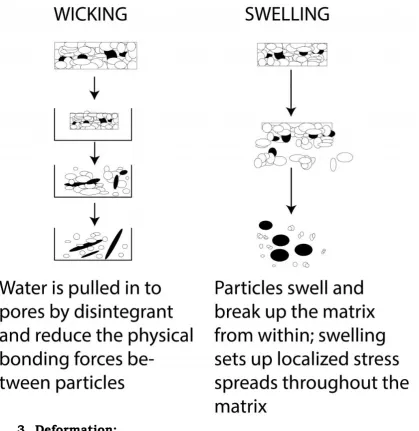
2) Porosity and Capillary Action (Wicking) 3) Deformation
4) Due to disintegrating particle/particle repulsive forces 5) Enzymatic reaction
1. Swelling:
[image:48.595.112.523.422.506.2]Swelling is believed to be a mechanism in which certain disintegrating agents (such as starch) impart the disintegrating effect. By swelling in contact with water, the adhesiveness of other ingredients in a tablet is overcome causing the tablet to fall apart. E.g Sodium starch Glycolate.38
Fig.1. Swelling of granules due to superdisintegrants
2. Porosity and Capillary Action (Wicking):
Fig.2. Wicking & Swelling
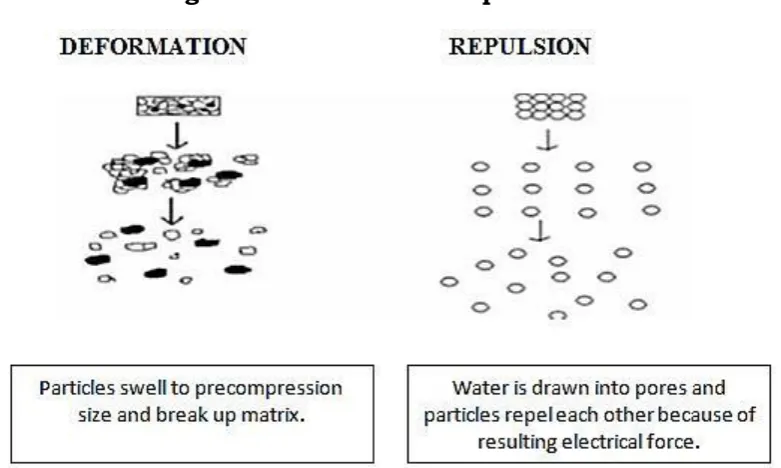
3. Deformation:
Fig.3. Deformation and repulsion
4. Due to disintegrating particle/particle repulsive forces: Another mechanism of disintegration attempts to explain the swelling of tablet made with “nonswellable” disintegrants. Guyot-Hermann has proposed a particle repulsion theory based on the observation that nonswelling particle also cause disintegration of tablets. The electric repulsive forces between particles are the mechanism of disintegration and water is required for it. Researchers found that repulsion is secondary to wicking. It is believed that no single mechanism is responsible for the action of most disintegrants. But rather, it is more likely the result of inter-relationships between these major mechanisms.
5. By Enzymatic Reaction:
Enzymes present in the body also act as disintegrants. These enzymes enhance the binding action of binder and helps in disintegration. Due to swelling, pressure is exerted in the outer direction that causes the tablet to burst or the accelerated absorption of water leads to an enormous increase in the volume of granules to promote disintegration.41
rate and extent of drug dissolution. Once a tablet disintegrates, the characteristics of the API, either alone or assisted by other formulation ingredients, determine the dissolution rate and extent of the API. Thus, the choice of superdisintegrant is important, especially with poorly soluble APIs.
Fig.4. Enzymes enhance helps in disintegration
1.14.NOT ALL SUPERDISINTEGRANTS ARE THE SAME:
The three most common classes of superdisintegrants are: crospovidone, croscarmellose sodium and sodium starch glycolate. In general, all of these provide rapid disintegration at low use levels in both wet and dry granulations and direct compression tablet processes; however, the classes of disintegrants differ in chemistry and particle morphology. Crospovidone possesses unique pyrrolidone chemistry and a highly porous particle morphology that results in high surface area. The high surface area combined with unique chemistry results in high-interfacial activity that serves to enhance the dissolution of poorly soluble drugs in a way that is not possible with other disintegrant technologies. Indeed, studies have shown that tablets containing a poorly soluble API and crospovidone, Type B, have significantly faster dissolution rates compared with tablets formulated with other superdisintegrants.
amorphous solid dispersions, more traditional approaches such as the influence of superdisintegrants on dissolution are now being considered. The selection of a superdisintegrant and the use level plays a key role in determining the drug release of finished formulations.
1.15.CHOOSING AN OPTIMAL SUPERDISINTEGRANT:
It is important to consider the impact of the superdisintegrant with respect to the performance of the final dosage form. As drug dissolution is essential for absorption by the body, formulators no longer select disintegrants based on the lowest disintegration time because it is important to also consider the effect of the superdsintegrant on dissolution. Additionally, the ionic nature of both the API and the superdisintegrants must also be considered. Anionic superdisintegrants, such as croscarmellose sodium and sodium starch glycolate, can interact with cationic APIs and retard dissolution. Thus, nonionic superdistegrants are preferred when working with cationic APIs. Formulators also consider the impact of the superdisintegrant on physical tablet characteristics, such as tablet breaking force and friability. In today’s high-speed tablet presses, superdisintegrants that provide tablets with high breaking force and low friability, while maintaining fast disintegration, are particularly important.42
1.16.SELECTION OF SUPERDISINTEGRANT:
Since superdisintegrant is used as an excipient in the tablet formulation, it has to meet certain criteria other than its swelling properties. The requirement placed on the tablet disintegrant should be clearly defined. The ideal disintegrants should have 43
1. Poor solubility 2. Poor gel formation
3. Good hydration capacity
4. Good moulding and flow properties
6. Good mouth feel.
7. It should also be compatible with the other excipients and have desirable tableting properties.
Three major groups of compounds have been developed which swell to many times their original size when placed in water while producing minimal viscosity effects. Different commonly used superdisintagrants are:44
1. Modified Starches - Sodium Carboxymethyl Starch (Chemically treated Potato Starch) i.e. Sodium Starch Glycolate (Explotab, Primogel).
Mechanism of Action: Rapid and extensive swelling with minimal gelling.
Effective Concentration: 4-6%. Above 8%, disintegration times may actually increase due to gelling and its subsequent viscosity producing effects.
2. Cross-linked polyvinylpyrrolidone - water insoluble and strongly hydrophilic. i.e. crospovidone (Polyplasdone XL, Kollidon CL).
Mechanism of Action: Water wicking, swelling and possibly some deformation recovery.
Effective Concentration: 2-4%
3. Modified Cellulose - Internally cross-linked form of Sodium carboxymethyl cellulose. i.e. Ac-Di-Sol (Accelerates Dissolution), Nymcel
Mechanism of Action: Wicking due to fibrous structure, swelling with minimal gelling.
1.17.METHOD OF ADDITION OF SUPERDISINTEGRANTS:
There are three methods of incorporating disintegrating agents into the tablet.
i) Internal Addition
In wet granulation method, the disintegrant is added to other excipients before wetting the powder with the granulating fluid. Thereby, the disintegrant is incorporated within the granules. In dry granulation method, the disintegrant is added to other excipients before compressing the powder between the rollers. In a computer optimized experiment, the study show the effect of incorporating a disintegrant, croscarmellose sodium, intragranularly, extra granularly or distributed equally between the two phases of a tablet in which a poorly soluble drug constituted at least 92.5% of the formulation. The results analyzed by means of a general quadratic response surface model suggest that, tablets with the same total concentration of crosscarmellose sodium dissolve at a faster rate when the super disintegrant is included intragranularly. Tablet friability is not affected by the method of disintegrant incorporation.
ii)External Addition
In both wet and dry granulation method, the superdisintegrant is added to the granules during dry mixing prior to compression. The effect of mode of incorporation of superdisintegrants (croscarmellose sodium, sodium starch glycolate and crospovidone) on dissolution of three model drugs with varying aqueous solubility (carbamazepine, acetaminophen and cetrizine HCl) from their respective tablet formulations by wet granulation was studied. It is proved that crospovidone is effective in improving the dissolution of the drugs in extra granular mode of addition seems to be the best mode of incorporation, irrespective of the solubility of the main tablet component. iii) Internal and External Addition
compression. This method can be more effective. If both intragranular and extragranular methods are used, extra- granular portion break the tablet into granules and the granules further disintegrate by intra-granular portion to release the drug substance into solution. However, the portion of intra-granular disintegrant (in wet granulation processes) is usually not as effective as that of extra-granular due to the fact that it is exposed to wetting and drying (as part of the granulation process) which reduces the activity of the disintegrant. Since a compaction process does not involve its exposure to wetting and drying, the intragranular disintegrant tends to retain good disintegration activity.44
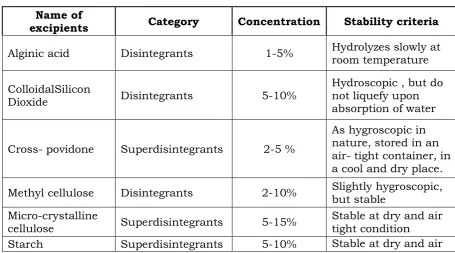
Table-1 List of Common Disintegrants and Superdisintegrants
Name of
excipients Category Concentration Stability criteria
Alginic acid Disintegrants 1-5% Hydrolyzes slowly at room temperature
ColloidalSilicon
Dioxide Disintegrants 5-10%
Hydroscopic , but do not liquefy upon absorption of water
Cross- povidone Superdisintegrants 2-5 %
As hygroscopic in nature, stored in an air- tight container, in a cool and dry place.
Methyl cellulose Disintegrants 2-10% Slightly hygroscopic, but stable
Micro-crystalline
cellulose Superdisintegrants 5-15% Stable at dry and air tight condition
Starch Superdisintegrants 5-10% Stable at dry and air
tight condition
1.18.ADVANTAGES OF SUPERDISINTEGRANTS:
The uses of superdisintegrants are extended in the applications of immediate release tablets, oral disintegration tablets, fast-dispersible tablets, capsules, mouth-dissolving films, etc
• No lump formation on disintegration
• Compatible with commonly used therapeutical agents and excipients
• Work equally effective in hydrophilic and hydrophobic formulations.
• Provides good mechanical strength to the tablet facilitating easy packing and transportation.
• Does not stick to the punches and dyes.
• Although there are many superdisintegrants, which show superior
disintegration, the search for newer disintegrants is ongoing and researchers are experimenting with modified natural products.45
1.19.EVALUATION OF TABLETS: These tests are as following:-
1. Appearance 2. Thickness 3. Hardness
4. Weight variation 5. Friability
6. Disintegration
7. Uniformity of dispersion 8. Wetting Time
9. Water absorption ratio 10. Drug content
1.20.CHALLENGES AND LIMITATIONS FOR ODTS:
Drugs with relatively larger doses, are difficult to formulate into ODTs e.g. antibiotics like ciprofloxacin with adult dose tablet containing about 500 mg of the drug.
The application for technologies used for ODTs is limited by the amount of drug into each unit dose. The drug dose must be lower than 400mg for insoluble drugs and 60mg for soluble drugs.
However Flashdose technology can accommodate larger drug doses and offers improved mechanical strength. Orasolv® technology can accommodate a wide range of active pharmaceutical ingredient from 1 mg to 500 mg.
Mechanical strength - ODTs are made of porous or soft molded matrices in order to allow its disintegration in mouth. This makes tablet friable and handling becomes difficult.
Orodispersible tablets with highly porous structure and good mechanical strength have been developed by sublimation method. Also Durasolv® has much higher mechanical strength than Orasolv due to the use of higher compaction pressures during compression. Palatability - ODTs are intended to be dissolved in mouth. Most of the drugs have bitter taste. Bitter taste can be masked with
enough sweetener and flavors. Specifically, methods of taste masking include lipophilic vehicles, coating with polymers, carbohydrates, lipids or proteins complexation with cyclodextrins or ion-exchange resins, formation of salts, use of salting out layers and solid dispersions. OraQuick utilizes its own patented taste masking technology i.e. MicroMask®. In MicroMask® technology, taste-masking process is done by incorporating drug into matrix microsphere.
tablet sizes which are both easy to handle and swallow are difficult to achieve. For the patient compliance, to make the swallowing easier, round shape punches having optimum dimensions can be used.
Drug candidates should be stable both in water and in saliva, should not ionize at oral cavity pH and should be able to permeate oral mucosal tissue to diffuse and partition in upper GI epithelium (logP > 1, or preferably > 2, not have short half-life). To optimize solubility problem of the active pharmaceutical ingredient some solid buffers and surfactants can also be chosen.
ODT requires special packaging for proper stabilization and safety of stable product.
1.21.Future of ODTs:
ODT technology is applicable to a wide range of therapeutic agents including generics, thereby adding value, i.e. "supergenerics" for veterinary or human application.
Some new quality control methods can be developed to determine the technological aspects of orally disintegrating tablets to define the characteristics of ODTs.
Protein and peptide–based therapeutics that used via oral route, have limited bioavailability when administered by immediate release tablets. Those kinds of products usually degrade immediately in gastrointestinal system. The developments of improved oral protein delivery Technology by ODTs, that dispersed and/or dissolved in the saliva, are very promising for the delivery of high molecular weight protein and peptide.
2. LITERATURE REVIEW
Nivedithaa V.R. et al., [2018] has studied on the obesity is known to have significant impact on physical and psychological health related issues in many countries. Combination therapy of Atorvastatin Calcium, a lipid lowering agent and Bisoprolol Fumarate, an antihypertensive agent was preferred for obesity treatment. The present research work was envisaged to develop immediate release tablet of Atorvastatin Calcium and Bisoprolol Fumarate by direct compression method to minimize dose dependent side effect and improve patient compliance for obese people. The formulation that showed more than 90% release was considered to be optimized formulation of combination tablet. Study reveals that combination of beta-blocker and statins were good candidate for blood pressure and lowering lipoproteins in obese patient and may increases patient compliance by reducing the multi dosage form therapy and prescription costs.34
product. An FDA and ICH regulatory body portrays the layout of these stability limitations for the stability and degradation point of view.
Priyanka Patel et al., [2015] has discussed that the Studies of drug-excipient compatibility represent an important phase in the preformulation stage for the development of all dosage forms. The potential physical and chemical interactions between drugs and excipients can affect the chemical, physical, therapeutical properties and stability of the dosage form. The present review contains a basic mode of drug degradation, mechanism of drug- excipient interaction like
physical, chemical and biopharmaceutical. Different Thermal and Non-thermal method of analysis, Tools and software for incompatibility is also discussed. Once the type of interaction is determined we can take further steps to improve the stability of drug and dosage form. From review, we conclude that consequent use of thermal and non-thermal method provide data for drug- excipient interaction which can further help in selection of excipient for the development of stable dosage form.
Ramdooss Karthikeyan et al., (2015) described the method of analysis for ambrisentan in pharmaceutical dosage form by reverse phase HPLC using C-18 coloumn(4.6 X 250mm) and 10mM phosphate buffer(pH 6.0), acetonitrile(50:50, v/v) is used as mobile phase and eluents were monitored at 226nm. The method has shown a good linearity in concentration range 6-30 mg/ml.
technology, evaporative precipitation in aqueous solution, use of precipitation inhibitors, solvent deposition, precipitation, selective adsorption on insoluble carriers. Novel drug delivery technologies developed in recent years for solubility enhancement of insoluble drugs are size reduction technologies, lipid based delivery system, micellar technologies, porous micro particle technology. Solid Dispersion Technique and various types of solid dispersion systems have also been explained briefly.
Jishan Ali Ahmed et al., (2015) expressed various advantages including ease of ingestion, avoidance of pain, versatility and most importantly patient compliance. Sometimes immediate onset of action is considered obligatory immediate release tablets are the final option. Recently immediate release tablets have started gaining popularity and acceptance as a drug delivery system, mainly because they are easy to administer and lead to better patient compliance. In the present work, we engage in discussion about formulation, development and evaluation of immediate release tablets. They are also a tool for expanding markets, extending product life cycles and generating opportunities.
Virender Kaur et al., (2015) studied about the disntegrants in Immediate drug release dosage forms disintegrate rapidly after administration with enhanced rate of dissolution. The basic approach used in development tablets is the use of superdisintegrants like Cross linked Polyvinylpyrrolidone or crospovidone (Polyplasdone), Sodium starch glycolate (Primogel, Explotab), carboxymethylcellulose (Croscarmellose) etc. These superdisintegrants provide instantaneous disintegration of tablet after administration in stomach.35
however in many cases immediate onset of action is required than conventional therapy. To overcome these drawbacks, immediate release pharmaceutical dosage form has emerged as alternative oral dosage forms. There are novel types of dosage forms that act very quickly after adminstration. The basic approach used in development tablets is the use of superdisintegrants like Cross linked carboxymelhylcellulose (Croscarmellose), Sodium starch glycolate (Primogel, Explotab), Polyvinylpyrrolidone (Polyplasdone) etc. which provide instantaneous disintegration of tablet after administration. The development of immediate release tablets also provides an opportunity for a line extension in the market place. A wide range of drugs (e.g., cardiovascular drugs, analgesics, antihistamines, and drugs can be considered candidates for this dosage form. As a drug entity nears the end of its patent life, it is common for pharmaceutical manufacturers to develop a given drug entity in a new and improved dosage form. Immediate release dosage form allows a manufacturer to extend market exclusivity, while offering its patient population a more convenient dosage form or dosing regimen. Now a day, immediate release formulations are similar to many sustained release formulations that are now commonly available.[9]
self-emulsifying systems and their selection criteria are critically reviewed. The attempts of various scientists to transform the liquid self-emulsifying drug delivery systems (SEDDS) to solid-SEDDS by adsorption, spray drying, lyophilization, melt granulation, extrusion, and so forth to formulate various dosage forms like self emulsifying capsules, tablets, controlled release pellets, beads, microspheres, nanoparticles, suppositories, implants, and so forth have also been included. Formulation of SEDDS is a potential strategy to deliver new drug molecules with enhanced bioavailability mostly exhibiting poor aqueous solubility. The self-emulsifying system offers various advantages over other drug delivery systems having potential to solve various problems associated with drugs of all the classes of biopharmaceutical classification system(BCS).[8]
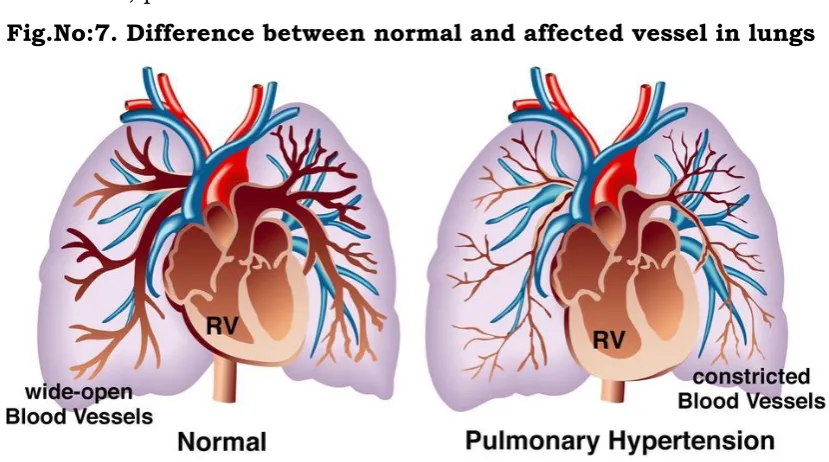
blockade of ET receptors has been suggested as an attractive target in a number of acute and chronic cardiovascular indications, including pulmonary arterial hypertension (PAH), systemic hypertension, and heart failure. In Phase III clinical trials in patients with PAH, ambrisentan (2.5– 10mg orally once-daily) improved exercise capacity, time to clinical worsening, WHO functional class, and quality of life compared with placebo. This review discusses the endothelin family of proteins and receptors and their role in the pathophysiology of pulmonary hypertensive diseases.
Sarfaraz et al., (2013)Immediate release tablets are highly accepted fast growing drug delivery systems and thus, an attempt was made to improve the onset of action of drug. To achieve this goal, selective superdisintegrants croscarmellose sodium, crospovidone and sodium starch glycolate in different concentrations (2.5 – 7.5%w/w), were evaluated for their effect on the disintegration behaviour of tablets, while microcrystalline cellulose and lactose were used as diluents. The tablets were prepared by direct compression method and were evaluated for various physicochemical properties, FTIR, in vitro disintegration and in vitro drug release studies.[12]
Natarajan R et al., (2011) to formulate various formulations of immediate release tablet of Paroxetine using different superdisintegrants (Sodium Starch Glycolate, Croscarmellose, Crospovidone) and different grades of di calcium phosphate by wet granulation method. The drug-excipients interaction was investigated by FTIR. The granules and tablets of Paroxetine were evaluated for various pre and post compression parameters like Angle of repose, Compressibility index, Hausner’s ratio, Tablet hardness, Friability, Weight variation, Drug content and in vitro dissolution. Their results were found satisfactory. The in vitro dissolution studies show the release is in the following order of superdisintegrants: Sodium Starch Glycolate>Croscarmellose>Crospovidone. These results suggest that, as determined by f2 factor (similarity factor) and maximum in vitro dissolution was found to be with Formulation F-7 and it clearly shows due to Sodium Starch Glycolate (4%).[10]
Patel N. et al., (2011) Opadry White was used for coating the core tablets. Total 16 batches were formulated. In that last 6 batches were optimized by process parameters like kneading time, lubrication time and by sizing. T