© 2015, IRJET ISO 9001:2008 Certified Journal
Page 16
Dynamic Stability Improvement of a Grid Connected Wind Generators:
A Case Studied
Van-Tri Bui
1, Dinh-Nhon Truong
2, Dac-Loc Ho
31
Hochiminh City Vocational College of Technology, Vietnam
2Hochiminh City University of Technology and Education, Vietnam
3
Hochiminh City University of Technology, Vietnam
---***---Abstract -
In this paper, dynamic stabilityimprovement of a grid connected wind power system in Ninh Thuan power system has been presented. The installed capacity of wind power system is 20 MW including of 10 x 2-MW wind turbine-based doubly fed induction generators (DFIG) interconnected to the 22-kV power grid. When a large amount of wind power being integrated into power system, it will make system stability deterioration thus a static VAR compensator (SVC) is proposed to improve the stability of the studied system. Simulation results are performed to test the stability of the system with a severe fault. It can be concluded that when the employed SVC joining with studied system the dynamic stability is improved under a severe operating condition.
Key Words:
DFIG, SVC, dynamic stability.
1. INTRODUCTION
In recent years, the extraction of power from the wind has become a recognized industry due to its simple economics and clean energy. But the ability of a power system to absorb available wind energy and maintain the system reliability and stability is reduced as the wind penetration in the system is increased [1]. Relating to wind power generators in wind power generation systems, doubly-fed induction generators (DFIGs) are the most widely used [2]. It has been recognized that the controllers have a critical impact on the stability performance of grid connected DFIG. Therefore, the controllers should be designed appropriately [3]. In [4], rotor angles of synchronous generators are directly influenced by the type of reactive power control employed by the wind generation. The implementation of appropriate control strategies in wind farms, particularly the terminal voltage control, can lessen the reactive power requirements of conventional
synchronous units and help to mitigate large rotor angle swings. Meanwhile, it is suggested that a good control strategy for the static synchronous compensator (STATCOM) will significantly improve the system dynamics [5]. At present these methods for improving stability are not very economical. For solving this problem a power system stabilizer (PSS) are installed for synchronous generator (SG), through properly regulating PSS and AVR parameters to observe the stability of various situations. The simulation results shown that wind power integrated system with auto voltage regulator (AVR) and PSS has damping effect, can reduce the oscillation of rotor angle difference, improve voltage stability [6].
The growing utilisation of wind power brings new challenges for voltage control and reactive power compensation. The amount of integrated wind power in one area can be increased by using extra reactive power support, i.e. static var compensator (SVC), thus increasing the voltage stability limit with respect to the produced active power at the wind farm. It is recognised that voltage control and reactive power compensation have influence on the damping of the system’s oscillation modes, but in an interconnected system it is not always obvious if this has a positive or negative impact. Furthermore, it is relevant to ask if changes in power system damping, e.g. caused by changes in power flow or stabilizer tuning, affect the voltage stability limits [7].
© 2015, IRJET ISO 9001:2008 Certified Journal
Page 17
2.
SYSTEM CONFIGURATION
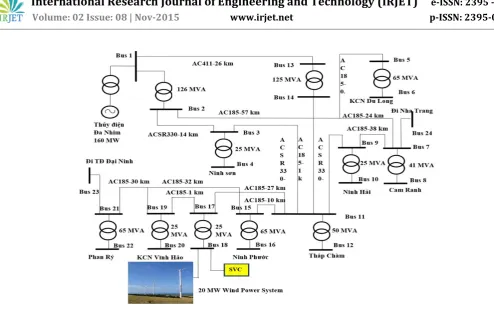
The 22-kV system with 20-MW wind farm including 10 x 2-MW wind turbine doubly fed induction generator (DFIG) in Ninh Thuan Province connected to a 110-kV national grid. The overall of Ninh Thuan is shown in Fig. 1. For modelling this complex system, the 20-MW wind farm is represented by a large equivalent aggregated DFIG driven by an equivalent aggregated wind turbine (WT) through an equivalent gearbox connected to Bus 18 [8]. The proposed SVC is connected to the same bus of wind system for supplying adequate reactive power to maintain voltage profile and to damp oscillations of the system. The employed mathematical models of the studied system are described as follows.
2.1. Wind Turbine Model
The captured mechanical power (W) by a WT can be written by
3
1
(
,
)
2
mw w rw W pw w w
P
A
V
C
(1)
where w is the air density (kg/m3), Arw is the blade impact area (m2), VW is the wind speed (m/s), and Cpw is the dimensionless power coefficient of the WT. The power coefficient of the WT Cpw is given by
5 7
2
1 3 4 6
( , ) ( β c ) exp
pw kw w w w
kw kw
c c
C c c c c
(2)
in which
9 3 8
1
1
1
kw w w
c
c
(3)
bw bw
w
W
R V
(4)
[image:2.595.40.535.54.367.2]where bw is the blade angular speed (rad/s), Rbw is the blade radius (m), λw is the tip speed ratio, w is blade pitch angle (degrees), and c1 ... c9 are the constant coefficients for power coefficient Cpw of the studied WT. The power coefficients of the WT can be referred to [9]. The cut-in, rated, and cut-out wind speeds of the studied WT are 2.5, 13, and 21 m/s, respectively. When wind speed VW is lower than the rated wind speed of the WT (VWrated), βw = 0. When VW > VWrated, the pitch-angle control system of the WT activates and the pitch angle of the WT (βw increases. The output power curve of VESTAS 2-MW DFIG-based WT is shown in Fig. 2 [10].
© 2015, IRJET ISO 9001:2008 Certified Journal
Page 18
Fig -2: Power curve of wind turbine2.2. DFIG Model and Control of Power Converters
Fig. 3 shows the one-line diagram of a wind DFIG driven by a WT. The stator windings of the DFIG are directly connected to the low-voltage side of the 0.69/22-kV step-up transformer while the rotor windings of the DFIG are connected to the same 0.69-kV side through a rotor-side converter (RSC), a DC link, a grid-side converter (GSC), and a connection line. For normal operation of a DFIG, the input AC-side voltages of the RSC and the GSC can be effectively controlled to achieve the aims of simultaneous output active-power and reactive-power control [8].
Pgw h
GB
g Psw Pew
VW DFIG
Prw
RSC GSC
vgw vdcw Rcw Lcw vrw CONTROL SYSTEM Turbine Pitch angle Bus 18 0.69/22kV
Fig -3: One-line diagram of wind DFIG-based WT
For normal operation of a wind DFIG, the input AC-side voltages of the RSC and the GSC can be effectively controlled to achieve the aims of simultaneous output active-power and reactive power control [9]. Fig. 4 shows the control block diagram of the RSC of the studied DFIG, and the operation of the RSC requires iqrw and idrw to follow the varying reference points that are determined by maintaining the output active power and the stator-winding voltage at the setting values, respectively. The required voltage for the RSC (vrw) is derived by controlling the per-unit q- and d-axis currents of the RSC. The control block diagram of the GSC of the studied wind DFIG is shown in Fig. 5. The per-unit q- and d-axis currents of the GSC, iqgw and idgw, have to track the reference points that are determined by maintaining the DC link voltage Vdc at the setting value and keeping the output of the GSC at unity power factor, respectively. The required per-unit
voltage of the GSC (vgw) is derived by controlling the per-unit q- and d-axis currents of the GSC.
AC Voltage Regulator
vw_ref
vw –+
+ – idrw idrw_ref AC Voltage Measurement vac Power Regulator Pw_ref
Pw–+
Power Measurement Current Measurement and coordinate transformation irw Tracking Characteristic + – vrw iqrw_ref iqrw iac gw Current Regulator (v
qrw, vdrw)
vac
4
Fig -4: Control block diagram for the RSC of the studied wind DFIG
DC Voltage Regulator Vdcw_ref
Vdcw–+
+ – idgw idgw_ref Current Measurement and coordinate transformation igw + – vgw iqgw_ref iqgw Current
Regulator (vqgw, vdgw)
Fig -5: Control block diagram for the GSC of the studied wind DFIG
2.3. SVC Model
The proposed SVC in this paper is for regulating the voltage at its terminals by compensating the proper amount of reactive power delivered to or absorbed from the connected power system. The single-phase equivalent circuit of the SVC with thyristor-controlled reactor-fixed capacitor (TCR-FC) type was shown in Fig. 6 [7, 10]. Assuming a balanced and fundamental-frequency operation, the equivalent BSVC of the SVC is a function of the firing angle α as shown below.
L C L SVC X X X B 2 2 2 sin 2 ) (
(5)
[image:3.595.312.561.136.240.2]where XL and XC are reactance of reactor and capacitor of SVC, respectively.
[image:3.595.316.556.289.412.2] [image:3.595.42.286.418.529.2]© 2015, IRJET ISO 9001:2008 Certified Journal
Page 19
reference value, the BSVC of the SVC is negative to absorb [image:4.595.319.547.121.711.2]reactive power from the power system.
Fig -6: Control block diagram of the employed SVC
Fig -7: Control block diagram of the employed SVC
3. TIME DOMAIN SIMULATION
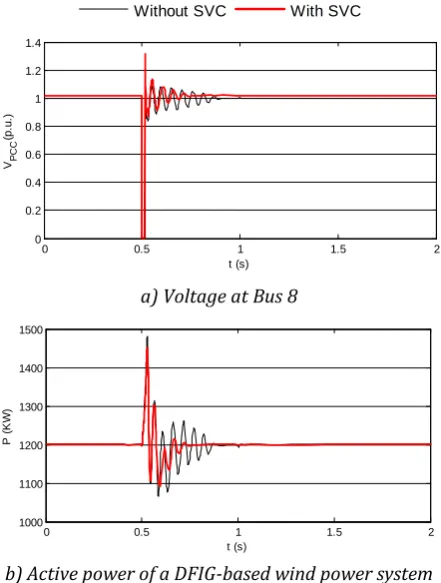
This section utilizes the nonlinear system model to compare the damping characteristics contributed by the proposed SVC. It is clearly seen that, the included SVC does improve the voltage profile. In order to ascertain the improvement on transient voltage stability, the system response to a three phase fault is studied. The short-circuit fault is located at Bus 11 and starts at t = 0.5 s and the fault is cleared after 5 cycles. In this case, the considered wind speed is selected as 10 m/s.
Fig. 8 shows the comparative transient responses of the system with SVC (red lines) and without SVC (black lines). It is clearly seen from Fig. 8(a) that when the SVC is in service the voltage at bus 18 is slightly increased and the damping of the system is better. Other parameters of wind power generator such as the active power, the DC-link voltage and the rotor speed are respectively shown in Figs.
8(b) to (d) also indicating the better transient response when the system with the proposed SVC.
0 0.5 1 1.5 2
0.5 0.6 0.7 0.8 0.9 1.1 1.2 1.3
t (s)
r
(
p
.u
.)
Without SVC With SVC
0 0.5 1 1.5 2
0 0.2 0.4 0.6 0.8 1 1.2 1.4
t (s)
VP
C
C
(
p
.u
.)
a) Voltage at Bus 8
0 0.5 1 1.5 2
1000 1100 1200 1300 1400 1500
t (s)
P
(
K
W
)
b) Active power of a DFIG-based wind power system
0 0.5 1 1.5 2
0 0.2 0.4 0.6 0.8 1 1.2 1.4
t (s)
VDC
(
p
.u
.)
c) DC voltage at DC-link of DFIG
0 0.5 1 1.5 2
0.5 0.6 0.7 0.8 0.9 1.1 1.2 1.3
t (s)
r
(
p
.u
.)
d) Rotor speed of DFIG
[image:4.595.36.288.133.349.2] [image:4.595.324.545.136.428.2] [image:4.595.29.290.390.485.2]© 2015, IRJET ISO 9001:2008 Certified Journal
Page 20
4. CONCLUSIONS
This paper has presented the comparative stability improvement of a grid connected wind generators system to the 22-kV power grid of Ninh Thuan Province. To supply the adequate reactive power to the system, PI damping controllers for the proposed SVC have been apply by using try and error method. Comparative time-domain simulation of the studied system subject to a three-phase short-circuit fault at the Bus 11 has been systematically performed to demonstrate the effectiveness of the proposed SVC on suppressing inherent oscillations of the studied system. It can be concluded from the simulation results that the proposed SVC has better damping characteristics to improve the performance of the wind energy system fed to the national power grid under a severe operating condition.
REFERENCES
[1] B. W. Kennedy, Integrating wind power: Transmission and operational impacts, Refocus, Vol. 5, pp. 36- 37, 2004.
[2] A. Grauers, Efficiency of three wind energy generator system, IEEE Trans. Energy Convers., vol. 11, no. 3, pp. 650–657, 1996.
[3] R. Pena, J. C. Clear, and G. M. Asher, Doubly fed induction generator using back-to-back PWM converters and its application to variable-speed wind energy generation, IEE Proc. Elect. Power Appl., vol. 143, no. 3, pp. 231–241, 1996.
[4] E. Vittal, M. O’Malley, and A. Keane, Rotor angle stability with high penetrations of wind generation, IEEE Trans. Power Syst., vol. 27, no. 1, pp. 353–362, 2012.
[5] M. S. El Moursi, B. Bak-Jensen, and M. H. Abdel-Rahman, Coordinated voltage control scheme for SEIG-based wind park utilizing substation STATCOM and ULTC transformer, IEEE Trans. Sustain. Energy, vol. 2, no. 3, pp. 246–255, 2011.
[6] H.-H. Kuang, Z.-Q. Wu, S.-Q. Li, and X.-N. He, Stability Improvement of Wind Power Integrated System Using PSS and SVC, Intelligent System Design and Engineering Applications (ISDEA), 2013 Third International Conference on , vol., no., pp.1282-1286, 2013.
[7] G. D. Marzio, O. B. Fosso, K. Uhlen, and M. Þ. Pàlsson,
Large-Scale Wind Power Integration, Voltage Stability Limits And Modal Analysis, 15th PSCC, Liege, 2005. [8] L. Wang and D.-N. Truong, Stability enhancement of a
power system with a PMSG-based and a DFIG-based offshore wind farms using an SVC with an adaptive-network-based fuzzy inference system, IEEE Transactions on Industrial Electronics,vol. 60, no. 7, pp. 2799-2807, 2013.
[9] D.-N. Truong and L. Wang, Application of a static synchronous series compensator to improve stability of an SG-based power system with an offshore wind farm, in Proc. IEEE PES General Meeting, San Diego, CA, USA, 2012.
[10] http://www.intechopen.com/books/wind-farm- technical-regulations-potential-estimation-and-siting- assessment/wind-farms-and-their-impact-on-environment.
[11]D.-N. Truong, V.-H. Pham, V.-T. Bui, and D.-L. Ho,
Application of an SVC to Enhance the Stability of DFIG-based Wind Turbine Generator Fed to Power Grid, Journal of Technical Education Science, Hochiminh City University of Technology and Education, no. 29, pp. 44-48, 2014.
BIOGRAPHIES
Van-Tri Bui, M.Eng. is currently pursuing his PhD degree at Hochiminh City University of Technology, Vietnam.
Dinh-Nhon Truong, PhD. A Senior lecturer at Hochiminh City University of Technology and Education, Vietnam.