© 2016, IRJET | Impact Factor value: 4.45 | ISO 9001:2008 Certified Journal | Page 579
ENHANCED VISION OF HAZY IMAGES USING IMPROVED DEPTH
ESTIMATION AND COLOR ANALYSIS
Mr. Prasath P
1,
Mr. Raja G
21Student, Dept. of comp.sci., Dhanalakshmi Srinivasan Engineering College,Tamilnadu,India.
2Assistant Professor, Dept. of comp.sci., Dhanalakshmi Srinivasan Engineering College, Tamilnadu,India.
Abstract
Images are captured during inclement weather conditions such as fog, sand, and mist, that images are called as hazy images. Those images are frequently feature degraded visibility and unwanted color cast effects. Due to these effects, original image may not be clear. In such situation Laplacian-based visibility restoration approaches usually cannot adequately restore images due to poor estimation of haze thickness and the persistence of color cast problems. In proposed system, Enhanced refined transmission technique is used to solve effectively inadequate haze thickness estimation and alleviate color cast problems. It improves the performance quality of systems such as object recognition systems, obstacle detection systems, video surveillance systems, intelligent transportation Systems. Experimental results via qualitative and quantitative evaluations demonstrate that the proposed method can dramatically improve images captured during inclement weather conditions and produce results superior to those of other state-of-the-art methods.
Key Words: Laplacian-based visibility restoration,
Enhanced refined transmission.
1. INTRODUCTION
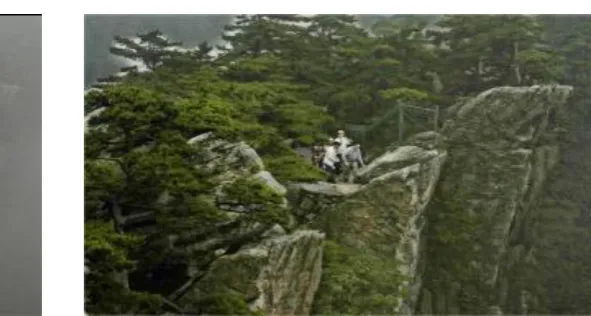
© 2016, IRJET | Impact Factor value: 4.45 | ISO 9001:2008 Certified Journal | Page 580 Fig .1 a) Input Haze Image b) Output Haze Free Image
In this paper, we discuss the degradations duo to bad weather like fog, haze, rain and snow in an image. The key reason of degradation of picture quality of outside screen in the mist and fog climate condition is for the most part the diffusing of a light before arriving at the camera because of these extensive amounts of suspended particles (e.g. haze, dimness, smoke, impurities) in the weather. This influences the typical working of automatic monitoring system, outdoor recognition system and intelligent transportation system. By the use of haze removal methods of picture we can improve the stability and strength of the visual framework. Haze is a case of the opaque medium (e.g., particles and water droplets) in the atmosphere, which will humiliate outdoor images due to atmospheric absorption and scattering [8].Its removal is an excessive undertaking as fog relies on upon the unknown scene depth data. Fog effect is the function of distance between camera and object. The haze removal approach might be divided into two classifications: image enhancement and image restoration. Image enhancement classification excludes the reasons of haze humiliating picture quality. This method loses a portion of the data in
regards to image additionally enhance the contrast of fog picture. Image restoration firstly studies the physical process of image imaging in foggy climate [9].Several algorithms have been anticipated to boost the quality of images taken under foggy environment, focusing for instance on visibility.
2. BACKGROUND
There are several methods for estimating the haze contribution in a single image. One of the most successful is the enhanced refined transmission, proposed by He et al.,4 and is used as the basis for haze estimation in this paper. Here we briefly summarize the approach.
The enhanced refined transmission is derived assuming a noise-free image with the following image formation model:
I(x) = R(x) t(x) + a∞ (1 − t(x)) (1)
© 2016, IRJET | Impact Factor value: 4.45 | ISO 9001:2008 Certified Journal | Page 581 represents each pixel location of the incoming
image; and t(x) represents transmission map, which is used to describe the non scattered light between the observed objects and the digital camera. Note that the first term J(x) t(x) and the second term A(1 − t(x)) of (1) represent the direct attenuation and the air light, respectively [26]. The decay of scene radiance J(x) can be described by direct attenuation, which is subject to medium and scene depth information.
Moreover, the air light value usually suffers from scattering and absorption by atmospheric particles, resulting in scene colour variation. When the atmosphere considered here is assumed to be homogenous, the transmission map t(x) can be expressed as
t(x) = e−βd(x) (2)
Where β represents the scattering coefficient of the atmosphere, and d(x) represents the scene depth information between the observed object and the digital camera’s obtained by simply subtracting the dark channel of the normalized image from 1. The scaling parameter, w, takes a value from 0 to 1, and corresponds to the amount of haze left in the image. After the initial haze estimate is obtained, a refinement step is required to suppress halo artefacts. He et al.4use the Matting Laplacian.12 Although this is not the quickest solution, it provides visually satisfactory results, and so is the process used in this paper. Finally, the dehazed image is usually recovered by simple inversion of Eq. (1), solving for R.
3. SYSTEM MODEL
In this section we consider the existing system design and the proposed system.
3.1 Existing System
In Existing the dark channel prior is to estimate scene depth in a single image and it is estimated through get at least one color channel with very low intensity value regard to the patches of an image. The transmission map will be estimated through atmospheric light estimation. The key to the dark channel prior is the observation that natural haze-free outdoor images are generally well textured, and contain a variety of colourful objects. As a consequence, most patches will contain one or more pixels with very low intensity in at least one of the colour channels. These dark pixels can be attributed to dark objects, shadows, or objects that are primarily a combination of only one or two of the RGB colour channels. With this observation in mind, one can construct the so called “dark channel” of an image, which can be expressed mathematically as a minimum value operation in patches around the target pixel:
(3)
where Idark(x) represents the”dark channel” of
image I at pixel location x, Ic is a colour channel of
image I, and y ∈ Ω(x) signifies all pixels y in a local patch around x. If applied to a haze-free image, the above observation yields:
(4)
In contrast, hazy images contain an additive atmospheric light component, yielding:
© 2016, IRJET | Impact Factor value: 4.45 | ISO 9001:2008 Certified Journal | Page 582 Since t(x) is essentially constant in a local window
and a∞ is usually close to white (meaning it won’t significantly affect the dark channel value), the dark channel prior effectively identifies the relative haze content throughout an image. This can aid in estimating the atmospheric light, a∞. Following Ref.
4, we estimate this component as the brightest RGB intensities in the hazy image among the pixels corresponding to the top 0.1% brightest dark channel locations, i.e. the regions where haze is most dominant.
3.2 Proposed System
In our method the haze removal was done using visibility restoration of single hazy images using color analysis and depth estimation with enhanced refined transmission technique. The hazy removal technique divided into three categories such additional information approaches, multiple image approaches, single-image approaches. The first two methods are expense one and high computational complexity. Recently single image approach is used for this dehazing process because of its flexibility and low cost. The restoration model is proposed with utilization of median filter and adaptive gamma correction technique. This approach overcomes the problems such as color distortion, artifacts and insufficient depth information.
3.2.1 Module description
3.2.1.1
Median filtering:
In noise removal process, initially we convert the image in gray. And then we filter the noise from the image. In Filtering we are applying Median filtering to our input image. Gaussian filtering is often used to remove the noise from the image. Here we used wiener2 function to our input image. Median filter
is windowed filter of linear class by its nature is weighted mean named after famous scientist Carl Gauss because weights in the filter calculated according to Gaussian distribution.
3.2.1.2 Adaptive Gamma Correction
Adaptive Gama correction is used to enhance contrast in digital image that improve the brightness of dimmed image via the gamma correction of luminance pixels. Automatic modifying histogram and enhancing contrast and Improve brightness of dimmed images, Gama correction often simply gamma, is name of a nonlinear operation used to code and decode luminance values in video or still image system. Gama correction is, in the simplest case, defined by the following power law expression.
Vout=ANinɤ
3.2.1.3 Depth Map Estimation
Depth estimation refers to the set of techniques and algorithms aiming to obtain a representation of the spatial structure of a scene and to obtain a measure of the distance of each point of the seen scene. Depth estimation in computer vision and robotics is most commonly done via stereo vision, in which images from two cameras are used to triangulate and estimate distances. However, there are also numerous monocular visual cues. Such as texture variations and gradients, defocus, color/haze.
3.2.1.4 Visibility Restoration
© 2016, IRJET | Impact Factor value: 4.45 | ISO 9001:2008 Certified Journal | Page 583
4. EXPERIMENTAL RESULTS
This section explores the qualitative and quantitative evaluations to comprehensively compare the proposed method to the other ERT-based methods, including the methods of He et al. [2], Xie et al. [7], Xu et al. [28], and Jin et al. [12]. The evaluations are achieved by using representative image databases, including Flickr [16], Picasa [18], and Google Images [20], for a total sample set of 1586 images. In addition, all compared approaches were implemented by using the C programming language on an Intel Core i3 3.07-GHz processor with 2 GB of RAM, running a Windows 7 operating system. Quantifying the restored images is a very difficult task. This is because a real-world haze-free reference image has not been validated for quantification of restored images. In general, the objective metrics used for quantitatively estimating the efficacy of the
restoration results can be divided into two categories, i.e., reference methods and non-reference method. In our experiments, we perform the local min operator using Marcel van Herk’s fast algorithm [8] whose complexity is linear to image size. The patch size is set to 15 × 15 for a 600 × 400 image. In the soft matting, we use Preconditioned Conjugate Gradient (PCG) algorithm as our solver. It takes about 10-20 seconds to process a 600×400 pixel image on a PC with a 3.0 GHz Intel Pentium 4 Processor. Figure e show our haze removal results and the recovered depth maps. The depth maps are computed using Equation (2) and are up to an unknown scaling parameter β. The atmospheric lights in these images are automatically estimated using the colour analysis method. As can be seen, our approach can unveil the details and recover vivid colour information even in very dense haze regions.
(a) (b) (c)
(d) (e)
© 2016, IRJET | Impact Factor value: 4.45 | ISO 9001:2008 Certified Journal | Page 584
CONCLUSION
It is the unique method for the Outdoor Object recognition systems. It is done using Color Analysis and Depth Estimation with Enhanced refined transmission. It is a simple and efficient method. The System has the better performance and less computation speed than the existing system. Future enhancement of this Project can be implemented to Advanced Driver Assistance System or Obstacle Detection systems by also adding sand and mist removal features.
REFERENCES
[1] Fang, Faming, Fang Li, Xiaomei Yang, Chaomin Shen and Guixu Zhang(2014), "Single image dehazing and denoising with variational method", IEEE International Conference on Image Analysis and Signal Processing (IASP), pp. 219-222.
[2] Huang S.C, F. C. Cheng, and Y. S. Chiu(2015), “Efficient contrast enhancement using adaptive gamma correction with weighting distribution” IEEE Trans. Image Process., vol. 22, no. 3, pp. 1032–1041.
[3] He, Kaiming, Jian Sun and Xiaoou Tang(2014), "Single image haze removal using dark channel prior.",IEEE Transactions on Pattern Analysis and Machine Intelligence, vol.33, no. 12, pp. 2341-2353.
[4] Long, Jiao, Zhenwei Shi and Wei Tang(2014), "Fast haze removal for a single remote sensing image usingdark channel prior", International Conference on Computer Vision in Remote Sensing (CVRS), pp.132-135.
[5] Tan, Robby T(2014), "Visibility in bad weather from a single image” IEEE Conference on Computer Vision and Pattern Recognition, CVPR, pp. 1-8.
[6] Tarel, J-P. and Nicolas Hautiere(2013), "Fast visibility restoration from a single color or gray level image",12th International Conference on Computer Vision, pp. 2201-2208.
[7] Ullah, E., R. Nawaz and J. Iqbal(2013), "Single image haze removal using improved dark channel prior",Proceedings of International Conference on Modelling, Identification & Control (ICMIC), pp. 245-248.
[8] Xu, Haoran, Jianming Guo, Qing Liu and Lingli Ye(2012), "Fast image dehazing using improved darkchannel prior", IEEE International Conference on Information Science and Technology (ICIST), pp.663-667.
[9] Huang and B. H. Chen, “Highly accurate moving object detection in variable-bit-rate video-based traffic monitoring systems,” IEEE Trans. Neural Network. Learn. Syst., vol. 24, no. 12, pp. 1920–1931, Dec. 2013.
BIOGRAPHY
Mr.P.Prasath received the B.E-CSE