© 2015, IRJET.NET- All Rights Reserved
Page 661
Development of Optimization Techniques on ARM based Embedded
Systems for Telecom Application
M.Rajendra Prasad
1, J.Pooja
2, D.Krishna Reddy
31
Associate Professor, ECE Department, Vidya Jyothi Institute of Technology, Hyderabad, Telangana, India.
2
Student, ECE Department, Vidya Jyothi Institute of Technology, Hyderabad, Telangana, India.
3
Professor, ECE Department,
Department of ECE,
Chaitanya Bharathi Institute of Technology, Hyderabad, India
---***---Abstract –
The performance of customized hardwaresystems known as embedded systems for telecom applications are determined by many factors. If performance is not meeting telecom application developer requirements we need to customize hardware or optimize application software to meet constraint of the telecom requirement. Optimization and Performance analysis is extremely important stage for telecom application developers who are working on customized hardware system platforms. There are different types of approaches to be optimization, which
are greatly differing from each other techniques. This
paper describes the optimization techniques for LAYER1 in IPBTS protocol stack application. It is used to increase the performance of task allocation on LAYER1 by reducing the density of code and to improve the performance and execution time of the on ARM11 Raspberry Pi processor board. The optimization and task allocation of real-time embedded systems are analyzed and optimized using functions, structures and pointers with results.
Key Words
: Embedded Systems, Performance
Analysis, Optimization, ARM11 Raspberry Pi Processor
Boar, LAYER1.
1. INTRODUCTION
Embedded Systems are characterized by the presence of processors running application specific programs. Typical examples of embedded systems are printers, cellular phones and automotive engine controller units. In embedded systems, with the flexibility of software and increasing application specific logic solution makes embedded systems an attractive solution. As system complexity grows and processor increases, the embedded system design approach for application specific systems is becoming more appealing. This makes many researchers to make efforts in the design and analysis of embedded systems.
Here, we are comparing the developing and analysis of optimization technique for LAYER LI module of IP-BTS application on Raspberry Pi board. The main aim to choose this project is to describe the optimization techniques that are used to increase the performance of task allocation on LAYER L1 by reducing the density of code and to improve the performance and execution of the LAYER1 telecom application . The optimization and task allocation of hard real-time embedded systems are analyzed and developed by using sample functions, structures and pointers that are used to optimize the code efficiency and improve the performance of the LAYER L1 of IPBTS At present Embedded Linux has become heart of research in embedded system fields so we are using Linux as an operating system with kernel version 4.0.6.
The embedded platforms for our experiment setup are ARM11, IP BTSController, LAYER1and linux operating system, By evaluating and analysis of these optimization technique results at the early stages for their performances telecom application user can decide which processor is suitable for required application. Thus we can reduce the efficiency, task allocation, code by investigating the performance of processor board and increasing the quality of embedded real time system for different telecom applications discussed with the results.
2. RELATED WORK
© 2015, IRJET.NET- All Rights Reserved
Page 662
Ettikan Kandasamy Karuppiah describes concept thatin-kernel implementations give lesser CPU load. By implementing UDP server and clientas modules in the kernel, the clock ticks (CPU load) needed torun the program reduces from 20% up to 50% depending on the buffer size [2]. Shuhaizar Daud1 R. Badlishah Ahmad 2 Nukala S. Murhty3 study the effects ofcompiler optimizations on embedded systems energyusage and power consumption in real time situationsand the importance ofrunning efficient binary codes inrealizing a more power efficient, and better performing embedded system[3]. Jianfeng He1, Yufeng Li1, Wei Zhang1 Fang Fang and Hongkun Xu2 analyzed real-time scheduling policy and clock mechanism on Linux2.6.12 kernel,a new optimization for embedded ARM-S3C2440 framework is introduced into kernel scheduling module. LSF scheduling algorithm is proposed to improvescheduling policy. At additional, four aspects: processscheduling mechanism, kernel preempt, clock mechanism,virtual memory mechanism are made simple modifications. Atfinal, new kernel is compiled and tested[4].Bassem Ouni, C´ecile Belleudy, S´ebastien Bilavarn, Eric Senn presented overhead of one of most important services of the embedded system which is the context switch. We execute the bench marks and we measure the context switch energy overhead with varying a set of hardware and software parameters, then we extract the energy models and traces the results to characterize and optimize the energy consumed and we will take into account these results in modeling the deployment of complex applications on hardware platforms using the Architecture Analysis [5]. This paper we are developed optimization methodology is developed and successfully applied to LAYER1 in IPBTS protocol stack application and discussed with results.
3.
SYSTEM
DESIGN
AND
OPTIMIZATION
METHODOLOGY
IP-BTS is designed to implement the different functions like Channel Encoding & Decoding, Multiplexing & De-multiplexing, Call establishment, Speech communication through full rate speech channel, Transmission of Speech through RTP on Abis interface and supporting transmission of signaling over TCP/IP on Abis interface on linux operating system ported on different processor boards.The block diagram of existing system IP-BTS protocol stack is shown in Fig 1. In this project we have developed a methodology to optimize code to increase performance of IPBTS application software. This optimization techniques are required to improve the performance of LAYER L1 of IP-BTS platform to reduce the code and to improve the efficiency. For optimized implementation of IP-BTS software, telecom application developer should characterize the early performance details of hardware and operating system of the processor board.
Fig -1: IPBTS Protocol Stack
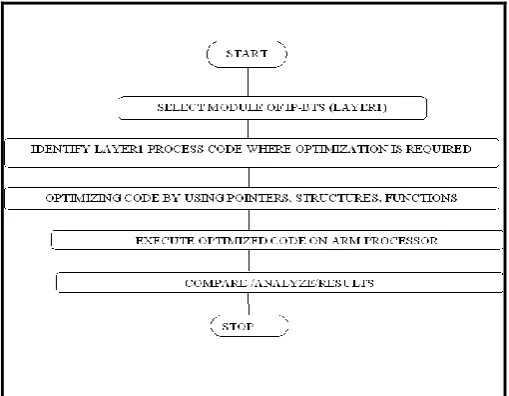
Here, We are building and transplanting linux kernel onto raspberry pi board and running optimization techniques used in LAYER L1 of IP-BTS platform and analyzing the performance results. The design flow of optimization methodology or LAYER L1 of IP- BTS based telecom applications is specified in Fig 2.
Fig -2: Optimization Methodology
[image:2.595.309.561.109.334.2] [image:2.595.308.563.451.649.2]© 2015, IRJET.NET- All Rights Reserved
Page 663
message obtained and then stop the procedure. Thesample code for structure, pointer and function code is shown in the Fig 3 with and with optimization.
Fig -3: Sample Code for Optimization Methodology
4. RESULTS AND DISCUSSIONS
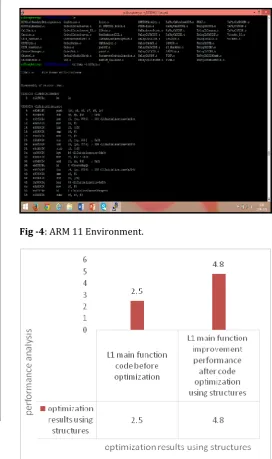
The result for defining the optimization techniques for Task Allocation in the IP-BTS platform on LAYER L1 can be obtained by executing the following commands on linux based raspberry processor board as shown in the Fig 4 Login as pi
Enter password:raspberry pi@ raspberry pi:$ cd pi@ raspberry pi:$ ls
pi@ raspberry pi:$ BTSSSOFT
pi@ raspberry pi:$ BTSCONTROLLORl pi@ raspberry pi: LAYER1
pi@ raspberry pi: objdump –d LAYER1MAIN.o the compiling process starts
Fig -4: ARM 11 Environment.
Chart -1: Optimization with Structures
[image:3.595.289.562.150.610.2] [image:3.595.299.563.158.382.2]© 2015, IRJET.NET- All Rights Reserved
Page 664
Chart 2: Optimization with PointersFrom the above results we can say that there will be an increase in the simulation results after using pointers and function in the code optimization from 30% to 40%.from the above results we can say that there is an increase in the execution time will be decreased and density of the code can be decreased and performance speed is increased.
Chart 3: Optimization with Functions
From the above result analysis we can say that the process execution is increased from 20to 50% after code
optimization and increase the overall performance and we
can decrease the code density
and we improve the
execution time and overall performance
From the above results we can say that the simulation results that are performed after optimization techniques in the layer L1 shows that there is increase in the performance from 30% to 60% by which we can say that we can improve the density of code and execution timewill be decreased.
5. CONCLUSION
© 2015, IRJET.NET- All Rights Reserved
Page 665
using highly advanced Raspberry pi board and with thehelp of growing technology the project has been successfully implemented.
When deciding whether to optimize a specific part of the program, Amdahl's Law should always be considered: the impact on the overall program depends very much on how much time is actually spent in that specific part, which is not always clear from looking at the code without a performance analysis.
A better approach is therefore to design first, code from the design and then profile/benchmark the resulting code to see which parts should be optimized. A simple and elegant design is often easier to optimize at this stage, and profiling may reveal unexpected performance problems that would not have been addressed by premature optimization.
In practice, it is often necessary to keep performance goals in mind when first designing software, but the programmer balances the goals of design and optimization.
ACKNOWLEDGEMENT
We would like to thank Correspondent and Director of Vidya Jyothi Institute of Technology, Hyderabad for their encouragement to publish this paper.
REFERENCES
[1] Pham Van Huong Nguyen Ngoc Binh “An Approach to Design Embedded Systems by Multi-objective Optimization” The 2012 International Conference on Advanced Technologies for Communications P.165-169
[2] Koh Minghao, Khong Yun Chyang, and Ettikan Kandasamy Karuppiah “Performance Analysis and Optimization of User Space versus Kernel Space Network Application”The 5th Student Conference on Research and Development – SCOReD 2007 11-12 December 2007, Malaysia
[3] Shuhaizar Daud1 R. Badlishah Ahmad 2 Nukala S. Murhty3 The Effects of Compiler “Optimizations on Embedded System Power Consumption” 2008 International Conference on Electronic Design University Malaysia Perlis
[4] 4.Jianfeng He1, 2 , Yufeng Li1, Wei Zhang1 Fang Fang2, Hongkun Xu2 “Real-Time Optimization and Application of the Embedded ARM-Linux Scheduling” 2011 International Conference of Information Technology pg.no:136-138.
[5] Bassem Ouni, C´ecile Belleudy, S´ebastien Bilavarn, Eric Senn “EMBEDDED OPERATING SYSTEMS ENERGY OVERHEAD” LEAT CNRS, 250 rue Albert Einstein, 406560 Sophia- Antipolis Cedex , France [6] Shen Khang Teoh, Vooi Voon Yap, Chit Siang Soh
Patrick Sebastian “Implementation and Optimization of Human Tracking System using ARM Embedded Platform”2012 4th International Conference on
Intelligent and Advanced Systems (ICIAS2012) p.353-356
[7] G.Indumathi ,Dr K V Ramakrishnan “STUDY AND ANALYSIS OF POWER OPTIMIZATION TECHNIQUES FOR EMBEDDED SYSTEMS” 2011 IEEE Computer Society Annual Symposium
P.365-366
[8] Bassem Ouni, C´ecile Belleudy Eric Senn “ Energy characterization and classification of embedded operating system services” 2012 15th Euromicro Conference on Digital System Design P.684-691 [9] Dong Jingwei, Wang Zhuo, Wang Rui, Shi Xianwei
“Optimizing Software of Memory Management on ARM ” 978-0-7695-4935-4/12 $26.00 © 2012 IEEE 2012 Second International Conference on Instrumentation & Measurement P.1390-1392 [10]Yu Jiang, Hehua Zhang, Zonghui Li, Yangdong Deng,
Xiaoyu Song, MingGu, and Jiaguang Sun Design and “Optimization of Multi clocked Embedded Systems Using Formal Techniques” IEEE TRANSACTIONS ON INDUSTRIAL ELECTRONICS, VOL. 62, NO. 2, FEBRUARY 2015 P.1270-1278
[11] Lizandro Oliveira, Júlio C. B. Mattos, Lisane Brisolara “Survey of memory optimization techniques for embedded systems” 2324-7894/14 $31.00 © 2014 IEEE2013 III Brazilian Symposium on Computing Systems Engineering P.65-7020.
[12] Juraj Feljan, Jan Carlson “Task Allocation Optimization for Multi-core Embedded Systems” 2014 40th Euromicro Conference on Software Engineering and Advanced Applications p.237-244 [13] Taeyoung Kim_, Bowen Zheng†, Hai-Bao Chen†, Qi
Zhu†, Valeriy Sukharev‡ and Sheldon X.-D. Tan† “Lifetime Optimization for Real-Time Embedded Systems Considering Electromigration Effects” 978-1-4799-6278-5/14/$31.00 ©2014 IEEE Department of Electrical and Computer Engineering, University of California P.434-439
[14]Ashraf El-Antably, Nicolas Fournel, Fr´ed´eric Rousseau “Lightweight task migration in embedded multi-tiled architectures using task code replication” 978-1-4799-6851-0/14/$31.00 c2014 IEEETIMA laboratory (CNRS/UJF/Grenoble INP) University Joseph Fourier p.95-99
[15]15. Nien-I Hsu_, Tseng-Yi Chen_, Yuan-Hao Changy, Hsin-Wen Weiz, Wei-Kuan Shih_, Norman Chan “Dynamic Tail Packing to Optimize Space Utilization of File Systems in Embedded Computing Systems” Department of Computer Science, National Tsing Hua University, Hsinchu, Taiwan
© 2015, IRJET.NET- All Rights Reserved
Page 666
[17]Santosh kumar rethinagiri Oscar palomar Javier ariasmoreno gulaa yalcin “System level power and energy estimation methodology and optimization techniques for CPU-GPU based mobile platforms” 978-1-4799-5795-8
[18] Hongqi He, Haifeng Chen Liehui Jiang Weiyu Dong “Hardware/software co-design of Dynamic Binary Translation in X86 Emulation” Department of Computer Science and Technology N10.
[19]Michael F. Cloutier, Chad Paradis and Vincent M. Weaver “Design and Analysis of a 32-bit Embedded High-Performance Cluster Optimized for Energy and Performance” 2014 Hardware-Software Co-Design for High Performance P DSC Zhengzhou China [20] Ahmed M. Omara 1, Mohamed K. El-Nemr 2, Essam
M. Rashad 3* “Real Time Implementation of High Performance Closed Loop Embedded Control System Interior Permanent Magnet Motors” 978-1-4799-1447-0/13/$31.00 ©2013 IEEE2013 International Conference on Electrical Machines and Systems, Oct. 26-29, 2013, Busan, Korea
BIOGRAPHIES
M.Rajendra Prasad obtained his B.E and M.E Electronics and Communication Engineering from SK University and Osmania University, Hyderabad respectively. He has 19 years of experience in embedded and telecom research development. Presently he is pursuing his research work on embedded system design for mobile applications. He is currently working as Associate Professor, ECE Department, Vidya Jyothi Insitute of Technology, Hyderabad. He has authored several research and technical paper in International Journals and had more papers in National Journals. He is a MIEEE.
Pooja Jannada is persuing her M.Tech with specialization of Embedded Systems at ECE Department, Vidya Jyothi Insitute of Technology.His area of research interests are Embedded System Design, and Optimization Techniques for Telecom applications .
D.Krishna Reddy was born in November 1966 at Gudipadu, Andhra Pradesh. He obtained his B.E. from Andhra University in 1990 with distinction and M.E. and Ph.D from Osmania University in 1995 and 2008 respectively. Presently he is working as Professor in CBIT, Hyderabad. He has 21 years of teaching experience. His present areas of interest includes 3G, data communications, LBS and GPS. He is MIEEE, Fellow of IETE, India and L.M of ISTE and SEM.