Georgia State University
ScholarWorks @ Georgia State University
Public Health Theses School of Public Health
1-5-2018
Impact of Finger Rings on the Presence of Bacteria
on Healthcare Providers' Hands
Anish Patel
Follow this and additional works at:https://scholarworks.gsu.edu/iph_theses
This Thesis is brought to you for free and open access by the School of Public Health at ScholarWorks @ Georgia State University. It has been accepted for inclusion in Public Health Theses by an authorized administrator of ScholarWorks @ Georgia State University. For more information, please contact [email protected].
Recommended Citation
Patel, Anish, "Impact of Finger Rings on the Presence of Bacteria on Healthcare Providers' Hands." Thesis, Georgia State University, 2018.
Impact of Finger Rings on the Presence of Bacteria on Healthcare Providers' Hands
By
Anish Jatin Patel
B.S. Georgia State University
M.S. Georgia State University
August 30, 2017
A Thesis Submitted to the Graduate Faculty of Georgia State University in
Partial Fulfillment of the Requirements for the Degree
MASTER OF PUBLIC HEALTH
ATLANTA, GEORGIA
30303
ABSTRACT
Despite some evidence that suggest that finger ring use is associated with higher bacterial colonization, healthcare providers continue to wear finger rings in a healthcare setting. The aim of this systematic review was to synthesize the evidence to date regarding whether finger ring use increases bacterial colonization of healthcare providers' hands. Articles that studied the association finger ring use with hand hygiene and bacterial colonization were searched using PubMed, Google Scholar, and Georgia State University's online library systems. The overall results of this review suggest that finger ring use does increase the bacterial colonization on the hands of HCPs but not with significant difference when compared to no finger ring use;
APPROVAL PAGE
Impact of Finger Rings on the Presence of Bacteria on Healthcare Providers' Hands
by
Anish Jatin Patel
Approved:
Dr. Lisa Casanova Committee Chair
Dr. Ashli Owen-Smith Committee Member
Author’s Statement Page
In presenting this thesis as a partial fulfillment of the requirements for an advanced degree from Georgia State University, I agree that the Library of the University shall make it available for inspection and circulation in accordance with its regulations governing materials of this type. I agree that permission to quote from, to copy from, or to publish this thesis may be granted by the author or, in his/her absence, by the professor under whose direction it was written, or in his/her absence, by the Associate Dean, School of Public Health. Such quoting, copying, or publishing must be solely for scholarly purposes and will not involve potential financial gain. It is understood that any copying from or publication of this dissertation which involves potential financial gain will not be allowed without written permission of the author.
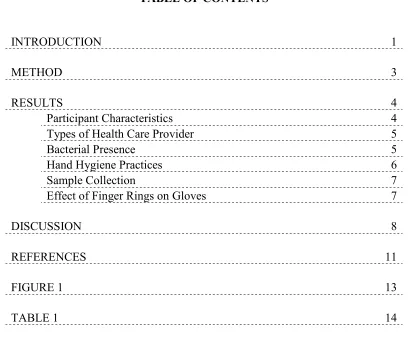
TABLE OF CONTENTS
INTRODUCTION 1
METHOD 3
RESULTS 4
Participant Characteristics 4
Types of Health Care Provider 5
Bacterial Presence 5
Hand Hygiene Practices 6
Sample Collection 7
Effect of Finger Rings on Gloves 7
DISCUSSION 8
[image:5.612.102.513.81.424.2]REFERENCES 11
FIGURE 1 13
1
INTRODUCTION
Transmission of pathogens in a hospital environment is a significant hazard. Healthcare
associated infections greatly impact patient morbidity, length of stay in hospital, and costs1.
Hand hygiene is a major factor that affects the rate at which these infections spread. Healthcare
providers (HCPs) often come in contact with bacteria by interacting with patients or
contaminated environmental surfaces that are close in proximity of the patient2. The hands of the
HCPs serve as a mode of transmission for infections.
Bacteria found on the hands could be categorized as either resident or transient2. The
resident flora can be found on the surface of the skin residing under the superficial cells of the
stratum corneum3. The main protective functions of the resident flora are microbial antagonism
and competition for nutrients3. Resident flora is less likely to be related with infections, but may
cause infections in sterile body cavities, the eyes, or on non-intact skin. Staphylococcus
epidermidis is the most common resident species found on the hands of HCPs; other resident
bacteria include S. hominis, other coagulase-negative staphylococci, followed by coryneform
bacteria (propionibacteria, corynebacteria, dermobacteria, and micrococci)3. Transient flora can
be found on the superficial layers of the skin; therefore, they are more likely to be removed by
routine hand hygiene2. Transient flora is also more frequently associated with infections and is
acquired by HCPs during patient contact2. The most common pathogenic transient flora present
on the hands of HCPs are methicillin resistant S. aureus, vancomycin resistant Enterococcus,
MDR-Gram Negative bacteria, Candida spp., and Clostridium difficle4.
Successful transmission of pathogens through HCPs’ hands is a sequential process.
Patients’ skin is colonized by transient pathogens shed onto surfaces surrounding the patient and
2
environment or patients’ skin during routine care activities, sometimes even with glove use5. It
has been shown that organisms are capable of surviving on HCPs’ hands for several minutes
following contamination5. Suboptimal hand hygiene practices then allow easier microbial
colonization and their transmission to patients or a fomite5. Therefore, hand hygiene plays an
important role in the control of bacterial transmission.
Although many healthcare institutes have a well-defined policy for hand hygiene, these
procedures may not always be followed6. A study conducted by Allegranzi and Pittet found low
hand hygiene compliance rates by HCPs in both developed and developing countries5. Some of
the reasons contributing to low hand hygiene compliance are the lack of appropriate
infrastructure and equipment to enable hand hygiene performance, the cultural background, or
religious beliefs5. Improving hand hygiene compliance could reduce the transmission of health
care associated infection7. Studies have demonstrated that rings are a major contributor to hand
contamination due to higher bacterial colonization of the skin underneath rings than in areas of
skin on fingers without rings8,9. Contamination with transient flora even after hand hygiene
practices is more likely when rings are worn10.
Currently, The Centers for Disease Control and Prevention has concluded that further
studies are needed to establish whether wearing finger rings results in an increased risk of
pathogen transmission in healthcare settings2. The World Health Organization (WHO)
recommends the removal of finger rings for HCPs in high risk settings such as the operation
room, but accepts the use of simple wedding rings only during routine care3. The WHO also
suggests the wearing of rings around their neck on a chain as a pendant.
Currently there are is no universal policy regarding finger ring use in the healthcare
3
and Attire for Nursing Students set by Emory University allows wearing plain wedding bands
but restricts wearing rings with stones11. The Association of Surgical Technologists recommends
the removal of finger rings for both sterile and non-sterile surgical team members prior to
entering the operation room12. In the United Kingdom, the Department of Health Guidance on
uniform and workwear policies for National Health Service employers recommends a bare below
the elbow policy, but allows wearing a plain wedding band13. The purpose of this systematic
review is to synthesize the current evidence available to date regarding whether finger ring use is
associated with increased presence of bacteria on HCPs' hands. If the evidence suggests that
finger ring use is associated with increased presence of bacteria on HCPs' hands, healthcare
facilities and policy makers should revise their guidelines on the use of finger ring by HCPs in a
healthcare setting accordingly.
METHOD
A systematic search was conducted of published literature that evaluated the hand
hygiene of healthcare workers and the use of finger rings. The PubMed, Google Scholar, and
Georgia State University's online library systems were used to search for publications from
January 1, 1985, through June 30, 2017. The following search details were generated by the
search query in PubMed: ((rings[All Fields] AND ("health personnel"[MeSH Terms] OR
("health"[All Fields] AND "personnel"[All Fields]) OR "health personnel"[All Fields] OR
("healthcare"[All Fields] AND "workers"[All Fields]) OR "healthcare workers"[All Fields]))
AND ("hygiene"[MeSH Terms] OR "hygiene"[All Fields])) AND ("microbiology"[Subheading]
OR "microbiology"[All Fields] OR "bacteria"[All Fields] OR "bacteria"[MeSH Terms]) AND
4
papers and systematic reviews were also scanned and manual searches for publications were
performed. Eligible articles had to be published in English and describe the effect of finger rings
on the bacterial presence on the hands of the HCPs. To ensure the articles met the criteria, the
titles and abstracts were evaluated. Next, the selected articles were reviewed and the information
about bacterial colonization associated with finger ring use and any hand washing method used
to reduce the presence of bacteria was extracted. The articles that included the assessments of
jewelry besides finger rings were not included in the evaluation.
RESULTS
As Figure 1 illustrates, 24 articles were initially identified. After removing duplicate
citations, 17 abstracts were screened. An additional 6 articles were excluded during title and
abstract review, primarily because they did not pertain to finger ring use by HCPs. Next, full-text
assessment of 11 articles was performed. Two articles were excluded because the assessment and
results of finger ring use was grouped with results of other jewelry in one study and fingernail
decorations in other study. This resulted in 9 final studies that met inclusion criteria and were
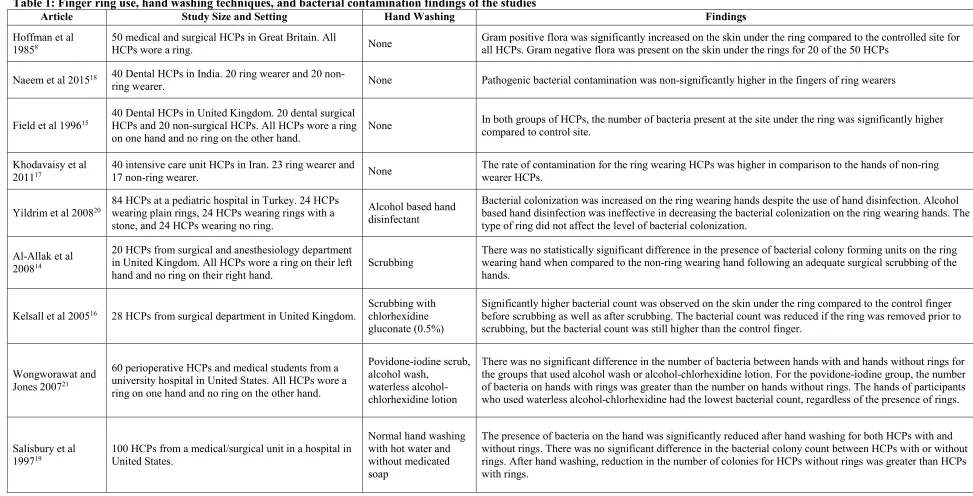
included in the review. Table 1 provides a summary of each study reviewed.
Participant Characteristics
The study population included HCPs of various types ranging from HCPs that have
limited contact with patients to HCPs that are involved in surgical procedures. The study size
varied between 20 HCPs and 100 HCPs. All studies included a comparison of bacterial
5 Types of Health Care Provider
The types of health care workers that participated in the studies include HCPs from high
patient risk settings as well as low patient risk settings. HCPs that worked in high patient risk
settings worked in departments such as the surgical, perioperative, intensive care unit, pediatric,
and dental surgery. HCPs that worked in relatively lower patient risk settings worked in
departments such as non-surgical general ward, non-clinical staff, anesthetists, medical students,
and nursing students. Two studies investigated the effect of ring use on the bacterial presence on
the hands of HCPs that participate in surgical procedures compared to the hands of HCPs that
perform routine patient care procedures such as receptionists, front desk personnel, or research
technicians. Field et al. conducted a study with 20 dental surgeons 20 were non-clinical staff.
They sampled the skin the skin directly under the ring and on the same finger of the other hand
to determine the presence of bacteria. In both groups, there were a significantly greater number
of bacteria isolated from under rings compared with control sites. Al-Allak et al. conducted a
study with 10 surgeons and 10 anesthetists. They reported that surgeons that wear rings have a
lower bacterial count than anesthetists that wear rings.
Bacterial Presence
The result of this systematic review shows mixed findings regarding finger ring use by
HCPs and its association with a higher bacterial colonization on their hands. Studies conducted
by Hoffman et al., Field et al., and Kelsall et al. reported statistically significant higher bacterial
counts associated with finger ring use. Studies conducted by Naeem et al., Khodavaisy et al.,
6
bacterial counts associated with finger ring use versus no finger ring, but the difference was not
significant.
The bacteria that were isolated from the hands of HCPs during these studies were
Staphylococcus aureus, Staphylococcus epidermidis, Escherichia coli, and Enterococcus spp.,
Klebsiella spp., Pseudomonas, Enterobacter spp., Acinetobacter spp., Stenotrophomanas
maltophilia, Serratia marsencens, Proteus mirabilis14-20.
Studies conducted by Hoffman et al., Field et al., Khodavaisy et al., and Naeem et al.
used no hand washing intervention and their purpose was solely to determine if wearing a finger
ring increased the bacterial colonization on the hands of HCPs8,15,17,18. In all studies the bacterial
count was higher for the ring wearers than for non-ring wearers when no hand hygiene practice
was implemented. Only Field et al. and Naeem et al. reported that bacterial presence was
significantly higher for the hands with rings compared to hands without rings.
Hand Hygiene Practices
Studies show that the use of finger rings by HCPs could reduce the effectiveness of these
hand hygiene practices21. Yildrim et al. and Wongworawat and Jones used alcohol-based
disinfectants in their study to determine if its use resulted in lower bacterial colonization in ring
wearing hands20,21. There was no significant difference in the number of bacteria between hands
with and hands without rings in either of these studies. Therefore, alcohol based hand
disinfection was ineffective in decreasing the bacterial colonization on the ring wearing hands.
Three studies used a surgical scrubbing method to determine if its use resulted in lower
bacterial colonization in ring wearing hands14,16,21. Wongworat and Jones observed higher
7
did not reduce the bacterial count significantly. Al-Allak et al. reported no statistically significant
difference in the presence of bacterial colony forming units on the ring wearing hand when
compared to the non-ring wearing hand following an adequate surgical scrubbing of the hands.
Kelsall et al. reported significantly higher bacterial count on the skin under the ring versus the
control finger before as well as after scrubbing. The bacterial count was reduced if the ring was
removed prior to scrubbing, but the bacterial count was still higher than the control finger.
The study conducted by Salisbury et al. examined the use of normal hand washing with
hot water and non-surgical soap to determine reduction in bacterial colonization in ring wearing
hands19. After normal hand washing, reduction in the number of colonies for HCPs without rings
was greater than HCPs with rings.
Sample Collection
All included studies mentioned their sample collection method for microbial analysis.
The sample collection method of swabbing of the area of interest was performed in six
studies8,14-18. The glove juice method of sampling was used in two studies20,21. The study
performed by Salisbury et al. utilized a friction rinse method using a sterile phosphate-buffered
saline solution for sample collection.
Effect of Finger Rings on Gloves
The scope of the studies included in this review did not include measuring the effect of
finger ring use on gloves. Two studies mention the negative effects of finger rings on the
integrity of the gloves used during patient care in the discussions portion of the article15,18. Field
8
patients in an event where the glove tears or perforates15. Rings provide a protected area in which
bacteria can flourish, they also make it difficult to wear gloves and increase the chances of
consequent damage to the glove18.
DISCUSSION
The result of this systematic review showed mixed findings regarding the association
between finger ring use by HCPs and a higher bacterial colonization on their hands. All of the
articles included in the review reported an increase in bacterial presence associated with ring use,
but only three out of nine article reported statistically significant increases. This evidence is not
sufficient to make a claim finger ring use increases the presence of bacteria on the hands of
HCPs.
The transmission of pathogens through hands of HCPs is a major public health problem.
The hands have the potential of coming in contact with numerous possible sources of infection.
With the promotion and implementation of proper hand hygiene, public health problems
associated with infections spreading via hands could be brought to a halt by controlling the mode
of transmission for infections.
Whether HCPs should wear finger rings while performing patient-related work has been a
subject of interest within the health care researchers for decades. Only nine studies have been
published on this topic, and most of them have small sample sizes ranging from 20 to 100
participants. The aim of this review was to examine the impact of finger rings and hand hygiene
practices on the presence of bacteria on the hands of HCPs.
To prevent the spread of infection, it is crucial to following proper hand hygiene practices
9
HCPs hand was evaluated in this review. The bacteria that were isolated from the hands of HCPs
during these studies were Staphylococcus aureus, Staphylococcus epidermidis, Escherichia coli,
and Enterococcus spp., Klebsiella spp., Pseudomonas, Enterobacter spp., Acinetobacter spp.,
Stenotrophomanas maltophilia, Serratia marsencens, Proteus mirabilis. None of the hand
hygiene studies resulted in a statistically significant decrease in the bacterial presence between
hands with and without rings post implementation of hand hygiene. Therefore, it not possible to
make recommendations about which hand hygiene technique is most suitable to reduce bacterial
presence associated with finger ring use.
It is reported that finger ring use is associated with ineffectiveness of gloves due to the
possibilities of causing micro-lesions puncture gloves. This leaves the gloves vulnerable to the
infection spread due to the possibilities of infiltration of bacteria inside the glove. If a finger ring
is worn, a form of hand hygiene should be accompanied to minimize the risk of spreading the
pathogens.
The limited number of data sources on this topic suggests that further research needs to
be conducted to evaluate whether wearing a finger ring by HCPs is appropriate in a health care
setting. The findings of this review indicate that not enough evidence is present to support the
association of finger ring use with increase bacterial presence on hands of HCPs.
This literature review was limited by only including articles written in English with
abstracts, and the use a limited number of search terms. Therefore, some articles pertaining to the
topic could have been excluded from the review. However, the findings of this review present
the state of the information available on the association of HCPs' finger ring use with hand
10
Another limitation in this review is the lack of comparable sample collection amongst the
included studies. Due to the researchers using different methods of sample collections, the
comparison of results amongst different studies is difficult. Also, some studies only collected a
sample via swabbing from only the finger versus other studies collecting the sample from the
entire hand of the participants.
One strength of this review is that it includes studies with participating HCPs from a
variety of departments. The studies included HCPs that worked in high patient risk departments
such as the surgical, perioperative, intensive care unit, pediatric, and dental surgery. The studies
also included HCPs that worked in relatively lower patient risk departments such as non-surgical
general ward, non-clinical staff, anesthetists, medical students, and nursing students. With the
inclusion of HCPs from both high and low patient risk settings in the studies provided results that
could be used by policy makers to set regulations based on the nature of the setting that the HCPs
work in.
The Center for Disease Control has stated that further studies are needed to ascertain if
wearing rings results in greater transmission of pathogens in healthcare settings. The World
Health Organization discourages the use of rings by HCPs that work with high-risk patients but
accept the use of finger rings by HCPs that participate in routine patient care that has low risk of
infection transmission. Until further research provides better evidence on this subject, healthcare
institutes should prohibit the use of finger rings by HCPs that work with high risk patients while
implementing and promoting a rigorous hand hygiene routine for the HCPs that wear a finger
11
REFERENCES
1. Scheithauer S, Haefner H, Schwanz T, et al. Hand hygiene in medical students: performance, education and knowledge. International journal of hygiene and environmental health 2012;
215(5): 536-9.
2. Boyce JM, Pittet D. Guideline for hand hygiene in health-care settings: recommendations of the Healthcare Infection Control Practices Advisory Committee and the
HICPAC/SHEA/APIC/IDSA Hand Hygiene Task Force. American journal of infection control 2002; 30(8): S1-S46.
3. Organization GWH. WHO Guidelines on Hand Hygiene in Health Care: First Global Patient Safety Challenge Clean Care is Safer Care; 2009.
4. Mathur P. Hand hygiene: Back to the basics of infection control. Indian Journal of Medical Research 2011; 134(5): 611-20.
5. Allegranzi B, Pittet D. Role of Hand Hygiene in Healthcare-associated Infection Prevention.
Journal of Hospital Infection 2009; 73: 305-15.
6. Bernthal E. Wedding rings and hospital-acquired infection. Nursing standard (Royal College of Nursing (Great Britain): 1987) 1997; 11(43): 44.
7. Sickbert-Bennett EE, DiBiase LM, Schade Willis TM, Wolak ES, Weber DJ, Rutala WA. Reduction of Healthcare-Associated Infections by Exceeding High Compliance with Hand Hygiene Practices. Emerging Infectious Diseases 2016; 22(9): 1628-30.
8. Hoffman P, Cooke E, McCarville M, Emmerson A. Micro-organisms isolated from skin under wedding rings worn by hospital staff. British medical journal (Clinical research ed)
1985; 290(6463): 206-7.
9. Jacobson G, Thiele JE, McCune JH, Farrell LD. Handwashing: ring-wearing and number of microorganisms. Nursing Research 1985; 34(3): 186-8.
10. Trick WE, Vernon MO, Hayes RA, et al. Impact of ring wearing on hand contamination and comparison of hand hygiene agents in a hospital. Clinical infectious diseases 2003; 36(11): 1383-90.
11. University E. Guidelines for Professional Appearance and Attire for Nursing Students. 2017. 12. Technologists AoS. AST Guidelines for Best Practices for Wearing Jewelry. 2017.
13. DH, Directorate C, Team PE. Uniforms and workwear: Guidance on uniform and workwear policies for NHS employers. 2010.
14. Al-Allak A, Sarasin S, Key S, Morris-Stiff G. Wedding rings are not a significant source of bacterial contamination following surgical scrubbing. Ann R Coll Surg Engl 2008; 90: 133-5. 15. Field EA, McGowan P, Pearce PK, Martin MV. Rings and watches: should they be removed
prior to operative dental procedures? Journal of Dentistry 1996; 24: 65-9.
16. Kelsall N, Griggs R, Bowker K, Bannister G. Should finger rings be removed prior to scrubbing for theatre? Journal of hospital infection 2006; 62(4): 450-2.
17. Khodavaisy S, Nabili M, Davari B, Vahedi M. Evaluation of bacterial and fungal
contamination in the health care workers? hands and rings in the intensive care unit. Journal of preventive medicine and hygiene 2011; 52(4).
18. Naeem A, Sachdev AS, Deo K, Malhotra S, Sachdev A, Bashir T. Contamination of
Dentist’s Hands with and without Finger Rings. Journal of International Oral Health 2015;
7(8): 114-7.
12
20. Yildirim I, Ceyhan M, Cengiz AB, et al. A prospective comparative study of the relationship between different types of ring and microbial hand colonization among pediatric intensive care unit nurses. International journal of nursing studies 2008; 45(11): 1572-6.
13
Figure 1: Flow chart used to identify articles examining finger ring use, hand washing techniques, and bacterial contamination findings of the studies
Identification
Articles identified from other sources:
N=7 Articles identified from
electronic databases (PubMed)
N =17
Total articles after duplicates removed
N = 22
Articles screened based on title and abstract
N =17
Full-text articles assessed for eligibility
N = 11
Articles excluded based on abstract information
N = 6
Full-text articles excluded N=2
Eligibility
Included Screening
Studies included in quantitative synthesis
14
Table 1: Finger ring use, hand washing techniques, and bacterial contamination findings of the studies
Article Study Size and Setting Hand Washing Findings
Hoffman et al 19858
50 medical and surgical HCPs in Great Britain. All
HCPs wore a ring. None
Gram positive flora was significantly increased on the skin under the ring compared to the controlled site for all HCPs. Gram negative flora was present on the skin under the rings for 20 of the 50 HCPs
Naeem et al 201518 40 Dental HCPs in India. 20 ring wearer and 20
non-ring wearer. None Pathogenic bacterial contamination was non-significantly higher in the fingers of ring wearers
Field et al 199615 40 Dental HCPs in United Kingdom. 20 dental surgical HCPs and 20 non-surgical HCPs. All HCPs wore a ring
on one hand and no ring on the other hand.
None In both groups of HCPs, the number of bacteria present at the site under the ring was significantly higher compared to control site.
Khodavaisy et al
201117 40 intensive care unit HCPs in Iran. 23 ring wearer and 17 non-ring wearer. None The rate of contamination for the ring wearing HCPs was higher in comparison to the hands of non-ring wearer HCPs.
Yildrim et al 200820 84 HCPs at a pediatric hospital in Turkey. 24 HCPs wearing plain rings, 24 HCPs wearing rings with a
stone, and 24 HCPs wearing no ring.
Alcohol based hand disinfectant
Bacterial colonization was increased on the ring wearing hands despite the use of hand disinfection. Alcohol based hand disinfection was ineffective in decreasing the bacterial colonization on the ring wearing hands. The type of ring did not affect the level of bacterial colonization.
Al-Allak et al 200814
20 HCPs from surgical and anesthesiology department in United Kingdom. All HCPs wore a ring on their left hand and no ring on their right hand.
Scrubbing
There was no statistically significant difference in the presence of bacterial colony forming units on the ring wearing hand when compared to the non-ring wearing hand following an adequate surgical scrubbing of the hands.
Kelsall et al 200516 28 HCPs from surgical department in United Kingdom. Scrubbing with chlorhexidine
gluconate (0.5%)
Significantly higher bacterial count was observed on the skin under the ring compared to the control finger before scrubbing as well as after scrubbing. The bacterial count was reduced if the ring was removed prior to scrubbing, but the bacterial count was still higher than the control finger.
Wongworawat and Jones 200721
60 perioperative HCPs and medical students from a university hospital in United States. All HCPs wore a ring on one hand and no ring on the other hand.
Povidone-iodine scrub, alcohol wash,
waterless alcohol-chlorhexidine lotion
There was no significant difference in the number of bacteria between hands with and hands without rings for the groups that used alcohol wash or alcohol-chlorhexidine lotion. For the povidone-iodine group, the number of bacteria on hands with rings was greater than the number on hands without rings. The hands of participants who used waterless alcohol-chlorhexidine had the lowest bacterial count, regardless of the presence of rings.
Salisbury et al 199719
100 HCPs from a medical/surgical unit in a hospital in United States.
Normal hand washing with hot water and without medicated soap