Mathematics Dissertations Department of Mathematics and Statistics
Spring 4-30-2018
Preservice Teachers’ Understanding Of Geometric
Definitions And Their Use In The Concept Of
Special Quadrilaterals
Jeffrey E. McCammonGeorgia State University
Follow this and additional works at:https://scholarworks.gsu.edu/math_diss
This Dissertation is brought to you for free and open access by the Department of Mathematics and Statistics at ScholarWorks @ Georgia State University. It has been accepted for inclusion in Mathematics Dissertations by an authorized administrator of ScholarWorks @ Georgia State University. For more information, please [email protected].
Recommended Citation
McCammon, Jeffrey E., "Preservice Teachers’ Understanding Of Geometric Definitions And Their Use In The Concept Of Special Quadrilaterals." Dissertation, Georgia State University, 2018.
THEIR USE IN THE CONCEPT OF SPECIAL QUADRILATERALS
by
JEFFREY E. MCCAMMON
Under the Direction of Draga Vidakovic, Ph.D.
ABSTRACT
The purpose of this study is to see how preservice teachers understand mathematical
definitions within a geometry context. Yet, within the collegiate mathematics coursework, many
preservice teachers do have struggles with some of the basic geometric concepts. Consequently,
this study specifically looks at the geometric definitions of quadrilaterals and how preservice
teachers use those definitions to form a holistic understanding of quadrilaterals.
Using the Action-Process-Object-Schema (APOS) theory as the theoretical framework,
the study proposes a preliminary genetic decomposition for the concept of the hierarchical
genetic decomposition or other constructions not considered.
Due to the importance of mathematical definitions in preservice teachers’ background
preparation for future field work, this study proposes the following questions:
1) What are preservice teachers’ understandings of geometric definitions?
i. What are preservice teacher’s personal definitions for special quadrilaterals?
ii. How do preservice teachers apply the distinction between necessary and sufficient
conditions for a mathematical definition?
2) How does the understanding of geometric definitions contribute to preservice teachers’
understanding of special quadrilaterals?
i. Are preservice teachers able to perceive and use the hierarchical nature of special
quadrilaterals?
ii. Are preservice teachers able to discern equivalent definitions for special quadrilaterals?
Based on the results of the data analysis, the genetic decomposition is revised. Finally, the study
concludes with pedagogical recommendations for teaching the concept of special quadrilaterals
and suggestions for further research on this topic.
THEIR USE IN THE CONCEPT OF SPECIAL QUADRILATERALS
by
JEFFREY E. MCCAMMON
A Dissertation Submitted in Partial Fulfillment of the Requirements for the Degree of
Doctor of Philosophy
in the College of Arts and Sciences
Georgia State University
Copyright by
THEIR USE IN THE CONCEPT OF SPECIAL QUADRILATERALS
by
JEFFREY E. MCCAMMON
Committee Chair: Draga Vidakovic
Committee: Vladimir Bondarenko
Mariana Montiel
Alexandra Smirnova
Electronic Version Approved:
Office of Graduate Studies
College of Arts and Sciences
Georgia State University
DEDICATION
In honor of
ACKNOWLEDGEMENTS
I give all praise, honor, and glory to God through Jesus Christ for the opportunity to do this
work and the abilities He has provided me to make it possible.
I would like to express my sincere appreciation for the enthusiastic support and supervision
of my advisor, Dr. Draga Vidakovic. Your guidance, time, and patience throughout this process
has been an encouragement for me to finally finish this project.
I would also like to express my appreciation for my committee members, Dr. Vladimir
Bondarenko, Dr. Mariana Montiel, and Dr. Alexandra Smirnova. Your comments and enthusiasm
to improve my dissertation are greatly appreciated.
My gratitude also goes out to Dr. Leslie Meadows, my cohort colleague from Georgia State
University. You have encouraged me when I most needed the encouragement. We made it through
comprehensive exams together and I have finally caught up to you with finishing my dissertation.
Finally, I am grateful to my family, Joy, Meighan, and Caid, for their love and support.
You have edged me on even when I may have been discouraged. I could not have finished without
TABLE OF CONTENTS
ACKNOWLEDGEMENTS ... v
LIST OF FIGURES ... x
LIST OF TABLES ... xv
1 INTRODUCTION... 1
1.1 Statement of the Problem ... 3
1.1.1 Elementary School Teacher Preparation ... 6
1.1.1.1 Elementary School Teacher Preparation in the State of Georgia ... 6
1.1.1.2 Elementary Teacher Preparation in the Collegiate Level ... 7
1.1.2 Preparation of Mathematics Content ... 9
1.1.3 Preparation in Geometry ... 10
1.2 Research Questions... 11
1.3 Theoretical Perspective ... 12
1.4 Outline of the Study ... 16
2 LITERATURE REVIEW ... 17
2.1 Epistemological Analysis of the Concept of Special Quadrilaterals ... 17
2.1.1 The Nature of Mathematical Definitions ... 17
2.1.2 Standard Geometric Definitions ... 22
2.1.2.1 Definition of a Polygon ... 23
2.1.2.2 Definition of a Square ... 23
2.1.2.3 Definition of a Rectangle ... 24
2.1.2.4 Definition of a Parallelogram ... 25
2.1.2.5 Definition of a Rhombus ... 25
2.1.2.6 Definition of a Kite ... 25
2.1.2.7 Definition of a Trapezoid (inclusive) ... 26
2.1.2.8 Definition of a Trapezoid (exclusive) ... 26
2.2 Prior Studies on Special Quadrilaterals ... 27
2.2.1 van Hiele Levels of Understanding... 28
2.2.2 Concept Image – Concept Definition ... 32
2.2.3 Figural Concepts Framework ... 34
2.3 Overview ... 37
3 METHODOLOGY ... 39
3.1 The Context ... 39
3.2 Procedure ... 40
3.3 Genetic Decomposition for the Concept of Special Quadrilaterals ... 41
4 DATA ANALYSIS AND RESULTS ... 44
4.1 Preservice Teachers’ Understandings of Geometric Definitions ... 46
4.1.1 Squares... 48
4.1.2 Rectangles ... 50
4.1.3 Parallelograms... 53
4.1.4 Rhombuses ... 57
4.1.5 Kites ... 59
4.1.6 Trapezoids (inclusive)... 62
4.1.7 Trapezoids (exclusive) ... 65
4.1.8 Summary for Research Question 1i ... 66
4.2 Preservice Teachers’ Application of the Distinction of Necessary and Sufficient Conditions ... 69
4.2.1 Question One ... 70
4.2.2 Question Two ... 74
4.2.3 Question Three ... 77
4.2.5 Question Five ... 84
4.2.6 Summary of responses for research question 1ii ... 86
4.3 Preservice Teachers’ Perception and Use of Hierarchical Nature of Special Quadrilaterals ... 89
4.3.1 Questions Regarding Special Cases... 90
4.3.1.1 Parallelograms... 92
4.3.1.2 Rectangles ... 93
4.3.1.3 Rhombuses ... 93
4.3.1.4 Kites ... 94
4.3.1.5 Squares... 94
4.3.1.6 Trapezoids (Inclusive) ... 95
4.3.1.7 Trapezoids (Exclusive) ... 95
4.3.1.8 Summary of the results for special cases of quadrilaterals ... 96
4.3.2 True/False Questions from Interview ... 98
4.3.2.1 Question 2A: All rectangles are parallelograms. ... 99
4.3.2.2 Question 2B: All rhombuses are parallelograms. ... 100
4.3.2.3 Question 2C: All rhombuses are kites. ... 105
4.3.2.4 Question 2D: All kites are parallelograms. ... 109
4.3.2.5 Question 2E: All parallelograms are trapezoids (inclusive). ... 112
4.3.2.6 Question 2F: All parallelograms are trapezoids (exclusive). ... 115
4.3.2.7 Question 2G: All trapezoids are kites. ... 117
4.3.2.8 Question 2H: All rectangles are kites. ... 119
4.3.2.9 Question 2I: All squares are kites. ... 121
4.3.2.10 Question 2J: All rectangles are isosceles trapezoids (inclusive). .... 123
4.3.2.11 Summary of Responses to True/False Questions from Interview ... 125
4.3.3 True/False Questions from Class Documents ... 128
4.3.3.1 Question (a): All rhombuses are parallelograms ... 130
4.3.3.2 Question (b): All rhombuses are kites. ... 131
4.3.3.3 Question (c): All kites are parallelograms. ... 133
4.3.3.5 Question (e): All rectangles are kites... 138
4.3.3.6 Summary of True/False Questions from Class Documents ... 141
4.3.3.7 Comparison of Five Questions ... 144
4.4 Preservice Teachers’ Discernment of Equivalent Definitions for Special Quadrilaterals ... 146
4.4.1 Question 3a ... 147
4.4.2 Question 3b ... 150
4.4.3 Question 4a ... 152
4.4.4 Question 4b ... 157
4.4.5 Question 5a ... 161
4.4.6 Question 5b ... 163
4.4.7 Question 5c ... 166
4.4.8 Summary of Responses for Seven Equivalent Definitions ... 168
5 DISCUSSION AND CONCLUSIONS ... 171
5.1 Discussion of the Results ... 171
5.1.3.1 Special Cases ... 178
5.1.3.2 True/False Questions ... 180
5.1.3.3 Final Examination True/False Questions ... 182
5.2 Revision of the Genetic Decomposition ... 190
5.3 Pedagogical Recommendations ... 192
5.4 Limitations of this Study ... 192
5.5 Suggestions for Further Research ... 193
REFERENCES ... 195
APPENDICES ... 204
Appendix A Sample Consent Form ... 204
LIST OF FIGURES
Figure 1: Preliminary Genetic Decomposition of Special Quadrilaterals ... 41
Figure 2: Anne's definition of a rectangle ... 50
Figure 3: Jamie's definition of a rectangle ... 51
Figure 4: Margaret's definition of a rectangle ... 53
Figure 5: Margaret's definition of a parallelogram ... 54
Figure 6: Jack's definition of a parallelogram ... 55
Figure 7: Amity's definition of a parallelogram ... 56
Figure 8: Amity's definition of a rhombus ... 58
Figure 9: Sonam's definition of a rhombus ... 59
Figure 10: Jake's definition of a kite ... 60
Figure 11: Sophie's definition of a kite ... 61
Figure 12: Cassie's definition of a kite ... 62
Figure 13: Jennifer's definition of a trapezoid (inclusive) ... 63
Figure 14: Heather's Definition of a Trapezoid (inclusive) ... 64
Figure 15: Cheryl's definition of a trapezoid (inclusive) ... 64
Figure 16: Anne's definition of a trapezoid (exclusive) ... 66
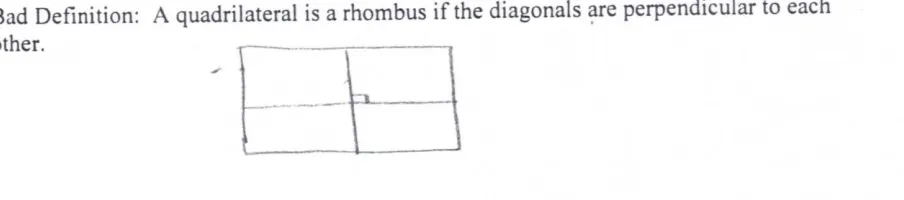
Figure 17: Mary's counterexample for a "bad" definition of a kite ... 71
Figure 18: Anna's counterexample for a "bad" definition of a kite ... 72
Figure 19: Susan's counterexample for a "bad" definition of a kite ... 73
Figure 20: Sophie's counterexample of a "bad" definition of a kite ... 73
Figure 21: Jennifer's counterexample of a “bad” definition of a parallelogram ... 75
Figure 22: Tammie's counterexample of a "bad" definition of a parallelogram ... 76
Figure 24: Anne's counterexample of a "bad" definition of a parallelogram ... 77
Figure 25: Tiffani's counterexample for a "bad" definition of a parallelogram ... 78
Figure 26: Ebony's counterexample of a "bad" definition of a parallelogram ... 79
Figure 27: Tammie's counterexample of a "bad" definition of a parallelogram ... 79
Figure 28: Lydia's counterexample of a "bad" definition for a parallelogram ... 80
Figure 29: Example of orthodiagonal figure that is not a kite ... 81
Figure 30: Stephani's counterexample of a "bad" definition of a rhombus ... 81
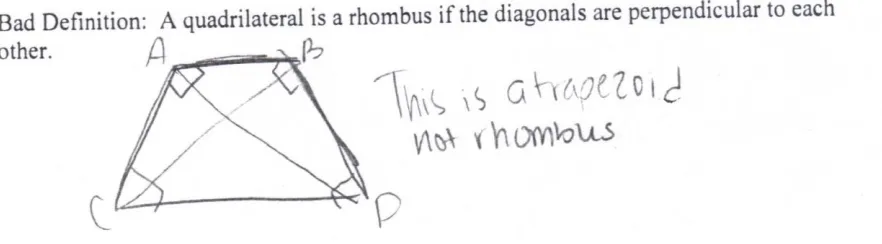
Figure 31: Mary's counterexample of a "bad" definition of a rhombus ... 82
Figure 32: Madison's counterexample of a "bad" definition of a rhombus ... 83
Figure 33: Leah's counterexample to a "bad" definition of a rhombus ... 83
Figure 34: Heather's counterexample of a "bad" definition for a rhombus ... 85
Figure 35: Ebony's counterexample of a "bad" definition for a rhombus ... 85
Figure 36: Bailey's counterexample of a "bad" definition for a rhombus ... 86
Figure 37: Tammie's work for All Rectangles are Parallelograms ... 99
Figure 38: Jennifer's Work for All Rectangles are Parallelograms ... 100
Figure 39: Anna's response to All Rhombuses are Parallelograms ... 101
Figure 40: Mary's response to All Rhombuses are Parallelograms ... 101
Figure 41: Julie's work on All Rhombuses are Parallelograms ... 103
Figure 42: Sarah's response for All Rhombuses are Parallelograms ... 104
Figure 43: Sarah's definition of a rhombus ... 105
Figure 44: Julia's response for All Rhombuses are Kites ... 106
Figure 45: Mary's response for All Rhombuses are Kites ... 106
Figure 46: Jennifer's response to All Rhombuses are Kites ... 109
Figure 48: Sophie's Response to All Kites are Parallelograms ... 111
Figure 49: Bailey's Response to All Kites are Parallelograms ... 111
Figure 50: Amity's Response to All Kites are Parallelograms ... 112
Figure 51: Jennifer's Response to All Parallelograms are Trapezoids (Inclusive) ... 113
Figure 52: Mary's Response to All Parallelograms are Trapezoids (Inclusive) ... 113
Figure 53: Lydia's Response to All Parallelograms are Trapezoids (Inclusive) ... 114
Figure 54: Jack's Response to All Parallelograms are Trapezoids (Exclusive) ... 115
Figure 55: Jennifer's Response to All Parallelograms are Trapezoids (Exclusive)... 116
Figure 56: Lydia's Response to All Parallelograms are Trapezoids (Exclusive) ... 116
Figure 57: Mary's Response to All Trapezoids are Kites... 117
Figure 58: Jennifer's Response to All Trapezoids are Kites ... 118
Figure 59: Amity's Response to All Trapezoids are Kites ... 118
Figure 60: Lydia's Response to All Trapezoids are Kites ... 119
Figure 61: Jack's Response to All Rectangles are Kites ... 120
Figure 62: Megan's Response to All Rectangles are Kites ... 120
Figure 63: Julia's Response to All Rectangles are Kites ... 121
Figure 64: Mary's Response to All Squares are Kites ... 122
Figure 65: Ebony's Response to All Rectangles are Isosceles Trapezoids (Inclusive) ... 124
Figure 66: Susan's Response to All Rectangles are Isosceles Trapezoids (Inclusive) ... 125
Figure 67: Jessica's Response to All Rhombuses are Parallelograms ... 130
Figure 68: Lydia's Response to All Rhombuses are Parallelograms ... 131
Figure 69: Stephani's Response to All Rhombuses are Kites ... 132
Figure 70: Cheryl's Response to All Rhombuses are Kites ... 132
Figure 72: Mary's Response to All Kites are Parallelograms ... 134
Figure 73: Margaret's Response to All Kites are Parallelograms ... 134
Figure 74: Jessica's Response to All Kites are Parallelograms ... 135
Figure 75: Margaret's Response to All Parallelograms are Trapezoids (Inclusive) ... 136
Figure 76: Stephani's Response to All Parallelograms are Trapezoids (Inclusive) ... 136
Figure 77: Anne's Response to All Parallelograms are Trapezoids (Inclusive) ... 137
Figure 78: Sophie's Response to All Parallelograms are Trapezoids (Inclusive) ... 138
Figure 79: Madison's Response to All Rectangles are Kites ... 139
Figure 80: Susan's Response to All Rectangles are Kites ... 140
Figure 81: Jennifer's Response to All Rectangles are Kites ... 140
Figure 82: Ebony's Response to Question 3a ... 148
Figure 83: Susan's Response to Question 3a ... 149
Figure 84: Tiffani's Response to Question 3b ... 151
Figure 85: Madison's Response to Question 3b ... 151
Figure 86: Heather's Response to Question 3b ... 152
Figure 87: Jack's Response to Question 4a ... 153
Figure 88: Sophie's Response to Question 4a ... 154
Figure 89: Cassie's Response to Question 4a ... 155
Figure 90: Julie's Response to Question 4a ... 156
Figure 91: Anne's Response to Question 4b ... 158
Figure 92: Jennifer's Response to Question 4b ... 158
Figure 93: Lydia's Response to Question 4b ... 160
Figure 94: Amity's Response to Question 4b ... 160
Figure 96: Julia's Response to Question 5a ... 162
Figure 97: Tiffani's Response to Question 5b ... 164
Figure 98: Julie's Response to Question 4b ... 165
Figure 99: Cassie's Response to Question 4b ... 166
Figure 100: Lydia's Response to Question 5c ... 167
LIST OF TABLES
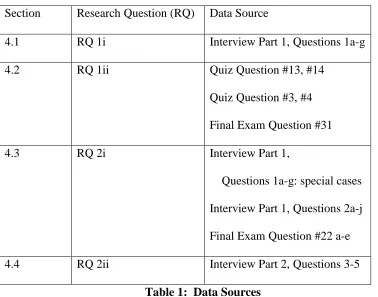
Table 1: Data Sources ... 45
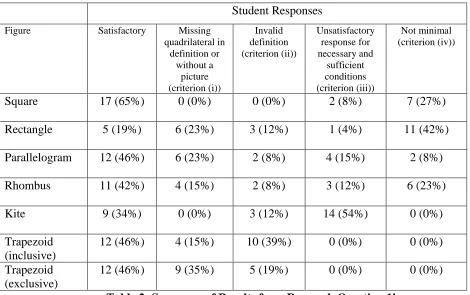
Table 2: Summary of Results from Research Question 1i ... 68
Table 3: Student Responses to Research Question 1ii ... 88
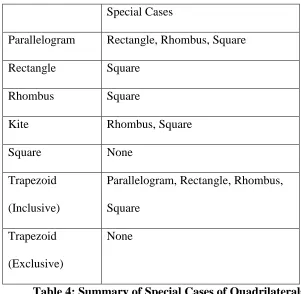
Table 4: Summary of Special Cases of Quadrilaterals... 90
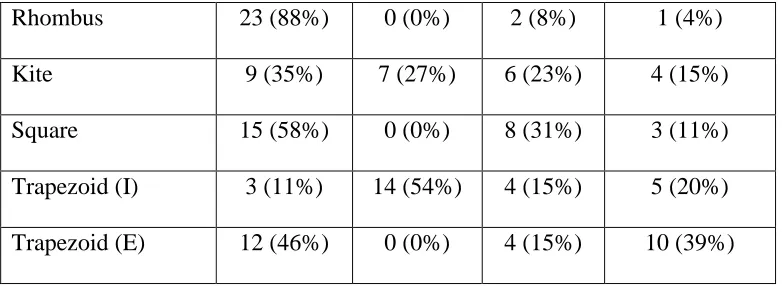
Table 5: Summary of Students' Responses about Special Quadrilaterals ... 97
Table 6: Students' Responses for True/False Questions given during the Interview ... 127
Table 7: Summary of Responses for True/False Questions given ... 142
Table 8: Comparison of Questions on Interview and Final Examination ... 144
1 INTRODUCTION
The purpose of this study is to explore how preservice teachers understand mathematical
definitions within a geometry context. Teacher preparation courses are designed to help future
teachers in their own comprehension of the subject matter they will eventually teach in the field.
Yet, within the collegiate mathematics coursework, many preservice teachers do have struggles
with some of the basic geometric concepts. Consequently, this study will specifically look at the
geometric definitions of quadrilaterals and how preservice teachers use those definitions to form a
holistic understanding of quadrilaterals.
Mathematical definitions are one of the cornerstones of mathematics. Proofs, which may
be the essence of advanced mathematical thought, are built on the deductive analysis between
definitions, axioms, and previously proven theorems (Brown, 1998). To build on prior
mathematical knowledge, the mathematician uses these new theorems to construct new
mathematical objects. Thus, with each new object, and for convenience of representation to the
mathematical community, a definition follows which clarifies the essence of the object for future
use and study.
In every mathematical system, a simple set of primitives can be used to create defined
terms (Brown, 1998). The primitive terms, sometimes referred to as undefined terms, may be
thoroughly described within the system. For example, in Set Theory, the primitives of set and is
a member of can be used to build all the remaining objects and axioms of the system (Brown,
1998). Yet, no specific definition of set or membership exists within the system.
The criteria for mathematical definitions are both eliminability and non-creativity. Any
definitions cannot help prove new theorems than what could have been proven without the
definitions (non-creativity) (Brown, 1998). In this instance, definitions represent mathematical
shorthand to describe new objects. Yet, when a definition is introduced, it cannot produce new
theorems just with the introduction of the new term alone. Brown shows that these concepts were
developed from the debates of Hilbert and Frege. Hilbert's work in geometry was to demonstrate
how axioms built on each other and each axiom was consistent based on the consistency of the
original axioms. Thus, definitions came from the context of the axioms. "Terms are not explicitly
and independently defined, but rather pick up their meaning by figuring in the axioms" (Brown,
1998, p. 115). Frege felt that terms should already have meaning before the axioms. "If terms are
being defined by the axioms, then taking an axiom to be true in one setting and false in another
setting changes the very meaning of any terms involved" (Brown, 1998, p. 119). Thus, consistency
proofs that Hilbert proposed as his formal approach would not be necessary since definitions are
separate from the axioms.
Lakatos offers yet another view of definition. He believed that definitions are theoretical
and should not be fixed (Lakatos, 1976). Instead definitions are changed through the proofs of
mathematical theorems. Brown argues that Lakatos felt that mathematics does not have a
foundation and so primitives would not exist. Thus, the difference between definitions and
theorems is only that theorems must be proved whereas definitions would adapt based on the
contextual need and the conventions within the mathematical community.
Yet, a mathematical object or symbol could have multiple definitions based on the context
of the definition. Wilhelmi, Godino and Lacasta explain their notion of “holistic meaning” when
dealing with the different categorical definitions of absolute value notion (Wilhelmi, Godino, &
is originally negative or positive which can be easily determined in the real numbers. Yet, the
absolute value of a complex number is defined as a measure of the distance from zero on the
complex coordinate system. Furthermore, Euclidean distance can be called the absolute value. In
this context, each definition is based on a higher level of abstraction of the use of absolute value.
In mathematics education, definitions can have various roles and uses. Definitions
introduce objects to a mathematical theory and help express the properties of the defined objects
(Mariotti & Fischbein, 1997). Definitions can also be a fundamental part of concept formation
(Tall & Vinner, 1981; Vinner, 1976). In addition, a definition can help categorize the difference
between examples of an object and nonexamples (Tsamir, Tirosh, & Levenson, 2008).
In the remaining sections of this chapter, I will establish why a study regarding preservice
teachers’ understanding of mathematical definitions in geometry is necessary; state the goals of
this study; and provide a theoretical framework that will guide the data analysis.
1.1 Statement of the Problem
Preservice teachers encounter mathematical definitions not only throughout their
preparatory coursework but in the field. The difficulties that teachers have in their geometric
understanding can eventually affect their practice with students (Mayberry, 1983; Quinn, 1997).
Quinn found that methods courses that used manipulatives, technology, and cooperative learning
brought a significant change in the attitudes of preservice elementary teachers towards
mathematics (Quinn, 1997). Quinn suggests that teaching Geometry in courses in a less abstract
fashion while modeling appropriate teaching pedagogies would be of great benefit to the teachers.
Cunningham and Roberts tested preservice teachers on their understanding of the altitude
of a triangle and the diagonals of a polygon (Cunningham & Roberts, 2010). Teachers could
non-prototypical diagonal of a concave polygon resulted in significant decrease in correct answers even
when the concept definition was given to the teachers. Their research shows that there were
disconnections between the definition and the actual understanding of the concept.
Mayberry applied a test designed to analyze which van Hiele Level of understanding (see
section 2.1) preservice teachers exhibited for different geometric concepts (Mayberry, 1983). Her
research showed that many of the preservice teachers who had even taken high school geometry
were below Level III. Thus, these future teachers were not ready for a more formal geometry
course. Furthermore, the tests revealed that students were on different levels for different concepts.
Consequently, research has attempted to address curricular and pedagogical changes in
educational coursework for teachers (Graeber, 1999; Shriki, 2010). Graeber was concerned with
how university students had difficulty in grasping the ‘big ideas’ of a course and what areas should
preservice teachers be covering in their methods courses (Graeber, 1999). One of the conclusions
in her research is that preservice teachers ought to have the knowledge of the difference between
procedural knowledge and conceptual knowledge. For example, students might understand the
procedure of multiplying two fractions but not conceptually understand fractions or multiplication.
Likewise, preservice teachers who can only do procedural mathematics will have difficulty with
explaining mathematics on a conceptual level to their students.
Shriki gave preservice teachers an opportunity to explore the realm of creativity in their
mathematics by creating a new geometric concept and finding appropriate properties of this new
concept (Shriki, 2010). The results led to a significant development of the preservice teachers’
mathematical knowledge, the meaning of definitions, and how mathematical objects related to
and suggested that further research is needed to determine the inhibitions by learners of using
creativity in mathematics education.
In the Principles and Standards for School Mathematics(NCTM, 2000), the National
Council of Teachers of Mathematics has emphasized that all grades 3-5 students should:
• Classify two – and three – dimensional shapes according to their properties and
develop definitions of classes of shapes;
• Make and test conjectures about geometric properties and relationships and develop
logical arguments to justify conclusions.
Furthermore, in grades 6-8 all students should:
• Precisely describe, classify, and understand relationships among two – and three –
dimensional objects using their defining properties.
Furthermore, the Common Core State Standards Initiative ("Common Core Standards," 2014) for
mathematics state the following:
Grade 3: Reason with shapes and their attributes.
• Understand that shapes in different categories (e.g., rhombuses, rectangles, and
others) may share attribute (e.g., having four sides), and that the shared attributes
can define a larger category (e.g., quadrilaterals). Recognize rhombuses,
rectangles, and squares as examples of quadrilaterals, and draw examples of
quadrilaterals that do not belong to any of these subcategories.
Grade 5: Classify two – dimensional figures into categories based on their properties.
• Understand that attributes belonging to a category of two – dimensional figures also
belong to all subcategories of that category. For example, all rectangles have four
• Classify two – dimensional figures in a hierarchy based on properties.
Both NCTM and the Common Core State Standards Initiative emphasize the importance of special
quadrilaterals in their respective lists of standards. Teachers of elementary mathematics will need
to understand these concepts well to adequately instruct students.
1.1.1 Elementary School Teacher Preparation
This section overviews the process of elementary school teacher preparation. Since teacher
certification is based on state certification requirements instead of federal regulations, I will
present the process of certification required by the state of Georgia of which this study took place.
After an overview of the general process of elementary school teacher preparation, I will look
further at specific standards in mathematics and geometry that teachers must master before taking
their certification examination.
1.1.1.1 Elementary School Teacher Preparation in the State of Georgia
The Georgia Professional Standards Commission manages all the regulations and
procedures toward teacher certification ("Teacher Certification Degrees," 2015). A teacher must
hold a bachelor’s degree and obtain teacher certification from an accredited institute. Certificates
come in two forms: Clear Renewable and Non-Renewable. The Clear Renewable Certificate is
obtained through a more traditional route of a university teacher preparation program in
coordination with a bachelor’s degree. Under special circumstances, an educator can receive a
non-renewable certificate which may reflect an alternative teacher preparation program. In
addition, all teachers must pass the appropriate assessment from the Georgia Assessments for the
Alternative routes for gaining teacher certification are available, typically for those holding
a bachelor’s degree or higher in addition to the desire to teach in a “high need” area. Specifically,
teachers can commence teaching with a Non-Renewable Non-Professional certificate or through
the Georgia Teacher Academy for Preparation and Pedagogy (GaTAPP) certification pathway.
Upon completion of this process, the teacher will be eligible for the Clear Renewable certificate.
Approved fields of certification for elementary school teachers are the Elementary Childhood
Education (Birth – Grade 5) and Middle Grades Education (Grades 4-8).
On a traditional pathway, the future educator may attend an institute that offers an
accredited Georgia teacher certification program. These programs must be approved by the
Georgia Professional Standards Commission (GaPSC) as well as the Southern Association of
Colleges and Schools (SACS). Although not mandatory, future educators should also consider a
program that is accredited by the Council for Accreditation of Educator Preparation (CAEP). This
national agency is recognized by the US Department of Education and is known for approving a
distinguished standard of teaching excellence in the educational field.
In the next section, I will discuss further the traditional pathway for elementary school
teacher preparation using a college with an approved accredited program for elementary school
teacher preparation.
1.1.1.2 Elementary Teacher Preparation in the Collegiate Level
The Georgia Profession Standards Commission (GaPSC) oversees and approves educator
preparation programs in Georgia ("Georgia Standards for the Approval of Professional Education
Units and Educator Preparation Programs," 2008). There are 8 standards that the program must
Standard 1: Candidates preparing to work in schools as teachers or other school
professionals know and demonstrate the content knowledge, pedagogical content knowledge and
skills, pedagogical and professional knowledge and skills and professional dispositions necessary
to help all students learn. Assessments indicate that candidates meet professional, state, and
institution/agency standards.
Standard 4: The professional education unit designs, implements, and evaluates curriculum
and provides experiences for candidates to acquire and demonstrate the knowledge, skills, and
professional dispositions necessary to help all students learn. Assessments indicate that candidates
can demonstrate and apply proficiencies related to diversity. Experiences provided for candidates
include working with diverse populations, including higher education and P-12 school faculty,
candidates, and students in P-12 schools.
In addition, CAEP has aligned with the National Council for Accreditation of Teacher
Education regarding standards for educator preparation. Standard 1 specifically states that
“Candidates demonstrate knowledge, skills, and professional dispositions for effective work in
schools” ("CAEP Standards for Educator Preparation Aligned with the NCATE Standards," 2013).
This standard is aligned with the GaPSC’s first standard for approved teacher preparation
programs.
The emphasis on teacher knowledge and skills for future educators provides the motivation
for this research. Elementary school teachers are to excel in the content areas of their respective
subjects. Likewise, an educator preparatory program must design a curriculum (Standard 4) that
emphasizes teacher content knowledge (Standard 1). Specifically, in preparation for Common
Core Mathematics standards, the teacher must understand the material being taught and know
The next section reviews the necessary knowledge of mathematics content that elementary
teachers must master. This material may be covered on the GACE examination required for
certification. In addition, this mathematics will be in the standards that potentially will be taught
in the regular education classroom.
1.1.2 Preparation of Mathematics Content
Elementary school teachers must know and understand the mathematics they are required
to teach. With the advent of the Common Core Standards, educators should focus on the following
domains in elementary schools: Counting and Cardinality, Operations and Algebraic Thinking,
Number and Operations in Base Ten, Measurement and Data, Geometry, and Numbers and
Operations with Fractions. Consequently, educator preparation programs expect evidence of
content understanding, methods preparation, or a combination of both in the forms of coursework,
assessments, and passing the state certification examination.
In Georgia, the GACE examination for Early Childhood Education has two parts and
emphasizes six major topics: Reading and Language Arts, Social Studies, Analysis, Mathematics,
Science, and Health Education/Physical Education/the Arts. The mathematics portion of the test
is 53% of the second test. Specifically, each section has test objectives that are aligned with the
questions.
Objective 1: Understand and applies knowledge of counting and cardinality
Objective 2: Understands and applies knowledge of operations and algebraic thinking
Objective 3: Understands and applies knowledge of numbers and operations in base 10
Objective 4: Understands and applies knowledge of numbers and fractions
Objective 6: Understands and applies knowledge of geometry.
Under Objective 6, the GACE exam also focuses to:
The beginning Early Childhood Education teacher:
A. Knows how to reason with shapes and their attributes
B. Knows how to graph points on the coordinate plane to solve real-world and
mathematical problems
C. Knows how to draw and identify lines and angles and can classify shapes by properties
of their lines and angles
Although the GACE exam can only cover certain topics to be tested, the test design provides an
emphasis of study that the examinee must know before the test. Furthermore, the material is in
alignment with Common Core Standards.
In the next section, I will go more in depth with the Geometry standards that elementary
school teachers must know and prepare for in the classroom.
1.1.3 Preparation in Geometry
Several Common Core standards prepare students for problem solving with special
quadrilaterals.
Grade 2: Recognize and draw shapes having specified attributes, such as a given number of
angles or a given number of equal faces. Identify triangles, quadrilaterals, pentagons, hexagons,
and cubes.
Grade 3: Understand that shapes in different categories (e.g., rhombuses, rectangles, and
others) may share attributes (e.g., having four sides), and that the shared attributes can define a
of quadrilaterals, and draw examples of quadrilaterals that do not belong to any of these
subcategories.
Grade 5: Understand that attributes belonging to a category of two-dimensional figures also
belong to all subcategories of that category. For example, all rectangles have four right angles and
squares are rectangles, so all squares have four right angles.
Classify two-dimensional figures in a hierarchy based on properties.
Preservice teachers must acquire understanding in these areas before teaching the concept
of special quadrilaterals in the elementary education classroom. University programs may require
their students to take math classes that cover most of the mathematics they will need in their
practice. In this study, the participants involved were from such a math class that prepared future
elementary school teachers for the Geometry content they would eventually teach.
This section concludes the general outline for elementary school teacher preparatory
programs with emphasis on mathematics and geometry. In the following section, I will review the
research questions for this study.
1.2 Research Questions
Due to the importance of mathematical definitions in preservice teachers’ background
preparation for future field work, this study proposes the following research questions:
1) What are preservice teachers’ understandings of geometric definitions?
i. What are preservice teacher’s personal definitions for special quadrilaterals?
ii. How do preservice teachers apply the distinction between necessary and sufficient
2) How does the understanding of geometric definitions contribute to preservice teachers’
understanding of special quadrilaterals?
i. Are preservice teachers able to perceive and use the hierarchical nature of special
quadrilaterals?
ii. Are preservice teachers able to discern equivalent definitions for special
quadrilaterals?
A research framework is needed to guide the design of the study and analysis of data
regarding the understanding of mathematics. This study uses the Action-Process-Object-Schema
(APOS) theory (Arnon et al., 2014; Asiala et al., 1996; Cottrill et al., 1996). Each of these
constructs will be elaborated in the following section.
1.3 Theoretical Perspective
APOS Theory, which is based on the ideas of Piaget, states that the process of learning a
concept involves a construction of mental structures and certain mental mechanisms that are
applied to the particular concept (Dubinsky, Weller, McDonald, & Brown, 2005). These
mechanisms are called interiorization, encapsulation, coordination, and generalization and the
structures are actions, processes, objects, and schemas. Understanding a concept requires a
construction of the schema corresponding to that concept (Hamdan, 2006). The description of how
students may learn a concept through this construction process is called a genetic decomposition
of the concept.
APOS Theory is based on two hypotheses. The first hypothesis is as follows:
context and by constructing or reconstructing mathematical actions, processes and objects and organizing these in schemas to use in dealing with situations. (Asiala et al., p. 5)
This hypothesis acknowledges that what a person knows and her capabilities are not always
readily available to her in each situation. The issue is two-fold: learning the concept and being
able to access it when needed. The reconstructing of mathematical knowledge may hinge on initial
perception of that knowledge and the reflection of that work.
The second hypothesis is centered on learning and teaching. Put simply, learners do not
learn mathematical concepts linearly. When individuals are considering a new mathematical
concept, not all the relevant mental constructions are remembered in this situation. Consequently,
students cannot be expected to learn mathematics in the logical, axiomatic system that may be
organized for the mathematical community (Arnon et al., 2014; Asiala et al., 1996). Rather,
students need a holistic approach to the presentation of the concept. Even so, the student’s
understanding may grow in spurts and stops; the student may even develop only partial
understanding of the concept.
In APOS Theory, a learner’s level of mathematical knowledge can be represented as one
of four general stages: actions, processes, objects, and schema. According to the theory, the
development of a mathematical concept originates as an individual applies a transformation on one
of these types of mathematical knowledge. The initial conception of the mathematical concept is
an action in that the learner is only able to perform under the reaction of an external stimulus
(Cottrill et al., 1996). The learner might be able to recall a fact from memory or is able to perform
a task by rote skill. For example, a student may understand that a rectangle is a quadrilateral with
congruent angles. A student has an action conception of a rectangle if he/she can only identify its
When the action is repeated and reflected upon, it may be interiorized into a mental process.
The learner has adapted the concept so that he does not have to actually perform the action
explicitly but rather mentally (Trigueros & Martinez-Planell, 2010). The process is perceived as
an internal construction and does not depend on the external nature of an action. Using the
rectangle example, the student is at a process conception of understanding of a rectangle when she
can state that all rectangles have congruent angles by imagining in her mind different rectangles
and observing that the angles are congruent. Through reflection on those actions in her mind
without drawing the rectangle she can conclude that all rectangles would have congruent angles.
Once a learner developed a process conception, the process can be transformed in several
ways. Processes can be reversed (e.g. given the property that a quadrilateral has congruent angles,
it must in fact be a rectangle) and/or can be coordinated with two or more other processes to form
another process or even a schema (Cottrill et al., 1996).
If an individual becomes aware of a process as a totality and can construct transformations
explicitly or mentally on it then the individual has encapsulated the process into an object. The
learner can also de-encapsulate the object back to the process from which it came from (Arnon et
al., 2014; Asiala et al., 1996). In the concept of a rectangle, students are operating at an object
understanding when the student can compare a rectangle to other objects, such as kites. That is,
to compare a rectangle to a kite, the student needs to think of both entities as objects. Further, to
perform the comparison, the student needs to de-encapsulate each object back to its original
process including the properties. For example, the object of a rectangle (and kite) would need to
be de-encapsulated back to the properties of the rectangle (and kite). The student would compare
these different sets of properties and then encapsulate these properties that are similar or different
Once an individual has constructed objects and processes, then an interconnection can link
more than one process together. All the actions, objects, and coordinated processes related to the
concept make up the schema of the mathematical concept. A schema refers to all the mental
objects and operations which the learner is able to develop for the mathematical concept
(Dubinsky, 1986). A schema can be treated as an object and included in an organization of a
“higher level” schema (Arnon et al., 2014; Asiala et al., 1996). A student who can take properties
of rectangles and apply them in other contexts (such as advanced area or volume problems) is
working at a schema level.
The paradigm for APOS theory consists of a three-step cycle: Theoretical Analysis, Design
and Implement Instruction, and Observations/Assessments (Arnon et al., 2014; Asiala et al., 1996;
Cottrill et al., 1996). Research begins with the Theoretical Analysis component by evaluating the
epistemology of the mathematical concept, the researcher’s own understanding of the concept, and
the Literature Review. Based on this analysis, the initial (hypothetical) genetic decomposition is
developed. For this study, the concept of understanding special quadrilaterals will be broken down
into elemental mental constructs that an individual would need to develop to understand this
concept.
This initial genetic decomposition leads to the component of Designing and Implementing
Instruction. The design of the instruction should address how the learner moves through stages of
cognitive growth through each of the mental constructs as proposed in the genetic decomposition.
By implementing the instruction, the cycle moves to a stage of Observation and Assessments. Data
is gathered and analyzed which leads to a reconsideration of the initial theoretical analysis. In this
study, a revised genetic decomposition of the concept of special quadrilaterals will emerge that
mathematical definitions and how students’ understandings of this notion impact their concepts of
special quadrilaterals.
In short, this study will begin with an initial genetic decomposition of the concept of
quadrilaterals. A key component of that genetic decomposition is the notion of mathematical
definitions and how hierarchical definitions provide a systematic organization of quadrilaterals
relating the properties of one object to the properties of another more generalized description of
the object. For example, a hierarchical definition is used when the properties of a rectangle are
noted to also be included as some of the properties of a square.
1.4 Outline of the Study
In the following chapters, this study will attempt to answer the research questions (as stated
above in Section 1.2) regarding the understanding of mathematical definitions in a geometry
context. Chapter 2 presents a review of the literature to the field of research in analyzing student
conceptions in geometry. The literature review includes prior research conducted on students’
understanding of special quadrilaterals and the notion of mathematical definitions. Chapter 3
describes how APOS theory will be used throughout the analysis. A preliminary genetic
decomposition will be discussed. This chapter also gives details to the methodology for data
collection and analysis. Chapter 4 reports the results of the data analysis pertaining to each
research question. Chapter 5 provides conclusions of the research. This chapter also presents
implications for pedagogical applications, limitations of the study, and concludes with suggestions
2 LITERATURE REVIEW
In the previous chapter, I gave an introduction and a brief overview of literature that justifies
the need for this study. This chapter provides a more comprehensive literature review that shows
relevant research in this field of study. Section 2.1 describes an epistemological analysis of the
concept of special quadrilaterals. Section 2.2 reviews literature related to different frameworks
for analyzing geometrical reasoning.
2.1 Epistemological Analysis of the Concept of Special Quadrilaterals
In the following sections, I will focus on studies that regard the nature of learning the concept
of special quadrilaterals. Section 2.1.1 discusses the nature of mathematical definitions. Section
2.1.2 will present the standard mathematical definition of polygon and special quadrilaterals.
Finally, Section 2.1.3 will give the definitions as presented by the textbook used in the Geometry
course the students took.
2.1.1 The Nature of Mathematical Definitions
A definition cannot be proven but instead it introduces a new expression or word that can
describe the mathematical context succinctly. All mathematical systems are built on "primitives"
or terms that cannot be defined within the system. A definition uses primitives or other definitions
to construct a new term that can be useful in proving theorems within the system.
In Euclidean Geometry, "points" and "lines" are undefined in the system. These terms
would be primitives. Yet, a term like "collinear points" which is defined as points on the same
line would be considered a definition based on the primitives. This new term is used as an
The concept of definition has evolved over time. A modern view would be that
definitions must exhibit the characteristics of eliminability and non-creativity (Brown, 1998). A
defined term can be explicitly replaced with undefined terms, known as primitives (eliminability),
and no theorems can be proven with definitions that could not be proven without them
(non-creativity). These concepts were developed from the debates of Hilbert and Frege. Hilbert's work
in geometry was to demonstrate how axioms built on each other and each axiom was consistent
based on the consistency of the original axioms. Thus definitions came from the context of the
axioms (p. 113). "Terms are not explicitly and independently defined, but rather pick up their
meaning by figuring in the axioms" (p. 115). Frege felt that terms should already have meaning
before the axioms. "If terms are being defined by the axioms, then taking an axiom to be true in
one setting and false in another setting changes the very meaning of any terms involved" (p. 119).
Thus, according to Frege, consistency proofs that Hilbert proposed as his formal approach would
not be necessary since definitions are separate from the axioms.
Definitions are one of the foundations of mathematical proof and theory. Zaslavsky and
Shir describe the main roles of mathematical definitions as follows:
1) Introducing the objects of a theory and capturing the essence of a concept by conveying
its characterizing properties
2) Constituting fundamental components for concept formation
3) Establishing the foundation for proofs and problem solving
4) Creating uniformity in the meaning of concepts, which allows us to communicate
mathematical ideas more freely (Zaslavsky & Shir, 2005)
Furthermore, Vinner suggests five characteristics of the role of definitions in mathematics:
2) Students will use definitions to solve problems and prove theorems when necessary
from a mathematical point of view.
3) Definitions should be minimal.
4) It is desirable that definitions will be elegant.
5) Definitions are arbitrary. (Vinner, 1991)
In terms of arbitrary, one could define a trapezoid as a quadrilateral having at least one pair of
opposite sides which are parallel. Another definition of a trapezoid could be a quadrilateral having
only one pair of opposite sides which are parallel. In which case, the former definition implies
that parallelograms are trapezoids whereas in the later definition they are not. To differentiate the
two definitions, I will refer to the first definition as the inclusive definition of a trapezoid and the
second definition as the exclusive definition of a trapezoid.
Similarly, Winicki-Landman and Leikin suggest the following mathematical
characteristics of a definition:
1) Defining is giving a name. The name of the new concept is presented in the statement
used as a definition and appears only once in this statement.
2) For defining the new concept, only previously defined concepts may be used.
3) A definition establishes necessary and sufficient conditions for the concept.
4) The set of conditions should be minimal.
5) A definition is arbitrary. (Winicki-Landman & Leikin, 2000)
The necessary conditions would be the properties of the concept. The sufficient conditions are
indications of the concept. Any statement that provides both necessary and sufficient conditions
can define the concept. Moreover any statement that belongs to the class of definitions could be
(Winicki-Landman & Leikin, 2000; Zazkis & Leikin, 2008). For example, a square could be
defined as a rhombus with congruent angles. A square could also be defined as a rectangle with
congruent sides. Whichever definition is used the other statement can be proven using the
definition and the given properties of a rhombus or rectangle.
Yet another choice in the creation of definitions is whether a concept will follow in a
hierarchical relationship with another concept or whether a partitional system is employed. The
hierarchical classification implies that a concept represents a subset of another concept. For
example, the definition that a rhombus is a kite with congruent sides classifies all rhombuses with
the characteristics of kites. Yet a partitional system makes the concept disjoint from another
object. In this case, although unconventional, a kite could be defined as a quadrilateral with two
distinct pairs of adjacent congruent sides and all sides cannot be congruent. By this definition
rhombuses and kites are separate objects. De Villiers suggest several reasons that a hierarchical
definition be considered over the partitional system:
1) It leads to more economical definitions of concepts and formulation of theorems.
2) It simplifies the deductive systematization and derivation of the properties of more
special concepts
3) It often provides a useful conceptual schema during problem solving
4) It sometimes suggests alternative definitions and new propositions
5) It provides a useful global prospective. (De Villiers, 1994)
In general, hierarchical definitions are shorter than partitional definitions since many times the
partitional definition must specifically exclude characteristics of other objects. Hierarchical
inclusion also assists in proving properties of an object especially when that object is in a subset
kite then all the properties of kite are also properties of a rhombus. In terms of global perspectives,
hierarchical definitions can also lead to greater connectivity between objects. As an example,
since a rhombus is an intersection of a kite and a parallelogram it follows that the diagonals of a
rhombus must be perpendicular bisectors since all the properties of the diagonals of a kite
(perpendicular) and the properties of the diagonals of a parallelogram (bisect each other) must be
in a rhombus.
Lakatos offers yet another view of definition. He believed that definitions are theoretical
and should not be fixed. Instead definitions are changed through the proofs of mathematical
theorems. Lakatos felt that mathematics does not have a foundation and so primitives would not
exist (Brown, 1998). Thus, the difference between definitions and theorems is only that theorems
must be proved whereas definitions would adapt based on the contextual need and the
conversations within the mathematical community. The Lakatosian viewpoint establishes
definitions as generated from proofs (Ouvrier-Buffet, 2006). However, this viewpoint is difficult
to bring to the classroom. Pimm states:
(This notion) seems particularly problematic in terms of teaching mathematics, because of
needing to perceive the definition as a tool custom-made to do a particular job that cannot
be known by those trying to learn it, certainly not with an order of presentation that seems
to require definitions to come first (Pimm, 1993, p. 272).
Yet Lakatos’ approach does provide a model of mathematical discovery which combined both the
social and conceptual aspects (Ouvrier-Buffet, 2006).
Teachers of mathematics must be proficient in mathematical definitions especially when
(Groth, 2006). If teachers do not have deeper understanding of these conventions and their
implications, they will have limitations in their guidance of student learning.
The next section covers standard geometric definitions of polygons and special
quadrilaterals.
2.1.2 Standard Geometric Definitions
The following sections will present definitions of polygons and special quadrilaterals.
These definitions have been created under the same criteria listed in the previous section. Of
interest in this study are the following criteria for a definition of a special quadrilateral:
i) Identifies that object is a quadrilateral (or closed four-sided polygon or figure)
ii) Identifies properties correctly
iii) Establishes necessary and sufficient conditions
iv) The set of conditions should be minimal
Since each of the figures in this study are special quadrilaterals, the definition given by
students needs to at least identify that the figure is a quadrilateral (criterion (i)). Also, a definition
must have correctly listed properties according to mathematical convention (criterion (ii)). As
teachers of elementary students, preservice teachers must convey correct mathematical knowledge.
Criterion (iii) employs Winicki-Landman and Leikin’s condition that definitions must establish
necessary and sufficient conditions (Landman & Leikin, 2000). Finally, Vinner,
Landman, and Leikin recommend that definitions should be minimal (Vinner, 1991;
Winicki-Landman & Leikin, 2000). Minimal means using the least amount of properties to sufficiently
parallelogram with congruent sides and perpendicular diagonals. A minimal definition could be
the following: a rhombus is a quadrilateral with congruent sides.
I will start with a definition of a polygon and then the remaining definitions will be specific
quadrilaterals.
2.1.2.1 Definition of a Polygon
A polygon can be defined as a geometric object "consisting of a number of points (called
vertices) and an equal number of line segments (called sides), namely a cyclically ordered set of
points in a plane, with no three successive points collinear, together with the line segments joining
consecutive pairs of the points. In other words, a polygon is closed broken line lying in a plane"
(Coxeter, 1967, p. 51). Another definition is “a polygon is a closed, two-dimensional figure that
consists of three or more straight line segments” (Salomon, 2011, p. 88) Both of these definitions
do not define what is meant by a closed figure in the plane and they both imply that the polygon
is the border of the figure and not the interior (Weisstein, 1999-2015a).
The complexities of the polygon shape show up in different forms. Polygons can be
convex, concave, or star (Weisstein, 1999-2015a). A planar polygon is convex if it contains all
the line segments that connect any two points on the polygon. If a planar polygon is not convex,
it must be concave. The star polygon is formed by connecting with straight lines every qth point
out of p regularly spaced points lying on a circumference (Weisstein, 1999-2015b).
2.1.2.2 Definition of a Square
In a study by Zazkis and Leikin, participants were asked to give as many examples for the
definition of a square (Zazkis & Leikin, 2008). The following are 13 examples from an expert
1) A regular quadrilateral
2) A quadrilateral with all the angles and all the sides equal
3) A quadrilateral with all the sides equal and an angle of 90
4) A rectangle with equal sides
5) A rectangle with perpendicular diagonals
6) A rhombus with equal angles
7) A rhombus with equal diagonals
8) A parallelogram with equal adjacent angles and equal adjacent sides
9) A parallelogram with equal and perpendicular diagonals
10)A quadrilateral having 4 symmetry axes
11)A quadrilateral symmetric under rotation by 90
12)The locus of all the points in a plane for which the sum of the distances from two given
perpendicular lines is constant
13)The locus of all the points in a plane for which the maximum of the distances from two
given perpendicular lines is constant
2.1.2.3 Definition of a Rectangle
The following definitions for a rectangle are acceptable in this study:
1) A quadrilateral with four right angles.
2) A quadrilateral with congruent angles.
3) A parallelogram with at least one right angle.
4) A parallelogram with four right angles.
5) A parallelogram with congruent angles.
2.1.2.4 Definition of a Parallelogram
The following definitions for a parallelogram are acceptable in this study:
1) A quadrilateral with opposite sides that are parallel.
2) A quadrilateral with opposite sides that are congruent.
3) A quadrilateral with a pair of congruent parallel sides.
4) A quadrilateral with diagonals that bisect each other.
5) A quadrilateral with congruent opposite angles.
2.1.2.5 Definition of a Rhombus
The following definitions for a rhombus are acceptable in this study:
1) A quadrilateral with congruent sides.
2) A quadrilateral whose diagonals are perpendicular bisectors of each other.
3) A parallelogram with congruent sides.
4) A quadrilateral with both diagonals are lines of symmetry.
2.1.2.6 Definition of a Kite
The following definitions for a kite are acceptable in this study:
1) A quadrilateral with two distinct pairs of congruent adjacent sides.
2) A quadrilateral with at least one diagonal that is a line of symmetry.
3) A quadrilateral with at least one diagonal that is a perpendicular bisector of the other
2.1.2.7 Definition of a Trapezoid (inclusive)
Trapezoids can be defined inclusively or exclusively. An inclusive definition allows for
other special quadrilaterals to be special cases of the trapezoid. The inclusive definition of a
trapezoid is a quadrilateral that has at least one pair of parallel sides. Consequently,
parallelograms, rectangles, rhombuses, and squares are all special cases of a trapezoid.
2.1.2.8 Definition of a Trapezoid (exclusive)
The exclusive definition of a trapezoid removes the hierarchical nature and partitions
trapezoids as an object of its own kind. The exclusive definition of a trapezoid is a quadrilateral
with only one pair of parallel sides. Consequently, no other special quadrilateral listed above is a
special case of a trapezoid.
2.1.3 Textbook Definitions
The preservice teachers who took the one semester Geometry course were given two
textbooks for their Geometry studies. One textbook (Tussy, 2010) used in the course defines
polynomials as a “closed geometric figure with at least three line segments for its sides.” A
quadrilateral is a “polygon with four sides.” The text then proceeds to mention common
quadrilaterals and gives a brief description/definition:
Parallelogram (Opposite sides parallel)
Rectangle (Parallelogram with four right angles)
Rhombus (Parallelogram with sides of equal length)
Trapezoid (Exactly two sides parallel).
The other textbook (Aichele, 2008) gives the following definitions for some special quadrilaterals:
Inclusive Trapezoid: a quadrilateral with at least one pair of parallel sides.
Exclusive Trapezoid: a quadrilateral with only two sides parallel.
Kite: A quadrilateral with two separate pairs of equal adjacent sides
Students were familiar with these definitions from the class instruction.
In the next section, I will introduce prior studies in special quadrilaterals.
2.2 Prior Studies on Special Quadrilaterals
There are three significant frameworks that have been used in geometric mathematical
research. A predominant framework in geometric mathematical research since 1976 has been the
van Hiele Levels of Understanding (Burger & Shaughnessy, 1986; Currie & Pegg, 1998; Fujita,
2012; Fuys, Geddes, & Tischler, 1988; Gutiérrez, Jaime, & Fortuny, 1991; Mayberry, 1983; Unal,
Jakubowski, & Corey, 2009; Usiskin, 1982; Wilson, 1990). Another framework that has impacted
mathematical research is the Concept Image – Concept Definition framework (Cunningham &
Roberts, 2010; Roh, 2008; Tall & Vinner, 1981; Vinner & Dreyfus, 1989). A third approach
includes Figural Concepts (Fischbein, 1993; Fujita, 2012; Mariotti & Fischbein, 1997).
In the following sections, I will introduce these frameworks to provide context to the
geometric studies from previous research. In each section, I will also show what some of the
significant research has been accomplished in the field of special quadrilaterals.