Georgia State University
ScholarWorks @ Georgia State University
Computer Information Systems Dissertations Department of Computer Information Systems
Fall 11-21-2016
Towards a Better Comprehension of Adaptation to
Information and Communication Technologies: A
Multi-level Approach
Najma Saidani
Follow this and additional works at:https://scholarworks.gsu.edu/cis_diss
This Dissertation is brought to you for free and open access by the Department of Computer Information Systems at ScholarWorks @ Georgia State University. It has been accepted for inclusion in Computer Information Systems Dissertations by an authorized administrator of ScholarWorks @ Georgia State University. For more information, please [email protected].
Recommended Citation
Saidani, Najma, "Towards a Better Comprehension of Adaptation to Information and Communication Technologies: A Multi-level Approach." Dissertation, Georgia State University, 2016.
Towards a better Comprehension of Adaptation to Information and Communication Technologies: A multi-level Approach
BY
Najma Saidani
A Dissertation Submitted in Partial Fulfillment of the Requirements for the Degree Of
Doctor of Philosophy In the Robinson College of Business
Of
Georgia State University
GEORGIA STATE UNIVERSITY ROBINSON COLLEGE OF BUSINESS
Copyright by Najma Saidani
ACCEPTANCE
This dissertation was prepared under the direction of the Najma Saidani Dissertation Committee. It has been approved and accepted by all members of that committee, and it has been accepted in partial
fulfillment of the requirements for the degree of Doctor of Philosophy in Business Administration in the J. Mack Robinson College of Business of Georgia State University.
Richard Phillips, Dean
DISSERTATION COMMITTEE
Co-Chair: Pr. Richard BASKERVILLE
Co-Chair: Pr. Christophe ELIE-DIT-COSAQUE Co-Chair: Pr. Michel KALIKA
Pr. Mark KEIL
Dr. Likoebe MARUPING Pr. Isabelle WALSH Pr. Jessie PALLUD
ABSTRACT
Towards a better Comprehension of Adaptation to Information and Communication Technologies: A Multi-level Approach
BY
Najma Saidani
November, 21st, 2016
Committee Chair: Chair’s name
Major Academic Unit: Computer Information Systems
Despite the variety of literature on ‘adaptation to technology’, the literature still witnesses a gap concerning the concept of adaptation especially about its multi-level nature. Recognizing the multilevel nature of IS adaptation, we rise the challenge of conducting an alternate template analysis of three cases of adaptation to IS in order to provide complementary explanations about the phenomenon.
Acknowledgements
I am delighted to acknowledge: My dissertation co-chairs Pr. Richard Baskerville, Pr. Christophe
Elie-Dit-Cosaque and Pr. Michel Kalika for their continuous support, encouragements and advice.
I want to thank:
Dr. Mike Gallivan for his availability and his continuous encouragements
The entire CIS faculty and staff
Mrs. Adenike Brewington for her support with administrative issues.
It was a great and very rich experience. My gratitude goes all the PhD students I met there:
Shane, Arun, Neetu, François, Dina, Youyou and Said. Thank you! My time at GSU was
wonderful.
I also thank Pr. François-Xavier DeVaujany for his continuous support and mentoring since my
first steps in Dauphine.
I have been incredibly fortunate to have great friends and colleagues who have been by my side
during the whole doctoral process and without whom this journey would not have been that
extraordinary.
Special thanks to Pierre Laniray, my research twin, who has been of a great support. It was an
incredibly amazing journey since 2010…Thank you for your humor, your encouragements and
your dropbox files!
A special debt of gratitude to Mélia, Laura and Sakura, the “trio” who kindly adopted me during
tough moments. I love, respect and admire you dearly. I am also grateful to Christine for her
kindness and her optimism. Good luck for you brilliant researcher!
I also express my deepest thankfulness to Hélène, Guillaume, Alexis, Julie, Myriam, Anthony,
Oriane, Mounir, Jean-Yves, Mazou, Alexandre, Yasmine for the wonderful moments…I will
keep great memories of those times and cherish them for life.
A word of gratitude goes to Fatma and Sabrine, my sweeties for all the loughs and the amazing
moments. You were my second family! I also truly thank Mymy.
I thank my father and mother for being phenomenal parents. I hope that I might one day be as
good a parent. As I grow older, I am increasingly in awe of everything they have done for me.
Finally, there are no words to describe my gratitude to that guy… My lover, my best friend, my
confident, my slice of happiness…Since the first time I met you, I felt like a part of my soul has loved you since the beginnings of everything…for sure, we are from the same star…. When we
will get older, I will be telling anyone who will listen the delicious story of how we fell in love,
how you have been teaching me how to love life… In a hundred lifetimes, I’ll find you and I’ll
ATTENTION : The English version of the dissertation begins on page 16
Towards a Better Comprehension of Adaptation to
Information and Communication Technologies:
A Multi-level Approach
By
Table of Contents
Chapter 1 : Introduction Générale ...1
1.1. Résumé ...1
1.2. Pourquoi étudier l’adaptation sur différents niveaux ? ...2
1.3. Les paradigmes de l’approche multi-niveaux : ...3
1.4. Le positionnement ontologique et épistémologique de notre thèse ...7
1.5. Présentation des études de la thèse : ... 10
1.5.1. L’exploration de l’émergence des réponses adaptatives des travailleurs intellectuels au technostress : ... 11
1.5.2. La performance adaptative du groupe : une perspective par les affordances et la structure d’usage : ... 13
1.5.3. L’adaptation organisationnelle à la surcharge informationnelle : une perspective par l’apprentissage organisationnel : ... 14
Chapter 2 : General Introduction ... 16
2.1. Abstract ... 16
2.2. Why studying adaptation with a multi-level approach?... 16
2.3. Multi-level approach in the IS field: ... 18
2.4. Ontological and Epistemological Positions of the Thesis: Critical Realism ... 23
2.5. Overview of the multiple studies ... 25
2.5.1. Exploring knowledge workers’ adaptation to technostress: a Misfit perspective: ... 26
2.5.2. Adaptive team performance: an affordance and structure of use perspective ... 28
2.5.3. Organizational adaptation to information overload: an organizational learning perspective ... 30
Chapter 3 : Exploring the Mechanisms of Knowledge Workers’ Adaptation to Technostress: A Misfit Perspective ... 33
3.1. Introduction ... 34
3.2. Literature Review ... 37
3.2.1. Technostress ... 37
3.2.2. Coping and Adaptation to Technostress ... 48
3.3. Methodology: ... 53
3.3.1. Sample Selection: ... 54
3.3.2. Data Sources and Collection: ... 56
3.3.3. Data Analysis... 56
3.4.1. Technostress among Knowledge Workers ... 60
3.4.2. Individual Adaptation to Technostress ... 68
3.4.3. Synthesis of Results ... 75
3.5. Discussion ... 77
3.6. Contributions to Theory and Practice ... 78
3.7. Limitations and Future Research ... 79
3.8. Conclusion ... 80
Chapter 4 : Adaptive Team Performance: An Affordance and Structure of Use Perspective ... 81
4.1. Introduction: ... 82
4.2. Theoretical Framework ... 84
4.3. Model ... 100
4.4. Methodology ... 101
4.4.1. Sample Selection ... 101
4.4.2. Data Collection ... 102
4.4.3. Data Analysis... 104
4.5. Results ... 104
4.6. Discussion ... 129
4.7. Contributions to theory and Practice ... 129
Chapter 5 : Organizational Adaptation to Information Overload: An Organizational Learning Perspective ... 132
5.1. Introduction ... 133
5.2. Literature Review ... 135
5.2.1. ESN in the IS literature ... 135
5.2.2. Organizational learning and adaptation... 136
5.2.3. Organizational learning in the IS literature ... 138
5.2.4. Social Cognition: ... 140
5.3. Model and Propositions Development ... 143
5.4. Methodology ... 146
5.4.1. Sample Selection ... 147
5.4.2. Data Collection ... 149
5.4.3. Data Analysis... 151
5.5. Results ... 152
5.6. Discussion ... 174
Chapter 6: General Conclusion... 181
6.1. Conclusion of the studies: ... 181
6.2. General Discussion & Contributions to Theory: ... 184
6.3. Limits and Future Research: ... 189
1
Chapter 1
: Introduction Générale
1.1. Résumé
Malgré la variété des travaux sur l’adaptation aux technologies de l’information et de la
communication (TIC) dans la recherche en Systèmes d’Information (SI), la littérature
continue à présenter un intérêt à l’étude du concept d’adaptation et plus spécifiquement à sa
nature multi-niveau.
Afin de contribuer à une meilleure compréhension des problématiques relatives à ce
phénomène, cette thèse, à travers l’analyse de trois cas d’adaptation aux SI, traite le sujet de
l’adaptation en mobilisant trois cadres théoriques distincts afin d’offrir des explications
complémentaires au phénomène. En effet, nous étudions le phénomène de l’adaptation sur
trois niveaux : le niveau individuel, le niveau du groupe et le niveau organisationnel.
Cette thèse, examine 1) l’émergence des réponses adaptives des ‘travailleurs intellectuels’
(knowledge workers) aux technostress et les facteurs qui influencent ce processus 2) la
performance adaptive d’un groupe (Adaptive Team Performance) face à une technologie
nouvellement implémentée qui affecte ses routines de travail et 3) le processus d’adaptation
d’une organisation aux changements technologiques qui touchent son l’environnement, en l’occurrence, la percée de l’utilisation des outils collaboratifs, notamment des réseaux sociaux d’entreprise.
Pour répondre aux questions de recherches qui sont posées, ces études adoptent des
méthodologies qualitative enracinée (Grounded Theory) (Chapitre 3) et qualitative réaliste
critique (Chapitre 4 et 5).
Ce chapitre introductif est structuré de la façon suivante: dans un premier temps, nous
motivons notre intérêt pour l’étude du phénomène de l’adaptation sur différents niveaux et
indiquons comment nous entendons améliorer notre compréhension du phénomène. Ensuite,
nous exposons nos positions ontologique et épistémologique adoptées dans la thèse. La
troisième partie de ce chapitre présente synthétiquement chacune des trois études. Pour
2
d’apporter une réponse, sont présentés, suivis des questions de recherche et d’une présentation
de l’approche méthodologique adoptée.
1.2. Pourquoi étudier l’adaptation sur différents niveaux ?
La recherche en SI examine des phénomènes aussi riches que complexes qui se focalisent
notamment sur les interactions entre humains et technologies (Aubert, Barki et al. 2008)
Nous considérons dans nos travaux que l’adaptation aux SI est un phénomène multi-niveau.
L’examen de ce phénomène implique ainsi la prise en considération de différents niveaux
d’analyse ainsi que les interactions et influences entre ces niveaux.
Les trois études que nous avons réalisées, chacune se focalisant sur un niveau, considèrent le
processus d’adaptation comme l’effort fourni afin d’apporter les ajustements nécessaires à la
situation actuelle, généralement de déséquilibre, pour produire une nouvelle situation qui
serait conforme aux exigences et regagnerait l’équilibre initial.
Dans chaque étude, la dimension technologique est centrale dans le développement théorique
ainsi que dans le travail empirique visant à évaluer l’émergence et l’évolution des processus
d’adaptation. En effet, dans les trois études, la technologie constitue l’élément central
déclencheur et catalyseur des trois processus d’adaptation sous étude.
Ainsi une caractéristique commune entre les trois études est l’attention portée à l’interaction
entre différents acteurs de différents niveaux (les individus, le groupe comme collectif et
l’organisation comme entité) et la technologie.
Dans la première étude, qui traite du niveau individuel de l’adaptation, la collecte et l’analyse
des données ont été réalisées sur le niveau individuel. Dans les deuxième et troisième études,
les données ont été collectées sur le niveau individuel mais agrégées au niveau du collectif
lors des analyses.
En effet, les définitions que la littérature propose à l’adaptation individuelle, de groupe et
organisationnelle témoignent de la nature multi-niveau du phénomène. Dans le tableau 1 qui
3
Niveau Définition
Individuel
Les efforts cognitifs et comportementaux qu’une personne engage afin de gérer des demandes internes ou externes et qui sont perçues comme dépassant ses propres ressources d’adaptation
(Lazarus and Folkman, 1984)
Groupe
Le changement dans la performance d’un groupe en réponse à d’importants signaux environnementaux impliquant un changement pour le groupe. L’adaptation du groupe se manifeste dans l’invention ou la modification des structures existantes, des capacités de ses membres et/ou de leurs objectifs (aussi bien cognitifs que comportementaux)
(Burke et al., 2006)
Organisationnel Les modifications et changements entrepris d’une organisation ou de certaines de ses composantes afin de s’ajuster à son environnement.
(Cameron, 1984)
Tableau1 : Définitions de l’adaptation selon les niveaux d’analyse
1.3. Les paradigmes de l’approche multi-niveaux :
La recherche en Systèmes d’Information présente un intérêt à pour les approches
multi-niveaux. Les deux idées fondamentales de ces approches sont 1) la centralité des échanges
entre humains et technologies dans le domaine des SI et 2) les interactions entre les entités
composant chaque niveau et leurs influences mutuelles. Ces interactions contribuent à
l’émergence de construits de plus haut niveau (higher-level constructs) qui ne sont pas
uniquement de nature humaine.
De ce fait, les chercheurs en comportement organisationnel ont développé des paradigmes qui
ont tenté d’apporter des réponses aux questionnements fondamentaux constituant la base de l’approche multi-niveau. Certains se sont focalisés sur 1) Qu’est-ce-qu’un collectif ?
Comment sont constitués les niveaux micro et macro (Morgeson and Hofmann 1999) ;
(Kozlowski and Klein 2000). D’autres se sont intéressés aux questions 2) Quels liens à établir
entre les différents niveaux ? Quelle modélisation des liens peut-on développer ? (Chan, 1998;
4
analyser les différentes variables et entités au sein du même niveau et entre les différents
niveaux ?
Nous traitons les différents points que les paradigmes de l’approche multi-niveau soulèvent
tout en démontrant comment les différentes perspectives que nous présentons dans cette thèse
y répondent.
En ce qui concerne le premier point (à savoir qu’est-ce qui constitue les niveaux micro et
macro), nous présupposons l’existence de deux niveaux distincts : le niveau micro et le niveau
macro. Dans notre cas, le niveau micro fait référence aux individus, à leurs perceptions et aux
actions qu’ils entreprennent en relation avec les technologies. Le niveau macro considère un
plus haut niveau où les entités du niveau micro sont agrégées. L’agrégation de ces entités peut
se manifester aussi bien sous la forme de dyade, d’une équipe, d’un groupe ou d’une
organisation. Elle se base sur une hypothèse centrale selon laquelle les entités du niveau micro
qui forment le collectif sont nécessairement en interaction. Les interactions entre les entités et
leurs influences mutuelles conditionnement l’agrégation des entités du niveau micro en un
seul collectif. Ce collectif, étant un système ouvert, peut, lui-même être en interaction avec
d’autres collectifs ce qui résulte en l’émergence de nouveaux collectifs d’ordre plus grand.
Dans notre première étude (Chapitre 3), nous explorons du processus que suivent les
travailleurs intellectuels (knowledge workers) pour engager une réponse adaptative aux états
de technostress qu’ils vivent. Nous considérons le travailleur intellectuel comme unité d’analyse et nous focalisons sur ses perceptions et actions. Nous nous positionnons donc au
niveau micro parce que les entités qui constituent ce niveau ne sont pas en interaction ce qui
empêche la formation d’un collectif.
Dans la deuxième étude (Chapitre 4), nous analysons le processus d’adaptation d’une équipe
au sein d’une organisation à une nouvelle technologie qui affecte ses routines de travail. Nous considérons cette équipe comme un collectif dont les entités (les membres de l’équipe) interagissent afin d’accomplir une tâche commune. Les données ont été collectées au niveau
micro et leur analyse entreprise au niveau du collectif.
Dans la troisième étude (Chapitre 5), nous étudions le cas d’une transformation
organisationnelle engagée en réponse aux changements environnementaux en matière
d’évolution technologique. Nous examinons les effets des changements des cadres
5
d’apprentissage de l’organisation. L’organisation est donc une entité qui représente un
collectif compte tenu des interactions qui existent entre ses composantes (individus, équipes,
départements…).
Concernant le deuxième paradigme, à savoir quels liens sont à établir entre les entités au sein
du même niveau et entre les différents niveaux, Rousseau (1985) a proposé une classification
des modèles de recherche multi-niveau. Trois modèles existent; 1) les modèles de
composition où des interactions ont lieu entre des variables appartenant à différents niveaux
mais non-dépendantes les unes des autres et 2) les modèles croisés (Cross-level models) où il
y existe des interactions aussi bien entre les entités du même niveau qu’entre les entités de
différents niveaux. En d’autres termes, les modèles croisés supposent que :
Des interactions existent entre les entités du même niveau (l’examen des interactions
entre les entités dépendantes et indépendantes du même niveau aide à offrir des
explications du phénomène en établissant des liens de causalité) ce qui implique, L’émergence d’une explication du même phénomène sur un plus haut niveau
d’analyse se basant sur l’examen des interactions entre les entités appartenant à
différents niveaux.
Le troisième modèle concerne les modèles multi-niveaux qui incluent les deux modèles
précédents et qui suppose l’existence d’interactions entre les entités dépendantes et indépendantes de différents niveaux d’une part et la généralisation de ces relations d’autre
part.
Chan (1998) a également proposé une typologie des modèles multi-niveau qui se base sur le
niveau de collecte de données et sur le niveau d’analyse de ces données. Seule notre étude au
niveau du groupe obéit à cette typologie, vu que les données ont été collectées au niveau
individuel mais agrégées, lors de l’analyse, afin d’établir des conclusions au niveau collectif.
Dans une récente méta-analyse sur les recherches multi-niveaux dans la littérature en
Systèmes d’Information, Bélanger, Cefaratti et al. (2014) ont présenté une typologie des
modèles de composition initialement développés par Rousseau (1985). Ces auteurs ont établi
une distinction entre les modèles « mono-composition » et les modèles «
mixed-composition ». Les premiers, aussi libellés « modèles de mixed-composition originaux », concernent
les modèles où les entités en interaction sont de même nature (généralement des individus
6
constituant le type majoritairement utilisé dans les recherches en organisations, ne convient
pas pour les recherches en Systèmes d’Information qui se veulent multi-niveaux. En effet, ce
type de modèle ignore l’un des fondamentaux de la recherche en SI à savoir l’interaction entre
humains et technologies, deux entités de natures différentes.
La recherche en SI examine différentes situations où les humains et les technologies
interagissent. Par exemple, les recherches sur le développement des Technologies de
l’Information (TI) et sur leur usage ; traitent des interactions entre humains et technologies.
Les recherches sur les pratiques se basant sur les TI (comme la collaboration grâce aux
réseaux sociaux d’entreprise, ou le management des connaissances grâce aux outils de
partage), traitent des interactions entre humains via les technologies. Cette distinction soulève
la problématique de la mobilisation de l’approche multi-niveau en SI et plus spécifiquement
de la place de la technologie dans ces modèles. En effet, les technologies, comme entités à
part entière, peuvent être examinées au travers de modèles de « mono-composition », par
exemple par l’étude des différents modules (entités du niveau micro) dans un progiciel (entité
d’un niveau plus haut) ou aussi à travers des modèles de « mixed-composition », par exemple par l’étude de la rapidité des décisions des humains utilisant différents modules d’un ERP).
Les trois études qui composent notre thèse, adoptent des modèles de composition mixtes. En
effet dans la première étude (Chapitre3), nous proposons d’étudier les réponses adaptatives des travailleurs intellectuels au technostress générés essentiellement par l’utilisation massive
des Technologies de l’Information et de la Communication (TIC). Cela implique la prise en
compte l’interaction entre les travailleurs intellectuels comme individus et les technologies,
deux entités de natures différentes.
Dans la deuxième étude (Chapitre 4), nous examinons le processus d’adaptation que l’équipe
de travail (comme collectif) met en œuvre face un évènement technologique qui influence ses
routines de travail. Une première réflexion à propos du type de ce modèle laisse penser à un
modèle de mono-composition vu que nous cherchons à examiner les perceptions et les actions
collectives à travers l’analyse des perceptions et actions individuelles et donc que nous
utilisons des entités de même nature (des humains qui constituent un collectif d’humains).
Une réflexion plus profonde opterait pour la typologie « modèle de composition mixte » parce
que les individus formant le collectif dépendent en partie de la technologie dans leurs
7
Dans la troisième étude, nous examinons comment une organisation a implémenté un réseau
social d’entreprise afin de lutter contre la surcharge informationnelle et visant à instaurer un
nouveau schéma de dynamiques et interactions organisationnelles. La technologie, en
l’occurrence un réseau social d’entreprise, est le moyen des interactions entre individus
formant le collectif. Par conséquent, nous considérons cette étude comme relevant d’un
modèle de composition mixte.
Aussi, Bélanger, Cefaratti et al. (2014) ont proposé une catégorisation des thématiques SI
étudiées à travers l’approche multi-niveaux. Les trois perspectives du concept de l’Adaptation
que nous proposons dans cette thèse rentrent dans les champs de la dite catégorisation. Nous
les exposons dans le tableau 2 suivant.
Thématique SI Description Numéro de l’étude correspondante
Usage continu des SI
Se concentre sur l’examen des impacts des TI sur les
perceptions des individus, leurs comportements et l’usage qu’ils en font.
Etude #1:
Explorer l’émergence de l’adaptation des travailleurs intellectuels au technostress.
Usage initial des SI
Se concentre sur l’introduction des TIC auprès d’usagers finaux.
Etude#2:
Analyser l’adaptation d’une équipe de travail à une technologie nouvellement implémentée.
Collaboration
Se concentre sur la technologie comme moyen d’interactions entre deux individus ou plus ayant des objectifs de travail communs.
Etude #3:
Etudier le cas d’Alpha, une entreprise qui s’est lancée dans un programme de transformation digitale en remplaçant les emails par un réseau social
d’entreprise.
Tableau 2 : les thématiques SI correspondantes aux trois études
1.4.Le positionnement ontologique et épistémologique de notre thèse
8
ontologique et épistémologique ou opter pour différentes positions. Dans notre thèse, nous
avons opté pour la première alternative parce que la deuxième aurait nécessité le travail de
plusieurs chercheurs sur une longue période de temps (Petter and Gallivan 2004).
Nous adoptons le réalisme critique comme position méta-théorique qui est réaliste dans son
ontologie et relativiste dans son épistémologie (Archer et al. 1998; Bhaskar, 1979). Cette
position présuppose une certaine perception du ‘monde’ et de la construction des
connaissances humaines. En effet, les réalistes critiques sont considérés comme réalistes parce
qu’ils croient en l’existence d’une réalité objective et la séparation entre cette réalité et la
connaissance humaine s’y rapportant. Cette idée présente des différences avec les ontologies
classiques comme le positivisme où la réalité est restreinte aux connaissances que les humains
développent en testant et mesurant cette réalité ou comme le constructivisme pur où la réalité
est une construction humaine se basant sur les interprétations qu’ils développent et leurs
perceptions des phénomènes.
La dimension critique du réalisme critique provient du fait que la réalité est considérée
comme objective, perceptible et compréhensible mais que les perceptions que les individus en
développent sont fonction des cadres théoriques qu’ils adoptent. Les humains sont capables de développer des perceptions de la réalité et d’y apporter des explications pare qu’ils sont dotés
de la faculté de raisonnement dans le sens Kantien.
Les réalistes critiques considèrent la réalité comme non seulement intransitive mais aussi
stratifiée de deux manières. La première stratification concerne les liens entre trois domaines :
les mécanismes, les évènements qu’ils génèrent et la partie perceptible de ces évènements. Les mécanismes et les évènements constituent le domaine du ‘réel’ ou l’ensemble de la réalité
objective. Le domaine de ‘l’actuel’ est constitué des évènements qui existeraient (ou pas) dans
la sphère réelle. Le domaine ‘empirique’ est constitué uniquement des évènements dont l’expérience est possible par les humains.
La deuxième stratification concerne la notion de l’«emergent power materialism » selon les
termes de Bhaskar. En effet, dans le domaine du réel, il existe des interactions complexes
entre différents systèmes ouverts, stratifiés et dynamiques, matériels ou non matériels qui
suivent des structures particulières et résultent en des liens de causalités, des tendances et des
9
Dans la recherche en Systèmes d’Information, l’intérêt porté pour le réalisme critique comme
une approche métathéorique est croissant parce qu’elle permet aux chercheurs de fournir de
plus riches explications des phénomènes complexes et de ne plus uniquement se concentrer
sur les méthodes et les données.
Les trois études que nous présentons dans notre thèse adoptent une position réaliste critique en se focalisant sur l’émergence des processus d’adaptation et leurs évolutions.
Dans la première étude (Chapitre 5), nous explorons l’émergence des réponses adaptatives des
travailleurs intellectuels confrontés au technostress afin de comprendre la nature de ce
processus. La question centrale de l’étude consiste à déterminer le « comment » de l’émergence et l’évolution des actions adaptatives engagées par les travailleurs intellectuels.
Dans la deuxième étude (Chapitre 4), nous étudions le processus par lequel l’action adaptative d’une équipe de travail émerge lors de l’utilisation d’une nouvelle technologie. Nous avons procédé à cet examen en mobilisant le concept de ‘performance adaptative du groupe’, le concept de ‘Affordances’ et le concept de ‘Structure d’usage’ qui reflètent les mécanismes d’émergences des actions adaptatives lors des interactions entre humains et technologies
Dans la troisième étude, nous suivons comment une organisation, à travers la veille de
l’environnement, détecte des signaux de changements et les interprète comme nécessitant une
transformation organisationnelle. Nous nous sommes intéressés à comprendre comment cette
décision de transformation digitale a émergé et comment sa mise en œuvre a affecté le
10
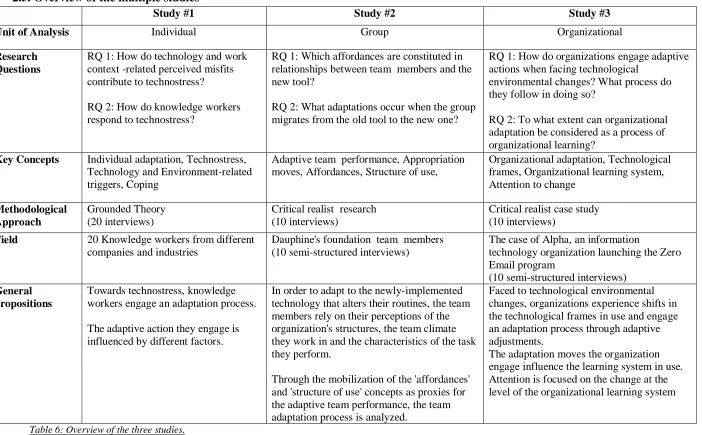
1.5. Présentation des études de la thèse :
Etude #1 Etude #2 Etude #3
Unité d’Analyse Individu Groupe Organisation
Questions de Recherche
QR 1: Comment les facteurs
technologiques et environnementaux produisent-ils des misfits résultant en l’état de Technostress ?
QR 2: Comment les travailleurs intellectuels répondent-ils au technostress?
RQ 1: Quelles affordances sont constituées au cours des interactions entre les membres de l’équipe et la nouvelle technologie. Quelle est la structure d’usage de la nouvelle technologie?
RQ 2: Quelles adaptations ont lieu?
QR 1: Par quel processus les organisations engagent-elles des actions adaptatives face à des changements technologiques dans leur
environnement ?
QR2: Comment leur système d’apprentissage organisationnel est-il affecté?
Concept clés Adaptation individuelle, Technostress,
Coping, TIC
Performance adaptative du groupe, Mouvements d’appropriation, Affordances, Structure d’usage
Adaptation organisationnelle, Cadres
technologiques, Apprentissage organisationnel, Attention au changement.
Approche Méthodologique
Grounded Theory (20 entretiens)
Recherche qualitative réaliste critique (10 entretiens)
Etude de cas réaliste critique (10 entretiens)
Echantillon 20 travailleurs intellectuels de
différentes organisations et industries.
L’équipe d’une fondation universitaire, la « Fondation Dauphine » de l’Université Paris-Dauphine
(10 entretiens semi-directifs).
Le cas d’Alpha, une organisation qui s’est lancée dans un programme de transformation digitale en remplaçant l’email par un réseau social
d’entreprise.
Propositions Générales
Face au Technostress, les travailleurs intellectuels engagent un processus d’adaptation.
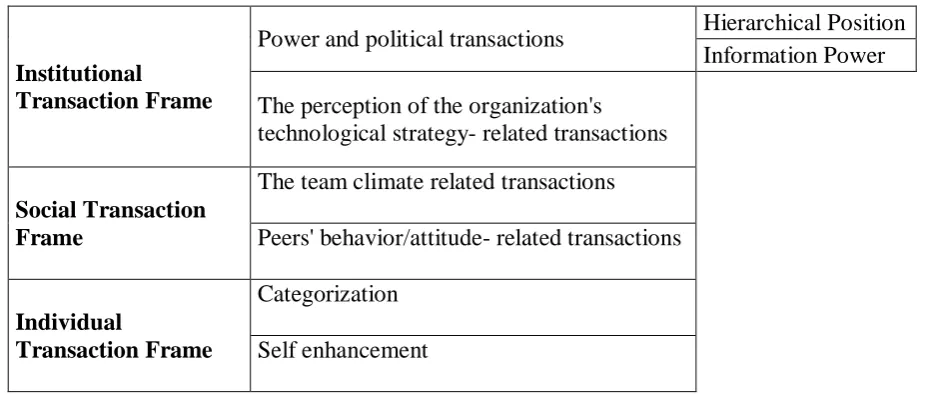
L’action adaptative qui en résulte est fonction de différents facteurs (institutionnels, sociaux et individuels).
Afin de s’adapter à la nouvelle technologie affectant leurs routines de travail, les membres de l’équipe se basent sur leurs perceptions des structures
organisationnelles, du climat de leur équipe et des caractéristiques de leurs tâches.
Confrontées à des changements technologiques, les organisations changent de cadre
technologique et engagent un processus d’adaptation afin d’apporter les ajustements nécessaires. Par conséquent, elles modifient leur système d’apprentissage.
11
1.5.1. L’exploration de l’émergence des réponses adaptatives des travailleurs intellectuels au technostress :
La première étude de notre thèse propose d’apporter des réponses à une question relativement
peu développée dans la littérature en Systèmes d’Information à savoir : Comment les
travailleurs intellectuels s’adaptent-ils au technostress ? Les deux objectifs de cette étude sont 1) établir l’état d’art de la littérature SI sur le phénomène de Technostress et 2) comprendre
comment la réponse adaptative des travailleurs intellectuels se forme et quels facteurs
l’influencent.
En effet, cette étude tente de répondre à différents appels dans la littérature concernant
l’analyse des conséquences négatives des investissements des organisations dans les Technologies de l’Information et la Communication (TIC) (Tarafdar, Gupta et al. 2013). Il est
admis que les TIC offrent de nombreux avantages aux organisations mais qu’elles ne les
épargnent pas de phénomènes néfastes comme le Technostress, défini comme le stress que les
salariés éprouvent quant à l’usage des systèmes d’information dans le contexte
organisationnel (Tarafdar, DArcy et al. 2015). Les travailleurs intellectuels sont considérés
comme les premiers « consommateurs » de ces technologies vu que l’information constitue la
matière première de leur travail. Ils utilisent donc ces technologies quotidiennement afin
d’accomplir leurs tâches ce qui les exposent en continu au technostress et les obligent à s’y
adapter.
Un courant dans la recherche en SI s’est focalisé sur les effets néfastes de l’utilisation massive
des TIC dans les contextes organisationnels. Les chercheurs ont été intéressés à des
phénomènes proches du Technostress comme le burnout au travail (King and Sethi 1997),
(Pawlowski, Kaganer et al. 2007) ou encore l’angoisse face aux ordinateurs connu sous le
nom de ‘Computer Anxiety’ (Thatcher and Perrewe 2002), (Fuller, Vician et al. 2006),
(Buche, Davis et al. 2007). Le phénomène de Technostress gagne ainsi en importance depuis
deux décennies et le travail fondateur de Brod (1984). En plus des différentes définitions que
les chercheurs ont proposées, différentes conceptualisations théoriques et approches
empiriques ont vu le jour.
Malgré ces travaux, la littérature SI sur le technostress reste encore très fragmentée (D’Arcy,
Gupta et al. 2014), (Tarafdar, DArcy et al. 2015). Les revues de référence en SI manquent
12
articles sur les effets négatifs de l’usage des TIC au sein des organisations dans les principales revues en SI n’affiche ainsi que 37 articles entre 1995 et 2005 (Pirkkalainen and Salo, 2016).
Notre étude répond à ces questionnements aussi bien conceptuels que managériaux et tente
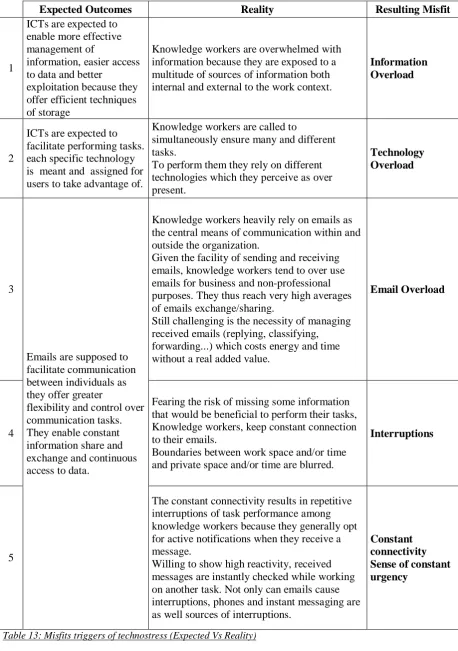
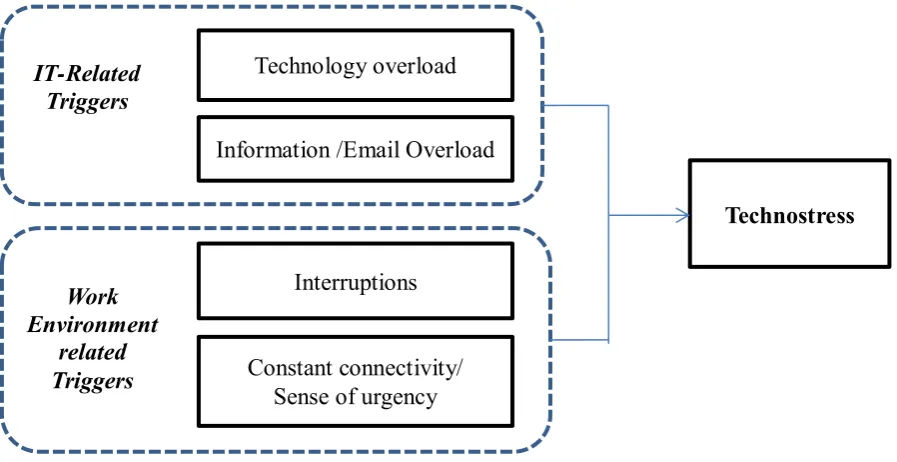
d’offrir de nouvelles perspectives de recherche sur le technostress. Pour cela, nous explorons les situations d’inadaptation qui sont susceptibles d’engendrer le technostress et les classons
en situations d’inadaptation technologique et/ou environnementale. Nous postulons que les
états de technostress sont la manifestation de cas de dissonance que les travailleurs
intellectuels vivent. Cette dissonance représente l’écart existant entre la attentes et la réalité :
en l’occurrence, les avantages escomptés de l’investissement en TIC ne sont pas toujours
atteints en réalité du point de vue des salariés notamment ; ces avantages « théoriques » se
transforment parfois en inconvénients.
Un autre phénomène qui a été peu étudié dans la littérature SI est la façon dont les individus
s’adaptent au technostress qu’ils vivent. En effet, la littérature SI s’est beaucoup intéressée à l’adaptation individuelle et différentes approches ont vu le jour au travers de différents
concepts, comme par exemple : l’appropriation (Poole, Homes et al. 1988), (DeSanctis and
Poole 1994), la réinvention (Rice and Rogers 1980), (Leonard-Barton 1988), les ajustements
(Majchrzak and Cotton 1988), le coping (Beaudry and Pinsonneault 2005). Ces concepts ont
permis de mieux comprendre plusieurs facettes de l’adaptation individuelle aux technologies.
Beaudry and Pinsonneault (2005) proposent le ‘Coping Model of User Adaptation, un cadre
intégrateur qui tient compte des apports des travaux relevant de ces différentes traditions de
recherche.
La littérature sur l’adaptation individuelle aux TIC, en particulier celle qui se fonde sur le
concept de coping se base toutefois sur un postulat commun ; les individus, face à des
évènements technologiques perturbateurs, mettent en œuvre des stratégies d’adaptation afin
de retrouver leur situation d’équilibre initial. Nous considérons que cette approche de
l’adaptation n’est pas pleinement compatible avec le technostress qui ne constitue pas des
événements perturbateurs ponctuels mais des états continus dans le temps. Pour cela, une
compréhension plus complète de l’adaptation est nécessaire pour pouvoir explorer comment
les individus s’adaptent au technostress.
Nous tentons de répondre aux questions de recherche suivantes :
13
QR2 : Comment les travailleurs intellectuels s’adaptent-ils au technostress ?
Afin de répondre à ces questions, nous adoptons une approche qualitative enracinée
(Grounded Theory) vu la nouveauté des questionnements et la littérature peu abondante les
concernant. Nous avons conduit 20 entretiens semi-directifs avec des managers appartenant à
différentes entreprises et différentes industries.
1.5.2. La performance adaptative du groupe : une perspective par les affordances et la structure d’usage :
Notre deuxième étude contribue à la littérature SI sur la performance adaptative du groupe.
Nous étudions le processus d’adaptation engagé par une équipe de travail lors de l’utilisation
d’une nouvelle technologie dont l’usage affecte significativement les routines de travail.
L’adaptation du groupe constitue l’une des thématiques les plus riches et étudiées en SI. Elle a
été étudiée selon différentes approches comme la motivation des salariés à collaborer
(DiMicco, Millen et al. 2008), le sense-making (DiMicco, Geyer et al. 2009), l’apprentissage
organisationnel (Brown and Duguid 1991), les dynamiques de développement de
connaissances (Griffith, Sawyer et al. 2003), la proximité perçue (O'Leary, Wilson et al.
2014), le pouvoir des règles (Johnson, Faraj et al. 2014) , le partage de connaissance (Beck,
Pahlke et al. 2014) et aussi l’identité du groupe (Ren, Harper et al. 2012).
Nous proposons une autre approche pour étudier l’adaptation du groupe en mobilisant un
concept qui, malgré sa pertinence, a reçu relativement peu d’attention, à savoir le concept de
‘Performance adaptative du groupe’. Ce concept fait référence au processus entamé par les membres d’un groupe/ d’une équipe au travers duquel ces derniers apportent des changements
dans leurs perceptions et comportements ainsi que sur les structures afin de retrouver une
situation d’équilibre. Une idée fondamentale de ce concept est que la performance adaptative
fait référence à tout le processus et non pas uniquement à des résultats. Ce concept de
performance adaptative reste toutefois difficile à cerner empiriquement. Pour ce faire, nous
proposons d’utiliser deux concepts comme ‘proxy’ à savoir les affordances (Leonardi and
Barley 2008, Leonardi 2011, Leonardi 2013) qui sont constituées lors des interactions entre
14
Ces deux concepts permettent une compréhension des mouvements adaptatifs engagés par le
groupe comme seule entité d’analyse.
Premièrement, les affordances sont les relations d’interaction qui émergent lors de
l’interaction entre ce que la technologie offre comme fonctionnalités et ce que les individus
perçoivent comme possibilités d’action. Si les individus s’approprient ces affordances, un
changement de structure peut avoir lieu (Leonardi 2013). Nous explorons donc quelles
affordances ont été constituées entre les membres de l’équipe et la nouvelle technologie avant
de les agréger au niveau collectif.
Deuxièmement, la structure d’usage occupe une place centrale entre les technologies et leurs
conséquences. A travers ce concept, nous explorons quelle structure d’usage les membres de
l’équipe manifestent.
Nous tentons de répondre aux questions de recherche suivantes :
QR1 : Quelles affordances sont constituées au cours des interactions entre les membres de l’équipe et la nouvelle technologie ? Quelle est la structure d’usage de la nouvelle technologie?
QR2 : Quelles adaptations ont eu lieu au niveau du collectif ?
Afin de répondre à ces questions, nous adoptons une méthodologie qualitative, inscrite dans
une approche réaliste critique. Notre échantillon est l’équipe d’une fondation universitaire, la
fondation Dauphine, qui a été confrontée à un changement de technologie affectant
significativement les routines de travail de ses membres.
Les données ont été collectées au niveau individuel mais agrégées au niveau du collectif afin
de produire des résultats au niveau du groupe.
1.5.3. L’adaptation organisationnelle à la surcharge informationnelle : une perspective par l’apprentissage organisationnel :
Cette étude explique le processus d’adaptation organisationnelle aux changements
technologiques survenus dans leur environnement. En mobilisant le concept de ‘cadre
technologique’ (Orlikowski et Gash, 1994), nous tentons de mieux comprendre les
changements des cadres technologiques de managers suite au lancement d’une transformation
15
programme qui remplace l’email par un réseau social d’entreprise. Ce dernier est interprété
comme un élément fondamental des changements technologiques survenus dans
l’environnement : la percée des technologies collaboratives au sein des organisations.
La thématique des réseaux sociaux d’entreprises a gagné en importance dans la littérature
mais beaucoup reste à comprendre sur le sujet. Des thématiques proches ont intéressé les
chercheurs en SI comme principalement la collaboration électronique ou la e-collaboration
(Riemer, Steinfield et al. 2009) et “online communities” (Kudaravalli and Faraj 2008, Faraj,
Jarvenpaa et al. 2011) ; (Ma and Agarwal 2007); (Lee, Vogel et al. 2003) ; (Chen, Xu et al.
2011); (Preece 2001).
Des études récentes ont considéré la nouvelle génération des médias sociaux, notamment les
réseaux sociaux d’entreprise, comme suscitant un intérêt particulier vu leurs spécificités. Par
exemple, Treem and Leonardi (2012) ont considéré les nouveaux médias de communication
(blogs, wikis, social networking sites, micro-blogging, etc.) comme ayant des conséquences
différentes comparés aux outils et technologies traditionnels de communication.
Nous explorons les effets d’un réseau social d’entreprise au sein d’une organisation, en
mobilisant le concept de système d’apprentissage organisationnel comme cadre théorique. En
effet, nous tentons non seulement de voir comment les changements des cadres
technologiques des managers se produisent, mais aussi les effets des décisions qui en résultent
sur le système d’apprentissage organisationnel.
Nous adressons les questions de recherche suivantes :
QR1 : Quels processus les organisations suivent-elles pour engager des actions adaptatives ?
QR2 : Quels effets cela a –t-il sur le système d’apprentissage en place ?
Pour y répondre, nous conduisons une étude de cas réaliste critique. Nous étudions le cas
d’Alpha, une organisation dans l’industrie des technologies de l’information, qui a engagé un
programme de transformation digitale visant à remplacer l’email par un réseau social
16
Chapter 2
: General Introduction
2.1. Abstract
Despite the variety of literature on ‘adaptation to technology’, the literature still witnesses a
gap concerning the concept of adaptation especially about its multi-level nature. Recognizing
the multilevel nature of IS adaptation, we rise the challenge of conducting an alternate
template analysis of three cases of adaptation to IS in order to provide complementary
explanations about the phenomenon.
In order to expand the comprehension of the ‘adaptation’ concept, a multi-study dissertation
model is adopted. The objective is to examine the adaptation concept on three different levels:
the individual, the group level, and the organizational level. This thesis aims at 1) exploring
the shaping of individual adaptive actions that knowledge workers engage towards
technostress with a focus on the factors that influence their adaptation process; 2) examining
the adaptive performance of a group facing an newly-implemented technology based on the
adaptive structuration theory (DeSanctis and Poole 1994) under which were puzzled the
concepts of affordances (Leonardi 2011, Leonardi, Huysman et al. 2013) and the structure of
usage (Burton-Jones and Straub Jr 2006, Burton-Jones and Gallivan 2007); 3) examining,
through an organizational learning lens (Argyris and Schon 1978), the case of an
organizational adaptation to environmental technological changes examined within a
managerial cognition conceptual framework (Orlikowski and Gash 1994); (Bijker 1987,
Bijker 1995). To answer the different research questions, the three studies adopt a qualitative
approach falling within a critical realist perspective.
2.2. Why studying adaptation with a multi-level approach?
In our three essays, we admit that adaptation is a multi-level phenomenon. They all consider
17
of the new one. In each one of the three studies, the technological factor constitutes the lens
through which we focus attention on how the adaptation process emerges and evolves. In
other words, the situations of adaptation that we explore are either triggered or affected by the
technological factor.
The mutli-level nature of Adaptation to IS has origins in the definition of an IS itself.
According to Mason and Mitroff (1973), an information system represents ‘at least a person
of any psychological type… (Mason and Mitroff, 1973, p.475) which means that it can take
the form of an individual, a group or an organization.
By alternating between models and levels, this thesis is an attempt to uncover the processes of
adaptation through which the individual, the group and the organization cope with
technological circumstances. Combining several models in bracketing the same social
phenomenon on higher and lower-level constructs and analysis offers richer understandings of
the phenomenon (Hackman 2003), (Lapointe and Rivard 2007).
The common feature between the three studies is the centrality of the interaction between
different actors (knowledge workers within the organizational context, a group within an
organization, an organization as an entity) and the technology; an examination that implies the
consideration of constructs existing on multiple levels of analysis. In fact, we posited in each
of the three studies, research questions dealing with the adaptation process on a different level
each time.
In the first study, we focused on the individual level; both data and analysis have concerned
the individual level. In the second and third studies, whereby the research questions laid the
emphasis on the group adaptation and the organizational adaptation, data was collected on the
individual level but aggregated to the group and organizational level in the course of the
analysis.
The different definitions of the adaptation constructed through the three studies demonstrate
18
Level Definition
Individual
A person’s cognitive and behavioral efforts to manage specific external and/or internal demands which are appraised as taxing or exceeding the person’s resources’
(Lazarus and Folkman, 1984)
Group
A change in team performance, in response to a salient cue or cue stream that leads to a functional outcome for the entire team. Team adaptation is manifested in the innovation of new or modification of existing structures, capacities and/or behavioral or cognitive goal-directed actions.
(Burke et al., 2006)
Organizational
Modifications and alterations in the organization or its components in order to adjust to changes in the external environment’
[image:30.595.67.525.127.375.2](Cameron, 1984)
Table 4: Definitions of adaptation across levels.
Although the adaptation construct is conceptualized differently from one level to another, one
common characteristic emerges: the interactions between actors (humans or humans and
technology).
2.3.Multi-level approach in the IS field:
The IS field explores complex phenomena where the interplay between human actors and
technologies constitutes a central focus (Aubert, Barki et al. 2008). The examination of this
interplay results in the consideration of constructs existing at multiple levels of analysis
because various entities interact and influence each other (Barki, Titah et al. 2007). Two main
ideas constitute the basis of this consideration: 1) the interaction between human actors and
technologies and 2) the mutual influence of entities under examination leads to the emergence
of higher-levels collectives (not only human collectives) which, itself, requires a multi-level
lens of study.
Organizational behavior researchers have developed paradigms for multi-level research. In
19
research. They proposed to answer questions such as 1)What constitutes the collective, the
micro, the macro? (Morgeson and Hofmann 1999), (Kozlowski and Klein 2000); 2) What
relationships to establish between the different levels - also called the models of multi-level
research (Chan 1998), (Rousseau 1985) and 3) How to test and analyze entities and variables
(Dansereau, Alutto et al. 1984), (Markham, Yammarino et al. 2010).
We uncover each dimension of those proposed earlier.
Regarding the first one, we adopt the idea of the existence of two fundamental levels in
multi-level organizational research: the individual (the micro) and the collective (the macro). While
the first focuses on the individual’s perceptions, beliefs and actions, the second treats larger
entities as an aggregation of the micro one. These entities can take the form of dyad, a team/ a
group, an organization or an industry. To constitute a collective, the entities of the micro level
have to be interacting with each other because the structure of the collective is defined
through actions and reactions. The collectives themselves, as open interaction systems,
interact with other collectives which results in the emergence of larger collectives (Morgeson
and Hofmann 1999).
In the first study, we examine knowledge workers’ coping to technostress and the process by
which they shape their adaptive actions towards technostress. We thus consider individual
actions and adopt a micro level of analysis.
In the second study which focuses on the adaptation of a work-team to a newly-implemented
technology, we analyze data collected at the individual level to explain the emergence of a
collective behavior. We thus focus on actions on the collective level of analysis.
As for the third study about the case of an organizational adaptation to environmental
technological changes, the analysis is conducted on a collective (the organization) level.
The second dimension of the conceptualization of multi-level research concerns the models of
the research or the relationships between the different levels. Rousseau (1985) suggested the
existence of three types of models: 1) the composition models where there are relationships
between independent variables at different levels , 2) the cross level models where there are
relationships between dependent and independent variables at the different levels which
results in a causality between a phenomenon at one level and another at a different level; and
3) the multi-level models which include the two previous models and posit the generalization
of the relationships between dependent and independent variables across two or more levels.
20
independent and dependent variables within and across levels. Rousseau contends that the
composition models deal with variables of the same nature at multiple levels of analysis
whereas the cross-level and the multiple level models treat different dependent and
independent variables at different levels of analysis for the first and aiming to generate
generalizations across levels for the second.
Chan (1998) has developed a typology of composition models where he proposed five types
of composition models based on the way data was collected at the lower level, and how it has
been aggregated to establish higher-level constructs. Positioning our studies within Chan’s
typology, only the group-level study (Chapter 4) represents interest regarding the second
study where data were collected on the individual level and aggregated to the group-level; the
level on which the research questions were constructed. The two other studies do not obey to
this classification because data were collected on the same level of analysis.
In a recent meta-analysis of the multi-level research in the IS field, Bélanger, Cefaratti et al.
(2014), proposed a typology of composition models. They distinguished mono-compositional
models from mixed-compositional models. Mono-compositional models, also called
traditional models, generally lay emphasis on the examination of one type or one source of
entities nesting within larger collective of the same source (eg: nesting people within large
collectives of people/ lower -level entities and higher- level entities). This type of models is
very present in the organizational studies but does not perfectly fit the multi-level IS research
due to a central reason: IS research deals with the interaction between people and
technologies either by investigating the relationship of humans and technologies (eg.
Research on IT development, initial IS use, continued IS use) or the interaction between
humans via technologies (eg. Research on collaboration, knowledge management and sharing
enabled by technologies). This specificity of the IS field requires a reconsideration of the
place of technologies in the IS multi-level research by giving them the status of ‘separate
entity’ either by examining them separately within a mono-compositional model (eg.
Studying the differences in automated decisions (the higher-level entity) between some ERP
modules (lower-level entities)) or in a mixed-compositional models (e.g. Studying the
differences in people’s speed of decision using the same ERP, among the different modules of
the ERP).
The three studies that compose our thesis consider mixed models.
while examining the shaping of knowledge workers’ adaptive actions towards technostress in
21
(their usage of the technology) can constitute sources of stress and that the actions they
undertake to adapt to that stress is partly mediated by technologies. Thus, an emphasis was
laid on the place of ITs as entities that, added to humans, compose a mixed model.
In the second study, we proposed the examination of a work team’s adaptation process
towards a disruptive situation (a newly-implemented organizational webmail). While the
model of this multi-level research appears to be mono-compositional model because it
investigates the emergence of human collective structures and actions (higher-level entities)
from individual actions and beliefs (lower-level entities) and thus treats the same source of
entities (people nesting within larger human collectives); a deeper thinking would consider it
as mixed-compositional model because the IT entity was heavily nested within the group of
people because the technology has heavily impacted the team members’ communication and
coordination processes and had a determinant role in the construction of shared practices.
As for the third study, we also adopted a mixed-compositional model. We examined the case
of an organization that implemented a collaborative tool (an enterprise social network) to
change the ostensive dimension of its employees’ routines (Pentland and Feldman 2005). The
ESN was a means to institutionalize the new schematic form of organizational interaction and
procedures. The ESN can thus be considered as an entity because it has changed the
organization’s work practices and structure to conform to the new system.
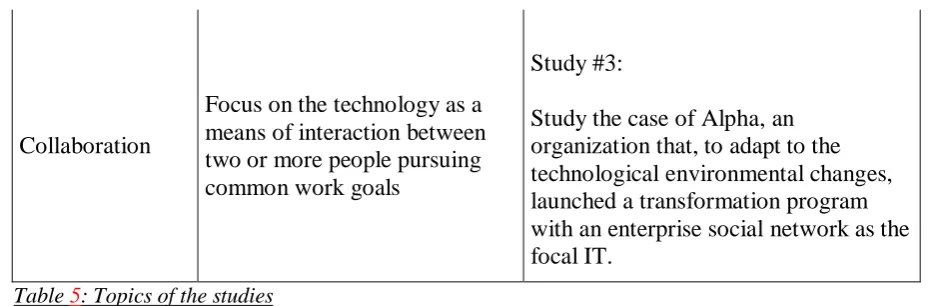
In the following table 4, we establish a classification of our three studies according to themes
of research in the IS field. These themes have been proposed by Bélanger, Cefaratti et al.
(2014) as the most recurring research topics examined in the multi-level research within the
IS field. Indeed, the multi-level approach has been shown useful in studying these themes.
IS related theme Description Related topic of the thesis (# Study)
Continued IS use
Focus on investigating the on-going impacts of IT on individual use behaviors or beliefs
Study #1:
Explore the shaping of knowledge workers’ adaptation to technostress.
Initial IS use Focus on the introduction of a system to the end users
Study #2:
22
Collaboration
Focus on the technology as a means of interaction between two or more people pursuing common work goals
Study #3:
Study the case of Alpha, an organization that, to adapt to the technological environmental changes, launched a transformation program with an enterprise social network as the focal IT.
Table 5: Topics of the studies
The third and last dimension in the conceptualization of multi-level research consists in not
only the identification of entities that can be characterized as whole units or parts but also the
establishment of relationships between hypothesized units. In other words, it is required for
multi-level researchers to precise if they examine their entities as composed of similar units
which represents ‘a whole’ and thus prove the homogeneity of the units constituting the
collective (Klein, Dansereau et al. 1994). Researchers can be in another multi-level type of
research and posit the independence of the units forming the collective (Klein, Dansereau et
al. 1994). In this case, the level of theory is the unit; and what is valid for the unit is not
necessarily valid for the other units of the collective. The third case concerns studies where
the level of theory is neither the unit nor the collective but the unit within the collective ,
coined the heterogeneity by Klein, Dansereau et al. (1994). It is especially used to explore
relative effect of individual attributes on the collective. Labeled as the ‘heterogeneity’ by
Klein, Dansereau et al. (1994), this type of multi-level research is the less common one in
organizational studies.
Following this principle, it should thus be acknowledged that we ensured, in each study of
ours, that the units under investigation fall within the first configuration.
Regarding the first study, we collected our data across knowledge workers who rely heavily
on ITCs in performing their work. Each knowledge worker constitutes a unit, and thus
belongs to the community of knowledge workers by holding that status. Knowledge workers
constitute a whole.
The second study that investigates the adaptive process of a team to a new technology also
obeys to the same principle because we collected data across parts (the team members) and
[image:34.595.64.530.66.219.2]23
Finally, the third study considers the organization as a ‘whole’ and data were collected
among the team that was leading the transformation project because they are representative of
the organization.
2.4. Ontological and Epistemological Positions of the Thesis: Critical Realism
In this thesis, we adopt critical realism as the meta-theoretical position that holds realist
ontological assumptions and relativist epistemological assumptions (Archer et al., 1998;
Bhaskar, 1979). These assumptions assume a specific consideration of the ‘world’ and the
construction of human knowledge. In fact, critical realists are called realists because they
strongly believe in the ontology of the existence of an objective reality and in the
independence of the world from the knowledge that humans hold of the world. This idea
posits itself against what classical positivists consider of the restrictiveness of the world to the
mere fact which can be empirically observed and measured and against the pure
constructivists positing that the world is nothing other than the knowledge that humans hold
about it. Critical realists are called critical because they believe that the reality is perceptible
and is likely to be known and understandable but holding that the access to this reality is
always mediated by perceptual and theoretical lenses. Critical realists also advocate the
capacity of humans to access the world because they are endowed with the faculty of
reasoning and thus are critical in a Kantian sense.
The reality, according to critical realists, is not only intransitive but also stratified in two ways
(Archer, 1998). The first stratification resides in the relationships between three domains: the
mechanisms, the events they generate and the subset of events that is experienced. The
mechanisms, for critical realists, represent the domains of ‘the real’ where are also found the events and the experience representing the whole reality. The domain of ‘the actual’ only
consists of the events occurring (or not) in the real sphere, itself including the domain of ‘the empirical’ which is restricted to the events which are observed and/or experienced.
The second stratification resides in the following idea: In the realm of objects, causal powers
at one level can be examined as generated from those of lower level through ‘the emergent
powers materialism’ (term of Bhaskar), which means that in the domain of the real, there are
complex interactions between systems that are open, stratified and dynamic, material or
24
acting. These particular structures are called ‘generative mechanisms’ by Bhaskar (1979) because they generate the sphere of ‘the actual’.
The critical realism has been of a growing interest in the IS field in that it enables a shift in
researchers’ focus from data and methods of analysis to deeper examinations of phenomena
and their causes. Critical realism represents a framework for using various methods to gain a
better understanding of phenomena. Indeed, a recent special issue of MISQ (September 2013)
proposed ‘a discussion of critical realism as a philosophy of science and its extensions into the social realm’ and proposed papers that deal with the critical realism theory,
methodological challenges, and applications.
As for our three studies, we consider that we adopted a critical realism perspective because
we focused attention on the emergence of phenomena which is a central concept of the critical
realism position.
In the first study, we explored the shaping of individuals’ adaptive responses to technostress
and thus centered attention on the construction of the adaptive action on one hand and
searched for contextual factors that influence its generative mechanism on the other.
In the second study, we analyzed the processes by which a group adapted to a newly-
implemented technology which is focal to their work. We laid the emphasis on the emergence
of the team members’ appropriation moves by mobilizing the ‘affordances’ concept.
The third study exposes the case of an organization that, seeking to respond to environmental
changes, engaged in a transformation program. To analyze this case, we mobilized a concept
which falls into the critical realism perspective, with a view to knowing the ‘technological
frames’ referring to the mental models that people hold about the technology. As we analyzed
the shift that the managers have experienced concerning the best communication and
coordination technology to be used in their organization, we directed attention on the
emergence of new technological frames. We also analyzed how the new technological frames