ISSN: 1992-8645 www.jatit.org E-ISSN: 1817-3195
KNOWLEDGE SHARING VIA ONLINE SOCIAL MEDIA
DURING FLOOD DISASTER EVENTS: A REVIEW
1
WAN NUR TASNIM WAN HUSSIN, 2NOR HIDAYATI ZAKARIA AND 3MOHAMMAD
NAZIR AHMAD 1
Student, Faculty of Computing, UNIVERSITI TEKNOLOGI MALAYSIA
2
Senior Lecturer, Faculty of Computing, UNIVERSITI TEKNOLOGI MALAYSIA
3
Senior Lecturer, Faculty of Computing, UNIVERSITI TEKNOLOGI MALAYSIA
E-mail: [email protected], [email protected], [email protected]
ABSTRACT
As we know, online social media is gaining popularity nowadays as one of the most used IT mediums. It allows users to communicate with each other across time and space differences even as strangers. Recently, previous research has acknowledged the importance of online social media as one of the most widely - used IT tools for sharing information during a disaster event. Flooding is a common natural disaster in the world and can result in loss of life and damage to property. Online social media has itself become a means of knowledge sharing during flooding events. Although online social media is gaining popularity, it is unknown how this digital application will achieve the task of knowledge sharing. Therefore, this study has been carried out to examine the use of online social media as a knowledge sharing tool during flood disasters. The process of developing this paper involved finding articles, papers, and news from other researchers, and observing the nature of online social media groups and pages. This paper will also use Australia and Malaysia as real examples of how online social media is currently utilized during flood disasters. Hopefully, this study will contribute to the introduction of a new era of understanding the usage of online social media and its benefits during flood disasters.
Keywords: Knowledge Sharing, Online Social Media, Flood, Knowledge Sharing During Flood,
Knowledge Sharing Through Online Social Media
1. INTRODUCTION
Online social media has become a means of knowledge sharing (KS) during flooding events. KS means the management of explicit or tacit knowledge, which involves performing one or several knowledge processes including transferring,
creating, integrating, combining and using
knowledge [1]. The other authors have defined KS as procedures undertaken by people whenever they are exchanging ideas, by means of discussion, so that new knowledge or thoughts will be formed [2]-[4]. The KS process actually already involves online social media both directly and indirectly. Online social media can be used as a tool for knowledge management, for example in regards to the creation, exchange and transformation of knowledge. Online social media features such as personal profiles, group communication and the expression of opinions, can enhance KS in regards to the transfer of information [5]. So, according to the statements of previous authors, online social
media can enhance KS when transferring
information and knowledge about flooding’s events.
ISSN: 1992-8645 www.jatit.org E-ISSN: 1817-3195 and nowadays, people tend to search for and send
information using mobile-based applications,
especially through Facebook and WhatsApp.
A lot of emergency response organizations around the world are using online social media right now to announce warnings, recoveries and responses, replacing traditional media such as newspapers and television. According to White [7], online social media is used by all levels in emergency management in all types of agencies, each with different purposes and objectives when using online social media as the solution for
meeting their agencies’ needs. When the
importance of online social media is already known, we can suggest that communities, agencies or individuals use online social media as a means of transferring knowledge that cannot be overlooked. Knowledge sharing is important in this situation, with the hope that information can be quickly transferred and that people dealing with floods already have the knowledge needed to face its impacts. Also, online social media makes it easy for volunteers to give support to victims.
Therefore, a research question has been identified for this study which is: “What is the current utilization or usage of online social media during flood disasters?” The research objective is to find an answer to that research question, and is specifically identified as: To identify the current usage and utilization of online social media during flood disasters.
This paper is organized into six sections. The first section is an introduction, with the research question and objective also stated there. The second section provides the research background. The third section provides an overview of the research methodology. The fourth section is a literature review, containing general information about flooding, knowledge sharing, online social media and its usage during flooding events. The fifth section offers a discussion of findings based on the literature review of the work of previous authors, and an observation of the current use of Facebook and Whatsapp application, in order to determine how users utilized online social media during flood disasters. The last section contains a conclusion that stresses the usage of online social media during flood disaster events, and offers suggestions for future works in this field.
2. RESEARCH BACKGROUND
Normal floods are commonly welcomed in many parts of the world as they provide water, can enrich
soil, and offer a means of transportation. However, a destructive flood can cause damage to the environment, to livelihoods, and even to human lives and other living things [8]. Many countries in the world face flooding events, including Thailand, Indonesia, Malaysia and Australia. A case study example is that of the state of Victoria in Australia. Victoria faced flooding between September 2010 and March 2011. During that time, many community members used online social media as a means to receive information about the floods and to share information, news and photographs with others [9]. As a major disaster, the floods were widely covered by both Australian and international mainstream media, especially when they began to have an impact on major population centers. In addition, online social media including Facebook and Twitter, as well the Flickr and YouTube content sharing sites, also began to play important roles [10].
Generally speaking, Australia was chosen for this study because it is developed country with one of the world’s most outstanding economies having in recent years experienced high growth, low inflation and low interest rates. It is one of the world’s most urbanized countries, with about 70 per cent of the population living in its 10 largest cities [11]. Since Australia is a developed country, their awareness of online social media use is high, especially during disaster events like flooding events. Their research regarding the use of online social media is also high. As we can see in Table 2 of the Discussion section, most of this paper discusses flooding in Australia. Also discussed is how the nation’s management and citizens co-operated with each other and how they possess high facility systems for disasters. Australia has its own flood warning system. According to [12], the purpose of flood warnings is to persuade people to increase their safety, enable them to take action accordingly, and to reduce the costs of flooding. A total flood
warning system requires the cooperative
ISSN: 1992-8645 www.jatit.org E-ISSN: 1817-3195 (Communication), and the fifth is encouraging and
achieving the appropriate protective behavior from the threatened community and from the agencies involved (Response). The last element is the examination of the various aspects of the system with a view to improve its performance (Review).
Malaysia still has a long way to go when compared to Australia, and still experiences a lack of social media use, especially during disaster events, so that is the reason Malaysia and Australia have been chosen for this study. The literature review so far shows that there has been limited research, especially within the area of disaster management within Malaysia [13]. Knowledge sharing is also being delayed in Malaysia, because people are still unaware of the importance of using online social media as a first source of information. Meanwhile, the information can be quite confusing. In the event of a disaster, sharing information effectively is vital for helping to save lives, providing immediate relief and support, and minimizing the effects of disaster [14]. Recent major natural disasters have witnessed a global increase in online social media approaches to disaster relief [15]. Online social media is now helping to narrow the gap in the response time between on-site and online crisis response activities, because of their instant connectivity to the open platform [16]-[17]. Online social media can be used in various situations during a time of crisis, because of its information sharing capability. Citizens can share information, coordinate various disaster relief events, and collaborate in order to execute those events [18]. Therefore, using online social media as a knowledge sharing device is truly the best solution for generating information and distributing information during flooding events.
3. RESEARCH METHODOLOGY
Within this study, the researcher used three important keywords to obtain information regarding the topics. The keywords included ‘flood’, ‘knowledge sharing’ and ‘social media’. The found journals were located through ScienceDirect, Institute of Electrical and Electronics Engineers’ (IEEE), and Google Scholar. These search tools allowed the identification of recent papers, and helped in locating the full texts of articles. For example, in order to find the most recent papers, options at the tops of pages were utilized, qualifiers including ‘search all fields’, ‘author name’, ‘journal or book title’, ‘volume’, ‘issue’, or ‘page’ were either selected or typed in. This work could also be undertaking using advanced search options. Such
interfaces are user friendly and easy to understand. Papers were not the only resources being downloaded. News pieces, articles, brochures and guideline books were also downloaded and selected for the research. The downloaded files included 62 flood articles, 25 knowledge sharing articles, and 29 social media articles. After going through a selection process, six flood articles, six knowledge sharing articles and five social media articles were chosen for inclusion into the literature review, and were also utilized within the introduction and research background section.
Then, after the specific articles were found using the specific keywords, the researcher then combined the keywords to search within the search engine. Then, the articles were be downloaded during searching processes. The downloaded articles were kept in a single folder, allowing the research to look through all the downloaded articles in order to find the information needed for the study. In this instance, 24 articles were downloaded and only 11 articles were selected for discussion.
After that, the researcher made comparisons and highlighted important points. These points could be placed in a table, or illustrated in a mind map, for simple understanding. For example in this study, the researcher yearned to know about the nature of flooding, knowledge sharing and online social media, and the impact of online social media as a means of knowledge sharing during flood disaster events. The researcher included all the required information in a table with specific column or rows, such as those detailing the titles of papers, authors and years, and the criteria of what needs to be identified through the research, be that definitions, concepts, or impacts. Then, while undertaking the literature review report, the researcher will copy and paste information from original authors, and remake sentences in order to avoid plagiarism issues. It is important to cite articles, and thereby give required credit to previous researchers. The final listed papers included 23 altogether, and these were included in Table 2 within Discussion section and findings of each paper are further explained there.
ISSN: 1992-8645 www.jatit.org E-ISSN: 1817-3195
4. LITERATURE REVIEW
is one of the most important processes of knowledge management (KM), and is indeed the most essential part of implementing KM [19]. Due to knowledge sharing’s importance, it is this study’s central focus. In the case of new technology such as online social media, this online interaction can have impacts on KS. Many advantages are drawn from its use, which can explain its huge global application [20].
The authors, Zahari and Raja Ariffin undertook research regarding flooding through the use of interviews, surveys and questionnaires. Based on feedback from the respondents, and having experienced many flooding events, they could personally take several precautions that became common knowledge amongst themselves. The precautions they took included: placing their belongings at higher levels within their houses, or relocating some belongings to safer locations, for instance to homes of relatives or friends that does not face flood disasters. They also ensured that their children were in safe places, avoided buying expensive furniture because it is the most common items damaged in flooding events, and came home early from work in times of heavy rain, thereby ensuring the condition of their homes and saving necessary items and important documents [21]. It is very good if this knowledge from respondents can be shared with others through online social media, as people nowadays enjoy seeing online social media updates.
The following strategies are effective approaches for the development of flood management programs, based on the earlier experiences of victims [22]. The strategies include the following:
i. Prevention by avoiding the construction of
buildings and industry in present and future flooding areas;
ii. Preparedness by providing information to
the public, via knowledge sharing about what to do and where to go in the event of flooding and also about flood risks;
iii. Recovery and lessons learned after
flooding events, bringing the situation back to normal conditions as soon as possible [23].
On the other hand, online social media is technology that aids users in bonding with others, by having user profiles, allowing families, friends, and even strangers to access their profiles, commenting on each other’s posts, and sending
private messages. . Online social media serves as a platform for dialogue through forums, messages or comments, and acts as a discussion tool in order to facilitate knowledge sharing. Its functions also include communicating lifesaving knowledge, and providing information about past experience [24]. Examples of the online social media popular today include Facebook, Twitter, and WhatsApp. Within online social media, the KS process is involved directly or indirectly, as others can see the information shared by friends, or by friends of friends. Consequently, online social media can enhance KS, in terms of the transfer of flooding information and knowledge
Facebook is a very popular free online social media website, that allows registered users to create profiles, update statuses, upload photos and videos, comment each other’s posts, send messages, and join groups that have similar interests. Within each member's personal profile, there is the Wall, which is essentially a virtual bulletin board. Posts on these Walls can allow people to easily find news about flooding [9]&[25].
Twitter is an online social media tool which enables users to send and read text-based posts that are limited to 140 characters, known as ‘tweets’. Messages on Twitter may be tagged with one or more hashtags (words or phrases prefixed with the # symbol). Users can search for hashtags within Twitter, and all posts with the tagged word or phrase will appear in the search results. Popular hashtags during the 2011 Victorian floods were #vicfloods and #vicrains. Individual user accounts within Twitter are identified by the ‘@’ symbol, followed by the name of the account. Examples include, @victoria_ses and @QPSmedia [9].
Another popular common messaging tool used today is the WhatsApp application. WhatsApp Messenger is a cross-platform instant messaging application that allows smartphone users to exchange text, images, video and audio messages, either to individuals or within group chats, which allows for an easy exchange of information regarding flooding [26].
ISSN: 1992-8645 www.jatit.org E-ISSN: 1817-3195
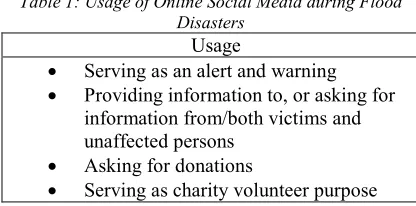
Table 1: Usage of Online Social Media during Flood Disasters
Usage
• Serving as an alert and warning
• Providing information to, or asking for
information from/both victims and unaffected persons
• Asking for donations
• Serving as charity volunteer purpose
4.1. Alert And Warning
Online social media serves as one more channel for emergency services to send real time alert and warnings, especially during disasters. Many emergencies require an early warning system which can reach as many people as possible, and as fast as possible, as some victims may be unable to move because of high waters or a lack of suitable transport. Twitter and Facebook can offer solutions in these instances, because most users will receive notifications instantly [27]. Users also actively spread official messages of warnings and information. This willingness to spread official messages through individual personal networks presents an opportunity to substantially increase the reach of official communications. The second behavior was the willingness of users to give
relevant information back to emergency
management agencies [9].
A news piece by Riordan, entitled “Police tweet on the beat during flood crisis”, detailed the importance of online social media as a knowledge sharing tool during the flood disaster. On the day of the floods, Charlton sent an urgent message from the Queensland Police Service (QPS) Twitter and Facebook accounts. The message asked residents living near Lockyer Creek to leave their homes until further notice were given. Less than an hour later, the message sent out via Twitter was even more urgent, as the residents needed to leave immediately from their houses in order to find higher and safer places [28]. If the police had not quickly tweeted the alert and warning, more serious consequences would have occurred, such as a lot of people becoming trapped during the flooding event.
Moreover, the Victoria State Emergency Service (VICSES) also realized the importance of online social media. Between the 12th of January and the 10th of February 2011, VICSES responded to more than 17,500 requests for assistance, while 320,000 individual Emergency Alert messages were delivered and the VICSES Flood and Storm Information Line received over 16,800 calls.
Communication of warnings and information to the community was vitally important, and meanwhile online social media outlets were used broadly by communities, media, emergency services, and other interested people [9].
4.2. Information To Victims And Unaffected
Persons
Online social media can provide information to victims such as emergency phone numbers, and the locations of nearest and most available hospitals. It can also be used to, provide information regarding whether evacuation centers are full with victims or not, and if they are full, where the nearest evacuation centers and routes are [27]. From another perspective, during the 2011 Japan earthquake and tsunami, isolated sufferers were able to use online social media services via their smart phones to call for help [29].
Users have recommended a focus of not only communicating with affected persons, but also realizing that unaffected persons can be equally worried and require information. Unaffected persons may want to confirm that their hometown, family or place where their live is safe, or that they will not be soon impacted by the flooding. Citizens not affected by the flooding can better understand the impacts caused by the flooding, learning that can help them better prepare for future flooding that might impact them. During flood events, children or other family members can know the status of their families faster, through online social media. Online social media can help provide assuring information that family and friends are safe [27]. Robert Heath, an emergency management expert, from the University of South Australia, said that the use of online social media can calm people down, as they are at least receiving information [28].
4.3. Donations
ISSN: 1992-8645 www.jatit.org E-ISSN: 1817-3195 services can also avoid the flows of unnecessary
materials, while developing synergies with
communities by indicating on online social media exactly what types of contributions are needed [10]&[27].
4.4. For The Charity Volunteer Purpose
A significant amount of NGOs and charity volunteers obtain information from online social media [27]. Online social media can connect large numbers of volunteers during disaster events and can also strengthen bonds between people who may not have previously known each other. After Haiti’s 2010 earthquake, online social media helped connect healthcare suppliers requiring supplies, to those who could source them. Amanda Ripley, in her research for the publication “The Unthinkable: Who Survives When Disaster Strikes–and Why”, comments that people actually become highly social during disaster events, and have a need for comfort and human connection [29].
4.5. Advantages
The use of online social media, can aid the process of transferring information regarding flooding in a faster and more efficient way [9]. QPS sent out information directly to the community via Facebook and Twitter, thereby cutting out the ‘middle man’ and delivering news within a matter of minutes rather than within periods of several hours [30]. The benefit of using online social media was that it allowed the QPS to talk directly with Queensland’s people. The small QPS Media Unit maintained a continuous flow of information, including that regarding road closures. People re-tweeted posts and international media began to gather content from online social media [28].
The advantages of online social media have been positively associated with the response and recovery phases of emergency management. Within the disaster preparedness phase, online social media can act as the teacher or guide, and can be used for sharing emergency plans. During the disaster and recovery phases, SNS can be used to reconnect the public with lost or missing persons [29].
When the website that contained flood evacuation maps closed down, police were able to temporarily revive the page, take screen shots of the maps, and post them on the Flickr image hosting website. Online social media quickly became an effective means of flood response. Other type of knowledge-sharing devices such as newspapers and television broadcasts, can prove to be slow. By using online social media as an information source,
one does not need to wait until a newspaper publishes the next edition of the TV news, or even until the next radio bulletin. There is no longer a need to post, evacuation notices posted on every door in a street. The change from hand-delivering papers to Tweeting and Facebooking represents a significant shift in approach, and one that is environmentally-friendly due to a reduction of paper costs [31].
Community members can also establish online social media websites through their own efforts, in order to share information without the involvement from emergency services during the floods. Some of these pages have had several thousand ‘fans’ or likers, and they have seen high levels of engagement during floods. This type of derivative highlights that online social media discourse will take place during emergency situations, even without the involvement of official sources in dialogue or comments. Such a scenario also points to a considerable level of difficulty related to self-organization within the online social media communities at the peak of emergency situations, for instance, during flood disasters [10].
Now with the on-going development of communication technologies, we are able to follow the progress that has been synonymous with the annual flooding of coastal areas in eastern Malaysia. Rapid information can be provided by relatives and friends of flood victims, in the form of texts and images. Employers should not be concerned if employees are absent from their duties, due to flooding, as a result of valid information via smart phones.
Online social media can also be used to indicate a willingness to assist in the event of an emergency. Although some people are not able to help victims by themselves, they can help the situation by sharing important information with others who are willing to come and offer support directly to victims [27].
QPS updated its Facebook page almost every ten minutes on the day that the floods hit Grantham in the Lockyer Valley. Using online social media also gave QPS a way to stop rumors, by posting corrections immediately via Facebook. As a result, QPS became renowned as one of the first public sector organizations which effectively used online social media during a time of crisis [30].
ISSN: 1992-8645 www.jatit.org E-ISSN: 1817-3195 ousting [28]. When erroneous reports of sharks in
flood waters surfaced, they were quickly rebuffed by the police service that was carefully monitoring online social media traffic [29]. Charlton stated that being able to oust misinformation was almost as important as being able to send out the right information [28].
In summary, the benefits of the use of online social media during the disaster, according to Queensland Police Service (QPS), are the following [32]:
• It was an immediate service, and allowed
Police Media to proactively push out large volumes of information to large numbers of people.
• The QPS Facebook page became the
trusted hub for the dissemination of information and facts for the community and the media.
• Large amounts of specific information
could be directed straight to communities without them having to rely on mainstream media coverage to access relevant details.
• It provided access to immediate feedback
and information from the public at the disaster scenes.
• The mainstream media embraced online
social media and found it to be a valuable and immediate source of information.
• It provided situational awareness for QPS
members in disaster-affected locations who otherwise had no means of communications.
4.6. Limitations
As we know, the advantages of using online social media also come with disadvantages or limitations, which can relate to either significant or insignificant matters. The limitations of this research is that no one can predict how great floods will be each year, and the degree of their potential impact on humans, livestock and living things. In addition, some information distributed in online social media can be based on rumours. People receiving wrong information during a flood disaster can be considered the worst-case scenario [28]. Users cannot differentiate between true and false information. The worst possible scenario is if people take advantages of flooding incidents, for example by, taking money donations and not passing them on victims. Hopefully, the limitations can be progressively overcome, and only valid information will be spread to users.
Despite creating opportunities in times of crisis, the challenges of using online social media have also been stressed as well. The trustworthiness of online social media content is sometimes questioned, although filtering tools have been developed that reduce time spent reading irrelevant
messages from untrustworthy sources. The
obstacles faced in online social media is that a
broad range of players can communicate
simultaneously, using various channel. This represents an opportunity, as it can speed up emergency responses, but also presents challenges through the spreading of inappropriate rumours. Errors can occur, such as the provision of inaccurate information, and the mishandling of sensitive information [27].
In future, online social media disaster
communications will be improved, but will not necessarily become more widespread. They require two-way communications, and need to be responsive and extremely informative in a real time basis. Drawbacks were avoided in the Calgary situation, because both Twitter and hashtags within Twitter were used. Some cities used Twitter but did not use hashtags, meaning that nobody could track the information. Having apps on smart phones offers an invaluable means for the population to receive direct notifications [31].
5. DISCUSSION
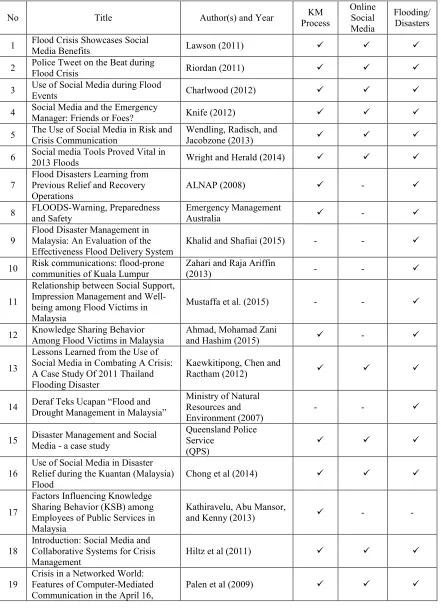
The Table 2 in index shows the three main terms in this study, which are flooding/disasters, knowledge management processes and online social media. This table is needed in order to show the comparison between flood, knowledge sharing and online social media within each paper. By accessing that table, the researcher can easily summarize what the findings are from those papers, and whether they relate to those three terms, or only cover one term. From the table, we can see that there are twelve sources that have three terms, namely, KM process, online social media and flooding/disasters, four sources that have two and seven sources that have one.
ISSN: 1992-8645 www.jatit.org E-ISSN: 1817-3195 earthquake and tsunami. Source number 5 and 19
cover disaster in general; source number 6 covers flooding in Calgary; and source numbers 7, 8, 9, 10, 14, 23 focus more on flooding in general, including definitions of flooding, its concept, flooding’s type, flooding’s system and flooding’s preparation. Sources 11, 12 and 16 focus on flooding in Malaysia; source number 13 focuses on Thailand’s flooding and lastly, source number 18 provides some insight into Japan’s tsunami.
Within online social media, Facebook and Twitter provide the latest updates during crises (source 1); Twitter and Facebook spread messages to residents, requesting that they leave their homes until further notice, while calming individuals down through the provision of information (source 2). Message spreading methods, such as shares, retweets, repostings and comments regarding donations, relief, warnings, news, and general emergency information, were used in Facebook and Twitter (source 3). Twitter followers can be notified of emergency alerts and warnings, while blogs can detail individual experiences and household preparedness tips, and YouTube can provide protective action recommendations and information about how to implement them (source 4). Twitter and Facebook can let volunteers and emergencies units know the conditions and locations of victims while a challenge here is to limit the spread of inappropriate rumors (source 5). A shift from hand-delivering paper information, to providing it through Tweeting and Facebooking is environmentally-friendly, due to the resulting reduction in paper costs (source 6). YouTube videos can provide issue warnings, education and updates about disasters, Facebook can offer moral support and can help members communicate and collaborate with each other. Twitter can help victims quickly connect with the rest of the world, so that relief can be immediately mobilized in order to minimize the impact of disasters (source 13). The purpose and benefits of QPS Facebook, Twitter, and YouTube were detailed in source 15; the use of Facebook status updates were presented in source 16 and the use of online social media in general were detailed in sources 18 and 19. The use of online social media in e-learning was detailed in source 22 and lastly, an overview of the use of notifications, bulletin boards and Twitter messaging, communication tools and chat, forum and discussion groups was detailed in source 23.
The key online social media behavior in this regard related to message spreading, which covered 43 per cent of the total dataset. The processes of
spreading messages included sharing posts, retweets, reposting, and the distribution of comments related to donations, relief, warnings, news, and general emergency information. Message spreading related to relief and donations were most dominant, followed closely by the spreading of news items. Message spreading related to warnings represented only 7.5 per cent of the total dataset, which is considered to be low, due to a lack of official agency use of online social media for warnings. It is worth taking note that VICSES now use the practice of automatically post all warnings directly to the organization’s Twitter and Facebook accounts [9].
The VICSES Facebook page received a number of direct posts from online social media users, containing detailed information about local conditions, road closures, and images and videos of local flood consequences. Facebook was most significantly used for commentary by people who were directly involved in the floods. Twitter was most often used for spreading news, information and warnings [9].
Twitter followers can be notified of emergency alerts and warnings, blogs can provide detail individual experiences and provide household preparedness tips, and YouTube can present protective action recommendations and details of how to implement them. You Tube can provide situational awareness to disaster responders, and Twitter can be used to request blood donations or volunteer assistance from users who see the news and updates [29].
Meanwhile, several figures below show
[image:8.612.314.524.565.699.2]examples of knowledge sharing via Facebook and WhatsApp about flooding in eastern Malaysia. The purpose of these figures is to identify the current usage and utilization of online social media during flood disasters. This is done by observation method.
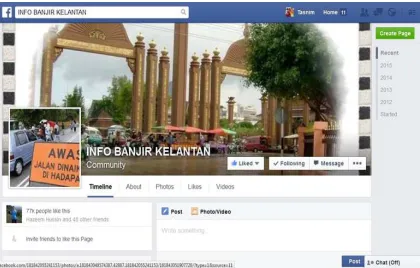
ISSN: 1992-8645 www.jatit.org E-ISSN: 1817-3195 Figure 1 above shows the “Info Banjir Kelantan”
[image:9.612.108.282.142.331.2]page on Facebook, whose posts have focused on knowledge sharing in regards to news, pictures, videos or stories.
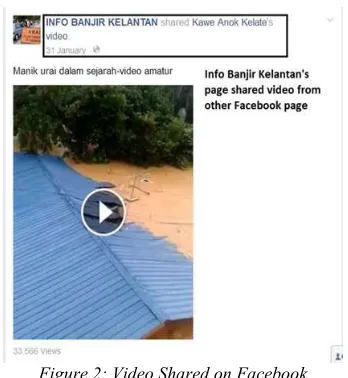
Figure 2: Video Shared on Facebook
Figure 2 above shows a video shared on the “Info Banjir Kelantan” page, shared from another Facebook page focused on flooding impacts. This is an example of knowledge sharing.
[image:9.612.110.279.463.631.2]Figure 3 below shows police information shared on the “Info Banjir Kelantan” page, which details the contributions that can be donated to flood victims.
Figure 3: Police’s Information Shared on Facebook
Figure 4: Post Shared through the WhatsApp Application
Figure 4 above is an example of flood information knowledge sharing through the WhatsApp application. Due to limitations from the figure and also the limitations of this study, is we cannot identify whether the information is true or not. People themselves need to ensure they spread only true information. It is therefore good for other researchers to research the issue of trust of information in online social media, during future flooding or emergency events.
[image:9.612.314.526.587.721.2]From the research background, literature review and discussion, a comparison of the situation in Malaysia and Australia is provided in Table 3 below. An example of a Facebook page in Malaysia is “Info Banjir Kelantan”, meanwhile the example for Australia is that of the Queensland Police Service (QPS). The Facebook page in Australia is more professional when compared to that of Malaysia. Research levels, the involvement of agencies and usage are all also higher in Australia when compared to Malaysia.
Table 3:Comparison between Australia and Malaysia in Online Social Media Usage during Flood Disaster
Comparison Australia Malaysia
Professional High Low
Research A lot A few
Usage High
High, but less efficient Involvement of the
emergency response organizations
High Not really
Examples of
Facebook Pages QPS
ISSN: 1992-8645 www.jatit.org E-ISSN: 1817-3195 In general, the impacts of this research can be
divided into two categories, namely practical and literature. Within the practical category, this research can help victims to survive flood disasters, by notifying online social media groups, for instance group pages on Facebook, of their locations should they be trapped during disasters. The victims can also receive alerts regarding flood news. Other than that, online social media can help
volunteers or non-government organizations
(NGOs) to identify the locations of flood’ victims by obtaining relevant updates from online social media. They can supply food, drinks, and essential utilities including blanket to the victims. Online social media can also be used as a means to guide generous and kind people, who may not be able to access the impacted locations themselves, in providing financial support to correct and trusted agents. Meanwhile, literature in this field can introduce a new era of understanding the usage of online social media, and its benefits during flood disasters. By studying the benefits of online social media, we can encourage people to provide related inputs and outputs resulting from flood disasters that will be useful in the future.
6. CONCLUSIONS AND FUTURE WORK
In summary, this paper explains flooding itself, its concept, and the scenarios of real cases such as flood disasters in Malaysia and also in Australia. In addition, the concept of knowledge sharing and online social media has also been highlighted here. The paper also overviews the role of knowledge sharing through online social media during flood disasters, and the reality of the situation.
An important lesson from this research is that online social media is beginning to play an integral role in the way that people both gather and
communicate information during emergency
situations. As with all methods of communication during emergency events, online social media is just one channel that should be used as part of an overall communications platform that encompasses multiple tools. Online social media cannot, and arguably should not, replace or supersede traditional approaches to emergency management communications, but if leveraged strategically, it can be an effective means of strengthening and augmenting current systems (Charlwood, 2012). The best case study of the positive impact of online social media is that of its use in the state of Victoria, Australia during the 2011 flood disaster.
Online social media can increase knowledge sharing especially during flooding disasters, as
discussed in Table 1 which details its usage and advantages. The uses of online social media include its ability to spread alerts and warning messages, to provide information to victims and non-victims, to coordinate charity and volunteers, and to ask for donations and related information. Its advantages include cutting costs, reduced time involved and the elimination of reliance on a middle man.
Through the above discussion, the specific goal of the research which is to identify the current usage and utilization of online social media during flood disasters has been achieved. Online social media can be used after a disaster or crisis event, in order to investigate the lessons learnt and processes utilized, all of which are useful materials for researchers when undertaking research [27].
Cooperation with emergency response
organizations and people also needs to be improved and observed. Both players are important within flooding situations. Future works related to this research include preparing the questionnaire, distributing it to respondents, and analyzing the results in order to examine the influence of knowledge sharing during flood disasters, through the use of online social media tools.
ACKNOWLEDGEMENT
The authors wish to thank the Ministry of Higher Education Malaysia for funding this study under Long Term Research Grant Scheme
(LRGS/b-u/2012/UUM/Teknologi Komunikasi dan
Informasi) with Grant No – 4L809, Universiti Teknologi Malaysia.
REFERENCES:
[1] Sarkheyli, A., Alias, R. A., Ithnin, N. and Esfahani, M. D. 2012. Dimensions of Knowledge Sharing Quality: An Empirical Investigation. Journal of Information Systems
Research and Innovation.
[2] Alam, S., Abdullah, Z., Ishak, N. and Zain, Z. 2009. Assessing Knowledge Sharing Behaviour among Employees in SMEs: An Empirical Study International Business Research, (2)2. [3] Nordin, N., Daud, N. and Osman, W. 2012.
Knowledge Sharing Behaviour among
Academic Staff at a Public Higher Education
Institution in Malaysia. World Academy of
ISSN: 1992-8645 www.jatit.org E-ISSN: 1817-3195 [4] Kathiravelu, S. R., Abu Mansor, N. N. PhD and
Kenny, K. PhD. 2013. Factors Influencing Knowledge Sharing Behavior (KSB) among Employees of Public Services in Malaysia. International Journal of Academic Research in
Economics and Management Sciences Vol. 2,
No. 3.
[5] Mahmood, J., Mohamed Dahlan, H. and Che Hussin, A. R. 2013. Enhancing Knowledge Sharing in e-learning by Incorporating Social
Network Features. Journal of Information
Systems Research and Innovation.
[6] eMarketer. 2013. Social Networking Reaches Nearly One in Four Around the World. 18 June 2013. Retrieved on 9 May 2015 from http://www.emarketer.com/Article/Social- Networking-Reaches-Nearly-One-Four-Around-World/1009976
[7] White CM. 2012. Social Media, Crisis Communication, and Emergency Management: Leveraging Web2.0 Technology. Boca Raton: CRC Press.
[8] ALNAP. (2008). Flood Disasters Learning from previous relief and recovery operations.
[9] Charlwood, J., Dennis, A., Gissing, A., Quick, L. and Varma, S. 2012. Use of social media during Flood Events. Retrieved on 28 February 2015
from
http://floods.org.au/wp- content/uploads/Jilly-Charlwood-Full-Paper1.pdf
[10] Bruns, A. 2011. Towards Distributed Citizen Participation: Lessons from WikiLeaks and the
Queensland Floods. Conference for
eDemocracy and Open Government 2011,
Retrieved 30 November 2011 from
http://snurb.info/publications.
[11] About Australia Pty Ltd. Australia Facts, 2015.
Retrieved on 6 October 2015 from
http://www.about-australia.com/facts/
[12] Emergency Management Australia (EMA). FLOODS-Warning, Preparedness and Safety. Flood brochure.
[13] Mustaffaa, C. S., Ahmad Marzuki, N., Ariffin, M. T., Salleh, N. A. and Rahaman, N.H. 2014.
Relationship between Social Support,
Impression Management and Well-being among
Flood Victims in Malaysia. Procedia - Social
and Behavioral Sciences 155, 197 – 202.
[14] Ahmad, M., Mohamad Zani, N. and Hashim, K. F. 2015. Knowledge Sharing Behavior among
Flood Victims in Malaysia. ARPN Journal of
Engineering and Applied Sciences Vol. 10, No.
3, February 2015.
[15] Chong, T., Leong, C., Pan, S. L., Bahrts, S. and Ahmad Khan, A. F. 2014. Use of Social Media in Disaster Relief during the Kuantan
(Malaysia) Flood. Teaching Case. Thirty Fifth
International Conference on Information
Systems, Auckland 2014.
[16] Palen, L., Vieweg, S., Liu, S. B. and Amanda Lee Hughes. 2009. Crisis in a Networked World
Features of Computer-Mediated
Communication in the April 16, 2007, Virginia
Tech Event. Social Science Computer Review
OnlineFirst, published on April 8, 2009 as
doi:10.1177/0894439309332302
[17] Kaewkitipong, L., Chen, C. and Ractham, P. 2012. Lessons Learned from the Use of Social Media in Combating a Crisis: A Case Study of
2011 Thailand Flooding Disaster. Thirty Third
International Conference on Information
Systems, Orlando 2012.
[18] Hiltz, S. R., Diaz, P., and Mark, G. 2011. Introduction: Social media and collaborative
systems for crisis management. ACM Trans.
Comput.-Hum. Interact. 18, 4, Article 18
(December 2011), 6 pages. DOI =
10.1145/2063231.2063232
http://doi.acm.org/10.1145/2063231.2063232 [19] Baharul Azhar, N. H. 2012. Motivation Factors
on Knowledge Sharing among Public Sector Organizations in Malaysia. Master Thesis. Universiti Sains Malaysia.
[20] Din, N. and Haron, S. 2012. Knowledge Sharing as a Culture among Malaysian Online
Social Networking Users. Procedia - Social and
Behavioral Sciences 50, 1043 – 1050.
[21] Zahari, R. K. and Raja Ariffin, R.N. 2013. Risk communications: flood-prone communities of
Kuala Lumpur. Procedia Environmental
Sciences 17, 880–888.
[22] Ministry of Natural Resources and
Environment.(2007). Deraf Teks Ucapan
“Flood and Drought Management in Malaysia”. [23] Khalid, M. S. and Shafiai, S. (2015). Flood
Disaster Management in Malaysia: An
Evaluation of the Effectiveness Flood Delivery
System. International Journal of Social Science
and Humanity, Vol. 5, No. 4.
[24] Dorasamy, M., Raman, M., Muthaiyah, S. and
Kaliannan, M. (2012). Knowledge-based
Emergency Management Information Systems:
Mapping DERMIS Principles. Knowledge
Management International Conference
(KMICe), Johor Bahru, Malaysia.
ISSN: 1992-8645 www.jatit.org E-ISSN: 1817-3195 http://whatis.techtarget.com/definition/Faceboo
k
[26] McLaughlin, E. What is WhatsApp?, WhatIs.com, June 2013 (retrieved on November
26, 2014).
http://searchconsumerization.techtarget.com/def inition/WhatsApp
[27] Wendling, C., J. Radisch and S. Jacobzone 2013, “The Use of Social Media in Risk and Crisis Communication”, OECD Working Papers on Public Governance, No. 24, OECD Publishing.
http://dx.doi.org/10.1787/5k3v01fskp9s-en [28] Riordan, K. 2011. Police tweet on the beat
during flood crisis. 20 January 2011. Retrieved
on 1 March 2015 from
http://www.abc.net.au/news/2011-01-20/police-tweet-on-the-beat-during-flood-crisis/1912328 [29] Knife, J. 2012. Social Media and the
Emergency Manager: Friends or Foes?
Retrieved on 1 March 2015 from
http://patimes.org/social-media-emergency-manager-friends-foes/
[30] Lawson C. 2011. Flood crisis showcases social media benefits. 6 June 2011. Retrieved on 28
February 2015 from
http://www.colelawson.com.au/NewsResources/ LatestNews/tabid/118/post/social-media-benefits/Default.aspx
[31] Wright, M. and Herald, C. 2014. Social media tools proved vital in 2013 floods. 16 February 2014. Retrieved on 1 March 2015 from http://www.calgaryherald.com/technology/Soci al+media+tools+proved+vital+2hhhh013+flood s/9517574/story.html
ISSN: 1992-8645 www.jatit.org E-ISSN: 1817-3195
Table 2:Summarization Of Different Sources Of Research Regarding Flooding, Knowledge Management And Online Social Media
No Title Author(s) and Year KM
Process
Online Social Media
Flooding/ Disasters
1 Flood Crisis Showcases Social
Media Benefits Lawson (2011)
2 Police Tweet on the Beat during
Flood Crisis Riordan (2011)
3 Use of Social Media during Flood
Events Charlwood (2012)
4 Social Media and the Emergency
Manager: Friends or Foes? Knife (2012)
5 The Use of Social Media in Risk and
Crisis Communication
Wendling, Radisch, and Jacobzone (2013)
6 Social media Tools Proved Vital in
2013 Floods Wright and Herald (2014)
7
Flood Disasters Learning from Previous Relief and Recovery Operations
ALNAP (2008) -
8 FLOODS-Warning, Preparedness
and Safety
Emergency Management
Australia -
9
Flood Disaster Management in Malaysia: An Evaluation of the Effectiveness Flood Delivery System
Khalid and Shafiai (2015) - -
10 Risk communications: flood-prone
communities of Kuala Lumpur
Zahari and Raja Ariffin
(2013) - -
11
Relationship between Social Support, Impression Management and Well-being among Flood Victims in Malaysia
Mustaffa et al. (2015) - -
12 Knowledge Sharing Behavior
Among Flood Victims in Malaysia
Ahmad, Mohamad Zani
and Hashim (2015) -
13
Lessons Learned from the Use of Social Media in Combating A Crisis: A Case Study Of 2011 Thailand Flooding Disaster
Kaewkitipong, Chen and Ractham (2012)
14 Deraf Teks Ucapan “Flood and
Drought Management in Malaysia”
Ministry of Natural Resources and Environment (2007)
- -
15 Disaster Management and Social
Media - a case study
Queensland Police Service
(QPS)
16
Use of Social Media in Disaster Relief during the Kuantan (Malaysia) Flood
Chong et al (2014)
17
Factors Influencing Knowledge Sharing Behavior (KSB) among Employees of Public Services in Malaysia
Kathiravelu, Abu Mansor,
and Kenny (2013) - -
18
Introduction: Social Media and Collaborative Systems for Crisis Management
Hiltz et al (2011)
19
Crisis in a Networked World: Features of Computer-Mediated Communication in the April 16,
ISSN: 1992-8645 www.jatit.org E-ISSN: 1817-3195 2007, Virginia Tech Event
20 Dimensions of Knowledge Sharing
Quality: An Empirical Investigation Sarkheyli et al (2012) - -
21
Motivation Factors on Knowledge Sharing among Public Sector Organizations in Malaysia
Baharul Azhar (2012) - -
22
Enhancing Knowledge Sharing in e-learning by Incorporating Social Network Features
Mahmood, Mohamed Dahlan and Che Hussin (2013)
-
23
Knowledge-based Emergency Management Information Systems: Mapping DERMIS Principles