A SMART SCHEDULING SCHEME WITH VOICE
ENHANCEMENT FOR VOICE SERVICES IN LTE
1M. KARPAGAM, 2N.NAGARAJAN
1
Assistant Professor, Department of ECE, SKCET, Coimbatore
2
Principal, CIET, Coimbatore E-mail: [email protected]
ABSTRACT
Long Term Evolution (LTE) technology supports only packet based services. To facilitate better Quality of Service (QoS) for Voice packets, LTE has resorted to Circuit Switched Fallback (CSFB) approach to deliver voice services. However, the CSFB scheme has many disadvantages whichare discussed in detail in the later stages of the paper. In this paper, we propose a scheduling scheme with voice enhancement for effective delivery of voice services in LTE. The proposed scheme uses packet switching unlike the CSFB scheme which uses circuit switching to guarantee delivery of voice services, thereby, providing the network with the flexibility of resource allocation that is provided in the packet switching. Apart, the simulation results have demonstrated that the proposed scheme was able to achieve the same QoS delivery provided by the CSFB approach.
Keywords: LTE, Voice Services, Scheduling, QoS, CSFB
1. INTRODUCTION
The thirst for greater data rates exhibited by users of mobile wireless services has been on an exponential trajectory. Long Term Evolution seeks to improve voice quality and expand broadband data services, to deliver high-definition video and audio and other on- demand and real-time content in an “anything-anywhere-anytime” manner. Wireless customers are increasingly using mobile devices as their main tool to surf the Internet, play games,stay connected with friends and family, and watch real-time news, favourite TV programs, or the latest blockbuster movie. Offering high-speed data over wireless networks to meet and encourage such ever-increasing service demands is of significant interest to the wireless operators around the world. The wireless industry has evolved from using second-generation (2G) technologies to today’s Third Generation Partnership Project (3GPP) LTE Release 8, with increasing spectrum efficiency more than 100 times. With the limitation of available contiguous spectrum being allocated and licensed to the wireless operators, carrier aggregation is needed to meet the International Telecommunication Union — Radio communication Sector’s (ITU- R’s) 1 Gb/s peak rate requirement for IMT-Advanced. Carrier aggregation has been introduced to 3GPP
LTE-Advanced work since 2009 as one of the key components for 3GPP LTE Release 10 [1], [2].
Before the comparison of different solutions currently used to handle Voice Calls in LTE networks, two facts have to be underlined.
1. LTE already has well defined Voice Call solution (called Voice over LTE, or shortly VoLTE) and it was planned from the beginning [4].
2. Even without VoLTE there are many third-party applications that are providing acceptable solution for Voice Call service in the form of various free VoIP software installed on smart phones (Viber, Skype and others to be mentioned as the most popular ones).
Combined with LTE's data service these applications are sufficient for many LTE customers. However, both of these solutions carry some restrains. The first one, VoLTE, requires IP Multimedia Subsystem (IMS). IMS has been chosen as the architecture for voice and multimedia communication services for LTE. Although IMS is not new technology it has not been as widely adopted as experts predicted years ago, when LTE was in drafts. It is so due to cost and complexity of IMS [5]. This is the main reason why VoLTE wasn't implemented as the first and only solution for Voice Call service. It left operators coping with transitional solutions where the re-use of existing equipment was the imperative.
The second one, so called Over The Top (OTT) solution, where third-party software is used for voice calls, would turn the mobile operators to data-only providers (regarding LTE networks), destroying the current business model where relatively small amount of traffic (10 to 20%) generated by voice service is still generating the most of the revenues, as explained previously. This is unacceptable for mobile operators.
One universally accepted solution for LTE systems to transmit high quality voice is by adapting to Circuit Switched Fall Back Mechanisms. 3GPP has standardized the procedure for switching to 3G network. It is called CSFB as "fallback" to "lower" technology. To provide CS services LTE reuses 2G/3G infrastructure which is the most preferred solution from business perspective because it relies on the technologies that were already invested in and licensed for the years to come using the existing and operational equipment. CS Fallback works in a way that mobile terminal is camping on LTE when MTC arrives via paging message. Terminal is informed that network is calling for CS (voice call) service and it switches to 3G where communication is continued. Similar procedure takes place in the case
of MOC. Mobile terminal sends a CS fallback service request to the MME which replies with handover command. Once the procedure of handover to 3G is done the terminal continues communication in 3G domain. In more details, for an incoming CS Call, the UE is registered to the CS core network in addition to MME. In the case UE receives CS paging, or wants to initiate a mobile originated CS Call, the UE indicates that the NAS: Ext-Service Request message is for the CS fallback to MME. Than MME indicates that S1: Initial Context Setup Request is for CS Fallback. Depending on the target system and the capability of the targetcell, Base Station performs PS handover or cell change order procedure and the UE starts the CS call setup once it moves to target cell [6],[7],[8].
However, there are numerous drawbacks with the CSFB approach to interim voice and messaging, which Disruptive Analysis believes should prompt operators and standards authorities to look afresh at alternative interim mechanisms. Part of the problem has been that past assessments of the standards have focused mostly on the technical aspects, rather than addressing issues around user experience and behavior, or impacts on broader application usage and indirect impacts on business models. Some of the challenges faced by the LTE system while resorting to CSFB approach for transmitting voice is discussed in this section
[9] compares the various methodologies of handling the voice traffic in LTE networks and provides the measurement results for each of the methods. It has been clearly demonstrated in [9] that CSFB scheme achieves good QoSthan the other packet based scheduling schemes in terms of supporting voice calls. However, the simulation results also clearly indicate the degradation in performance of the other packet based scheduling schemes, which is totally not acceptable.
are also discussed in [10]. The article demonstrates that the success rates of the CSFB call setups clearly depend on the optimization factor of the network.
[11] demonstrates why LTE architecture does not support native circuit switching services and relies on the IP Multimedia Subsystem (IMS) for supporting voice and Short Messaging Service (SMS). It also indicates the limitations of IMS and the challenges it poses for operators who wish to deploy LTE in the near future. It also mentions that voice and SMS drives a major portion of the service provider revenue and the need for an efficient packet based scheduling scheme that can provide effective voice streaming at the same time guarantying the QoS of other packet based schemes.
[12] discusses about the nature of the LTE systems and the lack of support for Circuit Switched (CS) voice service which has been the main revenue generator for operators in LTE systems. The paper also elaborates how to provide voice call when a user is in LTE and also methodologies to ensure voice call continuity when it moves out of LTE coverage. It also addresses the technical challenges faced by the LTE system in supporting voice through circuit switching networks.
The following issues are also said to be associated with the CSFB approach [13], [14]. 1. Additional call set-up latency 2.Requirements on network coverage. 3. Side-effects of dropping the data connection during voice calls 4.Impact on data applications, especially on multi tasking devices. 5. Issues relating to SMS support 6.Implementation cost and practicalities 7.Negative impacts on current or potential new LTE business models, eg MVNOs, 8. Poor fit with new types of voice application 9.Problematic integration with femtocells
.
References [9] through [14] have discussed the various advantages and disadvantages of adopting the CSFB approach in LTE systems. It is clear that CSFB solves the purpose of supporting VoIP traffic in LTE systems. However, it is achieved at the cost of depletion of resources of other packet-based services. In addition it also poses additional technical challenges as discussed in [13],[14]. This is not acceptable. A scheduling scheme, which will stream voice traffic through packet switching at the same time guarantying the QoS delivered by the CSFB mechanism, will be the ideal solution.
There are many packet-scheduling schemes that are available in the market. However, most of the proposed packet scheduling schemes fails in two aspects. First, they do not carry out real time traffic estimation, as the authors usually prefer to evaluate the scheme or algorithm on synthetic networks. But for implementation in a real time situation it is very much necessary to carry out a real time traffic estimation mechanism that will actually evaluate the effectiveness of the scheme. Second, most of the packet scheduling schemes foe LTE are aimed at maximizing the throughput of the LTE network. However these schemes fail miserable when it comes to fair allocation of resources because there is a large trade off factor always associated. In this paper, we intend to provide a scheduling scheme that will work effectively in a real time LTE switch and not a comprehensive system level simulation scenario. Further, the scheduling scheme also focuses on the physical resource blocks that are assigned.
In this paper, we propose a scheduling process that works well in LTE systems. The proposed scheme employs packet switching for voice transmission. The process is developed after careful estimation of the speech traffic in different conditions and also exploiting the physical layer properties of the channel to make the scheme more effective. The proposed scheme was able to achieve equivalent performance as that of the circuit switching networks or the CSFB approach.The scheduling scheme was evaluated using OPNET Simulator and the results were exported to MATLAB.
The rest of the paper is organized as follows. In the next section, we introduce the traffic estimation process and the scheduling scheme. In section 3, we analyze the results and in section 4, we conclude the paper.
2. SPEECH TRAFFIC ESTIMATION AND SCHEDULING SCHEME
carried out in the modeller. By definition if a single user establishes a call that lasts for the entire hour, 1 Erlang of traffic is generated. One of major influencer that identifies the model is Call Arrival Pattern. There are three main call arrival patterns namely, Smooth call Arrival Pattern, Peaked Call Arrival Pattern and Random Call Arrival Pattern. A smooth or hypo-exponential traffic pattern occurs when there is a small amount of variation in traffic. Peaked call or also known as hyper-exponential call pattern with longer spikes from the mean and requires extra capacity to manage peak period. Poisson & exponential distribution is random traffic pattern. The call arrival is unpredictable and arrive in random. Normally many callers generate this pattern but each contributes only small traffic[14].
Analyses is made based on the services group called Speech call, Video call and Packet switch call. Hourly data is selected instead of daily data to show the behaviour of the traffic during the data period taken. The best situation is to take the busy-hour. The following information can be derived from hourly data or Daily busy hour, Weekly busy hour, Monthly busy hour and busy hour of a cluster. VoLTE is Voice over packet call & transmitted via IP to evolve Packet Core (ePC). The VoIP IMS based profiles defines a minimum mandatory set of features a wireless device and network are required to implement in order to guarantee an interoperable, high quality IMS-based telephony service over LTE radio access [15]. During conversation, the speech signal will be digitized & compressed by a vocoder. The codec used in LTE is AMR which were described in 3GPP TS 26.104 specification. The total of 160 samples is generated on every encoded AMR speech frame [16]. These encoded voices are packetized into voice frame in the transport layer called Real Time Transport Protocol (RTP).
Packetization and coding rate can influence the gross bandwidth throughput of VoLTE. AMR has 8 modes with different code rate where the higher coding rate, the better speech quality. AMR codec samples the waveform at regular interval with 8000 samples per second. These samples are then concatenated into VoIP packet for a fixed period 20ms. Common usage in AMR code is 1 frame per packet. The choice of having more frames per packet is a trade-off between latency and IP transmission overhead. Total header for VoIP packet in VoLTE is 78 octets. The IP packet rate can be calculated using:
Packet rate = Total load (octet) x packet per second number of frame per packet where;
Total load = Total header + payload,
Total header = Ethernet header + IP header + UDP header + RTP header
Payload = frame octet x number of frame.
RoHC was specified in 3GPP TS 36.323 IETF RFC 3095 and RFC 4815 which explained the compression scheme for IP/UDP/RTP header [8], [13]. The VoLTE IP/UDP/RTP is a constant 40 octets in length. This size is large as compared with the payload of 12 octets for AMR mode 0. This header value corresponds to 51% of the total frame size.
AMR like others codec such as G.729B and G.723.1A has the capability to detect talk-spurts and silence gaps. Voice Activity Detection (VAD) suppresses transmission data during silence period. During silence period the UE will send Silent Indicator frame in the payload instead of speech payload together with a timestamp [6]. Similarly, the UE will insert silence mode called Discontinuous Transmission (DTX) in RAN.
Mode Adaptation was aimed to maintain the AMR speech call under a wide range of transmission media. This technique enables UE and network to adapt the codec mode according to the link transmission quality. If the IP link media is bad, source coding is reduced and coding mode is increased. To perform mode adaptation, the decoder (speech receiver) needs to signal the encoder (speech sender) the new mode it prefers [16], [17]. The signalling is called Codec Mode Request (CMR) and transmitted over the speech frame.
allocation unit in the frequency plane is the PRB. Each PRB has 12 subcarriers.
The amount of data that can be transmitted in one PRB depends on the link conditions that exist between the Base Station and the user terminal. This is because the 3G LTE system uses Adaptive Modulation and Coding to maintain the quality of delivery irrespective of the channel conditions. In a scheduling mechanism the Base Station is expected to continuously monitor the quality of the channels from the feedback it receives and prioritize the resources based on the input from the feedback. In the proposed scheduling scheme there are independent buffers for every call and this helps because if one mobile user has more than one active call then the Base Station may allocate separate queues for every call.
(1) Insert UE (2) Schedule TTI
Initialize TTI:=1 Increment TTI (3) if (voice traffic==true) (I) then
Apply VOIP optimization SA (ii) if(count>limit)
(iii) then
Apply normal algorithm, factor=QF*QL;
(iv) initialize UE Decrement UE Until UE>=factor (v) if (RB’s and voice packets!=0)
Then repeat (3)(iv) Else end
(vi) else
Find arrival time
(vii) calculate factor=QL*OF (viii) initialize voice traffic Decrement voice traffic Until (voice traffic>=factor) (ix) if (RB’s and voice
packets!=0)
Then repeat (3)(viii) Else if (RB!=0) Then repeat (3)(v) Else
End Else
Repeat from (3)(iii)
Proposed Scheduling Algorithm
The proposed scheduling algorithm aims to maximize the performance of voice traffic that will be transmitted over the LTE network. This algorithm is activated at every time frame. The algorithm considers two factors, namely, the arrival of a new voice call, and if the duration of the call has exceeded the limit specified by the algorithm. We use the traffic estimation process mentioned above to monitor the duration of the call. Another alternativemethod that is used in call duration estimation process isgiven [18]. The algorithm then computes the number of packets dropped and based on the outcome of the result it sets upper and lower bounds for the scheme and the process can be adaptively changed. When the call ratio is high it means that there are many active VoIP calls, and hence it is necessary to increase the limits to allow more frames to be dedicated to VoIP calls. On the other hand, if the call drop ratio is low it implies that the QoS of VoIP calls are satisfied at decent levels, and thus it is safe to reduce the duration of the algorithm and serve other service in the network.
The proposed scheduling scheme is designed by modifying the algorithm in [18]. The proposed Scheduling Algorithm allocates the PRBs to VoIP calls based on the number of call arrivals and the QoS demands of the calls. Once the PRB are allocated to the calls, the scheduling algorithm estimates the Quality Index of every call arrival. The quality index of the calls is determined by the size of the following factors: Channel Quality and queue length of the voice call. If the quality factor values are good then the corresponding call is entertained with higher priority.
Quality Index (i)= Q channel quality(i)* Q length(i)(1)
Q channel quality(i)and Q length(i)indicate the Channel
enabled time frames exceed the limit. If both these conditions fail then the normal mode operation is triggered. In the normal mode operation the scheduler allocates the PRBs to non-real time traffic based on similar factors as set by equation (1) and the count is reset. If the above mentioned metrics are satisfied then the VoIP calls are assigned one PRB at a time. Calls with long queues and better channel quality are served first. The process continues as long as there are enough frames or PRBs left out and there are calls which have data packets to be sent. Once all the VoIP calls are served then the remaining frames or PRBs are assigned to non-real time traffic in the same way as the normal mode. This prevents the frames from being wasted.
3. RESULTS AND DISCUSSIONS
To analyze the performance of the proposed scheduling algorithm, we comparedits performance with that of a proven scheduling scheme, namely, the energy efficient scheduling scheme [18]and also with the performance of the CSFB mechanism. The energy efficient scheduling scheme uses the same frame allocation procedure as ours except for the fact that they do not use the voice allocation as similar simulation parameters and ours except that they don’t use the intelligent Voice enhancement algorithm. The CSFB scheme on the other hand switches to circuit switching to serve the voice packets. These two schedulers were used as a benchmark in the OPNETfor evaluating the performance of the proposed scheme.
.Figure 1: System Throughput
The observations from the Figure 1 indicate that the proposed scheduling scheme was able to achieve significant increase in system throughput with respect to the energy efficient Scheduling
scheme. Figure 1 illustrates that the proposed mechanism achieves upto 100 percent more efficiency in terms of system throughput with the CSFB scheme and upto 40 percent better performance than the energy efficient scheme. It is important to note that the proposed scheme increased the system throughput with respect to the CSFB mechanism because in the CSFB mechanism the system wastes the much important bandwidth by adopting to circuit switching mechanism to cater the voice calls. This leads to the wastage of a lot of precious bandwidth. However, it is also significant to note that the proposed algorithm achieves about significant increase in system throughput with respect to the proven energy efficient scheme. This is mainly attributed to the intelligent allocation of packets by the Voice enhancement algorithm. As mentioned earlier the CSFB scheme wastes resources by switching to circuit switching mechanism for voice transmission whereas the proposed algorithm does not switch to circuit switching to route the voice call thereby saving the bandwidth. On the other hand the voice enhancement algorithm fails on two grounds. It does not do a real time traffic estimation before allocating resources which leads to the Base Station switching hence and forth. It also fails to capitalize on the rich opportunity that exists in the physical layer (OFDMA) while allocation of slots. The proposed scheme overcomes both these disadvantages. However, it is worth mentioning that saving bandwidth is not the only aim of the proposed algorithm or in other words it is important to ensure that the proposed scheme has not achieved improved system throughput at the cost of the other QoS parameters. In order to verify if the proposed scheme ensures other QoS parameters we also estimate the BLER, MOS and Voice Jitter.
[image:7.595.295.515.75.317.2]
circuit switching for VoIP calls, but it is achieved at the cost of wastage of large bandwidth.
Figure 2: Block Error Rate
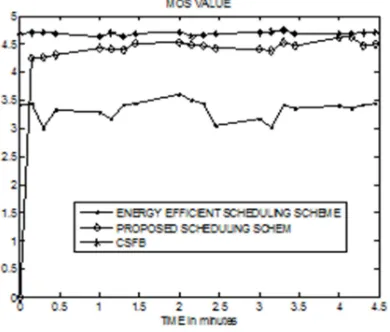
[image:7.595.98.274.151.360.2]While evaluating a scheduling scheme it is important to note that the scheme does not achieve one QoS parameter at the cost of compromise of another QoS parameter. Hence two other QoS parameters are measured in order to evaluate the performance of the proposed scheme. Mean Opinion Score (MOS) is a measure of quality of the voice signal. It may be noticed from Figure 3 that the proposed scheduling scheme was able to achieve almost the same MOS of CSFB. This is a considerable achievement because of the fact the scheduling scheme has achieved the MOS using packet switching.
[image:7.595.89.284.522.688.2]Figure 3: Mean Opinion Score
Figure 4: Voice Jitter
Similar to MOS, the observations from Figure 4 indicate that the proposed scheduling scheme was able to achieve the same quality in terms of Voice Jitter as that of the CSFB and even better performance in terms of JITTER than the Energy Efficient Scheduling Scheme.
Simulation results using OPNET clearly indicate two facts. First, the proposed scheme has achieved considerably better performance than the proven packet based energy efficient scheme bothin terms of throughput as well as the other QoS parameters. So the first inference from the results indicates that the proposed scheme is definitely much better than existing or proven packet based schemes. This is mainly attributed to the excellent traffic modulation mechanism and the cross layer approach that is followed in the scheme, which is not available in the existing packet based scheduling schemes for LTE networks.
Second and more important inference that is obtained from the simulation results is that the proposed scheme was able to achieve comparable performance compared to the CSFB schemes in terms of various QOS parameters, which include, BLER, MOS and Voice Jitter. Though the CSFB scheme achieves better performance than the proposed scheme the proposed scheme has managed to perform equally better to satisfy the QoS requirements of the subscriber. Apart, the most distinguishing factor is though the proposed scheme has been able to achieve the QoS at an improved system throughput of approximately 100 percent, which is phenomenal.
requirements of the users. Now that the proposed packet based scheduling scheme matching the QOS requirements of the subscriber, there is no reason for the LTE systems to resort to circuit switching to stream voice.
4. CONCLUSION
From the simulation results it has been proved that the proposed scheduling scheme was able to achieve better performance than the Energy Efficient Scheduling scheme in terms of both throughput and Quality of delivery of voice packets. This may be mainly attributed to the efficient voice estimation and scheduling process with voice enhancement proposed in this paper. It was also able to match the performance of the CSFB method. However, considering the fact that CSFB method uses circuit switching for Voice packet transmission whereas the proposed scheme uses packet switching it is a significant achievement because of the enormous bandwidth saved. In addition, the proposed scheme also provides the flexibility in utilizing the resources because it adopts the packet switching mechanism which is not possible in the CSFB scheme. The proposed scheme works well for real time traffic conditions. However, it will be interesting to find out how the algorithm works on a Hardware switch. One significant challenge that is associated with the scheme is that it becomes very difficult to estimate the traffic in a heterogeneous traffic scenario involving both real-time and non-real-time services. Since the success of the scheme is purely based on the estimation of traffic, it definitely poses a serious challenge to the algorithm.
REFERENCES:
[1] Wen-Ching Chung, Chung-Ju Chang, and Li-Chun Wang, “ An Intelligent Priority Resource Allocation Scheme for LTE-A Downlink Systems”, IEEE WIRELESS COMMUNICATIONS LETTERS, VOL. 1, NO. 3, JUNE 2012.
[2] C. F. Tsai, C. J. Chang, F. C. Ren, and C. M. Yen, “Adaptive radio resource allocation for downlink OFDMA/SDMA systems with multimedia traffic,” IEEE Trans. Wireless Commun., vol. 7, no. 5, pp. 1734–1743, May 2008.
[3] O. Malik, “Mobile data is growing, but voice &sms slowing”, 2012. available at: http://gigaom.com/2012/04/29/as-mobile-data-zooms- voice-sms-revenues-slow/
[4] M. Poikselka; H. Holma; A. Toskala; J. Hongisto; J. Kallio, “Voice over LTE VoLTE”, John Wiley & Sons Ltd, United Kingdom, May2012.
[5] VoLTE Conference, Paris, 10 to 12 October 2012.
[6] Alcatel-Lucent, “NPO Introduction: NPO Document Concept Guide Release M3”,2009. [7] C. M. Yen, C. J. Chang, and L. C. Wang, “A
utility-based TMCR scheduling scheme for downlink MIMO/OFDMA systems,” IEEE Trans. Veh. Technol., vol. 59, no. 8, pp. 4105– 4115, Oct. 2010.
[8] M. Katoozian, K. Navaie, and H. Yanikomeroglu, “Utility-based adaptive radio resource allocation in OFDM wireless networks with traffic prioritization,” IEEE Trans. Wireless Commun., vol. 8, no. 1, pp. 66–71, Jan. 2009.
[9]Tekovic, A.; Pesut, I.; Moric, Z., "Voice service in an LTE network-CSFB," ELMAR, 2013 55th International Symposium , vol., no., pp.251,254, 25-27 Sept. 2013.
[10] Bautista, J.E.V.; Sawhney, S.; Shukair, M.; Singh, I.; Govindaraju, V.K.; Sarkar, S., "Performance of CS Fallback from LTE to UMTS," Communications Magazine, IEEE , vol.51, no.9, pp.136,143, September 2013. [11] Casey, C.J.; Rajagopalan, S.; Muxi Yan;
Booker, G.; Sprintson, A.; Magnussen, W., "Supporting Voice over LTE: Solutions, Architectures, and Protocols," Computer Communications and Networks (ICCCN), 2013 22nd International Conference on , vol., no., pp.1,7, July 30 2013-Aug. 2 2013.
[12] Paisal, V., "Seamless voice over LTE," Internet Multimedia Services Architecture and Application(IMSAA), 2010 IEEE 4th International Conference on , vol., no., pp.1,5, 15-17 Dec. 2010.
[13] A critical examination of CSFB as a solution for providing Voice-on-LTE Independent white paper commissioned by Kineto Wireless December 2009.
[14] L-E.Jonsson, K. Sandlund, G. Pelletier, P. Kremer, “Network Working Group RFC 4815”, February 2007.
[15] Alasti, M.; Neekzad, B.; JieHui; Vannithamby, R., "Quality of service in WiMAX and LTE networks [Topics in Wireless Communications]," Communications Magazine, IEEE , vol.48, no.5, pp.104,111, May 2010
[16] Qi Bi; Vitebsky, S.; Yang Yang; Yifei Yuan; Qinqing Zhang, "Performance and Capacity of Cellular OFDMA Systems With Voice-Over-IP Traffic," Vehicular Technology, IEEE Transactions on , vol.57, no.6, pp.3641,3652, Nov. 2008
[17] Oyman, O.; Foerster, J.; Yong-jooTcha; Seong-Choon Lee, "Toward enhanced mobile video services over WiMAX and LTE [WiMAX/LTE Update]," Communications Magazine, IEEE , vol.48, no.8, pp.68,76, August 2010