RESEARCH AND APPLICATION OF WIRELESS NETWORK
EQUIPMENT IN COAL MINE GAS MONITORING SYSTEM
1HONGYU SUN, 1ZHIYI FANG, 1YAMIN LI, 1YANG YU, 2SIQI KONG AND 1YAO SUN
1College of Computer Science and Technology Jilin University Changchun, 130012, P.R. China 2Institute of Computer Application, China Academy of Engineering Physics, Mianyang, Sichuan 621900
Email: [email protected]
ABSTRACT
This paper presents a research which based on the protocol.802.11,which is a universal standard put
forward for each manufacturer. The advance of this proposal not only guaranteed the data exchange of
Wireless network of different manufacturer but also provided guarantee on the application in various area.
Especially in recent years, home use wireless network provided chance of application in various areas of
devices which are based on 802.11 protocols. This paper discussed the real time transfer technology of
dangerous gas content which based on 802.11 protocols and the composition and method of well wireless
network monitoring under the background of safety process for coal mine production. In the end, this paper
proposed a solution of multi-functional monitoring system which composed of voice, image and data by
using 802.11 protocols.
Keywords: 802.11 Protocol, Monitoring System, WIFI.
1. INTRODUCTION
Currently, as the improvement of coal output of
coal mining enterprises, the accidents of coal
mining are increasing constantly. So, it is
meaningful to establish a dependable timely
accurate monitoring system for the workers of coal
mining enterprises.
As wireless sensor network are developing
rapidly in recent years, more and more applications
based on Wireless network technology come into
our daily lives. For example, the applications in
medical monitoring, environment monitoring,
military affairs and etc. furthermore, in 1997, IEEE
formulated the first standard for wireless local
network, short for WLAN, ----IEEE 802.11. In
1999, IEEE group proposed standards of 802.11b [1]
and 802.11a [2] separately. In July of 2003,
standard 802.11g has been approved by IEEE
group, which is based on 802.11b, and its speed can
reach 54Mbit/s. In September of 2009, standard
802.11n was passed by IEEE group. The speed of
802.11n was improved by 300Mbps to 600Mbps
compared with 54Mbit/s of 802.11a [3]. Intelligence
antenna technology was also used in 802.11n [4],
and its coverage may extend to several million
square kilometers. Wireless network technology has
a widely use in mobility.
The coal mine gas monitoring system is a basic
requirement of coal production. The coals mine gas
monitoring mainly contains methane, carbon
monoxide and oxygen monitoring. Methane is the
primary dangerous gas of the three, so it should be
key monitoring object Dispatching room should
take care of the areas where is dangerous. Methane
sensor or other gas sensors need to be established so
that we can take action in time to control harmful
order to avoid the life or property losses. In this
paper, we mainly make a research on how to
transfer the data of the gas saturation in time.
The reminder part of this paper are as follows: The
second part introduced the application of the gas
monitoring system [5,8], the real-time data system of
gas monitoring, the research of wireless monitoring
system, the research of workers locating based on
MAC address [6]. This part proposes the coal mine
gas monitoring system based on fiber Ethernet and
wireless LAN [7]. The third part researched how to
choose the wireless devices. Network schemes and
the equipment [9, 10, 11] chosen are also proposed in
this part. Finally, the conclusion is given to describe
the development direction of coal mining systems
and further research method.
2. THE MONITORING SYSTEM
2.1 Wireless Voice Protocol
SIP (Session Initiation Protocol) [2] is a kind of
Session layer protocol which can reduce the time
delay for applications development. Wireless
communication system has been designed based on
this VoIP (Voice over Internet Protocol).
There are four components of SIP: they are SIP
User Agents, SIP registrar, SIP proxy servers and
SIP redirect server. SIP user agent could be divided
into two parts, the user end caller and the user
response. When user “A” calls another user “B”, the
procedures are as follows:
(1) “A” send message to SIP proxy server, which
proxy server used to contact to user “B” according
to the message;
(2) SIP proxy server requires SIP registrar server
provides the IP address of user “B”, it will forward
the invitation message which user “A”
communicates with user “B” and ready for
communication as soon as SIP proxy server get the
user's IP address;
(3) SIP proxy server convey this message to user
“B”, thus, SIP session is established.
2.2 Gas Data Real-Time Monitoring
System can control the throttle amount of state,
hairdryer state, local fans of the open stop, major
fan of open stop through monitoring centration of
methane, carbon monoxide, carbon dioxide, oxygen,
and hydrogen sulfide and etc. It has methane gauge
alarm by sound and light, if the amount of the
methane is out of the range, the power will be off
automatically, methane's wind power will also be
locked, and the same as other control functions.
Coal mining gas monitoring system was composed
of three parts:
(1) Gas detection part: the main function of this
part is detecting the air quality of the coal mining
system; its method is transforming physical quantity
into electrical signal to meet sub-station. The sensor
itself must be able to sensor the voice and light
alarm.
(2) Data transmission part: Its main function is to
send the electrical signals of underground's monitor
to the receiver of ground via RS485 or Ethernet
port, for example, on the ground switch, or voice
conversion boxes, and etc.
(3) Data processing and display section: Its main
function is to display and alarm handling
information underground. Then show the real-time
information and process the information. For
example: control main or sub blower fan ON-OFF
or stop, etc.
2.3 Wireless Video Systems
Video surveillance system is applicable to life
and production in many aspects, which is primarily
used in the long-term monitoring the region and the
incident for processing. This video surveillance
system mainly includes cameras, video processor
In the coal mining surveillance system, wireless
monitoring system has better flexibility and reduces
the expense of cable compared with cable monitoring
system because its monitor point is not restricted to
the geographical position. What’s more, the
convenience of wireless makes wireless surveillance
system easier to maintain and upgrade.
2.4 People Tracking System
The staff and positioning system is an important
component of a coal production safety monitoring
system, which can get hold of the flow information
of the staff and traffic. Once an accident happened,
it can obtain the accident ready-made personnel
quantity and geographic location in the shortest
possible time to cooperate with other coal mine
monitoring system in order to improve the
efficiency. Personnel and positioning system can be
real understanding of the underground dynamic, it
also has some special job to track and improve
management standards by keeping in touch with the
equipment at the same time of ensuring staff of the
register.
WIFI location system is based on IEEE 802.
11b/, it is the same as family wireless networks
we use. It sends its own MAC address to the
wireless station. Then, the data is sent to the
ground by the switcher.
3. THE DESIGN AND IMPLEMENT OF
WIRELESS MONITORING SYSTEM
The multi-functional monitoring system is an
integration of wireless communication system, gas
monitoring system and people tracking system,
which based on fiber ring network platform.
3.1 Fiber Ring Network Platform
This system uses the ZoneDirector 1012 serie
s program which is proposed by RUCKUS Wir
eless [4]. Wireless network can cover the areas
by connecting ZoneDirector 1012 and ZoneFle
x 2942. It has the following functional character
istics.
(1) Intelligence Wi-Fi antenna-array technology
which is known as BeamFlex. It can provide a
broader coverage which aims to implement a more
reliable Wi-Fi access.[5]
(2) Intelligent mesh network. It can reduce th
e cost for laying Ethernet cable in the areas if
necessary.
(3) Security. We can easily encrypt the devic
es by sharing the secret key from802.1x.
(4) The best signal path selection, interferenc
e avoiding and the management of radio freque
ncies.
(5) High-performance 802.11 n access point.
Within the scope of coverage it can give servic
e to 802.11n and 802.11a/b/g client continuous.
(6) The set spend only few minutes, and the
installation process need only several hours.
(7) Intelligence Wi-Fi access point can work
whether the WLAN controller is installed or not
.
(8) The controller is deployed outside WLAN
client, and it just manage flew.
(9) Intelligence Wi-Fi interface deals with all the
control of flow include data flow and deals with
various requests/ response.
3.2 VOIP Wireless Communication Systems
Wireless communication systems use MDS80
IP-PBX host of ZED-3 as primary telephone
switching equipment, and access it to the Internet
switchers. The host set the same network segment
as RUCKUS Wireless Zone director1012 in order to
manage wireless or telephone network terminal. The
Figure 1 RUCKUS Wireless
3.3 Gas Monitoring System
This system mainly monitors the concentration
of harmful gases by various sensors such as
temperature sensors, methane sensor, carbon
monoxide sensors, etc. Monitoring host can do
related operations according to the gas
concentration. For example, the wind power will be
shut down automatically when methane reaches a
certain concentration.
(1) Use the gas sensor MZ2002 that produced by
Hongtai electronic company. It is composed of high
stability, catalytic sensing original, 1% methane
guard concentration, working voltage is 3.5~5.5V,
working current is less than 100mA.
When the methane is out of limit, the protocol
designed in advance will alarm.
(2) Use temperature sensor SHT11 produced by
Fumeisi Electronic technology ltd in Shanghai. It is
composed of standard output temperature sensors.
The sensor includes a humidity sensors and a
temperature sensitive original.
(3) Use carbon monoxide sensors MQ-7
produced by Fumeisi Electronic technology ltd in
Shanghai. It has high-precision for carbon
monoxide monitoring.
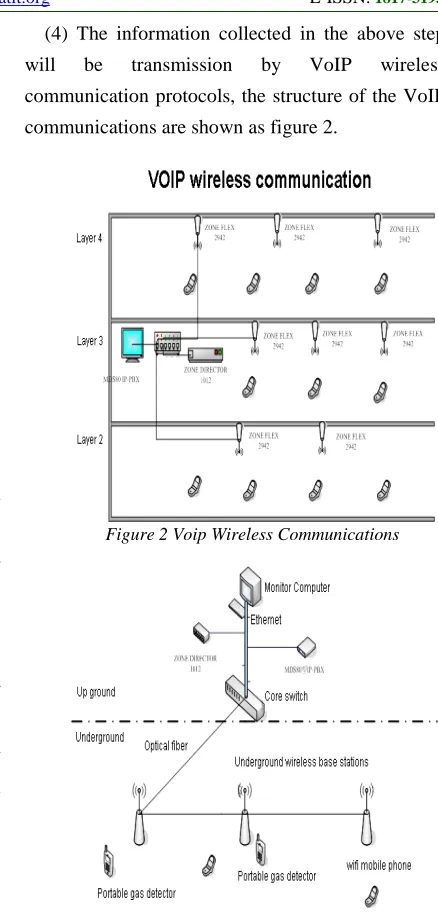
(4) The information collected in the above step
will be transmission by VoIP wireless
communication protocols, the structure of the VoIP
[image:4.612.90.293.75.279.2]communications are shown as figure 2.
Figure 2 Voip Wireless Communications
Figure 3 Wifi Gas Monitoring System
The voice image and other information will be
transmission by WIFI protocol, and the position of
the staffs can be located by WIFI system, too. The
WIFI gas monitoring system is shown as figure 3.
3.4 The Implement Of People Tracking System
The system uses indoor AP of 2942 system
produced by RUCKUS for the wireless base station,
the wireless base station underground need to cover
the targeted area of all personnel underground, for
[image:4.612.300.519.85.546.2]water storage and refuge chamber, etc. Through the
mine fiber-optic Ethernet ring, the identification
card information underground and it will be
transmitted to the ground.
Identification Card send the MAC address
information carried by itself to the wireless base
station though WIFI protocol. The base stations
transform the electrical signals into optical signals,
and send it to the ground switchers though cables.
Then the MAC address is send to the computer
through Ethernet, and handled by the software that
installed in the computer. For example, the location
software installed by Changchun Dongmei can sort
the data of persons or vehicles carrying
identification cards (TAG) out. The monitor can
display the location, residence time, action track of
the identification Card. This monitoring information
will be analyzed and stored by the data system.
4. CONCLUSION
This paper presented a research which based on
the 802.11 protocol; we have joined up a resolution
of multi-functional monitoring system which
composed of voice, image and data by using 802.11
protocols. We have introduced the application of the
gas monitoring system, the real-time data system of
gas monitoring, and the research of wireless
monitoring system.
REFERENCES:
[1].http://www.ieee802.org/11/IEEE standards
Amendments, and Recommended.
[2].http://en.wikipedia.org/wiki/Session_Initiation_Pr
otocol IETF all right received.
[3].Ti.com - Texas Instruments, Application Report,
SLLA070D–June 2002–Revised May 2010,
RS-422 and RS-485 Standards Overview and
System Configurations.
[4].http://www.ruckuswireless.com/zonedirector/
RUCKUSWIRELESS all right received.
[5].http://www.ruckuswireless.com/AP/
RUCKUSWIRELESS all right received.
[6].Guo Dongwei, Jia Chenhui. “A WSN routing
algorithm using overpayment on complex
network”.5th International Conference on
Intelligent Computation Technology and
Automation, pp.324-333, 2012.
[7].Sun Hongyu, Fang Zhiyi, Wang Tianyang, Ma
Yongbo, RenNaiji. “CDHL: A hybrid range-free
localization algorithm in wireless sensor
networks”. Proceedings - 5th International
Conference onFrontier of Computer Science and
Technology, pp180-183, 2010. [3] Fang
Zhiyi, Liu Zhuang, Ma Yongbo, Sun Hongyu,
RenNaiji. “Anew coordinate correction
localization theory and its implementation
mechanism in wireless sensor networks”.
Journal of Information and Computational
Science, Vol.8, No.1, pp.23-28, 2011.
[8].Lu Hong, Jing Yang. “An Energy-Balance
Multipath Routing based on Rumor Routing for
Wireless Sensor Networks” .Fifth International
Conference on Natural Computation,pp.
87-91,2009.
[9].Xiao-Bing Hun, Mark S. Leeson, Evor L. Hines.
“An effective genetic algorithm for network
coding”. ELSEVIER, pp.952-963, 2012.
[10].Lei, Yang,Shang,FengJun,Long, Zhaohua , Ren Yunsen. “An energy efficient
multiple-hop routing protocol for wireless
sensor networks”. Proceedings - The 1st
International Conference on Intelligent
Networks and Intelligent Systems, pp.147-150,
2008.
[11].Yang, Y., Zhong, C., Sun, Y., Yang, J. “Network
coding based reliable disjoint and braided
multipath routing for sensor networks”. Journal
of Network and Computer Applications, Vol.33,