
STUDY ON MCM TEST SCHEME USING ADAPTIVE
GENETIC ALGORITHM AND PARTICLE SWARM
OPTIMIZATION ALGORITHM
1CHEN LEI
Guilin University of Electronic Technology, P.R. China
E-mail: [email protected]
ABSTRACT
The paper presents a new interconnect test generation scheme based on adaptive genetic algorithm (AGA) and particle swarm optimization algorithm (PSO) for Multi-chip Module (MCM) applications. By combing the characteristics of interconnect test and constructing particle expression of test generation, the velocity updating equation and position updating equation of discrete PSO are presented in this paper. AGA generates the initial candidate test vectors in this scheme. In order to improve the fault coverage of the test vector, PSO is employed to evolve the candidates generated by AGA. The international standard MCM benchmark circuit was used to verify the scheme. Comparing with not only the evolutionary algorithms, but also the deterministic algorithms, simulation results demonstrate that the hybrid scheme can achieve high fault coverage, short CPU time and compact test set, which shows that it is a novel optimized method deserving research.
Keywords: Adaptive Genetic Algorithm (AGA), Particle swarm optimization (PSO), Multi-chip Module
(MCM)
1. INTRODUCTION
The development of digital integrated circuit has put forward urgent demands for test technology. The high reliability of Multi-chip Module (MCM) is due to that bare integrated circuit chips are welded and interconnected under high density and small dimension condition [1]. But it is also hard to resolve the problem of MCM interconnect test. So study on novel method of interconnect test generation to acquire better test set is significant.
Various deterministic interconnecting algorithms have been studied during recent years. We describe the performance of some representative algorithms as follows. For Counting Sequence Algorithm (CSA) [2] , log2N vectors are optimal for detecting all shorts in a circuit of N nets, while Modified Counting Sequence Algorithm (MCSA) needs
2
log (N+2)
[3] vectors for testing all faults.
In order to make the fault coverage rate equal to 100%, True/Compliment Algorithm (T/CA) generate 2log2(N+2) [4] test vectors; Walking One’s Algorithm (WOA) is a very common test approach for interconnect testing, whose test set length is N[4] .
We consider the following classes of faults in MCM interconnect test [4]:
(1) Two-Net AND-type Short. If the drivers are such that a ‘0’ dominates, then the resultant logic value is an AND of the logic values on the individual nets.
(2) Two-Net OR-type Short. If the drivers are such that a ‘1’ dominates, then the resultant logic value is an OR of the logic values on the individual nets.
(3) Single-Net Faults. These are stuck-at-one, stuck-at-zero, and open faults on single nets.
The fault model allows for single or multiple occurrences of either two-net faults and for single-net faults with deterministic behavior. The logic value on the net can also be non-deterministic or undefined. This behavior is not included in this fault model and is not considered in the remainder of this paper.
solve various optimization problems and shows great potential in practice. Now, it has been widely applied in many other areas, such as artificial neural network and fuzzy system control.
In this paper, a hybrid optimization scheme of AGA [7, 8] and PSO is presented for the MCM interconnect test generation problem. By combing the characteristics of interconnect test, this paper made the velocity-position model of discrete particles swarm optimization [9] for automatic test generation. The optimized search is guided by the swarm intelligent generated from cooperation and competition among particles of swarm. AGA generates the initial candidate test vectors by utilizing genetic operator in this scheme. The implementation methods of the objective function, selection operator, crossover operator, and mutation operator of AGA are discussed in details. Employing the velocity updating equation and position updating equation, PSO evolves these initial candidates generated by AGA. A fault simulator is employed to compute the fitness of each candidate vector. The simulation results on the international standard MCM circuit prove that the scheme is able to achieve very good performances, comparing with other algorithms.
The article is organized as follows. Section 2 is dedicated to the study of a hybrid optimization scheme for MCM test generation, which is based on the AGA and PSO. The velocity updating equation and position updating equation of PSO are then described in this section, where an AGA framework is also given in details. Section 3 provides an overview of simulation results on a set of standard test problems and comparisons of those using well-known interconnect test generation algorithms. Section 4 briefly summarizes the main results and indicates directions for further research.
2. AGA-PSO-BASED HYBRID
OPTIMIZATION SCHEME
Informally, the new optimization scheme for the MCM interconnects test generation works as follows: AGA is utilized to generate an initial population of individual test vectors for PSO, by utilizing genetic operator. After the AGA-based optimization is completed, the population provided by AGA is evolved through PSO by using the velocity updating equation and position updating equation. Each particle is evolved by employing the velocity updating equation specially presented for MCM interconnect test. By choosing the input value of each net according to a probabilistic position updating equation, it generates a complete
test vector, which is consisted of the input value (represented by binary code 0 or 1) of all nets in the tested circuit. The swarm searches for optima solution by repeating the above operation during a sufficient number of iterations. After the evolutionary operation is completed, the best individual is selected and added to the test set. Then an interconnect fault simulator is used to update the fault list of the circuit. The process is iterated until all faults are detected. The whole process of the generation scheme is illustrated in Figure1.
2.1 Adaptive Genetic Algorithm
Informally, the AGA works as follows: the algorithm begins by getting an initial population of individual test vectors, which is generated randomly in this paper. During generation of individuals, each character of a chromosome in the population is mapped to an input of a net of a circuit. The population is evolved by randomly selecting two individuals, crossing the tow individuals and mutating characters in the resulting individuals with an adaptive crossover and mutation rate. An interconnecting circuit fault simulator is used to evaluate the fitness of each candidate. After the evolutionary operation is completed, the best individual evolved is selected and added to the test vector set. At the same time, the fault simulator is employed to update the fault list and to drop the detected faults. In the following, the design of AGA for MCM test generation is described in details.
During generation of individuals, each character of a chromosome in the population is mapped to an input of a net of a circuit. So a binary code is utilized and the chromosome represents a test vector. The initial population is generated randomly. AGA is composed of populations of chromosomes and three evolutionary operators: selection, crossover and mutation. The selection scheme in the paper is binary tournament selection without replacement, where two individuals are selected by the roulette wheel approach, and the better individual is selected from the two. After two chromosomes are selected, the crossover operator is employed to generate two offspring. We use the uniform crossover scheme, where each chromosome position is crossed with an adaptive probability. As the new individuals are generated, each character is mutated with an adaptive rate. In the binary code, mutation is done by flipping a bit.
'
1 2 '
1 max ' 1 ( )( ) ( ) { (1) avg avg avg avg c c c c c
P P f f
P f f
f f
P
P f f
− − − ≥ − = <
)
2
(
)
(
)
)(
(
{
' 1 ' max ' 2 1 1 avg avg avg avgf
f
P
f
f
f
f
f
f
P
P
P
P
m m m m m<
≥
−
−
−
−
=
Where Pc1=0.9, Pc2=0.6, Pm1=0.1, Pm2=0.01.
An accurate fitness function is essential to achieve a high quality test set. The fitness of a candidate vector is a measure of the number of faults tested, which can be calculated by applying the rule given by Eq. 3.
)
3
(
_
)
(
_
fault
all
k
fault
tested
fitness
=
Where tested_fault(k) is the number of faults, which can be detected by candidate k; all_fault means the total number of faults in the tested circuit during the AGA generation process.
2.2 Particle Swarm Optimization Algorithm In the following, we discuss the velocity updating equation and position updating equation of PSO.
The velocity updating equation of PSO for interconnecting test works as follows: Once all particles have moved to their new positions, the velocities of the particles are updated according to Eq. 4.
)
4
(
2 2 1 11
w
v
c
r
pbest
c
r
gbest
v
k+=
⋅
k+
⋅
⋅
k+
⋅
⋅
where
v
k+1is the velocity of current particle, w isinertia weight which balances the global exploitation and local exploration abilities of the particles, cl and c2 are acceleration constants, rl and r2 are random values between 0 and 1, pbest is the best position found by the current particle itself, gbest represents the best position found so far by the whole swarm.
In order to avoid premature stagnation, the velocities of the particles are limited in [Vmin, Vmax]. If v is smaller than Vmin, an element of the velocity is set equal to Vmin; if v is greater than Vmax, and then set equal to Vmax.
In PSO, positions of the particles are candidate solutions to the problem, and the moves of the particles are regarded as the search process of better solutions. The position updating equation of PSO is given in Eq.5.
)
5
(
)
(
)
(
)
(
1 1 1
≤
>
=
+ + +β
β
k k k k kv
if
i
x
v
if
i
x
i
x
Where _ ( )
_
vector faul k
all faul
β = is the threshold
which determines whether or not to change the positions of the particles, vector_faul(k) is the
number of faults from net i (i∈ [1,2 …n]), n is
the total number of nets for the tested circuit; Y
N
Generate the initial test vectors by using AGA
End
Evaluate fitness of candidates utilizing fault simulator Evolve populations of candidates by usingPSO
Start
Add the best candidate into the testvector set
All faults are detected?
all_faul means the total number of faults in the
tested circuit. If
v
k+1( )
i
is bigger thanβ
,the value of No. i net will be the same; if is less thanthreshold
β
, the value of No. i net will be reversed,i.e. the input value of the net will be changed from 0 to 1 or form 1 to 0.
An accurate fitness function is essential to achieve a high quality test set. The fitness of a candidate particle is a measure of the number of faults tested, which can be calculated by applying the rule given by Eq. 6.
)
6
(
)
(
_
)
(
_
k
fault
all
k
fault
tested
fitness
=
[image:4.612.100.515.260.323.2]Where tested_fault(k) is the number of faults which can be detected by candidate particle k, all_fault(k) means the total number of faults in the tested circuit when particle k is generating a test vector. If the fitness value is better than the best fitness value pbest or gbest, the current value will be set as the new pbest or gbest.
Table 1. Comparison Of Simulation Results For MCM Benchmark Circuit
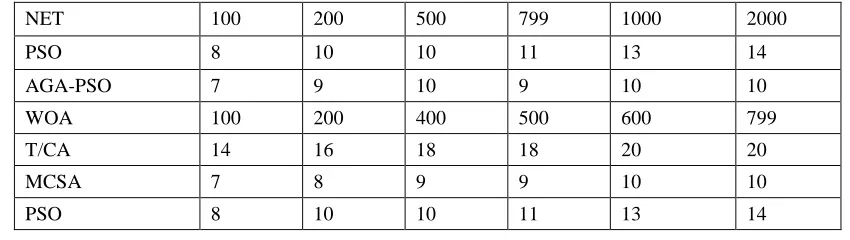
Table 2. Comparison Of Simulation Results For Different Net Number
3. SIMULATION RESULTS
The AGA-PSO-based optimization approach was implemented by using the interconnecting circuit fault simulator, which was written in C++ language. Using the ACA-SA-based test vector generator on a PIV1.6 computer with 128 MB memory, test vectors are generated for the mcc1-75 MCM interconnecting circuit provided by the MCNC group, which contains 799 nets and 320399 faults.
Given that the fault coverage rate of all algorithms is equal to 100%, results in the following tables are averaged over ten runs. In all experiments of the following sections, the parameters of PSO are set to the following values: w=0.5, rl = r2 =0.2, cl =0.3, c2 =0.7, the iteration number 10, the number of particles 8. Here we set the parameters of GA: the population size equal to 10, the number of generation 8. These values were obtained by a preliminary optimization phase, where the experimental optimal values of the
parameters were largely independent of the problem.
Test results compared with other algorithms are shown in Table 1.In the Table 1, the parameters of PSO are set the same as the AGA-PSO. The parameters of GA are set as follows. Here we set the population size equal to 20, the number of generation 20. We use a crossover rate of 0.6, a mutation of 0.01
Results in Table 1 demonstrate that test set length of AGA-PSO is only 1.4% that of WOA, 28% that of GA, 55% that of T/CA, 78% that of PSO, equal to that of MCSA. Test set length is shorter than other algorithms except for MCSA. And the execution time of AGA-PSO and MCSA is 12.0s and 9.0s respectively. The results indicate that the performance of the scheme in execution time, test set length and fault coverage is comparable to other interconnect generation algorithms.
Algorithms WOA T/CA MCSA GA PSO AGA-PSO
execution time[s] 8 5 9 24 11 12
test set length 799 20 10 39 14 10
NET 100 200 500 799 1000 2000
PSO 8 10 10 11 13 14
AGA-PSO 7 9 10 9 10 10
WOA 100 200 400 500 600 799
T/CA 14 16 18 18 20 20
MCSA 7 8 9 9 10 10
[image:4.612.99.524.355.475.2]Furthermore, tests are generated for the circuits with different net number by using different algorithms. Results in Table 2, where the fault coverage rate of all algorithms is equal to 100%, and results of all algorithms are averaged over ten runs, showing that the optimized scheme can also achieve good performances.
Therefore, comparing with other algorithms, the optimized approach based on AGA and PSO can achieve very good performances in execution time, fault coverage rate and test set length.
4. CONCLUSIONS
In this paper, a novel optimization scheme based on AGA and PSO is developed for the MCM interconnect test generation applications. AGA is utilized to generate an initial population of individual test vectors by utilizing genetic operator. Employing the velocity updating equation specially presented for MCM interconnect test, PSO evolves the candidates generated by AGA. A fault simulator is employed to compute the fitness of each candidate vector. After the AGA-PSO-based optimization is completed, the best individual is selected and added to the test set. Then the simulator is used to update the fault list of the tested circuit. The process is iterated until all faults are detected.
The international standard MCM benchmark circuit was used to verify the approach. Comparing with the other algorithms, experimental results demonstrate that the approach is able to achieve very good performances in execution time and fault coverage.
REFRENCES:
[1] Doane D A, Franzon P D., Multichip Module Technologies and Alternatives: the Basics, Brooks Publishing Company (New York, 1995), pp. 1-85.
[2] W.K.Kautz, “Testing of faults in wiring interconnects,” IEEE Transaction on Computer, Vol C-23, No.4, (1974), pp.358-363.
[3] P. Goel and M. T. McMahon, “Electronic chip-in-place test,” Proceeding of International Test Conference, (1982), pp.83-90.
[4] Najmi Jarwalw and Chi W. Yau, “A New framework for analyzing test generation and diagnosis algorithms for wiring interconnects,” Proceedings of International Test Conference, (1989), pp.63-70.
[5] J.Kennedy, R.C.Eberhart., “Particle swarm optimization,” Proceedings of IEEE International Conference on Neural Networks,
Piscataway, NJ (1995), pp. 1942-1948.
[6] Eberhart, R.C., Kennedy , “A New Optimizer Using Particles Swarm Theory,” Proceedings of the Sixth International Symposium on Micro Machine and Human Science, (Nagoya, Japan), IEEE Service Center, Piscataway, NJ (1995) , pp.39-43
[7] Srinivas M, Patnaik L.M: Adaptive probabilities of crossover and mutations in Gas. IEEE Trans. on SMC, vol. 24, No.4, (1997), p.656-667. [8] Elizabeth M.Rudnick et al, “A Genetic
Algorithm Framework for Test Generation,” IEEE Translations on Computer-aided Design of Integrated Circuits and Systems,VOL 16, (1997), pp.698-704.
![Assessment of Physiological Health Status in Relations to Different Anthropometric and Cardio respiratory Measures of Head Supported Load Carrying Male Porters of Sikkim, India [Article Retracted]](data:image/gif;base64,R0lGODlhAQABAIAAAP///wAAACH5BAEAAAAALAAAAAABAAEAAAICRAEAOw==)