USER’S AWARENESS SURVEY ON 1CITIZEN PROGRAM
IN UNIVERSITI SAINS ISLAM MALAYSIA (USIM)
1
SHAHARUDIN ISMAIL, 2ZUL HILMI ABDULLAH, 3NAJWA HAYAATI MOHD ALWI,
4
MOHD ZALISHAM JALI
1,3,4 Senior Lecturer, Faculty of Science and Technology, Universiti Sains Islam Malaysia (USIM), Bandar
Baru Nilai, 71800 Negeri Sembilan, Malaysia.
2 Lecturer, Faculty of Science and Technology, Universiti Sains Islam Malaysia (USIM), Bandar Baru
Nilai, 71800 Negeri Sembilan, Malaysia.
E-mail: [email protected] , [email protected] , [email protected] ,
ABSTRACT
The Malaysia government educates the digital etiquette among teenagers, especially the tertiary education, through a special awareness training program named 1CITIZEN Program. The main objective of the program is to foster national unity via appropriate use of technology. It inspires Netizen to become critical thinkers that understand the ethical consequences of online behavior. Universiti Sains Islam Malaysia (USIM) conducted two survey research – pre and post training sessions - among the participants of the 1CITIZEN Program of the Faculty of Science and Technology, in order to know their level of knowledge related to digital etiquette. This paper discusses the results of the survey research related to the topic of information security. Overall, the findings indicated higher percentage of the participants have either “Knowledgeable and able to clarify well” or “Competent and can put to practice fully” about the related topics in information security after attending the training program, means the participants have better knowledge of the information security compared to their previous knowledge.
Keywords: Digital Etiquette, 1CITIZEN, Netizen, Information Security, Digital Certification.
1.
INTRODUCTIONThe commercial Internet in Malaysia began in 1990. Since then, the emerging of new technology and improvement of the infrastructure had made possible the increase coverage areas and ease of access to the Internet. These factors had increased the number of Internet users in Malaysia from 13,000 in 1995 [1] to 17.7 million in 2012 [2].
Besides the availability of Internet coverage, the availability of portable devices such as smartphones and tablets enable the number of Internet users in Malaysia increases. These “easy-to-handle” portable devices target the teenagers. The country could face a digital etiquettes problem with these kind users as they lack of experiences and eager to explore and to know more.
In order to address the issues of digital etiquette among teenagers, especially the tertiary education, a special awareness training program named 1CITIZEN Program was introduced in 2011 which was a joint collaboration between the Ministry of
Higher Education (MoHE) and Prestariang Systems Sdn. Bhd. The main objective of the program is to foster national unity via appropriate use of technology. It inspires Netizen to become critical thinkers that understand the ethical consequences of online behavior. This 2-day training program help the students getting their IC CITIZEN Certification; a world class certification program in Netiquette to confirm and verify your understanding of ground rules for acceptable use in the digital world today. The program certifies knowledge and understanding of the following Values: Access, e-Literate, e-Rule, e-Safety, e-Interaction & Collaboration, e-Enterprise, e-Care and e-Accountability.
USIM conducted two (2) surveys to measure the students’ level of awareness and knowledge of information security. The surveys were done before (pre) and after (post) the training sessions and targeted 215 second year students of Faculty Science and Technology.
This paper discusses the results of the survey research related to the students’ level of awareness and knowledge of information security, including Credit Card Fraud, Cyber-Bullying, Digital Crimes, Digital Ethics, Digital Security Breaches, Personal Information Disclosure, Secure Online Transactions, and Virus and Personal Information Protection, based on their prior knowledge and knowledge acquired after completion the 1Citizan training program.
2.
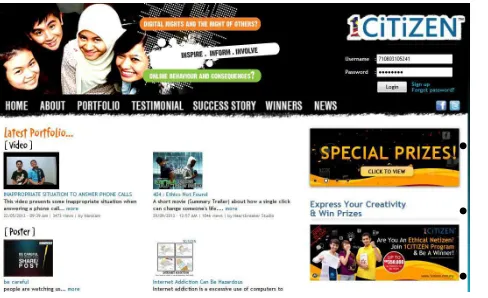
1CITIZEN PROGRAM [image:2.595.89.333.452.601.2]The 1CITIZEN Program was introduced in 2011 which was a joint collaboration between the Ministry of Higher Education (MoHE) and Prestariang Systems Sdn. Bhd. The official launch of 1CITIZEN Program was performed by Dato’ Seri Mohamed Khaled Nordin, Minister of Higher Education on 14 December 2012. The 1CITIZEN portal (Error! Reference source not found.) could be accessed at http://www.1citizen.com.my/
Figure 1 : The 1CITIZEN Portal
The main objective of the 1CITIZEN program is to foster national unity via appropriate use of technology. It inspires Netizen to become critical thinkers that understand the ethical consequences of online behavior. The program vision are [3]:
• To develop a sense of 'keNegaraan', collaboration, responsibility and ownership to the communities during their online digital experience equation.
• To promote positive messages among Youth.
• To encourage youth activism and volunteerism.
• To integrate a Malaysia-owned Globally Benchmarked and Standards for digital literacy Certification.
This 2-day training program help the students getting their IC CITIZEN Certification; a world class certification program in Netiquette to confirm and verify the students’ understanding of ground rules for acceptable use in the digital world today. The IC CITIZEN is applicable to all the internet users or Netizen [4] that is responsible for their actions and what they post online.
IC CITIZEN Certification is the first of its kind in the world that is specially developed and designed to produce digitally literate and responsible citizens. This unique yet universal certification program aims to impart Acceptable Usage Policy (AUP) that lays down rules of acceptable 'netiquette' or behavior that must be applied when operating digital devices and accessing the Internet within a society. The IC CITIZEN Certification objectives include the following [3]:
• To produce digitally literate and responsible citizens via:
o Becoming critical thinkers in analyzing
sources of information and messages as well as to evaluate what the impact can be.
o Understanding ethical consequences of
online behavior.
o Making good ethical decision of their
behaviors online.
• To prepare users for a society full of technology without misusing and abusing them.
• To globally promote 'good behavior' when communicating, foster 'unity' and 'collaborative culture' in the digital world.
• To ensure the rights to an equitable, secure and reliable access to Digital Media and Resources.
The program certifies knowledge and understanding of the following Values:
• e-Access module explores the gap between
• e-Literate module provides an introduction
to 21st century global digital technology. It explains the capabilities to use digital technology and knowing when, when not and how to use it. It stresses on the ethics, process of learning about technology and the uses of technology.
• e-Rule module will introduce and explain the details concerning cybercrimes and copyright issues and the effect they bring to people and businesses. Participants will also get to look at Data Protection legislation; what it means and how important it is in protecting your rights.
• e-Safety module guides the participants on how to protect important information from Internet threats.
• e-Interaction & Collaboration module
highlights the exchange and sharing of information using digital systems or tools. It includes humility, loyalty and respect for others when communicating. If the tools are used properly, it can foster unity. In some society, forwarding SMS or text messages and e-mails without checking its authenticity and origin is socially unacceptable. This chapter educates the participants as the Netizen to become critical thinkers in analyzing sources of information and messages as well as to evaluate what the impact can be. Therefore, it helps them to make good ethical decision of your behaviors online.
• e-Enterprise module emphasizes the
consequences of poor practices such as impulsive buying and bidding in online marketplaces.
• e-Care module will take a look at some of the most common health and safety issues and the steps that can be taken to reduce the risks. Participants will also be introduced to several terms such as ‘computer & Internet addictions’, 'ergonomics' as well as the environmental impact of using computers.
• e-Accountability module discusses the
issue of “being accountable” when using digital technologies in our everyday life. It covers the right and privileges of Net users and the behaviors that should come with them. It highlights the importance of having a sense of responsibility as a user of digital technology. This module will introduce the concept of Acceptable User Policy (AUP) in organizations and institutions.
3.
METHODOLOGYThe methodology used consists of research
design, instrumentation, data collection and analysis. It was adopted in order to achieve the stated objectives. As this research aims to investigate the information security related knowledge and awareness among students, the quantitative strategy (a questionnaire) method was used during this research.
The questionnaires were taken from the Check List of the 1CITIZEN Student Quick Reference program book. Among the 35 questions / statements from the Check List, around 11 of the questions / statements were related to the topic of information security, including Credit Card Fraud, Cyber-Bullying, Digital Crimes, Digital Ethics, Digital Security Breaches, Personal Information Disclosure, Secure Online Transactions, and Virus and Personal Information Protection, which is the interest of this paper.
3.1 Sampling and Data Collection
In survey research, the important elements are randomization and bias, and the descriptive survey method demands that the researcher select from the general population a sample population that will be both logically and statistically defensible [5]. A total of 215 second year students of Faculty Science and Technology in Universiti Sains Islam Malaysia (USIM) participated in this study.
3.2 Questionnaire Development
The questionnaires were taken from the Check List of the 1CITIZEN Student Quick Reference program book. This survey research has a total of 35 questions which are divided into Eight (8) parts according to the Values: Access (5 questions), Literate (6 questions), Rule (4 questions), e-Safety (4 questions), e-Interaction & Collaboration (4 questions), e-Enterprise (4 questions), e-Care (4 questions) and e-Accountability (4 questions) [6].
Based on the students’ prior knowledge for the Pre-survey session and based on the students’ knowledge acquired after completion the 1CITIZAN program for the Post-survey session, they indicate the scales that are most appropriate to them, in the scale provided.
The Scales are as the following: 0 - No knowledge.
1 - Limited knowledge.
4.
RESULTS AND DISCUSSIONThis paper discusses the results for the questions / statements related to the topic of information security, including Credit Card Fraud, Cyber-Bullying, Digital Crimes, Digital Ethics, Digital Security Breaches, Personal Information Disclosure, Secure Online Transactions, and Virus and Personal Information Protection.
4.1 Demographics
A total of 215 second year students participated in this survey research – 169 females and 46 males. It was found that the number of female students is larger as compared to male students due to the fact that the majority of the tertiary education students are female.
4.2 Credit Card Fraud
[image:4.595.318.494.151.291.2]Error! Reference source not found.shows the results for the question on credit card fraud. Based on the results, 184 (85 %) students are able to acquire necessary knowledge related to the definition and details of credit card fraud, and know the proper ways to protect their family and themselves from any credit card fraud.
Table 1: Understand What Credit Card Fraud Is And Know Proper Ways To Protect From The Credit Card
Fraud.
Rating Scales 1CITIZEN Program PRE POST 0 – No Knowledge 20 0 1 – Limited
Knowledge
65 31
2 – Knowledgeable and able to clarify well
95 104
3 – Competent and can put to practice fully
35 80
4.3 Cyber Bullying
[image:4.595.103.276.466.608.2]When users are using electronic means, such as e-mails and media social, to bully or harass any individuals or groups for their personal purposes, it is called Cyber-Bullying, which usually involves teenagers. Error! Reference source not found.provides the statistics for the questions / statement about the understanding of the meaning of cyber-bullying and how users should do to avoid ecoming a victim.
Table 2: What Is Cyber-Bullying And How To Avoid Becoming A Victim
Rating Scales 1CITIZEN Program PRE POST 0 – No Knowledge 4 0 1 – Limited
Knowledge
34 2
2 – Knowledgeable and able to clarify well
107 90
3 – Competent and can put to practice fully
70 123
The result also shows an increase number of students’ rating for Scale “3 - Competent and can put to practice fully” from 70 (32%) to 123 (57%). A total of 213 (99%) respondents is knowledgeable or competent in avoiding themselves from becoming a cyber-bullying victim.
4.4 Digital Crimes
Identifying various forms of digital crimes are important in order to avoid becoming a victim.
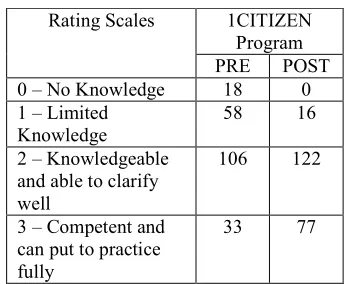
Error! Reference source not found.Error! Reference source not found.show the responses related to the questions / statements on digital crimes.
Table 3: Able To Identify Various Forms Of Digital Crimes
Rating Scales 1CITIZEN Program PRE POST 0 – No Knowledge 18 0 1 – Limited
Knowledge
58 16
2 – Knowledgeable and able to clarify well
106 122
3 – Competent and can put to practice fully
33 77
[image:4.595.319.493.485.627.2][image:5.595.103.275.183.324.2]
(11%) students rated the same scale before the training sessions.
Table 4: Fully Aware Of How Digital Crimes Can Affect Individuals And The Economy
Rating Scales 1CITIZEN Program PRE POST 0 – No Knowledge 5 0 1 – Limited
Knowledge
31 20
2 – Knowledgeable and able to clarify well
121 107
3 – Competent and can put to practice fully
58 88
4.5 Digital Ethics
[image:5.595.103.277.483.622.2]Two (2) questions related to digital ethics were included in the survey research. The first question is related to the capability to evaluate unethical digital acts and security issues that affect the security of electronic data (results in Error! Reference source not found.). The other question is about knowing what is considered as ethical and unethical uses of technology (results in Error! Reference source not found.).
Table 5: Capable To Evaluate Unethical Digital Acts
Rating Scales 1CITIZEN Program PRE POST 0 – No Knowledge 19 0 1 – Limited
Knowledge
78 26
2 – Knowledgeable and able to clarify well
101 112
3 – Competent and can put to practice fully
17 77
Table 6: Know What Is Considered As Ethical And Unethical Uses Of Technology
Rating Scales 1CITIZEN Program PRE POST 0 – No Knowledge 9 0 1 – Limited
Knowledge
39 13
2 – Knowledgeable and able to clarify
110 86
well
3 – Competent and can put to practice fully
57 116
Based on the results in Error! Reference source not found., there is drastic increase in the students’ competency related the issues of digital ethics. Students are able to describe digital ethics and its importance. This shows that the training is able to feed them with useful information as the topic was under-taught subject in schools. New technologies bring about the need to interpret old values in new ways, but also may call for the creation of new codes of conduct when new actions are made possible with the use of technology. Several ethical codes dealing with technology use exist and many schools have adopted Acceptable Use Policies that include rules for the proper use of information technologies. Teachers, students, and parents need to know and understand these codes.
4.6 Digital Ethics
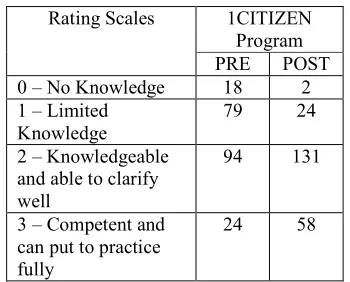
The ability to identify different forms of digital security breaches, such as cyber-stalking and Internet Predator, are vital in preventing and taking necessary precautions against the breaches. The students’ knowledge on this issue can be seen in
[image:5.595.319.494.485.626.2]Error! Reference source not found.
Table 7: Able To Describe Different Forms Of Digital Security Breaches And Take Necessary Precautions
Against Them
Rating Scales 1CITIZEN Program PRE POST 0 – No Knowledge 18 2 1 – Limited
Knowledge
79 24
2 – Knowledgeable and able to clarify well
94 131
3 – Competent and can put to practice fully
24 58
There are two (2) students responded as “0 – No Knowledge” which may be the student's absence or lack of intention or interest during training sessions, or they unable to understand the new terms of digital security.
4.7 Personal Information Disclosure
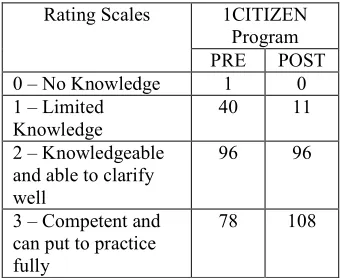
[image:6.595.104.275.285.425.2]This question / statement asks the students to rate their understanding of the proper ways to disclose their personal information to others on the Internet. The responses are in 0
Table 8: Understand How To Disclose Personal Information On The Internet
Rating Scales 1CITIZEN Program PRE POST 0 – No Knowledge 1 0 1 – Limited
Knowledge
40 11
2 – Knowledgeable and able to clarify well
96 96
3 – Competent and can put to practice fully
78 108
There are an increase number of students’ rating for Scale “3 - Competent and can put to practice fully” from 78 (36%) to 108 (50%). This shows the training benefits the students in understanding about the proper ways to disclose their personal information to others on the Internet.
4.8 Virus and Personal Information Protection
Computer viruses or malware are a major threat to our computer systems. The capability to update the virus protection software is significant in protecting personal information. Error! Reference
source not found.shows the results for the
questions / statement related to the students’ capability to update virus protection software and protect their personal information.
Table 9: Able To Update Virus Protection Software And Protect Personal Information
Rating Scales 1CITIZEN Program PRE POST 0 – No Knowledge 20 2 1 – Limited
Knowledge
60 31
2 – Knowledgeable and able to clarify
94 110
well
3 – Competent and can put to practice fully
41 72
Based on the results in Error! Reference source not found., majority of students are able to acquire necessary knowledge related to updating their virus protection software and protect their personal information.
Two (2) students responded as “0 – No Knowledge” which may be the student's absence or lack of intention or interest during training sessions, or they unable to understand the new terms of in information security.
4.9 Secure Online Transactions
[image:6.595.318.495.465.605.2]Two (2) questions related to secure online transactions were identified in the set of survey research. The first question is “I know how to determine a secure website for my online transaction activity,” (results in Error! Reference source not found.). The other question is “I know how to keep all my transaction details safe from identity theft,” (results in Error! Reference source not found.).
Table 10: Able To Determine A Secure Websites For Online Transaction Activity
Rating Scales 1CITIZEN Program PRE POST 0 – No Knowledge 13 0 1 – Limited
Knowledge
65 19
2 – Knowledgeable and able to clarify well
100 103
3 – Competent and can put to practice fully
37 93
Table 11: Know How To Keep Online Transaction Safe From Identity Theft
Rating Scales 1CITIZEN Program PRE POST 0 – No Knowledge 9 0 1 – Limited
Knowledge
65 23
2 – Knowledgeable and able to clarify well
3 – Competent and can put to practice fully
37 96
Based on the results above, students have better knowledge on the importance of secure online transactions
.
5.
CONCLUSIONThe Malaysia government educates the digital etiquette among teenagers, especially the tertiary education, through a special awareness training program named 1CITIZEN Program. The main objective of the program is to foster national unity via appropriate use of technology. It inspires Netizen to become critical thinkers that understand the ethical consequences of online behavior. This 2-day training program helps the students getting their IC CITIZEN Certification, which certifies knowledge and understanding of the following Values: Access, Literate, Rule, Safety, e-Interaction & Collaboration, e-Enterprise, e-Care and e-Accountability. Universiti Sains Islam Malaysia (USIM), two surveys were conducted – pre and post training sessions - among the participants of 215 second year students of Faculty Science and Technology, in order to know their level of knowledge related to digital etiquette. Among the 35 questions given, 11 of the questions were related to the topic of information security - including Credit Card Fraud, Cyber-Bullying, Digital Crimes, Digital Ethics, Digital Security Breaches, Personal Information Disclosure, Secure Online Transactions, and Virus and Personal Information Protection. From the survey research results, the findings indicated higher percentage of the participants have either knowledgeable or competent about the information security issues after attending the training program, means the participants have better knowledge of the information security compared to their previous knowledge. This shows that the training could improve the participants' knowledge and capability related to information security topics and issues.
6.
ACKNOWLEDGEMENTAuthors of this paper would like to thank all participants who participated and contributed to the findings. This work is funded by USIM under the internal research grant ‘USIM Short Term Grant – PPP/USG-0114/FST/30/10214’
Thanks also to the Government of Malaysia through the Ministry of Education (formerly known as Ministry of Higher Education (MoHE)) for sponsoring the 1Citizen Certification Program in
USIM, and Prestariang Systems Sdn. Bhd. for providing the 1Citizen Certification Program materials and the set of Check List questionnaire for the survey research.
REFRENCES:
[1] T. N. Joorabchi, M. S. H. Hassan, and M. N. Osman, “Relationship between Internet Usage and Positive Youth Development in Malaysia,” Journal of the South East Asia Research Centre for Communication and Humanities, vol. 5 no. 2, 2013, pp. 37-49.
[2] “Internet Users in 2012”. International Telecommunication Union (ITU). www.itu.org
[3] 1Citizen Certification Program.
http://www.1citizen.com.my
[4] M. Hauben. The Net and Netizens: The Impact the Net has on People’s Lives. pp. 1-20 IN M. HAUBEN. Netizens: On the History and Impact of Usenet and the Internet. Los Alamitos, CA: IEEE Computer Society, 1997. [5] P. D. Leedy,). Practical Research: Planning and
Design, Prentice-Hall: New Jersey. 1997. [6] Prestariang Systems. 1Citizen Student Quick