DEVELOPMENT AND VALIDATION OF A
QUESTIONNAIRE TO MEASURE GAME INTERFACE
PREFERENCES BASED ON CULTURAL VALUES
1RATNA ZUARNI RAMLI, 2NOR AZAN MAT ZIN, 3NORAIDAH SAHARI @ASHAARI,
4
SALYANI OSMAN
1 Faculty of Science Computer and Mathematics, UiTM, Malaysia 2Assoc. Prof., Faculty of Information Science and Technology, UKM, Malaysia 3
Assoc. Prof., Faculty of Information Science and Technology, UKM, Malaysia
4
Faculty of Information Science and Technology, UKM, Malaysia
E-mail: [email protected],[email protected], [email protected], [email protected]
ABSTRACT
Culture is a mental model that governs how people act and believe. Individuals with different cultures may have different perceptions about the same object. A general or standard design does not address different perceptions of different players when it comes to the design of a game interface and this may compromise the game intuitiveness or its natural feel. Hence, to address this issue, a model for a game interface with cultural values is proposed, based on past studies. The model consists of space and layout, menu buttons and dialogue or language, and three cultural elements – IDV, UAI and context. To verify the model, a valid and reliable instrument was developed. This paper discusses the development and validation of the instrument which is a questionnaire, to validate the proposed game interface with cultural values model. To validate the questionnaire, a structured interview involving four panels of experts in culture and human computer interaction (HCI) was conducted. Some changes to the questionnaire were subsequently made based on comments from the panels. Face and content validation was done using a focus group consisting of five avid game players. Finally, a pilot study using purposive sampling of 52 respondents was carried out. The calculated reliability value, α = 0.955.The final version of the questionnaire was then validated by all panel members and thus deemed suitable for model verification.
Keyword:Game Interface; Questionnaire Validation; VSM94; High Context
1. INTRODUCTION
Game interface is one of the most important elements of game design. A good game interface design should cater to players’ perception and preference of how a good game design should be. To do this, the designer needs to have a comprehensive understanding of their target players, particularly the players’ own cultural values which frequently influenced their perception and preference (Biljon & Kotzé, 2008).
Cultural values are a huge concern among researchers. There are various theories of culture but one of the most popular theories, connected to computer science discipline, is Hofstede’s theory. Hofstede constructed the Hofstede Cultural Dimension in the 1980s, integrating a few elements of cultural values including uncertainty avoidance
index (UAI) and individualistic(IDV) elements (Hofstede, 1983). A culture with a high value of IDV means the particular group has a loosely knit social framework. A high value of UAI indicates that people in this culture have very low tolerance for high-risk situations. Another theory of culture widely employed in computer science discipline is Hall’s theory, which is context with two conditions; high and low. These two conditions can be determined by differentiating some factors, for example the emotion stemming from close relationships, directness of message, and nonverbal language. A high context (HC) value may point to an emotionally charged social relationship. People in this culture usually use indirect messages (Hall & Hall, 2001).
websites, interactive multimedia and electronic advertisements. Apparently, there are differences in terms of design for specific cultures. For example,the Chinese have a high context cultural value and prefer to have a complex website interface with a lot of information whilst the British have a low context cultural value and prefer having a simple website interface with minimal information. However, the influence of cultural values, specifically on the design of game interface, is yet to be discovered.
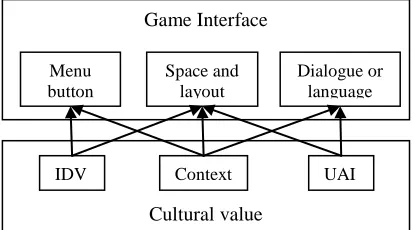
[image:2.612.91.298.541.656.2]In this research, three elements of game interface are selected; design of space and layout, menu button and dialogue or language. Space and layout is the arrangement of objects on the interface. The menu buttons are navigation keys that can be found at the initial interface pages where players start to play the game and appear throughout the process of playing. Dialogue or language is a form of interaction messages between characters in a game or between players and the game or displayed just for plain information. Based on previous researches, the design of space and layout is influenced by UAI, IDV and context cultural values (De-Angeli, 2009; R. Juric, I. Kim, & J. Kuljis, 2003; Radmila Juric, Inhwa Kim, & Jasna Kuljis, 2003; Marcus, Krishnamurthi, & Aykin, 2009; Omoush, Saleh, Yaseen, & Atwah Almaaitah, 2012; Sun, 2001). The design of menu buttonsis influenced by IDV and context cultural value and the design of dialogue or language is influenced by context and UAI cultural values (Alcantara-Pilar, Del Barrio-Garcia, & Porcu, 2013; Evers & Day, 1997; Khanum, Fatima, & Chaurasia, 2012; Kim, Coyle, & Gould, 2009; Singh, Kumar, & Baack, 2005). Figure 1 shows the model of a game interface with cultural values.
Figure 1: Game Interface Model With Cultural Values
A questionnaire is constructed to identify player preferences, for the purpose of verifying the model in Figure 1. A good questionnaire is required in order to get a reliable response from players. This
paper discusses the development and validation of the questionnaire before it is used to validate the model.
2. METHOD
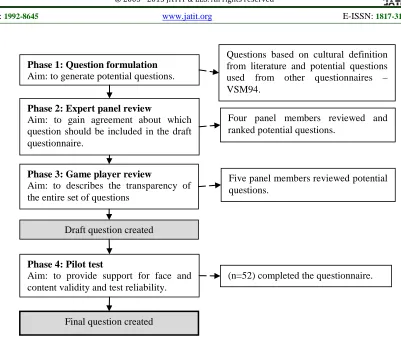
There are four phases in the development and validation of a questionnaire. The first phase is question formulation. According to Brockmyer et al. (2009) and Bargas-Avila, Lotscher, Orsini, & Opwis(2009), formulation of questionnaires can be done by adapting a validated culture questionnaire, in this case the Model Value Survey (VSM94), and input from past studies. Next is to gain approval from selected experts; their reviews on formulated questions are required (Spector, 2013). In the third phase, a focus group method is executed, which involves five players describing their understanding of the questions. Then, in the final phase, a pilot survey is carried out to measure the reliability of the questionnaire. Figure 2 illustrates this process of questionnaire development.
2.1 Development Of Questionnaire
VSM94 consist of 26 validated items designed to compare the value of a country's culture with another(Hofstede, 1994). It consists of five constructs, which are power distance index (PDI), masculinity(MAS), IDV, UAI and long-term orientation (LTO). Since, only two of Hofstede culture elements - UAI and IDV are employed in this research, VSM94 is filtered to include only these elements. Three UAI questions have been repeated twice for space and layout, and dialogue or language categories. Two IDV questions have been repeated twice for space and layout, and menu button categories. As a result, a total of eight questions were adapted from VSM94. Other than the VSM94 study, previous researches to discover the influence of culture on the design of space layout, menu button and dialogue or language in a different medium were also referred. Twelve questions were adapted and added to the questionnaire. Respondents were required to answer using the 10-point Likert scale ranging from 1, for strongly disagree, until 10, for strongly agree.
The final set of items in phase one consists of 20 questions in total. Seven questions target design of space and layout, eight questionsfocus on design of menu button and five questions concentrate on design of dialogue or language. This questionnaire then undergoes the validation process in the next phase.
Game Interface
Cultural value
Space and layout
Dialogue or language Menu
button
2.2 Validation Process
The validation process started in phase two where four panels of experts were selected based on their experience in culture and HCI. An invitation email was sent to all four experts to invite them to participate in the validation process. As soon as their acceptance was received, the set of newly formulated questionnaire, VSM94 and references from past studies were sent to them through email. Original questions from VSM94 and input from past studies are put in a table format for ease of reference. The new questionnaire was placed in another table. Both tables were given to the four experts so they can rank each question; whether it suits the meaning of culture and HCI theories or not by using a 10-point Likert scale. The experts were given ample time to read and rank the items in the questionnaire. Then, an appointment for an interview session was arranged. The interview session took approximately 30 to 60 minutes where experts were requested to give further comments for each item. Items ranked less than five needs to be rephrased based on experts’ comments or may be dropped altogether if it is deemed not suitable. Feedback from the first round of interviews was considered and the questionnaire is revised accordingly. The revised questionnaire was then forwarded again to the same experts for the next round of ranking until all experts fully agreed with the items in the questionnaire. In this studies, two rounds of interview sessions was conducted and an agreement from all panels is achieved.
In the third phase, a focus group that consists of five players is conducted. The purpose of this method is to get the players’ perceptions and opinions on the modified questionnaire. They are required to express their understanding of every question. Whenever a question is difficult to understand, it was revised and rephrased.
A pilot study is then conducted in the final phase of the validation process. The purpose of the pilot study is to measure the reliability of the questionnaire. The respondents were asked to rate the questionnaire using a 10-point Likert scale, 1- for strongly disagree to 10- for strongly agree. The questionnaire was distributed online to 62 targeted respondents. Respondents submitted their feedbacks voluntarily.
3. RESULTS AND DISCUSSION
The final set of questionnaire contains 31 questions, 20 questions of game interface design preferences based on cultural values and an
addition of 11 demographic questions. Some changes have been made throughout the process of validation. Out of 20 questions on game interface design preferences based on cultural values, panel expert 1, who is an expert in culture discipline, ranked only one question with five points, one question with six points and the remaining 18 questions with seven, eight and nine points. The question ranked five points is a question on design of menu button with IDV cultural value. Panel expert 1 commented that the question does not really reflect the meaning of IDV. However after some explanation and discussion, expert panel 1 agreed with the question and suggests attaching a picture with the question so that it will be easier to understand. The question that has been ranked six points is a question in design of space and layout category with a high context cultural value.
Two sets of questionnaires were given to panel expert 2. One set is the initial formulated questionnaire and the other one is the modified questionnaire based on comments from panel expert 1. Expert panel 2, who has knowledge in culture theories and computer science, prefers to comment and rephrase the questions before giving points. Therefore, some questions were redefined and changed based on comments of panel expert 2. Panel expert 2 suggested initiating questions with the phrase “I like or I prefer” rather than using phrase “Player prefers or player likes”.The modified version of the draft questionnaire was then forwarded to panel expert3 and 4, who are both HCI experts. They were requested to give comments from an HCI point of view. Both experts were interviewed consecutively. This resulted in minor modifications to the questionnaire. A second interview session with panel expert 1, 2, 3 and 4 was arranged. However for the second round,only panel expert 1 and 4 were available to be interviewed face to face. Panel expert 2 and 3, on the other hand, agreed to give responses through email. This second round resulted in positive feedback from all panel experts and the questionnaire was then finalized. For phase three, all five avid players gave very good feedback for all 31 questions.
considered real gamers, only responses from respondents that play computer games 7 times or more per week; 52 respondents were calculated. Based on the reliability test, the value of Cronbach alpha for overall questions is 0.955. This value indicates that the reliability of this questionnaire is very high.
4. CONCLUSION
The chosen method of development for this questionnaire, has been detailed in this paper, gives a strong foundation for the validity and initial reliability of the questionnaire. Duration of the whole process is approximately 23 weeks. The validated questionnaire is in Malay language. The feedback given by the experts help in producing a valid set of a game interface questionnaire with cultural value. Basically, the questionnaire is used to verify the model of game interface with cultural value as shown in Figure 1. Based on the result of the pilot study, the influence of cultural value is highly significant to the design of space and layout, menu button and dialogue or language. Previously, a set of questionnaire to identify game players’ preferences in graphic and animation based on their cultural values has been developed and validated. In future study, both questionnaires will be combined and a purposive sample of players using this validated questionnaire will be conducted to verify the proposed model.
ACKNOWLEDGMENT
This research is funded by UniversitiKebangsaan Malaysia under the research grant, UKM-GUP-2011-236.
REFERENCES
[1]. Alcantara-Pilar, J. M., Del Barrio-Garcia, S., & Porcu, L. (2013). A cross-cultural analysis of the effect of language on perceived risk online. Computers in Human Behavior, 29(3), 596-603.
[2]. Bargas-Avila, J. A., Lotscher, J., Orsini, S., & Opwis, K. (2009). Intranet satisfaction questionnaire: Development and validationof a questionnaire to measure user satisfaction with the Intranet. Computers in Human Behavior, 25(6), 1241-1250.
[3]. Biljon, J. v., & Kotzé, P. (2008). Cultural Factors in a Mobile Phone Adoption and Usage Model. Journal of Universal Computer Science, 2650-2679.
[4]. Brockmyer, J. H., Fox, C. M., Curtiss, K. A., McBroom, E., Burkhart, K. M., & Pidruzny, J. N. (2009). The development of the Game Engagement Questionnaire: A measure of engagement in video game-playing. Journal of Experimental Social Psychology, 45(4), 624-634.
[5]. De-Angeli, A. (2009). Cultural variations in virtual spaces design. AI & Society, 24(3), 213-223.
[6]. Evers, V., & Day, D. (1997). The Role of Culture in Interface Acceptance. Paper presented at the Human Computer Interaction, Interact’97., London.
[7]. Hall, E. T., & Hall, M. R. (2001). Key concepts: Underlying structures of culture. International HRM: Managing Diversity in the Workplace, 24-40.
[8]. Hofstede, G. (1983). National Cultures in Four Dimensions: A Research-based Theory on Cultural Differences among Nation. International Studies of Management & Organization, 8(1-2), 46-74.
[9]. Hofstede, G. (1994). Values survey module 1994 questionnaire (VSM 94). Institute for Research on Intercultural Cooperation (IRIC), Tilburg, Netherlands.
[10]. Juric, R., Kim, I., & Kuljis, J. (2003). Cross cultural web design: an experiences of developing Uk and Korean cultural markers. Paper presented at the Information Technology Interfaces, 2003. ITI 2003. Proceedings of the 25th International Conference on. IEEE, 2003., SALAH.
[11]. Juric, R., Kim, I., & Kuljis, J. (2003). Cross cultural web design: an experiences of developing UK and Korean cultural markers. Paper presented at the Information Technology Interfaces, 2003. ITI 2003. Proceedings of the 25th International Conference on.
[12]. Khanum, M. A., Fatima, S., & Chaurasia, M. A. (2012). Arabic Interface Analysis Based on Cultural Markers.
[14]. Marcus, A., Krishnamurthi, N., & Aykin, N. (2009). Cross-Cultural Analysis of Social Network Services in Japan, Korea, and the USA Internationalization, Design and Global Development, 5623, 59-68.
[15]. Omoush, A., Saleh, K., Yaseen, S. G., & Atwah Almaaitah, M. (2012). The impact of Arab cultural values on online social networking: The case of Facebook. Computers in Human Behavior, 28(6), 2387-2399.
[16]. Singh, N., Kumar, V., & Baack, D. (2005). Adaptation of cultural content: evidence from B2C e-commerce firms. European Journal of Marketing, 39(1/2), 71-86.
[17]. Spector, P. E. (2013). Survey design and measure development. In T. D. Little (Ed.), The Oxford Handbook of Quantitative Methods in Psychology (Vol. 1, pp. 170).
Figure 2: Questionnaire Development Process Phase 1: Question formulation
Aim: to generate potential questions.
Questions based on cultural definition from literature and potential questions used from other questionnaires – VSM94.
Phase 2: Expert panel review
Aim: to gain agreement about which question should be included in the draft questionnaire.
Four panel members reviewed and ranked potential questions.
Phase 3: Game player review
Aim: to describes the transparency of the entire set of questions
Five panel members reviewed potential questions.
Draft question created
Phase 4: Pilot test
Aim: to provide support for face and content validity and test reliability.
Final question created