http://dx.doi.org/10.4236/jis.2016.73007
Trusted Heartbeat Framework for Cloud
Computing
Dipen Contractor1, Dhiren Patel1, Shreya Patel2
1Department of Computer Engineering, NIT, Surat, India 2Department of Computer Engineering, CKPCET, Surat, India
Received 26 November 2015; accepted 29 March 2016; published 1 April 2016
Copyright © 2016 by authors and Scientific Research Publishing Inc.
This work is licensed under the Creative Commons Attribution International License (CC BY).
http://creativecommons.org/licenses/by/4.0/
Abstract
In cloud computing environment, as the infrastructure not owned by users, it is desirable that its security and integrity must be protected and verified time to time. In Hadoop based scalable computing setup, malfunctioning nodes generate wrong output during the run time. To detect such nodes, we create collaborative network between worker node (i.e. data node of Hadoop) and Master node (i.e. name node of Hadoop) with the help of trusted heartbeat framework (THF). We propose procedures to register node and to alter status of node based on reputation provided by other co-worker nodes.
Keywords
Trusted Heartbeat, Cloud Computing, Hadoop Framework, Reputation, Attestation
1. Introduction
Outsourcing computation to cloud can reduce IT expenditure spent by companies. Still, most of them are not willing to do so, due to security concerns with cloud computing environment and services. As per survey [1], it is found that despite of huge benefits, fear is still there about security threats like loss of control of data and in-tegrity of systems. Computing nodes (virtual machines) can be tampered with or ill configured to produce wrong results. E.g. Assigned Hadoop task (related to financial data consolidations) may generate incorrect result due to few malfunctioning nodes [2]. Due the large size of data and its processing, the error is very hard to identify in collective results, and it may result in huge loss.
Malfunctioning Nodes and Infrastructure Attacks
(TPM) [7] has been gaining attestion from industry as well as acadamic. Hardware manufacturer is also participating to accelerate the adoption of TC across varios platform.
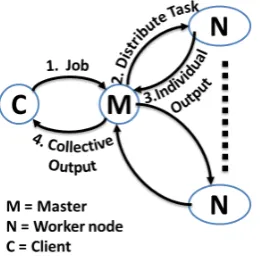
We consider a cloud system, which takes a user task, distributes among computing nodes, and gathers its output as shown in Figure 1. We propose a framework for integrity verification of cloud. We use three proce- dure viz: for registration, for verification and for detection of virtual machine. TPM based node registration process will initially establish trust. Attested heartbeat procedure periodically verifies the trustworthiness of every node in the system. Tampered or misconfigured nodes can be identified quickly by reputation based decision procedure.
Rest of the paper is organized as follows: In Section 2, we discuss background and related work on Heartbeats and TPM. In section 3, we propose the Trusted Heartbeat infrastructure. Section 4 shows usage model of proposed framework with conclusion and references at the end.
2. Background and Related Work
2.1. HadoopApache Hadoop [8] is framework that facilitates the data intensive distributed processing of massive data sets across clusters machines. It supports extension of processes from a single to thousands of machines. Designed with a fundamental assumption that hardware failure is common, making it the software’s responsibility to identify and handle failures at the application layer. It replicates data across multiple nodes with rapid data transfer facility. Hadoop implementation essentially consists of two major components: (i) Hadoop Distributed File System (HDFS) [9]: A file system that manages all the nodes in a cluster for data storage, and (ii) Map- Reduce [10]: The framework that allocate work to nodes in a cluster. Hadoop Cluster can be designed in various ways. One of which includes a single master and multiple worker nodes. The master node consists of a Job- Tracker, TaskTracker, NameNode and DataNode. A worker node acts as both a DataNode and TaskTracker, it depends on avalability of physical or virtual resources (Figure 2).
2.2. Heartbeat in Hadoop Environment
[image:2.595.251.383.572.701.2]Heartbeat [11] is a communication mechanism that provides a efficient; yet simple way for a Hadoop system to monitor performance and make that information available to external observers. Applications can use heartbeat
Figure 2. Hadoop cluster adopted from [10].
information to automatically add or subtract resources from their pool. HDFS replicates file blocks for fault to-lerance. An application can specify the number of replicas of a file at the time it is created. The NameNode makes all decisions concerning block replication. Each DataNode sends heartbeat messages timely to its Na-meNode, so the later can identify loss of connectivity if it stops receiving these messages. The NameNode marks such node as dead DataNode (not responding to heartbeats) and desists from sending requests to it. Data stored on such node is no longer available to a client (Figure 3).
2.3. Trusted Platform Module (TPM)
The trusted computing group consortium has developed specifications for the trusted platform module. The TPM is a special purpose microcontroller on a motherboard. By incorporating a physical facility for secure gen-eration and storage of cryptographic keys, the TPM becomes the core supporter for creating an interoperable “trusted computing” environment. These capabilities that every TPM provides include hashing by SHA-1 rith, random number generation, asymmetric key generation as well as encryption and decryption by RSA algo-rithm. Following in Table 1; is the list of different types of keys can be created with TPM with their properties.
Integrity verification of the software components to support mitigation of security concerns related to cloud computing infrastructure. Though, it does not actually provide absolute assurance, trusted computing improves the complexity for attackers by operating at hardware level. With a correct implementation, an attacker would need physical access to the hardware in order to subvert the TPM [13]. In our proposed work, we use TPM to prevent Man-In-The-Middle attack and verify the integrity of Virtual machine via attestation.
2.4. Related Work
Figure 3. Heartbeat in Hadoop environment adopted from [12].
Table 1. TPM Key types with their pupose [7].
Key Name Purpose
Endorsement Key (EK) A key-pair based on RSA algorithm; imposed by TPM manufacturer to identify uniquely TPM.
Storage Root Key (SRK) A non-transferable key generated by the platform owner to serve as the root key in the hierarchy of keys associated with the TPM.
Attestation Identity Key (AIK) Used for attestation and identification of a TPM (identity certificate by signing public key part of AIK. i.e. activated mode). Trusted third party can create
Signing Key Used by the system to sign messages.
Storage Key Used to encrypt and decrypt other keys. (using RSA)
Identity Key Used for operations that requires TPM identity.
Binding Key Used for Unbind operations to decrypt a data.
We propose a scheme to determine whether a particular VM is trustworthy or not. Only attested and trusted VMs can get the tasks and collaborate in network. Negative reputation is assigned if node does not generate output (or produce malicious output).
3. Trusted Heartbeat Framework
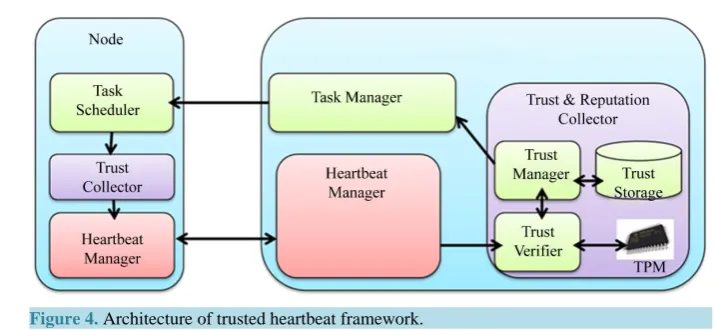
In this framework, we assume TPM communication cannot temper, and storage is not exposed. The main inten-tion of TPM is to repel most of the attacks on the software, we presume that trusted platform can assess each and every software module loaded on platform in terms of hash code [7]. In addition, we assume Master node works as a trusted party which performs attestations as suggested by TC [21]. For better understanding of our frame-work, we denote job tracker as a master node and task tracker as simple node. Proposed framework is as shown in Figure 4. The Task scheduler present at every node executes tasks assign to them. Trust collector is attached to each node to manage assessments and support the attestation service. In master node, the task scheduler dep-loys jobs to nodes and collects their outcomes. Task manager stores node information and their assign task in-formation. In addition, trust and reputation collector manages the trust information of nodes, and Trust Verifier performs attestations to them. The collected security properties (Endorsement Key and Attestation Identity Key) are stored in the Trust storage.
Figure 4. Architecture of trusted heartbeat framework.
(a) Initial Node Registration
Initially, when a data node joins a network, node registration takes place. It identifies a genuineness of TPM and exchanges keys for sealing and binding operations. The genuineness of TPM is identified by its public EK key.
Every time a worker node initiate connection request to the master node, an initial attestation procedure will be executed by master node. Verifier has collected all the properties of each node whose information is stored at the storage. Therefore, only registered node with allowed properties will be included to the list of the task Man-ager (for completing tasks). TC credentials and public session keys are stored at trust storage.
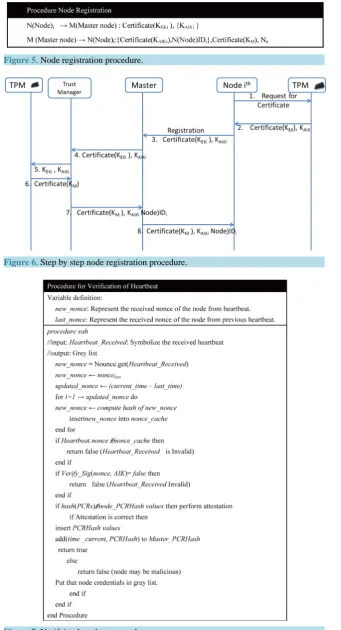
In Trusted Heartbeat framework, every node (N) is identified with its corresponding and unique AIK, and the Master (M) facilitates as the Privacy-CA defined by TC infrastructure [22], for registering and identifying all these AIKs. Whenever a new node is included to the Hadoop based cloud system, it is first get registered at the Master and assigned with AIK key credentials. Figure 5 shows steps for node registration. As suggested earlier, only registered node can communicate with master and can get tasks with genuine TC credentials. Node regis-tration procedure is more elaborated in Figure 6. In our Trusted Heartbeat framework implementation, the Trust & Reputation Collector is added to Master node and Trust collector to every node. Their exchanged messages are incorporated into the heartbeat protocol via Heartbeat manager. To simplify our protocol, we assign ma-nually AIK credentials to node.
Time to time collector and trust storage updates the nonce information, and initiate the attestation procedure by invoking the TPM Quote from TPM instruction with the fresh nonce. As shown in Figure 9(a), latest gener-ated nonce and reputation is then added to the request and sent to the Master. The verifier collects and maintains the public credentials of individual nodes. When a request in heartbeat message; with genuine AIK credentials is received, verifier will first perform verification followed by registration of that node. The properties indicated from the worker node’s Stored Message Logs (SML) are inspected with security policies which are defined ear-lier and stored in Trust storage (shown in Figure 9(c)), and only the expected worker node can be added in fu-ture. As shown in node registration procedure (Figure 6), Trust verifier maintains nonce information in a cache (i.e. for faster execution) and revise cache value by execution the SHA-1 hash operation to get the new value. Time interval between each received messages and the stored information of the cache together determines the longer time for a heartbeat to be valid (Figure 7).
(b) Verification of Heartbeats
Figure 6. Step by step node registration procedure.
[image:6.595.185.460.333.710.2](c) Reputation based detection
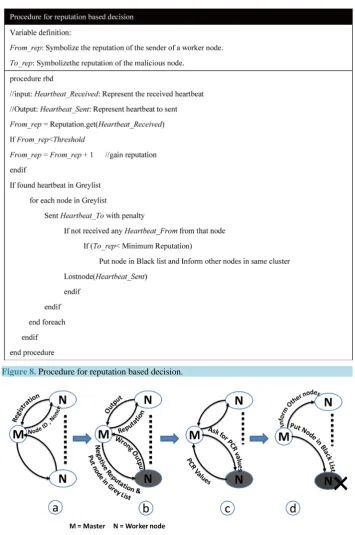
[image:7.595.135.491.172.708.2]Reputations are gathered with each Heartbeat message received from Master. Calculated reputations, which are lower than a pre-defined threshold, master node, will unregister that node or mark it as a lost one. The thre-shold value can be computed based on the number of nodes and previously stored information available at trust storage. The Black list is one that contains a list of all such failed nodes. Similarly, Gray list is one that contains a probable list of nodes that have faced some decrements in reputations (Figure 8). Every susceptible node comes in Graylist first and then after inactivity it will be in Blacklist (shown in Figure 9(d)). Since reputations
Figure 8. Procedure for reputation based decision.
In this paper, we propose Trusted Heartbeat framework; that creates a collaborative network among virtual ma-chines. With remote attestations and heartbeat messages, a Master node can define the exact status (working or malfunctioning) of its nodes. This proposed framework identifies the genuine worker node using trusted compu-ting facilities. Heartbeat interval time is very important parameter in our system. Trust and reputation based de-tector improve Hadoop like distributed systems in detecting malicious nodes quickly. This framework shows utilization of common messages to establish trust among all the corresponding nodes in distributed environment.
References
[1] (2012) What’s Holding Back the Cloud.
http://www.intel.in/content/dam/www/public/us/en/documents/reports/whats-holding-back-the-cloud-peer-research-rep ort2.pdf
[2] Khan, S.M. and Hamlen, K.W. (2012) Hatman: Intra-Cloud Trust Management for Hadoop. CLOUD’12: Proceedings of 5th International Conference on Cloud Computing, Honolulu, 24-29 June 2012, 494-501.
http://dx.doi.org/10.1109/cloud.2012.64
[3] Feng, J., Chen, Y., Ku, W. and Liu, P. (2010) Analysis of Integrity Vulnerabilities and a Non-Repudiation Protocol for Cloud Data Storage Platforms. ICPPW’10: Proceedings of 39th International Conference on Parallel Processing Workshops, San Diego, 13-16 September 2010, 1-8. http://dx.doi.org/10.1109/icppw.2010.42
[4] Sujitha, G., Varadharajan, M., Rao, Y.V., Sridev, R., Gauthaum, M.K.S., Narayanan, S., Raja, R.S. and Shalinie, S.M. (2013) Improving Security of Parallel Algorithm Using Key Encryption Technique. Information Technology Journal,
12, 2398. http://dx.doi.org/10.3923/itj.2013.2398.2404
[5] Contractor, D. and Patel, D. (2012) Trust Management Framework for Attenuation of Application Layer DDoS Attack in Cloud Computing. IFIPTM 2012:6th IFIP WG 11.11 International Conference on Trust Management, 374, 201- 208. http://dx.doi.org/10.1007/978-3-642-29852-3_14
[6] Futral, W. and Greene, J. (2013) Introduction to Trust and Intel Trusted Execution Technology. Intel Trusted Execution Technology for Server Platforms, 1-14.
[7] TPM Software Stack (TSS) Specification, Version 1.2.
http://www.trustedcomputinggroup.org/resources/tcg_software_stack_specification_tss_12_faq
[8] White, T. (2012) Hadoop: The Definitive Guide. O’Reilly.
[9] Dean, J. and Ghemawat, S. (2008) MapReduce: Simplified Data Processing on Large Clusters. Communications of the ACM, 51, 107-113. http://dx.doi.org/10.1145/1327452.1327492
[10] Borthakur, D. (2007) The Hadoop Distributed File System: Architecture and Design.In hadoop.apache.org, 2007. http://hadoop.apache.org/docs/r0.18.0/hdfs_design.pdf
[11] Hoffmann, H., Eastep, J., Santambrogio, M.D., Miller, J.E. and Agarwal, A. (2010) Application Heartbeats for Soft-ware Performance and Health. ACM Sigplan Notices, 45, 347-348. http://dx.doi.org/10.1145/1837853.1693507
[12] Hanson, J. (2011) Hadoop Heartbeat. http://www.ibm.com/developerworks/library/wa-introhdfs/
[13] Krautheim, F.J., Phatak, D.S. and Sherman, A.T. (2010) Introducing the Trusted Virtual Environment Module: A New Mechanism for Rooting Trust in Cloud Computing. TRUST ’10: Proceedings of 3rd International Conference on Trust and Trustworthy Computing, Berlin, 21-23 June 2010, 211-227. http://dx.doi.org/10.1007/978-3-642-13869-0_14
[14] Scales, D.J., Nelson, M. and Venkitachalam, G. (2010) The Design of a Practical System for Fault-Tolerant Virtual Machines. ACM SIGOPS Operating Systems Review, 44, 30-39. http://dx.doi.org/10.1145/1899928.1899932
[15] Roy, I., Setty, S.T.V., Kilzer, A., Shmatikov, V. and Witchel, E. (2010) Airavat: Security and Privacy for MapReduce.
[16] Wang, Y. and Wei, J. (2011) VIAF: Verification-Based Integrity Assurance Framework for MapReduce. CLOUD’11:
Proceedings of IEEE International Conference on Cloud Computing, Washington DC, 4-9 July 2011, 300-307. http://dx.doi.org/10.1109/cloud.2011.33
[17] Zaharia, M., Konwinski, A., Joseph, A.D., Katz, R.H. and Stoica, I. (2008) Improving MapReduce Performance in He-terogeneous Environments. OSDI, 8, 7.
[18] Garfinkel, T., Pfaff, B., Chow, J., Rosenblum, M. and Boneh, D. (2003) Terra: A Virtual Machine-Based Platform for Trusted Computing. SIGOPS Operating System Review, 37, 193-206. http://dx.doi.org/10.1145/1165389.945464
[19] Becherer, A. (2010) Hadoop Security Design Just Add Kerberos? Really. iSEC PARTNER, 1-10.
[20] Devi, S. and Kamaraj, K. (2014) Architecture for Hadoop Distributed File Systems. International Journal of Enhanced Research in Management & Computer Applications, 3, 13-19.
[21] Ko, S.Y., Hoque, I., Cho, B. and Gupta, I. (2010) Making Cloud Intermediate Data Fault-Tolerant. Proceedings of the
1st ACM Symposium on Cloud Computing, Indianapolis, 2010, 181-192. http://dx.doi.org/10.1145/1807128.1807160
[22] Schiffman, J., Moyer, T., Vijayakumar, H., Jaeger, T. and McDaniel, P. (2010) Seeding Clouds with Trust Anchors.
![Figure 2. Hadoop cluster adopted from [10].](https://thumb-us.123doks.com/thumbv2/123dok_us/7976353.755539/3.595.202.432.82.283/figure-hadoop-cluster-adopted-from.webp)
![Figure 3. Heartbeat in Hadoop environment adopted from [12].](https://thumb-us.123doks.com/thumbv2/123dok_us/7976353.755539/4.595.173.537.80.298/figure-heartbeat-in-hadoop-environment-adopted-from.webp)