D. Kumara Swamy et al. J Sci Res Pharm, 2019;8(1):1-7 World Inventia Publishers
J
ournal of
S
cientific
R
esearch in
P
harmacy
http://www.jsrponline.com/
Vol. 8, Issue 1, 2019 ISSN: 2277-9469 USA CODEN: JSRPCJ
Research Article
STABILITY INDICATING RP-HPLC METHOD DEVELOPMENT AND VALIDATION FOR SIMULTANEOUS ESTIMATION OF ISONIAZID AND RIFAMPICIN IN BULK AND SOLID DOSAGE FORMS
Dr. D. Kumara Swamy *, CH. Sumanth, D. Titus, SK. Nasreen, Dr. K. Praveen Kumar, Dr. K. Srinivas Reddy
Vaagdevi College of Pharmacy, Ramnagar, Hanamkonda, Telangana, INDIA.
Received on: 11-12-2018; Revised and Accepted on: 23-01-2019
ABSTRACT
A
simple, fast, precise, accurate, robust, economic and stability-indicating reversed phase high performance liquid chromatographic method was developed for the simultaneous estimation of Rifampicin and Isoniazid, using a Hypercil C18 column and a mobile phase composed of Acetonitrile:water 80:20 (v/v). Flow rate was 0.8 mL/min and UV detection wavelength at 303nm. The retention times of Rifampicin and Isoniazid were found to be 2.7 min and 3.3 min respectively. Linearity was established for both Rifampicin and Isoniazid in the range of 10-50 µg/ml respectively. % RSD of Rifampicin and Isoniazid were 1.18 and 1.34 respectively. The correlation co-efficient (r2) of regression was found to be 0.998 and 0.996 for Rifampicin and Isoniazid respectively. Thepercentage recoveries of Rifampicin and Isoniazid were found to be in the range of 100% and 99.98-100.1% respectively. Both the drugs were subjected to acid, alkali, oxidation and thermal degradation. The degradation studies indicated, both Rifampicin and Isoniazid bulk were degraded under acid, alkali and oxidative stress in only one day. For tablet dosage form of Rifampicin and Isoniazid degraded under acid, alkali stress in only one day as bulk and degraded under oxidation stress in three days. No degradation of both individual Rifampicin and Isoniazid in bulk was observed in Thermal condition (dry heat at 60°C). So this method can be successfully employed for analysis of drug and degradation products in stability samples in industry and simultaneous quantitative analysis of Rifampicin and Isoniazid in bulk drugs and formulations.
KEYWORDS: Rifampicin, Isoniazid, Method development, Validation, RP-HPLC, Stress Conditions, Stability Indicating Method, Simultaneous Estimation Method.
INTRODUCTION
T
uberculosis is an infectious disease that usually affects the lungs. Compared with other diseases caused by a single infectious agent, tuberculosis is the second biggest killer, globally. TB is a chronic granulomatous disease. About 1/3rd ofthe world population is infected with Mycobacterium
tuberculosis and it is major health problem in developing countries.
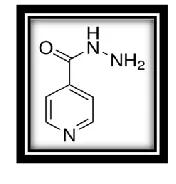
Isoniazid is a mild mono amine oxidase inhibitor. Chemically Pyridine-4-carbohydrazide. It is a prodrug activated by the mycobacterial catalase-peroxidase to an active compound which inhibits the synthesis of mycolic acid, an important constituent of the mycobacterial cell wall. Isoniazid is
*Corresponding author:
Dr. D. Kumara Swamy
Vaagdevi College of Pharmacy, Ramnagar, Hanamkonda, Telangana, INDIA.
* E-Mail: [email protected]
DOI: https://doi.org/10.5281/zenodo.2557216
bactericidal to rapidly dividing mycobacteria, but is bacteriostatic if the mycobacteria are slow-growing.It inhibits the cytochrome P-450 system and hence acts as a source of free radicals [1, 2].
Fig. 1: Structure of Isoniazid
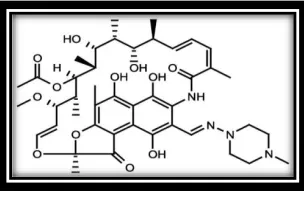
Rifampicin is bactericidal to Mycobacterium
physically blocking elongation, and thus preventing synthesis of host bacterial proteins [3].
Fig. 2: Structure of Rifampicin
The literature survey reveals that the various publications are available regarding determination method of Isoniazid and Rifampiciin but most of the methods are applicable for the analysis of Isoniazid or Rifampicin either alone or in combination with other drugs in pharmaceutical dosage forms [4-11].Only one method is reported for the Liquid
Chromatographic Method for the Determination of Rifampicin and Isoniazid in Pharmaceutical Formulations [12].
To our present knowledge, no stability-indicating Liquid chromatographic method for the determination of Isoniazid and Rifampicin in combine dosage forms has been published consequently, the focus in the present study was to develop a validated stability indicating RP-HPLC method for the combination, by degrading the drugs together under various stress conditions like Acid hydrolysis, Base hydrolysis, Oxidation, Thermal stress which is recommended by ICH guidelines [13-15].
MATERIALS AND METHODS
Standard and samples:
Rifampicin and Isoniazid working standards were provided by Vivimed laboratories, Hyderabad, India. R-Cinex (Capsules) and R-Cinex 600 (Tablets) by Lupin Limited were purchased from local market.
Table No. 1: List of Chemical/reagents used
S.No Name of the chemical Grade Manufactured by
1. Acetonitrile HPLC Research Lab Fine Chem Industries
2. Methanol HPLC Research Lab Fine Chem Industries
3. Water HPLC Avantor Performance Materials India Limited
4. Hydrochloric acid LR Research Lab Fine Chem Industries
5. Sodium hydroxide LR Research Lab Fine Chem Industries
6. Hydrogen peroxide LR Merck
Table No. 2: List of Instruments used
S.No Instrument Model Make
1. HPLC SPD-20A SHIMADZU
2. UV-VIS Spectrophoto meter UV-1800 SHIMADZU
3. Analytical balance AUY220 SHIMADZU
4. Ultra sonicator 1.5L50 ULTRASONICS
Chromatographic Conditions:
The mobile phase consisted of Acetonitrile and Water. The chromatograph was operated in the isocratic mode starting at a mobile phase of Acetonitrile:Water (80:20%v/v). Eluent was delivered at a flow rate of 0.8 mL/min. Absorbance was monitored at λmax = 303nm.
Preparation of Mobile Phase:
Mobile phase was prepared by mixing 80 ml of Acetonitrile with 20 ml of Water (HPLC Grade) and degassed by placed in Ultrasonic waterbath for 15 minutes.
Vehicle: Mobile phase used as vehicle
Preparation of Standard Solutions:
Accurately weighed and transfered 10 mg each of Rifampicin and Isoniazid standard drugs into a 10 ml of clean and dry volumetric flask, added about 7ml of mobile phase and sonicated to dissolve and degas completely and made volume up to the mark with the mobile phase. Further dilutions like 10, 20, 30, 40, 50, 60, 70, 80, 90, 100 µg/ml (10-100 µg/ml) were made up with mobile phase.
Preparation of Tablet Sample Solution:
Twenty tablets of R-CINEX 600 (RIF-600 mg, INZ-300 mg) were taken and powdered. A quantity of powder equivalent
to 10 mg of Isoniazid (equivalent to 20 mg of Rifampicin) taken and transferred in to 10 mL volumetric flask and made up to the required volume by using mobile phase. The solution was filtered through 0.45 µm filter. From the filtrate 0.1mL was taken in 10mL volumetric flask and made up to the mark with mobile phase to get a sample solution concentration of 10 µg/mL of isoniazid (20 µg/mL of Rifampicin).
Preparation of Capsule Sample Solution:
Twenty capsules of R-CINEX (RIF-450 mg, INZ-300 mg) were taken and powdered. A quantity of powder equivalent to 10 mg of Isoniazid (equivalent to 15 mg of Rifampicin) taken and transferred in to clean and dry 10 mL of volumetric flask and made up to the required volume by using mobile phase. The solution was filtered through 0.45 µm filter. From the filtrate 0.1mL was taken in 10mL volumetric flask and made up to the mark with mobile phase to get a sample solution concentration of 10 µg/mL of isoniazid (equivalent to 15 µg/mL of Rifampicin).
RESULTS AND DISCUSSION
Method Development:
To optimize the operation conditions for isocratic RP-HPLC detection of Rifampicin and Isoniazid a number of parameters such as the mobile phase composition and the flow rate were varied.
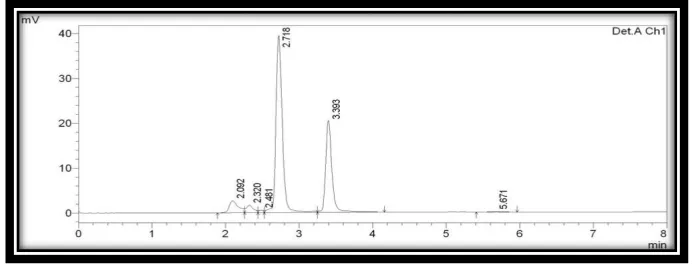
A mixture of Acetonitrile and Water in the ratio of 80:20 %v/v, flow rate 0.8 mL/min using Hypersil C18 (250mm × 4.6mm i.d., 5µm) column and UV detection at 303nm was proved the most suitable of all combinations since the chromatographic peaks were better defined, resolved and almost free from tailing. The standard solution chromatogram was represented in was represented in Fig. 3.
Fig. 3: Chromatogram of Optimized method
Table No. 3: Results of the optimized method
Drug Rt
(min) Peak area heightPeak plates/meterTheoretical HETP Tailingfactor Rifampicin 2.718 316827 39434 29497.218 33.902 1.331
Isoniazid 3.393 149382 20433 49134.684 20.352 1.363
Method Validation:
The developed method was validated according to ICH guidelines for the following parameters:
1. Linearity
2. Precision
3. LOD and LOQ
4. Robustness
5. Accuracy
1. Linearity:
The linearity of the method was tested over a concentration range of 10 to 100 µg/mL of Rifampicin and Isoniazid. 20 µL of each concentration was injected in triplicate into the HPLC system. The response was read at 303 nm and the corresponding chromatograms were recorded.Linearity results were presented in Table No.4.
2. Precision:
The precision of the method was determined by intraday studies. Solutions of standard and sample were repeated thrice in a day and percentage relative standard deviation (%RSD) was calculated by using formula:
%RSD = (S.D × 100)/Mean
Results for the Intra-day precision of Rifampicin and Isoniazid presented in Table No.5.
3. Limit of Detection and Limit of Quantification:
LOD was calculated using the following formula:
LOD = 3.3 × (S.D/S)
LOQ was calculated using the formula:
LOQ = 10 × (S.D/S)
Where, S.D → Standard deviation
S → Slope of the Calibration curve
LOD and LOQ results were presented in Table No.6.
4. Robustness:
Robustness of the method was studied by making slight changes in chromatographic conditions, such as mobile phase ratio and mobile phase flow rate. Results were presented in Table No.7.
5. Accuracy:
The accuracy of the method was determined by recovery experiments. The recovery studies were performed by the regular addition method. At 50%, 100%, 150% level, the percentage recovery was calculated. For both the drugs, recovery was performed in the same way. The recovery studies were performed in triplicate. Results were presented in Table No.8.
Forced degradation studies:
Fig. 6: Chromatogram of Rifampicin and Isoniazid for Acid degradation in Bulk after 1 day
Fig. 7: Chromatogram of Rifampicin and Isoniazid for Base degradation in Bulk after 1 day
Fig. 8: Chromatogram of Rifampicin and Isoniazid for Oxidation stress in Bulk after 1 day
Fig. 10: Chromatogram of Rifampicin and Isoniazid for Base degradation in Tablet dosage form (R-Cinex 600)after 1 day
Fig. 11: Chromatogram of Rifampicin and Isoniazid for Oxidation stress in Tablet dosage form (R-Cinex 600) after 3 days
Fig. 12: Chromatogram of Rifampicin (Bulk) for Thermal degradation after 5 days
Table No. 4: Results for the Linearity of Rifampicin and Isoniazid
S.No Concentration
(µg/mL) Peak area of Rifampicin Peak area of Isoniazid
1. 10 316827 149382
2. 20 631936 306732
3. 30 920999 433869
4. 40 1226345 606976
5. 50 1484353 723786
Correlation co-efficient (r2) 0.998 0.996
Fig. 4: Calibration curve of Rifampicin Fig. 5: Calibration curve of Isoniazid
Table No. 5: Results for the Intra-day precision of Rifampicin and Isoniazid
S. No. Peak area of Rifampicin Peak area of Isoniazid
1. 230058 168115
2. 234620 163830
3. 237735 169245
4. 234699 167080
5. 235430 164886
Average 234508.4 166631.2
S.D 2789.047 2243.183
% R.S.D 1.18 1.34
Table No. 6: Results for the LOD and LOQ of Rifampicin and Isoniazid
Table No. 7: Results of Robustness for Rifampicin and Isoniazid
S.No Mobile phase
( % v/v ) ( mL/min )Flow rate ( nm )λmax Rifampicin%R.S.D of %R.S.D of Isoniazid
1. 75:25 0.8 303 0.08 0.21
2. 85:15 0.8 303 0.10 0.09
3. 80:20 0.7 303 0.36 1.42
4. 80:20 0.9 303 0.99 1.61
Table No. 8: Results of Accuracy for Rifampicin and Isoniazid
Level of %
recovery Rifampicin % assay of % assay of Isoniazid Mean recovery of Rifampicin Mean recovery of Isoniazid
50 % 100% 99%
100% 99.9±1%
100 % 100% 100.1%
150 % 100% 99.9%
Drug LOD LOQ
Rifampicin 0.30 µg/mL 0.50 µg/mL
Table No. 9: Results for Forced degradation study of Rifampicin and Isoniazid
Degradation type Degradation (days) Bulk Dosage form Acid dgradation 1 day 1 day
Base degradation 1 day 1 day
Oxidation stress 1 day 3 days
Thermal degradation No No
CONCLUSION
A
simple, fast, precise, accurate, robust, economic and stability-indicating reversed phase high performance liquid chromatographic method was developed and validated according to ICH guidelines for the simultaneous estimation of Isoniazid and Rifampicin in Bulk and Solid dosage forms.The degradation studies indicated, both Rifampicin and Isoniazid bulk were degraded under acid, alkali oxidation stress in only one day. For tablet dosage form of Rifampicin and Isoniazid degraded under acid, alkali stress in only one day as bulk and degraded under oxidative stress in three days. No degradation of both individual Rifampicin and Isoniazid in bulk was observed in Thermal condition (dry heat at 60°C). So this method can be successfully employed for analysis of drug and degradation products in stability samples in industry and simultaneous quantitative analysis of Rifampicin and Isoniazid in bulk drugs and formulations.
REFERENCES:
1. Rang HP, Dale MM, Ritter JM, Moore PK. Pharmacology. 5th ed., Published by Elsevier, New Delhi: 2003;649-650.
2. Indian Pharmacopoeia. Vol-II, 7th ed., Published by the
Indian Pharmacopoeia Commision, Ghaziabad: 2014; 2005-2006 and 2659.
3. Ashutosh Kar. Medicinal chemistery. 4th ed., New Age
International Publishers, New Delhi: 2006;878-881. 4. Umang S, Patel S, Raval M. Stability Indicating Reverse
Phase HPLC Method for Estimation of Rifampicin and Piperine in Pharmaceutical Dosage Form. Curr Drug Discovery Tech 2018;15(1):54-64.
5. Ritesh D. Stability Indicating RP-HPLC Method for Rifampicin in Bulk and Pharmaceutical Dosage Form. Int J Pharm Pharm Res 2017;10(4):265-282.
6. Pratap Kumar G, Prasuna DG. Stability Indicating Method Development and Validation for the Simultaneous Estimation of Ethambutol and Isoniazid in Bulk and Pharmaceutical Dosage form by using RP-HPLC. Int J Pharm Res Health Sci 2016;4(5):1424-1428.
7. Kishore Kumar K, Maniyar U, Katariya MV, Jaiswal S, Katariya VR, Karva GS. Forced Degradation Study for Assay Method of Rifampicin, Isoniazid and Pyrazinamide in Combined Pharmaceutical Dosage Form. Asian J Pharm Tech Innov 2016;4(18):68-73.
8. Prasanthi B, Ratna JV, Phani RS. Development and validation of RP-HPLC method for simultaneous estimation of rifampicin, isoniazid and pyrazinamide in
human plasma. J Anal Chem2015;70(8):1015-1022.
9. Ayyappan J, Umapathi P, Quine SD. Development and Validation of a Stability Indicating High-performance liquid chromatography (HPLC) method for the estimation of isoniazid and its related substances in fixed dose combination of isoniazid and ethambutol hydrochloride tablets. Afr J Pharm Pharmacol 2011; 5(12):1513-1521.
10. Glass BD, Kustrin SA, Chen YJ, Wisch MH. Optimization of a Stability-Indicating HPLC Method for the Simultaneous
Determination of Rifampicin, Isoniazid, and
Pyrazinamide in a Fixed-Dose Combination using Artificial Neural Networks. J Chromatogr Sci 2007;45(1): 38-44.
11. Ali J, Ali N, Sultana Y, Baboota S, Faiyaz S. Development and validation of a stability-indicating HPTLC method for analysis of antitubercular drugs. Acta Chromatogr 2007; 18:168-179.
12. Kumari MK, Jyothi K, Kasthuri K, Babu BH, Satyanarayana PVV, Tchaleu BN. A Validated Liquid Chromatographic Method for the Determination of Rifampicin and Isoniazid in Pharmaceutical Formulations. Br J Pharm Res 2015;7(4):299-307.
13. Basha DM, Venkata Reddy G, Rani S, Ranjith Reddy K. A
Review on Forced Degradation Studies and its importance in Analytical Method Development and Validation. Int J Innovative Pharm Sci Res 2014;2 (11):2929-2940.
14. Bakshi, Saranjit Singh. Development of validated
stability-indicating assay methods-a critical review. J
Pharm Biomed Anal 2002;28(6):1011-1040.
15. ICH-Q2A. Validation of Analytical Procedure/
Methodology ICH Harmonised Triplicate Guidelines, Geneva, Switzerland: 1996;1-8.
How to cite this article:
D. Kumara Swamy et al. STABILITY INDICATING RP-HPLC METHOD DEVELOPMENT AND VALIDATION FOR SIMULTANEOUS ESTIMATION OF ISONIAZID AND RIFAMPICIN IN BULK AND SOLID DOSAGE FORMS. J Sci Res Pharm 2019;8(1):1-7.
DOI: https://doi.org/10.5281/zenodo.2557216
Conflict of interest: The authors have declared that no conflict of interest exists.