EDB Eurasian Integration Yearbook 2008
Vinokurov, Evgeny
Eurasian Development Bank
October 2008
Online at
https://mpra.ub.uni-muenchen.de/20907/
An annual publication of the Eurasian Development Bank
Edited by Evgeny Vinokurov, EDB
Advisory Council: Sailau Baizakov,
Insitute for Economic Research, Astana
Michael Emerson,
Centre for European Policy Studies, Brussels
Valery Geets,
Institute for Economic Forecasting, Kyiv Ruslan Grinberg,
Insitute of Economy RAS, Moscow
Ivan Korolev,
Institute for World Economy and International Relations RAS, Moscow
Luk Van Langenhove,
United Nations University, Bruges Johannes Linn,
Brookings Institute, Washington
Liu Huaqin,
Chinese Academy of International Trade and Economic Cooperation, Beijing
Katlijn Malfliet,
Catholic University of Leuven
Ivan Samson,
University of Grenoble II
Leonid Vardomskiy,
Institute of Economy RAS, Moscow
Vladimir Yasinskiy,
Eurasian Integration Yearbook 2008. – Almaty, 2008. - p. 264 ISBN 978-601-7151-00-3
An annual publication of the Eurasian Development Bank
Edited by Evgeny Vinokurov
The Eurasian Development Bank is an international financial institution established to promote economic growth and integration in Eurasia. The Bank was founded by an in-tergovernmental agreement signed in January 2006 by the Russian Federation and the Republic of Kazakhstan. Accession negotiations are currently under way with several neighbouring countries. Electric power, water and energy, transportation infrastruc-ture and high-tech and innovative industries are the key areas for Bank’s financing ac-tivities.
As part of its mission the Bank carries out extensive research and analysis of contem-porary development issues and trends in the region, with particular focus on Eurasian integration. The Bank also hosts regular conferences and round tables addressing various aspects of integration. In 2008, the Bank launched an annual EDB Eurasian In-tegration Yearbook (in English) and a quarterly Journal of Eurasian Economic Integra-tion (in Russian). Both publicaIntegra-tions are available online at www.eabr.org. The Bank’s Strategy and Research Department publishes detailed Industry and Country Reports and plans to undertake a number of research projects. Developing the EDB Eurasian Integration Index is the first project in the pipeline.
ISBN 978-601-7151-00-3 ББК 65.9(2)8
© Eurasian Development Bank, 2008
Address:
Republic of Kazakhstan
Panfilov St. 98, Almaty, 050000 Eurasian Development Bank Tel.: +7 (727) 244 40 44, ext. 6146 Fax: +7 (327) 244 65 70, 291 42 63 E-mail: [email protected] http://www.eabr.org
Notes on the Contributors 4
List of Abbreviations 6
Greetings
Igor Finogenov, Chairman of the Board, Eurasian Development Bank 8
Tair Mansurov, Secretary General of the EurAsEC 9
Sergey Lebedev, Chairman of the CIS Executive Committee 11
Johannes F. Linn, Executive Director, Brookings Institute 12
1. Introduction 14
Evgeny Vinokurov
Institutional Integration
2. The Sustainability of Regional Integration Projects in the Post-Soviet Space 22 Aleksandr Libman
3. Opportunities and Obstacles to EurAsEC Integration 38
Michail Golovnin
Economic Integration: Industries, Sectors, Issues
4. Cooperation in the CIS Machine-Building Sector: Decreasing Rather than Increasing 54 Yuriy Shishkov
5. Transborder cooperation on Russia’s ‘New’ and ‘Old’ Borders 63 Leonid Vardomskiy
6. The CIS Common Electric Power Market 81
Evgeny Vinokurov
7. Preconditions and Prospects for Banking Integration
in the Eurasian Economic Community 102
Anna Abalkina
Measuring Regional Integration and Economic Development
8. The Metropolisation of the FSU: Temptative Measurement via the Method
of Hyperlinks Notoriety 115
Uljana Agibetova and Ivan Samson
Reports
9. Nuclear Energy Complexes in Russia and Kazakhstan: Prospects for Development
and Cooperation. EDB Industry Report no.1 136
Evgeny Vinokurov
10. Water and Energy Resources in Central Asia: Development and Utilisation Issues.
EDB Industry Report no.2 163
EDB Strategy and Research Department
Chronicles, Digests and Book Reviews
11. Chronicle of Eurasian Regional Integration 2007 206
Nazira Tiuliundieva
12. International and Regional Development Banks in Central Asia: Overview of Activities 230 Natalia Maqsimchook
13. First and Second EDB Round Tables on Regional Integration,
November 2007 and May 2008 246
14. Book Review: Boris Kheifets and Aleksandr Libman “Corporate Integration.
An Alternative for the Post-Soviet Space” 252
Erzhan Moldabekov
Information for authors 254
List of Figures and Tables
Figures
Figure 2.1. The link between the quality of governance
and the population of an integration group 30
Figure 2.2. The link between GDP per capita and the size
of population of an integration group 31
Figure 2. 3. Deviation of counterfactual size from actual size 31
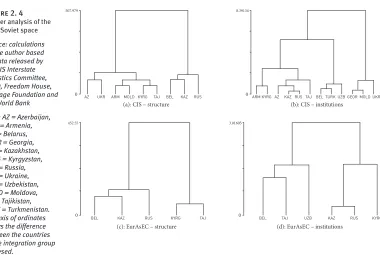
Figure 2. 4. Cluster analysis of the post-Soviet space 34
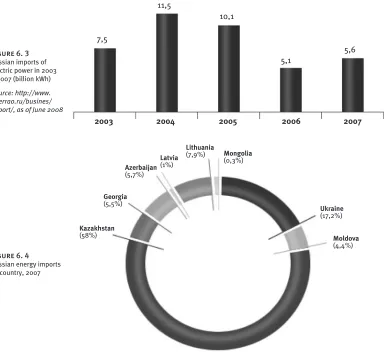
Figure 6. 1. Russian electric power exports in 2002–2007 85
Figure 6. 2. Russian energy exports in 2007 85
Figure 6. 6. Existing and potential regional and sub-regional electric energy markets 97
Figure 7.1. Foreign network in EurAsEC as a share of bank’s assets
and capital at the beginning of 2007 109
Figure 7.2. Share of foreign capital, including from EurAsEC member countries,
in the banking system 109
Figure 7.3. The dynamics of monthly interest rates on loans issued
to non-financial sector in EurAsEC countries 111
Figure 7.4. The spheres of influence of Russian and Kazakh banking capital 113
Figure 8.1. The population of Big Cities in FSU 117
Figure 9.1. Nuclear’s Contribution to World Energy Supplies 137
Insertion 10.1 Development of the Hydro energy potential of the River Vakhsh 178
Insertion 10.2 Cost Estimates for the Construction of Large Dams 180
Figure 10.1. Location map of Kambarata HPP-1 and HPP-2 182
Figure 12.1. ADB: Cumulative lending, Kazakhstan 234
Figure 12.2. ADB: Cumulative lending, Kyrgyzstan 234
Figure 12.3. ADB: Cumulative lending, Tajikistan 236
Figure 12.4. ADB: Cumulative lending, Uzbekistan 238
Figure 12.5. WB: Commitments by sector in 2008 239
Figure 12.6. EBRD: Commitments by sector 242
Tables
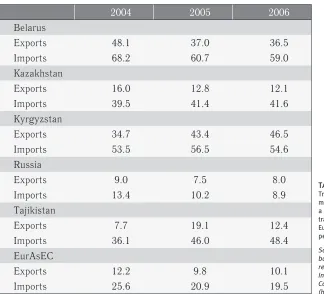
Table 3. 1. Trade with EurAsEC member countries as a share of total foreign trade
for selected EurAsEC countries 43
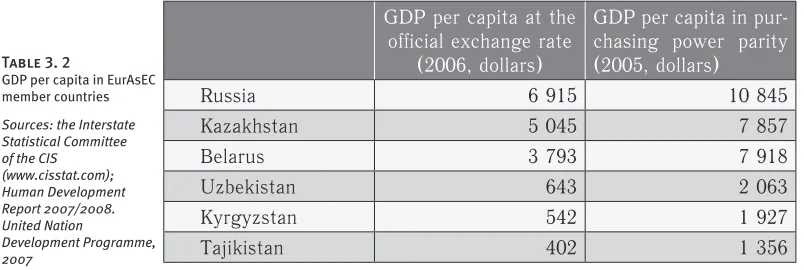
Table 3. 2. GDP per capita in EurAsEC member countries 46
Table 3. 3. Financial development indicators in EurAsEC countries 50
Table 4. 4. Intra-regional exports of machines, parts and components
in seven integrated supra-national blocs in 1995 and 2005 60
Table 6. 1. Export of electric power to CIS countries and EurAsEC in 2004–2007 83
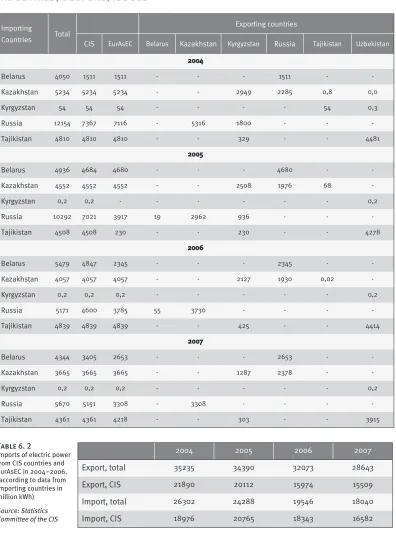
Table 6. 2. Imports of electric power from CIS countries and EurAsEC in 2004–2006 84
Table 6. 3. Import and export of electric power by the CIS 84
Table 6. 5. Trans-border investment in the electric power industry in the CIS 88
Table 6. 6. Foreign assets of INTER RAO 89
Table 7.1. Banking sector indicators in EurAsEC member countries 103
Table 7.2. Interest rate margin in EurAsEC member countries 111
Table 8.1. The First Ten Cities of the FSU with Strong Simple Notoriety 121
Table 8.2. Integration Ratio Typology 123
Table 9.1. Global Uranium Recovery 139
Table 9.2. Largest Uranium Consumers 139
Table 9.4. Description of Operating NPPs 143
Table 9.5. Uranium Recovery by Mine 148
Table 10.1. Water Resources of the Aral Sea Basin 165
Table 10.2. Irrigated land in the Aral Sea Basin 165
Table 10.3. Key indicators of water and land utilization in the Aral Sea Basin 166
Table 10.4. Agriculture’s contribution to GDP 167
Table 10.5. Structure of the Production of Primary Fuel and Energy 168
Table 10.6. Annual Production and Consumption of Primary Fuel and Energy 168
Table 10.7. Hydro Energy Potential of the Central Asian Rivers 169
Table 10.8. The largest HPPs in Tajikistan and Kyrgyzstan 172
Table 10.9. Inflow and outflow of water at the Toktogul reservoir 175
Table 10.10. Territorial Water Deficits in the Amu-Darya Basin in 2000 176
Table 10.11. Tajikistan’s Export and Import Relations with the Countries
of the Eurasian Economic Community, 2005–2006 185
Table 10.12. Kyrgyzstan’s Export and Import Relations with the Countries
of the Eurasian Economic Community, 2005–2006 185
Table 10.13. Kyrgyzstan’s Electricity Export and Import Operations
with the Countries of the Eurasian Economic Community 2004–2006 186
Table 12.1. Central Asian countries’ IFI membership 231
Table 12.2. ADB: Loans, TA and grant approvals in 2007 233
Table 12.3. WB: Lending in 2002–2008 238
Notes on the Contributors
Anna Abalkina – Candidate of Economic Sciences, Associate of the Academy of Finance under the Government of Russian Federation, Senior Researcher at the Institute of Economics of the Russian Academy of Sciences. Areas of research covers interaction in the banking sphere in the CIS, analysis of impact of foreign bank capital on national economy, regional financial integration world-wide. Anna Abalkina is a winner of a number of contests, including 2008 laureate of the program “The Best Economist of Russian Academy of Sciences” and winner of the grant contest of the President of Russian Federation in support of young Russian scientists – Candidates of Sciences and their academic supervisors.
Uljana Agibetova – Ph.D. (Economics). Post-doctorate at UMR lab “Espaces et Sociétés” on “Functions and Influence of Big Metropolitan Regions in EU” at Rennes University. She defended her thesis on “The Metropolisation Within the FSU space: a Temptative Measurement” at UPMF-Grenoble in 2008; earlier graduated in International Relations and European Studies at IEHEI-Nice, Berlin, Rome.
Mikhail Golovnin – Deputy Head of the Centre for Problems of Globalisation and Integration of the Institute of Economy, Russian Academy of Sciences. Candidate of science in Economics. In 2000 he graduated Master School of Economic Faculty of Moscow State University (economic and social policy). In 2003 he received candidate of science degree for his thesis “Monetary Sphere in Transition Economies (Comparing the Experience of Russia and Central and Eastern European Countries)”. He is the author of more than 50 publications, including papers in the leading Russian economic journals (Voprosy Ekonomiki, Mirovaya Ekonomika i Mezhdunarodnye Otnosheniya, Problemy Prognozirovaniya, Obshestvo i Ekonomika, etc.) Scope of research interests – monetary and financial integration, monetary policy, financial globalisation.
regional development, and external aid coordination.
Ivan Samson – Professor of economics and social sciences at UPMF Grenoble University, Director of the Research Institute Espace Europe. Honoured Doctor of KAZEU University, Almaty. Published more than 150 books and papers. Expert in transition economics, regional economics, development economics and institutional economics. Director of large EU technical assistance contracts (TACIS, Meda) and policy advisor at national level in Russia, Georgia, Kazakhstan and Ukraine. Researcher and advisor in regional planning in Russia (Kaliningrad), Algeria, Morocco, Venezuela and Western Africa. Director of RECEP, Moscow, in 2000– 2002, he advised the Russian Government and the EU on the content of the Common European Economic Space between Russia and EU.
Yury Shishkov – Doctor of Economic Sciences; Professor; Senior Researcher at the Institute of the World Economy and International Relations of the Russian Academy of Sciences; specialist in regional integration, globalisation and international industrial co-operation; author of nine monographs, 20 brochures and 360 articles published in various scientific magazines. Honoured Scientist of the Russian Federation, winner of the Varga Prize of the Russian Academy of Sciences.
Leonid Vardomskiy – graduated from the Faculty of Geography of the Moscow State University. Candidate of Geographic Sciences (1973). Doctor of Economic Sciences (1998). From 1987 to 2005 worked at the Institute of International Economic and Political Studies of the Russian Academy of Sciences; since 2005 works at the Institute of Economics of the Russian Academy of Sciences. Head of the Centre of Comparative Studies of Transformation Processes. His area of interests includes regional processes and politics in transitional economies; integration processes in the world and post-Soviet space; trans-border cooperation; and economic development of the border regions of Russia and neighbouring countries. Published some 200 works.
Abbreviations
APEC – Asia-Pacific Economic Cooperation ADB – Asian Development Bank
ADF – Asian Development Fund
ASEAN – Association of Southeast Asian Nations BL CCT – Basic list of Common Customs Tariffs BTEC – border trade and economic complex
CABCD – Central Asian Bank for Cooperation and Development CACM – Central American Common Market
CAR – Central Asia Region
CAREC – Central Asia Regional Economic Cooperation Caricom – Caribbean Community
CBC – cross-border cooperation
CICMA – Conference on Interaction and Confidence Building Measures CIS – Commonwealth of Independent States
CPC – Caspian Pipeline Consortium CPM – common electric power market
CSTO – Collective Security Treaty Organization
EBRD – European Bank for Reconstruction and Development ECCAS – Economic Community of Central Africa States ECOWAS – Economic Community of West African States EDB – Eurasian Development Bank
EIA – Environmental Impact Assessment
EMAP – Executives’ Meeting of East Asia Pacific Central Banks EPC – CIS Electric Power Council
ETCI – Early Transition Countries Initiative EU – European Union
EurAsEC – Eurasian Economic Community FSU – Former Soviet Union
FTBZ – free trade border zone FTP – Federal Target Programmes GCC – Gulf Cooperation Council GDP – gross domestic product HPP – hydropower plant
IAEA – International Atomic Energy Agency
ICD – Islamic Corporation for the Development of the Private Sector IDA – International Development Agency
IDB – Islamic Development Bank IEA – International Energy Agency IFI – International Financial Institution IIS – international information security
INSA – International Fund for Saving the Aral Sea
INTERREG – Trans-European Co-operation for Balanced Development Programme
MFA RK – Ministry of Foreign Affairs of the Republic of Kazakhstan MoU – Memorandum of Understanding
NAFTA – North American Free Trade Agreement NPP – nuclear power plant
OCAC – Organisation of Central Asia Cooperation
OSCE – Organisation for Security and Cooperation in Europe PAFTA – Pan-Arab Free Trade Area
PPFE – Production of Primary Fuel and Energy RF – Russian Federation
RFCA – Regional financial centre Almaty RK – Republic of Kazakhstan
SADC – Southern Africa Development Community SCO – Shanghai Cooperation Organisation
SEA – Strategic Environmental Assessment SES – Single Economic Space
TA – technical assistance
TACIS – Technical Assistance to Commonwealth of Independent States TPP – thermal power plant
TRASECA – Transport Corridor Europe-Caucasus-Asia
UCTE – Union for the Coordination of Transmission of Electricity UN – United Nations
UNECE – United Nations Economic Commission for Europe
UNESCAP – United Nations Economic and Social Commission for Asia and Pacific
UNIDO – United Nations Industrial Development Organisation UNO – United Nations Organisation
VLKSM – Vsesoyuzny Leninskiy Kommunisticheskiy Soyuz Molodezhi (Komsomol organisation)
WB – World Bank
of EDB Eurasian Integration Yearbook
It is my great pleasure to welcome readers to the first edition of the EDB Eurasian Integration Yearbook.
The Eurasian Development Bank was founded in January 2006 at the initiative of the Presidents of Russia and Kazakhstan. The Bank’s mission is to promote economic development and integration in the Eurasian region. Having identified our fundamental goals, the founders of the EDB have forged swiftly ahead with the process of making our vision a reality. With credit and investment as its core activities, the EDB has already financed a number of development projects in our member states.
The Eurasian Development Bank is a new bank, operating alongside other well-known international financial institutions in the field of economic development. Our aim, however, is not to compete but to build upon existing synergies which will enable us to respond more effectively to the needs of our member states. Our activities may be similar to other well-established multilateral development banks, but the EDB’s mission, strategy and corporate values are what make the Bank unique. Firstly, our belief that regional cooperation and integration are key to the future economic development of CIS countries means that we prioritise projects which will contribute to regional economic integration. Secondly, we are the “local” development bank, and have adapted our terms and conditions to the specific development context and needs of our member states.
In line with our strategic goals for 2008–2010 the Bank aims to become a centre of research excellence and a leading supplier of information on regional integration. We have recently set up a Technical Assistance Fund to support regional integration programmes, specialised inter-state initiatives and financial consultancy. Through its regular conferences, which bring together academics and representatives from the public and private sectors, the Bank provides a platform for the discussion of existing and emerging issues relating to the integration process, and for the formulation of recommendations.
You are among the first readers of our Yearbook. The aim of this publication is to present to the international community the most authoritative articles and studies on economic and political integration in Eurasia written in Russian. The Yearbook’s editorial board is made up of well-known academics, practitioners and renowned experts on regional integration.
I believe that the EDB Eurasian Integration Yearbook will become a popular and trusted source of information for all stakeholders in the integration process.
It is a great pleasure to welcome readers to the Eurasian Integration Yearbook. This new volume of research and analysis aims to become an authoritative source of information on integration issues for academic researchers, university lecturers, experts, governmental and public organisations, businesses and indeed anyone with an interest in thriving economic and humanitarian cooperation in Eurasia.
The Eurasian Economic Community (EurAsEC) was founded in October 2000 to promote and establish an institutional framework for economic integration in countries which are actively pursuing this goal – Belarus, Kazakhstan, Kyrgyzstan, Russia, Tajikistan and, since 2006, Uzbekistan.
The EurAsEC is relatively new and is widely recognised as the most effective international structure in the post-Soviet space. Its main task is to foster economic integration through the creation of a free trade zone, a customs union and a common economic area.
To date, the EurAsEC has maintained a trade regime with no restrictions, customs duties or taxes on commodities produced in its member countries. Thanks to this regime, trade turnover in the EurAsEC increased by more than 3.4 times over seven years, exceeding USD 102 billion in 2007.
Efforts to improve the investment climate and promote integration have also had a positive effect on the inward flow of investment capital in our countries. In the seven years to 2007, mutual investment between EurAsEC countries increased five-fold.
In response to these trends, in August 2006 the heads of the six member states decided to progress to the next phase of integration – the creation of a customs union and a common economic space. Initially, the customs union will comprise those countries in the vanguard of the integration movement, i. e., Belarus, Kazakhstan and Russia. Other member countries will join them as their economies and legislation.
The EurAsEC’s remit also includes to the goals of sustainable economic development in each member country, environmental protection, transport, energy, water supply, agriculture, technological innovation, and cooperation in science, culture, information and humanitarian issues.
The creation of the Eurasian Development Bank (EDB) to finance integration projects is a turning point for EurAsEC, and brings with it the need to discuss the long-term prospects for integration. Recently, the Integration Committee of EurAsEC adopted a resolution granting the EDB observer status in the EurAsEC.
integration and jointly organised the Astana Economic Forum and the founding of the Eurasian Economic Club of Scientists in June 2008.
The launch of Eurasian Integration Yearbook is without doubt a very significant contribution to ongoing debate surrounding integration. I am confident that the publication will become a much-valued source of information on these issues, and wish all its readers every success and prosperity!
Dear friends,
The Commonwealth of Independent States has reached a stage in its history where we must build upon the success we have achieved in our cooperation and integration so far, and make this cooperation even more effective.
Today, all the Commonwealth’s countries are focusing their efforts on implementing the decisions adopted by their heads of state in Dushanbe. Perhaps the most important of the documents ratified there are the Concept for the Future Development of the CIS and the Action Plan for implementing the Concept. These strategic documents are aimed at adapting the CIS to present-day circumstances and increasing the efficiency of the union.
Work is under way to draft a CIS Economic Development Strategy until 2020, which will incorporate the 14 areas addressed in the Concept for the Future Development of the CIS.
The focus of this Strategy is innovation – building a new economy based on our successful cooperation, and developing products and services for today’s world which will give Commonwealth countries a competitive advantage for many years to come.
The Executive Committee of the CIS welcomes the launch of Eurasian Integration Yearbook, a publication that will cover a wide range of issues relating to the Commonwealth. I hope that this outstanding volume will make a tangible contribution to the integration of the CIS member states.
With best wishes,
A Global Opportunity for the 21st Century
The second half of the 20th Century saw powerful forces of global economic integration, led by the rapid expansion of trans-oceanic economic links among the major economic powers of the then “Western” world. The US and Europe expanded trade and capital flows across the Atlantic at an unprecedented speed, followed closely by the transpacific integration of the Japanese and South East Asian economies with the US. The developing countries of “South” (Africa, Latin America and South Asia) also participated in this process of globalization, albeit with less political influence and less economic success. In the meantime, the predominant powers of the “East” – the Soviet Union and China – faded economically and politically during the waning stages of the Cold War, suffering from self-imposed economic isolation and debilitating internal economic and political mismanagement.
One of the key aspects of this period of globalization was that the economic space of the Eurasian supercontinent – stretching from the Atlantic to the Pacific Oceans and from the Arctic Sea to the Indian Ocean – lagged behind dramatically in the global economic integration process. Not only did the huge overland distances discourage land transport and continental trade, but political barriers – the Iron and Bamboo Curtains especially – and isolationist and dysfunctional economic policies in key countries discouraged the development of transcontinental transport and communications links and the expansion of trade and capital flows across the hard borders separating Eurasian neighbors.
All this began to change dramatically with the opening up of China in the 1980s and the collapse of the Soviet Union in the early 1990s. These historic developments meant that towards the end of the 20th Century the long-standing barriers to economic integration and political cooperation across the Eurasian super-continental space started to tumble. As a result, we now, at the beginning of the 21st Century, see a transcontinental process of economic integration gather speed.
The economic integration process is particularly rapid in the energy sector, as pipelines increasingly connect the oil and gas rich areas of Russia and the Caspian Sea Basin not only with Western Europe, but increasingly also with China and Japan towards the East and eventually also with Pakistan and India towards the South. Similarly Central Asian hydropower in the coming years will supply customers from Russia to China to South Asia. Non-energy trade between the emerging continental economies of Eurasia – especially China, India and Russia – is also rapidly expanding benefiting from and at the same time helping to support their exceptionally rapid growth.
and Central Asia close to the hubs of commerce and knowledge everywhere in a way that could hardly be imagined even twenty years ago. Capital flows much more freely now among the countries of Eurasia, with not only European banks, but also Russian, Kazakh and Chinese banks investing across borders. China’s and Russia’s investments and aid flows are playing an increasing role in Central Asia. Tourism is expanding across Eurasia in ways that replicates the earlier waves from the US and Japan into Europe, as Chinese tourists begin to flock to Europe and other parts of Eurasia. At the same time the growing cross-continental illicit drug trade is a common threat to Europe, Russia, China and India and threats from the spread of communicable diseases, whether SARS, bird flu or HIV/AIDS are shared across Eurasia.
This process of Eurasian economic integration creates great opportunities for all countries of the super continent, and for the rest of the world, as the catch-up of the Eurasian integration process in overall globalization supports world-wide growth and as economic cooperation and prosperity in this region provides the basis for political stability, cooperation and peace. At the same time, this integration also presents challenges for governments and private investors. The development of infrastructure networks throughout the vast continental space requires huge investments as well as sustained efforts to maintain the infrastructure and create the regulatory and governance capacity that facilitates energy and non-energy trade and financial flows across Eurasia. Regional and sub-regional organizational structures must be created or strengthened to support the cooperative development of infrastructure and regulatory capacity, to attract the private investments needed and to help mediate the sometimes conflicting or competing interests of the many countries engaged in this historic process of economic integration of Eurasia.
The Eurasian Development Bank, together with other regional organizations in Eurasia, therefore has an important role to play in helping to create the economic links among businesses in Eurasia, to support investments in critical infrastructure, and to develop a better understanding of the role which economic integration plays in creating a prosperous and peaceful Eurasian economic and political space. I am convinced that the new Yearbook “Eurasian Economic Integration” will make a great contribution in encouraging and disseminating research on this important topic and thus will help create a knowledge base on which all participants in this historic process of the 21st Century can build.
Introduction
The Eurasian Development Bank and its Mission
The Eurasian Development Bank (EDB) is an international financial institution with a mandate to facilitate economic growth and integration processes in the Eurasian region. The Bank was founded by an intergov-ernmental agreement that was signed in January 2006. The initiative for establishing the Bank came from the Presidents of the Russian Federation and Kazakhstan.
As a multilateral development bank, the EDB feels strongly about the creation of public goods. In the research sphere, we are focusing on the development of a wide range of research and analytical products, which will serve the needs of states, policy-makers, businesspeople, and expert society, providing them with reliable information as well as venues to discuss issues of economic development and integration. The Yearbook is just one product in the line that we offer to practitioners and researches, mostly in member states, but also to the global community. The EDB considers it a part of its mission to become a catalyst for regional in-tegration. This function is anchored in its Charter. In particular, Article 1 identifies the support of mutual trade and investments between Mem-ber States as a primary objective. In pursuit of these commitments, the Bank not only finances projects with substantial integration impact but also collects and analyses data on development and economic integration (Article 2 and 11).
Thus, in compliance with the Bank’s Charter, EDB research puts em-phasis on the processes of the regional integration of its member states. The Bank holds conferences on the issues of regional integration twice a year – in spring and autumn. These conferences attract leading experts in the field, as well as representatives of public agencies, international organisations and businesses. In October 2008, the EDB started a quar-terly ‘Journal of Eurasian Economic Integration’. This Russian-language journal intends to become the leading source of analytical support for the regional integration processes. In addition to this, the Bank has in-troduced a series of Reports on selected countries in the post-Soviet space and particular industries, such as electric power, hydro- and nuclear power, the transport sector, aerospace, agriculture etc. Another series of Country Reports, focusing on the Central Asian republics, Russia, and other FSU countries, are currently being prepared. We also foresee the realisation of large research projects along the way. The first of these is the ‘EDB System of Indicators of Eurasian Integration’, а large-scale ap-plied research project, which should result in the development of a valu-able set of tools, suitvalu-able for measuring the state and dynamics of various
Evgeny
Vinokurov
facets of regional integration. The Bank offers consulting to its clients and strategic partners. Administered by the Research Department, consulting services employs the expertise of various departments within the Bank, drawing on our extensive expert pool from the CIS countries.
On the concept of the EDB Eurasian Integration Yearbook
The ‘Eurasian Integration Yearbook’ publishes a wide range of articles and other materials on theory and practical aspects of Eurasian integra-tion. The major part of the annual almanac consists of the English ver-sions of selected articles published in the ‘Journal of Eurasian Economic Integration’ and other analytical publications of the EDB. Integration chronicles will supplement these for the previous years, book reviews, interviews etc. The Yearbook aims at improving access of the world community to the best articles published in the Russian language and providing a comprehensive and coherent view of regional integration in the ‘Eurasian’ area. Aside from articles published in the Journal, papers written specifically for the Yearbook in Russian and English languages are also welcome.
While it is largely focused on economics, the Yearbook publishes materials addressing a broad spectrum of urgent issues in Eurasian integration. This includes theories of integration, including its relevance to the development context; economic integration (trade, investment and financial institutions); institutional integration; other cooperation issues in the post-Soviet space as well as international experience of regional integration.
We are happy to announce the formation of a reputable Advisory Council. The Council currently comprises twelve world-class experts on various integration issues from: Belgium, France, Kazakhstan, Russia, the U.S.A., and Ukraine. The Council will serve as a consultative body on the contents of the Yearbook and also on the Eurasian Development Bank’s research activities.
This volume has been drafted for wide distribution among the interna-tional community of researchers and practitioners. The book can also be downloaded free of charge at the EDB website.
What is Eurasia? What is Eurasian economic integration?
What is ‘Eurasia’ in the context of ‘Eurasian integration’, as used widely on the pages of this volume?
political entity, which has only limited relevance to the politics and eco-nomics of the region. Aside from this, all of these terms artificially bind the actual political and economic geography of the region.
The straightforward solution to the problem would be to find an ap-propriate geographical description of the territory in question. It would seem that, ‘Northern and Central Eurasia’ would be the closest to being correct. This sounds a bit awkward however, and would be far too long a phrase for practical use.
In our ‘Journal of Eurasian Economic Integration’ and in the ‘Eur-asian Integration Yearbook’ we focus predominantly on the post-Soviet states. When doing so, we can combine the emphasis placed on the internal integration process with the willingness to address any external integration considerations of the post-Soviet states. It is advisable to keep in mind what Johannes Linn, former Vice-Director for Europe and Cen-tral Asia of the World Bank and current Executive Director of Brookings Institute, described as the ‘Eurasian Super-Continent’. Linn rightly points out that the break-up of the Soviet Union triggered the process of eco-nomic integration on the whole Eurasian super-continent. In the 11th to 14th centuries Eurasia represented a relatively integrated economic space – undoubtedly relative to the overall levels of economic ties in other re-gions of the world. The current geo-economic situation is favourable to the new round of economic integration on the Eurasian continent, this time in a qualitatively ‘smaller’ world. Due to its geographic location and national economic interests, Russia, Kazakhstan, and other FSU states are directly interested in Eurasian integration, which would spill over the tight bounds of the post-Soviet space.
In conclusion, this Yearbook will focus on the regional integration processes of relevance to post-Soviet states, which means monitoring and analysing both internal and external developments. This is why, while be-ing aware of the limitations, we opt for ‘Eurasia’ as a description of the region in question.
What is Eurasian economic integration in the context of the volume? We imply a wide definition of economic integration in the sense of ad-vanced regional economic cooperation. Functional scope is particularly important to us for three reasons. First, we regard it as both practical and suitable for the development bank to concentrate on. Second, it is theoretically, conceptually and statistically underresearched. Third, the fragmentary information for economic sectors and industries as well as specific issues (such as customs, rules of transit, migration, education, soft security etc.), which are available to Russian-speaking readers, might not be as readily available for the global English-speaking audience. The ‘Eurasian Integration Yearbook’ is there to partially fill this gap.
About the contents
supple-mentary materials. The core of the Yearbook is composed of seven papers and two reports, grouped into four sections.
The first part is entitled ‘Institutional Integration’. It contains analysis of the institutional issues of regional integration in the post-Soviet space. Chapter 2, written by Aleksandr Libman, ‘The Sustainabil-ity of Regional Integration Projects in the Post-Soviet Space’, looks at the sustainability of integration groupings. Counterfactual analysis of the concept of integration as the regional union for EurAsEC shows that the size of this group is close to (but nevertheless higher than) its sustain-able optimum considering quality of governance, and below the optimum in terms of economic development. Nevertheless, EurAsEC is closer to its sustainable size (in terms of the quality of governance) than all other integration projects in the former Soviet Union.
Following on from this is a discussion on the ‘The EurAsEC Integra-tion: Opportunities and Obstacles’, written by Michail Golovnin. In the medium term, the creation of a customs union will play a key role in encouraging formal integration in the EurAsEC. It will face impediments that are both objective (disparities in the structure of member country economies) and political in origin (for instance, Russia’s self-serving ap-proach fails to create attractive opportunities for partners prepared to make concessions from their side). The most likely basis for a customs union at the moment is the SES-3 (three countries of the Single Eco-nomic Space – Russia, Kazakhstan and Belarus); however, some major challenges continue to affect this association too. Golovnin comes to the conclusion that the potential for further integration is constrained by the need to coordinate many aspects of hugely varying national economic policies.
The financial sector holds the most promise for further cooperation in the EurAsEC. It is linked neither with the troubles of the fuel and energy, nor with the inefficiencies of machine-building industry inherited from the Soviet economic system. Corporate integration between Russia and Kazakhstan can be strengthened through the expansion of their financial institutions into one another’s markets. Like Libman in Chapter 2, Go-lovnin points out the crucial issue of Russia-Kazakhstan ties. These two champions of financial services development could share their experience with others to facilitate the development of banking systems and financial markets in other EurAsEC member-states. It would be expedient, there-fore, to initiate a joint pilot project on development of a selected segment of financial markets of EurAsEC member states. Development of the corporate bonds market appears to offer the most potential.
economic gains. We intend to continue to emphasise functional integra-tion in specific industries and sectors in future Yearbooks.
In Chapter 4, Yuriy Shishkov assesses an often-overlooked handicap pertaining to the efficiency of the CIS machinery sector –insufficient co-operation between the CIS machine-building industry and their more ad-vanced foreign partners. Drawing on foreign experience, Shishkov clings to the possibility of a technological leap in the sector, which can be based on a deeper economic cooperation. International cooperation, in particular within the CIS where there is a long history of strong mutual depen-dence, would harmonise technical standards between countries, expand international scientific and technical cooperation, and reduce disparities in the legal regulation of economic relations in this sphere. In successfully integrated organisations (the EU, NAFTA and others) the intermediate machine-building sector in member countries exports 50-100% more than in the CIS, where a rapid contraction of exports threatens to dismantle the industrial foundations of integration.
The Yearbook continues with Chapter 5 by Leonid Vardomskiy, ‘Trans-border Cooperation on the ‘new’ and ‘old’ Russian Borders’. Prospects of transborder cooperation of Russia with its CIS neighbours depend on whether it will manage to contain the ‘barrier function’ of its new bor-ders. Vardomskiy concludes that the security factor still prevails over the cooperation factor. Also, the economic effects of transborder cooperation are insufficiently studied, thus the picture of potential gains is distorted. When there is more data and research on economic effects, a more bal-anced decision-making on border policies and transborder cooperation will become feasible.
real mechanisms of transborder trade are established both at the material, technological, and regulatory levels.
Anna Abalkina starts her chapter, ‘Preconditions and Prospects for Banking Integration in the EurAsEC’ by pointing out that regional eco-nomic integration in the EurAsEC countries is increasingly considered in terms of cooperation in trade and investment. Much less attention is paid to the activities of the banking intermediaries that fund these operations. Abalkina delves into the most interesting, yet not sufficiently explored, world of financial integration, focusing on banks. (A parallel can be drawn with Chapter 3 by Golovnin, which states that the financial sector holds the most promise for further cooperation in the EurAsEC). She analysed a number of indicators, including the share of foreign assets and capi-tal owned by the CIS banks. Apparently we are witnesses of a wave of transactions between banks that leads the way to the formation of several CIS banking groups. Notably, Kazakh and Russian banks are particularly fervent in their pursuit to expand across the CIS.
On an institutional level, Abalkina argues for a ‘stable, rather than a single’ financial market in the EurAsEC member countries. EurAsEC and CIS countries could look into experience of Asia Pacific countries, which chose to reduce the role of foreign credit by developing a regional bond market which is less exposed to global crises. In other words, the creation of a formal common financial services market may be premature at the moment. It would be more beneficial to take steps to increase stability within national financial systems, to increase their capitalisation and to develop a regional credit market.
metropolisa-tion is not a simple task, especially in the post-Soviet context. The au-thors set up a method of measuring metropolisation through the number of hyperlinks in Internet search engines.
The next part of the volume, ‘EDB Reports’, logically relates to the collection of papers described above. EDB Industry Reports is a series that aims to provide in-depth analysis on sectors with substantial inte-gration potential. These sectors notably include power generation and distribution, transport, telecommunications, agriculture, aerospace, and finance. In this Yearbook we present two EDB Reports, ‘Nuclear Energy Complexes in Russia and Kazakhstan: Prospects for Development and Cooperation’ and ‘Water and Energy Resources in Central Asia: Develop-ment and Utilisation Issues’. These reports represent case studies of two sectors with critical consequences for the regional integration.
In particular, the first report deals with the growing cooperation be-tween Russian and Kazakh nuclear sectors. Kazakh uranium has become a focus of attention and fierce competition between the world’s largest consumers, including France, Canada, USA, Japan, China, South Korea, and Russia. Early this decade, Russia’s substantial production capacity and highly competitive uranium ore conversion technologies added to calls for the country to renew its economic links with Kazakhstan in the uranium mining and nuclear industries. Given Russia’s ambitious plans to develop nuclear energy, and the fact that its uranium stocks are practically depleted, the benefits of closer cooperation with Kazakhstan are clear. However, Russia will have to compete with other players for Kazakhstan’s uranium market. The need to integrate the nuclear power complexes of Kazakhstan and Russia along the entire production chain is a logical response to their urgent need to reduce their energy deficit, and to increase the synergies which exist between their production capaci-ties and technologies at each stage of the nuclear fuel production chain: uranium mining, uranium enrichment, production of fuel pellets and fuel elements, reactor design and production, the construction and operation of nuclear power plants, and nuclear waste processing and disposal. The first steps in these directions were undertaken through the act of join-ing forces and assets in three Russian-Kazakh joint ventures (extraction, enrichment, and nuclear reactors).
Tajikistan and Kyrgyzstan have vast hydro-energy capacity, but heav-ily depend on the supply of hydrocarbons from other countries in the region. During winter 2008, public electricity and heating was completely cut off in Tajikistan; production of aluminum at the Tajik aluminum plant, the country’s main source of foreign currency, fell dramatically.
Resolving the issues of shared utilisation of water and power resources in Central Asia has huge economic, ecological, political and international importance, as it is a major factor in preserving stability, economic pros-perity and ecological security in the region. The most important issues in this regard are the management of water and energy resources and lever-age of significant long-term investments in hydro-energy projects.
The last part of the Yearbook, ‘Chronicles, Digests and Book Reviews’, presents the Regional Integration Chronicle. The Chronicle serves the particular purpose of providing our readers with structured in-formation on integration events throughout 2007. The first section of the Chronicle is grouped around institutional integration and covers, among other issues, the CIS, the EurAsEC, the SCO, and Russia-Belarus Union. The second section covers various sectors and issues, in particular inte-gration initiatives in customs and transit, miinte-gration, energy, transport corridors, and education.
It is supplemented by the review of ‘Activities of Multilateral Develop-ment Banks’ in the region, written by Natalia Maqsimchook of EDB. You will also find information on the Round Tables conducted by the Eurasian Development Bank in November 2007 and May 2008 as well as a book review of the recent monograph by B. Kheifets and A. Libman on corpo-rate integration in the post-Soviet space.
We intend to continue publishing structured chronicles and reviews in the next Yearbooks, thus providing the global audience with a coherent and dynamic picture of Eurasian integration and economic development.
Overall, the Yearbook intends to provide a dynamic overview of inte-gration processes in the post-Soviet ‘Eurasian’ space and the challenges to which the Northern and Central Eurasian states will have to provide adequate responses. I genuinely hope that the EDB Eurasian Integration Yearbook will become a reliable companion to those studying regional integration.
The Sustainability of Regional
Integration Projects
in the Post-Soviet Space
Alexandr
Libman
The sustainability of integration groupings is extremely important in the selection of the most workable regional integration schemes. Quantitative analysis shows that of all integration projects in the former Soviet Union the EurAsEC-6 is closest to being what is considered a “sustainable size”. This stable integration structure is based on close cooperation between Russia and Kazakhstan.
Integration projects, which are being pursued in many parts of the world, emerge as the result of negotiations and coordination between various actors – both state (members and non-members of an integration group) and nongovernmental. This raises the question of when an emerging structure becomes relatively more sustainable, i.e. less susceptible to disintegration. Of all the factors influencing the sustainability of an integration project, its size must play an important role. It appears that, in terms of size, sustainability has both upper and lower limits (i.e., groupings are unsustainable if they become too large, but they can also be too small to survive). Small groupings are thus susceptible to practically unopposed “takeover” by their larger neighbours. Extremely large groupings face the constant threat of losing member countries.
Analysis of what constitutes a sustainable size for an integration grouping may be carried out from two angles. We may choose as our starting point the traditional understanding of regional economic integration, i.e., the creation of an international union between several countries. In this case its sustainable size may correlate to the number of countries of an integration grouping or to the size of its population. The latter approach may be the more useful, bearing in mind that the diversity within member countries may mean that their internal stability cannot be assumed. The second approach views an integration project as a network of agreements and accords reached by several regional countries. This approach is more flexible and to a greater extent reflects the reality of open regionalism models and tiered integration. In this case, when referring to the sustainable structure of an integration project, we define precisely which configuration of the framework of agreements is the most viable.
This article analyses the factors which influence the optimal size of an integration project and attempts to apply its conclusions to the former Soviet Union, in particular, the EurAsEC. We employ quantitative analysis techniques which generate unambiguous and non-contradictory results with regard to the sustainable size and structure of integration associations.
Factors Influencing the Sustainable Size and Structure of an Integration Association
When considering integration as an international union, the sustainable size of an integration grouping is defined by the outcome of interaction between two “markets” operating in the region’s political and economic system. The first market is the “interstate political market” which involves transaction between countries. The second market is the “market of institutions and economic policies”, in which private structures (corporations and citizens) operate, creating demand for certain institutional schemes which states offer. Specific mechanisms include participation in political life, lobbying or “voting with feet” facilitated by, among other factors, the mobility of the means of productions. Under this scheme, a sustainable integration grouping should meet two requirements: it must be attractive to the states involved in it and generate positive economic benefits to private structures.
The stability of an integration grouping is influenced most of all by the diversity of its members. If members of an integration group are alike and their populations and elite groups display a certain homogeneity, these structures seem to be less susceptible to disintegration. Excessive diversity threatens consensus among members of a grouping on the common integration conditions and increases the time spent in negotiation and coordination1. In other words, diversity increases the “cost” of deals
on the “interstate political market”, thereby reducing the attractiveness of integration. Diversity is defined by several component factors, for example, ethno-linguistic fractionalism; the circumstances of historical development and peculiarities of institutional systems; differences in living standards and the educational attainment of the population; and urbanisation. Where there is extreme diversity of preference, even efficient integration groupings (i. e., structures where the prosperity of all member countries is generally improved through integration) may become unsustainable2.
Another parameter defining the sustainability of an integration association is the efficiency of its institutional environment and management of the public benefits it makes available to all countries, such as reciprocal trade, security or a shared infrastructure. In other words, improving the efficiency of an integration grouping increases its sustainable size. This is especially related to the common benefits produced by integration groups. These influence the “market of institutions and economic policies”, improving the quality of the benefits states offer to private structures, thereby increasing their willingness to “pay” for these benefits. All other conditions being equal, the effective management of an integration grouping is directly related to the efficacy of governance within member countries. High quality governance in all
1 Ruta M. (2005) Economic Theories of Political (Dis)Integration. Journal of Economic Surveys,
Vol. 19.
2 Haimanko O., Le Breton M., Weber S. (2005) Transfers in a Polarized Country: Bridging the
states involved in an integration union does not guarantee the efficiency of its supranational bodies or of the negotiations which establish the basis of the integration grouping. However, in the absence of efficient interstate institutions, it is unrealistic to expect partners to formulate efficient interstate regulation. Indeed, efficiency of government reduces the “technical” costs of holding international negotiations, the importance of which should not be underestimated.
A problem arises because of the contradictory influences of diversity and efficiency. A grouping of highly diverse member states will, as stated above, have a smaller optimal size. Its very diversity, however, may ultimately boost the efficiency of its operation. Thus an increase in the cost of transactions on the “interstate political market” increases the benefits available on the “market of institutions and economic policies”. Indeed, an evolutionary approach to economic policy supposes that diversity in integration is a form of “capital” and establishes the conditions for the evolutionary, competitive processes of knowledge generation, innovation and dynamic development. Furthermore, this diversity of preferences is not a static phenomenon but is generated by a dynamic development process in which transactions on the “interstate political market” play an important role3.
It is apparent that an evaluation of the situation will depend on the general level of governance within the group. Relatively more advanced institutions, which incorporate the preferences and reciprocity of different groups, cope better with diversity issues and exploit their creative energy (in the terminology of a new, comparative economic theory, they are located on a higher “curve of institutional possibilities”). Less developed institutional systems are more susceptible to this problem and are obliged to find a compromise between diversity and the advantages of integration. This conclusion reinforces the importance of efficient decision-making to the sustainability of a regional structure. For example, in the case of EU expansion, the diversity of preference, though important, plays much less of a role than the ability of EU bodies to adopt decisions at minimum cost4. If we consider time spent on decision-making, the potential for
unilateral obstacles to be placed before an integration group’s member countries and non-egalitarian access to information supplied by various regions become much more significant. In the situation of non-egalitarian access to information, the method of its collection is also fundamentally important5.
The “sustainable size” of the integration group also depends on its member countries’ level of economic development. Economic development
3 Herrmann-Pillath C. 2006 Heterogenität, Wachstum von Staaten und wissensschaffender politischer Wettbewerb. In: Vollmer U. (Hrsg.) Oekonomische und politische Grenzen von Wirtschaftsräumen. Berlin: Duncker & Humblot.
4 Apolte Th. (2006) Gibt es eine optimale Grösse der Europäischen Union? In: Vollmer U. (Hrsg.). Oekonomische und politische Grenzen von Wirtschaftsräumen. Berlin: Duncker & Humblot.
directly influences the development of “markets of institutions and economic policies”, determining the behaviour of participants. In economic theory there is no generally accepted explanation of the link between economic development and the optimal size of an integration group. According to some estimates, the link between economic development and integration follows a U-shaped curve: early on, integration formations encourage efficient economic growth, but once a certain level of development is reached, countries are capable of generating similar advantages without the need for formal integration structures created at the expense of their own “coping strategy”6. Other experts proceed from the existing
linear link between economic development and inclination to integration7.
However, the results of negotiation between states (on the “interstate political market”) may significantly alter results.
Naturally, this is not an exhaustive list of the factors which influence the sustainability of an integration project. For example, the scale of economic liberalisation in the global economy as a whole plays a significant role. Obviously, in order to be sustainable, an integration grouping should maintain the optimal size of its internal market, and take advantage of economies of scale. However, given that the regulation of global trade is relatively liberal (thanks to the WTO and other world organisations) the sustainable size of integration groups is getting smaller8. Indeed, domestic economic entities can benefit from access to
each other’s markets without the need for complex inter-governmental negotiations. A reduction in the sustainable size of an integration group is thus brought about by changes in the “market of institutions and economic policies”, whose participants refuse to pay the costs exacted by the “interstate political market”.
There are more complex factors at work here, however. In particular, the global trade environment and the structure adopted by regional integration groups are defined by the same processes9; it is extremely
difficult, therefore, to establish cause and effect between them. Former Soviet countries, for example, pursued regional integration and integration into the global economy in parallel. In addition, the global trade regime is itself created not only by the efforts of global organisations but also by numerous overlapping regional agreements which are increasingly based on the principle of “open regionalism” (and which have given rise to the concept of “integration by network” which is discussed below)10.
6 Casella A., Feinstein J.S. (2002) Public Goods in Trade: On the Formation of Markets and
Jurisdictions. International Economic Review, Vol. 43.
7 Bolton P., Roland G., Spolaore E. (1996) Economic Theories of the Break-Up and Integration of
Nations. European Economic Review, Vol. 40.
8 Alesina A., Wacziarg R. (1999) Is Europe Going too Far? Carnegie-Rochester Conference Series
on Public Policy, Vol. 51.
9 Etro F. (2006) Political Geography. Public Choice, Vol. 127; Blankart C.B., Koester G. (2006)
Political Economics versus Public Choice: Two Views of Political Economy in Competition. Kyk-los, Vol. 59.
10 Baldwin R. (2006) Multilaterising Regionalism: Spaghetti Bowls as Building Blocks on the
One important factor which influences “sustainable size” is the conflict of laws, i.e., the competition between states for mobile means of production. The conflict of laws affects the structure of regional integration in three ways. Firstly, it stimulates the desire for harmonised economic policy as a means of alleviating competitive pressures within the tax and legal regimes11. It also encourages the “joy-rider” phenomenon, whereby the
violation of established harmonisation agreements has a disproportionate effect on the competition of jurisdictions. In addition, conflict of laws at the expense of ex post harmonisation reduces transaction costs on the “interstate political market”, creating the optimum conditions for negotiation. Finally, from the point of view of demand for integration projects in the “market of institutions and economic policies”, the conflict of laws makes “voting with the feet” relatively more attractive and reduces active opposition to the creation of an integration group, thus limiting the impact of the diversity of preferences12.
Finally, it is important in this analysis to discuss corporate integration (regionalisation), i.e., cooperation between states without the creation of formal international unions. There are numerous examples regional cooperation in the world, where formal integration trails some distance behind the development of informal economic cooperation. A classic example of this is the Asia-Pacific, where, in the absence of formal cooperation, Japanese multinational production chains and informal networks in the Chinese diaspora become vectors of regionalisation (i.e. formal deals on the interstate political market). Approaches to regionalisation may differ widely, depending on the degree to which a “shared identity” exists in the region’s countries and on the extent of their economic interdependence13.
Regionalisation may reduce the cost of coordinating a common policy and encourage the formation of integration associations (thanks to the emergence of shared identity and intensification of the conflict of laws). The reaction of private structures is mixed: in some cases their desire for formal association increases, while in other cases the situation is more complicated (especially where there is a switch from negative integration, which culminates in the abolition of market barriers – to positive integration, which works towards the creation of common institutions). In countries where leading private structures pursue expansion into neighbouring markets, experience shows that there is a clear, positive link between regionalisation and formal integration (for example, NAFTA and integration projects involving the USA and Central America)14.
Analysis of integration by network is a relatively new area of research and findings relating to the sustainability of regional network
11 Whincop J., Keyes M. (2001) Policy and Pragmatism in the Conflict of Laws. Aldershot. 12 Olofsgard A. (2003) Incentives of Secession in the Presence of Mobile Ethnic Groups. Journal of Public Economics, Vol. 87.
13 Mattlin M. (2005) Structural and Institutional Integration: Asymmetric Integration and Sym-metry Tendencies. Cooperation and Conflict, Vol. 40, No. 4.
agreements are limited15. Academic literature pays greater attention
to the homogeneity or symmetry of countries. As far as it is possible to judge, sustainable integration cooperation networks are formed by relatively “similar” countries16, these similarities existing mainly in
their institutional systems. Similarity of institutional environment reduces transaction costs, making business operations in such countries more attractive to commercial bodies. In addition, the “similarity” of institutional systems facilitates the identification of policies which are shared by the integration group’s member countries, reducing the effort required to uncover “shared” rules and institutions and adapt national policy to common standards.
Greater diversity between countries increases the scale of inter-sectoral trade between them and makes integration more attractive. Generally speaking, many modern integration groups (in particular, most North-North projects) are based on intra-sectoral trade with relatively similar states. However, in North-South integration inter-sectoral trade plays a key role17. It is important here to distinguish between diversity
of economic structure and diversity of economic institutions – the former allows economies to complement one another, while the latter, on the contrary, complicates integration. However, it is the economic institutions which define a country’s economic structure, and it is very likely, therefore, that countries with similar institutional systems develop similar economic structures. Empirical studies have in fact confirmed the link between sustainability, institutional homogeneity and successful integration18. The complementarity of foreign trade structures is also
used in analysis of the sustainability of integration networks. Empirical calculations in this field have been carried out for CIS countries19.
It is important to stress that, from the point of view of integration, it is the homogeneity of institutional systems as a whole that is definitive, rather than individual institutions. Institutions themselves seek complementarity, creating sustainable systems in which individual rules and norms, both official and unofficial, are interlinked. This tendency poses further problems for quantitative analysis.
15 Furasawa T., Konishi H. (2007) Free Trade Networks. Journal of International Economics,
2007, Vol. 72; Furusawa T., Konishi H. (2005) Free Trade Networks with Transfers. Japanese Economic Review, Vol. 56, No. 2; Goyal S., Joshi S.(2006) Bilateralism and Free Trade. Interna-tional Economic Review, Vol. 47, No. 3; Mauleon A., Song H., Vannetelbosch V. (2006) Networks of Free Trade Agreements among Heterogeneous Countries. DP 2006-29 U Louvain Department of Economics.
16 Das S.P., Ghosh S. (2006) Endogenous Trading Bloc Formation in a North-South Global
Economy. Canadian Journal of Economics, Vol. 39, No. 3.
17 Borrmann A. (1997) Interregionale Integration von Industrie- und Entwicklungsländern. HWWA-Diskussionspapier Nr. 45.
18 Feng Y., Genna G. (2004) Domestic Institutional Convergence and Regional Integration:
Fur-ther Evidence. In: Salavrakos I.D. (ed.) Aspects of Globalization, Regionalisation and Business. Athens: ATINER.
19 Plekhanov D. (2005) Prospects for Development of Mutual Trade in SES. Ekonomicheskoye
Assessing the Sustainable Size of Integration Projects in the Post-Soviet Space
Integration in the Form of International Union20
Let us begin by defining the optimal size of regional integration projects in the post-Soviet space where this concerns integration by international union. From the theoretical discussion above we conclude that improvements in the quality of governance within an integration grouping should encourage its growth by improving national aptitudes for coping with diversity. For the sake of simplicity we will assume that the quality of supranational institutions is a function of the quality of governance in individual member countries. This simplistic (but, we think, quite realistic) supposition allows us to conduct quantitative analysis of sustainability relating to the size of an integration grouping.
The sample group includes the 17 regional integration unions listed in a study by the European Central Bank in 200421. This list covers
practically all institution-based integration associations in the world. To determine the size of an integration group we take the combined populations of all its member countries in 2007 according to the US Census Bureau. To indicate the quality of governance we take the average of six Quality of Governance indices published by the World Bank in 2005. These indices are: the stability of the political system; the quality of economic policy; stage of development of a lawful state; the scale of corruption; the government’s accountability to citizens; and the quality of state administration. In order to define the quality of governance in regional integration group we calculate the average of indices for all the member countries.
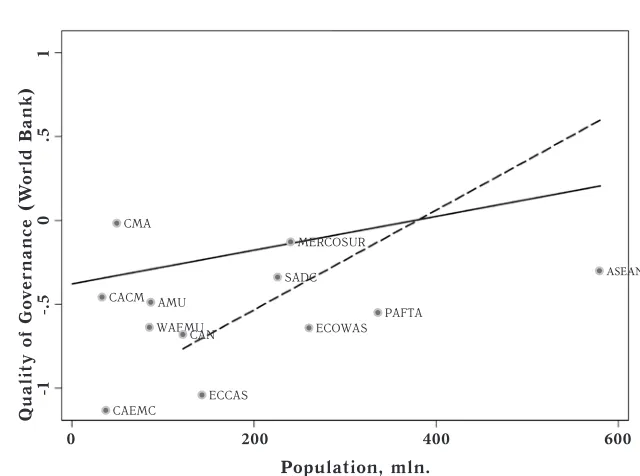
A summary of the data obtained is shown on Figure 1. The data show that there is indeed a link between population size and the quality of governance: regions in which the quality of governance is higher create bigger integration unions (solid line). However, this relationship is quite weak (there is a correlation of about 30%), which is attributed to the inclusion of integration groups in the Caribbean basin (ECCU and Caricom), which have small populations but enjoy high-quality governance. It is notable that this region is very fragmented and that great number of countries participate in integration groupings in this region. If we limit our analysis to nine integration groupings with a combined population of over 100 million people (the EU, NAFTA, Mercosur, ASEAN, the Andean Community of Nations, Africa’s SADC, Ecowas and ECCAS and the Middle East’s PAFTA), their interdependency becomes more sustainable (dashed line). The coefficient of correlation reaches about 65% in this
20 This chapter is based on a joint work of the author of this article with Dr of Economy L. Zevin
(Institute of Economics, the Russian Academy of Sciences). This issue is studied in detail in Zevin L., Libman A. Optimal Economic Space: Problems of Size. Mir Peremen, No. 4.