http://dx.doi.org/10.4236/am.2016.73018
A Note on Differential Equation with a
Large Parameter
S. O. Maliki, R. N. Okereke
Department of Mathematics Michael Okpara, University of Agriculture, Umudike, Nigeria
Received 23 October 2015; accepted 22 February 2016; published 25 February 2016 Copyright © 2016 by authors and Scientific Research Publishing Inc.
This work is licensed under the Creative Commons Attribution International License (CC BY). http://creativecommons.org/licenses/by/4.0/
Abstract
We present here asymptotic solutions of equations of the type x+ f t
( )
,λ x=0, where λ is alarge parameter. The Bessel differential equation
x t x
+ 2− 2−1 −2 =
0 4
λ λ is considered as a
typical example of the above and the solutions are provided as λ→ ∞. Furthermore, the beha-viour of the solutions as well as the stability of the Bessel ode is investigated numerically as the parameter grows indefinitely.
Keywords
ODE, Asymptotic Solutions, Bessel Differential Equation, Stability, MathCAD Solution
1. Introduction
The theory of ordinary homogeneous linear differential equations of the second order, containing a large para-meter, is well established [1]-[4]. The aim of this paper is to investigate detailed analytical solutions of equations of the form;
( )
, 0x+ f t λ x=
(1.1) where f :2 → is C0 and λ is a real parameter. We shall investigate the behaviour of solutions of this
differential equation, and the stability of the origin as λ→λ*. Without loss of generality, we take λ*= ∞.
First, we make the following remarks:
a) Any second order linear ODE of the form; x+a t x
( )
+β( )
t x=0 can be reduced to x+q t x( )
=0 by a suitable transformation.c) In Equation (1.1) if we take; f t
( )
,λ =λ2h t( ) ( )
+r t then, we have the well known Sturm-Liouville problem;( ) ( )
20
x+λ h t +r t x=
(1.2)
where t∈
[ ]
a b, ⊂, h t( )
is positive and of class 2C and r t
( )
∈C0, ,∀ ∈t[ ]
a b . Introducing the new variables;( )
12d ,( )
12h t t h t x
θ=
∫
µ= (1.3)If we suppress the variable t for the moment, it then follows that;
1 1 1 1
2 2 2 2
d d d d 1
d d h x dt h x dt 2h hx h x
µ θ θ
θ θ − = = = + Therefore
( )
(
)
1 1 2 2 2 21 1 3 1 3 1
2
2 2 2 2 2 2
d d 1
d 2
d
1 1 1 1
2 4 2 2
h hx h x t
h hx h x h hx h xh xh h x h x
µ θ θ
θ θθ θ − − − − − = + = + + − + + − + Since 1 2 h
θ= , then
3 2
1 2h h
θ= − , and after transforming the interval a≤ ≤x b into α µ β≤ ≤ , with further algebraic manipulations, the ode (1.2) becomes;
( )
22 2 d
dθµ λ µ ϕ θ µ+ = (1.4) where
( )
2 231 5
4 16
h h r h h h
ϕ θ = − − (1.5)
is a continuous function of θ∈
[
α β,]
⊂. It can be shown that the solutions of (1.3) satisfy the Volterra integral equation;( )
1 2(
) ( ) ( )
1
cos sin sin d
c c s s s s
θ
τ
µ θ µθ µθ θ ϕ µ
λ
= + +
∫
− (1.6)where α τ β≤ ≤ and c c1, 2 are arbitrary. µ θ
( )
and c1cosλθ+c2sinλθ have the same value, and the same derivate, at θ τ= . The solution to the integral Equation (1.5) can be obtained by successive approxima-tion in the form;(
)
(
)
0
, j ,
j
µ θ λ ∞ µ θ λ =
=
∑
(1.7)where;
(
)
(
)
(
) ( ) ( )
0 1 2
1
, cos sin 1
, sin , d , 0,1, 2,
j j
t
c c
x s s s j
θ
µ θ λ λθ λθ
µ θ λ λ θ ϕ µ λ
λ +
= +
=
∫
− = Assuming that the function ϕ θ
( )
is bounded, i.e., there exists a constant M such that ϕ θ ≤( )
M, then, one can show by induction that;(
)
1 2, , 1, 2,
!
n n
n n
c c M
n n
θ τ µ θ λ
In the case of a finite interval
(
α β,)
, it follows that (1.7) is uniformly convergent for α τ β λ≤ ≤ , >0, and is also an asymptotic expansion of µ θ λ(
,)
as λ→ ∞. Unfortunately, the µ θ λn(
,)
is very difficult to compute. Other approximations for large λ may be obtained from formal solutions, and these are usually di-vergent.2. Formal Solutions
Let us now consider the general ode;
( )
, 0x+ f t λ x=
(2.1)
If f t
( )
,λ is a formal power series in λ−1with coefficients which depend on x, then two linearly indepen-dent solutions of (2.1) may also be represented by a formal power series in λ−1
. However if the formal expan-sion of f t
( )
,λ in powers of λ contains positive powers of λ, then the formal expansion of x will be a Laurent series. We shall discover that in the case that f t( )
,λ , as a function of λ, has a pole at λ= ∞, we can still construct formal solutions.In (2.1), we shall assume that f t
( )
,λ is of the form;( )
( )
2( )
2( )
2 10 1
0
, n k n k k
n
f t λ f t λ f t λ f t λ
∞
− −
=
=
∑
= + + (2.2)where the fn
( )
t are independent of λ, and k +∈ Furthermore, we assume that f t0
( )
does not vanish in the interval over which t varies. We shall adopt a first formal solution of the form;( )
( )
1( )
0 0
exp k
n k v
n v
n v
x t q t λ β t λ
∞ −
− −
= =
=
∑
∑
(2.3)Substituting (2.3) into (2.1), with the convention that fn
( )
t =0,q tn( )
=0 for n= − − −1, 2, 3,, and βv=0for v= − − −1, 2, 3,, and also for v=k k, +1,,∞ All summations may then be assumed over all the integers, and we obtain
(
)
22
2 0
k v k v n k v n n k n n
v v qn v qn qn fn qn
β λ − β λ − λ− β λ − λ− λ− λ − λ−
+ + + + =
∑
∑
∑
∑
∑
∑
∑
∑
Picking out the coefficients of λ2k n−
we obtain;
2
2 0
n m m v m v n m m k n m n m n k
m v m m
q− f + β β − + q− β − + q − β − +q− =
∑
∑
∑
∑
(2.4)n ∀ ∈.
This first condition arises when n=0 Setting n=0,1, 2,,k−1 in (2.4) we obtain; 0, 0,1, 2, , 1
m v m v
v
f +
∑
β β − = m= k−It then follows that;
( )
20 f0 0
β + = (2.5)
1 0
1
2 0
m
m m v m v
v f
β β − β β − =
+ +
∑
= (2.6)
1, 2, , 1
m= k− .
Consequent upon these relations, we may restrict our summation to m≥k in the first sum in Equation (2.4). Now for n=k in (2.4) we get;
1
0 0 0 0
2 0
k
k v k v
qβ q β f β β
−
− =
+ + + =
∑
and when we replace n by k+n in (2.4) we obtain
1 1
0 0
1 1 1 1
2 2 0
k n k n
n n k v k v n m m k m v k m v n m m n k
v m v m m
qβ q β f β β q β f β β q β q
− −
− − + + − − −
= = = + =
+ + + + + + + + =
∑
∑
∑
∑
(2.8)
1, 2,
n=
It is now obvious that Equation (2.3) satisfies (2.1), provided that qn and βv satisfy (2.5) to (2.8).
In these equations, empty sums (i.e. those with upper limit<lower limit) are interpreted as zero. Since f0≠0
we may choose a branch of −f0
( )
t , and then (2.5) determines β0 up to an additive constant. Moreover,0 0
β ≠ , and hence (2.6) determines β β1, 2,,βk−1 recurrently, up to an additive constant in each. Equation (2.7)
determines q0 up to a constant factor, and (2.8) determines q q1, 2, recurrently, up to an additive con-
stant multiple of q0 in each. Corresponding to the two branches of −f0
( )
t , we obtain two formal solutions of the form (2.3).3. Another Formal Solution
A second type of formal solution is given by
( )
( )
0
exp k n
n n
x t β t λ
∞
−
=
=
∑
(2.9)Substituting (2.9) into (2.1) we get;
(
)
2 20
k n k n k n
n n fn
β λ − + β λ − + λ − =
∑
∑
∑
Equating coefficients of λ2k n− ,
( )
20 f0 0
β + = (2.10)
1 0
1
2 0, 1, 2, , 1
n
n n m n m
m
f n k
β β − β β− =
+ +
∑
= = − (2.11)
1 0
1
2 0, , 1,
n
n n m n m n k
m
f n k k
β β − β β− β − =
+ +
∑
+ = = + (2.12)
There are two linearly independent formal solutions of this type. The obvious connection between these two types of formal solutions can be seen from the fact that equations (2.10) and (2.11) are identical with (2.5) and
(2.6), and qnλ n −
∑
is the formal expansion of exp n k n n kβ λ ∞
−
=
∑
.3.1. Remark
In the foregoing, we have assumed that f t
( )
,λ as a function of λ, has a pole of even order at λ= ∞. If the pole is of odd order, then no solution of the form (2.3) or (2.9) exists, and instead of powers of λ, we must ex-pand in powers of1 2
λ .
3.2. Asymptotic Solutions
We shall now demonstrate that under certain assumptions, the differential Equation (2.1) possesses a fundamen-tal system of solutions which are represented asymptotically by the formal solutions obtained in preceding sec-tion. It actually does not matter whether we compare solution of (2.1) with
( )
1( )
1( )
0 0
exp
N k
n k v
n v
n v
x t q t λ β t λ
− −
− −
= =
=
where the qn and βn satisfy (2.5) to (2.8), or with
( )
1( )
0 exp
k N
k n n n
x t β t λ
+ −
−
=
=
∑
where the βn satisfy (2.10) to (2.12), for the q’s and β’s can be so chosen that the ratio of these two expres-sions is 1
( )
NO λ−
+ .
We now fix a positive integer N, and set;
( )
2 1( )
0 exp
k N
k n
j nj
n
t β t λ
+ −
−
=
Λ =
∑
(3.1)with β01= −β01, and for each j, the βnj satisfy (2.10) to (2.12). These coefficients are completely determined by f0,,f2k N+ −1, and certain derivatives of these functions, and we shall say that the fn are sufficiently often differentiable if all the derivatives entering the determination of the βnj,n=0,1,, 2k+ −N 1, exist and are continuous functions of t. We allow t to vary over a bounded and closed interval I=
{
t a: ≤ ≤t b}
, and λ over a sectorial domain S={
λ λ φ≥ 1, 0 ≤arg≤φ1}
. We have the following theorem.3.3. Theorem
Let S and I be as defined above then for each fixed λ∈S f t,
( )
,λ is a continuous function of t over I; If( )
2 1( )
( )
2 0
,
k N
k n N
n n
f t λ f t λ O λ
+ −
− −
=
=
∑
+ (3.2)Uniformly in t and argλ, as λ→ ∞ in S, where the fn
( )
t are sufficiently often differentiable in I, and( )
{
0}
Re λk −f t ≠0 (3.3) ,
S t I
λ
∀ ∈ ∈ , then the differential equation
( )
, 0x+ f t λ x=
(3.4)
possesses a fundamental system of solutions, x t1
( )
and x t2( )
, such that( )
( )
1( )
Nj j
x t = Λ t +O λ ,
( )
( )
1( )
Nj j
x t = Λ t +O λ− (3.5) Proof
Top establish the existence and asymptotic property of x t1
( )
, we substitute( )
( ) ( )
1 1
x t = Λ t v t (3.6) in Equation (3.4) to get
( )
1
1
2 , 0
v+ Λ v+F t λ =
Λ
(3.7)
where
( )
2 1 2 1 2( )
1
1 1
0 0
1
,
k N k N
k n k n N
n n
n n
F t λ f β λ β λ f O λ
+ − + −
− − −
= =
Λ
= + = + + =
Λ
∑
∑
(3.8)
uniformly in t and arg ,λ λ→ ∞ in S, by (3.2) and (2.10) to (2.12). Equation (3.7) may be written as
( )
( ) ( )
2 2
1 1
d d
, 0
d d
v
t t F t v
t t λ
Λ + Λ =
By two successive integrations, and a suitable choice of the constants of integration, we obtain;
( )
1( ) ( ) ( )
, , dv t K t s F s v s s
α
λ
= −
∫
(3.9)where
( )
2( )
2( )
1 1
, x d
s
K t s = Λ
∫
s Λ− x xSince Λ1
( )
t is an increasing function, we have Λ1( )
t ≤ Λ1( )
s ,∀ ≤t s and K t s( ) (
, ≤ b−a)
a s t b
∀ ≤ ≤ ≤ .
The existence of v t
( )
follows immediately from the theory of Volterra integral equations, or can be estab-lished by successive approximations. From (3.8) and (3.9), we have v t( )
= +1 O( )
λ−N , uniformly in t andarg ,λ λ→ ∞ in S. Furthermore v t
( )
is differentiable, i.e.( )
2( )
2( ) ( ) ( )
( )
1 1 , d
N
v t = − Λ
∫
α s Λ− t F sλ v s s=O λ−and
( )
( ) ( )
1( )
( ) ( )
( )
( )
1 1 1
1
1 N
t
x t t v t v t t O
t λ
−
Λ
= Λ + = Λ +
Λ
This proves (3.5) for j=1. The proof for j=2 is very much similar, except that b rather than a, must be chosen as fixed limit of integration in the integral equation.
4. Application
The methods of the last two sections can be applied to prove the asymptotic formulae for the Bessel functions
[1], viz;
1)
(
) (
)
[
]
1 2
sech 2π tanh exp tan , as .
Jλ λ β ≈ λ β − λ β λβ− λ→ ∞
2)
(
)
(
)
1 2
1 1 π
sec π tan exp tan , as .
2 4
Hλ λ β λ β i λ β λβ λ
−
≈ − − → ∞
3)
(
)
1 2
2 1 π
sec π tan exp tan , as .
2 4
Hλ λ β λ β i λ β λβ λ
−
≈ − − − → ∞
Equation (1) holds for β>0, uniformly in β >0 if 0<β1≤ ≤β β2< ∞.
Equations (2) and (3) hold for 0 π 2 β
< < uniformly in β>0 if 0 π . 2
ε β ε
< ≤ ≤ −
We observe that the functions;
( )
( )
1 1
2 2 , 2
t Jλ λt t Hλ λt are solutions of the differential equation
2 2 1 2
0 4
x+λ −λ − t− x=
(3.10)
This equation is of the form (3.4) with k 1,f0
( )
t 1 t2,f2( ) ( )
t 2t 2 −= = − = all other fn
( )
t vanishing identi-cally. The points t= ∞0, are singular points of (3.10) and t=1 is a so called transition point at which the condition (3.3) is violated for any value λ.5. Stability Analysis
In Section 1.0, we claimed that any equation of the form x+p x
( )
=0 is conservative. It turns out that such systems are characterized by closed curves in the phase plane. For the former equation, we only need to show that it possesses a Hamiltonian H, such that dH dt=0.( )
0xx +xp x = (3.11) Observing that
( )
2( )
2d 1 d
2
dt x = xx⇒xx=2 dt x Hence (3.11) becomes
( )
2( )
1 d
0 2 dt x +xp x =
( )
2( )
1 d
d constant
2 d
x
x p x t
t
⇒ +
∫
=Thus, the required Hamiltonian is 1 2
( )
d constant 2H= x +
∫
p x x= . The Bessel differential equation2 2 1 2
0 4
x+λ −λ − t− x=
can be recast in vector form as
1 2
2 2 2
2 1
1 4
x x
x λ λ t− x
=
= − − −
Clearly the origin (0, 0) is the only critical point and the corresponding Hamiltonian is;
2 2 2 2
1 1
d constant
2 4
H= x + λ −λ − t− x x=
∫
We use the above Hamiltonian to construct a Lyapunov function given by;
(
)
2( )
1 2 2 1 1
1
, d
2
V x x = x +
∫
p x xwith
( )
2 2 1 24
p x =λ −λ − t− x
and p
( )
0 =0. We note that V( )
0, 0 =0, furthermore;( )
1 2 1 1 2 2 1 2
2 2 2 2 2 2
1 2 2 1
2 2 2 1 2
2
1 1
2
4 4
1 4
V V
V x x p x x x x
x x
t x x x x t
x x t
λ λ λ λ
λ λ
− −
−
∂ ∂
= + = +
∂ ∂
= − − + − − −
= − − −
Thus 1 2 2 2 2
1 4
V = −x x λ −λ − t−
. Since 2 2 1 2
, 0 4 t t
λ >λ − − ∀ >
, it follows that V≤0 and hence the origin is asymptotically stable for all λ and t>0.
6. Numerical Investigation of Asymptotic Solutions
numeri-cal solution for large values of λ.
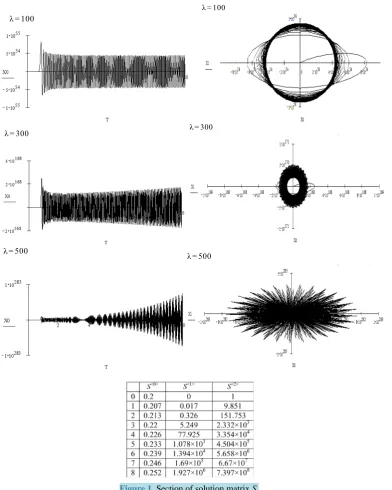
6.1. MathCAD Runge-Kutta Algorithm We define the following for the MathCAD algorithm.
t0: = 0.2 t1: = 10 Solution interval endpoint 0
: 1
ic =
Initial condition vector
N: = 1500 Number of solution values on [t0, t1]
(
)
(
)
1 2 2
0 2
0.25 , :
X D t X
X t
λ λ
−
=
− − ⋅
Derivative function
S: = rkfixed (ic, t0, t1, N, D) Runge-Kutta algorithm.
T: = S<0> Independent variable values.
X0: = S<1> First solution function values.
X1: = S<2> Second solution function values.
Remark: X0 represents solution values x satisfying the Bessel ODE, while X1 represents the derivative of X0
λ = 100
λ = 100
λ = 300 λ = 300
λ = 500 λ = 500
[image:9.595.123.516.82.573.2]
Figure 1. Section of solution matrix S.
6.3. Observations
For λ≥550 solutions no longer exist as they become unbounded. From the graphs shown, it is clear that the given Bessel differential equation is very sensitive to the parameter λ, and as λ→ ∞ the effect is to increase the oscillations until the solutions become unstable and die out. Furthermore, the phase portrait depicted shows that the Bessel differential equation represents a conservative system. This is clearly evident from the closed curves. However for λ=500, the phase portrait no longer appears like a closed curve but more like an explo-sion from the centre.
6.4. Conclusion
large parameter. We have shown that equations of this form represent a conservative system, meaning that they possess a conserved quantity, namely the Hamiltonian which is computed. As a special example, we consider the
Bessel differential equation 2 2 1 2 0 4
x+λ −λ − t− x=
for which the behaviour of the solutions as well as
the stability of the origin is investigated numerically as the parameter grows indefinitely.
References
[1] Olver, F.W.J. (1997) Asymptotics and Special Functions. Academic Press, New York. Reprinted by AK Peters, Wellesley.
[2] Shkil, M.I. (1971) Asymptotic Methods in Differential Equations. Vyshcha Shkola, Kyiv, 228 p.
[3] Territin, Kh.L. (1957) Asymptotic Expansion of Solutions to System of Ordinary Differential Equations Containing Parameter. Matematika: Sb. per., 1, 29-59.