Munich Personal RePEc Archive
Integration of migrants in Italy: A
simple general and objective measure
Di Bartolomeo, Anna and Di Bartolomeo, Giovanni
April 2007
Online at
https://mpra.ub.uni-muenchen.de/4421/
F
ACULTY OFC
OMMUNICATIONDepartment of Communication, Working Paper No. 10 – 2007
Integration of migrants in Italy: A simple
general
and
objective
measure
Anna Di Bartolomeo
Università di Roma “La Sapienza”
Giovanni Di Bartolomeo
Università degli Studi di Teramo
April, 2007
Abstract. Measuring migrants’ integration into host societies is a challenging task as, in general, measuring any social behavior and social phenomena. The task is affected by many specific problems related to the definition of the objective of study and the impact of subjective evaluations in the construction of an index. Our study aims to provide a measure of integration as much as possible general and objective. More
in details, first, we consider some different general aspects of the
integration problem related to migrants’ polarization, cultural diversification, social stability, integration in the labor market. Second,
we aggregate them in a synthetic linear index, which is rather objective
since the weights are computed by only considering the statistical properties of our dataset, i.e. choosing those weights that minimize the information loss in terms of data variances/co-variances.
1. Introduction
Understanding and monitoring the diversity that lies under migrants’ integration trends
is a challenge that policymakers must be able to face. The challenge is important for
governments and local administrations, but it is not limited to the national borders. The
issue is a general and faced by all European institutions at different levels. In this vein,
migrants’ integration can be placed in the more general issue of social cohesion, one of
the main policy targets of the European Union as the support of technological
innovation in the so-called Lisbon Strategy.
The migrants’ integration is also a challenging issue for its multi-disciplinary nature and
extended implications. Migrants’ integration is a socio-economic process that needs to
be understood of expertise that varies from psychology to law or geo-political
knowledge. Moreover, the growing impact of migrants on population affects other
policy debate from the reform of social security to the education system organization.
Political and socio-economic scientists as well as policymakers, in their current
activities, need quantitative data to evaluate the impact of policy and to understand and
monitor the current situation.
This paper attempts to derive a general index of integration. The aim of our index is to
give a general picture of integration reached and, in particular, of the differences among
Italian regions. The index is, of course, complementary to other indicators1 (as
specifically those related to specific micro-context) and not exhaustive of the
phenomenon because of the variety and extent of the migrants’ integration phenomenon.
The issue of measuring the integration of migrants into host societies is a challenging
task as, more in general, quantifying any social behavior and social phenomena. In
particular, measuring integration means evaluating two social processes since one
cannot look at the migrants alone, but also has to take the members of the host society
into consideration (see Borjas, 1994, 1999, Bauer and Zimmermann, 1997).2
The cornerstone for a measure of integration is its own definition since the concept of
what integration means and is to achieve differs. These differences are reflected in the
1
Other indicators will be later presented. 2
An interesting specific aspect is that of the sentiments of natives towards immigrants. See, e.g. Bauer et al. (2000), who explore the possibility that immigration policy may affect the labor market assimilation of immigrants and natives’ sentiments towards immigrants.
national policy goals and range from next-to-assimilation to multiculturalism. Different
definitions of what integration means form the basis of the national policies for
improving migrants' integration, the standard of when integration can be considered
successful varies.
This is important when it comes to compare the integration of migrants in different
countries and societies: It is because of these differences that the principal concepts of
integration and the different national policies resulting from these concepts need to be
looked at more closely, because they form the background for evaluating migrants’
integration. The national policies often reflect different definitions of what is meant by
integration. Although the term itself means joining parts (in) to an entity, its practical
interpretation and social connotation may vary considerably: Assimilation as well as
multicultural society may be considered synonyms or descriptions of (successful) integration. Thus, all forms of cultural or social behavior ranging from completely
giving up one’s background to preserving unaltered patterns of behavior are covered by
the term of integration. This problem of definition, of course, has a bearing on
measuring integration, because the requirements for success in assimilation are much
more difficult to meet than requirements for multicultural coexistence in a society that
remains indifferent about other people’s rites or customs.
Notwithstanding the definition or concept of integration applied, one will agree that the
integration of migrants into their respective host societies has at least four basic
dimensions concerning the social, economic and cultural (in terms of both assimilation
of the host society culture and of the native culture) role migrants play in their new
environment. We can summarize integration in four dimensions:
1) the degree of polarization,
2) cultural diversification,
3) social stability,
4) integration in the labor market.
These four dimensions will hardly be disputed by anybody as important fields of
integration. See, among others, Borjas (1994), Freeman (1995), Hansen (1999), Rogers
Penninx (2004), Geddes and Niessen (2005), which deeply discuss and survey different
integration aspects.
This paper considers the above dimensions of interaction and by taking account of them
provides an aggregate measure of integration. The task of measuring integration is
affected by many specific problems related to the definition of the objective of study
and the impact of subjective evaluations in the construction of the index, these aspects
cannot be neglected. This paper aims to provide a measure of integration as much as
possible general and objective. We consider the aforementioned aspects of integration
and aggregate them in a synthetic one-dimensional index by using the principal
component analysis. Our index is computed at a regional level; thus, it ranks region
levels of integration.
There are some related studies to our paper. The first is a CNEL study of 2004 (CNEL,
2004). This study investigates the regional differences by considering the four
dimensions above described. It aggregates twenty indicators by a simple ordinal
procedure. We will describe it more in detail in the next sections since our dataset is
based on this study. Another attempt to measure general integration is provided by the
Italian Commission for integration policy,3 which proposed the concept of “reasonable
integration” founded on no discrimination and of inclusion of differences. This concept
can be related to two dimensions of integration: integrity of the individual and positive
integration. The former means well-being and the latter living together peacefully (see
Zincone, 2000, 2001).
All aforementioned studies are inspired by the Council of Europe guidelines in terms of
social cohesion (Council of Europe, 2000) and are in line with the European debate on
migrants’ integration. In 2003, the European Commission has underlined the priorities
and political orientations on the consolidation of a legal European structure on
immigration, the strengthening of coordination policies, the attention towards processes
of integration and social inclusion, including attempts to have detailed and statistically
homogeneous information on the evolvement of the migratory fluxes.4 The OECD also
3
See Golini et al. (2001). 4
See the European Commission Report on immigration, integration and employment, 2003. See also the
First report on integration and immigration in Europe (2004), the Handbook on integration (2005), the
stress that to be effective, integration actions need to be based on the gathering and
analysis of information (see OECD, 2006)
The studies of the CNEL and Commission for integration policy attempt to give the
general picture of the integration in Italy. However, it should be note that specific
indexes are as much important since migrants’ integration has a specific nature that
varies according to the different dimensions under scrutiny or a geographical diminution
that can have a high degree of heterogeneity. Although we do not survey these indexes5
here because we also aim to build a general index, we would like to underline that the
policymaker needs of both to coordinate their decisions at a micro and macro levels.
Geddes and Niessen (2005) develop the “European civic citizenship and inclusion
index,” which is an attempt to measure the potential effectiveness of the actions
implemented by several member states as “civic citizenship” policies and for the job
market. The index is not related to the success of the immigrants’ integration process,
but it measures if the legal conditions to support such a goal have been created. The
inclusion indicators were chosen for each of the five legal fields that seemed to be more
relevant for integration: 1) labor market, 2) residence, 2) family reunion, 4)
naturalization, 5) addressing discrimination.
The rest of the paper is structured as follows. Section 2 describes our dataset, which is
collected by CNEL (2004). Section 3 compares our aggregation methodology to that
used in CNEL (2004). Section 4 derives and comments our result. A final section
occludes our work.
2. Integration and our data
At the beginning of 2004, according to the data of the Ministry of Interior Affairs,
regular migrants in Italy were 2.2 millions. The data of the Ministry is the most relevant
for policy analysis and refers to the people who have requested a residence permit. This
data underestimates migrants since it does not takes account of the migrants under 18
years. Each year, the data is corrected by the CARITAS report on migration; in 2004
migrants are estimated as 2.6 millions. Migrants thus represents about 4.5% of the
5
Italian population (one migrant each 22 residents) and by considering the net flow,
which is 681.665 units, their number is increased of 45% between 2003 and 2004 (cf.
CARITAS, 2004). Migrants are also reordered by ISTAT, which consider the census
data. The unit of observation of the census data is the resident migrants, who are
migrants registered at the General Registry Office a sub-sample of migrants who have
requested the residence permit (registered by the Ministry for Interior Affairs). The first
of January 2004, the resident migrants were 1.990.159 (978.232 female and 1.011.927
male). The resident migrants were thus the 3.4% of the total number of residents with an
increase with respect to the previous year of 28.4%.
All the data register the growing relevance of the migrants’ dimension and thus of the
associated problems and perspectives. Migrants have a heterogeneous composition and
distribution in the territory. Their incidence is stronger in the Northern and Central
regions. The most represented foreign nationalities are Rumania, Morocco and Albania,
followed by Ukraine and China. However, migrants are uneven distributed since they
tens to concentrates according to their nationality; an emblematic case is that of the
Chinese in the province of Prato, who represent almost the 100% of the migrants and
more than the 50% of the population.
Italy becomes a country of immigration in the 1970s from a long experience of
emigration. Although it is a country that only recently experienced this phenomenon, it
has already face the evolution of the immigration process from the first to the second
generations and a growing number of new problem related to the integration. The
change from the emigration to the immigration perspective and the economic impact of
the immigration are described in details by Del Boca and Venturini (2005).
In 30 years, integration thus becomes a very lively debated issue as well as the policies
supporting it important in both the domestic and the European,6 the problem of
international is, in fact, related to the more general discussion on the European welfare
system (see Boeri et al. 2002). The debate is complex and articulated. The common
departing point should be however that of measuring integration both for positive and
normative analysis. Integration can be measured by different factors that can be grouped
in subjective and objective measures. After a long preliminary study, CNEL (2004) has
6
summarized information about integration in some indicators, which represents our
dataset.7 It collects a group of indicators that represent the migrants’ integration under
different perspectives. More in details, CNEL individuates twenty key indicators, which
are describes below.
1. Incidence (INC) measures the quota of foreign residents on the total number of
residents in each region.
2. Incremental indicator (INR) measures the percent variation of foreign residents
between 1992 and 2002.
3. Permanence (PER) is the proportion of net migrant flows (residence permits
released in the year and still valid at the end of the year) on the gross flows
(residence permits released in the year).
4. Flow indicator (FLU) is the incidence of the new net flow of migrants on the
total amount of resident foreigners.
5. Pluralism indicator (PLU) is the number of foreign nationalities represented by
foreign resident in each region.
6. National heterogeneity 1 (ET1) measures the incidence of the largest foreign
national group on the total amount of foreign residents.
7. National heterogeneity 2 (ET2) measure the incidence of the ten foreign groups
more present on the total number of migrants.
8. Continental heterogeneity (ETC) is the degree of diversification of the
continental representatives, which is computed among the 10 foreign groups
more numerous within the migrants, It is build by an index number that
considers the migrants’ continental areas, the number of migrants’ ethnic groups
of the continent more represented (for more details, see CNEL, 2004).8
9. Religious difference (REL) measures the heterogeneity of the regional
confessions among migrants. It is the number of people accepting the more
diffused religious confession on the number of migrants.
7
The dataset is presented in the appendix (see Table 1.A). 8
10.Family reunion (RIC) is the incidence of foreign resident for family reasons on
the total amount of them.
11.Long (LUN) measures the long stays, i.e. the incidence of migrants who are
present from at least 10 years on the total number of migrants in 2000.
12.Citizenship (CIT) is the yearly number of foreign resident who acquire the
Italian citizenship for every 1.000 foreign residents.
13.Stability residence (STA) indicates the incidence of stable residents on the total;
stable residents are people resident for job, adoption, rejoining, study, religion,
elective residence, waiting for citizenship.
14.Deviance (DEV) is the incidence of resident foreigners complained to the police
authorities on the total number of resident foreigners (2001).
15.Potential employment (OCP) is the incidence of the foreign labor force on total
of foreign residents.
16.Effective employment (OCE) is the percentage of the foreign unemployed on the
foreign labor force.
17.Labor market sustainability (LAV) corresponds to the migrants’ incidence of the
net yearly flow of migrants hiring on the total number of net hiring;
18.Entrepreneurship (IMP) is the proportion of foreign entrepreneurs on the total
number of foreign citizens.
19.Work injury (INF) is the percentage of indemnities paid to foreign citizens on the
total indemnities in 2001.
The above indicators can be grouped according to the integration dimension they
capture. More in details, PER, INC, PRE, INR, FLU can be related to the degree of
polarization; ET1, ET2, ETC, REL, LUN can be associated to the cultural
diversification; STA, RIC, DEV, PLU, CIT concern about the social stability; and LAV,
OCE, OCP, INF and IMP summarize the integration in the labor market. In the next
section we critically describe how these indicators are aggregated by the CNEL study
Finally note that, as it will be later clear, to perform our analysis it is convenient to
consider quantitative indicators that display a value of zero for the lower possible level
of integration. Thus, our indicators are slightly different from the original data of
CNEL. We transformed some original data to obtain positive (increasing) measures of
integration and a zero measure for no integration. More in detail, we considered the
complement to one of the following indicators: ET1, ET2, DEV, OCE, INF and REL,
which in the original dataset are negative (decreasing) measures of integration. In our
framework, the interpretation of the indicators is exactly opposite to the original one
and the transformation is without any loss of generality since all variables were
expressed in percentage terms. For instance, consider OCE, in the original data set it
indicates the incidence of the unemployed on the total labor force within migrants; a
high value measures a low integration. By contrast, in our setup OCE indicates the
complement to one of the original variable, i.e. the incidence of the employed on the
total labor force within migrants and high values of OCE measure a high integration.
3. The CNEL aggregation and our methodology
The CNEL index is obtained by a two-step aggregation procedure. First all the
indicators are transformed in ordinal variables. Each of the 20 indicators is ordered and
a number between 1 and 20 assigned, 20 is also the number of observations i.e. the
Italian regions, 20 (1) for the highest (lowest) score, which indicates the best (worst)
performance in terms of integration. At the end each region is thus classified on the
basis of its ordinal rank.9 Second, transformed indicators are aggregated by simple sum
of the region scores. There are two levels of aggregation. The first one is partial and
measures the integration under the different aforementioned four dimensions of the
integration by considering only the indicators that refer to a specific dimensions (i.e.
polarization; cultural diversification; social stability; integration in the labor market);
the second measures the general level of integration and takes account of all of them.
For instance, after the dataset transformation in ordinary values, by summing the scores
of Abruzzo in PER, INC, PRE and INR, we obtain the value for the index of
9
polarization for Abruzzo, by summing all the indicators we derive the score of CNEL
integration index for Abruzzo.
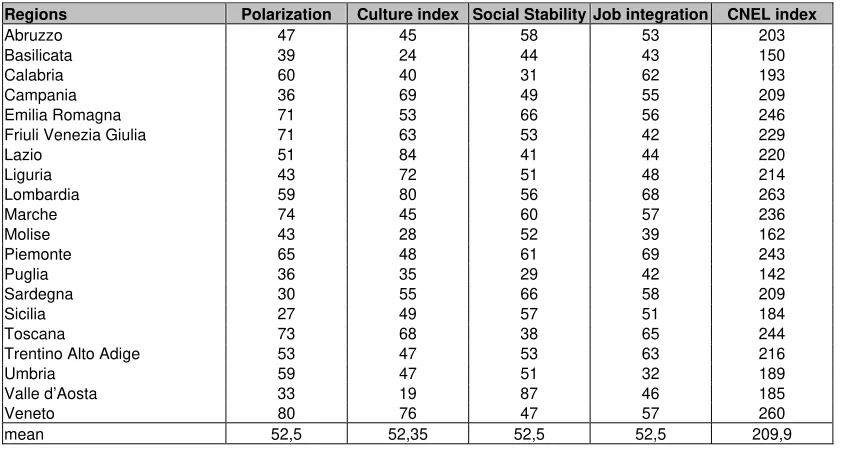
The four sub-indexes and the CNEL integration index obtained as described above are
[image:11.595.83.507.232.463.2]reported in the following table.
Table 2 – The CNEL indexes.
Regions Polarization Culture index Social Stability Job integration CNEL index
Abruzzo 47 45 58 53 203
Basilicata 39 24 44 43 150
Calabria 60 40 31 62 193
Campania 36 69 49 55 209
Emilia Romagna 71 53 66 56 246
Friuli Venezia Giulia 71 63 53 42 229
Lazio 51 84 41 44 220
Liguria 43 72 51 48 214
Lombardia 59 80 56 68 263
Marche 74 45 60 57 236
Molise 43 28 52 39 162
Piemonte 65 48 61 69 243
Puglia 36 35 29 42 142
Sardegna 30 55 66 58 209
Sicilia 27 49 57 51 184
Toscana 73 68 38 65 244
Trentino Alto Adige 53 47 53 63 216
Umbria 59 47 51 32 189
Valle d’Aosta 33 19 87 46 185
Veneto 80 76 47 57 260
mean 52,5 52,35 52,5 52,5 209,9
Source: CNEL (2004).
According to the CNEL results, Italy is divided in three areas of integration. Above the
average: Lombardia, Veneto, Emilia Romagna, Toscana, Piemonte, Marche and Friuli
Venezia Giulia, respectively; close to the average: Lazio, Trentino Alto Adige, Liguria,
Campania, Sardegna, Abruzzo and Calabria; below the average: Umbria, Valle d’Aosta,
Sicilia, Molise, Basilicata and Puglia. The index emphasizes regional heterogeneities
and an easier integration in the North of the country. Regions also display certain
heterogeneity.
The procedure followed by CNEL to build the index has two main limitations:
1. It does not consider the relative distance among regions (by assuming an ordinal
score to the region according to their absolute position);
2. It attributes the same weight (1/20) to all variables in the construction of the
Our aim is to obtain an index that takes account of the above criticisms by using an
alternative procedure of aggregation. We directly aggregate the 20 indicators described
in Section 2 without transforming them by the principal component analysis.
Principal components analysis is one of the best-known and earliest ordination methods,
first described by Karl Pearson (1901). The underlying idea is to reduce the
dimensionality of the dataset by retaining its variability as much as possible and derive
synthetic indices of integration. Formally, it consists of an eigen-analysis of a
covariance or correlation matrix calculated on the original measurement data.
The principal component analysis searches for a few uncorrelated linear combinations
(principal components) of the original variables that capture most of the information in
the original variables.10 In the bi-dimensional case, one can summarize the correlation
between two variables by a scatter plot and a regression line. The regression line
represents the best summary of the linear relationship between the variables. If we could
define a variable that would approximate the regression line, that variable would capture
most of the essence of the two original variables, i.e. the dataset. The subjects’ single
scores on that new factor, represented by the regression line, could then be used in
future data analyses to represent that essence of the two items. In a sense, we have
rebuilt the two variables to one factor or component – the factor is in fact a vector made up of two numbers that can be conceived as weights on the former variables. Note that
the new factor is actually a linear combination of the two variables and its significance
increases in the two-variable correlation.
The example described above, which combines two correlated variables into one factor,
illustrates the basic idea of principal components analysis. If we extend the two-variable
example to multiple variables, then the computations become more involved, but the
basic principle of expressing two or more variables by a single factor remains the same.
By considering more than two variables, we can think of them as defining a space, just
as two variables defined a plane. Thus, when we have three variables, we could plot a
10
three-dimensional scatter plot, and, again we could fit a plane through the data (a plane
will individuate by two orthogonal lines). In the principal components analysis, after the
first factor has been extracted, that is, after the first line has been drawn from the data,
we continue and define another line that best fits the remaining variability, and so on. In
this manner, consecutive factors are extracted.
The principal component analysis can be performed by considering centered and non-
centered data. In the latter original data are used. In the former entries of the matrix of
data are transformed in deviations from the mean of the variables. The difference
between the two procedures is however not trivial and we need to discuss it as it is
relevant for our investigation. Non-centered principal components analysis implies an
all-zero point (vector) of reference: no interlock linkages. By contrast, centering on, or
normalizing by, some variables shifts the reference points to a hypothetical average
stand.11 Our benchmark is the case of no integration and we are attempting to find a
measure of how much each region differs from this reference point, we thus consider
the non-centered analysis, i.e. the zero vector as benchmark i.e. no integration.12
4. Empirical results
The principal component analysis produces a synthetic picture of a dataset by reducing
the loss of information, i.e. in term of explained variance. The principal component
analysis extracts, from the data matrix, the linear weights (loading) used to build an
index (component) from the data. One the first component is extracted, the process is
replicated and a second one obtained. The second component is the set of weights that
minimize the explained variance under the additional constraint of obtaining a
component uncorrelated to the first one. The process can be replicated as the number of
components is equal to the number of variables and all the expected variance is
replicated.
The principal component analysis can be performed by using either the mean deviations
(centered analysis) or not (non-centered analysis). The former synthesizes the sample
variability with respect to a hypothetical average observation (region, in our case). The
11
See Di Bartolomeo and Marchetti (2003) or Carbonai and Di Bartolomeo (2006) for discussions about the two procedures for some specific cases. See Noy-Meir (1973) for a general discussion.
12
latter investigates the variability with respect to an hypothetical region scoring zero to
all observed variables, which correspond to a region with the minimum degree of
integration. Moreover, the principal component analysis can be performed by
considering either the standardized or the non-standardized variables. The best
methodological choice depends on the researcher’s aim and the problem under scrutiny.
We consider standardized variables in a non-cantered analysis. We standardize the
variables to eliminate the effects of the unit of measure since not all the variables are
expressed in terms of ratio and as already claimed we use the non-centered analysis
[image:14.595.85.510.320.488.2]since our benchmark is the worst case of no integration.
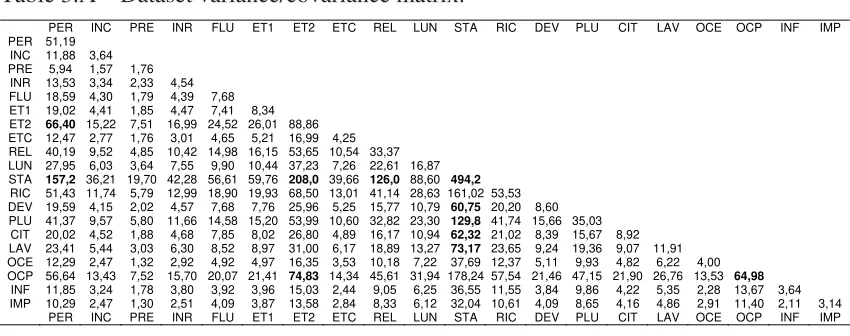
Table 3.A – Dataset variance/covariance matrix.
PER INC PRE INR FLU ET1 ET2 ETC REL LUN STA RIC DEV PLU CIT LAV OCE OCP INF IMP PER 51,19
INC 11,88 3,64
PRE 5,94 1,57 1,76
INR 13,53 3,34 2,33 4,54
FLU 18,59 4,30 1,79 4,39 7,68
ET1 19,02 4,41 1,85 4,47 7,41 8,34
ET2 66,40 15,22 7,51 16,99 24,52 26,01 88,86
ETC 12,47 2,77 1,76 3,01 4,65 5,21 16,99 4,25
REL 40,19 9,52 4,85 10,42 14,98 16,15 53,65 10,54 33,37
LUN 27,95 6,03 3,64 7,55 9,90 10,44 37,23 7,26 22,61 16,87
STA 157,2 36,21 19,70 42,28 56,61 59,76 208,0 39,66 126,0 88,60 494,2
RIC 51,43 11,74 5,79 12,99 18,90 19,93 68,50 13,01 41,14 28,63 161,02 53,53
DEV 19,59 4,15 2,02 4,57 7,68 7,76 25,96 5,25 15,77 10,79 60,75 20,20 8,60
PLU 41,37 9,57 5,80 11,66 14,58 15,20 53,99 10,60 32,82 23,30 129,8 41,74 15,66 35,03 CIT 20,02 4,52 1,88 4,68 7,85 8,02 26,80 4,89 16,17 10,94 62,32 21,02 8,39 15,67 8,92 LAV 23,41 5,44 3,03 6,30 8,52 8,97 31,00 6,17 18,89 13,27 73,17 23,65 9,24 19,36 9,07 11,91
OCE 12,29 2,47 1,32 2,92 4,92 4,97 16,35 3,53 10,18 7,22 37,69 12,37 5,11 9,93 4,82 6,22 4,00 OCP 56,64 13,43 7,52 15,70 20,07 21,41 74,83 14,34 45,61 31,94 178,24 57,54 21,46 47,15 21,90 26,76 13,53 64,98
INF 11,85 3,24 1,78 3,80 3,92 3,96 15,03 2,44 9,05 6,25 36,55 11,55 3,84 9,86 4,22 5,35 2,28 13,67 3,64 IMP 10,29 2,47 1,30 2,51 4,09 3,87 13,58 2,84 8,33 6,12 32,04 10,61 4,09 8,65 4,16 4,86 2,91 11,40 2,11 3,14
PER INC PRE INR FLU ET1 ET2 ETC REL LUN STA RIC DEV PLU CIT LAV OCE OCP INF IMP
By using the above matrix, we obtain the loadings indicated in Table 2 for the first
component as result of a non-centered principal component analysis on standardized
data.
Table 2 – First component loadings.
Indicators (1/2) Loadings (1/2) Indicators (2/2) Loadings (2/2)
The first component explains the 99% of sample variance; we thus do not consider the
other components, which are reported in the appendix. The indicators that contribute
more to the index are emphasized.
The region scores are reported in the following table that also indicates the average
[image:15.595.85.513.274.498.2]deviation from the average region.
Table 2 – Integration index.
Regions Integration index Average % deviation
Marche 13,018 3,04%
Friuli Venezia Giulia 12,881 1,95%
Lombardia 12,874 1,90%
Trentino Alto Adige 12,874 1,90%
Piemonte 12,854 1,74%
Veneto 12,841 1,64%
Lazio 12,830 1,55%
Umbria 12,827 1,52%
Emilia Romagna 12,760 0,99%
Abruzzo 12,736 0,80%
Sardegna 12,730 0,76%
Valle d’Aosta 12,695 0,48%
Toscana 12,626 -0,07%
Sicilia 12,590 -0,35%
Campania 12,489 -1,15%
Puglia 12,377 -2,04%
Liguria 12,369 -2,10%
Molise 12,326 -2,44%
Basilicata 12,235 -3,16%
Calabria 11,756 -6,95%
Mean 12,634 0.00%
The table describes the index (left column) and the percentage deviation of each region
with respect to the Italian regional average (right column). Marche, Friuli Venezia
Giulia, Lombardia are above the average. Emilia Romagna, Abruzzo, Sardegna, Val
d’Aosta, Toscana and Sicilia are closet o the average. Campania, Puglia, Liguria,
Molise, Basilicata and Calabria are below the average. Marche achieves the best
performance (3,04% above the average), Calabria the worst one placing itself largely
below the average (-6,95%). The index displays great and net heterogeneity in favor of
the North Regions.
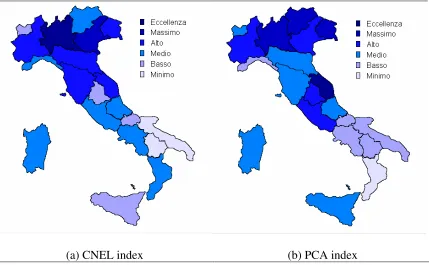
Figure 1 – A comparison between the CNEL index and our index.
(a) CNEL index (b) PCA index
According to our index, the most integrated region is Marche, instead of Lombardia
(CNEL index), which is one of the most integrated regions, but it occupies only the
third position in PCA index. The distance between the North and the South of Italy is
magnified, whereas the performance of the central Italy is greatly improved.
5. Conclusions
Measuring migrants’ integration into host societies is a challenging task sine the many
specific problems related to the definition of the objective of study and the impact of
subjective evaluations in the construction of an index cannot be neglected. In this study,
we have provided a measure of migrants’ integration relatively general and objective.
We have considered some important aspects of integration by taking account of 20
indicators, derived from a preliminary CNEL study that have derived these indicators
from a more large set. The 20 indicators measure different general aspects of migrants’
integration about polarization, cultural diversification, social stability, integration in the
labor market at a regional level. Then we have aggregated these indicators in a linear
computed by only considering the statistical properties of the dataset. In other words,
weights have been chosen by minimizing the dataset information loss.
Our study shows a further element of division between the North and South of Italy,
which is alarming news and a public policy field since the growing relevance of the
immigration problem. We have in fact found that Italy can be divided in some different
macro regions with very different levels of integration. In particular, by comparing our
results to those of previous studies, we found that there is not a substantial difference
between the North and Centre Italy, many central regions performs better than those of
the North. In contrast, the difference between North and South Italy is more than that
previously documented. The performance of the Sicily and Sardinia is more close to
that of the regions at the bottom of the North Italy that to that of the southern regions.
Acknowledgments
We are grateful to Antonella Guarnieri for her comments on previous versions.
References
Bauer, T. and K.F. Zimmermann (1997), 'Integrating the East: The labor market effects
of immigration,' in: S.W. Black (ed.), Europe’s economy looks East - Implications for
Germany and the European Union, Cambridge, Cambridge University Press, 269-306. Bauer, T., M. Lofstrom and K.F. Zimmermann (2000), “Immigration policy, assimilation of immigrants and natives’ sentiments towards immigrants: Evidence from
12 OECD countries,” Swedish Economic Policy Review, 7: 11-53.
Billotta, E, A. Di Bartolomeo, A. Guarneri, M. Simone (2006), “Opinioni e atteggiamenti degli studenti: un’indagine nelle scuole medie del Lazio”, Proceedings of
the Conference on Giornata studio sull’integrazione dei minori immigrati nelle scuole
at the University of Rome La Sapienza.
Boeri, T., G. Hanson and B. McCormick (2002), Immigration policy and the welfare
system, Oxford University Press, Oxford.
Borjas, G.J. (1994), “The economics of immigration,” Journal of Economic Literature,
32: 1667-1717.
Borjas, G. J. (1999), “The economic analysis of immigration,” in O. Ashenfelter and D.
Card (editors), Handbook of Labor Economics, Vol. 3A, New York, North Holland.
CNEL (2004), “Immigrazione in Italia. Indici di inserimento territoriale. III Rapporto,” CNEL, Roma.
Del Boca D. and A. Venturini (2005), “Italian migration,” in Zimmermann (2005): 303-336.
Di Bartolomeo, G. and E. Marchetti (2004), “Central banks and information provided to
the private sector,” BNL Quarterly Review, 230: 265-297.
Entzinger H. and Biezveld R. (2003), Benchmarking on immigrant integration, report
for the European Commission by European Research Centre on Migration and Ethnic
Relations (ERCOMER), EU project No. DG JAI-A-2/2002/006.
Freeman, G. (1995), “Modes of immigration politics in liberal democratic states.”
International Migration Review 29: 881-902.
Geddes A. and J. Niessen (edotors) (2005), European civic citizenship and inclusion
index, Foreign Policy Center, Migration Policy Group, British Council Brussels, Brussels.
Golini A., S. Strozza, F. Amato (2001), “Un sistema di indicatori di integrazione: primo tentativo di costruzione,” in Zincone (2001).
Gregori E. and L. Mauri (2005), “Un paniere di indicatori per il monitoraggio
dell’integrazione sociolavorativa degli immigrati” in Dinamiche di integrazione
sociolavorativa di immigrati. Ricerche empiriche in alcuni segmenti del mercato del lavoro lombardo edited by Cologna D., E. Gregori, C. Lainati, L. Mauri, Synergia, Guerini e Associati, Milan.
Gregori, E. (2006), “Indicators of migrants’ socio-professional integration,” FEEM Nota di Lavoro No 59.
Hansen, R. (1999), “Migration, citizenship and race in Europe: Between incorporation
and exclusion,” European Journal of Political Research 35: 415-444.
Jolliffe, I.T. (1986), Principal components analysis. Springer-Verlag, Berlin.
Noy-Meir, I. (1973), “Data transformation in ecological ordination: I. Some advantage
of non-centering,” Journal of Ecology, 61: 329-341.
OECD (2006), From immigration to integration: Local solutions to a global challenge,
OECD, Paris.
Penninx, R., K. Kraal, M. Martiniello and S. Vertovec (2004), Citizenship in European
Cities: Immigrants, Local Politics and Integration Policies. Aldershot, Ashgate.
Rogers A. and J. Tillie (2001), Multicultural policies and modes of citizenship in
European cities. Aldershot, Ashgate.
Zincone, G. (editor) (2000), Primo rapporto sull’integrazione degli immigratiin Italia,
Commissione per le politiche di integrazione degli immigrati, Il Mulino, Bologna.
Zincone, G. (editor) (2001), Secondo rapporto sull’integrazione degli immigrati in
Italia, Commissione per le politiche di integrazione degli immigrati, Il Mulino, Bologna.
Zimmermann K.F. (2005), European migration: What do we know?, Oxford University
Appendix A – The data set
Table 1.A – CNEL data.
Region PER INC PRE INR FLU PLU ET1 ET2 ETC REL LUN STA RIC CIT DEV OCP OCE LAV IMP INF ABR 38 64,1 1,4 2,8 12,3 142 21,6 65,9 6 35,2 16,9 96,2 42,7 12,4 8,7 46,4 2,9 13 5,2 7,11 BAS 34,9 82,2 0,23 1,05 15 99 32,4 76,3 16 51,2 18,1 93,7 37,1 12 13,1 48,8 7 21,1 0,3 3,2 CAL 41,1 84,8 1,2 1,8 24,8 135 27,7 65 17 50,9 25,5 78,3 28,8 7,56 11,1 42,9 18,8 26,2 11,3 1,9 CAM 36,2 2,1 3,9 2,2 7,2 153 17,5 66,5 14 28,7 27,3 94,5 40,7 4,4 7,6 47,8 9,7 24,1 3,8 2,1 EMI 40,8 110 10 6 9,7 166 17,7 61,3 2 48,7 27,7 97,7 31,8 5,8 5,1 60,2 4,51 14,8 4,92 13 FRI 42,9 75,6 3,2 5,2 13 155 13,1 67,9 6 29,2 22 93,4 36,2 7,7 6,16 47,9 4,1 15,5 3,4 15 LAZ 36 4,3 15,8 7,8 6,7 183 9,9 49 11 36,9 33,4 96,1 22,8 4,45 6,23 49,5 6,9 15,5 2,7 5,1 LIG 40,4 19,5 2,4 3,9 9,8 150 13,3 53,4 9 34,9 28,5 96,8 31,6 9 14,2 50,2 7,3 21,5 2,6 4,4 LOM 25,3 108 23 6,5 7,15 174 11,7 53,6 15 39,8 26,1 97,9 30,4 4,7 5,4 61 4,29 21,7 4,86 11,3 MAR 47,1 204 3,1 4,9 11,2 145 18 61,8 4 43,8 18,2 97,5 36,4 7,61 6 52,8 2,6 17,2 2,97 11,4 MOL 40,9 46,9 0,16 1,2 21,8 91 22,2 70,3 5 38,5 20,8 92,1 41,3 13,9 12,4 38,3 5,1 9,8 3,03 3 PIE 38,3 117 7,1 4,4 10,3 165 22,9 67,7 13 44,2 23,6 97,5 34,1 7,64 6,6 57,3 6,1 22,1 6,5 6,7 PUG 29,3 63,1 2,1 1,3 12,5 141 40,2 67,4 19 51,7 14,5 91,3 33,9 7 8,8 48,5 4,52 12,5 1,9 2,8 SAR 29,4 63,5 0,8 1,06 11,6 131 16,1 62,1 10 35,8 33,6 94,5 37,5 9,5 7,7 40,4 4,26 7,5 12 1,8 SIC 35,5 -23,5 3,3 1,7 7,1 148 19,1 74,6 20 43,3 36,8 95,8 35,8 5,7 7,5 53,7 8 14 3,9 3,1 TOS 41,3 90,4 7,4 5,3 11,2 164 18,2 62,1 12 33,2 21,5 96,7 31 6,4 9,1 51,8 4,28 19,1 5,3 6,5 TRE 34,4 95,2 2,6 5,6 10,1 144 14,3 69 1 34,1 25,4 97,6 27,8 5,5 5,2 62 3,2 23,4 2,1 13,3 UMB 39,1 66,9 2 6,2 11,5 150 20,1 61,6 3 39 19,6 96,9 32,2 5,2 4,1 52,1 5,5 9,2 0,7 10,5 VAS 35,7 67 0,19 3,5 8,2 91 30,4 73,6 8 50,3 35,1 97,8 36,5 8,9 4,8 53,8 8,2 20,7 2,8 7,14 VEN 46,1 154 10,2 5,5 10,3 162 15,2 60,9 18 38,8 20,4 97 33,4 5,1 6,1 58,8 3,5 14,8 4,4 14 Mean 37,6 74,8 5,0 3,9 11,6 144 20,1 64,5 10,5 40,4 24,8 95,0 34,1 7,5 7,8 51,2 6,0 17,2 4,2 7,2
Table 2.A – Ranking of the regions.
[image:20.595.86.517.411.626.2]Table 3.A – PCA results
Axis 1 Axis 2 Axis 3 Axis 4 Axis 5 Axis 6 Eigenvalues 3194.2 5.527 1.759 1.432 1.263 1.192 Percentage 99.431 0.172 0.055 0.045 0.039 0.037 Cumulative Percentage 99.431 99.603 99.658 99.702 99.74 99.78 PCA variable loadings
Axis 1 Axis 2 Axis 3 Axis 4 Axis 5 Axis 6
PER 0.125 0.08 -0.186 0.012 0.005 -0.078
INC 0.026 0.054 -0.596 -0.079 0.027 -0.031
PRE 0.016 -0.335 -0.035 -0.037 0.098 0.144
INR 0.034 -0.298 -0.363 -0.096 0.096 0.121
FLU 0.045 0.321 -0.038 0.141 -0.102 -0.158
ETC 0.032 0.055 0.393 0.128 0.001 -0.033
LUN 0.071 -0.116 0.526 0.107 0.028 0.031
STA 0.393 0.030 0.010 -0.148 0.128 -0.142
RIC 0.128 0.367 -0.004 -0.084 0.197 -0.206
PLU 0.103 -0.295 0.010 0.027 -0.119 0.098
CIT 0.050 0.367 0.009 -0.099 -0.12 -0.181
LAV 0.058 -0.112 -0.027 0.460 0.653 0.033
OCP 0.142 -0.243 0.010 0.066 0.117 0.065
IMP 0.026 0.085 -0.204 0.825 -0.309 -0.046
ET1 0.191 -0.129 0.024 0.000 -0.329 -0.008
ET2 0.092 -0.233 0.000 0.000 -0.491 0.074
DEV 0.577 -0.070 0.000 0.000 0.000 -0.149
OCE 0.477 -0.059 0.000 0.001 0.000 -0.126
INF 0.372 0.348 -0.001 -0.002 0.000 0.769
REL 0.149 -0.181 0.000 0.000 0.005 -0.428
PCA case scores
Axis 1 Axis 2 Axis 3 Axis 4 Axis 5 Axis 6 Abruzzo 12,736 0.479 -0.153 -0.140 -0.117 -0.318 Valle Aosta 12,695 0.381 0.235 -0.052 0.479 0.171 Basilicata 12,235 0.857 0.120 -0.168 0.456 0.185 Calabria 11,756 0.592 -0.014 0.913 -0.119 0.445 Campania 12,489 -0.183 0.379 0.150 0.274 -0.346 Emilia Romagna 12,760 -0.519 -0.272 -0.055 -0.074 -0.098 Friuli Venezia Giulia 12,881 0.028 -0.193 -0.118 -0.061 -0.143
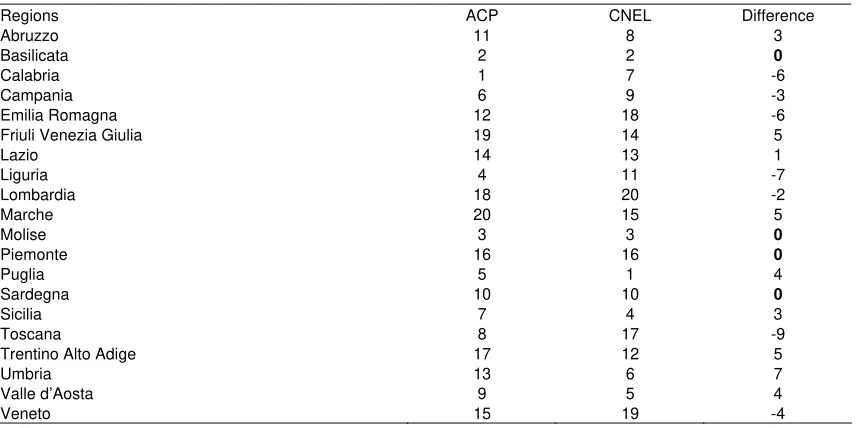
Table 2.B – Index comparison.
Regions ACP CNEL Difference
Abruzzo 11 8 3
Basilicata 2 2 0
Calabria 1 7 -6
Campania 6 9 -3
Emilia Romagna 12 18 -6
Friuli Venezia Giulia 19 14 5
Lazio 14 13 1
Liguria 4 11 -7
Lombardia 18 20 -2
Marche 20 15 5
Molise 3 3 0
Piemonte 16 16 0
Puglia 5 1 4
Sardegna 10 10 0
Sicilia 7 4 3
Toscana 8 17 -9
Trentino Alto Adige 17 12 5
Umbria 13 6 7
Valle d’Aosta 9 5 4