R E S E A R C H
Open Access
Iterative methods for split variational
inclusion and fixed point problem of
nonexpansive semigroup in Hilbert spaces
Dao-Jun Wen
*and Yi-An Chen
*Correspondence:
[email protected] College of Mathematics and Statistics, Chongqing Technology and Business University, Chongqing, 400067, China
Abstract
In this paper, we introduce a general iterative method for a split variational inclusion and nonexpansive semigroups in Hilbert spaces. We also prove that the sequences generated by the proposed algorithm converge strongly to a common element of the set of solutions of a split variational inclusion and the set of common fixed points of one-parameter nonexpansive semigroups, which also solves a class of variational inequalities as an optimality condition for a minimization problem. Moreover, a numerical example is given, to illustrate our methods and results, which may be viewed as a refinement and improvement of the previously known results announced by many other authors.
MSC: 47H09; 47H10; 47J22
Keywords: split variational inclusion; nonexpansive semigroup; fixed point; averaged mapping; general iterative method
1 Introduction
LetHandHbe real Hilbert spaces with inner product·,·and norm · , respectively. Recall that a mappingT:H→His called nonexpansive if
Tx–Ty ≤ x–y, ∀x,y∈H.
A one-parameter familyT :={T(s) : ≤s<∞}is said to be a nonexpansive semigroup onHif the following conditions are satisfied:
() T()x=xfor allx∈H;
() T(s+t) =T(s)T(t)for alls,t≥;
() T(s)x–T(s)y ≤ x–y, for allx,y∈Hands> ;
() for eachx∈H, the mappings→T(s)xis continuous.
Denote byFix(T) the common fixed point set of the semigroupT,i.e.,Fix(T) :={x∈ H:T(s)x=x,∀s> }. It is well known thatFix(T) is closed and convex (see Lemma in Browder []).
Recently, the fixed point problem of nonexpansive mappings and its iterative methods have become an attractive subject, and various algorithms have been developed for solving variational inequalities and equilibrium problems; see [–] and the references therein. In
, Marino and Xu [] introduced the following general iterative methods to approxi-mate a fixed point of a nonexpansive mapping:
xn+=αnγf(xn) + (I–αnB)Txn, (.)
whereαn∈[, ] satisfies certain conditions,f is a contraction ofHinto itself, andBis a strongly positive bounded linear operator onH. Moreover, they prove that{xn}converges
strongly tox∗∈Fix(T), the unique solution of the following variational inequality:
(B–γf)x∗,x∗–w≤, ∀w∈Fix(T),
which is also the optimality condition of the minimization problem. Thereafter, Liet al.[] and Cianciarusoet al.[] modified the general iterative method (.) to the case of non-expansive semigroups and equilibrium problems. To obtain a mean ergodic theorem of nonexpansive mappings, Shehu [] proposed an iterative method for nonexpansive semi-groups, variational inclusions, and generalized equilibrium problems.
Recall also that a multi-valued mappingM:H→His called monotone if, for allx,y∈
H,u∈Mxandv∈Mysuch that
x–y,u–v ≥.
A monotone mappingMis maximal if theGraph(M) is not properly contained in the graph of any other monotone mapping. It is well known that a monotone mappingMis maximal if and only if for (x,u)∈H×H,x–y,u–v ≥ for every (y,v)∈Graph(M) implies that
u∈Mx.
LetM:H→H be a multi-valued maximal monotone mapping. Then the resolvent mappingJM
λ :H→Hassociated withMis defined by
JλM(x) := (I+λM)–(x), ∀x∈H,
for someλ> , whereIstands for the identity operator onH. Note that for allλ> the resolvent operatorJλMis single-valued, nonexpansive, and firmly nonexpansive.
In , Moudafi [] introduced the following split monotone variational inclusion prob-lem: Findx∗∈Hsuch that
∈f(x∗) +B(x∗),
y∗=Ax∗∈H: ∈f(y∗) +B(y∗), (.)
Iff≡ andf≡, then problem (.) reduces to the following split variational inclusion problem: Findx∗∈Hsuch that
∈B(x∗),
y∗=Ax∗∈H: ∈B(y∗), (.)
which constitutes a pair of variational inclusion problems connected with a bounded linear operatorAin two different Hilbert spacesHandH. The solution set of problem (.) is denoted byZ ={x∗∈H: ∈B(x∗),y∗=Ax∗∈H: ∈B(y∗)}.
Very recently, Byrneet al.[] studied the weak and strong convergence of the following iterative method for problem (.): For givenx∈Handλ> , compute iterative sequence {xn}generated by the following scheme:
xn+=JλB
xn+A∗
JλB–I
Axn
. (.)
In , Kazmi and Rizvi [] modified scheme (.) to the case of a split variational inclusion and the fixed point problem of a nonexpansive mapping. To be more precise, they proved the following strong convergence theorem.
Theorem KR Let H and Hbe two real Hilbert spaces and A:H→Hbe a bounded
linear operator.Let f :H→H be a contraction mapping with constant ρ∈(, )and
T:H→Hbe a nonexpansive mapping such that=Fix(T)∩Z =∅.For a given x∈H
arbitrarily,let the iterative sequences{un}and{xn}be generated by
un=JλB[xn+A∗(JλB–I)Axn], xn+=αnf(xn) + ( –αn)Tun,
(.)
whereλ> and∈(, /L),L is the spectral radius of the operator A∗A,and A∗ is the adjoint of A; {αn} is a sequence in (, ) such that limn→∞αn = , ∞n=αn=∞, and
∞
n=|αn–αn–|<∞.Then the sequences{un}and{xn}both converge strongly to z∈, where z=Pf(z).
Inspired and motivated by research going on in this area, we introduce a modified gen-eral iterative method for a split variational inclusion and nonexpansive semigroups, which is defined in the following way:
xn+=αnγf(xn) + (I–αnB)
sn
sn
T(s)JλBxn+A∗
JλB–IAxn
ds, (.)
whereγ ∈[, ] andαn,βn∈[, ],Bis a strongly positive bounded linear operator onH.
Note that, ifγ = ,B=I, andT(s) =T, a nonexpansive mapping, scheme (.) reduces to the approximate method (.), which is mainly due to Byrneet al.[] and has been applied by Kazmi and Rizvi [].
Moreover, a numerical example is given to illustrate our algorithm and our results, which improve and extend the corresponding results of [, , , , ] and many others.
2 Preliminaries
LetCbe a nonempty, closed, and convex subset of a real Hilbert spaceH. For every point
x∈H, there exists a unique nearest point inC, denoted byPC, such that
x–PCx ≤ x–y, ∀y∈C.
ThenPCis called the metric projection ofHontoC. It is well known thatPCis a
nonex-pansive mapping and the following inequality holds:
x–u,y–u ≤, ∀y∈C,
if and only ifu=PCxfor givenx∈Handu∈C.
Recall that a mappingf :H→H is a contraction, if there exists a constantρ∈(, ) such that
f(x) –f(y)≤ρx–y, ∀x,y∈H.
Throughout the rest of this paper, we always assume thatBis strongly positive; that is, there is a constantγ > such that
Bx,x ≥γx, ∀x∈H.
A mappingS:H→His said to be averaged if and only if it can be written as the av-erage of the identity mapping and a nonexpansive mapping,i.e.,S:= ( –α)I+αT where α∈(, ) andT:H→His nonexpansive andIis the identity operator onH. We note that averaged mappings are nonexpansive. Further, firmly nonexpansive mappings (in par-ticular, projections on nonempty, closed, and convex subsets and resolvent operators of maximal monotone operators) are averaged.
In order to prove our main results, we need the following lemmas and propositions.
Lemma . Let Hbe a real Hilbert space.The following well-known results hold:
(i) x+y≤ x+ y, (x+y),∀x,y∈H ;
(ii) tx+ ( –t)y=tx+ ( –t)y–t( –t)x–y,t∈[, ],∀x,y∈H .
Lemma .[, ] Let D be a nonempty,bounded, closed, and convex subset of a real Hilbert space H and letT :={T(s) : ≤s<∞}a nonexpansive semigroup on D,then for any u≥,
lim
t→∞supx∈D
t t
T(s)x ds–T(u)
t
t
T(s)x ds= .
Lemma .[, ] Let S:H→H be averaged and T:H→H be nonexpansive;we
have:
(i) W= ( –α)S+αTis averaged,whereα∈(, ).
Lemma .[] The split variational inclusion problem(.)is equivalent to finding x∗∈ Hsuch that y∗=Ax∗∈H:x∗=JλB(x∗)and y∗=J
B
λ (y∗)for someλ> .
Lemma .[] Let B be a strongly positive linear bounded operator on a Hilbert space H
with a coefficientγ> and < <B–.ThenI– B ≤ – γ.
Lemma .[] Let C be a nonempty,closed,and convex subset of a Hilbert space H.
Assume that f :C→C is a contraction with a coefficientρ∈(, ) and B is a strongly positive linear bounded operator with a coefficientγ> .Then,for <γ <γ/ρ,
x–y, (B–γf)x– (B–γf)y≥(γ –γρ)x–y, ∀x,y∈H.
That is,B–γf is strongly monotone with coefficientγ –γρ.
Lemma .[] Let{an}∞n=be a sequence of nonnegative real numbers such that
an+≤( –γn)an+γnbn+σn,
where{γn}∞n=⊂(, )and{bn}∞n=,{σn}∞n=are sequences inRsuch that
(i) limn→∞γn= and ∞n=γn=∞; (ii) lim supn→∞bn≤;
(iii) σn≥and ∞n=σn<∞. Thenlimn→∞an= .
3 Main results
Theorem . Let H and H be two real Hilbert spaces,let A:H→H be a bounded
linear operator and B be a strongly positive bounded linear operator on Hwith constant γ > .Let B:H→H,B:H→Hbe maximal monotone mappings andT :={T(s) : ≤s<∞}be a one-parameter nonexpansive semigroup on Hsuch thatFix(T)∩Z =∅.
Assume that f :H→H is a contraction mapping with constantρ∈(, ).For anyα∈ (, ),define the mappingon Hby
(x) =αγf(x) + (I–αB)
t
t
T(s)JλBx+A∗JλB–IAxds,
where t> ,γ ∈(,γρ),and∈(,L),L is the spectral radius of the operator A∗A,and A∗ is the adjoint of A.Then the mappingis a contraction and has a unique fixed point.
Proof SinceJλB andJλB are firmly nonexpansive, they are averaged. For∈(, /L), the mappingI+A∗(JλB –I)Ais averaged; seee.g.[]. It follows from Lemma .(ii) that the mappingJλB(I+A∗(J
B
λ –I)A) is averaged and hence nonexpansive. By Lemma ., for anyx,y∈H, we have
(x) –(y)=αγf(x) + (I–αB)
t
t
T(s)JλB
x+A∗JλB–I
Axds
–αγf(y) – (I–αB)
t
t
≤αγf(x) –f(y)+ ( –αγ)JλB
x+A∗JλB–I
Ax
–JλBy+A∗JλB–IAy
≤αγρx–y+ ( –αγ)x–y
= –α(γ–γρ)x–y.
It follows fromγ ∈(,γρ) thatis a contraction mapping. Therefore, by the Banach con-traction principle,(x) has a unique fixed pointxα, that is,
xα=αγf(xα) + (I–αB)
t
t
T(s)JλBxα+A∗
JλB–IAxα
ds.
Theorem . Let H and Hbe two real Hilbert spaces,let A:H→H be a bounded
linear operator and B be a strongly positive bounded linear operator on H with
con-stant γ > .Let B : H →H, B: H →H be maximal monotone mappings and
T :={T(s) : ≤s<∞} be a one-parameter nonexpansive semigroup on H such that =Fix(T)∩Z =∅.Assume that f :H →H is a contraction mapping with constant ρ ∈(, ),L is the spectral radius of the operator A∗A,and A∗ is the adjoint of A. For given x∈H,λ> ,γ ∈(,γρ),and∈(,
L),suppose that the sequences{αn} ⊂(, ) and{tn} ⊂(,∞)satisfy:
(i) limn→∞αn= , ∞n=αn=∞,and ∞n=|αn–αn–|<∞; (ii) limn→∞sn= +∞andlimn→∞|sn–ssnn–|αn= .
Then the sequence{xn}generated by(.)converges strongly to q∈,which is the unique solution of the following variational inequality:
(B–γf)q,q–w≤, ∀w∈.
Proof Takingp∈=Fix(T)∩Z, we havep=JλBp,Ap=JλB(Ap), andT(s)p=p. From (.),un=JλB[xn+A∗(JλB–I)Axn], and Lemma ., we estimate
un–p=JλB
xn+A∗
JλB–IAxn
–JλBp
≤xn+A∗
JλB–IAxn–p
≤ xn–p+
xn–p,A∗
JλB–I
Axn
+A∗JλB–I
Axn. (.)
By the definition ofAandA∗, we obtain
A∗JλB–IAxn≤
JλB–IAxn,AA∗
JλB–IAxn
≤LJλB–IAxn,
JλB–IAxn
=LJλB–IAxn
. (.)
Using a similar method to [, Theorem .] and [, Theorem .], we have
= xn–p,A∗
JλB–I
Axn
= A(xn–p),
JλB–I
Axn
= A(xn–p) +
JλB–I
Axn–
JλB–I
Axn,
JλB–I
Axn
= JλBAxn–Ap,
JλB–I
Axn
–JλB–I
Axn ≤ J
B
λ –I
Axn
–JλB–I
Axn
≤–JλB–IAxn
.
Combining (.) and (.), we obtain
un–p≤ xn–p+(L– )JλB–I
Axn. (.)
Settingwn=sn
sn
T(s)undsforn≥, it follows from∈(,
L) and (.) that
wn–p=
sn sn
T(s)un–T(s)p
ds≤ un–p ≤ xn–p. (.)
It follows from (.), (.), and Lemma . that
xn+–p=
αn
γf(xn) –Bp
+ (I–αnB)
sn
sn
T(s)un–T(s)p
ds
≤αnγf(xn) –Bp+ ( –αnγ)
snsnT(s)un–T(s)p
ds
≤αnγf(xn) –f(p)+αnγf(p) –Bp+ ( –αnγ)un–p
≤ –αn(γ –γρ)
xn–p+αnγf(p) –Bp.
By a simple induction, we have
xn–p ≤max
x–p,
γ –γργf(p) –Bp
. (.)
Therefore,{xn}is bounded, and so are{un}and{wn}.
Now, we show thatlimn→∞xn+–xn= . From (.), we have
xn+–xn=αnγ
f(xn) –f(xn–)
+ (αn–αn–)γf(xn–)
+ (I–αnB)(wn–wn–) – (αn–αn–)Bwn–
≤αnγρxn–xn–+ ( –αnγ)wn–wn–
+|αn–αn–|
Bwn–+γf(xn–). (.)
On the other hand, forp∈, we have
wn–wn–=
snsnT(s)un–T(s)un–
ds + sn –
sn–
sn–
T(s)un––T(s)p
ds
+
sn
sn
sn–
T(s)un––T(s)p
Given that v– w
w= –v–w
v , v,w= .
It follows from (.) that
wn–wn– ≤ un–un–+
|
sn–sn–| sn
un––p. (.)
Moreover, for∈(,L), mappingJλB[I+A∗(JλB–I)A] is averaged and hence nonexpan-sive, then we have
un–un–=JλB
xn+A∗
JλB–I
Axn
–JλB
xn–+A∗
JλB–I
Axn–
≤JλB
I+A∗JλB–I
Axn–JλB
I+A∗JλB–I
Axn–
≤ xn–xn–. (.)
Combining (.), (.), and (.), we obtain
xn+–xn ≤αnγρxn–xn–+ ( –αnγ)
xn–xn–+
|
sn–sn–| sn
un––p
+|αn–αn–|
Bwn–+γf(xn–)
≤ –αn(γ–γρ)
xn–xn–+
|αn–αn–|+|
sn–sn–| sn
M, (.)
whereM=max{supn∈N[Bwn–+γf(xn–)],supn∈Nun––p}. It follows from condi-tions (i)-(ii) and Lemma . that
lim
n→∞xn+–xn= . (.)
Next, we will show thatlimn→∞xn–un= . Note thatwn=sn
sn
T(s)undsand
xn–wn ≤ xn–xn++xn+–wn
=xn–xn++αnγf(xn) + (I–αnB)wn–wn
≤ xn–xn++αnγf(xn) –Bwn.
Together with condition (i) and (.), we obtain
lim
n→∞xn–wn=nlim→∞
xn–
sn
sn
T(s)unds
= . (.)
Observe that
xn–T(u)xn≤
xn–
sn
sn
T(s)unds
+ sn sn
T(s)unds–T(u)
sn
sn
T(s)unds
+T(u)
sn
sn
T(s)unds–T(u)xn
≤xn–
sn
sn
T(s)unds
+ sn sn
T(s)unds–T(u)
sn
sn
T(s)unds
.
It follows from (.) and Lemma . that
lim
n→∞xn–T(u)xn= . (.)
By (.), (.), and Lemma ., we have
xn+–p=wn–p+αn
γf(xn) –Bwn
≤ wn–p+ αn
γf(xn) –Bwn,xn+–p
≤ un–p+ αn
γf(xn) –Bwn,xn+–p
≤xn–p+(L– )JλB–I
Axn
+ αn
γf(xn) –Bwn,xn+–p
≤ xn–p–( –L)JλB–I
Axn
+ αnM, (.)
whereM=max{supn∈Nγf(xn) –Bwn,supn∈Nxn+–p}and∈(,L), which implies that
( –L)JλB–I
Axn
≤ xn–p–xn+–p+ αnM ≤ xn+–xn
xn–p+xn+–p
+ αnM. (.)
It follows from condition (i) and (.) that
lim
n→∞J
B
λ –I
Axn= . (.)
Furthermore, using (.), (.), and∈(,L), we obtain
un–p=JλB
xn+A∗
JλB–I
Axn
–JλBp
≤un–p,xn+A∗
JλB–I
Axn–p
=
un–p+xn+A∗
JλB–IAxn–p
–un–p–
xn+A∗
JλB–IAxn–p
≤
un–p+xn–p+(L– )JλB–I
Axn
–un–xn–A∗
JλB–IAxn
≤
un–p+xn–p–
un–xn+A∗
JλB–I
Axn
– un–xn,A∗
JλB–I
Axn ≤
un–p+xn–p–un–xn+ A(un–xn)JλB–I
which implies that
un–p≤ xn–p–un–xn+ A(un–xn)JλB–I
Axn. (.)
It follows from (.) and (.) that
xn+–p≤ un–p+ αnM
≤ xn–p–un–xn+ A(un–xn)JλB–I
Axn+ αnM,
that is,
un–xn≤ xn–p–xn+–p+ A(un–xn)JλB–I
Axn+ αnM
≤ xn–xn+
xn–p+xn+–p
+ A(un–xn)JλB–I
Axn+ αnM.
Combining condition (i), (.), and (.), we have
lim
n→∞un–xn= . (.)
Since{xn}and{un}are bounded, we consider a weak cluster pointwof{xn}. Without
loss of generality, we may assume that subsequence{xnj}of{xn}converges weakly tow,
i.e.,xnjwasj→ ∞. From (.), we have{unj}of{un}, which converges weakly tow. Moreover,unj=J
B
λ [xnj+A∗(J
B
λ –I)Axnj] can be rewritten as
(xnj–unj) +A∗(J
B
λ –I)Axnj
λ ∈Bunj. (.)
By passing to the limitj→ ∞in (.) and by taking into account (.), (.), and the fact that the graph of a maximal monotone operator is weakly-strongly closed, we obtain ∈B(w). Furthermore, since{xn}and{un}have the same asymptotical behavior,{Axnj} weakly converges toAw. From (.) and the fact that the resolventJλB is nonexpansive, we obtainAw∈B(Aw). It follows from Lemma . thatw∈Z.
We now show thatlim supn→∞γf(q) –Bq,xn–q ≤, whereq=P(I–B+γf)q. Note
that the subsequence{xnj}of{xn}converges weakly towand
lim sup
n→∞
γf(q) –Bq,xn–q
=lim
j→∞
γf(q) –Bq,xnj–q
. (.)
Assume thatw=T(u)w. By (.) and Opial’s property, we obtain
lim inf
j→∞ xnj–w<lim infj→∞
xnj–T(u)w
≤lim inf
j→∞
xnj–T(u)xnj+T(u)xnj–T(u)w
≤lim inf
j→∞ xnj–T(u)xnj+xnj–w
≤lim inf
This is a contradiction. Thenw∈Fix(T). Consequently,w∈=Fix(T)∩Z. It follows from (.) that
lim sup
n→∞
γf(q) –Bq,xn–q
=γf(q) –Bq,w–q≤. (.)
On the other hand, we shall show that the uniqueness of a solution of the variational in-equality
(B–γf)x,x–w≤, w∈. (.)
Supposeq∈andqˆ∈both are solutions to (.), then
(B–γf)q,q–qˆ≤ (.)
and
(B–γf)qˆ,qˆ–q≤. (.)
Adding up (.) and (.) one gets
(B–γf)q– (B–γf)ˆq,q–qˆ≤. (.)
By Lemma ., the strong monotonicity ofB–γf, we obtainq=qˆand the uniqueness is proved.
Finally, we show that{xn}converges strongly toqasn→ ∞. From (.), (.), and
Lem-ma ., we have (note thatwn=sn
sn
T(s)unds)
xn+–q=
αnγf(xn) + (I–αnB)wn–q,xn+–q
=αn
γf(xn) –Bq,xn+–q
+(I–αnB)(wn–q),xn+–q
≤αnγ
f(xn) –f(q),xn+–q
+αn
γf(q) –Bq,xn+–q
+ ( –αnγ)wn–qxn+–q
≤αnγρxn–qxn+–q+αn
γf(q) –Bq,xn+–q
+ ( –αnγ)xn–qxn+–q
= –αn(γ–γρ)
xn–qxn+–q+αn
γf(q) –Bq,xn+–q
≤ –αn(γ–γρ)
xn–q+xn+–q
+αn
γf(q) –Bq,xn+–q
≤ –αn(γ–γρ)
xn–q +
xn+–q +α
n
γf(q) –Bq,xn+–q
.
It follows that
xn+–q≤
– (γ –γρ)αn
xn–q+ αn
γf(q) –Bq,xn+–q
. (.)
From < γ < γρ, condition (i), and (.), we can arrive at the desired conclusion
Theorem . Let Hand H be two real Hilbert spaces and A:H→H be a bounded
linear operator.Let B:H→H,B:H→H be maximal monotone mappings and
T :={T(s) : ≤s<∞}be a one-parameter nonexpansive semigroup on Hsuch that=
Fix(T)∩Z =∅.Assume that f :H→H is a contraction mapping with constantρ∈ (, ),L is the spectral radius of the operator A∗A,and A∗ is the adjoint of A.For given x∈H,λ> ,and∈(,L),define{xn}in the following manner:
xn+=αnf(xn) + ( –αn)
sn
sn
T(s)JλB
xn+A∗
JλB–I
Axn
ds, (.)
where the sequence{αn} ⊂(, )satisfies the following conditions: (i) limn→∞αn= , ∞n=αn=∞,and ∞n=|αn–αn–|<∞; (ii) limn→∞sn= +∞andlimn→∞|sn–ssnn–|
αn= .
Then the sequence{xn}converges strongly to q=Pf(q),which is equivalent to the unique
solution of the following variational inequality:
(I–f)q,q–w≤, ∀w∈.
Proof Puttingγ = andB=I, iterative scheme (.) reduces to viscosity iteration (.). The desired conclusion follows immediately from Theorem .. This completes the
proof.
Theorem . Let Hand H be two real Hilbert spaces,let A:H→Hbe a bounded
linear operator and B be a strongly positive bounded linear operator on Hwith constant γ > .Let B:H→H,B:H→Hbe maximal monotone mappings and T:H→H
be a nonexpansive mapping such that=Fix(T)∩Z = ∅.Assume that f :H→His a
contraction mapping with constantρ∈(, ),L is the spectral radius of the operator A∗A,
and A∗is the adjoint of A.For given x∈H,λ> ,γ ∈(,γρ),and∈(,L),define{xn}in the following manner:
un=JλB[xn+A∗(JλB–I)Axn], xn+=αnγf(xn) + (I–αnB)Tun,
(.)
where the sequence {αn} ⊂(, ) satisfieslimn→∞αn= , n∞=αn=∞, and ∞n=|αn– αn–|<∞. Then the sequence{xn} converges strongly to q,which is the unique solution of the following variational inequality:
(B–γf)q,q–w≤, ∀w∈.
Proof Clearly, Theorem . is valid for a nonexpansive mapping. Therefore, the desired conclusion follows immediately from Theorem .. This completes the proof.
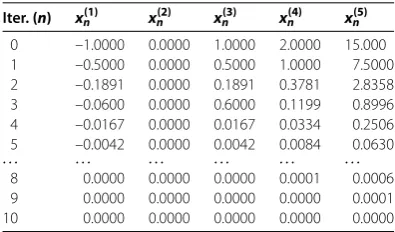
Table 1 Numerical results for some initial pointsx1= –1, 0, 1, 2, 15
Iter.(n) x(1)n x(2)n x(3)n xn(4) xn(5)
0 –1.0000 0.0000 1.0000 2.0000 15.000
1 –0.5000 0.0000 0.5000 1.0000 7.5000
2 –0.1891 0.0000 0.1891 0.3781 2.8358
3 –0.0600 0.0000 0.6000 0.1199 0.8996
4 –0.0167 0.0000 0.0167 0.0334 0.2506
5 –0.0042 0.0000 0.0042 0.0084 0.0630
. . . .
8 0.0000 0.0000 0.0000 0.0001 0.0006
9 0.0000 0.0000 0.0000 0.0000 0.0001
10 0.0000 0.0000 0.0000 0.0000 0.0000
Remark . Theorems . and . improve and extend the main results of Marino and Xu [] for nonexpansive mappings, and [–] for nonexpansive semigroups in different directions.
4 Numerical results
In this section, we give an example and numerical results to illustrate our algorithm and the main result of this paper.
Example . LetH=H=R. LetBx= xandBx= x. LetT :={T(s) : ≤s<∞}, whereT(s)x=+sx,∀x∈R. ThenB,B, andT satisfy all conditions of Theorem . and =Fix(T)∩L ={}. Let{xn}be the sequence generated byxand
xn+=αnγf(xn) + (I–αnB)
sn
sn
+ sJ
B
λ
xn+A∗
JλB–IAxn
ds. (.)
LetA=B=I, the identity operator, andf(x) = x,∀x∈R. Puttingγ =λ= ,=, and αn=√n,sn=n, then scheme (.) reduces to
xn+= √n
xn+
n(
√
n– )ln( + n)xn
. (.)
Settingxn–x∗ ≤–as stop criterion, then we obtain the numerical results of scheme
(.) with different initial pointsxin Table .
The computations are performed by Matlab Ra running on a PC Desktop Intel(R) Core(TM)i-M, CPU @. GHz, MHz, . GB, GB RAM.
Competing interests
The authors declare that they have no competing interests.
Authors’ contributions
D-JW carried out the primary studies of a split variational inclusion and the fixed point problem of nonexpansive semigroups and drafted the manuscript. Y-AC participated in algorithm design and convergence analysis. All authors read and approved the final manuscript.
Acknowledgements
The authors are grateful to the anonymous editor and referees for valuable remarks suggestions, which helped them very much in improving this manuscript. This work was supported by the National Science Foundation of China (11471059), Basic and Advanced Research Project of Chongqing (cstc2014jcyjA00037), Science and Technology Research Project of Chongqing Municipal Education Commission (KJ1400614, KJ1400618).
References
1. Browder, FE: Convergence of approximants to fixed points of nonexpansive nonlinear mappings in Banach spaces. Arch. Ration. Mech. Anal.24, 82-89 (1967)
2. Marino, G, Xu, HK: A general iterative method for nonexpansive mappings in Hilbert spaces. J. Math. Anal. Appl.318, 43-52 (2006)
3. Li, S, Li, L, Su, Y: General iterative methods for a one-parameter nonexpansive semigroup in Hilbert space. Nonlinear Anal.70, 3065-3071 (2009)
4. Cianciaruso, F, Marino, G, Muglia, L: Iterative methods for equilibrium and fixed point problems for nonexpansive semigroups in Hilbert spaces. J. Optim. Theory Appl.146, 491-509 (2010)
5. Shehu, Y: An iterative method for nonexpansive semigroups, variational inclusions and generalized equilibrium problems. Math. Comput. Model.55, 1301-1314 (2012)
6. Qin, X, Cho, SY, Kang, SM: Iterative algorithm for variational inequality and equilibrium problems with applications. J. Glob. Optim.48, 423-445 (2010)
7. Wen, D-J, Chen, Y-A: Strong convergence of modified general iterative method for generalized equilibrium problems and fixed point problems ofk-strict pseudo-contractions. Fixed Point Theory Appl.2012, 125 (2012)
8. Yang, L: The general iterative scheme for semigroups of nonexpansive mappings and variational inequalities with applications. Math. Comput. Model.57, 1289-1297 (2013)
9. Moudafi, A: Split monotone variational inclusions. J. Optim. Theory Appl.150, 275-283 (2011)
10. Censor, Y, Elfving, T: A multiprojection algorithm using Bregman projections in product space. Numer. Algorithms8, 221-239 (1994)
11. Censor, Y, Bortfeld, T, Martin, B, Trofimov, A: A unified approach for inversion problems in intensity modulated radiation therapy. Phys. Med. Biol.51, 2353-2365 (2006)
12. Censor, Y, Gibali, A, Reich, S: Algorithms for the split variational inequality problem. Numer. Algorithms59, 301-323 (2012)
13. Combettes, PL: The convex feasibility problem in image recovery. Adv. Imaging Electron Phys.95, 155-453 (1996) 14. Byrne, C: Iterative oblique projection onto convex sets and the split feasibility problem. Inverse Probl.18, 441-453
(2002)
15. Byrne, C, Censor, Y, Gibali, A, Reich, S: Weak and strong convergence of algorithms for the split common null point problem. J. Nonlinear Convex Anal.13, 759-775 (2012)
16. Kazmi, KR, Rizvi, SH: An iterative method for split variational inclusion problem and fixed point problem for a nonexpansive mapping. Optim. Lett. (2013). doi:10.1007/s11590-013-0629-2
17. Shimizu, T, Takahashi, W: Strong convergence of common fixed points of families of nonexpansive mappings. J. Math. Anal. Appl.211, 71-83 (1997)
18. Bauschke, HH, Combettes, PL: Convex Analysis and Monotone Operator Theory in Hilbert Spaces. Springer, New York (2011)
19. Xu, HK: Iterative algorithm for nonlinear operators. J. Lond. Math. Soc.66(2), 1-17 (2002)
20. Crombez, G: A geometrical look at iterative methods for operators with fixed points. Numer. Funct. Anal. Optim.26, 157-175 (2005)
21. Crombez, G: A hierarchical presentation of operators with fixed points on Hilbert spaces. Numer. Funct. Anal. Optim.