Journal of the Statistical and Social Inquiry Society of Ireland Vol XXV Part II
SYMPOSIUM IRELAND, EUROPE AND THE THIRD WORLD
TRADE AND INDUSTRY
JIM FITZPATRICK
(Read before the Society, 28th March, 1985)
1 INTRODUCTION
This paper discusses trade aspects of Ireland's relations with Third World countries As implied m the overall title of the symposium, "Ireland, Europe and the Third World", the topic is dealt with in a European Community (EC) setting Such a setting is particularly appropriate in the case of trade Unlike the case of aid, dealt with in Helen O'Neill's paper, Ireland does not have an independent bilateral trade policy regarding developing countnes Such trade policy is essentially an EC matter As will be clear in subsequent sections of the paper, this country's membership of the Community is therefore fundamental to the nature of our present and potential trade relationships with the developing world In discussing trade, the paper focuses principally on trade in manufactured goods Trade in agncultural products comes within the ambit of the Common Agncultural Policy with which Alan Matthews is dealing
2 IRELAND'S TRADE WITH DEVELOPING COUNTRIES
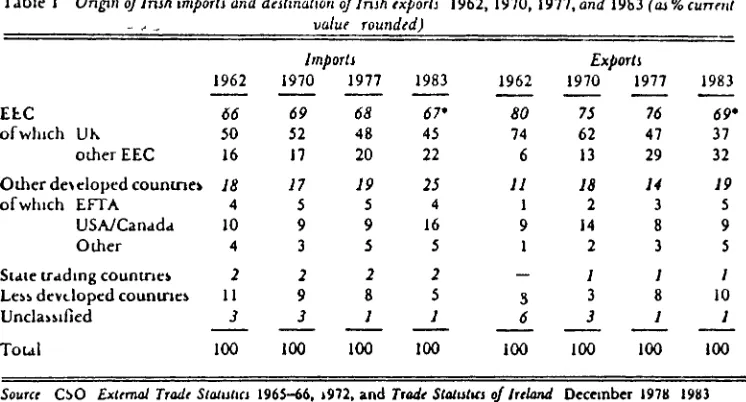
In 1983, the most recent year for which the figures are available, Ireland imported £392mn worth of goods from developing countnes and exported £658mn worth of goods to therr I am here taking a broad definition of "developing countries" as all countnes outside the OECD and COMECON, including oil exporters In percentage terms trade with developing countnes is small It accounted for 5 per cent of the current value of Irish merchandise imports in 1983, and for 10 per cent of the value of exports These are relatively low shares by international standards The share of the developing countnes in imports has been declining Despite a boost due to oil price increases during the 1970s, their share in Ireland's merchandise imports is now less than half its 1962 percentage level (Table 1) This reflects the failure of imports from developing countries, dominated by raw materials, to keep pace with the growth in imports of consumer goods and industrial components from developed countries Exports to developing countries, in contrast, have trebled their share in total exports since 1970 This reflects mainly food and agricultural exports to oil producmg countries
Table 1 Origin of Irish imports and destination oflnsh exports 1962, 1970, 1977, and 1983 (as % current value rounded)
EEC ofwhich UK
other EEC
Other de\eloped countries ofwhich EFTA
USA/Canada Other
State trading countries Less developed countries Unclassified Total 1962 66 50 16 18 4 10 4 2 11 3 100 Imports 1970 69 52 17 17 5 9 3 2 9 3 100 1977 68 48 20 19 5 9 5 2 8 1 100 1983 61* 45 22 25 4 16 5 2 5 1 100 1962 80 74 6 11 1 9 1 — 3 6 100 Exports 1970 75 62 13 18 2 14 2 / 3 3 100 1977 76 47 29 14 3 8 3 ; 8 1 100 1983 69* 37 32 19 5 9 5 1 10 1 100
[image:2.483.57.432.85.489.2]Source CSO External Trade Statistics 1965-66, i972, and Trade Statistics of Ireland December 1978 1983 •EEC (10), other years are EEC (9)
Table 2 Irish Trade with Developing Countries
by Country Grouping (percentages of current value)
OPEC NICs • Others 1970 40 7 53 100 Imports 1980 50 15 35 100 1983 14 40 46. 100 1970 17 17 66 100 Exports 1980 44 15 41
Too
1983 47 9 44 100* Brazil, Mexico, Hong Kong, Taiwan, Singapore, South Korea, Yugoslavia
imports from developing countries has declined rapidly in recent years and stood at 14 per cent in 1983 (Table 2) The "newly industrialising" developing countries2 (NICs)
have replaced OPEC as the dominant countries in Irish imports from the developing world Seven main NICs accounted for 40 per cent of these imports in 1983 This share has risen very rapidly over the past three years (Table 2) The NICs accounted for 9 per cent of exports to developing countries in 1983 All "other" developing countries accounted for 44 per cent of exports and 35 per cent of imports in 1983 This means that the vast majority of developing countries have little or no trade with Ireland
While relatively unimportant in aggregate imports and exports, trade with developing countnes is heavily sectorally concentrated and is therefore very significant for both particular sectors of industry and for individual firms It is also important from a balance of trade and payments viewpoint, since Ireland runs a significant surplus on its trade with developing countnes In 1983 there was a trade surplus of £266mn This compared with an overall trade deficit of £474mn, and a balance of payments deficit of £863mn
The foregoing and the following discussion concentrate exclusively on merchandise trade Reference should also be made to trade in services Unfortunately, Insh data on international "invisible" trade is highly inadequate and what there is, is fraught with both conceptual and statistical difficulties This was highlighted in the recent "black hole" controversy No geographical breakdown of invisible trade is available in official data It is clear that developing countries have no role as a source of invisible imports However, they have been an expanding market for many invisible exports over the past decade or so This is mainly in consultancy and related services It is probable that such exports presently account for the bulk of Ireland's foreign earnings in services outside the major traditional categories of tourism and transport
3 EC MEMBERSHIP AND TRADE WITH DEVELOPING COUNTRIES
Irish accession to the EC in 1973 is usually thought of in terms of its effects on relations with our EC partners However, it also had very important implications for trade and other relations with developing countnes This anses because a fundamental feature of the EC as a "common market" is a common external trade policy vis a-vis all non EC countries As a result, Ireland does not now operate an independent external trade policy but is a party to Community policy towards non community countries, which includes the developmg countries While certain aspects of this policy concern our exports to developing-countnes, the major elements in the EC external trade policy relate to imports from these countnes, and it is on these that I will concentrate
In considenng the vanety of EC trade policy instruments concerning developmg countries, a distinction can be made between two basic categories of such instruments These are
(n) instruments designed to control the level of imports into the Community from developing countries
Policy instruments in the first category reflect a desire to encourage economic develop ment m developing economies It rests on the assumption that increased exports by these countries are a "good thing" Instruments in the second category reflect fear that imports of competing goods from developing countries will displace output and employment, especially in industry, within the Community The co existence of these two apparently contradictory sets of policy instruments reflect a tension in EC trade policy towards developing countries and the combination of both well meaning altruism and deliberate self interest underlying this policy In this the EC is not unique All mdustralised countries' trade policies towards the developing world reflects the same dichotomy to a greater or lesser extent
Turning to the specific trade measures in question, the main "trade promoting" ones are the Generahsed System of Preferences (GSP), and the Lome Convention The main instruments in the "trade controlling" instruments are the Multifibre Arrangement (MFA) and the trade aspects of the Common Agricultural Policy (CAP) I deal with the Lome Convention and the MFA, respectively, in the subsequent two sections of the paper, while the CAP is the subject of Alan Matthew's paper Consequently, I will make a brief reference to the GSP here
The Generalised System of Preferences is a scheme whereby the EC (and other developed countnes) grants duty free access to the Community for most dutiable imports from developing countries These are mainly manufactured goods In the case of "sensitive" imports likely to have an adverse effect on Community producers, the level of duty free imports is subject to a quantitative limit, or "tariff quota" Ireland initiated its own GSP in 1972 but is now a party to the EC system This was established in 1971 for ten years and was renewed in 1981 It has been renewed in principle until 2000, but its specific provisions will be reviewed after five years while detailed regulations are issued annually Despite the considerable effort and attention which the GSP has received, observers agree that its effect has been limited For example, a study earned out by the Overseas Development Institute in London concluded that "there is little evidence that the GSP has made a major impace on LDC exports to the EEC "4 Some go so far as to
doubt its usefulness from a developing country viewpoint It would also appear not to have had very many adverse effects on EEC producers and has not been a target for complaint by these
Table 3 Ireland's Trade with Main "NICs", 1983
(£mn) Country jmports Brazil
Mexico Hong Kong Taiwan South Korea Singapore Yugoslavia
4 THE LOME CONVENTION
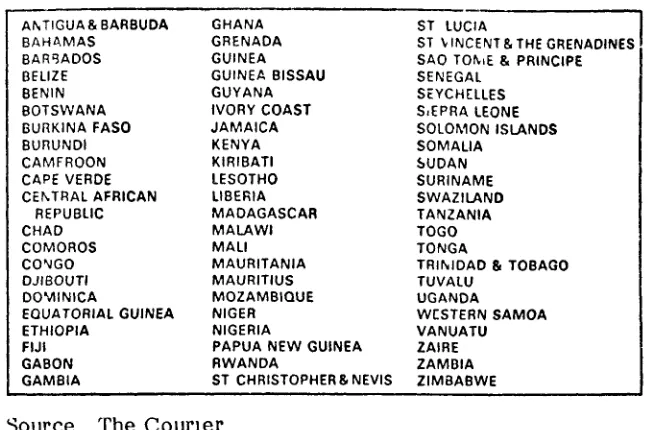
[image:5.483.84.409.245.460.2]In Ireland the Lome Convention tends to be the best known of the various EC trade mechanisms discussed here This probably has more to do with the fact that the three Conventions to date were signed during Ireland's Presidency of the Council of Ministers — the first (Lome I) by Garret FitzGerald in 1975, the second (Lome II) by Michael O'Kennedy in 1980, and the third (Lome III) by Peter Barry in December 1984 - than with its importance relative to other measures Unlike the GSP, which is a unilateral offer, the Lome Convention is an aid and trade agreement signed between the Community and 65 developing countries in Africa, the Caribbean and the Pacific (ACP) (Table 4) It has ansen out of the historical ties of a few EC countries and their former colonies However, the ACP group does not include the big, and mostly relatively poor, ex British colonies in Asia (India, Pakistan, Sri Lanka, Malaysia, Singapore and Bangladesh) It is Lome's trade provisions that are of interest here
Table 4 The 65 ACP States
ANTIGUA& BARBUDA BAHAMAS
BARBADOS BELIZE BENIN BOTSWANA BURKINA FASO BURUNDI CAMFROON CAPE VERDE CENTRAL AFRICAN
REPUBLIC CHAD COMOROS CONGO DJIBOUTI DOMINICA
EQUATORIAL GUINEA ETHIOPIA
FIJI GABON GAMBIA
GHANA GRENADA GUINEA GUINEA BISSAU GUYANA IVORY COAST JAMAICA KENYA KIRIBATI LESOTHO LIBERIA MADAGASCAR MALAWI MALI MAURITANIA MAURITIUS MOZAMBIQUE NIGER NIGERIA
PAPUA NEW GUINEA RWANDA
ST CHRISTOPHERS NEVIS
ST LUCIA
ST VINCENT&THE GRENADINES SAO TOrviE & PRINCIPE SENEGAL
SEYCHELLES S.EPRA LEONE SOLOMON ISLANDS SOMALIA
SUDAN SURINAME SWAZILAND TANZANIA TOGO TONGA
TRINIDAD & TOBAGO TUVALU
UGANDA
WESTERN SAMOA VANUATU ZAIRE ZAMBIA ZIMBABWE
Source The Courier
Duty free or other preferential access under Lome is non reciprocal, that is, ACP states are not required to grant corresponding preferences to EC exports In addition to preferential access to EC markets, other aspects of Lome have an impact on EC ACP trade flows Particularly important are the Stabex and Sysmin schemes These schemes are designed to stabilize commodity and mineral export earnings Lome also allows for EDF funding of export promotion activities by ACP countries
The trade provisions of Lome were intended, in the words of Lome I, to "secure additional benefits for the trade of ACP states, in order to accelerate the rate of growth of their trade and improve the conditions of access of their products to the market of the European Economic Community " Since the essence of Lome's trade provisions is preferential access to EC markets for ACP exports, the relative rather than the absolute export performance of the ACP group is an indicator of the Convention's impact Table 5 shows the share of the ACP countries in EC imports from all non EC countries and from all developing countries for the twelve years 1972 1983, inclusive This therefore includes three years prior to the signing of Lome I (1972 1974), the five years of Lome I (1975 1979) and four years of Lome II (1980 1983)
Table 5 Share of ACP Countries in EC Trade 1972 1983
As %
As
As °
As o
Source
a l l extra EC imports
imports from LDCs
a l l extra EC exports
of exports to LDCs
Curostat
1972
7 4
20 0
6 3
21 3 Pre 1 one
1111
7 3 19 3
5 7 19 5
1974 8 1 17 0
5 5 7 5
1975 7 0 15 7
18 5 1976
6 6 14 8
19 3 Lome I
1977 7 3 16 5
20 1 1978
6 7 16 6
19 0 6 8 16 6
16 8
| 9 8 0 7 0 16 3
18 6
Lome II 19JH
5 4 12 7
16 6 198T2
5 5 13 8
15 6 6 If
13 >1
0 0
6
During the Lome I years, the ACP countries had a share of 6 7 per cent of all EC merchandise imports from outside the Commumty This was slightly down on the three pre Lome years when this share was 7 8 per cent During Lome II this share fell even further, averaging 6 per cent
Imports from all non EC countries include Commumty imports from other developed countries The commodity composition of these is quite different from imports originating in ACP states Also, some non EC industrialised countries have more preferential trading arrangements with the EC either as part of EFTA or bilaterally
Table 6 shows similar data for Irish imports from and exports to ACP countries The outstanding feature of the table is the very small share of the ACPs in Irish foreign trade as a whole The proportion of total imports from developing countries originating in the ACP countries increase between 1974 and 1978, fell sharply between 1979 1981, and increased again in 1982 and 1983 After an initial boost in 1975, the share of Irish exports to developing countries accounted for by the ACP groups shows a declining trend since 1977, despite some recovery in 1980 and 1982
Table 6 Trends in Irish Trade with ACP Countries 1974-1983
197-1 IJ75 1976 1977 1978 1M79 1 J8» 1981 1982 |98J
Peicentage shurc of ACPs in total Irish imports 1 5 1 5 1 4 1 6 1 J 1 2 1 0 0 6 0 7 0 8
Percentage shure of ACPs in Irish imports from I ULs 13 8 14 8 15 9 18 8 27 2 20 b U 2 13 4 16 8 21 5
lercentuge share of AC1 s in total Irish exports 0 9 2 0 1 5 2 0 1 5 1 2 1 5 1 7 1 7 1 5
iercentage share of ACt s in Irish exports to I DCs lb 5 J5 0 21 3 25 1 21 0 15 4 b 8 14 1 17 3 16 5
Trade balance with ACPs ( 000 EUA) 25 +4 7 +1 23 27 +13 -»b3 *75 +60
In assessing Lom6's trade aspect it must be emphasised that there are certainly instances where the existence of the Convention helped individual ACP countries to increase and possibly to diversify their exports Mauritius is a case in point Also, caution is required in drawing any definitive conclusions from the evidence in Tables 5 and 6 Many national and international influences affect EC ACP trade flows, making isolation of the effect of Lome alone difficult and it can never be known what might have happened had Lome not existed Nevertheless, the indications are that in general Lome has not resulted in either significant growth or diversification of ACP exports to the EC or Ireland 5
5 THE MULTIFIBRE ARRANGEMENT
1978 and in 1982 Its current term expires in July 1986 The MFA proper is an umbrella arrangement Under it, textile exporters and importers enter into bilateral "voluntary export restraint" agreements However, the term "MFA" tends to be used loosely to cover the entire package
The EC is, as a Community, a partner to the MFA and has bilateral restraint agreements with about 25 low cost exporters The current agreements run from January 1983 -December 1986 Re negotiation of the MFA itself and of the Community's bilateral agreements are, therefore, scheduled to take place over the coming year and external textile policy will be a topical subject in debate
Ireland is a party to the MFA through membership of the Community In practice this means that imports of the mam categories of cheap textiles and clothing goods from developing countries are subject to an annual quantitative limit by both product category and country The Irish limits operating in 1981 for the main MFA products are shown in Table 7 by way of example These limits are enforced through import licences issued by the Department of Industry, Trade, Commerce and Tourism It is apparent from this that the one area of our economy at least is already subject to de facto central planning
During the lead in to each MFA re negotiation a great deal of words and ink are poured out regarding the "pros and cons" of the MFA itself and the related bilateral restraint system 6 The coming re negotiation is likely to see a repeat of this The positions of the
respective sides are predictable Internationally, the exporting countries themselves and the "Third World lobby" in the west argue against the MFA on the grounds of unfair discrimination against the world's poorer nations Trade in textiles and clothing among the western nations is not subject to similar controls These groups also find allies among economists who oppose such protectionism as being contrary to the principles of free trade
Arguing for the MFA will be the textile and clothing industries in the western countries, supported by the trade unions and usually by their Ministries for Industry All these see any liberalisation of trade m textiles and clothing as detrimental to firms and jobs in industrial countries Recession and high unemployment will add weight to their arguments
Here in Ireland the international battle lines will be largely replicated Industry and trade union representatives tend to echo their EC counterparts on the subject of the MFA In previous re negotiations, the Department of Industry, Trade, Commerce and Tourism, has been staunchly supportive of this approach in its contribution to EC policy making on the issue Ireland has sided with the protectionist countries in the Community (UK, Franch) against the more liberal ones (Germany, Holland) 7 The
Department of Foreign Affairs remains neutral Irish opposition to the MFA comes from the domestic Third World lobby Economists and economic bodies tend to be largely absent from the debate in Ireland
Table 7 Quantitative Ceilings on Exports to Ireland of Textile and Gothing Products in the Eight "Super-Sensitive" (Group 1) MFA Categories1 from MFA signatories,
China, and Taiwan, 1981, (Absolute Level and as a percentage of Total Ceilings on the Countries included)
COUNTRY2 Argentina Brazil Columbia South Korea Hong Kong India Mexico Pakistan Peru3 Romania Yugoslavia Egypt Hungary Malaysia Poland Singapore Thailand Macao Philippines Sri Lanka China4 Taiwan 5 Cate iory Tonnes 59 1,410 316 3 20 346 67 397 I 23 44 -39 0 1 JJ 2 50 11 0 0 12 2 14 0 1 1 -0 I 7 4 I 7 4 A 3 3 0 & Category Tonnes t>07 204 20 448 373 68 779 16 55 11 21 33 10 100 21 124
-I
495 4> 17 5 0 13 10 2 22 J 1 0 0 1 0 2 0 3 -_ 14 1 6 9 6 0 8 U 7 5 3 6 1 3 9 6 6 4 3 Tonnes 204 30 125 -& -4 157 79 27 124 -52 39 _ 24 3 14 -0 0 _ 0 18 9 3 14 -_ 6 4 0 5 7 7 5 5 4 3 2 6 1 6 000 Pieces _ 45 -121 145 42 _ 23 -18 14 • 3 23 7 94 23 15 22 13 21 13 _ 7 -18 22 6 _ 3 -2 2 . 0 3 I 14 3 2 3 2 3 2 0 6 6 8 2 5 6 1 6 6 3 4 0 3 0 000 Pieces -222 46 -9 6 20 4 _ 15 5 8 46 77 15 32 8 26 26 -39 d _ 1 1 3 0 . 2 0 I 8 13 2 5 1 4 4 3 I 4 1 5 7 6 9 4 1 6 6 7 4 6 6 000 Pieces a -58 70 -7 1 _ 0 9 1 21 2 19 17 34 8 3 -21 20 -_ -2 0 . 0 3 0 7 0 7 3 6 12 3 0 9 5 6 4 a 4 9 8 2 4 9 0 000 Pieces -12 26 105 10 0 I -0 3 . 37 8 4 14 20 2 r 7 -4 10 41 . 3 -0 0 . 0 1 _ 14 3 1 5 8 0 8 3 3 9 a 2 5 1 6 5 0 8Cat q o q 000 Pieces -60 53 181 34 -12 8 . I 5 5 51 12 5 27 38 4
f 8
* -_ U 10 34 6 2 I 0 U 0 9 2 0 5 7 0 2 0 1 4 2 5 2 9 9 6 2 9 6 1 1 7
TOTAL6 2 780 1U0 3 435 IOO 0 851 100 0 100 0 565 100 0 264 251 100 0
Note 0 means no inporta allowed - -Deans no restraints in force
1/ Category 1 = cotton yarn, Categ^. y 2 - cotton fabric (excluding terry) Cate pry ^ = woven synthetic fabric; Catejory 4 - knitted shirts, v>sts light pullovers Category 5 = jerae/s, pullo/ers, Categroy 6 s trousers, slacks Catsgory 7 = blouse3 Category 8 = bhirts
2/ Five further V A signatories a e not subject to restraints 3/ Excludes Tanguis and P n n a type 4/ Restrained under a bilateral <*q dement outside the MfA 5/ Restrained under unilateral quotas 6/ New "basket extractor" restrax it
general observations to which the topic gives rise First, the MFA highlights the fact that in many policy areas there is a sharp conflict between the interests, realtor perceived, of industrialised and developing countries This tends to be frequently overlooked in references to "development cooperation" and "mutual self interest" Progress m inter national economic relations between the rich and poor of the world requires that the existence of these thorny problems be faced and realistic solutions sought Western countries cannot expect to fulfil their apparent desire to help solve the dire problems of world poverty and underdevelopment without occasionally being willing to make modest sacrifices
Second, one such thorny problem is the question of import competition from cheap manufactured goods It seems to me that the overall lesson of the MFA is that the protectionist road is not the answer Leaving aside both economic principle and altruism, the evidence is that such protectionism does not solve the problems of the industries it is designed to save It also has a cumulative effect in that the further down the protectionist and controlled trade road one goes, the more difficult it is to get out of it again As an answer to problem of shifting international comparative advantage, this is a blind alley out of which it is very difficult to reverse
6 CONCLUSIONS
From the particularly Irish perspective, I would suggest three major conclusions as arising from this paper on the trade aspects of relations with developing countries
(1) trade is a very important aspect of these relations In 1983 Ireland's official development assistance to Third World countries was just under £30mn, less than one tenth of the value of imports from these countries Aid and trade flows are clearly not directly comparable Nevertheless, the contrasting potential impact of the two is clear Trade issues need to take a more prominent position alongside aid in public debate on Ireland's relations with the developing world,
(n) a theme I have stressed is the primary role of common EC policy in Ireland's trade relations with developing countries On the one hand, this means that Ireland's scope for independent bilateral initiatives in the area is very limited indeed, though it is not entirely absent On the other hand, however, membership of the Community gives us some small say in the external trade policy of a major inter national trading bloc with an impact vastly in excess of anything Ireland could achieve bilaterally The extent to which we use this voice, and the way in which we use it, is a matter that could benefit from greater public scrutiny,
"constituency" Co-ordinated national policies on matters straddling different Departments are, in theory, thrashed out in Cabinet However, many such policies can hardly attract very much Cabinet attention Relations with developing countries are a case in point We have relevant official advisory bodies whose brief cuts across departmental areas I am thinking of the Advisory Council on Development Co operation (which reports only to the Minister for Foreign Affairs)
and the Joint Oireachtas Committee on Co operation with Developing Countries However, a comparable inter departmental grouping with some degree of executive power is missing A Cabinet Sub Committee or a high level Inter Departmental Committee is required If the various elements in our national development co operation policy are not properly co ordinated, we may be simply giving with one hand and taking away with the other
FOOTNOTES
1 For a discussion see Fitzpatnck, J , 1984 "The Geographical Pattern of Irish Foreign Trade Test of a Gravity Model", The Economic and Social Review, Vol 16, No 1
2 See Fitzpatnck, J , 1983 "Trade between Newly Industrialised and Newly Industrialising Countries the Case of Ireland", Administration, Vol 31, No 2 3 For estimates see Coras Trachtala, 1983 Export Review, Vol 2, No 4
4 Weston, A et al, 1980 The EEC's Generalised System of Preferences - Evaluation and Recommendations for Change, London Overseas Development Institute 5 A more detailed discussion is contained in Fitzpatnck, J , 1983 "Trade and the
Lome Convention", Lome Briefing, Brussels Liaison Committee of Development NGOs to the European Communities, No 9
6 Recent examples are Wolf et al, 1984 Costs of Protecting Jobs in Textiles and Clothing, London Trade Policy Research Centre and GATT Secretariat, 1984 Textiles and Clothing in the World Economy, Geneva