Munich Personal RePEc Archive
Preference programming and
inconsistent interval matrices
Islam, R and Biswal, MP and Alam, SS
Indian Institute of Techn ology Kharagpur, India
1995
Online at
https://mpra.ub.uni-muenchen.de/10129/
ELSEVIER
EUROPEAN
JOURNAL
OF OPERATIONAL
RESEARCH
European Joumal of Operational Research 97 ( 1997) 53-62Theory and Methodology
Preferente programming and inconsistent interval judgments
R. Islam, M.P. Biswal *, S.S. Alam
Department of M athematics, Indian Institute of Technology , Kharagpur 721 302, India
Received March 1995: revised November 1995
Abstract
The problem of derivation of the weights of altematives from pairwise comparison matrices is long standing. In this paper, Lexicographic Goal Programming (LGP) has been used to find out weights from pairwise inconsistent interval judgment matrices. A number of properties and advantages of LGP as a weight determination technique have been explored. An algorithm for identification and modification of inconsistent bounds is also provided. The proposed technique has been illustrated by means of numerical examples.
Keywords: Analytic hierarchy process; Interval judgment; Preferente programming
1. Intmduction
Since the introduction of the Analytic Hierarchy Process (AHP) as a decision making tool by Saaty
[ 121 in the late 70s it has been successfully applied in solving a variety of real world problems, ranging from Sports, Medicine, Banking, Sociology (e.g., projec- tion of average family size), Politica1 Science (e.g., Presidential election), Computer Science (e.g., soft- ware selection, evaluation of data base management systems, etc) to Management Science [ 6,181. The ma- jor reasons behind AHP’s popularity are its concep-
tual simplicity and its capability of handling subjec- tive criteria and inconsistencies in the decision making process.
AHP solves a discrete multi-criteria decision mak- ing( MCDM) problem in four steps:
(i) Break down the problem into a hierarchy con- sisting of a finite number of levels, each leve1 consisting of a finite number of elements,
* Corresponding author.
(ii) construct the pairwise comparison matrices for al1 the criteria and for al1 the alternatives with respect to one criteria at a time,
(iii) derive the underlying weights from comparison matrices by using a suitable weight determina- tion technique, and
(iv) synthesize the foregoing local weights to obtain global weights of the alternatives.
The present paper is concemed with steps (ii) and
(iii) .
Saaty [ 121 proposed to use single points as the elements of the comparison matrices. Each element represents the degree of preferente of one factor over another and is taken from the ( 1/9-9) ratio scale. But at the time of collecting data to investigate the effect of splitting objectives in the AHP, some respondents propos4 US to use range of numbers for certain com- parisons [ 91. More specifically, respondents fee1 ease in articulating their “strength of preferente” by means of range of numbers( may be called interval judgment) in some particular situation. In fact, strength of pref- erence with respect to fuzzy criteria, e.g., taste, attrac-54 R. Islam et ai./European Journal qf Operational Research 97 (1997) 53- 62
tiveness, quality, comfort, etc, cannot be adequately expressed by a single number. The other reasons of adopting interval judgments are probabilistic uncer- tainty in the decision making environment [ 13 1, group decision [ 71, incomplete information [ 31, at the ini- tial phase of the elicitation process in the interactive mode [ 141, etc.
As in the case of single judgments, the crucial prob- lem arises regarding how to derive weights of the fac- tors (meaning criteria or alternatives) from interval comparison matrices, especially when they are incon- sistent. In the following section, we summarize the previous works and propose our new technique.
2. Previous works on interval judgments
To deal with subjective factors, Van Laarhoven and Pedrycz [ 171 considered the entries in the com- parison matrices as fuzzy numbers having triangular membership functions. For the same purpose, Buck- ley [ 51 used fuzzy intervals (i.e., fuzzy numbers with trapezoidal membership functions) . Boender et al. [4] pointed out the fallacy in the normalization pro- cedure for the computed fuzzy weights in the works of Van Laarhoven and Pedrycz [ 171 and subsequently they modified it.
Saaty and Vargas [ 131 introduced simulation ap- proach to find out weight intervals from matrices of interval judgments. They also pointed out the difficul- ties in this approach.
Arbel [ l] applied a Linear Programming (LP) ap- proach to find out weights wi’s from an interval com- parison matrix A = ([Zij, uq] )nxn, where 1, and u;j respectively denote the lower and upper bounds of a certain interval judgment. Salo and Hämäläinen [ 151 extended Arbel’s LP approach considerably. They syn- thesized the set of local priority weights to obtain global weight intervals for the alternatives. In order to find out local set of weights, Arbel [ 11 as wel1 as Salo and Hämäläinen [ 151 searched the set
w=
w=(w1,w2,...,{ W”) IijWj < Wi < UijWj
‘v’i,jand kwi=l}.
i=l
(1)
The inequalities in ( 1) constitute a set of linear con- straints, some of which may contradict with each other. This contradiction arises from the inconsistency in the DM’s judgments. Evidently, for an inconsistent inter- val judgment matrix, the set W is empty, i.e., no set of weights exists which can satisfy al1 the judgments si- multaneously. Here we can recall Arbel’s [ 1, p. 3231 question, “ What happens when one finds that the elic- itation process has yielded a non-solvable system of inequalities?“. Kress [ 111 pointed out the ineffective- ness of Arbel’s own suggestion of solving n(n - 1) number of linear programs to deal with inconsistent interval judgments. While searching for a more effec- tive technique, Arbel and Vargas [2] proposed non- linear programming technique. But in this technique, local optimum may not be global optimum because of the nonconvexity of the feasible region.
Salo’s [ 141 “extended region” approach is based on reconstruction of the inconsistent comparison matrix by means of
Uij = mkm{UikUkj}, $7 = l/fiji, for al1 i and j.
However, the differente (Cij - &j) may be much greater than (Uij - lij), which may be unrealistic to the DM. Apart from this, sij may violate the bounds of the fundamental ratio scale drastically. The larger the bounds, the slower is the rate of convergente. Al- though by applying Salo’s [ 141 approach the weights can be determined, absolute dominante or pairwise dominante bounds for the weights of alternatives are to be obtained upon interaction with the DM. But at the time of analysis, the DM may not be available, or even if he is available, he may not be persuaded to change his old judgments. Above al1 one should not force the DM to be artificially consistent. Saaty [ 12, p. 2371 writes: “. . .improving consistency does not mean getting an answer closer to real life situation. It only means that the ratio estimates in the matrix as a sample collection, are closer to being logically related than to being randomly chosen.”
In this paper, we investigate the problem which is stated as: “If the DM is no longer available after filling up a comparison matrix with ranges of numbers and if the matrix is inconsistent, then what method should be adopted to determine the local weights?“.
R. Islam et al./European Journal of Operational Research 97 (1997) 53- 62 5s
turns out to be inconsistent. If this is the case, then our main objective is to satisfy as many judgments (i.e., cells in the comparison matrices) as possible. Evidently this task can be done by lexicographic goal programming( LGP) .
3. Formulation of LGP as a weight determination technique
As already stated in the previous section, each judg- ment [lij, Ui,i] of the matrix A = ( [Zij, u;j] )nxn gives rise to the following two inequalities
lij
6Wi/W,j
<
Ui,j,i.e.
(2)
-Wi +
lij
Wj<
0, Wi-
UijWj 6 0.Upon introduction of the deviational variables pij, nii, pJi and nij, the foregoing inequalities can be trans- formed into equalities as:
-Wi + /ij W,j + TZij - pij = 0, (3)
Wi - Uij W,j + nu - pij = 0. (4)
Proceeding in this manner for al1 the entries of the concert& interval matrix, we have the following req- uisite formulation of LGP as a weight determination technique:
Lex. minimize
n-1 ”
a=
(
Pnn+nnnt
C
C(pij+pij))subject to
i=l j=i+ I
-Wi + lijWj + nij -Pij = 0,
Wi - Uij W,j + nij - p:j = 0,
i= 1,2 ,..., n- 1, j=i+ l,...,n, n
(5)
c
Wi+
nnn
-pnn = 1,i=l
Wi* nij,pij, n:j,pij 2 09 for al1 i and j.
Note that satisfaction of the normalization con- straint has been kept at the first priority leve1 followed by the priority of satisfaction of al1 the constraints. Although the term pnn + n,,,, is always zero in the lex- icographical minimization by LGP, it has been kept to
show the number of priority levels. If the DM is more confident on some judgments, then the concerned de- viational variables can be taken in the second and the rest in the subsequent priority level( s).
4. Some properties of LGP
After calculating the weights wi by LGP from in- consistent interval judgment matrix, the ratios wilw,, for al1 i and j may or may not belong to the inter- val [lij, Uij], i.e., because of inconsistency some of the ratios Wi/Wj may violate the concerned interval [Zij, uij]. Accordingly, we have the following lemma:
Lemma 1. The deviational variables n,, pij, nij and ph, for some particular judgment 1, = [lij, Uij 1, sat-
is& the following relations:
nijpij = 0, nijpij = 0, pijp;; = 0. (6)
Proof. The first two equalities directly follow from the theory of goal programming.
To prove the last equality, let US consider the fol- lowing cases:
Case I: Wi/w.i E [lij, Uij]. In this case, we have
-Wi + lijW,j < 0, Wi - Uij W,j < 0.
SO, from (3) and (4), we get nij, ng > 0. Hence, from the first two equalities, it follows that
pij = p(i = 0 * pijpij = 0.
Case II: wi/wj < 1,. In this case, we have
-Wi + IijWj 2 0, Wi - l4ijW.j < 0.
So, again from (3) and (4), we can infer that
pij > 0 and Pij = 0 * pijp; = 0.
A similar argument follows for the
4j . 0
case Wi/Wj >
56 R, Islam et al./European Journal of Operational Research 97 (1997) 53- 62
(Uij - lij) ( '2'Wj - (‘)Wj) + (aij + pij)‘2’Wj
+ ((*)nij + (')n;j)((2)nij + (2gj)
- (("p;,j + ("pij) + ((2)Pij + '2'Pij) = 0. (7)
Proof. In the first case, we have the equations:
_(‘Jw. + l,‘UWj + (‘)nij _ (‘)pij =O
(UWil_ u;j” )wj + (‘),U - “‘p:j =o:
(8)
(9)
Adding (8) and (9), we have
(lij - Uij) (‘jW j + ((‘)Q j + (‘),ij)
- (Q j + “‘p!) zo,
(Uij - lij)Q j - (% Q j + (‘)$
0’.
+ ((')pi,j +"'p$)=O. (10)
Similarly, in the modified case we have the equation
(Uij - lij) '2'Wj + ("ij +pij) (2) W,j
+ ppij + @'PI.) - (
‘I (2)TZ, + (2)fZij) = 0. (11)
Subtraction of ( 10) from ( 11) gives the required re- lation. •J
Theorem2. Let(‘)wiad(2)Wi, i= 1,2 ,..., n,
be
the two sets of weights obtained from the inconsistent
interval judgment matrices (
[lij,
Uij ] ) n x ,,and ( [ 1, -
4jvUi.j +Pijl )nxm
ffij, Bij > 0,i # j, respectively.
Then
c
(')pij 6c
ffij W W j + c ‘2’piji,j i,j (i.j)ED
(12)
hl
iJ
(i,j)ED
-
c
(2)n:j,
(i,j)ED’
(13)
where D denotes the set of ordered pairs (i, j) for
which w;/wj violates lower (or upper) bounds for
both the matrices (
[lij,u;j] ) “xn and ( [ 1, - “ij,
uij +Pijl )nxn
and D’ denotes the set of oníeredpairs (i, j)
where w;/wj violates the lower (or upper) bound of
[lij,
u;j
]but nat that of [ 1, - o;j,
Uij + pij].Proof. For an inconsistent interval judgment matrix, only one of the lower and upper bounds is violated. Accordingly, either p;j or
p:j
is positive. Without any loss of generality, let US assume that the lower bound is violated. Then by using Lemma 1, from the following equations_(‘),; + lij(UWj + (Un, _ ‘UPij = 0
-(2)Wi + lijc2)W,j - 0Ti.j ‘2’Wj + c2)nij _ c2)pij = 0,
we have
(UPij = _(‘JWi + lij(‘)wj,
aij’2’wj + (2jPij = _(2jw; + lij’2JWj
(assuming lower bounds have got violated in both the cases), or
(‘1
PU <. _ “ ij(2)wj _ ‘QPij
= (‘2’Wi - (‘)Wi) + lij(“‘Wj - (2)wj) ~ 0 (since lower bound has been decreased) or
(1)
PlJ .< < “ ij(2)wj + (VPij 1 (14)
If (‘)n;j = 0 and (2)n;j > 0, then the computed ratio (2)w;/(2)~j must be greater than
1, - o;j.
In this case, the inequality (14) wil1 be replaced by(UPij < Ly;j(2)wj - (Vnij* (15)
On summing over al1
i
and j in both the inequalities (14) and (15) we havec (‘1 PIJ 1 < c (y..(2)wj + V c (2) PIJ
i,j i,j (i.j)ED
-
c (2)?lij,
CiJ)@
where
D
andD’ are
as defined previously. The case of violation of the upper bounds can be treated simi- larly. clTheorem 3. Let wip (l)wi, f2)wi,
i =
1,2,. . .,n,de-
note the three sets of weights obtained respectively
from the matrices (.$(l;j + u;j))nxn, ([l;j,u;j])nxn,
and([l;j-cu;j,u;j+B;jl),.,,cu;j,p;j
aO,andi#j.
Then
C
JWi - (‘)Wil < C [Wi - (2)Wil. (16)R. Islam et al./European Journal of Operationul Research 97 (1997) 53- 62 57
Proof. Trivial. Cl
Theorem 4.
lf
there are rn altemate solutions
cwi:,w;,.. .,w;), k=
1,2 ,... ,m, of (5) fora con-sistent matrix (
[lij, Uij] )nxn,i.e.,
lij 6 Wf/WJk < Uij,
for i = 1,2 ,..., n- 1, j =
i+
l,..., nand k =
1,2 ,..., m, then
lij 6 Ef/i$ < Uij,
where
1 “ 1
@” = -
c
$9
i= 1,2 ,..., n.
m
k=lProof. Since (w:,wi ,..., wi),
k =
1,2 ,...,m, are
solutions of LGP in (5) for the consistent matrix([li.j~U;,jl)nxn~
we have1i.j < Wf /Wi
k= 1,2 ,,.., m,
i=
1,2,. ..,n- 1, j=i+lj W k > l..w” I ’ ‘J , ’
1 “1
=+-- kW: 2 lij:CW;,
m k=l k=l
Similarly, $/W,f < uij for
k =
1,2,. .1,2,... ,n-
I andj=i+l,..., n. 0. . . .
,n,
m, i =
Theorems 2 and 3 are useful in comparing the sum of the values of the deviational variables and the differ- ence of weights, respectively, obtained from the given as wel1 as the modified interval pairwise comparison matrices. Theorem 4 has been used to determine the single weight vector where alternate weight vectors are available.
5. Advantages of LGP
There are some advantages of LGP, namely, the second component of the achievement vector, be- (i) Since linear programming is a special case of comes positive, then this positivity indicates inconsis- LGP, the problem which can be solved by LP can tencies present in the articulated judgments. Presence also be solved by LGP. In addition to this, since goal of inconsistency can also be checked by the infeasi- programming does not give infeasible solution, it is bility of Arbel’s LP model. To identify the bounds always capable of finding weights even in the presence of inconsistency.
(ii) In general, a single comparison matrix may consist of no judgment, single point judgment, mul- tiple point judgments, interval judgment, multiple in- terval judgments, interval judgment having only one specified bound (e.g., 3 < wi/w,j or wi1w.j f 5) for some particular comparison. Moreover, the judg- ment(s) of this comparison may be inconsistent with other( s). Keeping al1 these points into account, LGP can be conveniently used to determine weights.
(iii) While forming comparison matrices, the DM may not be equally certain for al1 the pairs of compar- isons, i.e., the degree of confidence for al1 the compar- isons may not be equal. By degree of confidence, we mean how easily the DM has specified his judgments. Also, it can be easily checked that the marginal impact of al1 the cells on the resulting solution is not equal (Takeda et al. [ 161). In addition to this, the DM may prefer to satisfy some particular judgments for some specific reason. If this is the case, then it can be easily accomplished by plating the concerned constraint at the higher priority leve1 in the goal programming for- mulation. Even within same priority level, weights can be assigned to some particular deviational variables, if the DM wishes to do so. This advantage cannot be achieved by any of the existing methods.
(iv) If the DM’s matrix turns out to be inconsistent, then there exists no set of weights which can satisfy al1 the judgments simultaneously. In this case, the DM may be satisfied for minimum number of violations of approximately articulated judgments. Typically this job can be done by LGI?
6. Identification and modification of inconsistent bounds
To determine weights by using LGP, if the value of
n-1 n
58 R. Islam et al./Eurqean Journal of Operational Research 97 (1997) 53-62
which contribute the largest amount of inconsistency, we propose the following algorithm:
Step 1. Calculate the weights of alternatives by LGI? If a2 > 0, then go to Step 2, otherwise stop.
Step 2. Construct the matrices L = (Zii)nxn and ZJ =
(Uij)nXn taking the lower and upper bounds from the matrix A = ([Zij, Uij])nxn, respectively. (Note that L
and U are not reciprocal matrices.)
Step 3. Calculate the supplementary matrices C =
(Ci.j)nxn and D = (dij),,, where
Crj = (fJl!;!flkj)“ ” for i= 1,2 ,..., n - 1,
k=l
J ‘=i+ I,...,n,
Cji = l/Cij
and
dij =
(fi
UikUkj)
‘In
for i = 1,2,.k=l j=i+1,
,n - 1,
. ,n,
dji = l/d,.
Here, four cases may arise, namely,
(i) Zij,ui_j > 1 cij,dij 3 1, (ii) Zijy Uij 2 1 cij, dij < 1, (iii) Zijy Ujj < 1 Cij, dij 2 1,
(iv)
zyxwvutsrqponmlkjihgfedcbaZYXWVUTSRQPONMLKJIHGFEDCBA
Zij, Uij < 1 Cij,dij < 1,fori=1,2 ,..., n-l,j=i+l,..., n. Example 1. Let US take the following interval judg-
Step 4. Let ment matrix [ 111.
‘ij =
i
lij if Zij 3 1,
lilij if Z, < 1,
A B C D
A I ll.21 LI,21 12>31
B 1 13.51 14.51
C 1 [fi81
D 1
cij =
i
Cij if Cij 2 1,
l/Cjj ifCij < 1.
Similar notations are used for the upper bound case.
Step 5. Calculate the absolute deviations
Pi.j = (1; * Cij - Yij 1 and 77ij = [uij * db _ a,),
foralli=1,2 ,..., n-l,j=i+l,..., n,where‘*’
denotes the ‘-’ sign in cases (i) and (iv) and the ‘+’ sign in cases (ii) and (iii) in Step 3. The values of
yjj and 6, are 0 in cases (i) and (iv) and 2 in cases (ii) and (iii).
Step 6. Calculate the maximum of al1 the deviations Pi,j and Tij, i = 1,2, . . . , TI - 1, j = i + 1,. . . , TZ. If ppy is maximum, then modify Z,,,, otherwise if r],, gives the maximum value, change uljy.
If Z,,, - c,,~ < 0, then Z,,, should be increased, other- wise the modified value should be less than Z,,,. Sim- ilar treatment follows for the matrix of upper bounds.
Go to Step 1.
The rationality of the above algorithm can be stated as folows:
When the matrix is inconsistent, we have ai,j $ ajkak,j for some k. In the presence of inconsistency, we take the geometrie average of al1 possible ajj values as
aij = (fiaikakj)'fn.
k=I
Next, we find the deviation of this average value from the actual value of aij. The process is repeated for al1 i and j. In this regard, we have considered the assertion, “the larger the deviation of the average value from the articulated value, the more is the amount of inconsistency captured by the element itself” . The element corresponding to largest deviation is termed as the ‘most inconsistent bound’.
7. Numerical examples
R. Islam et al./European Journal of Operational Research 97 (1997) 53- 62 59
0.15 15, and 0.0910 for A, B, C, and D, respectively, with a2 = 0.5758.
Since the value of a2 is positive, we apply the al- gorithm given in Section 6 for identification of the in- consistent bounds. It is observed that ~34 ( = 3.6834) and 7734 ( = 3.7705) are the maximum values among al1 pij and vii, respectively. Perhaps the judgment for the ordered pair (C, D), i.e., [6,8], has been given carelessly. Changing this judgment to [ 2,3] we get the modified set of weights as: 0.3000,0.4500,0.1500, and 0.1000, respectively, with a2 = 0.20. Since a2 is stil1 positive, we calculate the absolute deviations p,,i and ~;i and it is observed that ~23 ( = 1.4349) and 7714 (. = 1.5663) are the maximum among the concerned deviations. Let US take the new bounds ~14 = 5 and 123 = 2. The moditìed set of weights are obtained as (0.3846,0.3846,0.1538,0.0769) or
(0.3704,0.3704,0.1852,0.0741) with a2 = O.O. Fur- thermore, instead of eliminating total inconsistency, a certain amount thereof can be eliminated by using the proposed algorithm. At this point, expectedly, there should be a cut-off value of u2 (like the AHP consis- tency index) below which solution may be wel1 ac- ceptable. This point is under further exploration. On the other hand, if the DM does not wish to modify any of the inconsistentjudgment( s), the the set of weights (0.3030,0.4545,0.15 15,0.0900) calculated by LGP should be used to calculate the overall weights.
Remark 1. In the usage of goal programming, two different forms of the ‘achievement vector’, namely, the lexicographic order of al1 the deviational variables (here deviational variables are uniformly weighted) and the linear weighting form (i.e., Archimedian form) are the most relevant to determine local weights from an interval pairwise comparison matrix. In the formulation (5) of goal programming, we have con- sidered only the lirst form. The difficulty in using the
second form is to provide the priority weights for the intervals. Nevertheless, if the DM is able to provide the same, this form can be used to estimate the weights. For instance, in the Archimedian form, we get the weight vector (0.3871,0.3871,0.1935,0.0323) and a = 0.7079, assuming the objective function
min: a = ( 1.5~12 + 1.5p{, + pi3 + pi3 + p14 + pi4
+ p23 + P:3 + p24 + p;4 + 1.5p34
+ 1.5p;, + $44 + zn@).
Remark 2. While deriving weights, we have consid- ered only the upper triangular part of an interval ma- trix as it was considered by Arbel [ 11. Actually, no new information is embodied in the lower triangular part, as the elements in this part are reciprocals of the corresponding elements in the upper triangular part. For the same reason, the most inconsistent bound( s) has been identified only from the elements in the up- per triangular part.
Example 2. We adopt this example from Islam et al. [ 101. Suppose, a person is interested to invest his money to any one of the four portfolios: bank deposit
(BD), debentures (DB), government bonds (GB), and shares (SH). Out of these portfolios he has to choose only one based upon four criteria: return (Re), risk (Ri), tax benefits (Tb), and liquidity (Li).
The pairwise comparison matrices for al1 the criteria as wel1 as for al1 the alternatives are as follows:
Re Ri Tb Li
Re I 13.41 15.61 16.71 Ri 1 14.51 IS.61
Tb I 13,41
Li I
Re BD DB GB SH
BD I 11/4,1/31 13.41 I1/6,1/51 DB I 16.71 I l/S, 1/4l GB I I1/7,1/61
SH 1
Ri BD DB GB SH
BD I 13.41 l4,51 16.71 DB 1 13,4l 15961
GB I 14.51
60 R. Islam et al./European Journal of Operational Research 97 (1997) 53- 62
Tb BD DB GB SH
BD 1 1 [I/6.I/51 [I/4.I/31 DB 1 [I/6.I/51 I I/4, I/31
GB 1 L4.51
SH 1
Li BD DB GB SH
BD 1 L3.41 6 16>71 DB 1 i3.41 13.41
GB 1 L3.41
SH 1
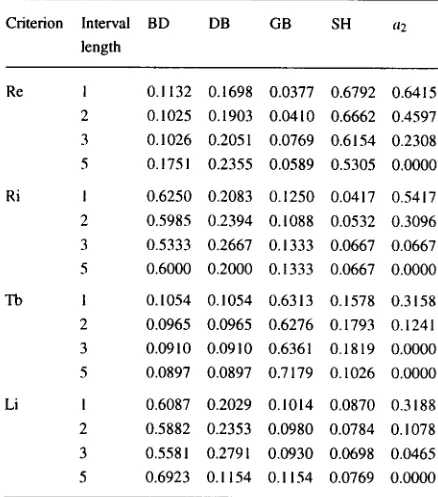
Traditional LP does not give a solution to any one of the above matrices, implying the presence of some contradictory inequalities in al1 the cases. Keeping in view the satisfaction of as many cells as possible, LGP has been applied to calculate the weights. Initially, the length of each of the intervals 1j.j = [Zjj,~jj] is assumed to be unity. In order to see variation in the weights, subsequently the intervals have been changed to [lij - 0.5,ujj + 0.51, [lij - l.O,ujj + 1.01, and
[Zij-2.0,U,+2.0],fOralli=1,2 ,..., n-l,j=
i+ 1,i+2,.
. . , n
( for Zij, Uij < 1, changes are made in the denominators) , where the respective lengths of changed intervals are 2, 3, and 5 units. The weights of the criteria and local weights of al1 the four portfolios are shown in Table 1 and Table 2, respectively. From these tables it is clear that the amount of inconsistency has been gradually decreased at the widening of the intervals. It is important to note that the lengths of the intervals have been increased to observe the nature of the varied weights, not to improve the consistency ofTable 1
Criteria weights for various Iengths of intervals
Interval Re length
Ri Tb Li (12
1 0.6383 0.2128 0.1064 0.0426 0.5745 2 0.5927 0.237 1 0.0912 0.0790 0.3070 3 0.558 1 0.279 1 0.0930 0.0698 0.0465 5 0.6154 0.2308 0.0769 0.0769 0.0000
Table 2
Local weights of altematives for various lengths of intervals
Criterion Interval BD DB GB SH length
(12
Re I 0.1 132 0.1698 0.0377 0.6792 0.6415 2 0.1025 0.1903 0.0410 0.6662 0.4597 3 0.1026 0.205 1 0.0769 0.6154 0.2308 5 0.1751 0.2355 0.0589 0.5305 0.0000 Ri I 0.6250 0.2083 0.1250 0.0417 0.5417 2 0.5985 0.2394 0.1088 0.0532 0.3096 3 0.5333 0.2667 0.1333 0.0667 0.0667 5 0.6000 0.2000 0.1333 0.0667 0.0000 Tb 1 0.1054 0.1054 0.6313 0.1578 0.3158 2 0.0965 0.0965 0.6276 0.1793 0.1241 3 0.0910 0.0910 0.6361 0.1819 0.0000 5 0.0897 0.0897 0.7179 0.1026 0.0000 Li 1 0.6087 0.2029 0.1014 0.0870 0.3188 2 0.5882 0.2353 0.0980 0.0784 0.1078 3 0.5581 0.279 1 0.0930 0.0698 0.0465 5 0.6923 0.1154 0.1154 0.0769 0.0000
the matrix. Consistency of the matrix has to be im- proved by using the algorithm given in the preceding section.
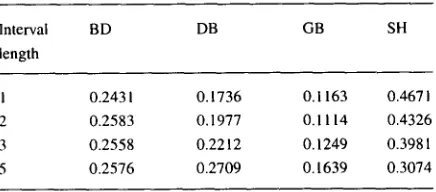
There are a number of alternate solutions for al1 the comparison matrices where the interval lengths of the entries are equal to live. In order to remove ambiguity in the choice of the preferred one from amongst the alternative solutions, following Salo and Hämäläinen [ 151 the global weights of the portfolios are obtained as ranges of numbers:
BD = [0.1663,0.3958] > DB = [0.1873,0.3430], GB = [0.1016,0.2163], SH = [0.2340,0.4199].
[image:9.563.77.248.65.254.2] [image:9.563.291.510.86.335.2]R. Islam et al./European Journul of Operationnl Research 97 (1997) 53-62 61
Table 3
Global weights of altematives obtained by LGP for various interval
lengths of entries in the comparison matrices Interval BD
length
DB GB SH
1 0.243 I 0.1736 0.1163 0.467 I
2 0.2583 0.1977 0.1114 0.4326 3 0.2558 0.22 12 0.1249 0.398 1
5 0.2576 0.2709 0.1639 0.3074
get the most preferred one. In case the DM does not wish to do so, then several alternatives are left before him. In one of them, he can take the average of the corresponding components of the local alternative so- lutions. Theorem 4 assures that the average weights satisfy the concerned set of constraints. For al1 the in- terval lengths, the global weights of the portfolios are shown in Table 3.
Theorem 3 has been verifìed for al1 the matrices of this example. In the course of verification, we consid- ered the interval lengths as 1, 1 S, 2,2.5, 3, 3.5,4,4.5, and 5 units respectively, for each of the entries of the comparison matrices. The detailed numerical results are hereby omitted.
8. Summary and concluding remarks
Approximate articulation of preferente ratios by means of range of numbers is a flexible way to deal with probabilistic or fuzzy uncertainties to choose the most preferred alternative in some decision making problem. In course of articulating these preferente ra- tios, quite often, the DM becomes inconsistent in his own judgments. In fact, it is almost impossible to be consistent, especially when one uses the bounded
( 119-9) ratio scale. It may be said that consistency in AHP is exception rather than a rule. There has been arguments over the choice of the most suitable method to extract weights from inconsistent pairwise compar- ison matrices. This argument has not yet been settled. While there is a number of methods to find out weights from inconsistent single judgment matrices, virtually there is not a single one for the inconsistent interval judgment matrices. In this paper, we have shown how LGP can be used to find out weights
from such inconsistent interval judgment matrices. A number of advantages and properties of the proposed method are discussed. In addition to the proposed method, we have also provided one algorithm by which the most inconsistent bound can be identi- fied and revised. There is greater possibility that a pairwise comparison matrix to be inconsistent and involve intervals for some of the entries to solve prac- tical problems. In view of this the proposed method promises a substantial real-world applications.
Acknowledgements
We are thankful to the anonymous referees for their valuable comments and suggestions to improve the earlier version of the paper.
References
1 11 Arbel, A., “ Approximate articulation of preferente and priority derivation”, European Journul of Operutionul Research 43 ( 1989) 3 17-326.
[ 2 1 Arbel, A., and Vargas, L.G., “The analytic hierarchy process with interval judgments” , in: A. Goicoechea, L. Duckstein and S. Zionts (eds.), Multiple Criteria Decision Making,
Springer-Verlag, New York ( 1992) 6 1-70.
13 1 Arbel, A., and Vargas, L.G., “Preferente simulation and preferente programming: Robustness issues in priority derivation”, Europeun Journul Of Operurionul Reseurch 69 (1993) 200-209.
141 Boender, C.G.E., de Graan, J.G., and Lootsma, F.A., “ Multi- criteria decision analysis with fuzzy pairwise comparisons”, Fuuy Sets und Systems 29 ( 1989) 133-143.
[ 5 ] Buckley, J.J., “Fuzzy hierarchical analysis”, Fuzzy Sefs trnd Systems 17 (1985) 233-247.
[ 61 Golden, B.L., Wasil, E.A., and Levy, D.E.. “ Applications of the analytic hierarchy process: A categorized, annotated bibliography” , in: B.L. Golden et al. (eds.), The AnuLyfic Hierurchy Process: Applications and Studies, Springer- Verlag, Berlin, 1989, 37-58.
171 Hiimäläinen, R.P., Salo, A.A., and Pöysti, K., “Observationx about consensus in a multi-criteria environment” . in: J.F. Nunamaker and J.F. Sprague (eds.), Pmceedings ofthe 251h Hawuii Internarional Con&rence on System Science, Vol. IV. Hawaii, 1992, 190-195.
181 Ignizio, J.P., Lineur Progrumming in Single & Multiple Objecrive Systems, Prcntice Hall. New Jersey ( 1982). (91 Islam, R., Biswal, M.P., and Alam, S.S., “The effect of
splitting objectives in the analytic hierarchy process”, Ricerctr Operutivu 24 ( 1994) 5-25.
[image:10.562.52.270.95.191.2]62 R. Islam et al./European Journal of Operational Research 97 (I997) 53- 62
and V.K. Sehgal (eds.), Operations Research: Theory and Practice, Spaniel Pub]., New Delhi, 1995, SI. No. 14. I II 1 Kress, M., “Approximate articulation of preferente and
priority derivation - A comment”, European Journal of Operatianal Research 52 ( 1991) 382- 383.
[ 121 Saaty, T.L., “A staling method for priorities in hierarchical structures”, Jaurnal of M arhematical Psy chology 15 ( 1977) 234- 281.
1 131 Saaty, T.L., and Vargas, L.G., “Uncertainty and rank order in the analytic hierarchy process”, Eurapean Jaurnal af Operafianal Research 32 ( 1987) 107-117.
1141 Salo, A.A., “lnconsistency analysis by approximately specifìed priorities”, M athematica1 and Computer M adelling 17 (1993) 123- 133.
[ 151 Salo, A.A., and Hämähiinenn, RP., “Ambiguous preferente statements in the analytic hierarchy process”, Research Report A39, System Analysis Laboratory, Helsinki University of Technology, Finland, 1991.
1 161 Takeda, E., Cogger, K.O., and Yu, PL., “Estimating criteria weights using eigenvectors: A comparative study”, Eurapean Jaurnal of Operational Research 29 ( 1987) 360- 369. I 17 1 Van Laarhoven, PGM., and Pedrycz, W., “A fuzzy extension
of Saaty’s priority theory”, Fuzzy Sets and Sy sfems 1 1 ( 1983) 229-241,